

Quick Take
- Surviving Pacific waters requires treating the needlefish as a greater threat than sharks.
- Operating bright lights at night triggers a high-speed anatomical hazard for boat occupants.
- Eggs require sticky threads to maintain position before the larvae enter their immediate feeding stage.
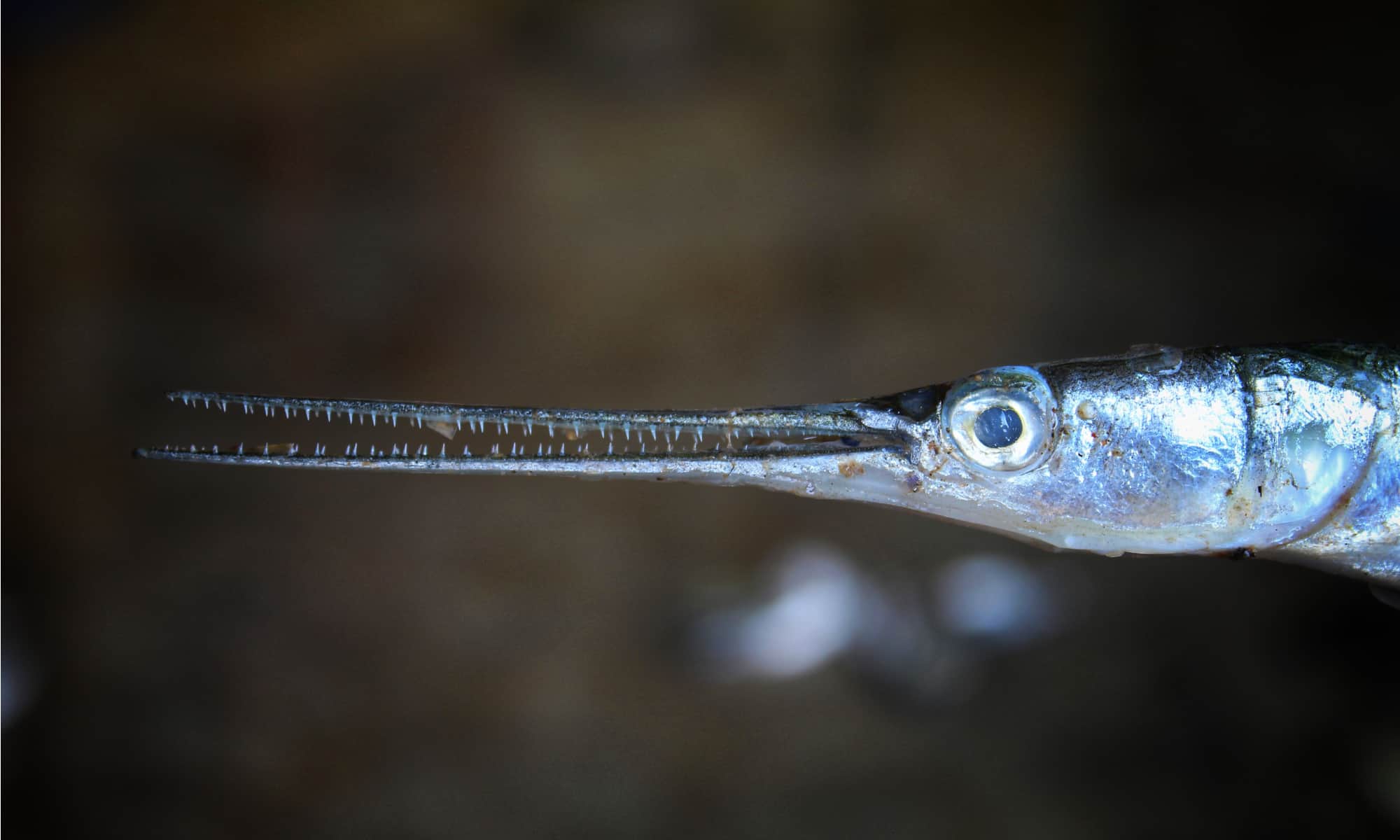
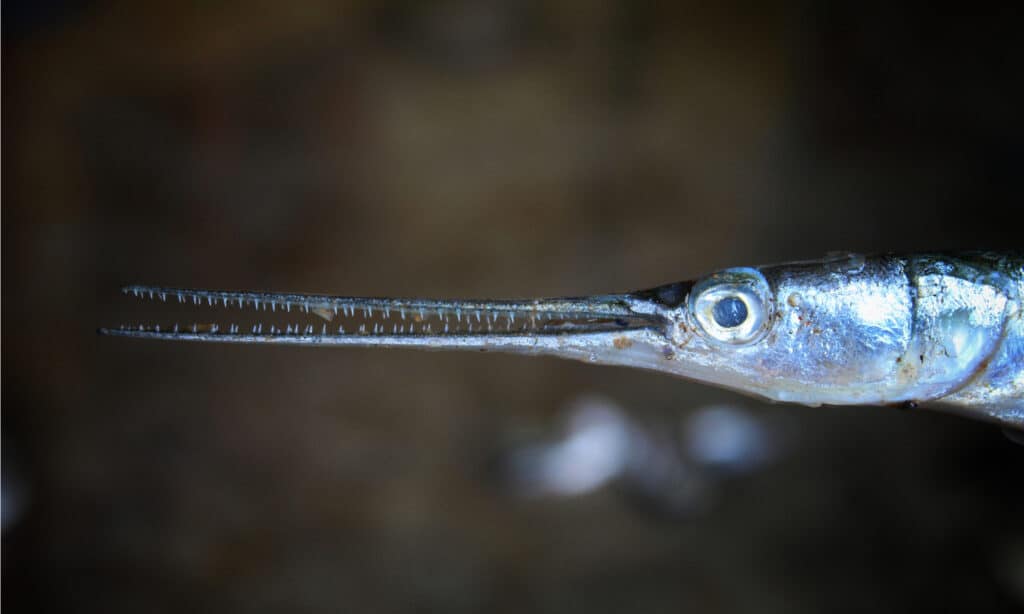
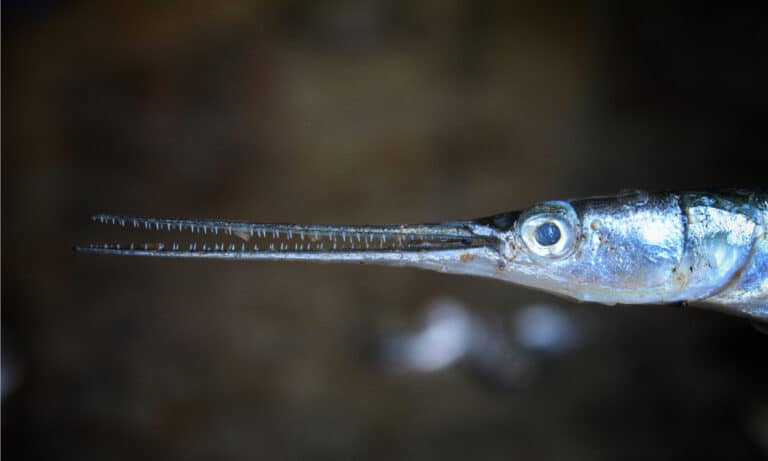
The name of the needlefish comes from its jaws containing numerous sharp teeth and thin, elongated bodies, which resemble those of North American freshwater gars. In the wild, needlefish live in social groups and will migrate between adjacent areas like the Atlantic Ocean and the Caribbean Sea to find different feeding areas. Scientists know little about their earliest ancestors, but needlefish are believed to have a long evolutionary lineage among ray-finned fishes.

Four Amazing Facts
- Bright lights at night lure needlefish, which is why they congregate on shores and bays.
- Needlefish do not have stomachs. Their digestive system secretes trypsin, which helps break down food.
- Most species have green or blue bones and flesh.
- They can jump out of the water, going as fast as 38 mph.
Classification and Scientific Name
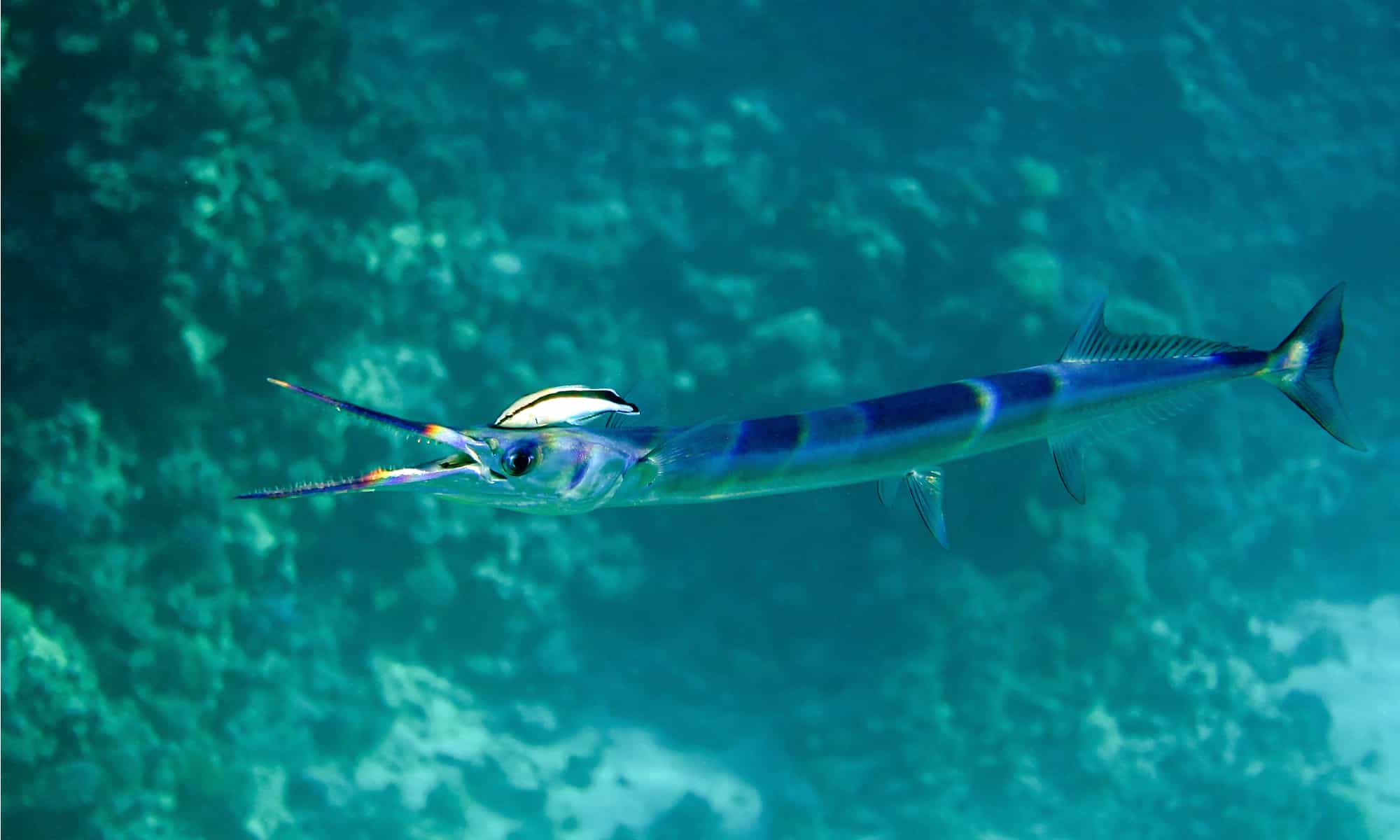
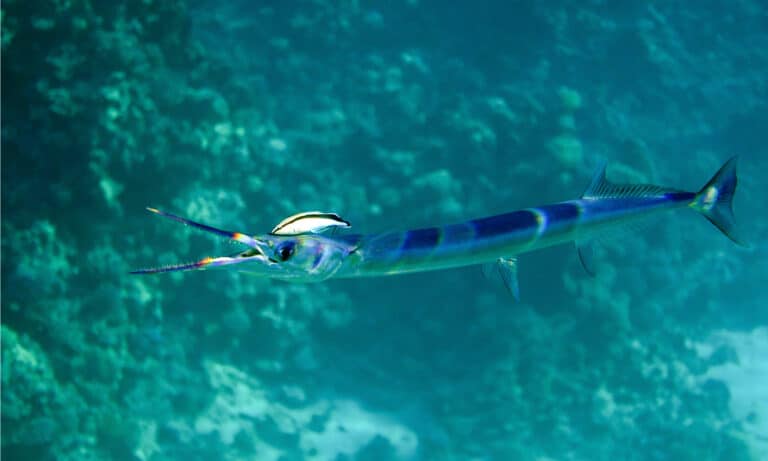
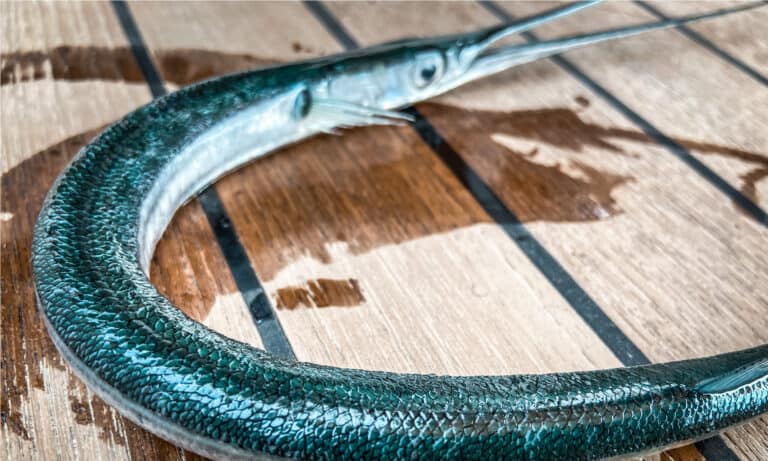
Needlefish are found throughout the world, mostly in subtropical climates.
©Miroslav Halama/Shutterstock.com
Needlefish belong to the class Actinopterygii, the class encompassing ray-finned fishes, comprising more than 50% of living vertebrates. They are in one of the six superfamilies of the order Beloniformes, further divided into the family Belonidae. From that family, true needlefish have ten commonly recognized genera: Ablennes, Belone, Belonion, Petalichthys, Platybelone, Potamorrhaphis, Pseudotylosurus, Strongylura, Tylosurus, and Xenentodon.
More than 60 species are scattered throughout the world, mostly in subtropical climates, although some species have been known to inhabit temperate waters. One of the more widely distributed species is the Keeltail Needlefish, with the scientific name Platybelone argalus, found in the Atlantic, Pacific, and Indian Oceans. Other examples are the garfish (Belone belone) of Europe and the houndfish (Tylosurus crocodilus), widely found in the tropics.
Appearance
The name needlefish comes from the elongated, pointed mouth that resembles a needle. Needlefish are generally blue to green coloration on top and silvery on the bottom. This coloration allows them to camouflage themselves as protection from predators.
The largest ones grow to about four feet in size, but you’ll find a considerable range. For example, Keeltail needlefish range between 17 and 20 inches long, which is about three to four times smaller than the Houndfish. The Belonion apodion and Belonion dibranchodon are among the smallest in size, at about two inches long.
Distribution, Population, and Habitat
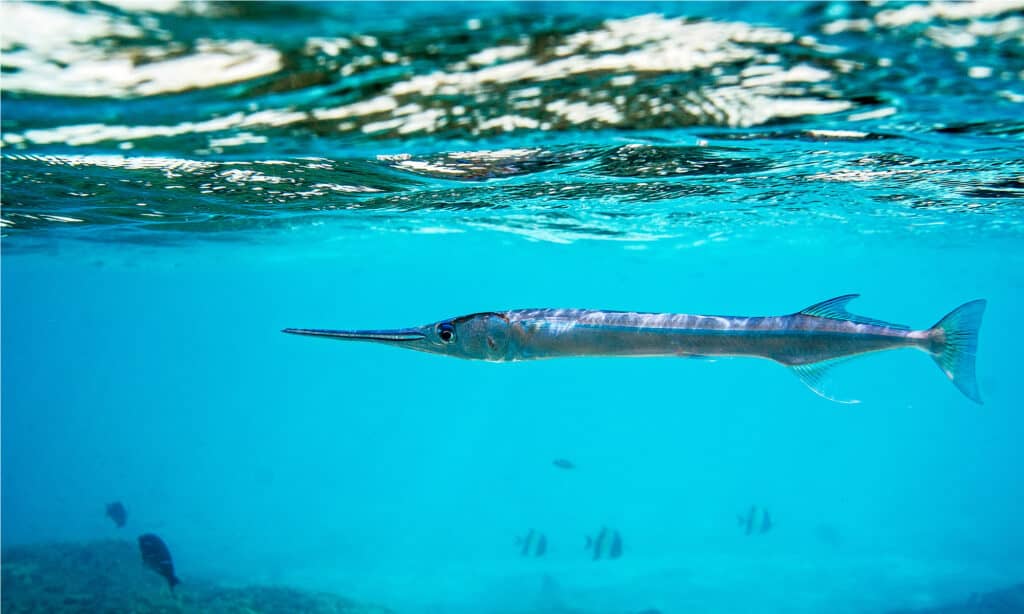
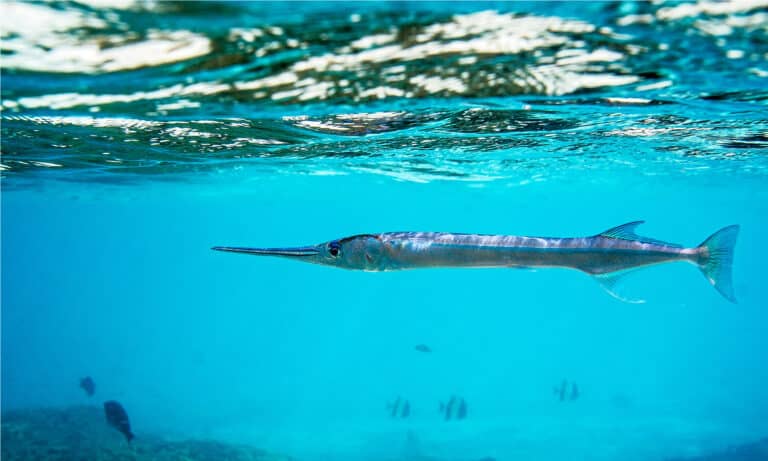
Needlefish live in large schools worldwide in tropical and warm temperate waters.
©AndrisL/Shutterstock.com
Needlefish distribution is worldwide in tropical and warm temperate waters. Their western Atlantic range spans from Maine in the north to Florida in the south and in the eastern Atlantic from Dakar to Angola. They also range from northern Florida southward to Brazil and inhabit the entire Caribbean region. Pacific habitats include western Mexico, where they are frequently caught and used in Mexican recipes, south to Peru, and from Japan and the East Indies in the eastern Pacific, south to Australia.
They inhabit shallow, coastal waters near island estuaries and coastal rivers. While most species live in saline or brackish waters, some species are found in freshwater inland rivers in Florida and Alabama. At night, you may find them on reef flats and, during the day, around jetties. Juvenile needlefish about two inches in size frequent seagrass beds in some marshy regions. Needlefish gather in large schools to travel and to have a better chance of survival. Younger fish sometimes congregate in bays and inlets.
Predators and Prey
Larger fish like tuna, and also dolphins, prey on needlefish, as well as humans who catch and eat them. Their habit of swimming close to the water’s surface, along with slender bodies and thin bones, makes them easy prey for eagles, hawks, and ospreys. However, as they have large numbers worldwide, they are not considered threatened.
Needlefish have a varied diet, eating primarily small marine creatures such as small fish and crustaceans like shrimp, plus killifishes, cephalopods, and silversides. Freshwater species prey on tadpoles, frogs, and insects. Juveniles consume plankton until they are big enough to eat other prey.
Almost every needlefish species has a slender body and less pronounced dorsal and anal fins. It helps these fish to attack with speed and precision. Their jumping behavior may also be involved in hunting, as they use the momentum when they fly back into the water to catch small fish. They often stalk prey and catch them with a sideways sweep of their jaws. Although they are not aggressive predators, they will sometimes gorge themselves one day and then hardly eat the next.
Reproduction and Lifespan
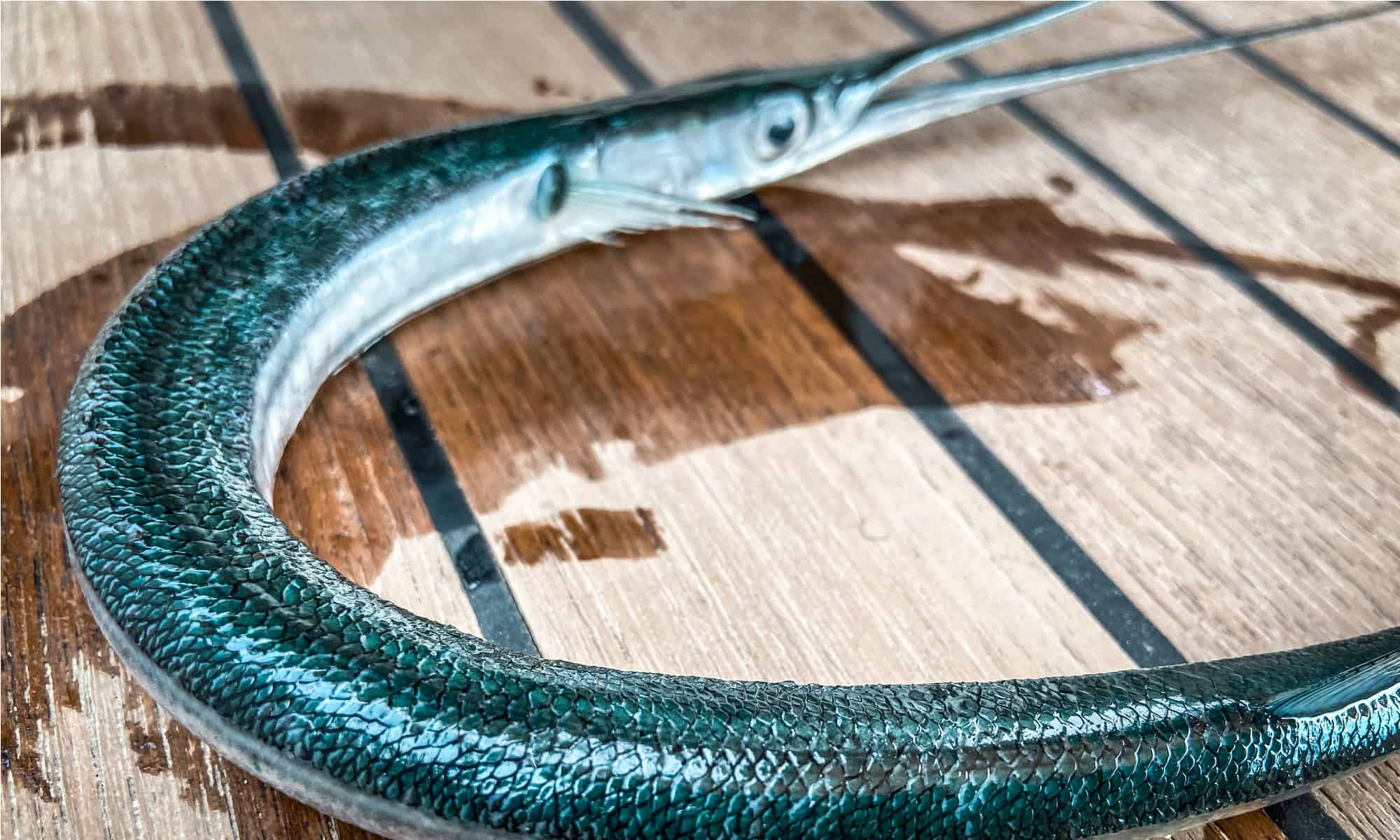
Needlefish eggs have a sticky thread that gets tangled in seaweed or floating debris.
©ArtDary/Shutterstock.com
Needlefish breed primarily in May and June because of warmer waters, but spawning can occur throughout the year, usually more than once. Their eggs have a sticky thread that gets tangled in seaweed or floating debris. Babies hatch in about 10 to 15 days. Juveniles often shelter in mangroves before moving out to deeper water. When the eggs hatch, the larvae begin to feed immediately.
Their maximum age is unknown, although those in captivity generally live three to five years. Lifespan and growth vary due to available food and factors like water temperature, dissolved oxygen, and salinity.
Freshwater needlefish, with the scientific name Xenentodon cancila and native to Southeast Asia, are often kept as aquarium fish, living three to five years. Scientists believe that Keeltail needlefish typically live three to five years. When in captivity, freshwater needlefish are best kept by themselves or with peaceful species like cichlids, catfish, or sleeper gobies, as they otherwise get stressed by more active fish.
Fishing and Cooking
Needlefish are considered gamefish as they are caught with trammel nets, casting with a lure, and trolling at the water surface. Needlefish are occasionally eaten in some regions, but they are not widely regarded as a popular dish due to their bony structure. Aguillhinha Frita is a popular needlefish recipe served at beach bars throughout Brazil.
Population
The worldwide population of needlefish is unknown, but they are abundant in many areas of the world. The IUCN Redlist conservation status of most of the needlefish species is of least concern.
Dangers to Humans
Even though needlefish generally aren’t very large, their long, thin anatomy, sharp teeth, and unique jumping behavior make them dangerous to humans in certain circumstances. Their sharp jaws and teeth can pierce people’s brains and torsos, killing them when the fish jump out of the water at high speeds and attack them. Larger species of needlefish, such as houndfish, are more dangerous than smaller varieties. Nighttime fishers working via bright lights in shallow waters are particularly in danger as trawling lights lure needlefish, making them jump over boats instead of swimming under them.
Schools of needlefish in various areas in and near the Pacific Ocean have been known to jump out of the water together. Their beaks can break off inside a human body after an attack and lodge there. Documented attacks of deaths caused by needlefish have occurred in Hawaii and Indonesia. For many Pacific Islanders, needlefish pose a greater danger than sharks.
Needlefish Pictures
View all of our Needlefish pictures in the gallery.

Miroslav Halama/Shutterstock.com
Sources
- Wikipedia / Accessed April 12, 2022
- Chesapeake Bay / Accessed April 12, 2022
- Mexican Fish / Accessed April 12, 2022
- Florida Museum / Accessed April 12, 2022
- Outdoor Alabama / Accessed April 12, 2022
- Wild Singapore / Accessed April 12, 2022
- About Animals / Accessed April 12, 2022
- Animal Spot / Accessed April 12, 2022
- Wide Open Spaces / Accessed April 12, 2022
- Kidadl / Accessed April 12, 2022
- The Online Guide to the Animals of Trinidad and Tobago / Accessed April 12, 2022