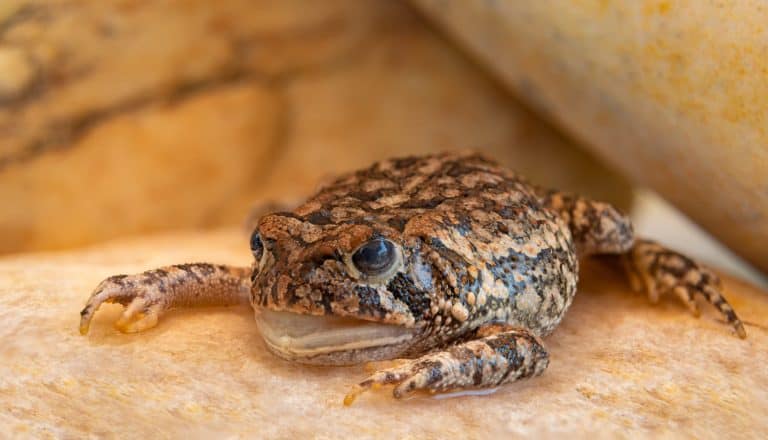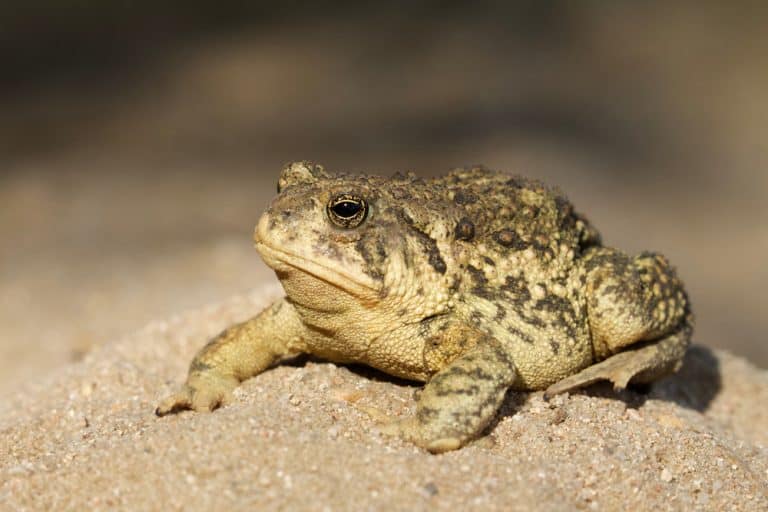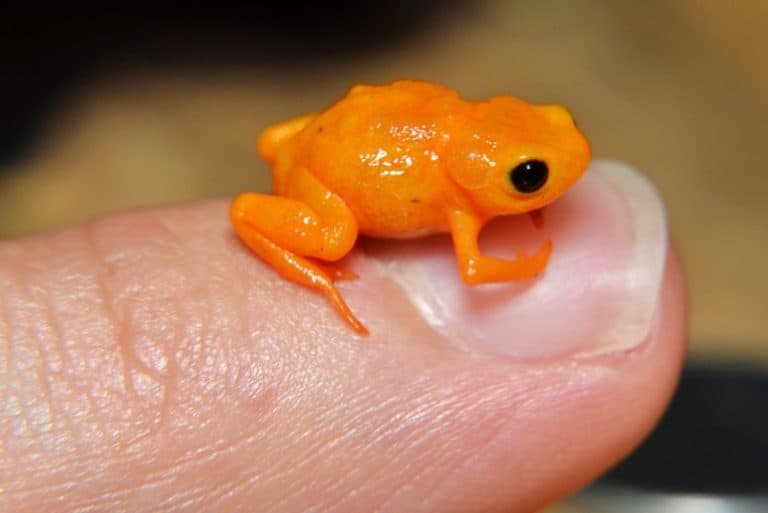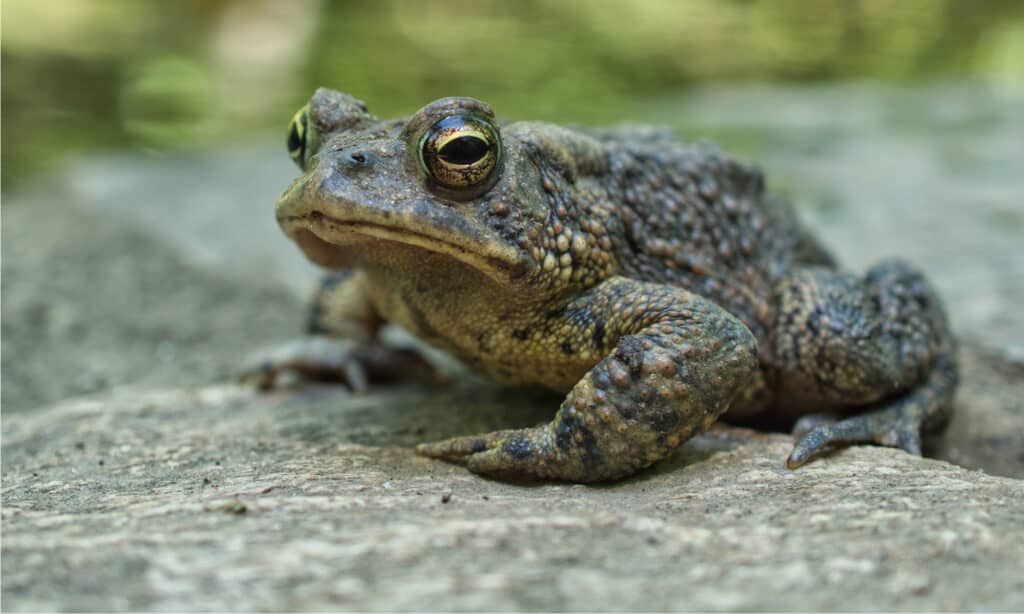
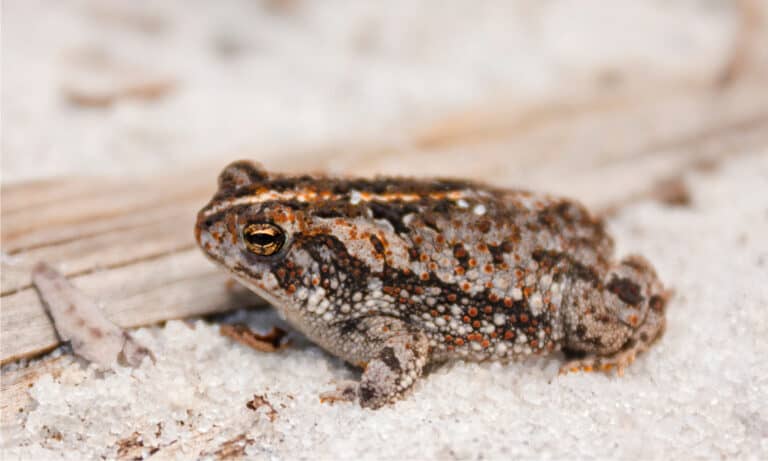
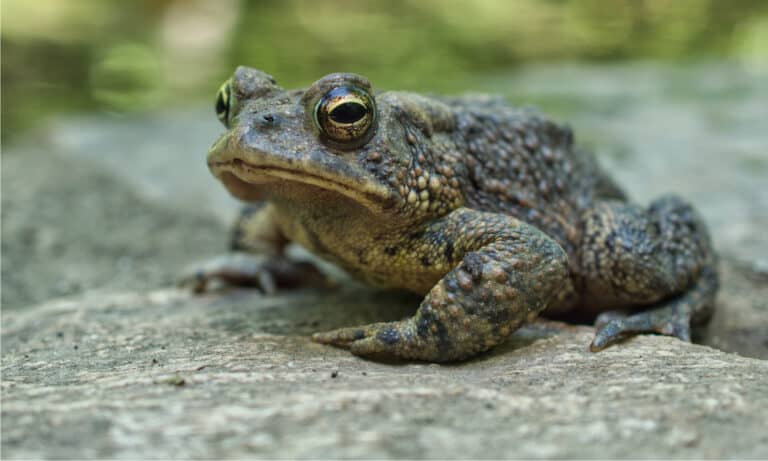
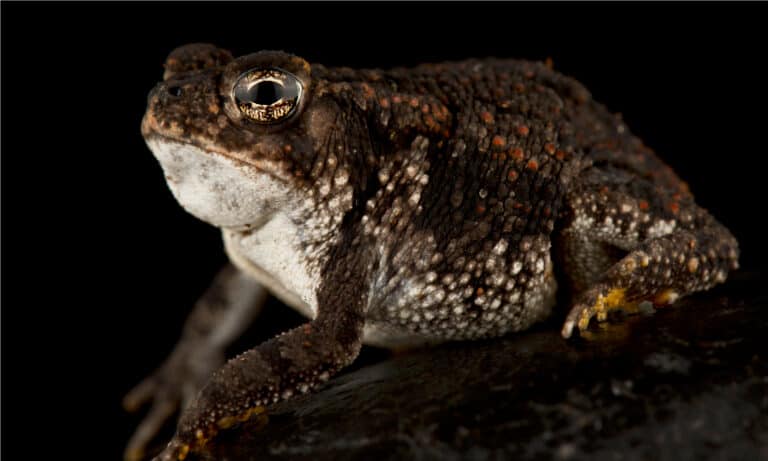
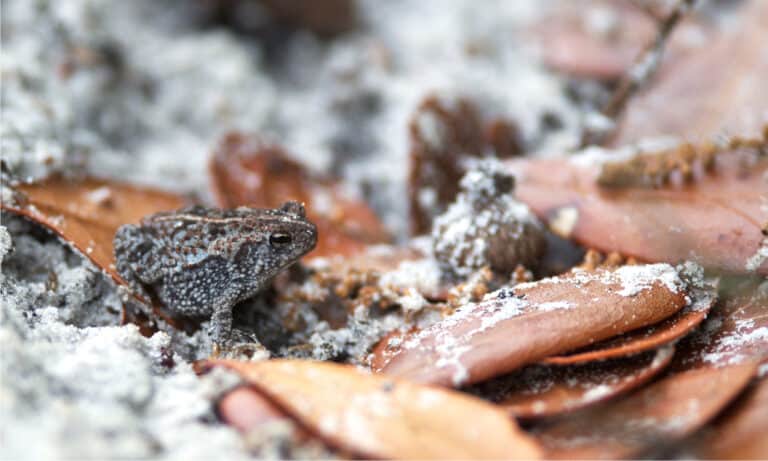

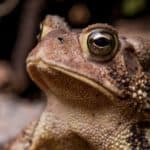
Oak toads are the smallest of the toad species in North America, easily identified by a mid-dorsal, light stripe with variable black and brown spots. They have proportionally large parotoid glands.
Most toads have that distinctive round vocal sound. The calling oak toad male has an elongated vocal sac. It extends significantly as they produce a chirp-like mating call.
Unlike cousins in the toad family, oak toads are pretty active in the daylight. You’ll find them lurking in southern pine forests, sandy flatwoods, and oak scrub. The species is also into shallow freshwater pools and ponds. But they’re also pretty reclusive in their habitat. So, you’ll have to turn over logs and search through woodland debris if you want to locate one.
In colder periods, the toads hibernate in loose soil, finding sanctuary in burrows in the pine and oak forests.
Oak toads are pretty good house pets if you prefer an animal that needs little handling. (In fact, this toad prefers little handling. They lean more towards people observing them.)
Let’s take a closer look at the oak toad.
5 Oak Toad Facts
Here are a group of fascinating facts about the oak toad.
- The species uses a series of high-pitched calls to communicate. They can warn other oak toads of predators or call out for mates.
- Toads prefer to crawl rather than hop.
- Oak toads taste bad. Or rather the poisonous fluid they secrete does. That’s how they chase away predators.
- The oak toad doesn’t ribbit. It has its call, which is more sing-song than anything.
- The creatures, like all toads, shed their external skin regularly. Once peeled, the toad places the substance under its tongue and proceeds to eat it.
Oak Toad Scientific Name
The oak toad’s scientific name Anaxyrus quercicus species in the Bufonidae family. The oak toad’s seen as the smallest toad in North America, maxing out at 1.3 inches.
Quercicusis comes from “quercinus.” That’s Latin for “of oak leaves.” It’s a reference to the general pattern and leaf color of the toad. Their range extends from Virginia‘s southeast Coastal Plain down to some of Florida‘s lower keys.
Oak Toad Appearance & Behavior
The species is small with a max length of a little over one inch. The species background color comes in black to gray. The oak toad has a conspicuous mid-dorsal that’s white, orange, cream or yellow.
Creatures with lighter backgrounds may have several pairs of dark spots visible on the backs. The toad’s skin is fine but roughened with tubercles. Bottoms of the hind and forefeet are orange-reddish tubercles. The animal’s skin is also moist and soft to the touch. The male’s vocal sac is either sausage-shaped (when inflated) or oval.
The oak toad comes with a short head and pointed nose. It has a short, flat, squat body On the back are four to five pairs of dark botches with a grayish-white underside. The oak toad has a poisonous teardrop parotoid gland. It’s used to fight off predators.
Oak Toad vs. Frog
Frogs and toads are easily mistaken for one another. They’re both green and eat similar meals. But they are not the same.
Let’s start with the face frogs can be twice the size of an oak toad. They can grow between 2.4 to 3.5 inches. Frogs have long legs that are longer than their bodies and heads. Toads in general have short legs. Rather than hopping, this toad tends to crawl.
You won’t find frogs and toads in the same habitats. Frogs lose moisture easily and are rarely far from bodies of water. Thanks to their skin, oak toads are comfortable in dry ecosystems.
Each baby is also unique. Frog tadpoles are slim while oak toad tadpoles will be chunkey. The oak toad baby is plain black while the frog baby will be gold-flecked.
Oak Toad Habitat
Oak toads love open canopied oak as well as pine forests with ditches and temporary ponds. For the most part, you won’t find oak toads in areas with permanent water and drained soils. They also have a fondness for wet prairies highlighted by short hydroperiods.
The animals are comfortable under logs and boards, in shallow depressions and burrows surrounded by vegetation like cabbage palms and saw palmettos.
During the winters, oak toads stay underground in shallow depressions and burrows for intermittent intervals. How long they stay will depend on ambient temps. During the cold, they also have inhabited under pine bark and in rotted oak logs.
Adult toads are insectivorous. Their fave meal is ants, but the toads have no problem munching on aphids, beetles, orthopterans, spiders, dipterans, centipedes and mollusks.
Juveniles diet on a lot of ants, smaller spiders, collembolans and mites.
Oak toads find refuge in open pine woods, pine oak, oak scrub, sandy pine flatwoods and maritime forests. Oak toads love open canopied oak and ditches and temporary ponds.
The species has a preference for moist and grassy areas near the aforementioned sectors. The animals seek out sandy soil, ponds and freshwater shallow pools in the vicinity.
For the most part, you won’t find oak toads in areas with permanent water and drained soils. They also have a fondness for wet prairies highlighted by short hydroperiods.
During colder seasons, the toads hibernate in loose soil burrow in the oak and pine forests. The animals are comfortable under logs and boards, in shallow depressions and burrows surrounded by vegetation, like cabbage palms and saw palmettos.
Though usually solitary critters, oak toads often group near waters, especially during mating seasons. They’re known to habitat together but only in an extremely cautious way.
During the winters, oak toads stay underground in shallow depressions and burrows for intermittent intervals. They also look for hidey-holes under pine bark and in rotted oak logs. How long they stay will depend on ambient temps.
Oak Toad Diet
Adult toads are insectivorous. Their fave meal is ants, but the toads have no problem munching on aphids, beetles, orthopterans, spiders, dipterans, centipedes and mollusks.
Juveniles diet on a lot of ants, smaller spiders, collembolans and mites.
Oak Toad Predators & Threats
The oak toad is a small animal with little means for defending itself physically. You’re not going to see a lot of YouTube videos of the creature fighting off a predator. Nor will you see a lot of predatory behavior where the oak toad attacks and kills.
But they do have to eat and they do have to survive, just like the rest of us.
Predators
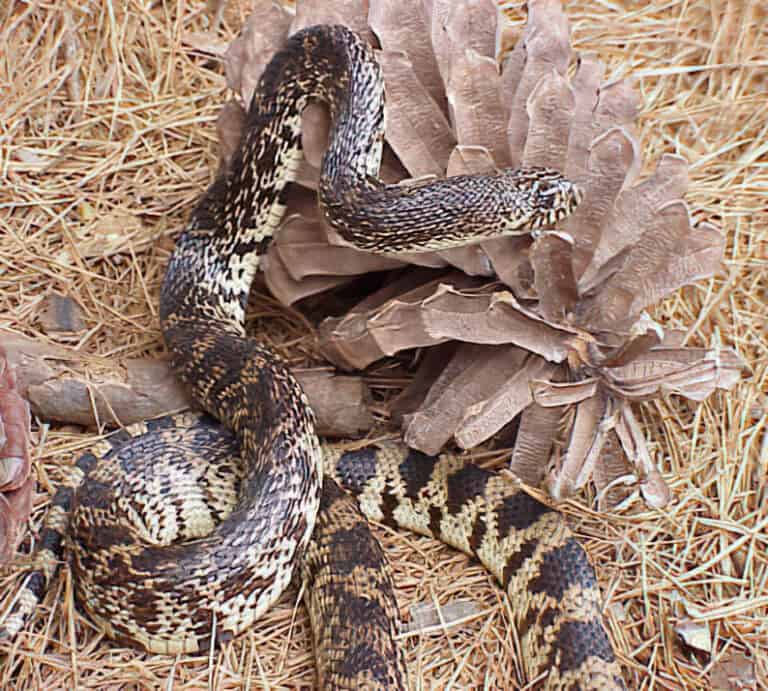
A variety of animals are on record of killing and ingesting the oak toad. Primarily, we’re talking crows, raccoons, hog-nose snakes and garter snakes, and cousins like Marine toads and distant relatives the gopher frog.
As a bufonid, the oak toad’s main anti-predator mechanism consists of inflating its body, especially when threatened by a snake. And there’s the parotid gland, which is poisonous. They’ll secrete these toxins when they need to push off a predator. The species’ eggs also possess these toxic properties.
Humans have parotid glands too. There is one on each side of the face, sitting just in front of the ears. The glands produce saliva that helps the chewing and digesting of food.
In our toad friends though, the gland milky alkaloid compounds deter predation via a neurotoxic reaction. The gland is a defensive tactic and is lethal to smaller animals, even our pets. Its impact on people is mild but can spark allergic reactions.
Depending on the toad species, the gland can cause serious damage if ingested. So, you choose to keep an oak toad as a pet, avoid handling it. Use gloves when you do so or at least carefully wash your hand after.
Threats
Conservationists categorize the oak toad as being of moderate concern. Its population levels with no current threats to its habitats are major reasons. But the destruction of wetlands, progressive development and continuous expansion of urban sprawl pose danger to all amphibian species.
When it comes to predation, any toad species’ biggest threat is snakes, particularly the hognosed variety. Garter snakes, which also have a fondness for the same habitats as oak toads, are always on the prowl for a toad meal.
Gopher frogs will happily chow on their cousins too. And if they’re around, the toad has to take care to keep an eye out for raccoons and sharp-eyed birds of prey.
Reproduction, Babies and Lifespan
Here’s information on how the oak toad maintains its reproduction cycle and lifespan.
Reproduction
Oak toads breed only once a year and seasonally. Mating begins with warmer temperatures and seasonal thunderstorms. The ovulation interval takes place between late May and mid-August.
The adult oak toad reaches sexual maturity between the ages of 1.5 and 2.3. They breed from April to October. Regularly, that’s during the rainy season and in shallow pools. Breeding season is the rare time this species is active at night.
The male toad attracts the female with the vocal sac, creating a call that attracts females.
After mating, the female can lay an average of 300 to 500 eggs in short bursts of four to egg batches. The eggs are set in strands along the range of submerged grass. The breeding process is so strenuous many females do not live long after.
Fertilization takes place externally with the males releasing sperm on the eggs, which hatch over a range of three to four days.
The Oak Toad Baby
Like all members of Anaxyrus quercicus and Anura (frogs), the baby oak toad is a tadpole. Tadpoles are born with a tail that falls off as they mature.
The eggs hatch, producing tadpoles, a larval, gill-breathing stage. Legless, they’ll use the tail to travel through water.
Lifespan
In captivity, the average lifespan of the oak toad is 1.9 years. Some have lived as long as four. Toads in the wild haven’t been subject to lifespan study.
Population
The oak toad population is strong enough to not worry conversations organizations. There are no specific numbers on record. But numbers are guestimated as very healthy. According to the IUCN Redlist, oak toads are classified as least concern.
Keeping a Pet Oak Toad
Oat toads make for great pets. Their size is quite appealing. And as they’re active in daylight, they make interaction easy.
A difficulty keeping the oak toad as a pet is also its size. They require small insects for feeding. Popular meals among owners are mealworms, crickets, waxworms and small cockroaches. This can be a challenge as you need somewhere to store insects most don’t want around.
Feedings should take place two or three times a week. You should dust food with a calcium powder. It would also be a good idea to give the pet a multivitamin at least once a week.
Habitat for a Pet Oak Toad
For good care, keep these animals in nothing larger than a tank 10 gallons in size. If you plan to keep more than one, you want a larger tank. Proceed with caution if you want more than one. These are solitary critters and housing oak toads with others is always a risk.
There should always be a supply of clean water. It needs to be de-chlorinated or you can go with bottled spring water. Use a substrate of sand and soil at a depth of two inches.
Keep temps comfortable for the creatures. That’s 75 to 80 degrees Fahrenheit with humidity levels at 50 to 60 percent, mimicking their climates.
Lightning isn’t a concern. There’s no evidence oak toads need UVB but some owners like to use them. If you’re keeping a live terrarium in the tank, aesthetics are a bet for the best care of your pet. A UVB with low strength will promote plant growth and perform an anti-microbial function.
Oak Toad Pictures
View all of our Oak Toad pictures in the gallery.

stephen curah/Shutterstock.com
Sources
- https://dickinsoncountyconservationboard.com/2018/06/04/five-facts-that-will-make-you-like-toads/
- https://www.fishandboat.com/Resource/AmphibiansandReptiles/PaAmphibiansReptiles/Pages/TheFrogsandToads.aspx#:~:text=Unlike%20adult%20frogs%20and%20toads,moist%20skin%20of%20the%20frog.
- https://kids.kiddle.co/Oak_toad
- https://www.outdooralabama.com/frogs-and-toads-alabama/oak-toad#:~:text=The%20Oak%20Toad%20has%20been,potential%20threats%20to%20amphibian%20species.
- https://en.wikipedia.org/wiki/Oak_toad
- https://kidadl.com/animal-facts/oak-toad-facts
- https://www.virginiaherpetologicalsociety.com/amphibians/frogsandtoads/oak-toad/oak_toad.php
- https://www.ncwildlife.org/Learning/Species/Amphibians/oak-toad
- https://thetyedyediguana.com/content/care-sheets/Oak-Toad-Anaxyrus-quercicus-care-sheet.pdf
- https://www.woodlandtrust.org.uk/blog/2019/05/what-is-the-difference-between-a-frog-and-a-toad/#:~:text=Frogs%20have%20long%20legs%2C%20longer,crawl%20around%20rather%20than%20hop.&text=Frogs%20have%20smooth%2C%20somewhat%20slimy%20skin.&text=Toads%20have%20dry%2C%20warty%20skin.