

S
Species Profile

Savannah Sparrow

Passerculus sandwichensis

Buzzy song of the open fields
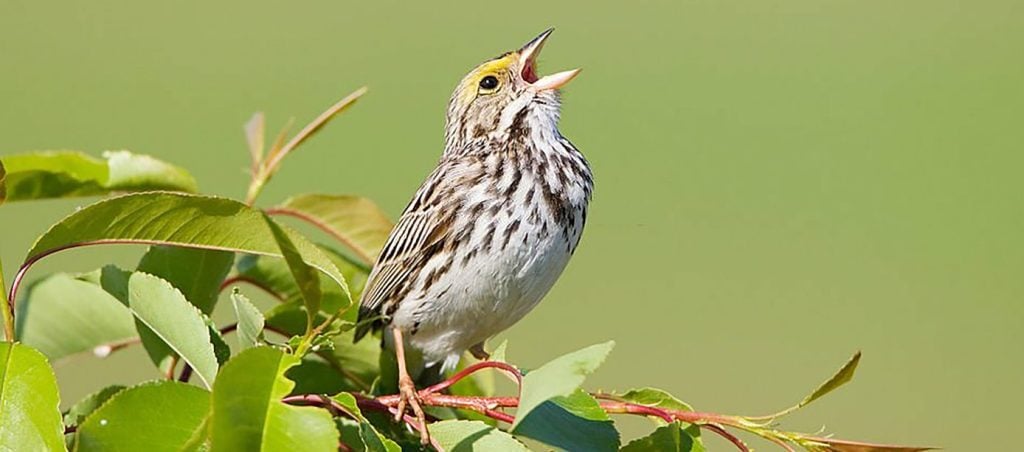
KensCanning/Shutterstock.com

Savannah Sparrow Distribution

Click a location to explore more animals from that region

Loading map...

Found in 59 locations

Savannah Sparrow in 4K Photo

At a Glance

Wild Species
Diet Omnivore
Activity Diurnal+
Lifespan 2 years
Weight 0.03 lbs
Status Least Concern
Did You Know?

Size: 11-14 cm long; 18-23 cm wingspan; ~15-28 g (Cornell Lab Birds of the World).

Scientific Classification

A small, streaky New World sparrow widespread across North America, strongly associated with open habitats and noted for its buzzy insect-like song.

Kingdom
Animalia
Phylum
Chordata
Class
Aves
Order
Passeriformes
Family
Passerellidae
Genus
Passerculus
Species
Passerculus sandwichensis

Distinguishing Features

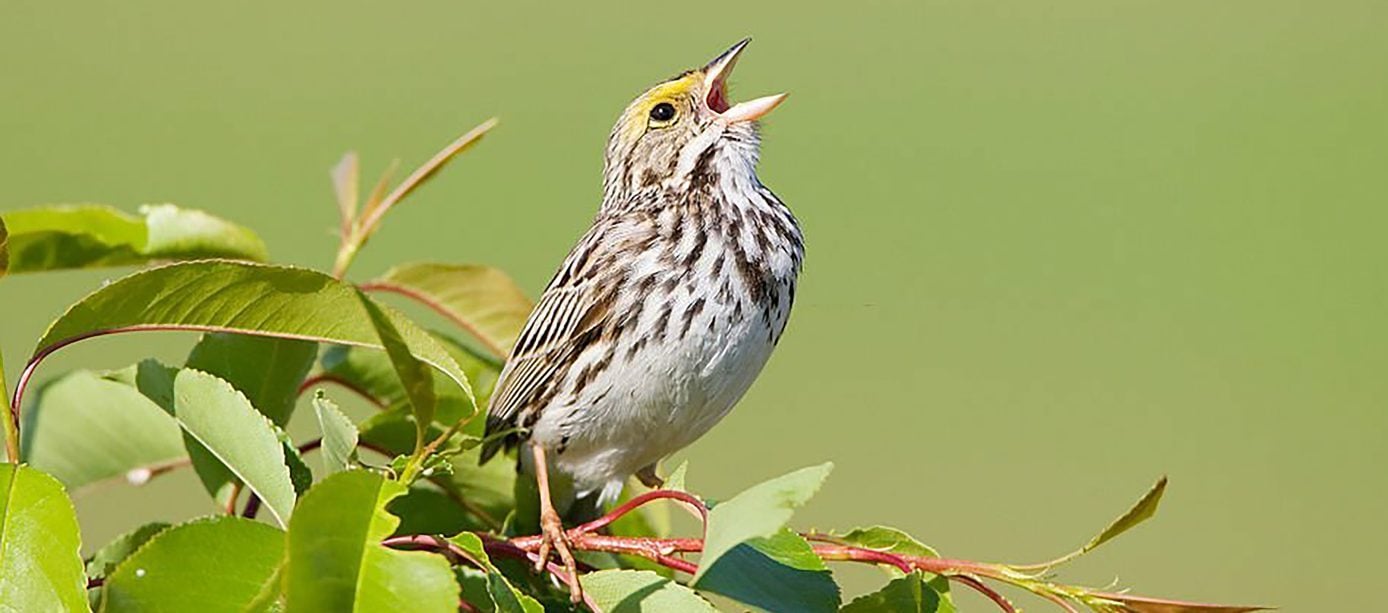
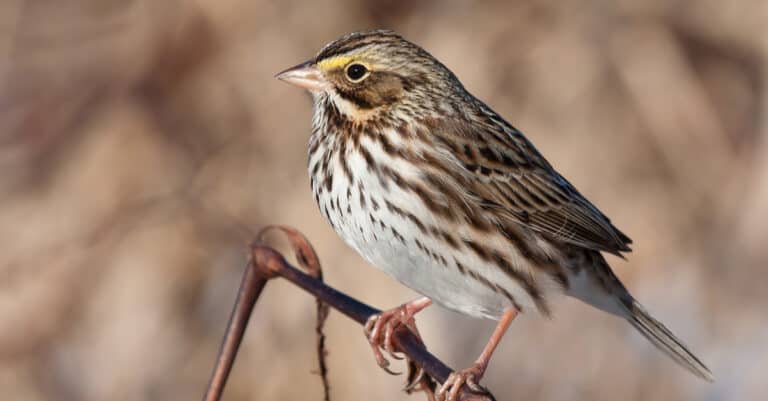
  • Small sparrow with heavily streaked brown upperparts and streaked breast (often with a central breast spot)
  • Typically shows a yellowish patch in front of the eye (lores/supercilium)
  • Relatively short tail and a fine, pointed bill; often forages on the ground in open areas
  • Song often a thin, high introductory note followed by a buzzy trill

Physical Measurements

Length
5 in (4 in – 6 in)
Weight
0 lbs (0 lbs – 0 lbs)
Tail Length
2 in (2 in – 2 in)
Top Speed
25 mph
flying

Appearance

Primary Colors
Secondary Colors
Skin Type Feathered body (keratin feathers); scaly tarsi/toes; horny conical bill adapted for seeds.
Distinctive Features
  • Adult size: length 12-14 cm; wingspan 18-23 cm; mass 0.015-0.028 kg (Birds of the World).
  • Yellow lores (in front of the eye), often the quickest diagnostic field mark.
  • Whitish to buffy underparts with dense, sharp breast streaking; a small central breast spot may be present.
  • Short, conical bill; overall 'streaky' appearance optimized for camouflage in open habitats.
  • Typically forages on the ground (walking/running, gleaning seeds and insects) in grasslands, fields, dunes, and marsh edges.
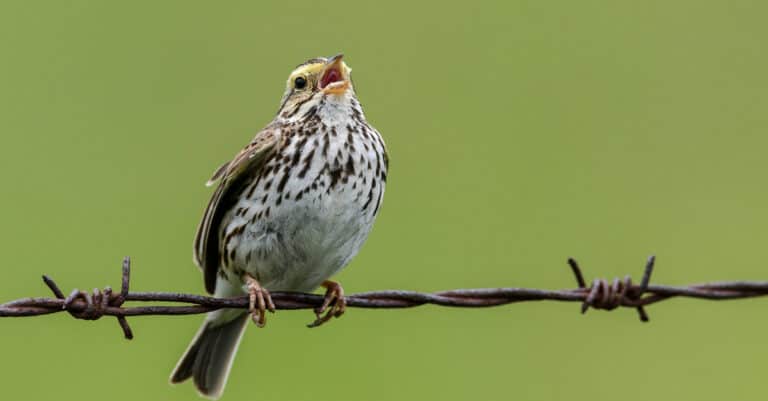
  • Song is a distinctive buzzy, insect-like series (often rendered "tsit tsit tsit...zzzz"), delivered from low perches or during brief display flights.
  • Longevity record: at least 8 years 2 months (USGS Bird Banding Laboratory longevity records).

Sexual Dimorphism

Sexes are similar overall; males average slightly larger and often show crisper streaking and stronger facial contrast. Females tend to appear a bit duller and are less conspicuous behaviorally outside nesting, while males sing frequently in breeding territories.

♂
  • On average slightly larger body size (species typical; overlap substantial).
  • Often slightly higher-contrast breast streaking and facial pattern, especially in fresh plumage.
  • More frequent conspicuous singing/display behavior in open habitat breeding territories.
♀
  • Slightly duller or browner overall tone on average; pattern usually similar to male.
  • Often less contrasty facial markings and streaking on average (variable).
  • More cryptic behavior during nesting; plumage supports camouflage in grass and marsh vegetation.

Did You Know?

Size: 11-14 cm long; 18-23 cm wingspan; ~15-28 g (Cornell Lab Birds of the World).

Field mark: many show yellow lores (between eye and bill) plus a streaked breast, often with a small central spot.

Nesting is mostly on the ground in a grass cup-built to vanish into vegetation.

Typical clutch is 3-5 eggs (reported range 2-6); incubation about 10-13 days; young fledge about 8-11 days after hatching (Birds of the World).

The song often starts with a few thin notes and ends in a distinctive buzzy trill-frequently compared to an insect.

It's one of the most widespread New World sparrows, breeding from Alaska/Canada across much of the northern U.S. and wintering broadly across the southern U.S. into Mexico and Central America.

The pale "Ipswich" form (P. s. princeps) is adapted to sand dunes and beaches-an iconic example of how varied this single species can be across habitats.

Unique Adaptations

  • Camouflage by design: heavy streaking and earth-toned plumage closely match grasses, thatch, and tundra plants-especially effective for a ground nester.
  • Long hind claw (a common grassland-sparrow trait) that helps with stability and walking on uneven ground and stems while foraging.
  • Flexible habitat specialization across many subspecies: forms range from coastal saltmarsh birds to tundra-breeders to pale dune-adapted birds (e.g., Ipswich form), reflecting local selection pressures.
  • Buzzy, high-carrying song structure suited to open habitats where wind and surf can mask simpler whistles (notably in coastal populations).

Interesting Behaviors

  • Ground-foraging specialist: walks or runs through grasses, picking seeds and insects from the soil surface and low vegetation.
  • Low, skimming flush: when startled, often bursts from cover and flies low over grass before dropping back into vegetation.
  • Song posts: males frequently sing from a low shrub, fence wire, or grass clump to advertise territory in open habitat.
  • Seasonal diet shift: relies heavily on insects (and other arthropods) in the breeding season, switching more to seeds in winter.
  • Marsh/grassland fidelity: many populations return to similar open breeding habitats year after year, using vegetation structure for concealment and nest placement.
  • Cryptic nesting behavior: adults approach the nest subtly and may slip away on foot through cover to avoid revealing nest location.

Cultural Significance

The Savannah Sparrow (Passerculus sandwichensis) is a grassland indicator: its presence and nesting success reflect open habitats like prairies, hayfields, tundra openings, and coastal marshes. Its name links to Savannah, Georgia and Sandwich Sound.

Myths & Legends

No well-documented, widely shared traditional mythology is specific to the Savannah Sparrow as a distinct species; in most regions it blends into broader cultural categories like "sparrows" or "small grass birds."

The Savannah Sparrow's English name links to Savannah, Georgia, while its Latin name, sandwichensis, comes from the old 'Sandwich Sound.' The names reflect a history of travel, collecting, and mapmaking.

The pale 'Ipswich' form of Savannah Sparrow is closely tied to Atlantic dunes, especially around Sable Island. Local nature writers use it as a symbol of windswept beaches and barrier islands, not folklore.

Conservation Status

LC Least Concern

Widespread and abundant in the wild.

Population Decreasing

Protected Under

  • United States: Migratory Bird Treaty Act (MBTA)
  • Canada: Migratory Birds Convention Act, 1994
  • International: Protected as a native migratory bird under U.S.-Canada-Mexico migratory bird frameworks

Life Cycle

Birth 4 chicks
Lifespan 2 years

Lifespan

In the Wild
0.25–9.75 years
In Captivity
1–12 years

Reproduction

Mating System Monogamy
Social Structure Socially Monogamous
Breeding Pattern Seasonal
Fertilization Internal Fertilization
Birth Type Internal_fertilization

Typically forms seasonal pair bonds on male-held territories; most nests are provisioned by both parents, though females incubate. Genetic studies show substantial extra-pair paternity (~20-40% of broods; Wheelwright et al. 1992), and occasional polygyny occurs.

Behavior & Ecology

Social Flock Group: 20
Activity Diurnal, Matutinal
Diet Omnivore Seasonally shifts: insects (especially beetles and caterpillars) during the breeding season; grass, sedge, and other small seeds during the nonbreeding season (as summarized in Birds of the World species account for the Savannah Sparrow).
Seasonal Migratory 2,485 mi

Temperament

Territorial and aggressive toward conspecifics during breeding; tolerance increases markedly in nonbreeding flocks.
Strong seasonal social shift-territorial pairs in breeding season, gregarious flocks in winter; variation by habitat and subspecies.
Generally cryptic and ground-oriented; flushes at close range and drops back into cover.
Longevity: banding records indicate individuals can reach ≥8 years; exact current USGS BBL maximum varies by dataset query.
Source basis for flocking/territoriality and seasonal change: Wheelwright & Rising, Birds of the World (Savannah Sparrow account; Cornell Lab of Ornithology).

Communication

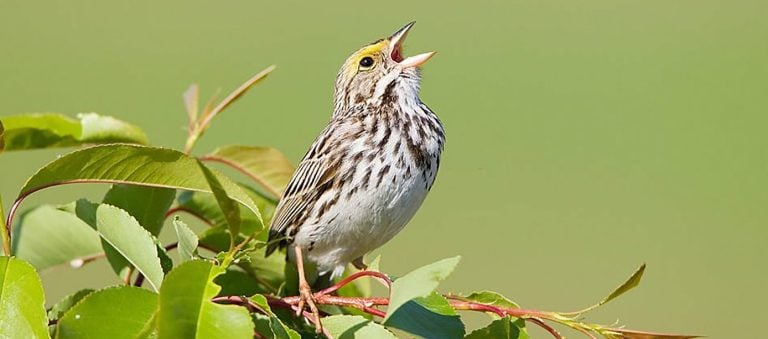
Primary song: thin introductory notes followed by a distinctive buzzy, insect-like trill.
Contact call: sharp 'tsip'/'sip' notes used within flocks and between mates.
Alarm call: higher, thinner 'seep' notes; harsher churr notes in agitation.
Song-post displays from grass stems/shrubs; elevated singing increases territory advertisement.
Visual threat postures and short chases at territory boundaries; wing-flicking and tail movements during agitation.
Courtship and mate-guarding via close following and repeated soft calls at the nest area.

Habitat

Biomes:
Temperate Grassland Tundra Alpine Wetland Temperate Forest Boreal Forest (Taiga) Mediterranean Freshwater Marine +3
Terrain:
Plains Coastal Island Riverine Valley Hilly
Elevation: Up to 13123 ft 4 in

Ecological Role

Open-habitat omnivorous ground-forager linking plant seed resources to arthropod prey (and in turn to higher predators).

Arthropod population suppression (consumes herbivorous insects such as caterpillars/orthopterans) Seed predation that can influence grass/forb recruitment and community composition Prey base for raptors, owls, and mesopredators (trophic support in grassland/coastal systems)

Diet Details

Other Foods:
Grass seeds Sedge and rush seeds Seeds of weedy broadleaf plants Small berries and soft fruits

Human Interaction

Domestication Status

Wild

Savannah Sparrow (Passerculus sandwichensis) is a wild bird with no domesticated or pet form. People mostly watch and count it and manage habitats—grasslands and shorelines—by changing mowing times. Adults are about 12–15 cm long and 15–28 g. Threats include habitat change, pesticides, cats, collisions, and conservation actions.

Danger Level

Low
  • Physical injury risk is minimal; at most, minor scratches/bites if handled during banding or rehabilitation.
  • As with most wild birds, there is a low but non-zero zoonotic risk if handled improperly (e.g., Salmonella from fecal contamination); standard hygiene and permitting protocols mitigate this.
  • No species-specific record of dangerous attacks on humans; primary risks are indirect (e.g., exposure during handling, not from normal observation).

As a Pet

Not Suitable as Pet

Legality: Keeping the Savannah Sparrow (Passerculus sandwichensis) as a pet is mostly illegal without permits. In the U.S. the MBTA and in Canada the MBCA protect it; only licensed wildlife rehabbers, researchers, or schools may hold them.

Care Level: Expert Only

Purchase Cost:
Lifetime Cost:

Economic Value

Uses:
Ecosystem services (insect consumption, food-web support) Ecotourism and recreation (birdwatching) Scientific research and monitoring Conservation program value (indicator of grassland/shoreline health)
Products:
  • Non-market value through birdwatching tourism and local recreation (field guides, tours, checklists; commonly tracked via birding participation metrics).
  • Ecosystem service value via consumption of insects during the breeding season and provision of prey for raptors and other predators (food-web support).
  • Research/education value through long-running banding and demographic studies used to evaluate grassland management, mowing schedules, and population trends (e.g., Breeding Bird Survey trend analyses; banding-based survival and longevity summaries).

Relationships

Related Species 7

Large-billed Sparrow Passerculus rostratus Shared Genus
Grasshopper Sparrow Ammodramus savannarum Shared Family
Baird's Sparrow Centronyx bairdii Shared Family
Henslow's Sparrow Centronyx henslowii Shared Family
Song Sparrow
Song Sparrow Melospiza melodia Shared Family
Nelson's Sparrow Ammospiza nelsoni Shared Family
LeConte's Sparrow Ammospiza leconteii Shared Family

Ecological Equivalents 5

Animals that fill a similar ecological role in their ecosystem

Grasshopper Sparrow Ammodramus savannarum Savannah Sparrow (Passerculus sandwichensis) and Grasshopper Sparrow are small grassland sparrows that feed on insects, forage and nest on or near the ground (especially during the breeding season), and sing insect-like songs over open grassy areas.
Baird's Sparrow Centronyx bairdii Ecological analog in northern prairies. A ground-nesting, grassland-dependent passerine that uses dense herbaceous cover for nesting and foraging; both species are sensitive to grassland structure and fragmentation and rely heavily on arthropods during the breeding season.
Song Sparrow
Song Sparrow Melospiza melodia Frequent habitat adjacency and partial overlap: they occupy low, shrubby or herbaceous edges (wet meadows, field margins) and forage on the ground for insects and seeds. Song Sparrows often share similar predator-prey pressures and similar responses to edge-habitat management.
Vesper Sparrow Pooecetes gramineus Similar open-field niche: both use dry open habitats (pastures, hayfields, and prairie edges), forage mainly on the ground, and shift seasonally from insect-rich diets during the breeding season to seed-heavy diets in the nonbreeding period.
Horned Lark Eremophila alpestris Convergent open-country life history. Both exploit sparsely vegetated open ground and short grass, nest on the ground, feed heavily on seeds outside the breeding season, and face similar ground-nest predation in agricultural and grassland landscapes.

Quick Take

Savannah sparrows are small, lively birds found throughout North America. They eat beetles, caterpillars, flies, and other insects as well as seeds. This bird is recognized by the distinctive yellow stripe above each of its eyes. There are 17 subspecies of this sparrow.

An educational infographic about the Savannah Sparrow, detailing its physical appearance, diet of insects, and migration patterns across North America.
Don’t let its size fool you—this common sparrow is a 50 MPH speedster with a secret life hidden in underground tunnels. © A-Z Animals

3 Amazing Facts

  • This bird was first recorded in Savannah, Georgia.
  • It is a fast runner.
  • It is one of many sparrows that spend the summer season in Maine.

Where to Find Savannah Sparrows

These sparrows live throughout North America, specifically in the United States, Canada, and Mexico. The best time to see these birds is in the spring.

Someone living in the midwestern United States is likely to see a lot of these birds beginning in late February as they prepare to breed. Someone in a northern state such as Alaska is likely to spot these birds in late May at the beginning of their breeding season. Maine is a popular place for these sparrows, along with many other types of sparrows, in the summertime.

Grasslands, meadows, and prairies are the best places to observe these birds. Their habitat has a temperate to tropical climate. Bird watchers appreciate these birds because they can be found perched out in the open. Plus, they have a distinctive call that sounds like tsip-tsip-tsip.

Nests

Once a male establishes his territory, his unique call signals other males to stay away. These birds build their nests on the ground. They position the nest within or under a gathering of decaying vegetation. The entrance to the nesting area takes the shape of a tunnel. The nest itself is built by the female sparrow and has a cup-like shape. It is made of twigs and lined with grass.

Classification and Scientific Name

The Savannah sparrow’s scientific name is Passerculus sandwichensis. The Savannah sparrow gets its name because one of the first known specimens of this bird was found in the city of Savannah, Georgia. It’s in the Passerellidae family and the class Aves.

There are 17 subspecies of this bird. Some of these are:

  • Passerculus sandwichensis labradorius
  • Passerculus sandwichensis oblitus
  • Passerculus sandwichensis brooksi

Size, Appearance & Behavior

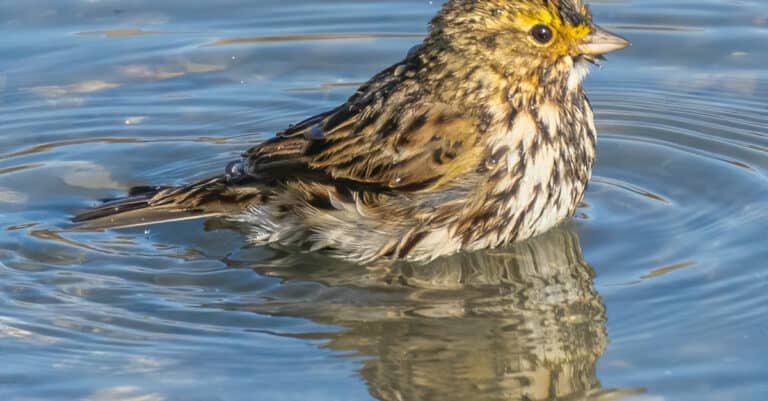
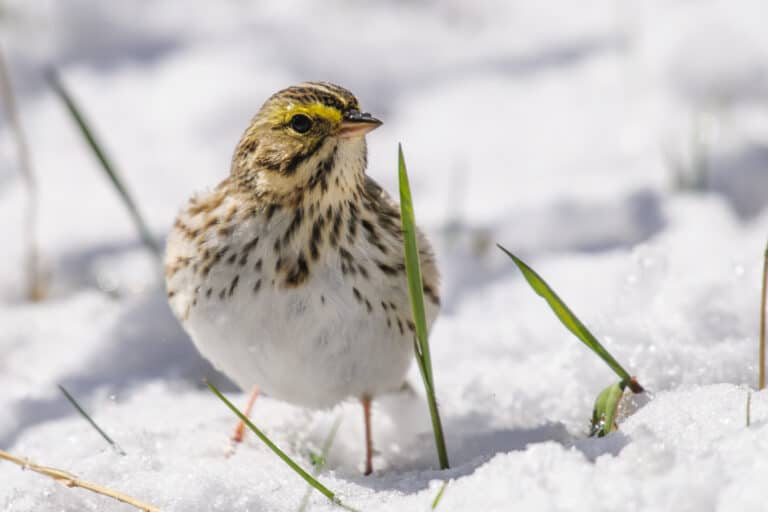
These birds have a mixture of dark brown, tan, and gray feathers on their wings. Their breasts are white with dark streaks. They are notable for having a yellow stripe above each eye.

This bird ranges from four to seven inches in length. Its weight range is 0.53 ounces up to one ounce. This bird’s wingspan is seven to nine inches.

Its dark feathers help it to blend in with the vegetation in its habitat. This small bird can fly at speeds of up to 50mph, so it can sometimes escape predators.
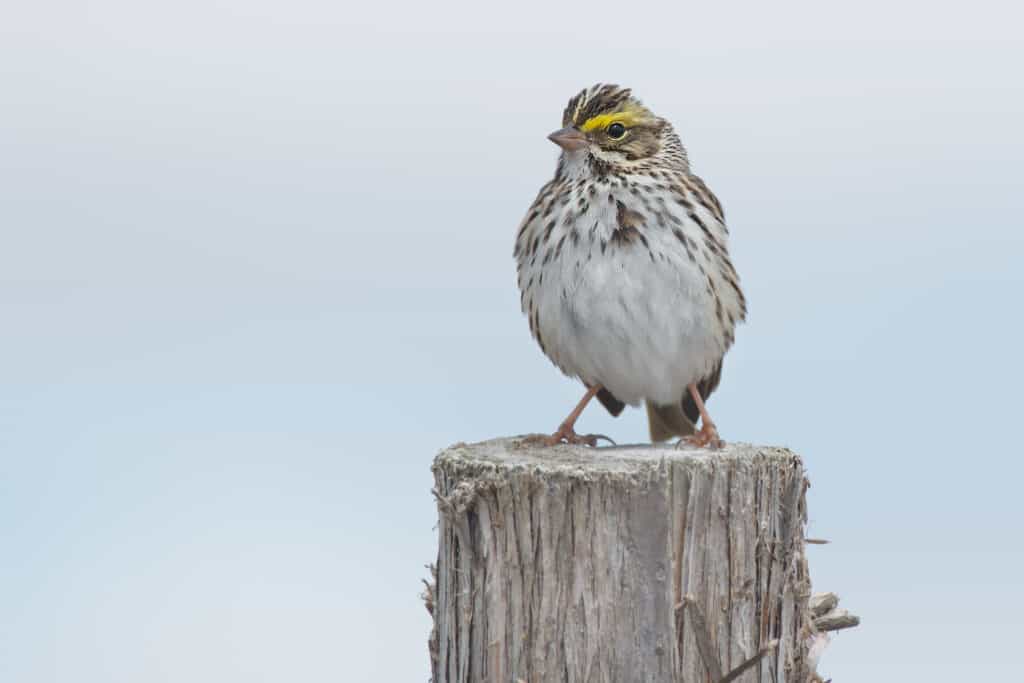
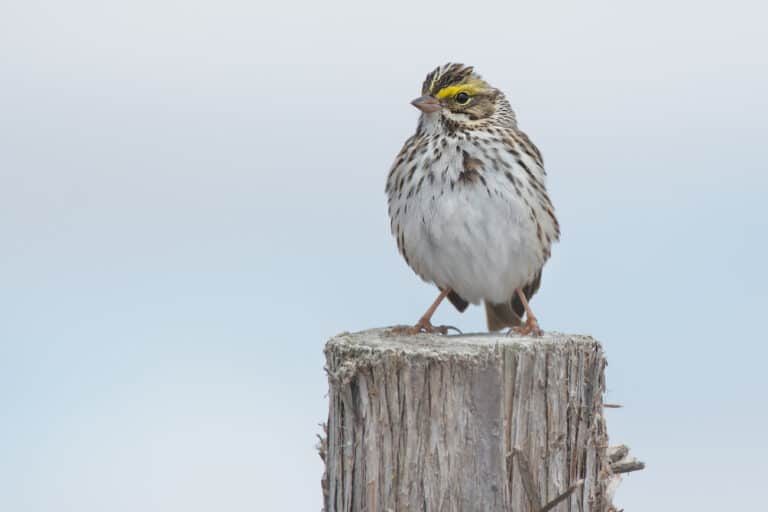
A Savannah Sparrow on a wooden fence post

Savannah Sparrows have a telltale yellow streak above their eyes.

Migration Pattern & Timing

Some of these sparrows stay in the same area year-round, while others migrate.

Some of these birds living on the coasts of California and Mexico remain there all year. Alternatively, Savannah sparrows living in areas of the eastern part of the United States such as Maine, Vermont, and New Hampshire spend the summer in those states. However, they move farther south in the fall season, so they can winter in warmer locations.

The spring breeding season for this bird begins in late February. Those that migrate south for the winter begin their flight sometime in September.

Savannah Sparrow vs Song Sparrow

A quick glance at these two birds may fool you into thinking you’re seeing the same sparrow. But while they share some commonalities, the Savannah sparrow and the song sparrow have many differences.

One of their similarities relates to their size. Both sparrows can be up to seven inches long and weigh up to one ounce. Plus, they both have white breasts featuring dark streaks or spots. Their wings display very similar coloration with brown or gray feathers streaked with a darker brown or black. As a note, if you see a yellow stripe above each eye, it’s a Savannah sparrow.

Another similarity is that these sparrows both make their home in North America. Both birds reside in certain states throughout the year, while some individuals of each species migrate when the weather turns cold.

One of the main differences involves habitat. These birds live in prairies, meadows, grasslands, and salt marshes. Alternatively, song sparrows have a wider range of habitats, from deserts to city parks. So, you’re more likely to see a song sparrow in your backyard.

A second difference involves their songs. A Savannah sparrow makes a tsip-tsip call, while a song sparrow’s call sounds more like chimp-chimp.

Diet

These sparrows are omnivores. Whether they eat more vegetation or insects depends on the season.

What does a Savannah sparrow eat?

These birds eat beetles, caterpillars, flies, and seeds. If this bird eats an insect that has ingested poison, it can make the sparrow sick or kill it.

Predators, Threats, and Conservation Status

These tiny birds weigh a single ounce at their heaviest. So, it’s not surprising they have predators of many types.

What eats Savannah sparrows?

Snakes, birds of prey, and cats can eat Savannah sparrows. A snake can easily prey on a nest of Savannah sparrows because the nests are built on the ground. Furthermore, birds of prey have no problem diving from high in the air to capture this sparrow.

Savannah sparrows are considered Least Concern by conservationists but are decreasing in number. This decline is likely due to the loss of their meadow and marsh habitats, as well as the ingestion of pesticides via the insects they eat.

Some protected areas have been established for Savannah sparrows, making it easier for them to breed.

Reproduction, Babies, and Lifespan

Savannah sparrows start their breeding season in late February. While some of these sparrows form permanent pairs, other males mate with several females in the spring.

The male establishes a territory where the female builds the nest. It’s constructed beneath decaying plants.

Females can lay from two to six eggs, but most of these birds lay four. The eggs hatch in ten to 13 days. The female Savannah sparrow is usually the one to feed her young, though sometimes the male helps. She must consume food totaling ten times her body weight to have enough energy for both herself and her chicks!

These sparrows feed and care for their chicks for three weeks. After that, the chicks can leave the nest to live independently.

Population

The population of this bird is estimated at 170 million individuals. They are recorded as Least Concern but their population continues to decline.

View all 391 animals that start with S

Sources

  1. Wikipedia / Accessed April 18, 2022
  2. Missouri Department of Conservation / Accessed April 18, 2022
  3. Tennessee Wildlife Resources Agency / Accessed April 18, 2022
  4. Maine Birds / Accessed April 18, 2022
A-Z Animals Staff

About the Author

A-Z Animals Staff

AZ Animals is a growing team of animals experts, researchers, farmers, conservationists, writers, editors, and -- of course -- pet owners who have come together to help you better understand the animal kingdom and how we interact.
Connect:

Thank you for reading! Have some feedback for us?


Savannah Sparrow FAQs (Frequently Asked Questions)

Savannah Sparrows are omnivorous. They eat flies, caterpillars, beetles, and seeds.