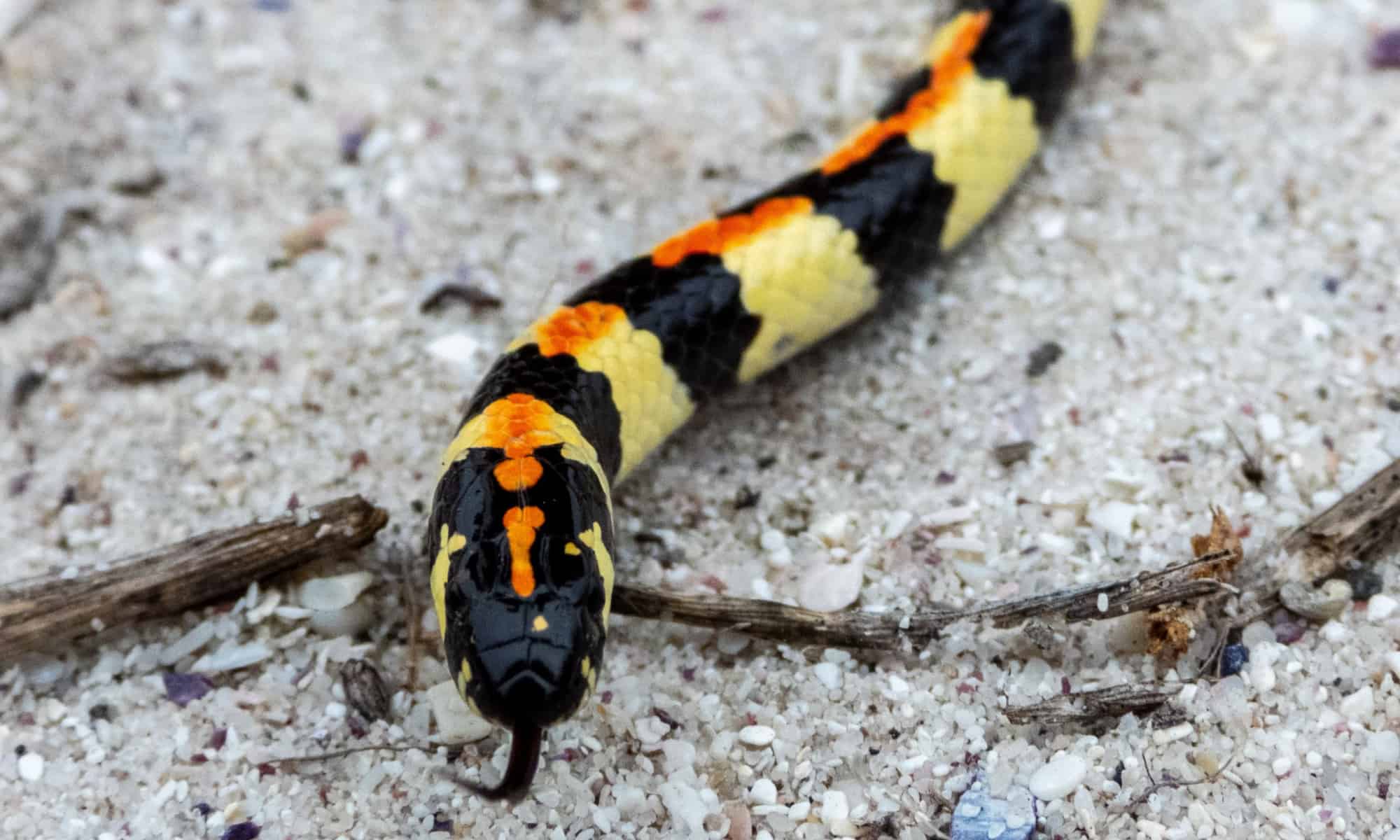

The natural world is full of fascinating plants and animals covered in dazzling colors and astonishing designs, especially when it comes to snakes. Many desert snakes have neutral, sandy colors, while others have bright and bold patterns that could easily inspire new fashion trends. While some snakes have large blotches, others sport stripes and spots of all shapes and sizes. There are even snakes with polka dots. Let’s take a closer look at 18 snakes with dots.
1. Twin Spotted Rattlesnake
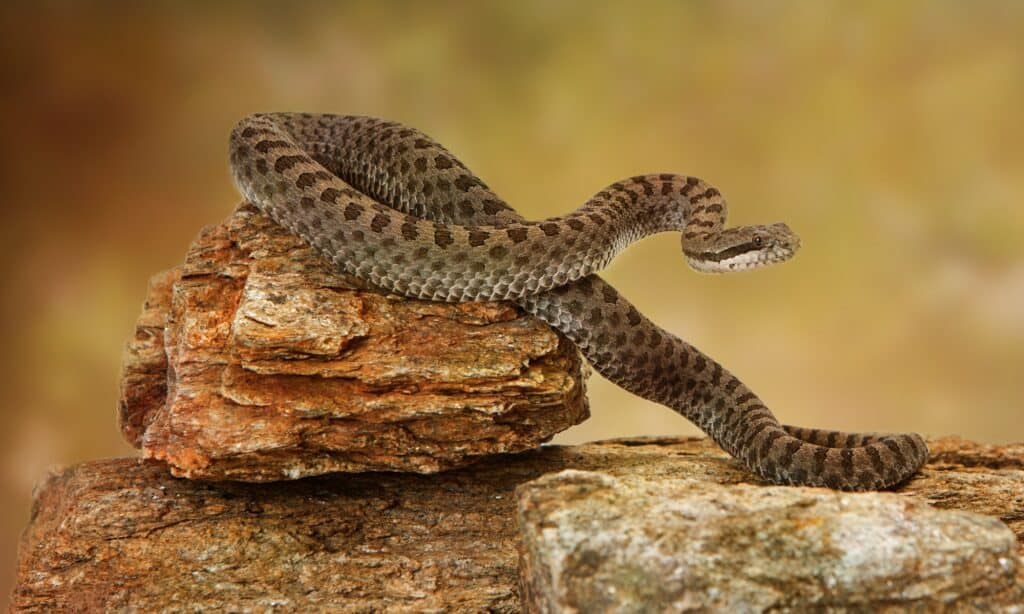
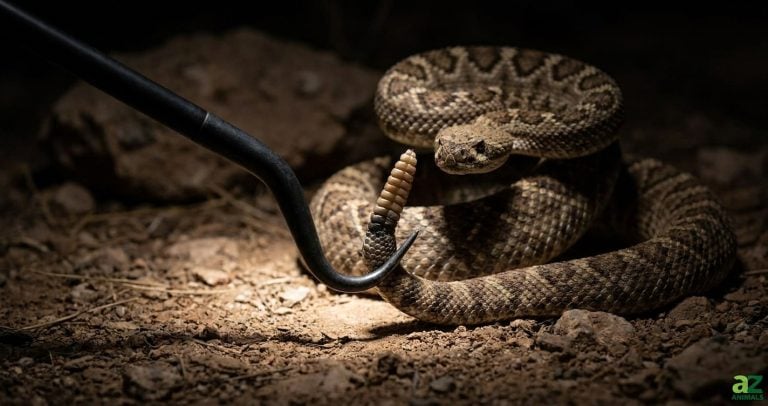
The twin-spotted rattlesnake is a venomous snake found mainly in southeastern Arizona and Northern Mexico.
©iStock.com/adogslifephoto
The twin-spotted rattlesnake is a small snake with a grey, blue-grey, grey-brown, or reddish-brown body. Two rows of small dark spots run down the snake’s back, and more small dark dots cover its body. These snakes can grow up to 26 inches long and have very large, triangular-shaped heads. Twin-spotted rattlesnakes live in the Sonoran Desert in Arizona and Mexico, often in high-altitude mountain ranges, rocky outcrops, forests, and canyons. These snakes mostly eat lizards, birds, and small rodents, but occasionally, they will also hunt other snakes.
2. Yellow-Spotted Wolf Snake
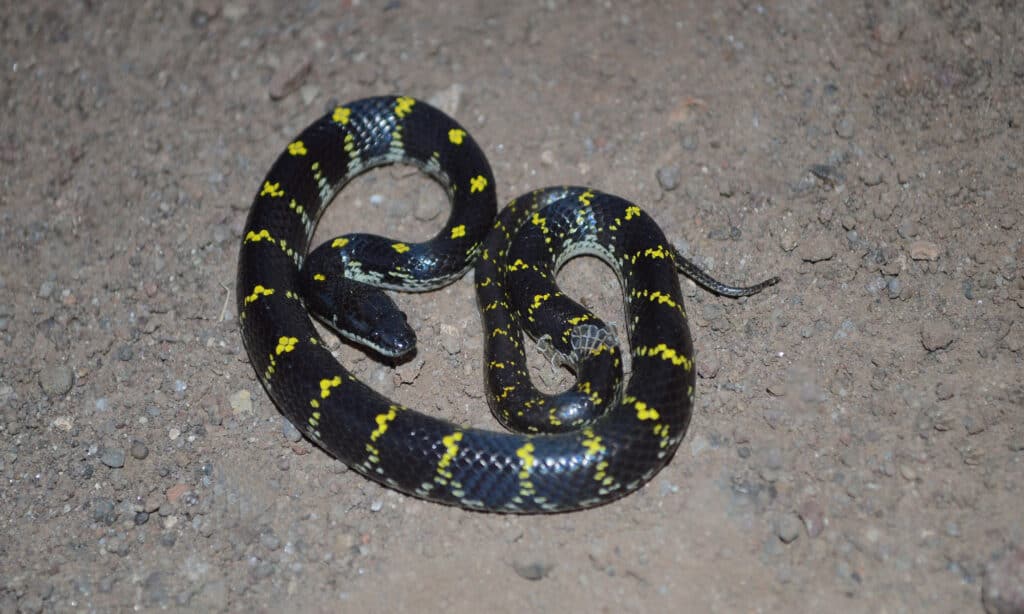
Yellow-spotted wolf snakes are small and only grow to 20 inches at the most.
©RealityImages/Shutterstock.com
The yellow-spotted wolf snake is a small snake, usually around 13 inches long, with a small head and a rounded snout. This snake has a black, glossy body with small yellow dots across its back. In some snakes, these yellow dots form clusters and small crossbands. The yellow-spotted wolf snake is non-venomous and lives in the Western Ghats of India. Unfortunately, however, this snake is often unnecessarily killed because it is mistaken for a venomous krait.
3. Spotted House Snake
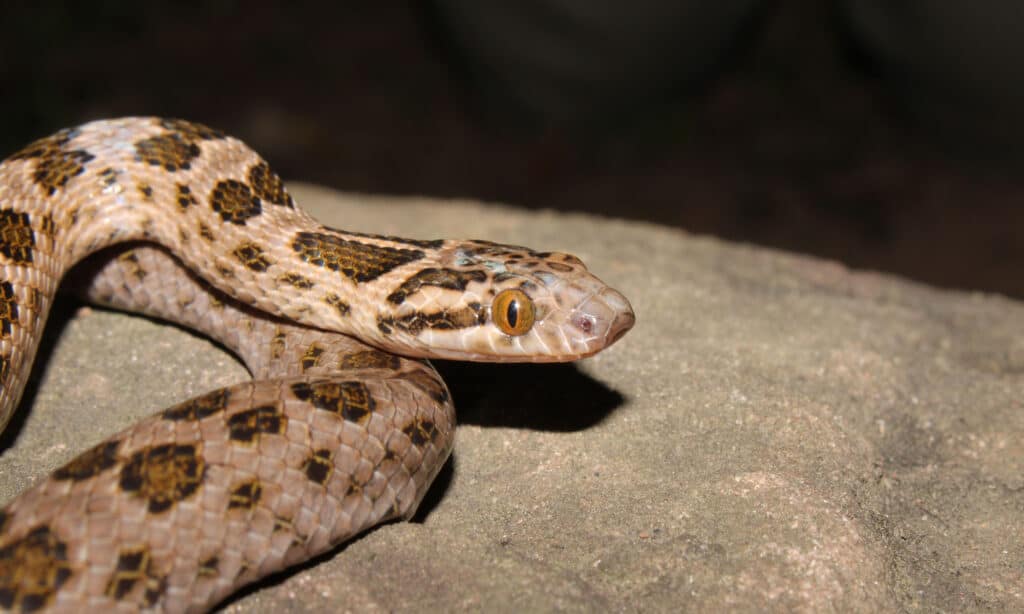
The spotted house snake is not easily confused with other snakes in South Africa due to its unique patterns and colors.
©Cormac Price/Shutterstock.com
The spotted house snake, or spotted rock snake, lives in many of the rocky regions of South Africa. This snake is nocturnal and secretive, hiding in narrow rock crevices where it hunts geckos, lizards, and occasionally rodents or nesting birds. There are many different colors of spotted house snakes. Commonly, these snakes have brownish, tan, cream, or pinkish bodies with dark brown or reddish-brown spots spaced out along their backs. Spotted house snakes are small and slender and grow between 16 and 24 inches long, on average. Their heads are wide and very flat, possibly so they can more easily navigate through narrow crevices in the rocks.
4. Speckled Kingsnake
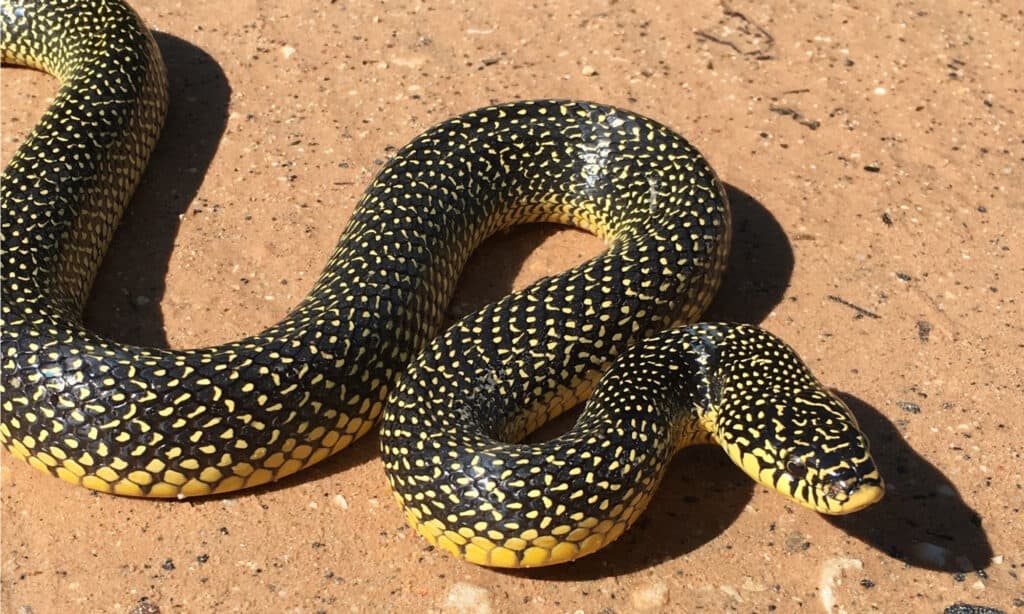
The speckled kingsnake has a glossy black body with whitish-yellow dots on its scales.
©Joe Farah/Shutterstock.com
The speckled kingsnake has a shiny black or dark brown body, with a mass of tiny yellow dots that give it its namesake “speckled” appearance. These colored dots provide a stark contrast to the snake’s dark body, which is why it is also called the “salt and pepper snake”. Speckled kingsnakes are nonvenomous and grow up to 48 inches long. These snakes are endemic to southern and central regions of the United States. They typically prefer to live in moist or wet habitats but often travel into dry areas as well. These snakes are common in swamps and near rivers, where they hunt lizards, small rodents, and other snakes. Speckled kingsnakes are unique because they can eat venomous snakes like cottonmouths, copperheads, and rattlesnakes.
5. Night Snake
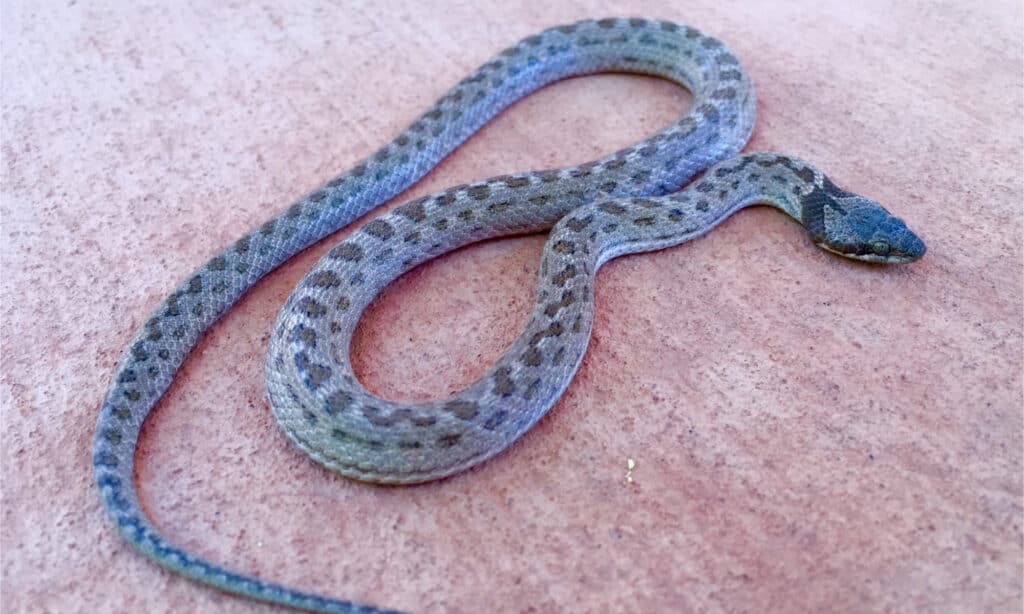
Night snakes are often confused with baby rattlesnakes because they look similar.
©Matt Jeppson/Shutterstock.com
The night snake is a small snake, measuring between 12 and 26 inches long, with a light brown, beige, or light grey body. There are brown or darker grey blotches running along the snake’s back, with smaller dark dots marking both sides of its body. Night snakes are slightly venomous, but they are not dangerous to humans. These snakes are secretive, and like their name, are only active at night. Night snakes live in North America, from Mexico through the western United States and up through Canada’s British Columbia. These snakes are docile but are often mistaken for young rattlesnakes. They mostly eat lizards, salamanders, blind snakes, frogs, juvenile rattlesnakes, and large insects.
6. Spotted Brown Snake
The spotted brown snake has a yellow, tan, or orange-colored body with tiny dark dots on its back. These dots are accentuated and appear bolder when the snake moves. Some snakes also have additional dark bands around their bodies. The spotted brown snake lives in northeast Australia and typically grows between 30 and 48 inches in length. This snake often buries itself deep inside cracks and crevices in the earth, usually near a water source. The spotted brown snake is venomous and eats reptiles and frogs. Occasionally, it will also eat small mammals or birds. This snake has a highly toxic venom. In fact, its venom is more toxic than the dugite snake and the Indian cobra.
7. Maritime Garter Snake
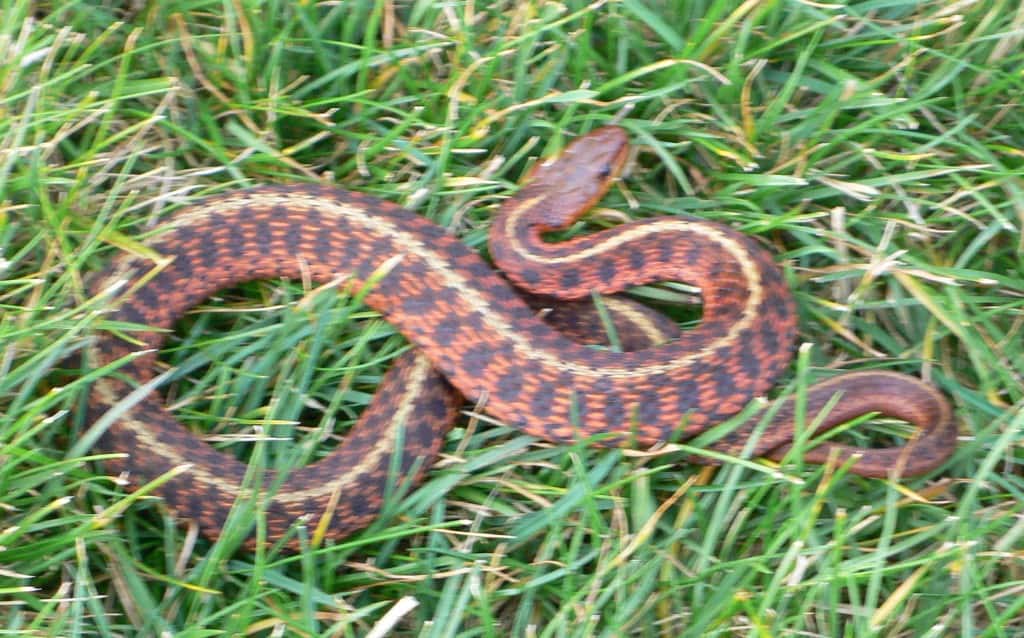
Maritime garter snakes are commonly found under logs and rocks.
© – License
The maritime garter snake lives in North America. Its body is brown, grey, dark green, or reddish in color, with a yellow stripe running down the middle of its back. Another yellow stripe runs along both sides of the snake’s body, along with brown, white, or black dots or checkered patterns. The maritime garter snake grows between 15 and 36 inches in length and lives in a wide variety of habitats. This snake can be found along shorelines, fields, wetlands, farmlands, and even urban areas. The maritime garter snake eats small animals like salamanders, small fish, toads, earthworms, frogs, tadpoles, and small rodents.
8. White Spotted Slug Snake
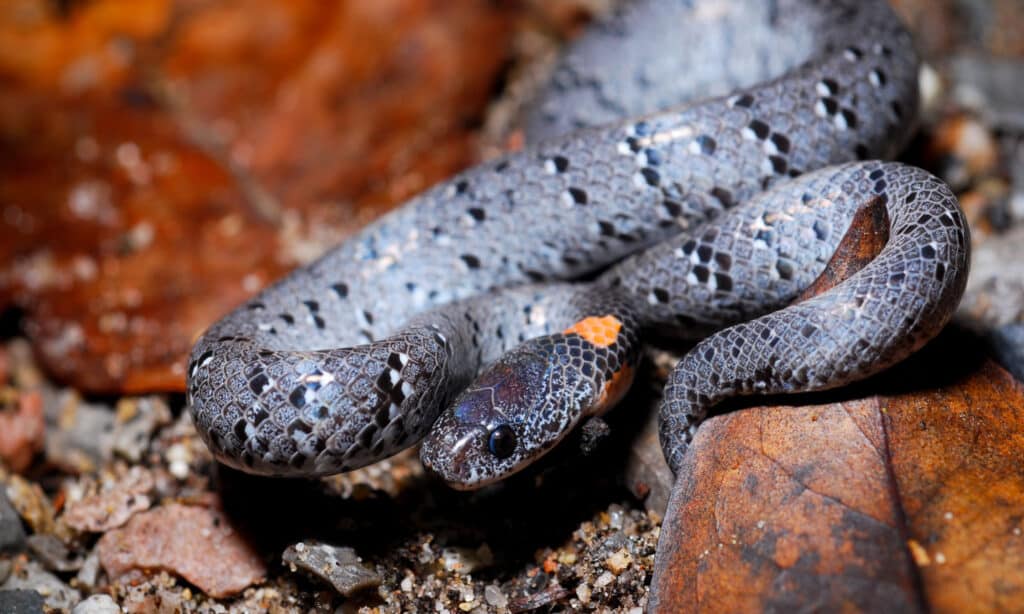
The white spotted slug snake is a common, harmless snake that eats small invertebrates.
©Attapol_R/Shutterstock.com
The white spotted slug snake is a small, harmless snake with a grey or brown body. It has a small orange or yellow band around its neck and black and white polka dots along the rest of its body. White spotted slug snakes are small, only around 18 inches long. As their name suggests, these snakes eat slugs, snails, and earthworms. The white spotted slug snake has uniquely designed fangs that help it remove snails from their shells before eating them. This snake lives on the forest floor in India, Myanmar, Bangladesh, Thailand, Vietnam, Laos, northwest Malaysia, and southern China.
9. Spotted Harlequin Snake
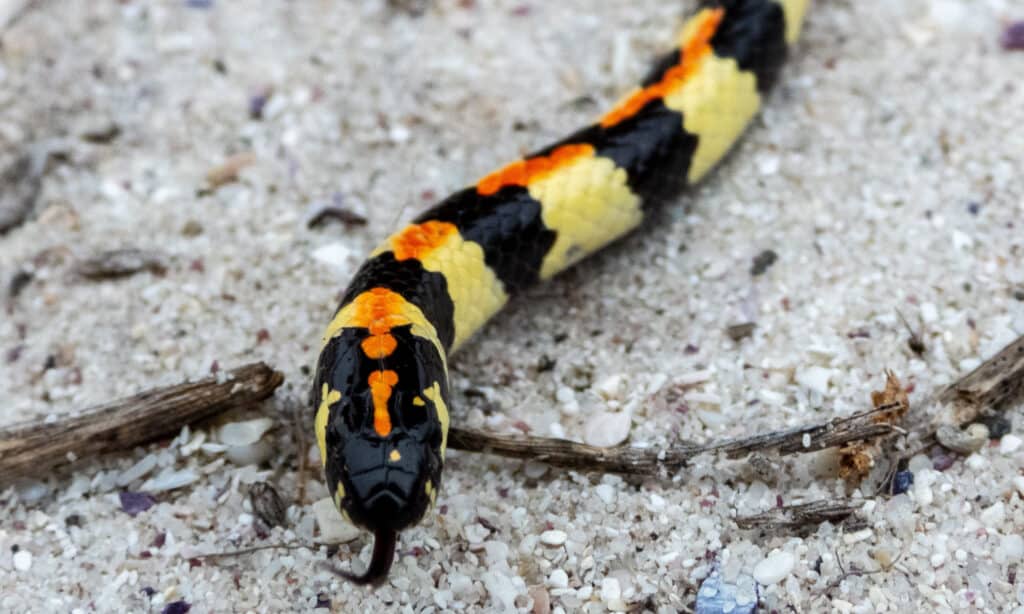
When the spotted harlequin snake feels threatened, it will violently wriggle its body in an attempt to escape.
©Willem Van Zyl/Shutterstock.com
The spotted harlequin snake is very colorful, although its colors and patterns may vary depending on where it lives. Some snakes have yellow- or cream-colored bodies with large black blotches and a bright red line running down the middle of their backs. Other snakes are black with countless cream-colored polka dots and a bright red stripe on their backs, a series of red spots. Spotted harlequin snakes are small, slender snakes and are typically only 11 to 16 inches long. These colorful snakes have mild venom and eat blind snakes, legless skinks, and other small reptiles. Spotted harlequin snakes are endemic to South Africa and spend most of their time underground buried in rocks, debris, or in deserted termite mounds.
19. Dekay’s Brownsnake
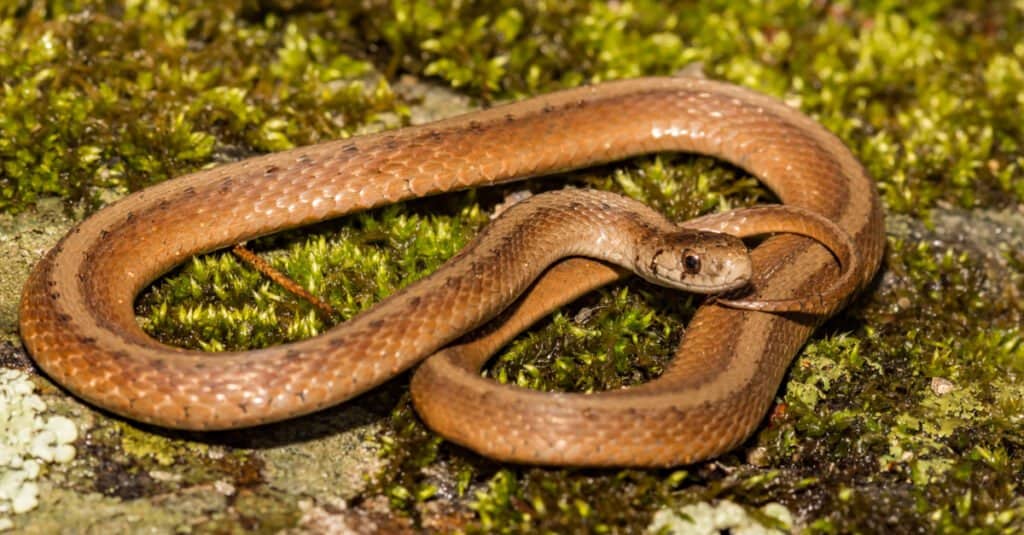
The Dekay’s brown snake has a specialized jaw that helps it to remove snails from their shells before eating them.
©Jay Ondreicka/Shutterstock.com
The Dekay’s brown snake is small and rarely grows longer than 12 inches in length. This snake has a gray or brown body with keeled or ridged scales. There are small black dots bordering both sides of a light-colored stripe that runs down the middle of the snake’s back. Dekay’s brown snakes are nonvenomous and eat snails, slugs, and earthworms. These snakes live in Honduras, Guatemala, Mexico, the eastern half of the United States, and some of the southern regions of Canada.
11. Eastern Glossy Swampsnake
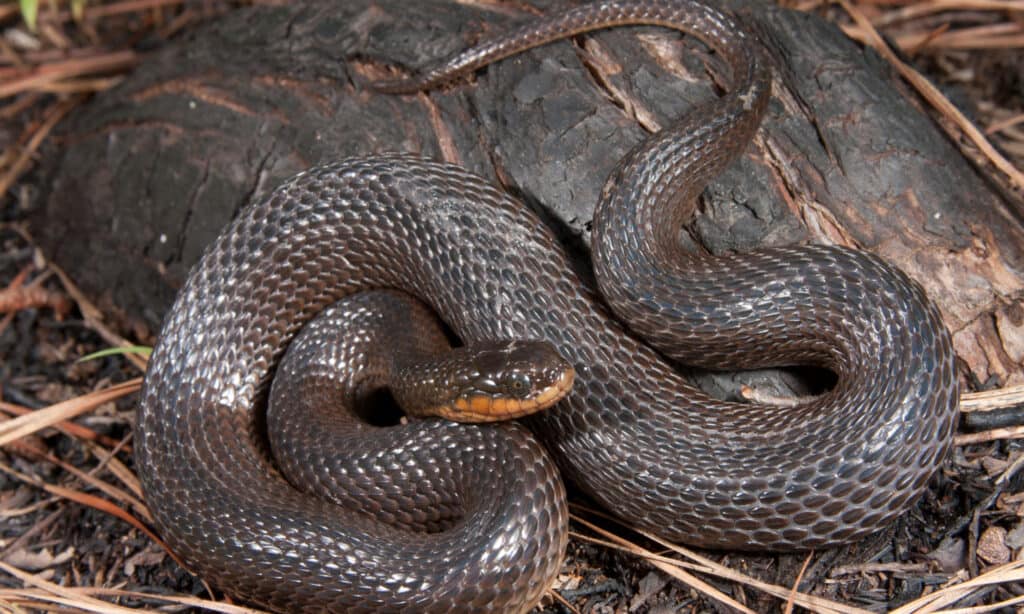
The eastern glossy swampsnake has two rows of black polka dots running down either side of its belly’s midline.
©Nathan A Shepard/Shutterstock.com
The eastern glossy swampsnake is 14 to 24 inches long and has a rather dull appearance at first glance. The snake’s back is brown or olive grey without any distinct patterns or designs. However, the snake’s belly is yellowish or cream-colored, with two distinct rows of black dots running down the middle. Eastern glossy swampsnakes are secretive, nonvenomous snakes that rarely encounter humans. These snakes live in freshwater areas in the southeastern United States. They primarily eat crayfish and are sometimes simply called “crayfish snakes”. On occasion, however, they may also eat small fish and frogs.
12. Black-Necked Garter Snake
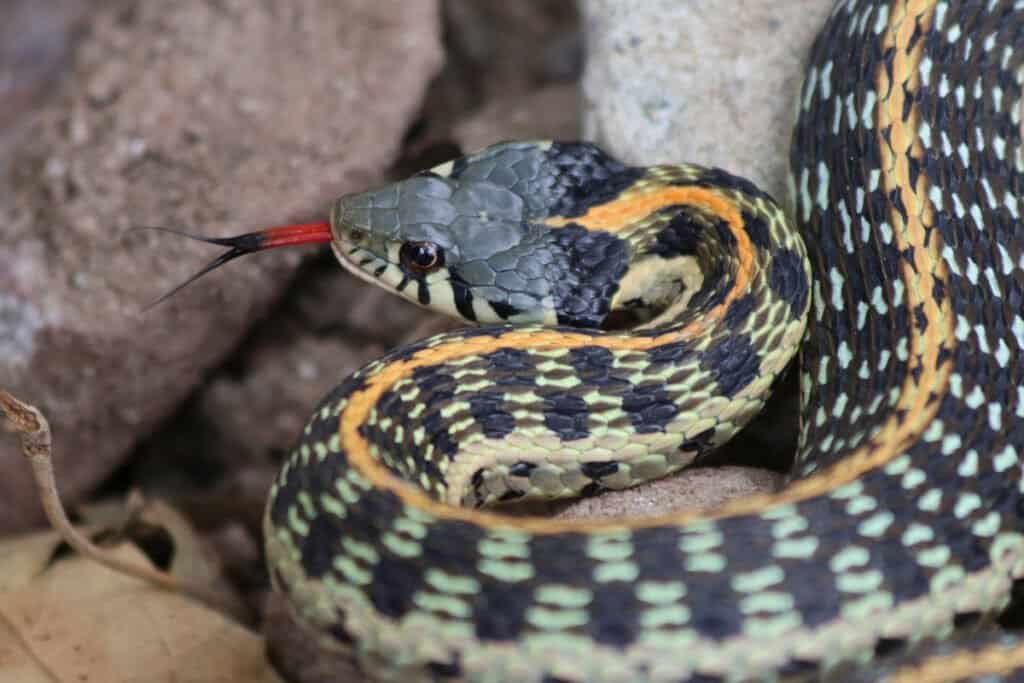
Black-necked garter snakes are active during the day and are commonly found in the late afternoon or mid-morning hours.
©Creeping Things/Shutterstock.com
The black-necked garter snake grows up to 42 inches long, with a slender, olive-grey body and a bright orange or yellow stripe that runs along the middle of the snake’s back. There is another cream-colored stripe on each side of the snake’s body, with additional black dots that run along its length. The black-necked garter snake lives in Guatemala, Mexico, and the southwestern United States. This snake is nonvenomous and harmless to humans. It is often found near water, where it commonly hunts amphibians, small fish, toads, and tadpoles.
13. Dusky Pygmy Rattlesnake
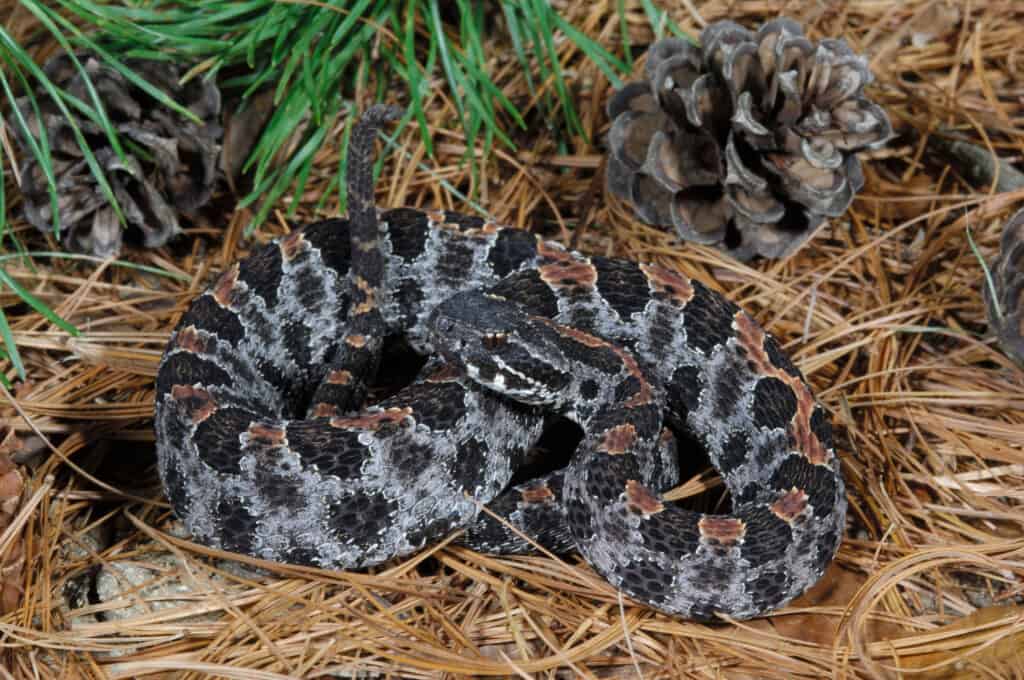
The dusky pigmy rattlesnake is one of three different subspecies of pygmy rattlesnakes.
©Breck P. Kent/Shutterstock.com
The dusky pygmy rattlesnake only grows 12 to 24 inches long, with a rather thick body. This snake is grey with numerous black blotches, spots, and small dots covering its back. It has a broad, triangular-shaped head with a dark line behind each of the snake’s eyes. Some snakes also have a rust-colored or reddish-brown stripe running down the middle of their backs. Dusky pygmy rattlesnakes are venomous pit vipers that live in many regions of the southern United States. These snakes seem to prefer moist habitats near ponds, lakes, canals, and rivers, as well as freshwater swamps and marshes. Pygmy rattlesnakes have very small rattles at the end of their tails that make a soft buzzing sound when they feel threatened.
14. California Red-Sided Garter Snake
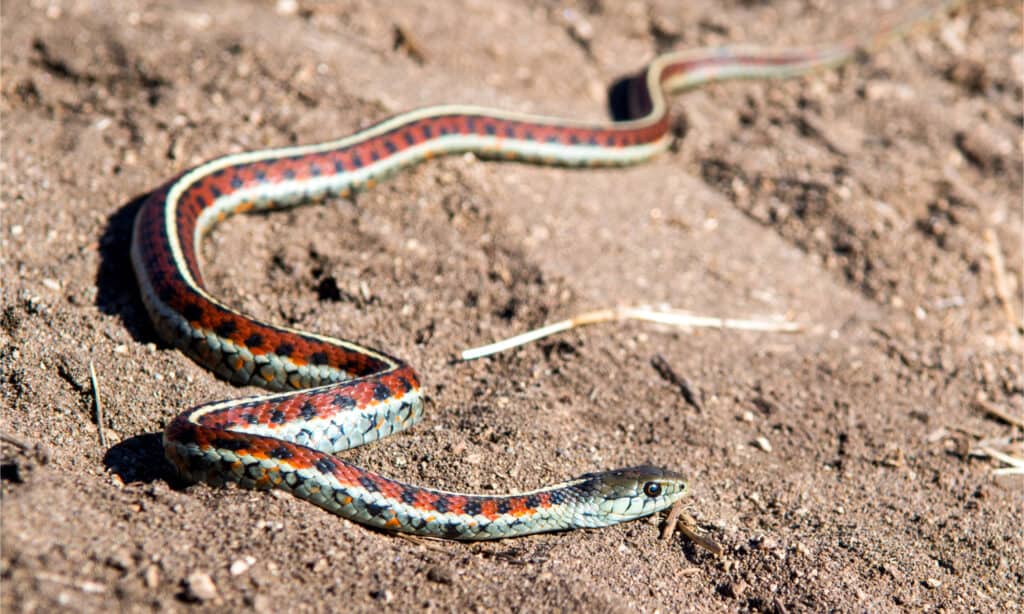
The California red-sided garter snake is not venomous.
©Simone O/Shutterstock.com
The California red-sided garter snake has a long, slender black body with blue or yellow stripes. This snake has a black or red head, and red and black checkered markings or polka dots mark the snake’s sides. California red-sided garter snakes live in California and prefer wet habitats like marshes, ponds, streams, and ditches, and they are excellent swimmers. These snakes are nonvenomous and eat worms, lizards, amphibians, and minnows. They typically grow between 18 to 55 inches long and have larger eyes than many other types of garter snakes.
15. Ringneck Snake
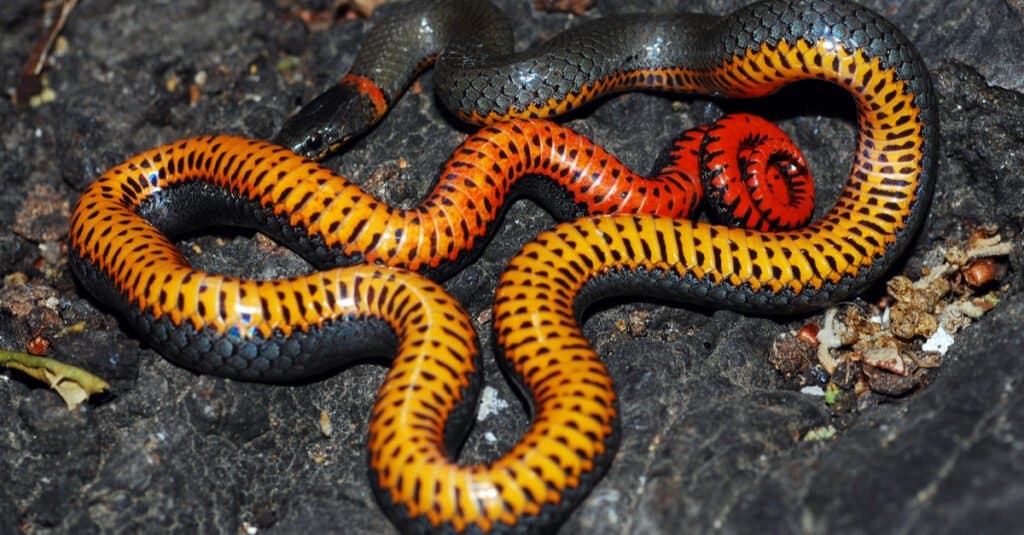
Ringneck snakes will play dead when threatened.
©Jason Mintzer/Shutterstock.com
The ringneck snake is a harmless and secretive snake that lives in the United States, Canada, and Mexico. This snake has a black, blue-grey, or olive-gray back, and a spectacularly bright underside. The snake’s belly is red, yellow, or yellow-orange, detailed with tiny black dots that run along the length of its body. Like its name, this snake also has a matching colored ring-like marking around its neck. When a ringneck snake feels threatened, it curls its body into a large coil and exposes its brightly colored belly. These snakes are small, only growing 10 to 15 inches in length. Their diet depends on what is available in the snakes’ region, but they commonly eat salamanders, frogs, slugs, earthworms, and juvenile snakes and lizards.
16. Spotted Bush Snake
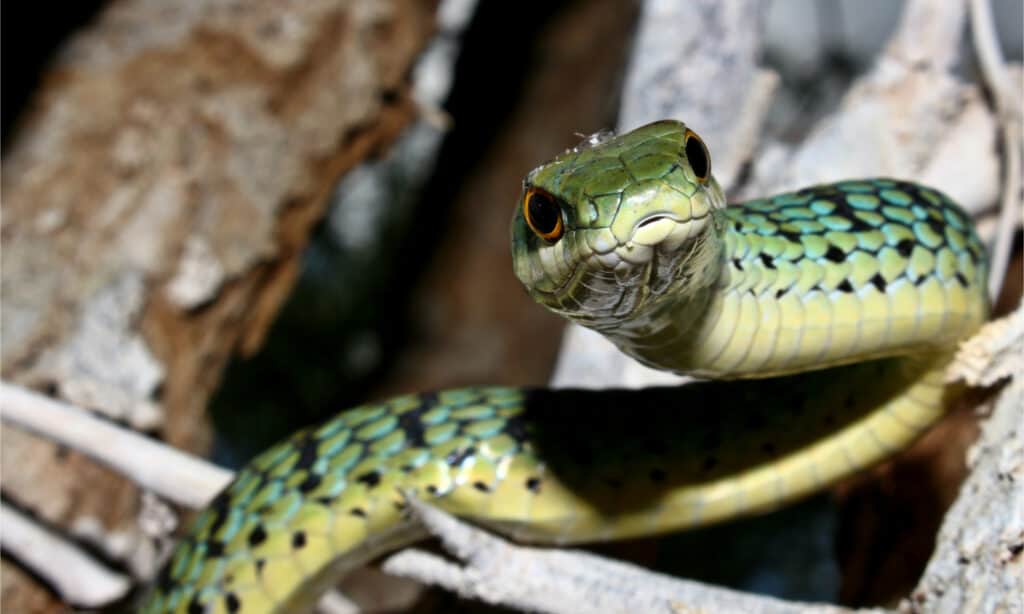
Spotted bush snakes are great swimmers and excellent climbers.
©Tallies/Shutterstock.com
The spotted bush snake has a bright green body plastered with numerous tiny black dots. Sometimes, these dots cluster together to form diagonal lines or small zigzagging bands, in addition to many singular dots sprinkled along the snake’s body. Spotted bush snakes are found in Africa and usually grow around 1.1 to 2.7 feet long. They are most common in trees and use their keeled scales for climbing vertical surfaces as they hunt tree frogs and lizards. At times, people mistake these snakes for the dangerous green mamba and tragically kill them. However, spotted bush snakes are nonvenomous and completely harmless.
17. Speckled Racer
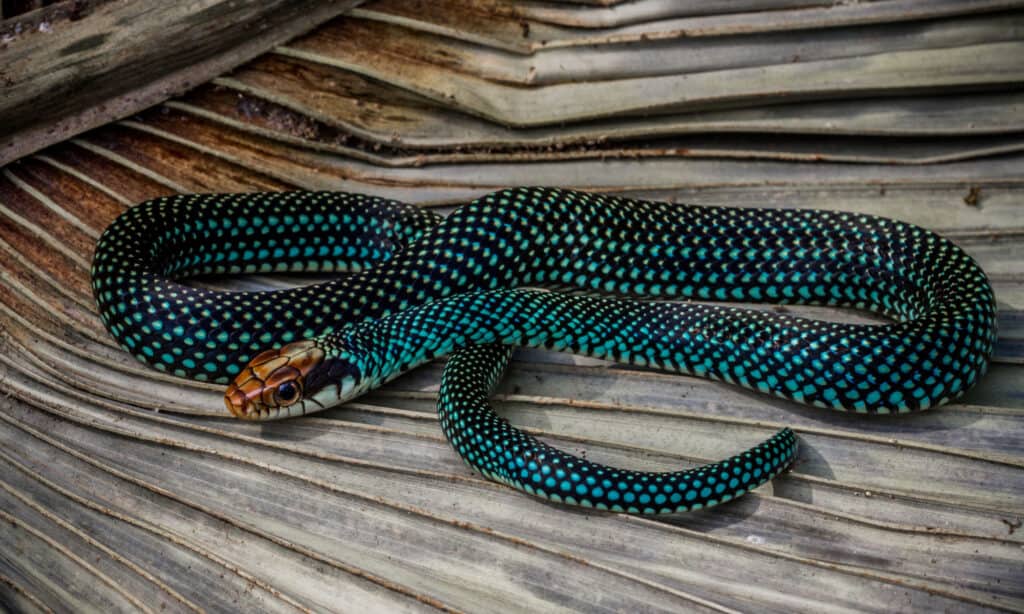
Speckled racer snakes are typically very nervous and will readily bite if they are restrained.
©Jakob Pammer/Shutterstock.com
The speckled racer snake is a glossy black snake with bold and distinct blue and yellow polka dots on each of its scales. These dots give the snake a dark greenish iridescent appearance when it moves. The scientific species name of this snake, Margaritiferus, is Latin and means “pearl-bearing”. This refers to the snake’s many lustrous polka dots. Speckled racers are agile snakes that measure between 30 and 40 inches long, on average. These nonvenomous snakes live in Central America, Texas, and along the Gulf Coast. Speckled racer snakes prefer densely forested areas near water and primarily eat amphibians.
18. Green Tree Python
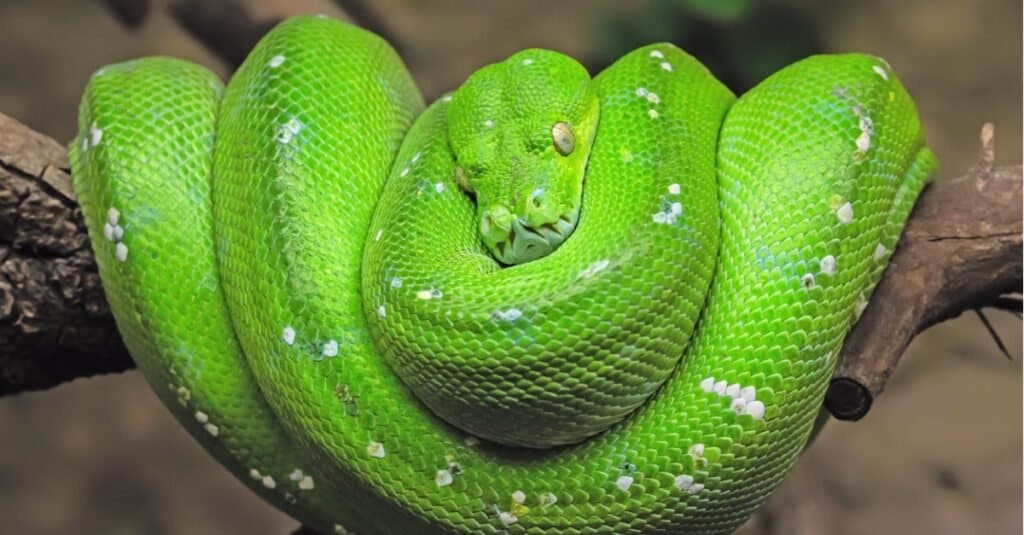
Green tree pythons have more than 100 long, sharp, backward-pointing teeth designed to bite into prey and hang on.
©iStock.com/tane-mahuta
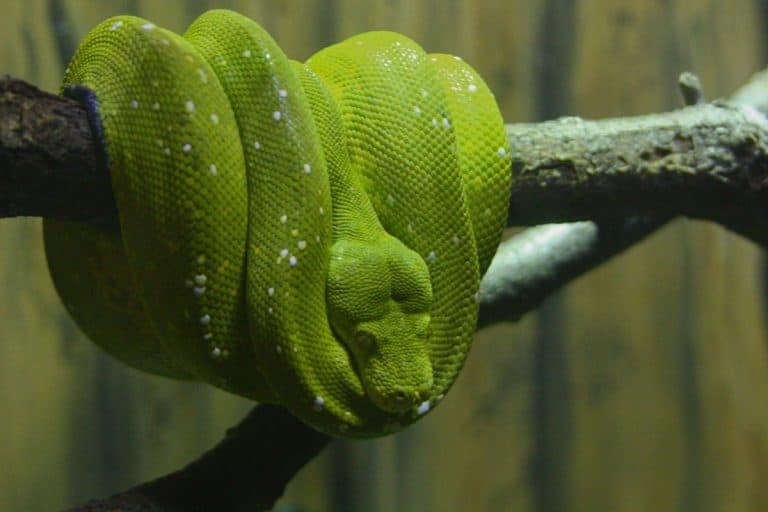
The green tree python is a large snake that is typically five or six feet long. This snake is native to New Guinea and lives on some Indonesian islands and the Cape York Peninsula in Australia. The green tree python has a prehensile tail and spends most of its time in trees. This snake is well known for its iconic resting posture: it loops its tail one or two times over a tree and rests its head in the middle of this coil-like shape. Green tree pythons are bright green with small yellow, blue, or green dots. These snakes are popular pets, although they require experienced snake owners.