

S
Species Profile

Spinone Italiano

Canis lupus familiaris

The bearded all-terrain bird dog
iStock.com/Motionshooter

Spinone Italiano Distribution

Click a location to explore more animals from that region

Origin Location

This map shows the native origin of the Spinone Italiano. As a domesticated species, they are now found worldwide.

Loading map...

Found in 1 country

Size Comparison

Human 5'8"
Spinone Italiano 2 ft 2 in

Spinone Italiano stands at 38% of average human height.

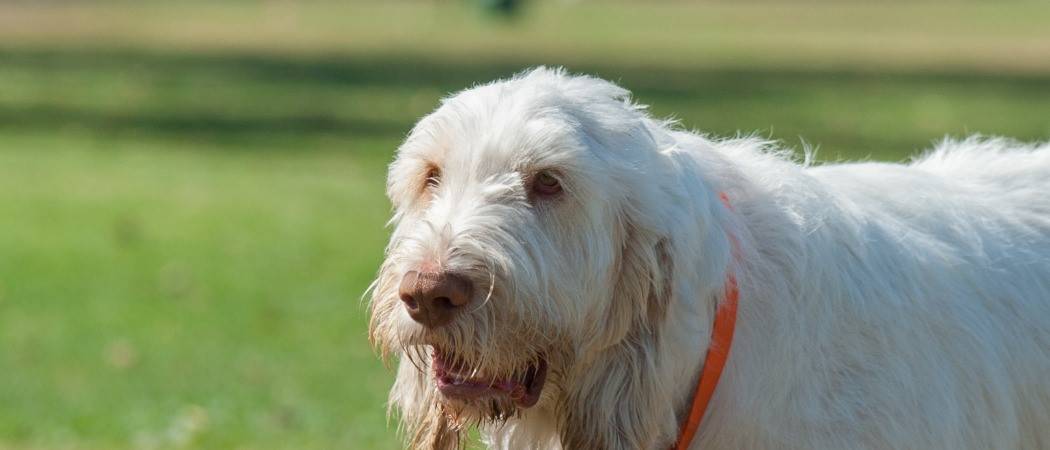
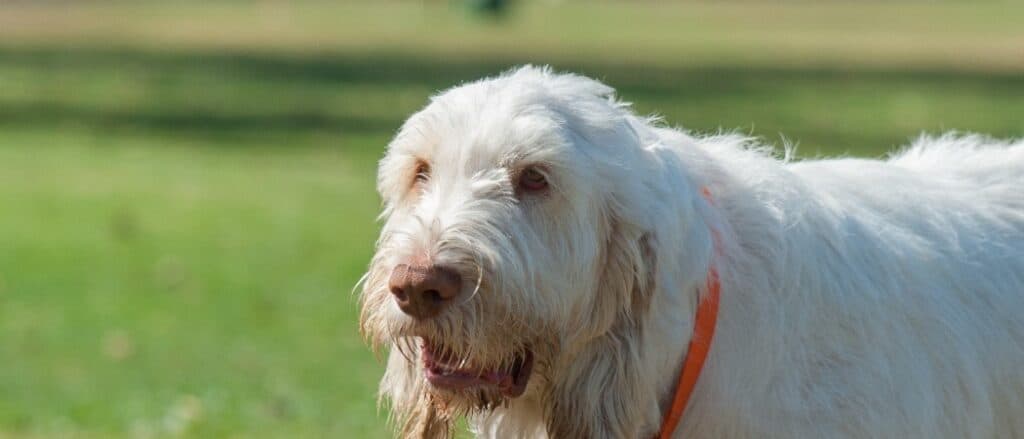
Spinone Italiano close-up

At a Glance

Domesticated
Also Known As Spinone, Italian Spinone
Diet Omnivore
Activity Diurnal+
Lifespan 4 years
Weight 39 lbs
Status Not Evaluated
Did You Know?

Name origin: The breed's name likely derives from a term meaning "thorn" or "thorny scrub," reflecting its work in brambles and dense, rough cover.

Scientific Classification

The Spinone Italiano is a large, rough-coated Italian gundog breed developed primarily for versatile hunting (pointing and retrieving) on land and in water; today it is also kept as a companion dog.

Kingdom
Animalia
Phylum
Chordata
Class
Mammalia
Order
Carnivora
Family
Canidae
Genus
Canis
Species
Canis lupus

Distinguishing Features

  • Large, sturdy build with a harsh/wiry coat
  • Distinctive facial furnishings (heavy eyebrows, beard/mustache)
  • Drop ears; square/rectangular muzzle with a gentle expression
  • Bred as an all-purpose pointing/retrieving gundog; steady, methodical working style

Physical Measurements

Males and females differ in size

Height
♂ 2 ft 2 in (1 ft 12 in – 2 ft 4 in)
♀ 2 ft (1 ft 11 in – 2 ft 2 in)
Length
♂ 3 ft 3 in (2 ft 9 in – 3 ft 9 in)
Weight
♂ 76 lbs (71 lbs – 82 lbs)
♀ 68 lbs (62 lbs – 75 lbs)
Tail Length
♂ 9 in (7 in – 10 in)
♀ 1 ft 2 in (12 in – 1 ft 4 in)
Top Speed
25 mph
running

Appearance

Primary Colors
Secondary Colors
Skin Type Thick, moderately loose skin with a harsh, wiry outer coat; undercoat is minimal or typically absent.
Distinctive Features
  • Domestic dog breed (Canis lupus familiaris) selectively bred from the gray wolf lineage for cooperative gun work.
  • Large, square, rugged build; designed for endurance in rough terrain and cold water retrieving.
  • Harsh, wiry coat with pronounced beard, mustache, and bushy eyebrows; face looks distinctly "bearded."
  • Drop, pendant ears increase risk of trapped moisture and debris after swimming or field work.
  • Broad head and deep chest; strong nose and steady pointing/retrieving drive rather than sprinting speed.
  • Common color look: white with orange/chestnut markings and roaning/ticking, aiding field visibility.
  • Temperament: gentle, people-oriented, patient; thrives on close human partnership and consistent training.
  • Grooming: regular brushing and occasional hand-stripping; keep beard clean to prevent odor/matting.
  • Care: frequent ear checks/cleaning, especially after water work; monitor for burrs in wiry coat.
  • Health concerns seen in the breed: hip/elbow dysplasia, gastric dilatation-volvulus (bloat), otitis externa, and hereditary cerebellar ataxia in some lines.
  • Exercise needs: steady daily activity, scent games, and retrieving; avoid overexertion in heat due to heavy coat.

Sexual Dimorphism

Males are typically taller, heavier, and more heavily boned with broader heads and chests. Females are slightly lighter and more refined in build, while coat texture and markings are generally similar in both sexes.

♂
  • Larger overall size and weight; more pronounced bone and chest depth.
  • Broader head and thicker neck, giving a more powerful silhouette.
  • Often appears more heavily "bearded" due to head size and furnishings.
♀
  • Slightly smaller, lighter frame with a more refined outline.
  • Narrower head and chest compared with males.
  • May show a more agile, less heavy-footed gait.

Did You Know?

Name origin: The breed's name likely derives from a term meaning "thorn" or "thorny scrub," reflecting its work in brambles and dense, rough cover.

Unlike many fast, high-drive pointers, the Spinone is famed for a slower, methodical hunting pace and persistence.

Its signature "furnishings" (brows and beard) help protect face and eyes in dense vegetation.

Bred to be versatile: points game, retrieves on land, and is notably willing in cold water for a rough-coated dog.

Often described as exceptionally tolerant and gentle with families-sometimes called a "calm clown" among gundogs.

The harsh, wiry coat is meant to be functional, not fluffy; correct texture sheds burrs and resists weather.

Italian hunters valued the breed for working close and staying connected to the gun-an early form of "team hunting" style.

Unique Adaptations

  • Harsh, dense, weather-resistant coat: helps insulate and protect skin during all-day work in wet, cold, or thorny terrain.
  • Protective facial furnishings: bushy eyebrows and beard reduce scratches and help deflect debris around eyes and muzzle.
  • Robust build and bone: supports endurance and stability on uneven ground compared with lighter, speed-focused pointing breeds.
  • Strong olfactory focus: selected for scenting and tracking wounded game, complementing classic pointing behavior.
  • Temperament selection for steadiness: bred to remain composed around gunfire and game, aiding controlled pointing and reliable retrieves.

Interesting Behaviors

  • Methodical quartering: works a hunting field in a steady, ground-covering pattern rather than sprinting wide.
  • "Soft mouth" tendency: many individuals naturally carry birds/game gently during retrieves.
  • Face-first investigating: uses beard and brows like a tactile shield when pushing into bramble patches.
  • Close-working partnership: often checks in frequently with the handler, especially when bred for foot hunting.
  • Water confidence: many show a natural willingness to enter cold water and swim for retrieves.
  • Expressive "talking": some Spinoni vocalize with grumbles/sighs during social interaction or anticipation.
  • Leaning/"Velcro" affection: commonly presses against people for contact, reflecting strong social bonding.

Cultural Significance

The Spinone Italiano (Canis lupus familiaris) is an Italian hunting breed used by foot hunters in marshes, fields, and hills. Known for pointing, tracking, and retrieving, it is also an Italian cultural export liked for being gentle and good with families.

Myths & Legends

In Italian hunting circles, old tales describe the Spinone as the "hunter's shadow," a dog that would refuse to abandon its person in foggy marshes-stories told to praise the breed's loyalty and close-working style.

The breed's name is commonly explained as coming from the Italian word for a thorn or thorny undergrowth, reflecting its traditional role as a hunting dog expected to work through brambles and dense cover.

Some traditional sporting stories credit the breed's bearded face with "wisdom" and an almost monk-like patience-an image repeated in hunters' storytelling to contrast it with faster, flashier pointers.

Historical accounts and breed lore often frame the Spinone as an old Italian type preserved by practical hunters: not a courtly show dog, but a resilient worker shaped by land, weather, and necessity.

In Italian breed stories at field trials and club meetings, exceptional retrieving Spinone Italiano dogs are named in tales like famous horses, personal legends that keep working lines and local pride alive.

Conservation Status

NE Not Evaluated

Has not yet been evaluated against the criteria.

Population Stable

Life Cycle

Birth 7 pups
Lifespan 4 years

Lifespan

In the Wild
1–8 years
In Captivity
8–14 years

Reproduction

Mating System Polygyny
Social Structure Managed Domestic
Breeding Pattern Serial
Fertilization Internal Fertilization
Birth Type Internal_fertilization

Behavior & Ecology

Social Pack Group: 4
Activity Diurnal, Crepuscular
Diet Omnivore Meat-forward, high-protein diets (e.g., poultry- or fish-based complete dog food)

Temperament

Breed vs base species context: far less territorial and fearful than wolves; selectively bred for cooperative work with humans.
HUBS (breed-wide pattern): gentle, people-oriented, affectionate; variation from reserved to very sociable with strangers.
Typically patient with children and other pets; may be clumsy due to large, heavy build.
Biddable but can be stubborn/slow-to-mature; responds best to calm, reward-based training.
High hunting drive for birds; reliable retrieving instincts when trained; may roam if under-exercised.
Moderate energy: needs daily aerobic exercise plus scentwork/retrieving to prevent boredom and weight gain.
Sensitive temperament: harsh corrections can cause shutdown or avoidance; consistent routines improve confidence.
Care requirements: rough coat needs regular brushing and hand-stripping/trim; check beard for debris after eating.
Care requirements: frequent ear checks/cleaning due to pendant ears and water work; dry after swims.
Health concerns seen in the breed: hip dysplasia and elbow issues; maintain lean body condition and controlled growth in pups.
Health concerns: ear infections and some eye issues (e.g., entropion/ectropion reported); routine veterinary screening advised.
Not an intense guarder; alerts with barking but usually friendly once introduced.
Generally tolerant in groups, but intact males may show competitive behaviors; early socialization reduces conflict.

Communication

Barking Alert and excitement; usually not constant
Whining/whimpering Attention, frustration, or anticipation
Growling Boundary-setting; often low-intensity
Howl-like vocalizations Occasional, often in response to sirens
Grumbling/moaning Common during relaxation or seeking contact
Close following and leaning Contact-seeking affiliative behavior typical of the breed
Tail wagging with broad body language; slower, heavier gait signals calm intent
Play bows and exaggerated bouncy steps during play invitations
Nose nudges and pawing to solicit interaction or guide handler attention
Scent investigation and ground-tracking; uses nose to communicate interest and arousal state
Facial expressions and ear position changes; pendant ears still shift subtly with mood
Scent marking (urine) and scratching; more common in intact individuals
Carrying objects/soft-mouth holds as self-soothing and social engagement

Habitat

Biomes:
Temperate Forest Mediterranean Temperate Grassland Boreal Forest (Taiga) Tundra Alpine Freshwater Wetland Marine Savanna Tropical Dry Forest Tropical Rainforest Temperate Rainforest Desert Hot Desert Cold +9
Terrain:
Plains Hilly Valley Riverine Coastal Muddy Rocky +1
Elevation: Up to 18044 ft 8 in

Ecological Role

Domesticated canid functioning as a human-associated omnivore; historically a hunting assistant that locates and retrieves game on land and in water rather than acting as an apex predator like wild wolves.

Supports regulated hunting by finding/retrieving downed game (reduces wounding loss) Human companionship and working partnership Scent-based detection and field work (locating game), aiding wildlife management activities In feral/unsupervised contexts, may exert predation pressure on small wildlife-mitigated by responsible ownership

Diet Details

Other Foods:
Cooked grains and starches Vegetables Fruits Wild plant matter

Human Interaction

Domestication Status

Domesticated

Spinone Italiano (Canis lupus familiaris) is a large, rough-coated Italian gundog bred over centuries for steady pointing and strong retrieving on land and in cold water. They are calm, people-oriented companions and hunting partners. They need regular exercise, gentle training, ear and coat care, and monitoring for hip, elbow, bloat, eye, and rare nerve problems.

Danger Level

Low
  • Bite/injury risk typical of any large dog, especially if poorly socialized, in pain, or startled; generally less prone to human-directed aggression than many breeds
  • Accidental knocking over of children/elderly due to size and enthusiasm
  • Zoonotic and allergen considerations common to dogs (e.g., parasites without preventive care, saliva/dander allergies)
  • Hunting context risks: accidental injury during field work (sharp vegetation, firearms safety handled by humans) and increased tick exposure for both dog and handler

As a Pet

Suitable as Pet

Legality: Generally legal where domestic dogs are permitted; subject to local ordinances (licensing/registration, vaccination requirements, leash laws, kennel limits, and nuisance/behavior rules). Breed-specific bans are uncommon for Spinone Italiano, but housing/insurance policies may impose restrictions.

Care Level: Moderate

Purchase Cost: $1,200 - $2,500
Lifetime Cost: $20,000 - $45,000

Economic Value

Uses:
Companion animal (family pet) Sporting/hunting dog (pointing & retrieving; upland and waterfowl support) Breeding/show market (purebred registration, conformation, stud services) Working/service roles (occasionally therapy, detection/scentwork sports, SAR participation) Pet services economy (training, grooming, boarding, veterinary care, equipment)
Products:
  • Puppies (registered purebred litters)
  • Stud services and breeding rights
  • Hunting companionship/performance value
  • Training services (obedience, field, recall, gun conditioning)
  • Grooming services (hand-stripping/coat maintenance)
  • Veterinary services (preventive care, orthopedic screening, GI/ear treatments)

Relationships

Ecological Equivalents 5

Animals that fill a similar ecological role in their ecosystem

Gray wolf
Gray wolf Canis lupus Compared to wild wolves, the Spinone Italiano (Canis lupus familiaris) is a domesticated hunting breed bred to work with people: it is steadier and more obedient, less wary, and more task-focused (pointing/retrieving). It requires grooming, exercise, and veterinary care for inherited health issues.
Wirehaired Pointing Griffon
Wirehaired Pointing Griffon Canis lupus familiaris Very similar working niche: a rough-coated, all-terrain pointing and retrieving gundog. Highlights the Spinone distinction: the Spinone is generally heavier-boned, more deliberately paced, and often described as softer and steadier in temperament. Both breeds require regular coat maintenance and high daily activity.
German Wirehaired Pointer
German Wirehaired Pointer Canis lupus familiaris Both occupy a comparable, versatile gundog role on land and water. The Spinone tends to be less sharp/high-drive and more easygoing; both breeds benefit from consistent training, ample exercise, and routine ear and skin checks after field work.
Labrador Retriever
Labrador Retriever Canis lupus familiaris Overlapping retrieving and waterwork niche. The Spinone is distinguished by a harsh, protective wire coat and a stronger tendency to point, while many Labradors are primarily retrievers. Spinone care is more grooming-intensive, requiring hand-stripping or thorough brushing of the harsh coat and removal of debris from facial furnishings.
Otterhound
Otterhound Canis lupus familiaris Shares large size, a rough coat, and strong scenting ability and water aptitude. The Spinone is typically a pointing/retrieving hunter rather than a dedicated scenthound; both breeds can be prone to ear issues due to pendulous ears and frequent exposure to wet environments.

With their bushy eyebrows, exaggerated beards, and soulful eyes, Spinoni Italiani have the appearance of a serious old man — and they’re indeed serious workers that are also some of the most competent and versatile hunting dogs on earth. In fact, they’re one of the oldest hunting dog breeds in existence. Their origin is unknown, but there is evidence of their existence already in the 1400s.

They’re capable of functioning as pointers, retrievers, and hunters as the situation warrants. They’re also a playful breed with a serious goofy side and a huge sense of affection for their caregivers.

Their gregarious personalities and easy-going natures make the Spinoni Italiani a great choice for families, but they also need a lot of love and attention — as well as a decent amount of physical exercise — to thrive in a household.

The Spinone Italiano breed has been called many names over the years, but the current designation is derived from Bracco Spinoso, an earlier name. It means “prickly pointer,” referencing their rough coats, which protect them from thorny shrubs.

3 Pros and Cons of Ownership

Let these facts help you decide if this breed is the right fit for your home.

Pros!Cons!
Athletic and playful, the Spinone Italiano is the perfect companion for active families and individuals. A Spinone Italiano becomes anxious when left alone for long periods and destructive when it doesn’t have a purpose to pursue.
The dog’s easygoing personality makes it a great choice for families of any size, and it gets along well with other dogs as well.This dog can be easily distracted, and its vigorous nature means that chasing it can be exhausting.
Intelligent working dogs, the breed is capable of working as pointers, hunters, and retrievers. This dog is prone to slobbering, a trait that is exacerbated in the presence of water or food.
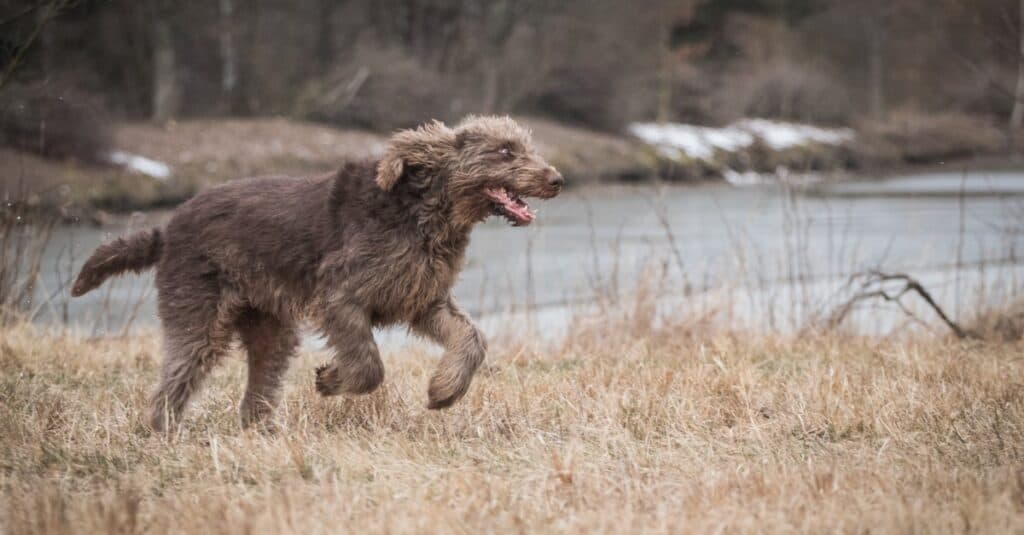
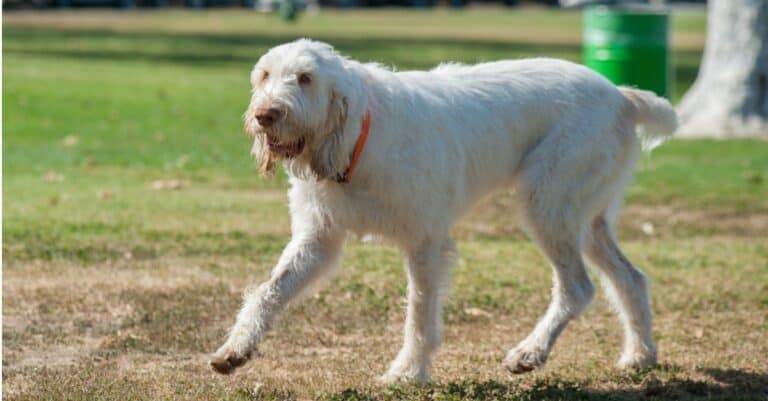
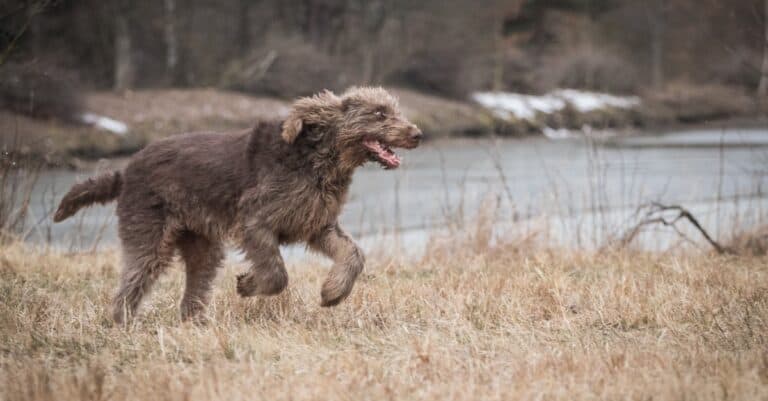
Running and playing Spinone Italiano dog.

The Spinone Italiano dog is athletic and capable of working as a pointer, hunter, or retriever.

Size and Weight

Muscular and stocky, the Spinone Italiano has been bred to run down its prey until the prey is tired rather than overcome it with raw acceleration. Females are roughly two feet long, on average, and can weigh up to 75 pounds. Males tend to have a few extra pounds and an extra inch or two on their female counterparts.

Height (Male) 23 – 27 inches
Height (Female) 22 – 25 inches
Weight (Male) 70 – 81 lbs
Weight (Female) 64 – 75 lbs

Common Health Issues

Spinoni Italiani are among the healthiest hunting dogs around, but that doesn’t mean that they’re immune to health issues. Hip or elbow dysplasia — an issue where the bone grows abnormally — is a relatively common physical issue, but not necessarily a serious one. This breed is also known for hypothyroidism and an eye condition known as entropion. Most recurring health issues in a Spinone Italiano are treatable and not life-threatening.

Temperament
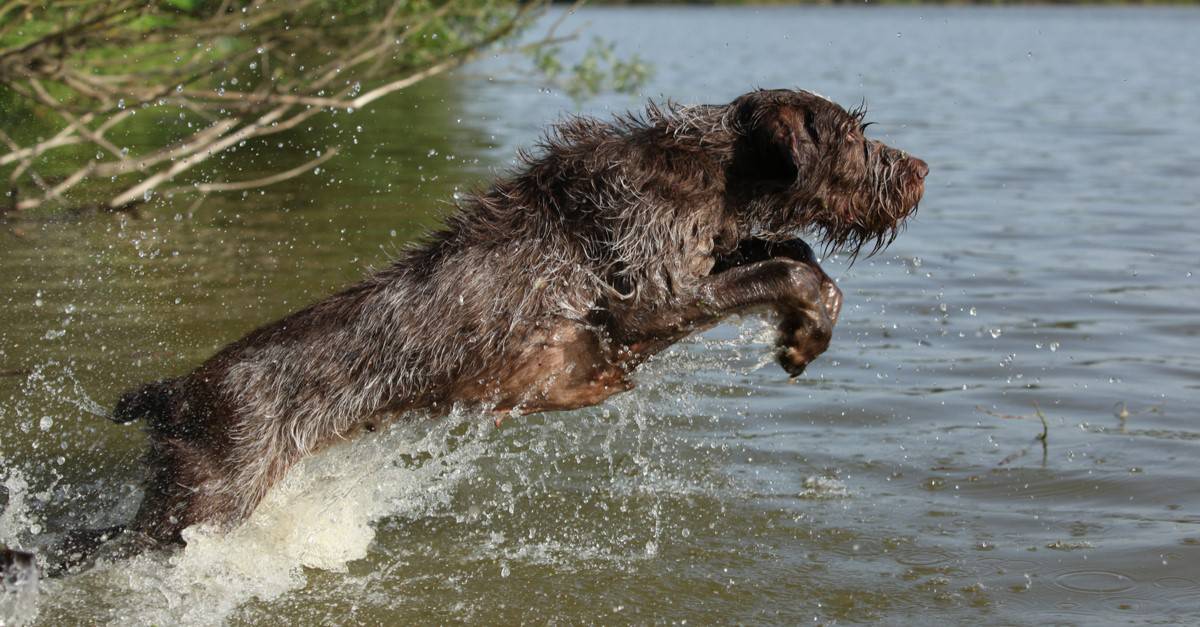
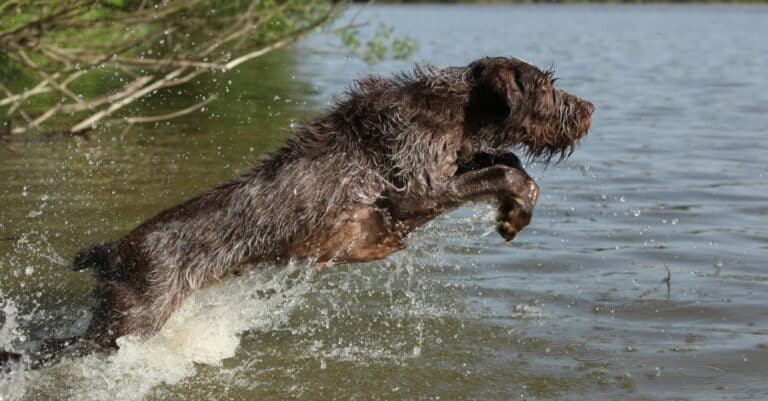
Spinone Italiano jumping into a river.

The Spinone Italiano combines a muscular and well-formed body with a sharp mind and a strong prey instinct.

Just as the Italians have a passion for life, so does the Spinone Italiano. This dog combines a muscular and well-formed body with a very sharp mind, and it really excels when given a purpose to channel those energies. But while a Spinone Italiano needs a decent amount of physical exertion, it is gentle, good-natured, and a bit goofy. The Spinone Italiano rarely meets anyone it doesn’t instantly consider a friend, and that extends to dogs as well as people. Just take care that it is properly socialized before introducing it to cats. This is a hunting dog through and through, and it possesses a relatively strong prey instinct. The Spinone Italiano isn’t especially known for barking, so excessive barking can be a sign of stress or boredom.

Care

Spinoni Italiani dogs and puppies are rather unique in terms of their looks and their personalities, and that means that there are some considerations to keep in mind when caring for one. From grooming its coarse coat to keeping its bright mind occupied, here’s everything a new pet parent needs to know about raising a Spinone Italiano.

Best Dog Food

There is nothing in particular about the Spinone Italiano that requires you to create a specialized dietary regimen. But some factors can affect its appetite. Be sure that the dog has a diet suitable for its age and that it’s eating and drinking fresh water at regular intervals.

Spinoni Italiani can be picky eaters, and they’re also somewhat prone to letting their stress affect their dietary habits. Being left alone or being in a stressful environment can lead to over-or under-eating. Providing a quiet place to eat will ensure that they don’t deal with discomfort or bloating.

Maintenance And Grooming
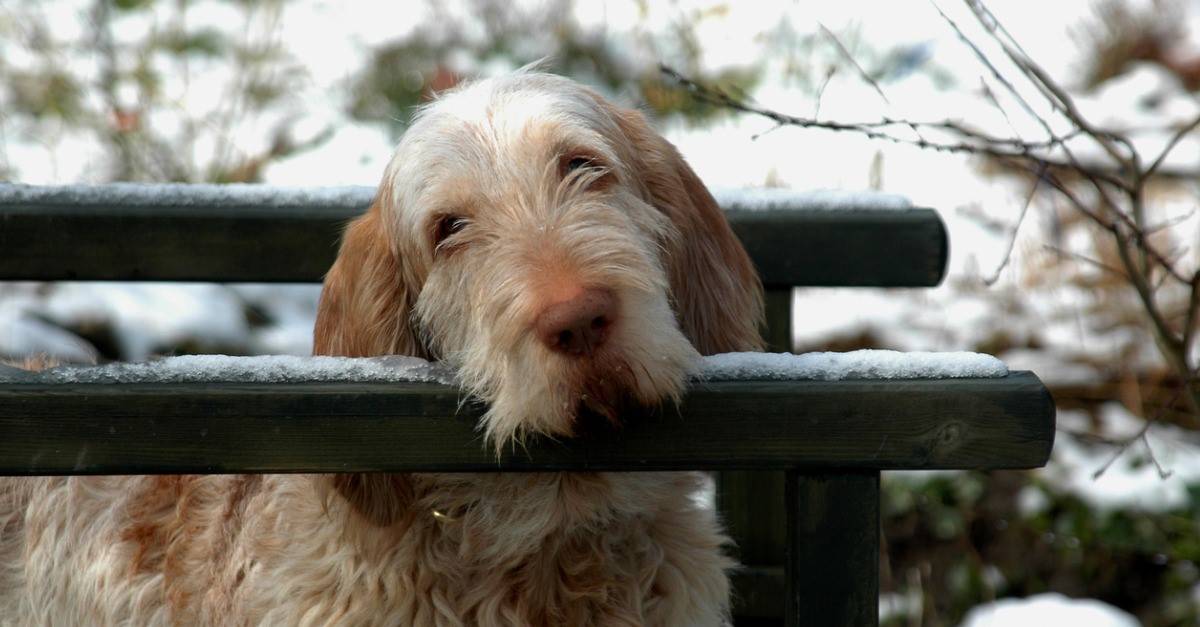
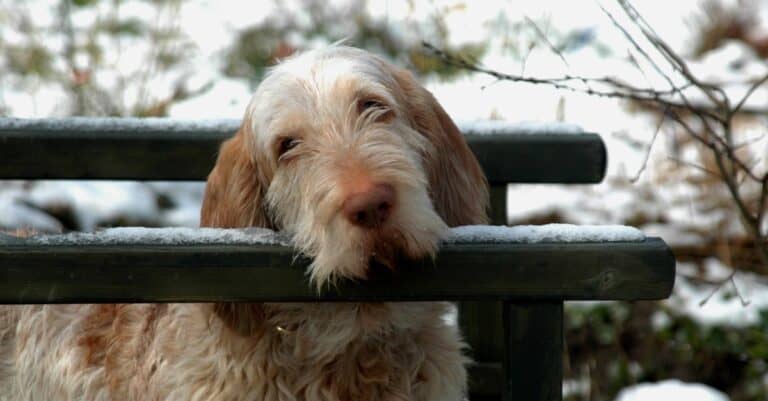
White-orange Spinone Italian dog rests its head on a handrail in a winterly park.

This white-orange Spinone Italiano dog, like others of its breed, has a thick and bristly coat that will need to be brushed and stripped.

The thick and bristly coat of the Spinone Italiano requires significantly less care than you might imagine. You’ll need to use a combination of brushing and stripping to ensure that the dead hair is stripped away and the coat is left healthy and comfortable. This can be handled by a salon, but it’s also easy for a pet parent to learn. Remember that the coat serves to protect this breed from the elements, so there’s no need to preen too much. They should rarely need to be bathed, but you should have their nails trimmed, teeth brushed, and ears cleaned regularly.

Training

The Spinone Italiano was bred to be one of the few all-around hunting dogs, and it is smart enough to know what that’s worth. Housetraining and the basics of obedience will usually be easy, but you can expect the dog to try to negotiate or withdraw its interest once training becomes too rigorous.

With the right training, this dog can excel as a sporting or agility dog, but it requires walking a careful line between holding it accountable and pushing it too hard. For the most part, expect a dog that will capably fulfill your commands but occasionally push back depending on its mood.

Exercise

A Spinone Italiano doesn’t require the amount of physical exertion that a Jack Russell Terrier, German Shepherd, or Golden Retriever demands, but that doesn’t mean that it can just laze around. This breed needs up to an hour a day of activity to stay healthy and happy, and it is the type of dog that can really benefit from having access to a full yard. Just keep in mind that a big yard isn’t a replacement for social activity.

A Spinone Italiano craves human affection, and play is as much about exercising as it is wearing out the dog. Being as friendly as they are, this breed can really enjoy visits to the dog park as well. These easy-going dogs often like to lounge around, but don’t let that dissuade you from keeping them to their regular exercise routines. These dogs are prone to overeating when bored and gaining weight steadily when not kept on an active exercise regimen.

Puppies
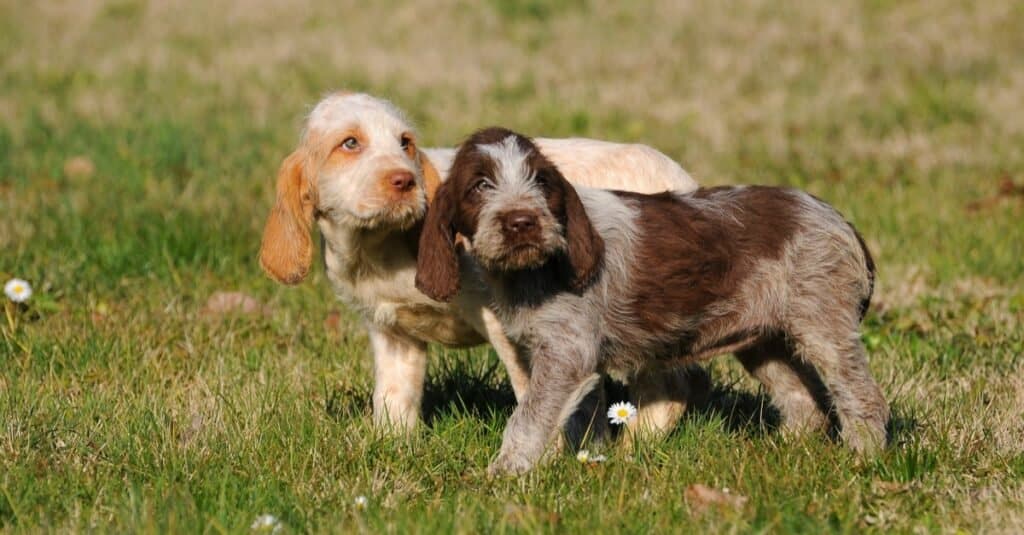
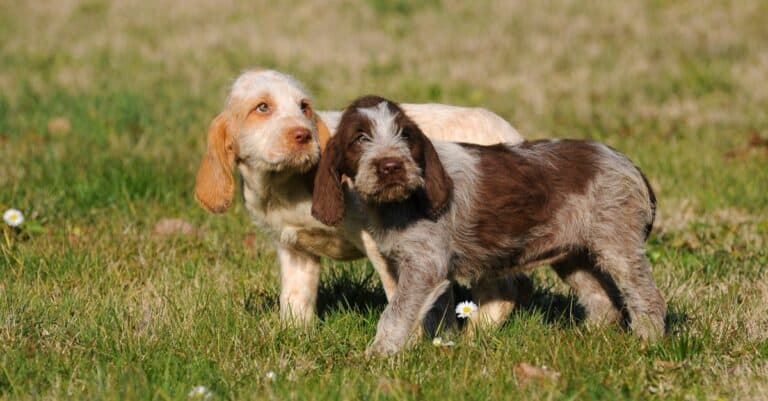
Two beautiful Spinone Italiano puppies playing in the grass.

Two beautiful Spinone Italiano puppies of two different color types, and both eager for activity.

The normal facts for raising a puppy apply to Spinone Italiano puppies, and you shouldn’t have to make any changes to accommodate their unique personalities. As active dogs, you can expect them to be doubly active puppies. Fortunately, they acclimate well to people and other dogs naturally, but you may want to socialize them to better interact with cats and smaller dogs. While these puppies are smart enough to distinguish between hunting and playtime, they do have an innate inclination to chase after smaller pets. Properly socializing your Spinone Italiano puppy can help reduce the risk of it developing social anxiety or overeating problems as it grows older.

Children

The gregarious disposition Spinoni Italiani extend to adults and other dogs is extended to children as well. Thanks to the fact that they enjoy playing and snuggling in equal measure, they can adapt well to the mood of a child, and their easy-going nature and sturdy build mean that they’re pretty mellow about the antics of children. Kids six years or older and trained in the responsible handling of pets get along dazzlingly with Spinoni Italiani.

This is a rare breed, so you’re not likely to find a rescue dedicated to Spinoni Italiani. Fortunately, they aren’t so rare that they can’t be found at shelters or more general-purpose rescues. With a little diligence, puppies can be found without going to breeders directly. If you do decide to work with breeders, be sure to seek out conscientious ones who can provide you with the paperwork and medical assurances you need before paying for them.

Similar Dogs

The Spinone Italiano is a truly unique breed and extends from one of the oldest lineages around. Despite that, these dogs have some similarities with other breeds, notably the English Setter, Australian Shepherd, and the Bernese Mountain Dog.

  • The English Setter is another playful and gentle hunting dog with a lot of personality, albeit not one quite as versatile at hunting as its Italian counterpart. Despite having a slightly shorter lifespan, their temperament and purpose are quite similar.
  • The Australian Shepherd is significantly more active than the Spinone Italiano, but they still have quite a bit in common. They’re active but sociable dogs that really shine in a house where they get lots of attention.
  • The Bernese Mountain Dog shares both its work ethic and its easy-going nature with the Spinone Italiano — traits that make them perfect breeds for family pets. Unfortunately, they also share a tendency to drool.
View all 391 animals that start with S

Sources

  1. United Kennel Club / Accessed October 2, 2021
  2. Petful / Accessed October 2, 2021
  3. Dogtime / Accessed October 2, 2021
  4. American Kennel Club / Accessed October 2, 2021
  5. Animals Network / Accessed October 2, 2021
  6. Your Pure Bred Puppy / Accessed October 2, 2021
Thank you for reading! Have some feedback for us?


Spinone Italiano FAQs (Frequently Asked Questions)

Spinone Italianos don’t need a lot of grooming, but they are apt to shedding throughout the entire year. Fur should be stripped and brushed daily during the heavy shedding season and weekly otherwise.