







Quick Take
- The zebu's hump serves a purpose most people would never guess, one that is not what you'd expect from a cattle breed. Discover the hump's purpose →
- Zebu cattle actually predate every other domesticated cattle breed on Earth, and the timeline of how they spread across continents is truly remarkable. Trace the zebu's ancient origins →
- There's a counterintuitive reason why zebu became the dominant breed across entire tropical regions of the world, rather than standard cattle. See tropical climate adaptations →
- The largest and smallest zebu breeds differ by a jaw-dropping margin, a gap made even more remarkable by the fact that one of the extremes exists entirely by nature, not human design. Explore the size extremes →
Because it is considered to be a sacred animal in Hinduism, the zebu is not a significant source of meat, and although it can provide plenty of milk, the zebu is not the most efficient dairy animal either. Approximately 75 breeds of zebu are currently recognized, many of them created from crosses with the other subspecies of domesticated cattle, the taurine. This unique union has produced many new breeds that suit a variety of climates and circumstances.

5 Incredible Zebu Facts
- The zebu evolved from a wild species of cattle called the aurochs. It is estimated that they were first domesticated around 6,000 to 8,000 years ago in the area of present-day Pakistan.
- Popular breeds include the gyr (or gir), the kankrej, the Nguni, and the American Brahman.
- The zebu was first introduced into the Americas in the 19th century.
- The zebu also sometimes goes by the name of humped cattle or indicine cattle.
- The zebu has inspired human art and culture for many thousands of years. It has appeared on coinage, architecture, and statues.
Origin
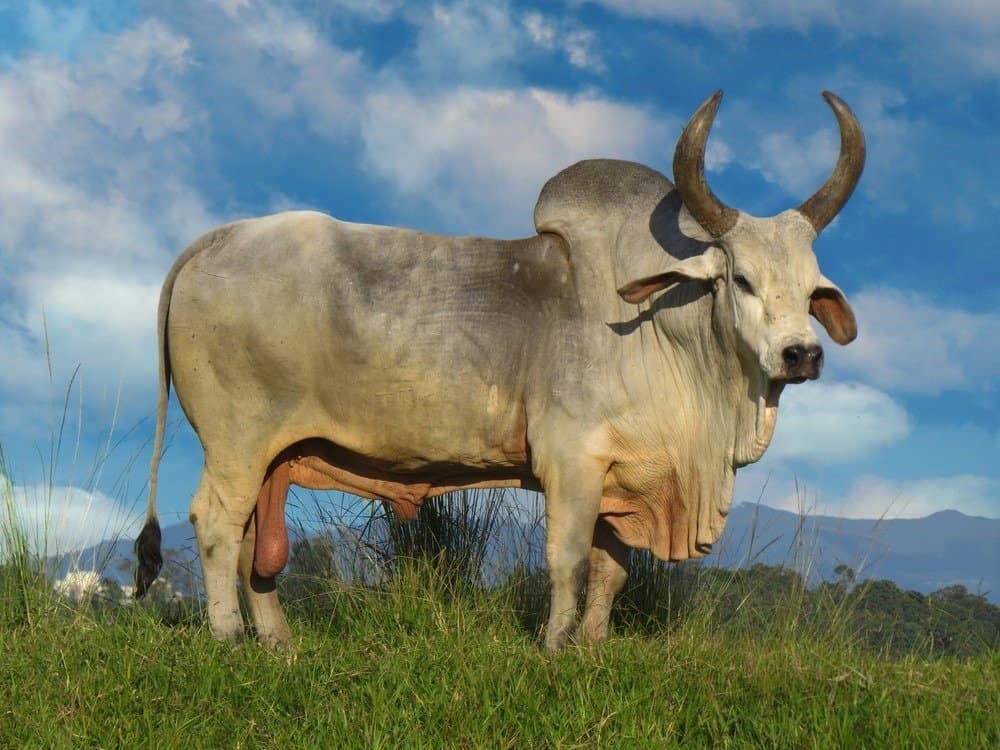
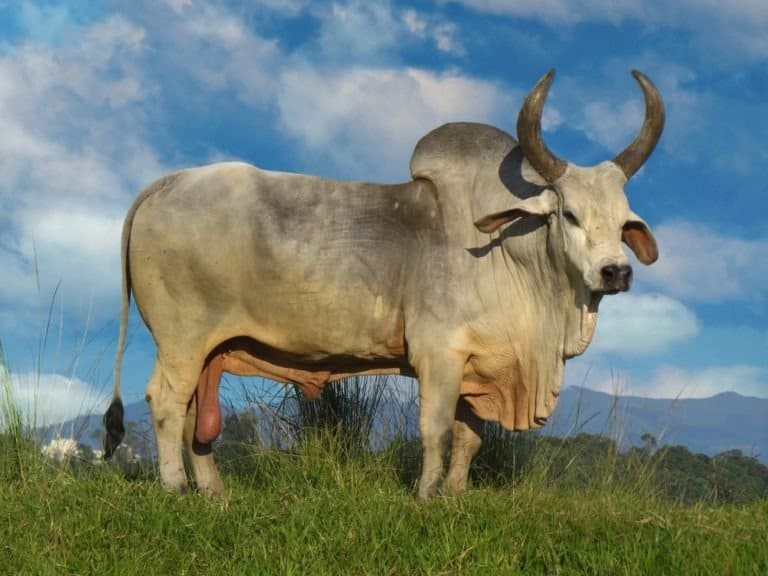
Zebu cattle have a long history. The Ox Guzera was the first breed of Zebu cattle to arrive in Brazil.
©Leonidas Santana/Shutterstock.com
the history of Zebu cattle goes back thousands — or even millions — of years. People bred them from the wild Asian or Indian aurochs, considered the ancestors of modern cattle. Fossil evidence indicates that the aurochs evolved from Bos acutifrons, which existed two million years ago in India.
The Zebu, or indicine cattle, was domesticated in the Indian subcontinent between 7000 and 6000 BCE. They were dispersed throughout northwestern South Asia by 4000 BCE, and by around 3300–2000 BCE they had reached Egypt and then spread across Africa. Taurine cattle were actually the first type of domesticated cattle to arise, domesticated from wild aurochs around 10,500 years ago in Anatolia and the Levant. A separate, independent domestication event later occurred in South Asia and gave rise to the other main lineage of domesticated cattle, the zebu.
The Zebu breed has been crossbred with numerous other taurine cattle, including the Charolais (which, when crossed specifically with the Brahman — a zebu-derived breed — resulted in the Charbray) and the Angus (which produced the Brangus). When it reached the shores of South America, breeders created the now popular Indo-Brazilian zebu. The rate of breeding is only limited by the human capacity to create them.
Classification and Scientific Name
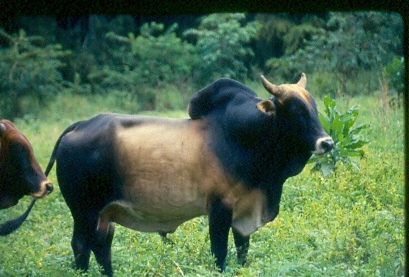
The scientific name for Zebu is Bos taurus, meaning ox or cattle, but it covers every type of domesticated cattle.
©L. Mahin / Creative Commons – Original
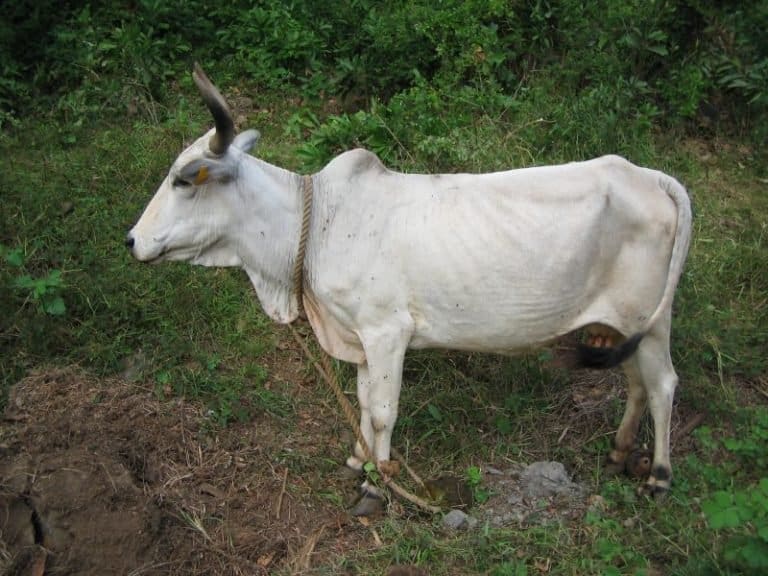
The scientific name of the zebu is Bos taurus or Bos taurus indicus. Bos is the name of the genus (which includes both wild and domesticated cattle) and simply derives from the Latin word for ox or cattle. The species name taurus (which actually just means bull in Latin) includes every type of domesticated cattle on the planet. Traditionally, this name has also referred to the bull-like astrological sign and the Greek mythological figure. Indicus, the Latin term for India, refers only to the subspecies of zebu. The animal is considered to be different enough from the other cattle subspecies (which is called Bos taurus taurus) to warrant a separate subspecies designation.
Like all domesticated cattle, the zebu is closely related to the bison, buffalo, sheep, goats, and antelopes in the family Bovidae. All members of this family belong to the order Artiodactyla, or the even-toed ungulates. The one physical characteristic that unites all members of this order is the presence of hooves on the feet that can bear weight equally on two toes; hence the name. Many (but not all) ungulates are ruminants that digest plants by fermenting them in the multi-chambered stomach.
There are 75 major breeds of Zebu, generally split between India and Africa. Among the best-known breeds, besides those mentioned elsewhere in this article, are the Guzerat, Sahiwal, Acchai, Cholistan, Dhanni, White Nukra, Lohanni, Red Sindhi, Umblachery, Vechur, Deoni, Ponwar, Malvi, and Nelore. Evidence of the widespread breeding of Zebu is indicated in some of the names, like Abyssinian Highland and H’Mong.
Appearance
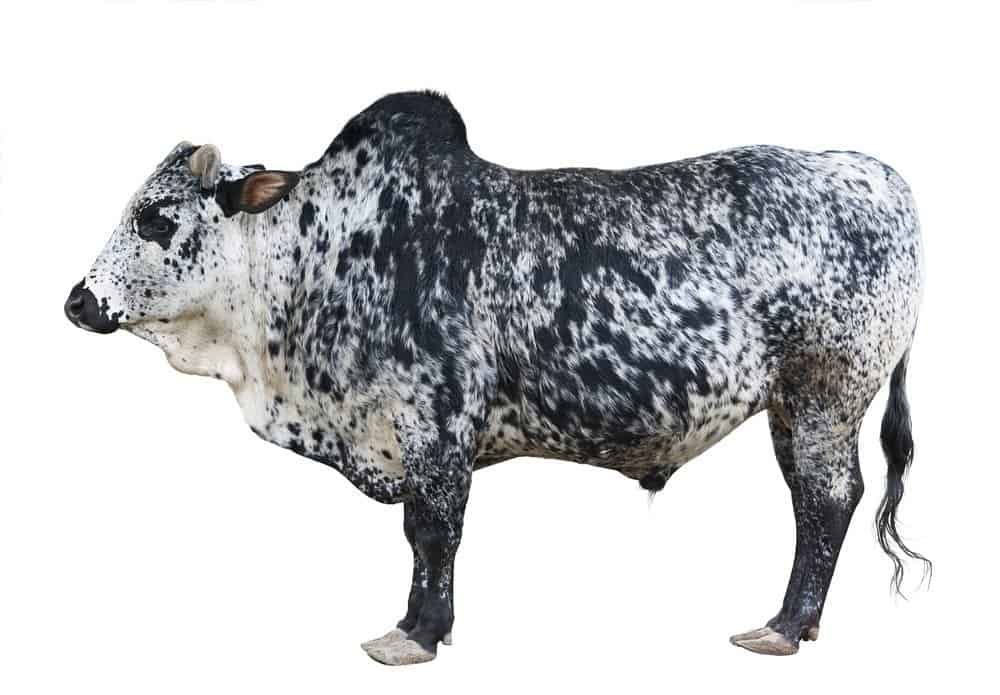
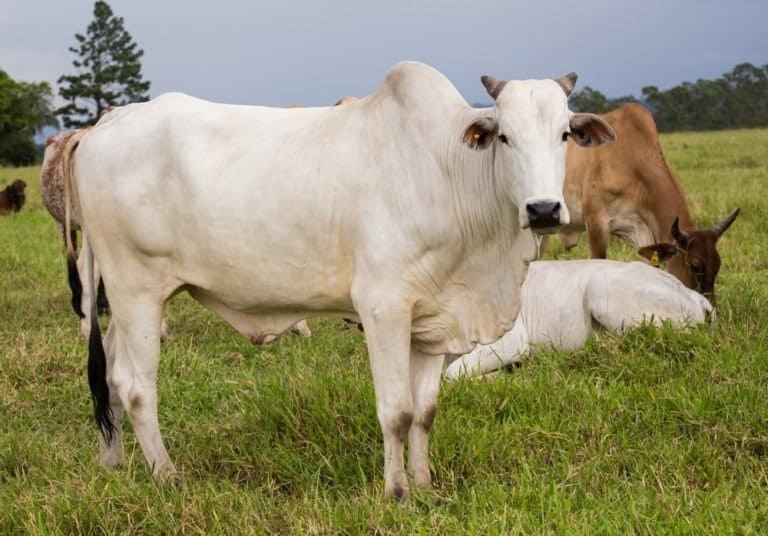
Zebu, also known as humped cattle or Brahman cattle, sometimes have spotted coloring.
©Ekaterina V. Borisova/Shutterstock.com
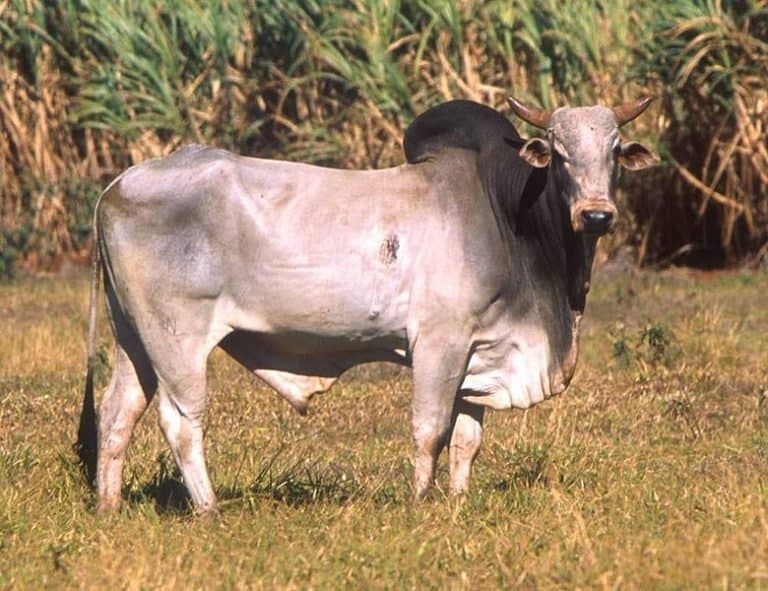
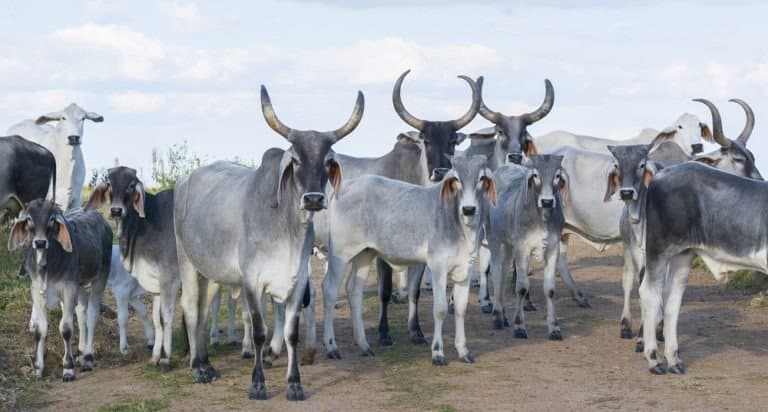
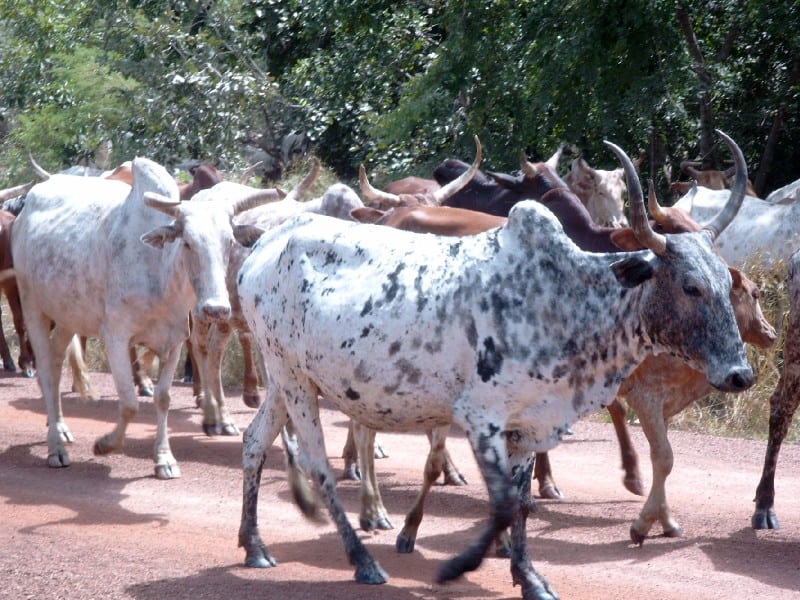
Compared to the standard taurine cattle with which most people are familiar, the zebu has many physical differences that attest to its separate origin. It is characterized by the prominent humped shoulders, drooping ears, loose skin (called a dewlap) around the neck, and horns that curve upward and back. Gray is the dominant color along the upper half of the body and the hooves (becoming black near the shoulders), while white dominates around the belly and legs. Other common colors include brown or red, sometimes occurring in a spotted pattern.
The largest breed is the Sibi Bhagnari, which measures a massive 84 inches long and up to 3,500 pounds in weight. However, in general, the typical zebu breed is less than 1,000 pounds. The miniature zebu (which is actually a naturally occurring breed, not created by humans) is the smallest zebu breed of all, weighing no more than 400 or 500 pounds.
The zebu exhibits high levels of sexual dimorphism (meaning large differences between the sexes). A sexually mature male zebu is almost always called a bull. An adult female, however, is only known as a cow after it has given birth to the first calf. Until then, it is known as a heifer. Males tend to be larger than females on average, but both sexes grow horns throughout their lives.
Like all other cattle, the zebu is specialized for a leisurely grazing lifestyle in which it chews and digests tough plant matter that would prove too difficult for most other species. This process begins when the zebu grinds up the grass in a circular motion with its specialized lower teeth. Once swallowed, the plant matter then passes through the first part of the four-chambered stomach, the rumen, where it’s mixed in with bacteria to break it down. At various intervals, the plant matter is regurgitated and chewed again as a substance called cud. In the final chambers, specialized proteins break down and absorb the nutrients into the bloodstream. It can take cattle some 70 to 100 hours just to process food. This is among the slowest rates of any animal.
Behavior
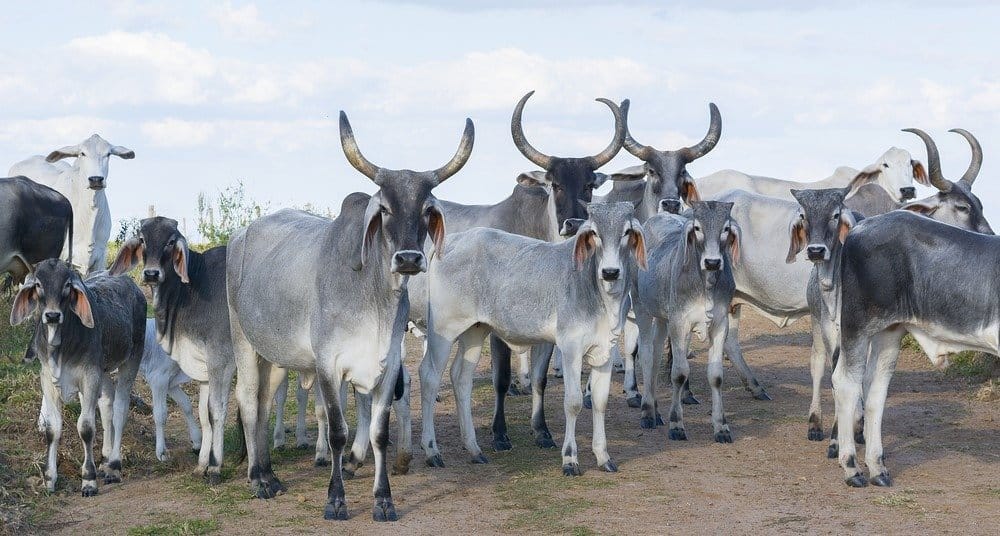
Zebu cattle live in large herds with a hierarchical organization.
©FabricioUZ/Shutterstock.com
The zebu is a social species that gathers together in large herds for the entire year. Wild groups are led by a single bull and contain both females and their offspring. The herd has a hierarchical organization, and each member of the herd must yield to the one above it or else face reprisals and attacks. These hierarchies are usually based on factors such as age, sex, and dominance, and calves are typically born with the same group status as their mother. The hierarchy is usually quite stable, which serves to minimize conflicts, but dominant males can lose their status when they are dethroned by another male.
Cattle communicate with each other through touch, sound, visual cues, and chemical signals. Combined with their excellent cognition, cattle can easily identify other members of the herd and form particularly strong bonds with their mothers. To spot incoming predators, the zebu has eyes on the side of its head with horizontal pupils to take in a massive field of view all around it.
The zebu is well-adapted for survival in the hotter, drier climates of India (and also have a high tolerance for droughts and famines) thanks to two specific adaptations. First, zebus contain more sweat glands on their body than any other type of cattle. Second, just like camels, the zebu’s hump serves as a storage reserve for nutrients that can be accessed when food is scarce. Zebus are also very resistant to viruses, diseases, and parasites. This makes them the preferred type of cattle in many southern or tropical regions of the world.
Habitat
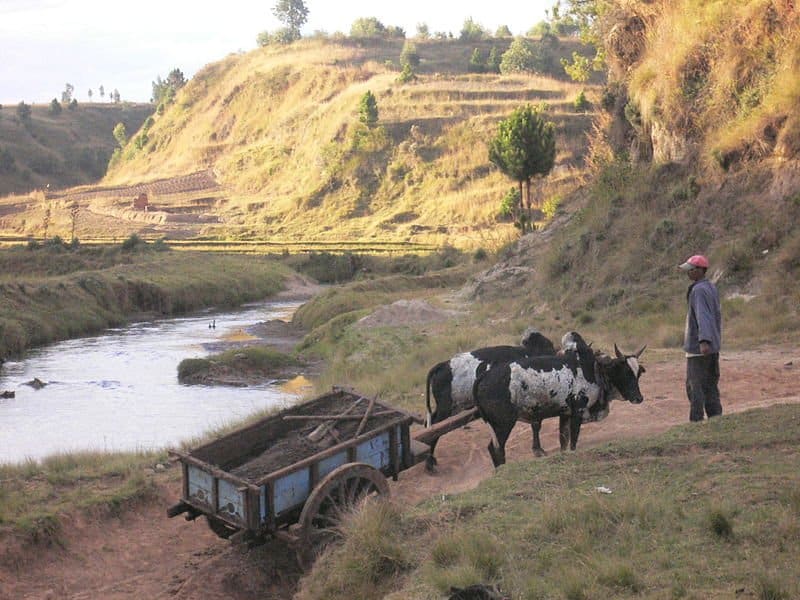
Zebu are used as working animals in many parts of the world to pull carts or plows or otherwise provide transportation.
©Ino Paap / Creative Commons – Original
The zebu was originally domesticated in Southern Asia and became the dominant form of domesticated cattle in India. From there it spread through most of the global south, including the Middle East, Africa, South America, and parts of Europe and North America, where people crossed it with local cattle to create unique breeds. Zebus prefer the open grasslands and plains where food is most abundant, but they are used in many countries as draft animals to pull carts or power farm implements.
Diet
The zebu’s diet consists entirely of grasses, clovers, stems, flowers, and other plant material. To support itself, the zebu can consume around 150 pounds of vegetation a day (depending on the weight of the breed). It grazes up to eight hours and spends the rest of its time resting and chewing cud.
Predators and Threats
Because of its size and herd-based lifestyle, the zebu has no natural predators except for the wolf, lion, bear, and a few other carnivores. These predators almost always prefer to attack a young, old, sick, or isolated zebu rather than a full-grown adult that has the protection of the herd. If threatened directly, the zebu can run away at speeds of up to 25 mph or stand its ground and fight with its horns. Domesticated cattle are obviously slaughtered in large numbers by humans, but because so many are bred every year, they are one of the most widespread mammalian species in the world.
Reproduction, Babies, and Lifespan
The Zebu herd has a dominant male who retains exclusive breeding rights to all females.
©Marco Schmidt / Creative Commons – Original
Because of the zebu’s hierarchical organization, the dominant male of the herd retains exclusive breeding rights to all of the females, and he has the ability to breed all year long instead of one specific season. Once impregnated by the dominant bull, the female carries a single calf for approximately nine months at a time. Because of the challenges presented by the birth process, she rarely produces twins.
Although it’s able to stand and walk at birth, the calf is nevertheless highly dependent on its mother, with whom it shares a very close bond. The cow nurses the calf for the first six months of life, while the entire herd plays a critical role in its protection and training until the calf achieves its independence. The zebu reaches sexual maturity somewhere between one and two years, and the typical life expectancy is around 20 years, about the same length as other cattle.
Population
It is estimated that there are more than 200 million zebus currently living on the planet. Most of these zebu breeds still reside in India, but there are millions more scattered throughout the rest of the world, particularly in Africa and Southeast Asia. Some breeds are considered more valuable or desirable than others, so population numbers can vary quite a bit by breed.
In the Zoo
The miniature zebu is a very popular exhibit throughout the United States because of its approachable and docile temperament. For people in the area, it can be found at the children’s section of the Saint Louis Zoo and the barnyard section of Zoo New England. It is also a prominent exhibit at the Sunset Zoo in Manhattan, Kansas, the Hattiesburg Zoo in Mississippi, the Erie Zoo in Pennsylvania, the Virginia Zoo in Norfolk, the Happy Hollow Park and Zoo in San Jose, and the Greater Vancouver Zoo in Canada. Besides the miniature zebu, the Peoria Zoo in Illinois keeps one of the larger zebu breeds in the contact barn section.
Zebu Pictures
View all of our Zebu pictures in the gallery.

Leonidas Santana/Shutterstock.com
Sources
- Britannica / Accessed December 3, 2020
- Animal Diversity Web / Accessed December 3, 2020
- Happy Hollow Park & Zoo / Accessed December 3, 2020