
Quick Take
- Honey badgers don't raid hives just for honey. What they're really after is far more surprising. Discover what they really want →
- A swarm of bees stinging relentlessly can't stop a honey badger, and there is a biological reason why. See why stings don't stop them →
- Beekeepers have a go-to retaliation against honey badgers, but there's a smarter fix that works better for everyone. Find the smarter solution →
A sticky situation is taking place in this Instagram post! The video shows a honey badger chomping away on a delicious-looking honeycomb. However, the badger is covered in bees who are desperately trying to defend their hive. We investigated the relationship between honey bees and honey badgers to better understand their dynamic.
Do Honey Badgers Actually Eat Honey?
Honey badgers, or ratels (Mellivora capensis), are part of the weasel family, so they are related to otters and other badgers, as well as weasels and wolverines. Despite its name, it does not raid hives for honey alone. It also eagerly seeks out nutrient-rich bee larvae and pupae found in the honeycomb, though honey is very much a prized part of the feast.
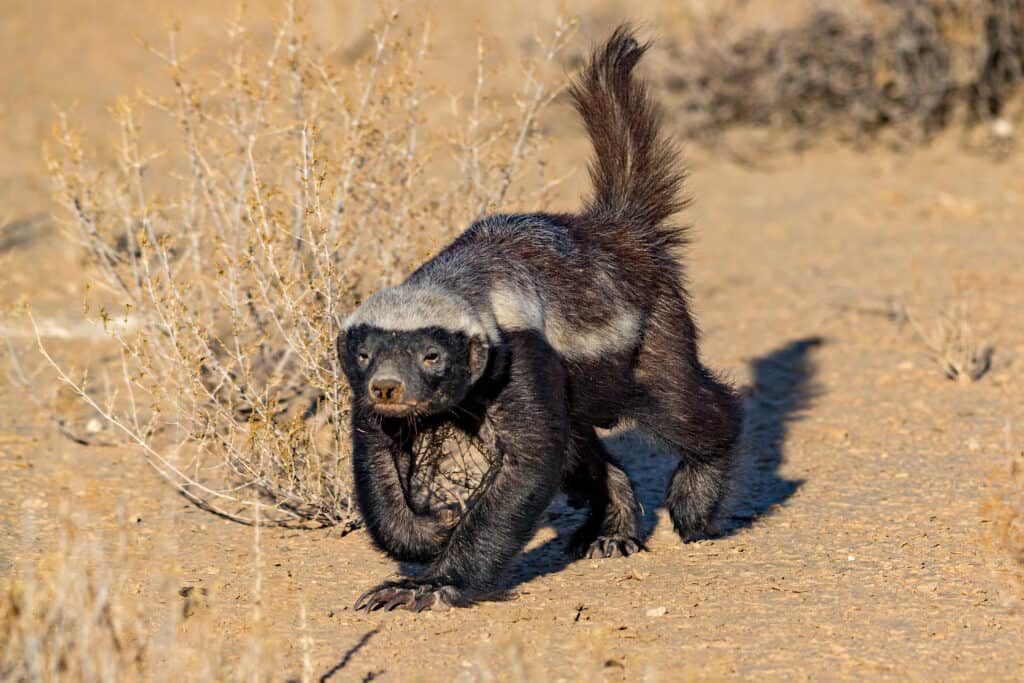
Honey badgers actually feed on bee larvae.
©Braam Collins/Shutterstock.com
You can find honey badgers from southern Morocco to Africa’s southern tip, and western Asia’s Caspian Sea, Turkmenistan, Afghanistan, Nepal, and western India. These badgers don’t just target beehives; they also feed on small mammals, insects, carrion, and fruit.
These guys have long, powerful claws which they use to access and rip apart beehives. They also have loose skin, so they can twist around and shake off attacking bees. Their thick skin and fur mean that very few bee stings actually reach their target.
Conflict With Bees and Beekeepers
The honeybees in this clip crawling all over the honey badger’s face are desperately trying to protect their hive, which is being wrecked by the ratel. This is not a mutually beneficial relationship!
Beekeepers consider the honey badger to be a pest, and they retaliate against individuals that raid their hives. They shoot, poison, and trap the badgers, which has resulted in declines in their population. A better approach is to raise the hives a few feet off the ground, where badgers cannot get to them. This way, the bees can work in peace, and the badgers will be forced to go elsewhere for a sweet treat.