H
Species Profile

Honey Badger

Mellivora capensis

Small mustelid. Big attitude.
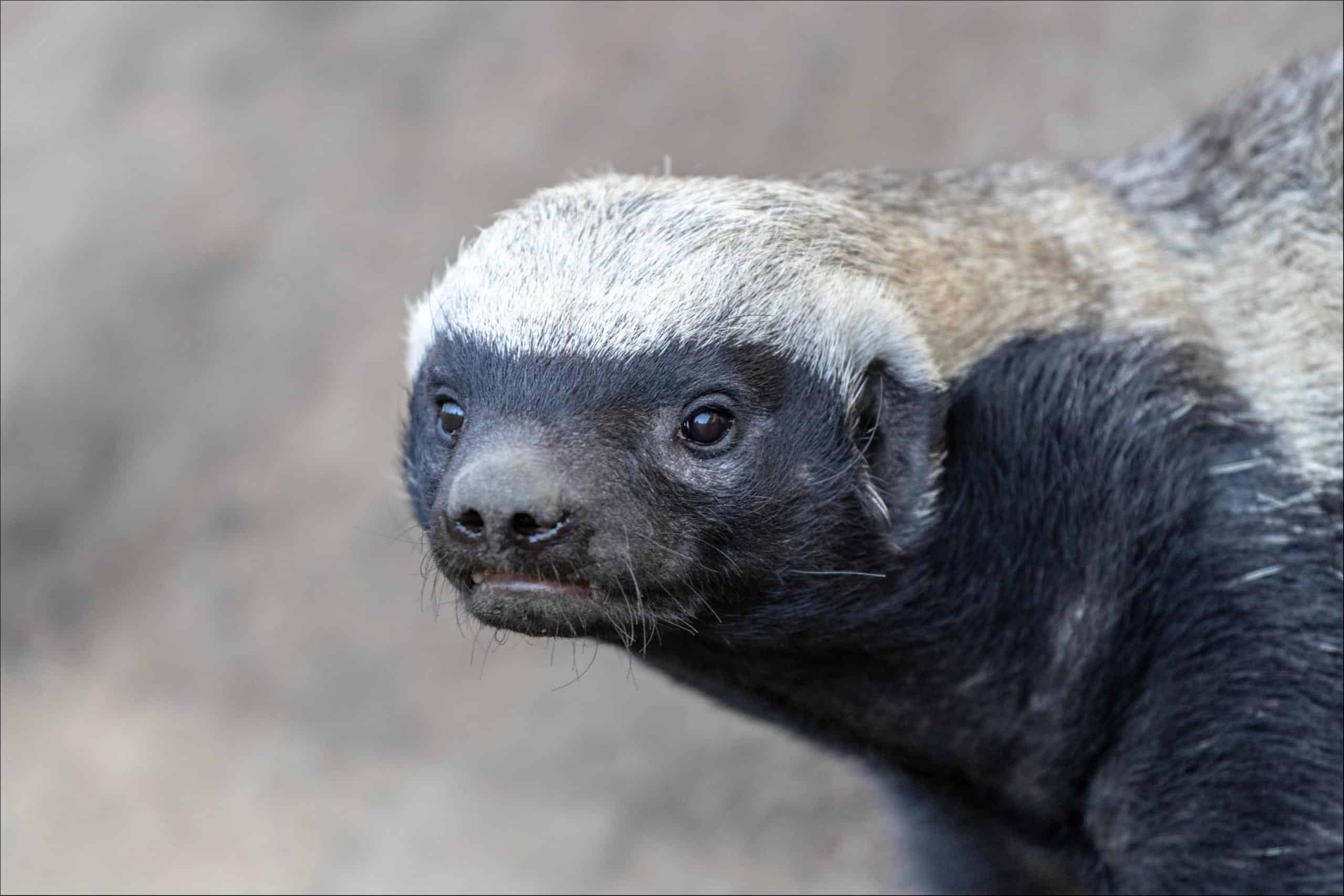
LM Gray/Shutterstock.com

Honey Badger Distribution

Click a location to explore more animals from that region

Loading map...

Size Comparison

Human 5'8"
Honey Badger 10 in

Honey Badger stands at 15% of average human height.

At a Glance

Wild Species
Also Known As Ratel
Diet Omnivore
Activity Cathemeral+
Lifespan 7 years
Weight 16 lbs
Status Least Concern
Did You Know?

Size: head-body length 55-77 cm; tail 12-30 cm (Nowak, 1999; Kingdon, 2013).

Scientific Classification

The honey badger (ratel) is a stocky, powerful mustelid known for opportunistic feeding (including honey, insects, small vertebrates) and notable defensive behavior.

Kingdom
Animalia
Phylum
Chordata
Class
Mammalia
Order
Carnivora
Family
Mustelidae
Genus
Mellivora
Species
Mellivora capensis

Distinguishing Features

  • Distinctive pale/gray mantle across the back with darker underparts
  • Robust build with strong forelimbs and long claws for digging
  • Thick, loose skin that can help resist bites and stings
  • Primarily solitary and wide-ranging with opportunistic diet

Physical Measurements

Males and females differ in size

Height
11 in (10 in – 12 in)
Length
3 ft 1 in (2 ft 9 in – 3 ft 6 in)
2 ft 8 in (2 ft 4 in – 3 ft 1 in)
Weight
26 lbs (20 lbs – 35 lbs)
15 lbs (11 lbs – 22 lbs)
Tail Length
10 in (9 in – 12 in)
8 in (6 in – 10 in)
Top Speed
19 mph
About 30 km/h (estimate)

Appearance

Primary Colors
Secondary Colors
Skin Type Honey badger skin has very coarse guard hairs and thick, loose skin especially around the neck and shoulders. This helps against bites and grabbing; strong scent glands near the rear make a musky odor.
Distinctive Features
  • A mustelid (Family Mustelidae) with a stocky, low-slung body, short legs, and broad head. Not a true badger (genus Meles) or American badger (Taxidea); sole living species, Mellivora capensis.
  • Coarse, high-contrast dorsal mantle ('cape') coloration: pale gray/silver over the back with a pale margin contrasted against black underparts-one of the most diagnostic field marks among mustelids.
  • Powerful forequarters and long, robust foreclaws adapted for digging (excavating burrows and opening termite mounds/bee nests); forelimb build is noticeably stronger than the hindquarters, consistent with a fossorial/generalist foraging lifestyle.
  • Small, rounded ears that sit low on the head (reduced external pinnae), a common fossorial/anti-injury trait in digging carnivores.
  • Thick skull and strong jaws typical of a generalist mustelid predator/scavenger; dentition suited to both vertebrate prey and tough invertebrates (e.g., beetle larvae) and to processing carrion.
  • Loose, tough skin (especially neck/shoulder region) allows the animal to twist within its skin when seized, a defensive trait documented in mustelids and emphasized in Mellivora.
  • Honey Badger (Mellivora capensis): adults about 55–77 cm body length, tail 12–30 cm, weight 5–16 kg; males are usually heavier. Sizes reported across Africa and Asia.
  • Honey Badger (Mellivora capensis) can live up to about 24 years in zoos; wild lifespans are shorter and vary with predators, fights, disease, and local conditions.
  • Found across much of sub-Saharan Africa and into southwest, central, and south Asia (Arabian Peninsula, Iran, parts of the Indian subcontinent). Dorsal mantle varies, often more frosted in dry, open habitats.
  • Behavioral context tied to appearance/adaptation: solitary, wide-ranging generalist forager; strong digging anatomy and durable skin/hair complement opportunistic feeding (insects, small vertebrates, carrion, and honey/bee brood) and defensive encounters rather than specialized 'true badger' burrow-lifestyle morphology.

Sexual Dimorphism

Sexual dimorphism is primarily size-based: males are typically longer and substantially heavier than females, while overall coat pattern remains similar between sexes (common mustelid pattern where coloration is not strongly sex-specific).

  • Larger average body mass (commonly reported ~9-16 kg for males in standard references) with more robust skull and neck/shoulder musculature.
  • Often slightly broader head and thicker neck, consistent with mustelid male-biased size dimorphism and intrasexual competition.
  • Smaller average body mass (commonly reported ~5-10 kg for females in standard references) with overall similar dorsal cape patterning.
  • More gracile overall build relative to males, while retaining the same digging-adapted forelimb/claw structure.

Did You Know?

Size: head-body length 55-77 cm; tail 12-30 cm (Nowak, 1999; Kingdon, 2013).

Strong sexual dimorphism: males commonly ~9-16 kg; females ~7-13 kg (Kingdon, 2013; IUCN accounts compile similar ranges).

Teeth: dental formula 3.1.3.1 / 3.1.3.2 = 34-built for both tearing flesh and crushing tougher foods (Nowak, 1999).

Home ranges can be enormous in arid systems: in the southern Kalahari, radio-tracked males averaged ~541 km² and females ~138 km² (Begg et al., Journal of Zoology, 2003).

Reproduction is slow for a mustelid: typically 1-2 cubs, with delayed implantation reported and total gestation commonly described around ~6 months (Nowak, 1999; Kingdon, 2013).

Longevity: wild lifespan is not well quantified; in captivity records reach ~24 years (zoo/curated longevity databases such as AnAge and zoo records).

Despite the name, it's not a "true badger" (genus Meles) nor the American badger (Taxidea): it's the only living species in genus Mellivora within Mustelidae.

Unique Adaptations

  • Extreme forelimb strength and long, robust claws for excavation-key to a diet that includes fossorial prey and bee nests.
  • Thick, loose skin and tough hide (widely described in mammal references) that can reduce the effectiveness of bites/stings and allows twisting within the skin when grabbed-useful against predators.
  • Small, low-profile ears and a flattened, muscular build that help when forcing into burrows and tight cavities.
  • Generalist dentition and powerful jaws: capable of cracking hard items (e.g., insect-rich combs, tough carcass bits) while still effective at shearing meat (mustelid carnassials plus robust skull).
  • Strong scent glands (a mustelid hallmark) used in defense and communication; odor can deter predators and may mark travel routes or den areas.
  • Physiological tolerance and behavioral strategies around venomous prey are frequently reported in field observations (especially snake encounters), aligning with a mustelid tendency toward high-risk prey handling, though precise venom-resistance levels vary and are not uniformly quantified across studies.

Interesting Behaviors

  • Opportunistic feeding: hunts and scavenges across many food types-small mammals, reptiles, birds/eggs, carrion, insects/larvae, and honey/bee brood (documented across range; e.g., Begg et al., 2003).
  • Power-digging predation: rapidly excavates burrows to reach rodents, reptiles, and invertebrates; often forages by zig-zagging with nose low, switching to intensive digging when scent cues spike.
  • Flexible activity pattern: largely nocturnal/crepuscular in hot conditions, but can shift toward daytime activity during cooler periods (reported from arid-zone field studies including Kalahari work).
  • Bold defensive displays: raises hackles, vocalizes (growls/roars), and may charge; will often face threats rather than flee-especially when cornered or at a den.
  • Predator theft and persistence: known to harass other predators or exploit kills/carcasses when opportunities arise-typical mustelid "high payoff" risk-taking.
  • Den use and roaming: alternates between long-distance travel and short bouts of intense feeding; uses burrows/termite mounds/rock crevices as day shelters, changing sites frequently in some habitats.
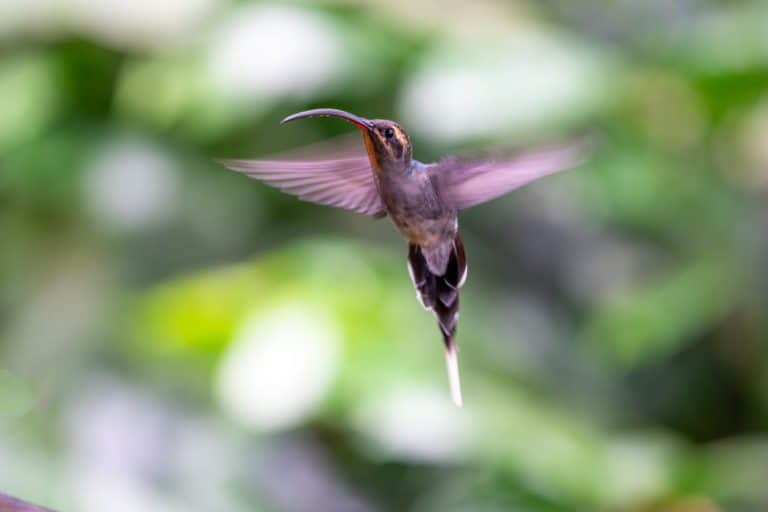
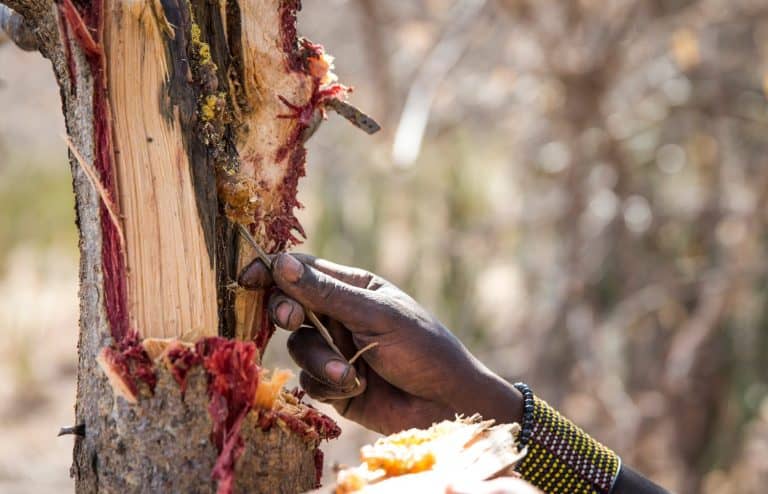
  • Possible interspecies "honey partnership": in parts of East Africa, local accounts describe honeyguides (Indicator indicator) leading honey badgers to bee nests; the badger opens the nest and both species feed-an interaction also investigated scientifically in the honeyguide literature and embedded in regional oral tradition.

Cultural Significance

Honey badger (Mellivora capensis) is a symbol of bravery. In East African stories it teams with the greater honeyguide to find bee nests. It is an example of mustelid diversity and differs from true badgers.

Myths & Legends

In East African tales, the Honeyguide bird leads the Honey Badger (Mellivora capensis) to a hidden bee nest; the badger breaks it open and both share the honey and brood.

In southern African folk tales, the honey badger (Mellivora capensis) is shown as a fearless troublemaker that will not be scared of larger animals and survives by boldness and grit when others give up.

Naming lore in southern Africa: a regional nickname for the honey badger is often popularly linked to a word meaning "rattle," and folk explanations say it echoes the animal's harsh, rattling vocalization when threatened.

Since the 20th century, films and internet stories made honey badger (Mellivora capensis) an almost-mythic symbol of fearlessness, used as a 'spirit animal' in sayings, mascots, and slang in southern and eastern Africa and online.

Conservation Status

LC Least Concern

Widespread and abundant in the wild.

Population Decreasing

Protected Under

  • Occurs in numerous national parks and reserves across much of its African and Southwest Asian range; protected-area coverage provides partial refuge but does not prevent persecution on surrounding private/agricultural lands.
  • Legal protection status varies by country/region; in some jurisdictions the species is protected wildlife, while in others it may be controlled under permit in response to livestock/poultry/beekeeping damage.
  • Not generally managed via an international CITES listing at the species level (trade controls, where present, are typically national).
  • HUBS (Mustelidae conservation landscape): Statuses range from Least Concern (many widespread weasels/stoats and the honey badger) to Near Threatened/Vulnerable and Endangered/Critically Endangered in range-restricted taxa; common threats include habitat loss/fragmentation, hunting/persecution (including conflict), trapping/snaring, and roadkill/infrastructure expansion. Notable at-risk mustelids include the European mink (Critically Endangered) and several otters in heavily modified freshwater/coastal systems that face habitat loss and pollution.

Life Cycle

Birth 1 cub
Lifespan 7 years

Lifespan

In the Wild
3–14 years
In Captivity
10–24 years

Reproduction

Mating System Polygyny
Social Structure Solitary
Breeding Pattern Transient
Fertilization Internal Fertilization
Birth Type Internal_fertilization

Honey badgers (Mellivora capensis) are mostly solitary and meet only to mate. Males have larger ranges overlapping several females (polygyny). Females raise 1–2 cubs alone after a pregnancy of about six months. No male care; some mating details are unknown.

Behavior & Ecology

Social None (solitary species; temporary mating pair; female with cubs) Group: 1
Activity Cathemeral, Nocturnal, Diurnal
Diet Omnivore Honey and bee brood (larvae/pupae) from raided nests/hives

Temperament

Bold
Highly defensive when threatened
Persistent/tenacious
Opportunistic
Risk-tolerant around larger animals
Curious/investigative
Generally intolerant of close conspecific proximity outside breeding and maternal care

Communication

growls Threat/aggression
hisses Threat/defense
grunts/snorts Close-range contact or agitation
screams/squeals High arousal, including distress
cub vocalizations Squeaks/squeals during contact and solicitation
scent marking with anal gland secretions Chemical signaling for territory/spacing and reproductive state
latrine use/defecation marking at conspicuous sites Reported in field observations
ground-scratching and rubbing at marking points Depositing scent
visual threat displays Piloerection, open-mouth display, rapid charges
tactile contact primarily in mother-cub interactions Nursing, grooming, close denning

Habitat

Biomes:
Savanna Tropical Dry Forest Tropical Rainforest Temperate Forest Mediterranean Desert Hot Wetland +1
Terrain:
Mountainous Hilly Plateau Plains Valley Coastal Riverine Rocky Sandy +3
Elevation: Up to 8530 ft 2 in

Ecological Role

Generalist mesocarnivore/invertebrate predator and facultative scavenger; ecosystem engineer via digging.

Regulates populations of small mammals and invertebrates (including some agricultural pests) through predation Contributes to carrion removal by opportunistic scavenging Soil turnover/bioturbation and microhabitat creation through frequent digging (aeration, nutrient mixing) Potential seed dispersal when consuming fruits (minor/seasonal)

Diet Details

Main Prey:
Rodents and other small mammals Reptiles Ground-nesting birds, chicks, and eggs Amphibians Insects and other invertebrates Bee Honey Carrion +2
Other Foods:
Wild fruits and berries Roots, bulbs, and tubers

Human Interaction

Domestication Status

Wild

Mellivora capensis (honey badger) is not domesticated or selectively bred. Occasionally kept briefly, they stay wild with strong prey drive, digging, and aggression. Adults 55–77 cm body, 12–30 cm tail, 5–16 kg. Wild ~7–8 years; captive up to ~24. Range: sub‑Saharan Africa to SW Asia. Human conflicts: hive raiding, poultry predation, killing, snares, roadkill, research/tourism.

Danger Level

High
  • Severe bites and lacerations if cornered/handled; exceptionally strong jaw/neck and persistent defensive behavior are widely documented in field and captive handling reports.
  • High risk during attempted capture/"pet" keeping due to escape behavior, powerful digging, and destructive chewing (creates frequent close-contact incidents).
  • Potential zoonotic disease exposure typical of wild carnivores (e.g., rabies risk in endemic regions; other pathogens depending on locality and contact).
  • Secondary injury risk when honey badgers engage venomous snakes near human dwellings-people may be bitten while intervening or handling animals.

As a Pet

Not Suitable as Pet

Legality: Honey Badger (Mellivora capensis), a wild carnivore (Mustelidae), is usually not legal as a private pet. Where allowed, special permits are needed for zoos, exhibitors, or research; import and welfare laws usually block private ownership.

Care Level: Expert Only

Purchase Cost:
Lifetime Cost: $50,000 - $150,000

Economic Value

Uses:
Ecotourism and wildlife-viewing value in protected areas Research/education value (behavioral ecology, carnivore conflict mitigation) Ecosystem services (predation on some agricultural pest species is possible but context-dependent) Human-wildlife conflict costs (apiary damage; poultry losses; property damage from digging/entry)
Products:
  • tourism revenue (guided wildlife viewing/photography in reserves)
  • research outputs (telemetry/ecology datasets used for land-use and conflict planning)
  • costs to beekeeping (destroyed hives/comb; hive reinforcement expenditures)
  • costs to smallholder poultry production (losses; predator-proofing infrastructure)

Relationships

Related Species 5

Wolverine
Wolverine Gulo gulo Shared Family
European badger Meles meles Shared Family
American badger Taxidea taxus Shared Family
Least weasel Mustela nivalis Shared Family
Eurasian otter Lutra lutra Shared Family

Ecological Equivalents 5

Animals that fill a similar ecological role in their ecosystem

Wolverine
Wolverine Gulo gulo Mellivora capensis (honey badger) is a solitary, wide-ranging mustelid with a robust body (head-body ~60–77 cm; mass ~6–16 kg, males larger). It is very tough and aggressive and eats many kinds of invertebrates, vertebrates, and carrion.
American badger Taxidea taxus Shares a similar niche as a ground-dwelling, fossorial carnivore/omnivore that excavates burrows to access prey (rodents, reptiles, invertebrates). Honey badgers likewise dig frequently for prey and refuge and are notable for a high bite force relative to their size and for strong forelimbs and claws.
European badger Meles meles Both species use digging and are omnivorous, consuming invertebrates, small vertebrates, and plant matter. Although European badgers are more social and less confrontational, both occupy a terrestrial mesocarnivore niche, rely heavily on scent, and possess robust cranial and neck musculature.
Striped skunk Mephitis mephitis Not closely related (skunks are in Mephitidae) but ecologically similar: both are omnivorous, nocturnal-capable mesocarnivores with strong predator-deterrence strategies. Skunks rely on chemical spray, while honey badgers substitute extreme aggression, thick/loose skin, and tenacity to achieve a similar predator-avoidance outcome.
Banded mongoose Mungos mungo Shares an insectivore/vertebrate-generalist niche in savanna/woodland mosaics, frequently exploiting ground prey (insects, reptiles, small mammals) and exhibiting anti-snake tactics; honey badgers likewise commonly target reptiles (including venomous snakes) and abundant invertebrate prey.

Honey badgers are the world’s most fearless animals.

Capybaras win the award for the world’s friendliest animal, but on the opposite end of the spectrum sits the honey badger, the planet’s gnarliest mammal! The “Guinness Book of World Records” lists the small, weasel-like species as the most fearless on Earth. And thanks to a 2011 viral YouTube video, they have earned the reputation for “not caring” — an apt description for animals that attack and steal at will!

Scientists haven’t studied the honey badger that much – maybe because of the animal’s bad reputation and inhospitable personality. Regardless, let’s dive into what we do know!
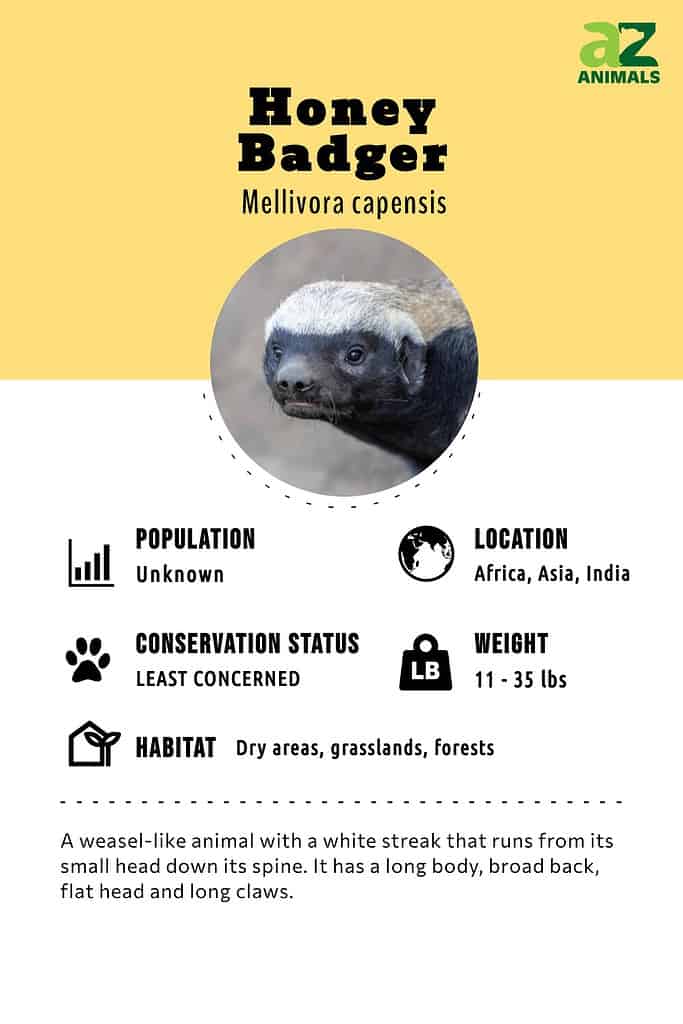
6 Phenomenal Honey Badger Facts

  • Honey badgers are one of the few animals naturally immune to venomous snake bites. It’s believed they developed this over time by eating slightly venomous creatures first and working their way up.
  • Their thick, loose skin can easily withstand shots from bows, arrows, and even machetes! The most effective way to kill honey badgers is a gunshot or skull-breaking blow to the back of the head.
  • Honey badgers are the only species in the Mellivora genus and are often locally known as ‘ratels.’
  • Using their sharp claws, ratels can dig a nearly 10-foot-long tunnel into hard earth within 10 minutes.
  • “Honey Badger” has become a common nickname for athletes and politicians with ruthless reputations.
  • In 2011, a video entitled “The Crazy Nastyass Honey Badger” went viral. It was a compilation of various honey badgers doing their ferocious thing, and the voice-over was a man saying, “honey badgers don’t care.” To date, people have viewed the video nearly 100 million times.
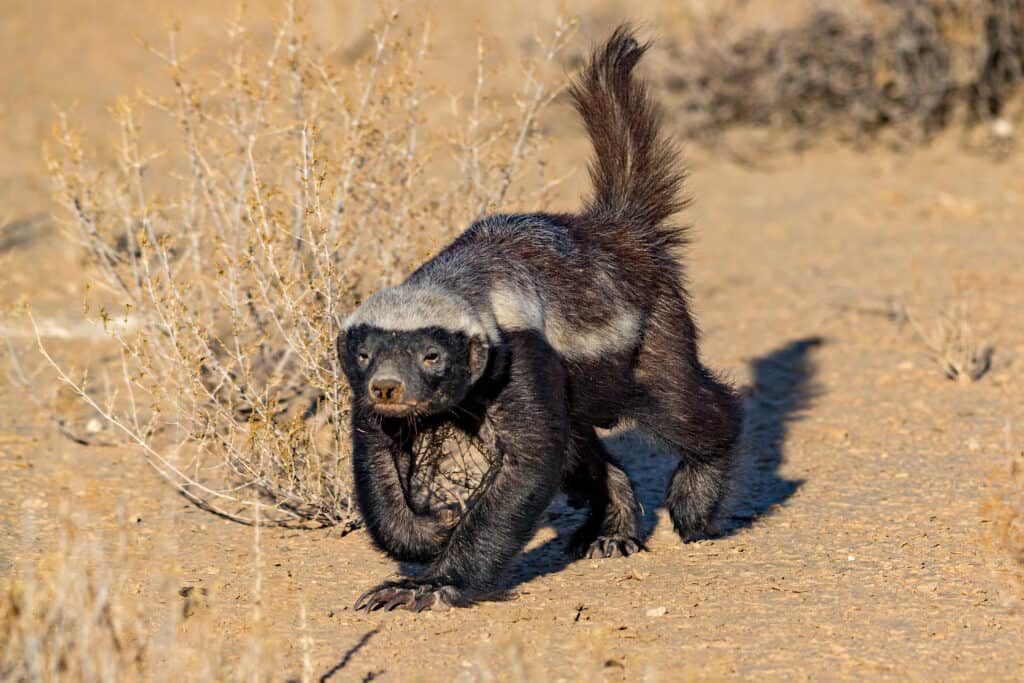
Honey,Badger

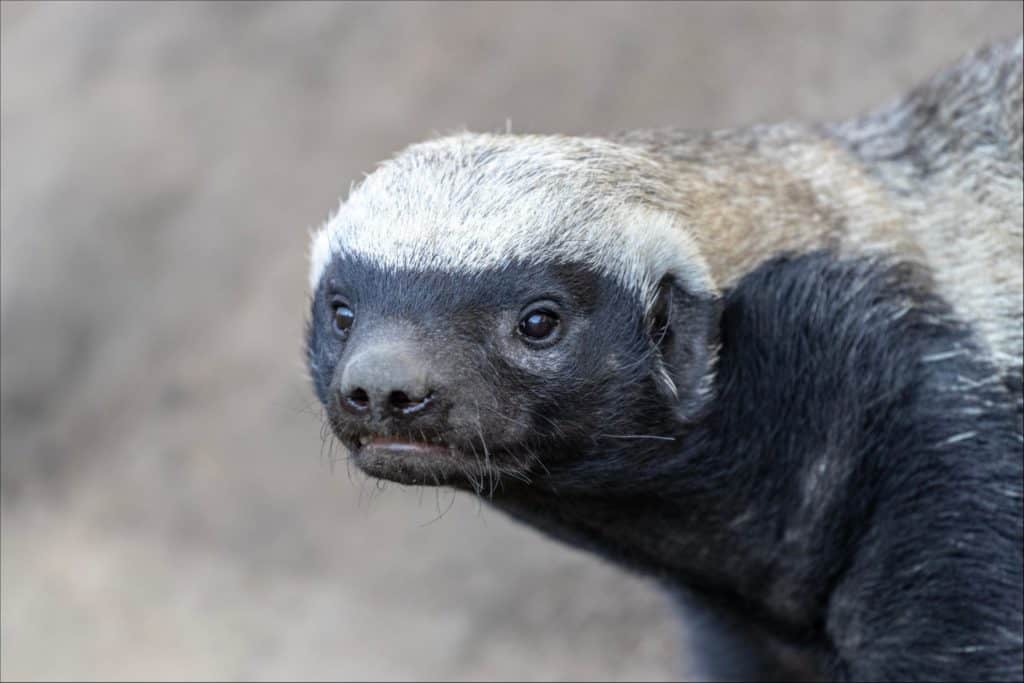
Honey badgers are also called “ratels” and are known to be one of the most fearless animals on the planet.

Scientific Name

The scientific name for honey badger is Mellivora capensis. Mellivora comes from both ancient Greek and Latin. “Meli” is Greek for “honey,” and “varo” is a Latin verb meaning “to eat” or “to devour.” Capensis is a geographical reference to the Cape of Good Hope, where Johann Christian Daniel von Schreber first described the species. So, strung together, the scientific name for honey badgers translates to “honey eater of the cape.” Which is fitting, since these animals do like to eat honey.

In some parts of the world, the animals are also known as “ratels.”

Evolution

The evolution of the honey badger is murky, at best. Scientists believe that honey badgers and the American badger evolved from weasels before the “true” badgers of Eurasia ever appeared. There is one species of honey badger that lives all over Africa, the Middle East, and India.

Fossil records are scarce, but an obvious example of an early honey badger was found in Pakistan in the 1860s and is estimated to have lived during the Ice Age two million years ago. Mellivora sivalensis was found in only one location and hasn’t been well studied.

Mellivora benfieldi has been identified in fossils from Italy, South Africa, and Ethiopia. They lived during the Late Miocene, 5 to 6 million years ago. The fossils of the honey badgers have been found among the fossils of sabretooth cats.
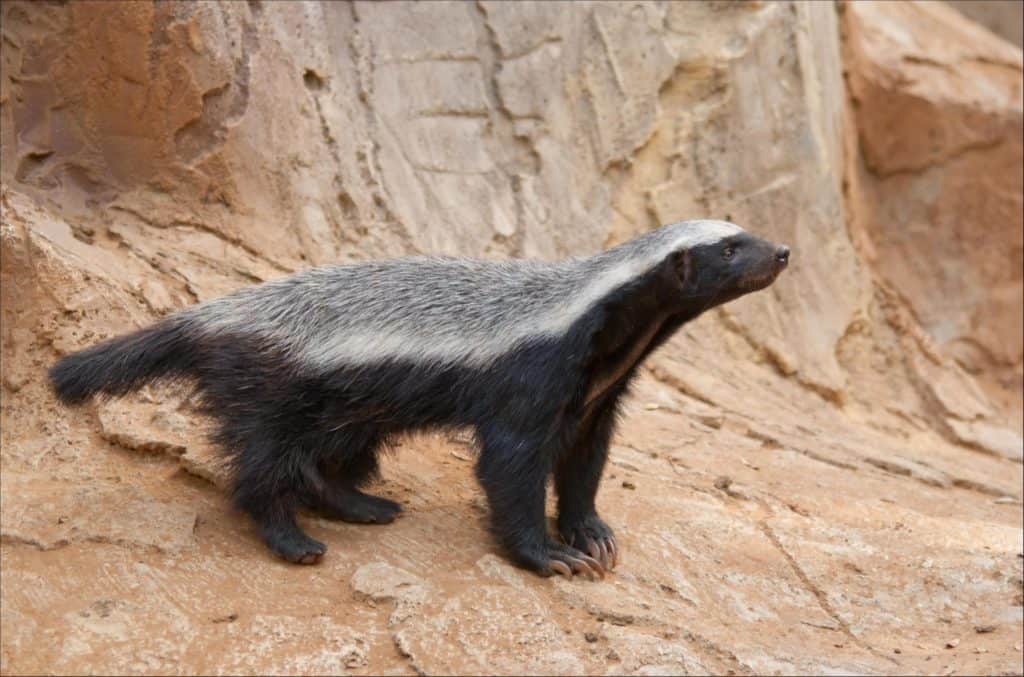
Honey badgers are related to weasels but look more like skunks with thick loose skin.

Appearance

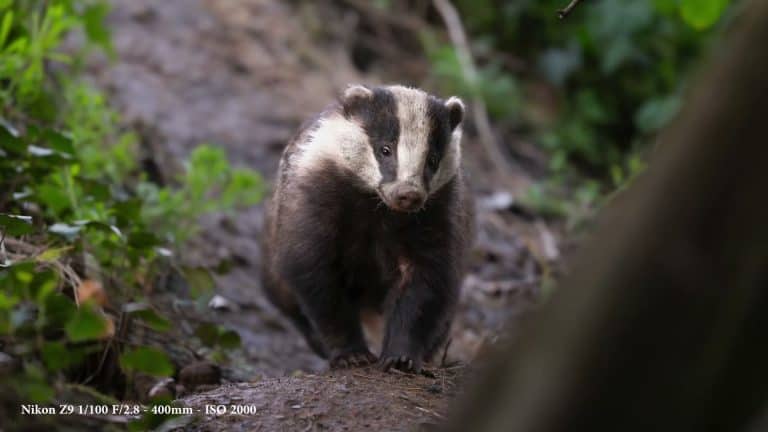
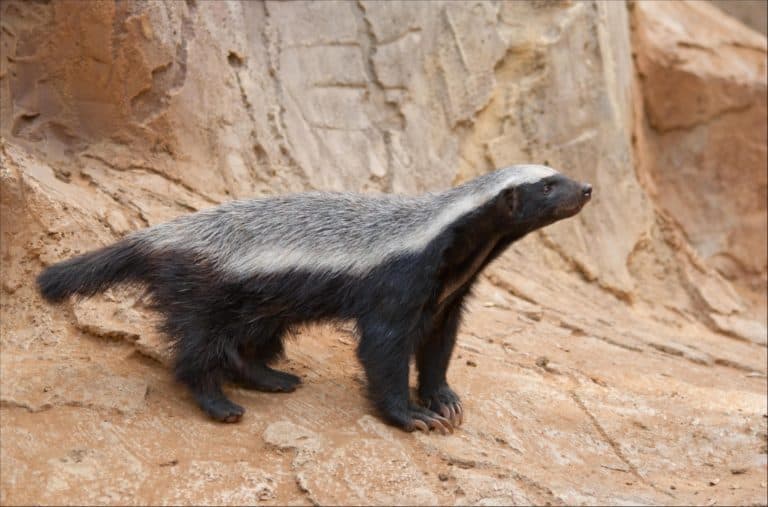
What do honey badgers look like? Well, anatomically speaking, they have more in common with weasels than other badgers. But in everyday terms, you could say that honey badgers resemble overgrown skunks.

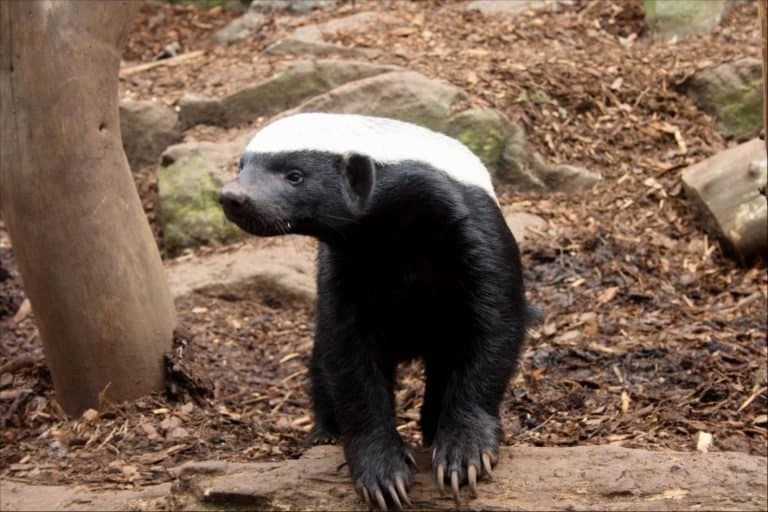
Scientists currently recognize 12 honey badger subspecies with slight aesthetic differences. Generally speaking, all honey badgers have long bodies, broad backs, flat heads, short legs, small eyes, tiny ear ridges, stumpy tails, and short muzzles. What isn’t tiny are their claws, which are strong and long.

Honey badgers are animals that are also known for having steel-like skin. It’s thick and loose and can withstand arrow piercings and machete attacks. Plus, bee stings and porcupine pricks don’t affect them in the slightest.

Depending on the subspecies, honey badgers have all-black fur or black fur with a white streak that runs along their spine. In the winter, they carry long, dense fur coats, which are shed in the summer.

Size-wise, ratels are the largest land mustelids in Africa. Typically, measuring from the shoulder, they’re between 9.1 and 11 inches tall and 22 to 30 inches long. Males usually weigh about 20 to 35 pounds on average; while females tip the scales between 11 and 22 pounds – about the size of a small or medium dog.

But if you find yourself lost in the bush, know that honey badgers can grow to enormous sizes under ideal conditions. Good examples are the three 40-pound females that researchers found living in the Iraqi wild.
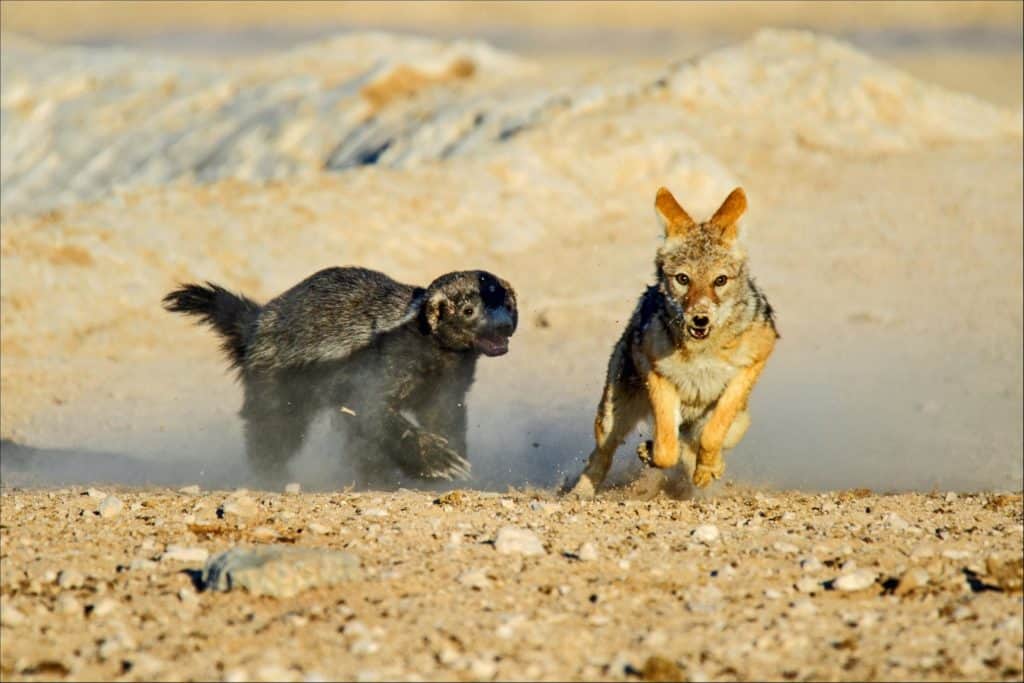
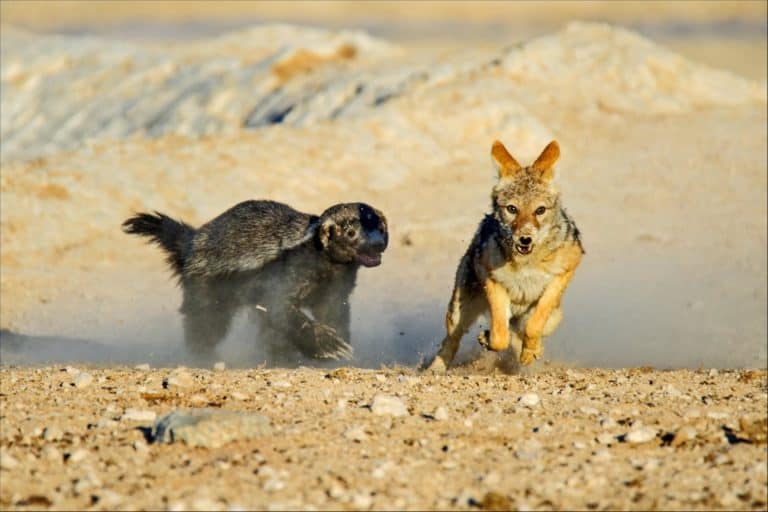
Honey badgers aren’t afraid to fight animals much larger than themselves.

Behavior

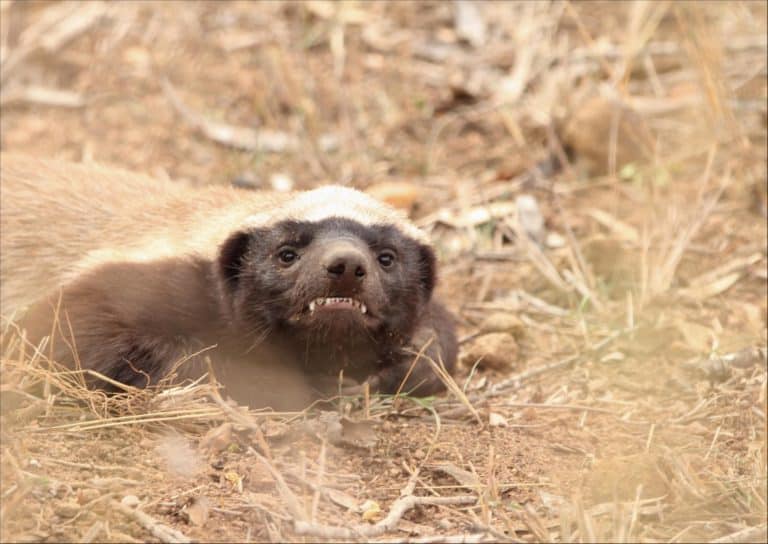
In terms of behavior, honey badgers are animals that are both notoriously cranky and aggressive. Ratels are both fearless and mean, and they’ll attack almost any animal, including humans, when there’s no escape. To boot, they purposely pick fights and rudely take over other animals‘ dens. Learn more about the toughest animals in the world here. For the most part, honey badgers stick to themselves, but mating pairs occasionally hang out together in the spring.

As Mother Nature’s backhoe, honey badgers are skilled diggers that can claw long tunnels and burrows in under 10 minutes. Other times, when they’re feeling lazy, ratels will commander the dens of aardvarks and warthogs.

Like skunks, honey badgers omit an atrocious odor to repel predators. Their scent also paralyzes bees, making it easier for honey badgers to raid hives for honey.
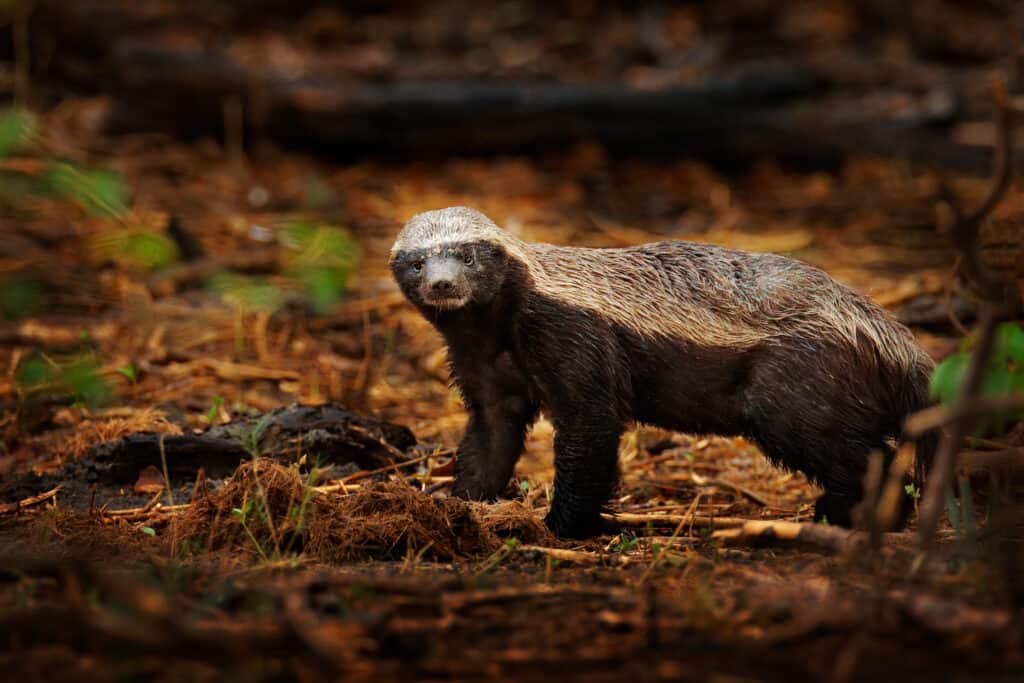
Honey badger

Honey badgers can thrive in arid grasslands or forest habitats.

Habitat

Twelve subspecies of honey badgers are scattered across Africa and parts of the Middle East, Asia, and the Indian subcontinent. Populations of the species stick to dry areas, grasslands, and forests.

Subspecies

The 12 different species of honey badgers live in different areas, shown in the table below.

SubspeciesLocation
Cape RatelSouth and Southwestern Africa
Indian RatelAsia, Afghanistan, Iran, Pakistan, India
Nepalese RatelNepal
White-Backed RatelWest Africa, Southern Morocco, Congo, Gabon, Central African Republic
Black RatelGhana, Congo
Lake Chad RatelSudan, Somali-land
Speckled RatelSierra Leone
Ethiopian RatelEthiopia
Persian RatelIran, Iraq
Kenyan RatelKenya
Arabian RatelSouthern Arabia
Turkmenian RatelTurkmenistan

Diet

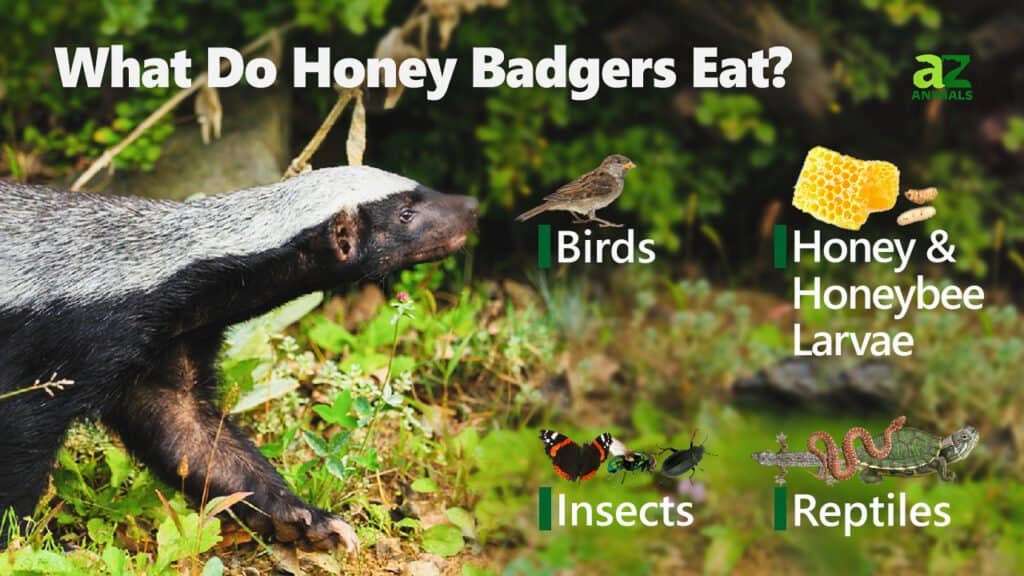
What Do Honey Badgers Eat

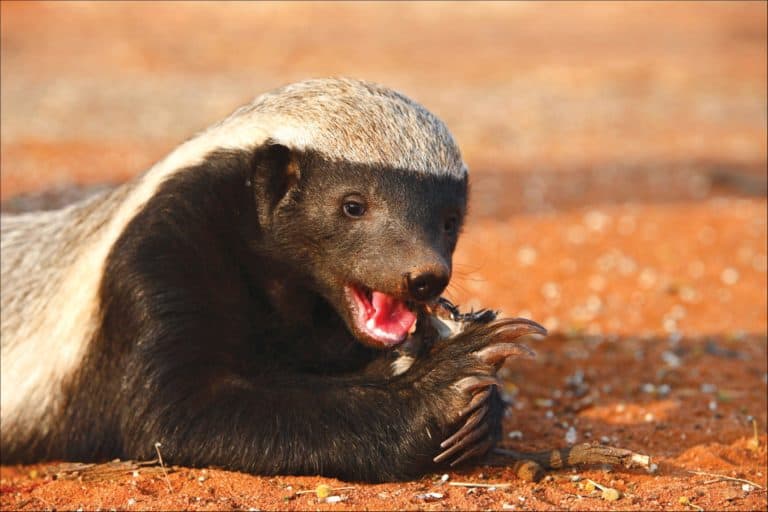
Ratels are omnivores with gigantic appetites, and when they kill, they eat the entire animal, including fur and feathers.

Honey badgers derive a chunk of their nutrients from digging up larvae and other insects, but they also feast on snakes, frogs, lizards, turtles, rodents, bird eggs, berries, bulbs, and roots. Honey badgers who call the Kalahari home also eat sheep and goats, and in India, ratels sometimes dig up human remains for meals.

They also eat a lot of poultry, and it’s nearly impossible for game farmers to guard against honey badgers because they dig tunnels to gain access to chicken coups. Plus, honey badgers can dismantle wood enclosures with little effort.

Evidenced by their name, honey badgers also love honey and regularly raid beehives to snatch their favorite snack.
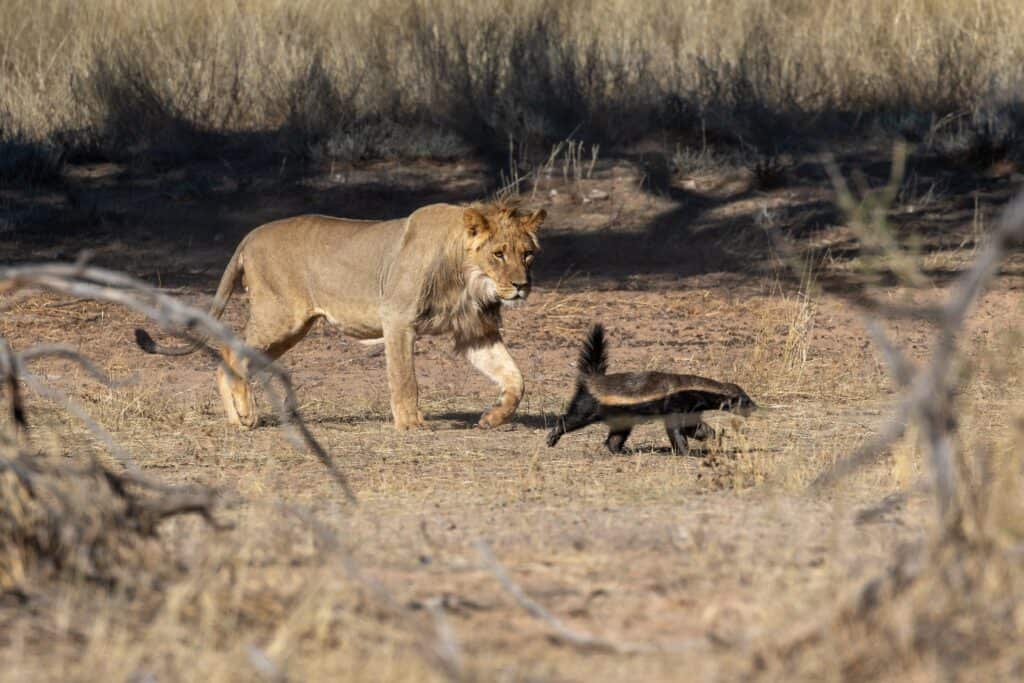
Honey badger and lion

Lions occasionally kill honey badgers – but typically give them a wide berth.

Predators and Threats

Humans aren’t the only species that honor honey badgers as formidable and ferocious foes. Even mighty lions — though they’ve been known to kill honey badgers on occasion — will typically grant the tenacious fighters a wide berth.

Not only is the species combative by nature, but their anatomical features serve as highly effective armor. They can squirm around in their thick, loose skin, making it harder for would-be predators to latch on. Plus, honey badgers are equipped with killer claws and teeth strong enough to slice through tortoise shells.

Despite their formidable defense mechanisms, honey badgers have a handful of natural predators, including African leopards, African rock pythons, Nile crocodiles, and spotted hyenas. Habitat encroachment is also a problem.
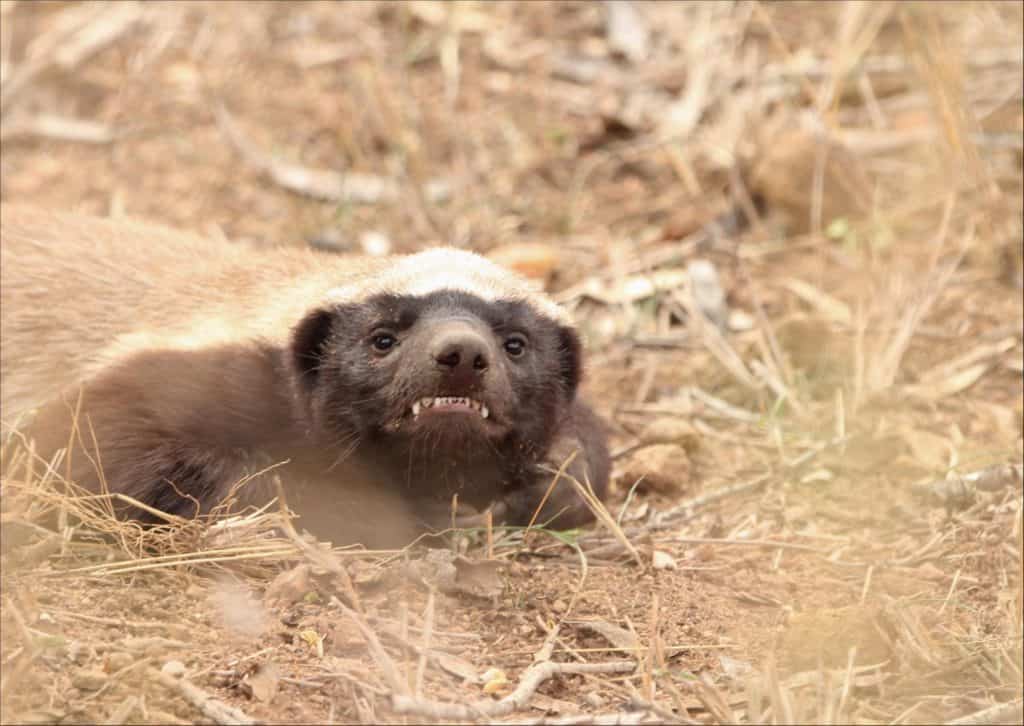
Baby honey badgers are called kits and live with their mothers for up to a year.

Reproduction, Babies, and Lifespan

Very little is known about honey badgers’ reproductive and parenting lives. The only reliable data is from a 42-month-long study conducted by the Kgalagadi Transfrontier National Park.

What do we know about honey badger reproduction? They mate throughout the year, with a spike in the spring, and gestation lasts about six months. Females have four teats to nurse newborns but only give birth to one or two kits — the term for badger cubs — at a time.

Babies are born blind, suckle for two to three months, and are dependent on their mothers for about a year. In the wild, honey badgers live for about seven to eight years, whereas individuals living in captivity live to the ripe old honey badger age of about 24.
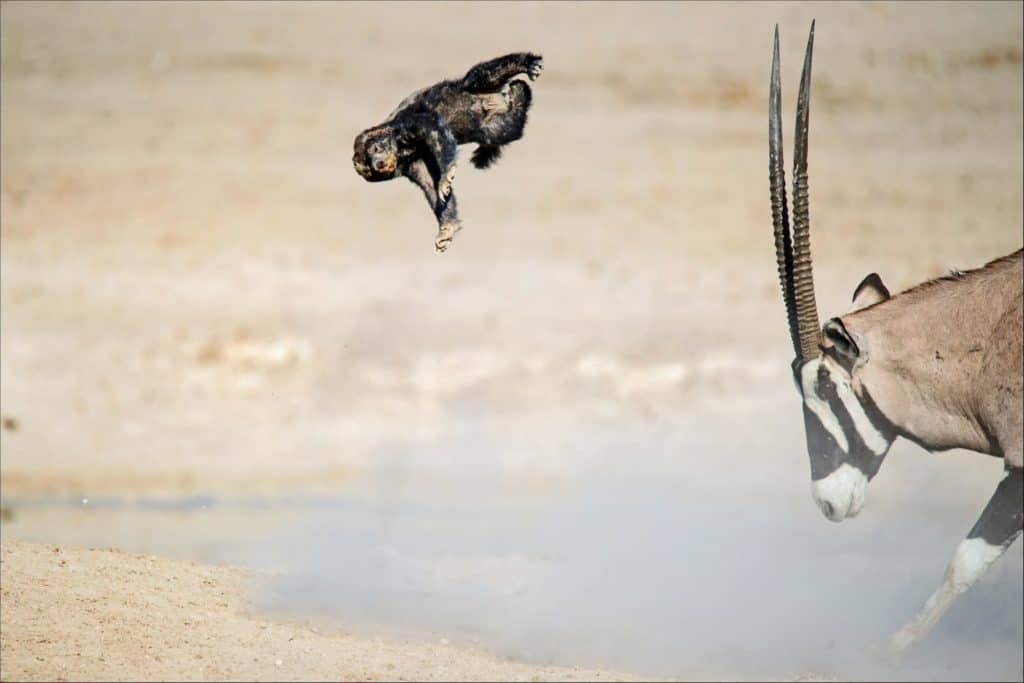
Honey badgers seem to be able to survive almost anything and are not in danger of extinction.

Population

According to the International Union for the Conservation of Nature, honey badgers are a least concern species and not in danger of imminent extinction. But that doesn’t mean honey badgers are without threats.

Human population growth causes more wildlife encroachment. In the days of old, people and honey badgers rarely came into contact. But these days, honey badgers often find themselves face-to-face with armed farmers committed to protecting their livestock. As a result, honey badger population numbers are declining.

Currently, there isn’t a worldwide estimate for the honey badger population, but they’re disappearing from places where they were once plentiful.
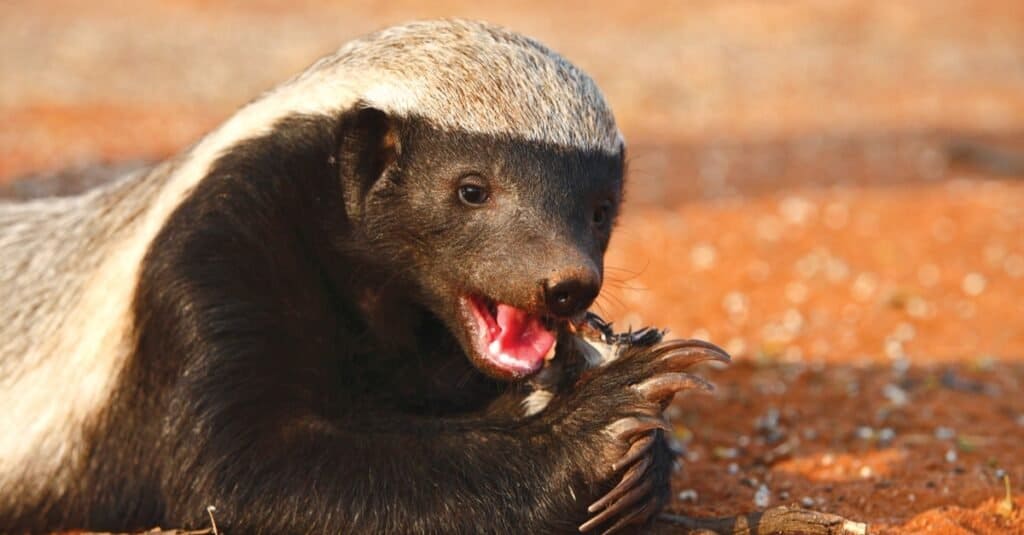
What Eats Snakes

Up to 25 percent of the honey badger’s omnivorous diet consists of venomous snakes.

Honey Badger FAQs

What is a honey badger?

A honey badger is a weasel-like, hyper-aggressive, four-legged animal that lives in parts of Africa, the Middle East, Asia, and India.

Are honey badgers carnivores, herbivores, or omnivores?

Honey badgers are omnivores, meaning they eat flesh and plants. Much of their diet consists of insects, but they will also eat snakes, turtles, berries, and, of course, honey.

Can a honey badger kill a human?

The jury is still out as to whether or not honey badgers kill humans. There are stories from the early 20th century of man-eating ratels, but historians and scientists think they’re probably folklore. However, Indian honey badgers reportedly attack young children, and individuals of the subspecies are known to dig up human remains for dinner.

In 2007, a conspiracy theory circulated about “man-eating” honey badgers in Iraq. But according to area vets and conservationists, honey badgers have always lived in the country’s rural areas, but a marshland flooding north of Basra that year pushed the animals towards the city.

How aggressive is a honey badger?

Honey badgers are one of the most aggressive species on Earth! The “Guinness Book of World Records” lists them as the world’s most fearless animals.

Why are honey badgers so fearless?

Honey badgers are so bold because they have built-in armor. Due to their protective skin, hardly anything can penetrate them, including other animals’ teeth, machetes, and arrows! Plus, they’re naturally aggressive, have strong jaws, and were endowed with teeth that can cut through just about anything.

How dangerous is a honey badger?

Honey badgers are dangerous! They never back down, have lethal teeth, and attack any moving thing if they feel threatened.

View all 288 animals that start with H
Lisha Pace

About the Author

Lisha Pace

After a career of working to provide opportunities for local communities to experience and create art, I am enjoying having time to write about two of my favorite things - nature and animals. Half of my life is spent outdoors, usually with my husband and sweet little fourteen year old dog. We love to take walks by the lake and take photos of the animals we meet including: otters, ospreys, Canadian geese, ducks and nesting bald eagles. I also enjoy reading, discovering books to add to my library, collecting and playing vinyl, and listening to my son's music.

Thank you for reading! Have some feedback for us?


Honey Badger FAQs (Frequently Asked Questions)

One question that’s often asked about honey badgers is whether they could battle much larger creatures. If a honey badger were to battle a Komodo dragon, it’s likely the Komodo dragon would simply be too large for the honey badger. With the two living on different continents, this battle has never happened in nature, however.