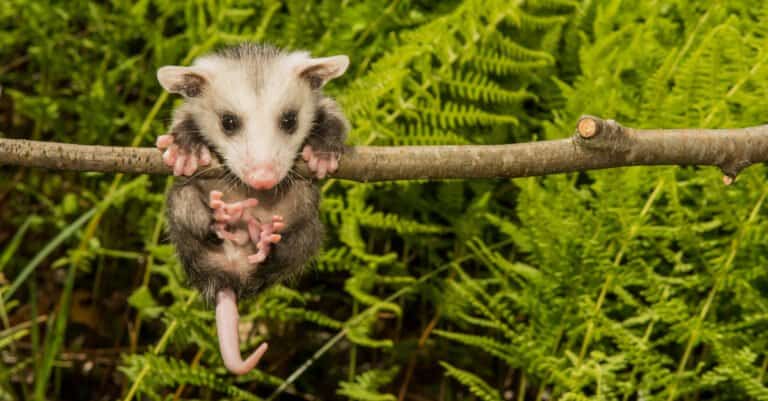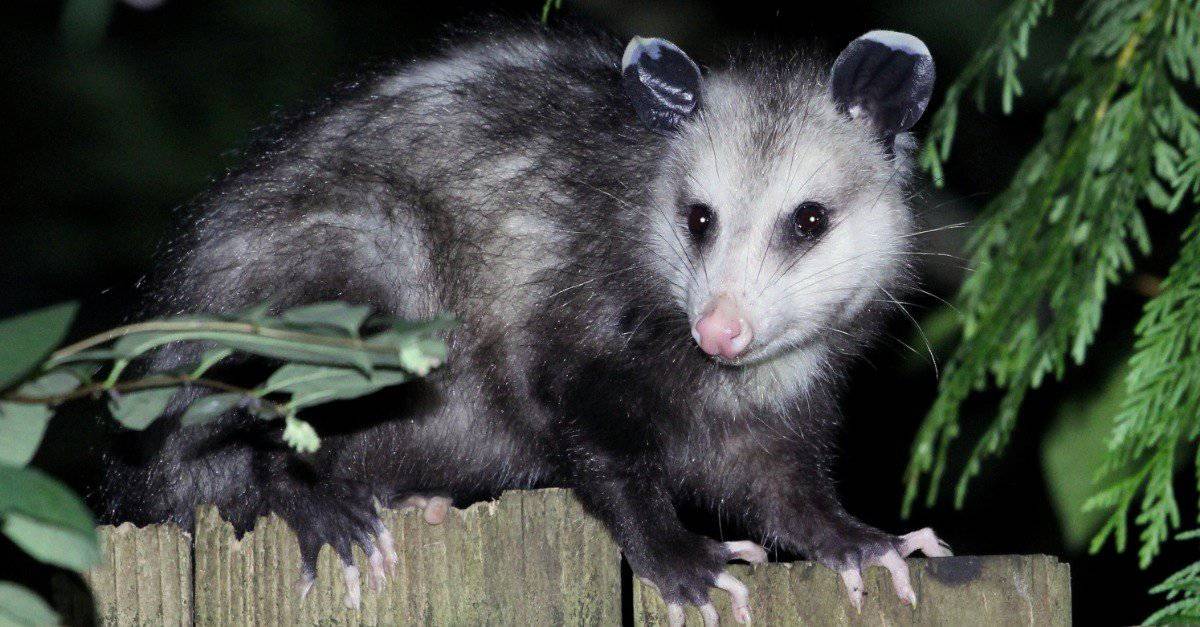

Opossums have five digits on all of their paws.
©iStock.com/galinast
If you are walking around and see some animal tracks or if you find tracks in your home, it can be very helpful to identify the creature that left them. Opossums leave tracks that may seem similar to those belonging to rats, and even though opossums may look like they are a type of rodent, they are not. Opossums are marsupials. There are some key details that help distinguish opossum tracks from those belonging to rodents. If you’ve seen them on a hike or are worried about an infestation, read on to learn about how you can identify opossum tracks.
| Track Component | Description |
|---|---|
| Fore paws | Print is 2 x 2 inches 5 digits |
| Back paws | Print is 2.5 x 2.3 inches 5 digits Opposable thumb on each paw |
| Stride | 7 to 10 inches |
| Claws | Present on all digits except thumbs |
Animal Overview
Distribution
Opossums only live in the Americas. In fact, they are the only marsupials found in North America. They originate in South America but migrated north approximately 3 million years ago. At that time, North and South America became connected via a small strip of land called the Isthmus of Panama that rose from the sea floor. This led to the Great American Interchange—a tremendous passage of animals between the two continents. As a result, there were dramatic changes in the distribution of land mammals across the Americas, including opossums.
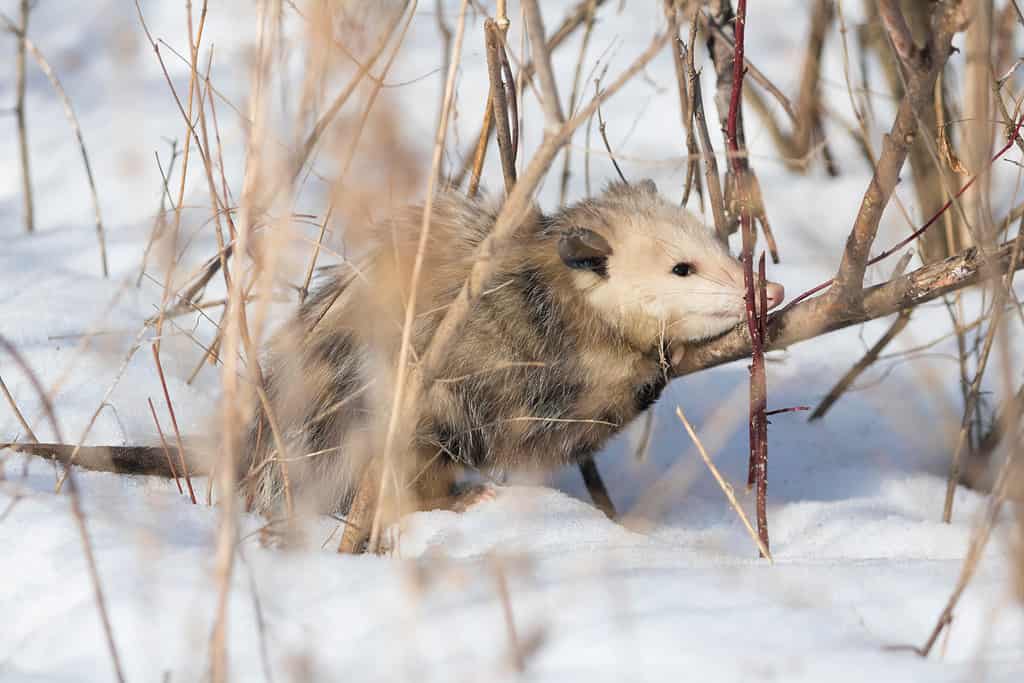
Opossums are not native to snowy places but their range is expanding north.
©KB Digital/Shutterstock.com
Today, the only opossum that lives in North America is the Virginia opossum (also known as the North American opossum). In North America, they mostly live in the eastern United States and extend into Canada in southern Ontario. They are not native to the western U.S. but were brought there during the Great Depression and exist in smaller numbers. The Virginia opossum is prolific in Central America and extends south as far as Costa Rica.
Description

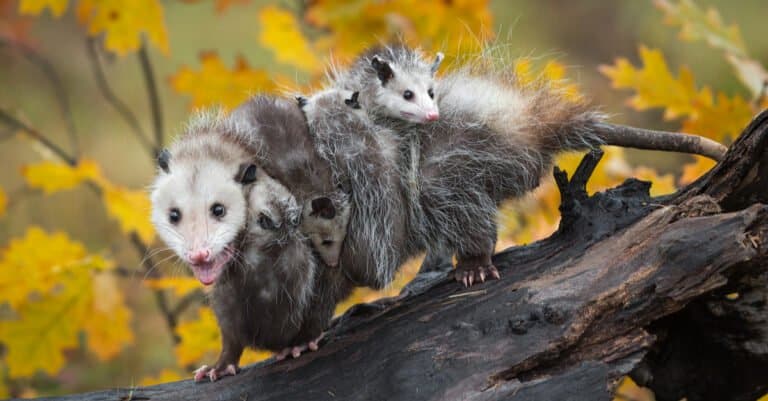
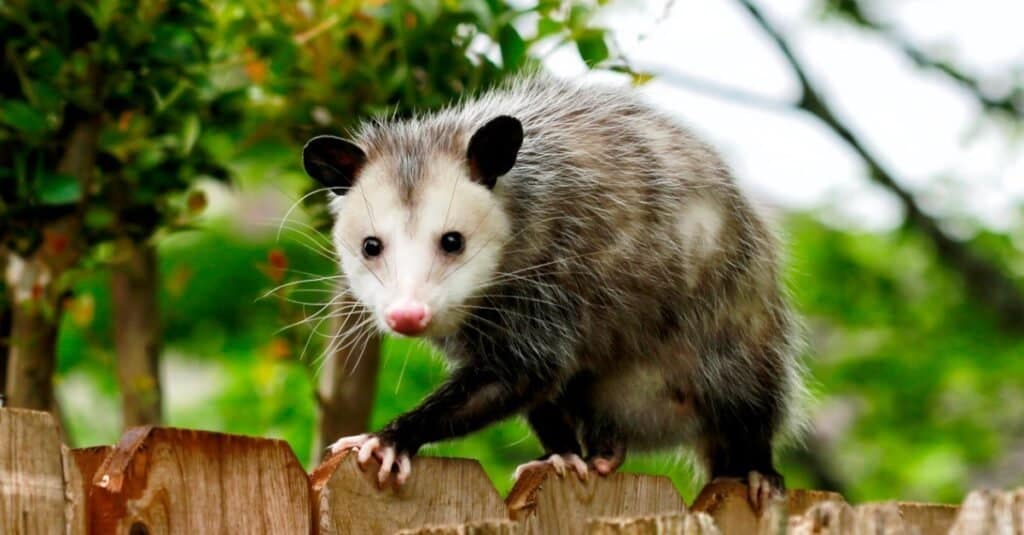
Opossums have a distinct white face and primarily gray fur on their bodies.
©Evelyn D. Harrison/Shutterstock.com
Opossums are the largest and only marsupial in the United States, but they can vary considerably in size. The Virginia opossum is between 4.6 to 6.2 pounds and 13 to 22 inches long not including the tail. The tails on average are 9.8 to 21.3 inches long, are hairless, and are prehensile. This means they can be used to grab branches or small objects. Opossum faces are white, and the rest of their coats are a grayish-brown color. Interestingly, opossums have 50 teeth, which is more than any other North American land mammal.
Opossum Tracks
Paw Morphology
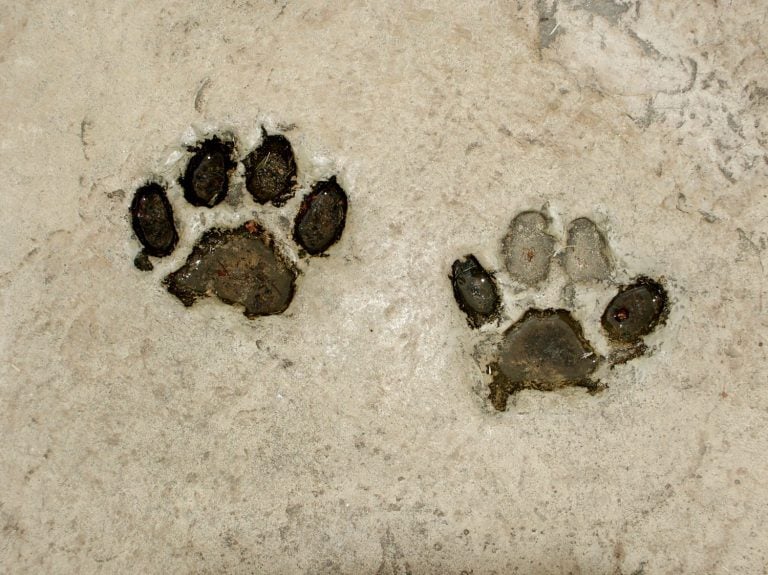
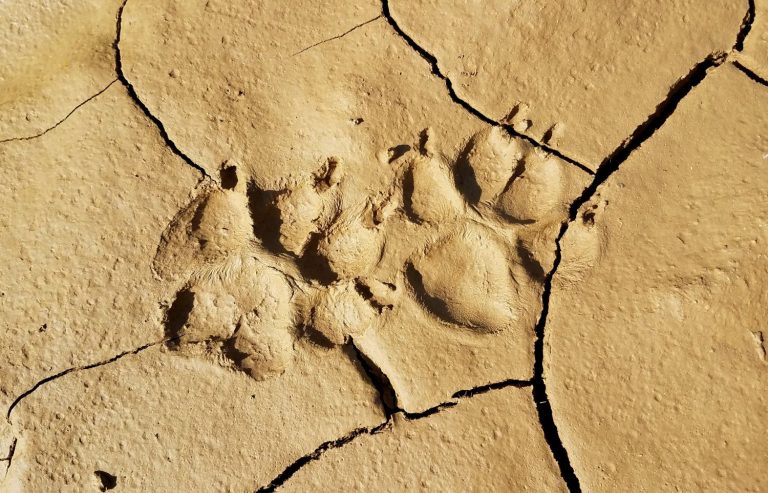
There are several ways that opossum paws are distinct from a rodent’s. Virginia opossums have five digits on their front and back paws, including opposable thumbs. Opossums have claws on all their digits except for the thumbs that appear in their tracks. The forepaws produce prints that are about 2 inches long by 2 inches wide and the hind paws 2.5 inches long by 2.3 inches wide. An opossum’s typically employ a “pacing” gait. This is when the forelimb and hindlimb on one side of the body move simultaneously before the limbs on the other side. The prints will therefore appear in a different pattern from rodents whose front paws move in unison and back paws move in unison.
Snow
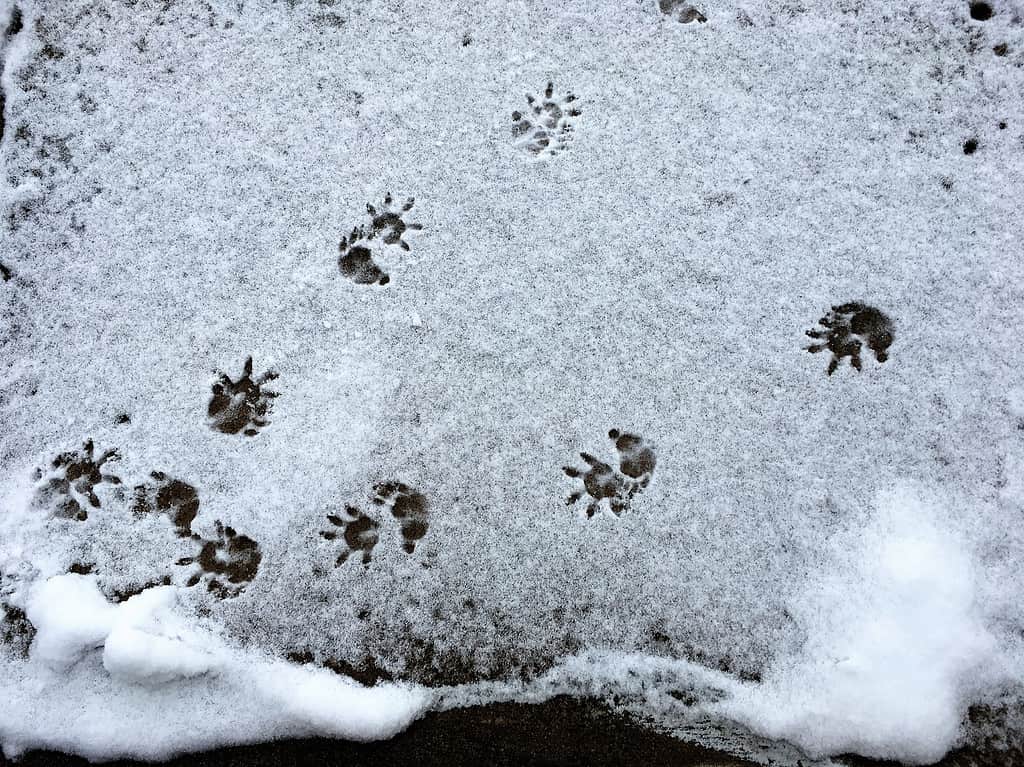
These opossum tracks clearly show impressions from the animal’s opposable thumbs.
©jelloyd/Shutterstock.com
Opossums are not well adapted to living in the snow and thus are less prolific in snowy places. As their range expands into the northern United States and Ontario, however, they may become more common. In deep snow, lack of contrast may obscure details such as claw marks in the prints. Opossum tracks can be distinguished from rodents because their larger body size causes their stride to be quite long. The main clue to look for when identifying opossum tracks in the snow is their opposable thumb. The thumbs on the hind paws will appear to jut out at a ninety-degree angle.
Mud
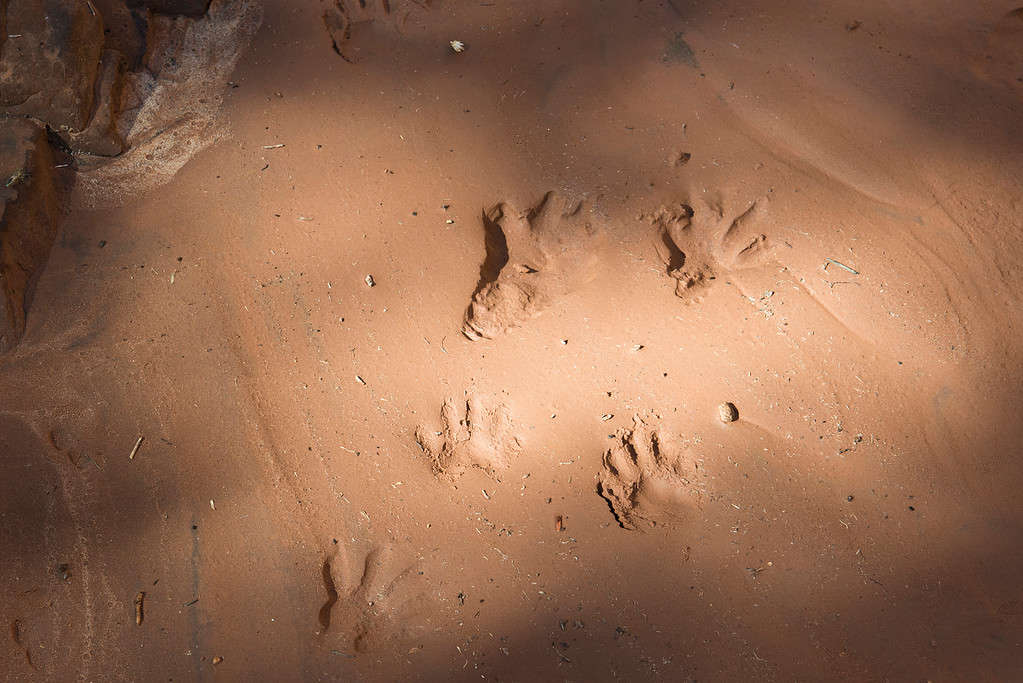
Opossum tracks can often be found in mud along bodies of water.
©Danita Delimont/Shutterstock.com
Opossums inhabit many areas that will have mud and dirt conducive to effective tracking. They live in diverse habitats including wet locations along streams, ponds, lakes, swamps, and marshes. In the mud, if it is not too saturated, the animal’s claws and thumbs will be clearly visible. If you find a trail of footprints, expect the strides to be approximately 7 to 10 inches long. Opossums often stay near bodies of water so look for muddy tracks at the water’s edge. Unlike rats and mice, opossums do not leave drag marks from their tails behind their tracks.