
Quick Take
- A saltwater crocodile is sitting in that muddy water. You just can't see it yet. See the hidden croc →
- The anatomy that makes saltwater crocodiles nearly invisible is more precise than most people realize. Watch the camouflage in action →
- Speed is only half of what makes a saltwater crocodile's attack so difficult to survive. The other half happens before it even moves. See the ambush unfold →
- Wildlife authorities have one hard rule about water in crocodile country, but most people don't take it seriously enough. Understand the attack statistics →
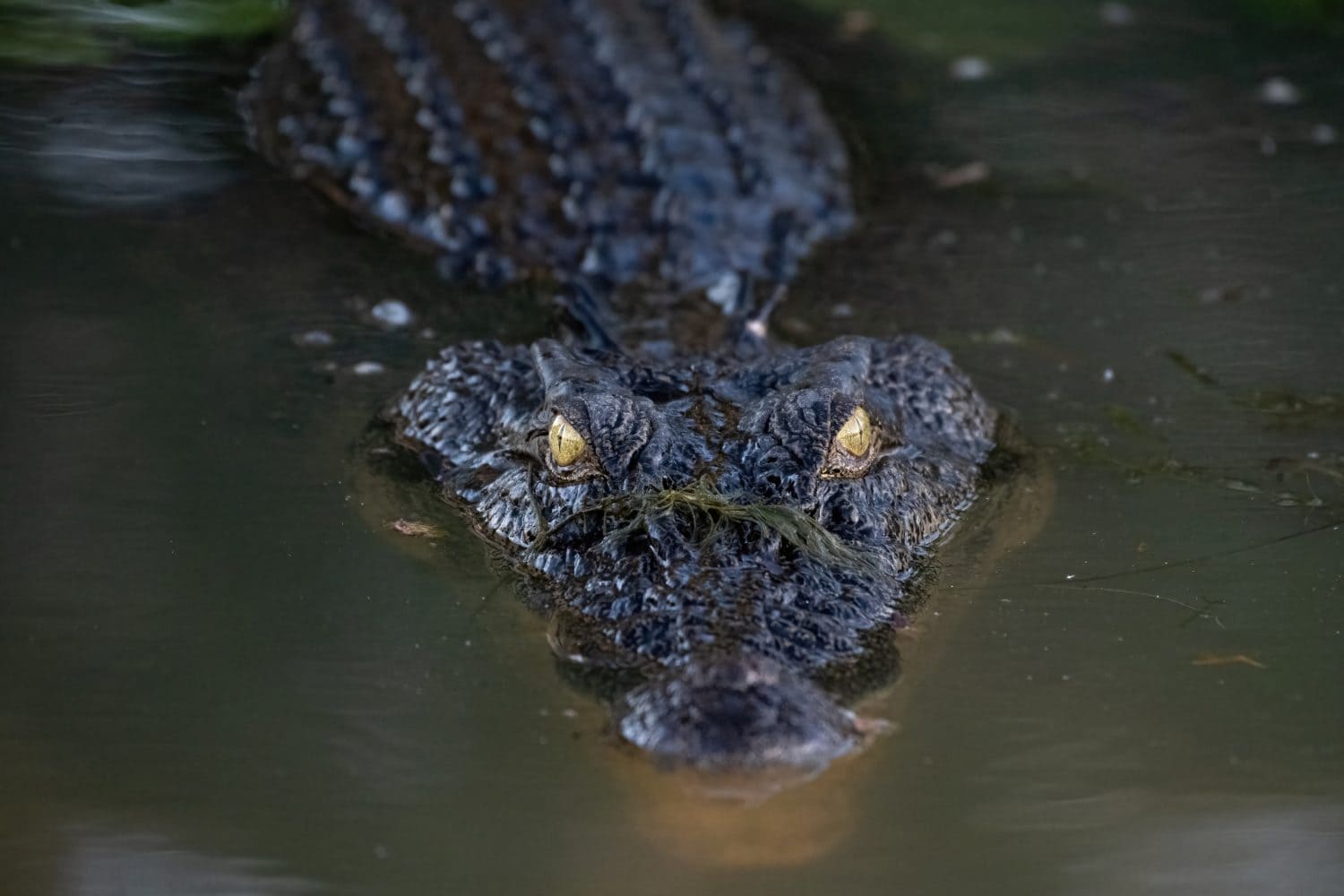
Few predators can disappear in plain sight quite like a saltwater crocodile. These enormous reptiles are the largest living reptiles on Earth, and much of what makes them dangerous happens before you ever see them. Their eyes and nostrils sit high on the head, allowing nearly the entire animal to remain hidden beneath the surface. The video above gives a pretty convincing demonstration of just how effective that camouflage can be.
Massive Saltwater Crocodile Hides Beneath Murky Water
The educational YouTube video posted at the top shows what appears to be a large saltwater crocodile during a feeding. The Bent on Fishing YouTube channel shared the footage. The person filming has an Australian accent, but the clip itself does not establish exactly where it was recorded, so it is safest not to pin the encounter to a specific location or facility.
The Crocodile Nearly Disappears Beneath the Surface
As the video begins, we see a fenced area surrounding a small body of extremely muddy water. At first glance, there does not appear to be much happening beneath the surface. That changes when a person carrying a bucket and a pole approaches the water, apparently preparing to feed the crocodile.
The person begins disturbing the murky water and, for a moment, there is still almost nothing to see. Then the crocodile’s back and scales begin appearing through the brown water. Saltwater crocodiles are remarkably well adapted for this kind of concealment. Their eyes, ears, and nostrils sit near the top of the head, allowing most of the body to remain submerged while the animal can still see, hear, and breathe. It is a lot more effective than anything Godzilla ever tried.
Seconds later, the crocodile surges out of the water toward the feeding area with startling speed. That sudden burst is exactly what makes these reptiles such effective ambush predators. The risk of crocodile attacks is particularly serious in and around the water, where the animals can remain concealed until they are extremely close. In this case, the person conducting the feeding appears prepared for the crocodile’s movement and backs away as the animal emerges.
What Do Saltwater Crocodiles Eat?
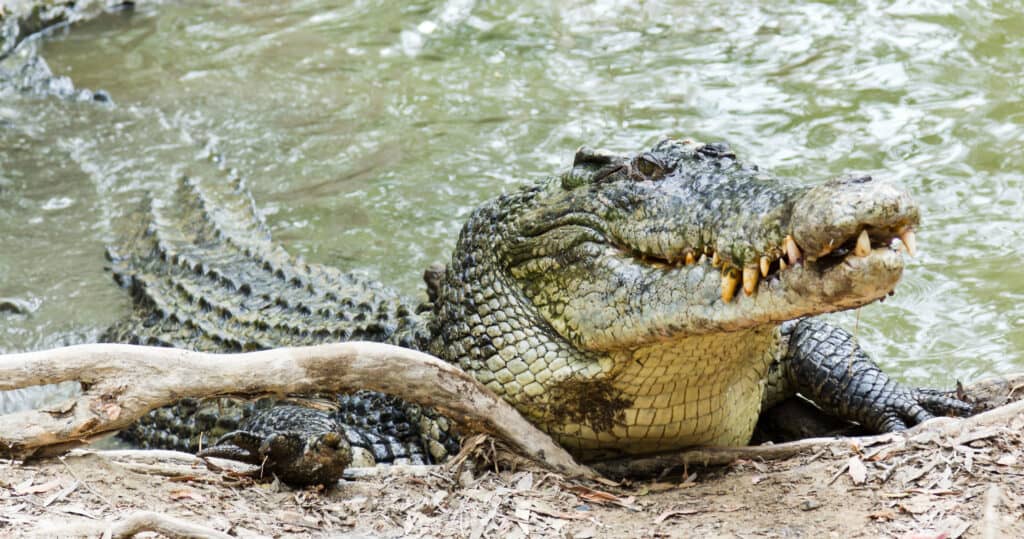
Saltwater crocodiles can remain almost completely submerged while keeping their eyes and nostrils above the surface.
©Meister Photos/Shutterstock.com
The saltwater crocodile (Crocodylus porosus) is the world’s largest living reptile and an opportunistic carnivore. According to the Australian Northern Territory Government, saltwater crocodiles mostly eat fish but will take almost anything they are large and powerful enough to overpower. Their prey can include turtles, goannas, snakes, birds, cattle, buffalo, wild boar, and mud crabs. Young crocodiles start much smaller, feeding on insects, crustaceans, frogs, reptiles, and small fish.
Saltwater crocodiles frequently rely on ambush rather than chasing prey over long distances. They can remain nearly motionless in the water and then launch themselves forward with a powerful burst from the tail when an opportunity appears. They may also be particularly active while hunting at night, one reason wildlife authorities urge people to be especially cautious around crocodile habitat after dark.
Attacks on people are uncommon compared with the number of people who live and travel in crocodile country, but the risk is very real. A 2005 review in the Wilderness & Environmental Medicine journal documented 62 definite, unprovoked attacks by wild saltwater crocodiles in northern Australia between 1971 and 2004, 17 of which were fatal. That is a historical study period rather than a current attack total. Modern Northern Territory guidance is straightforward: never swim in water where saltwater crocodiles may live, stay well back from the water’s edge, and never approach, provoke, or feed one in the wild.