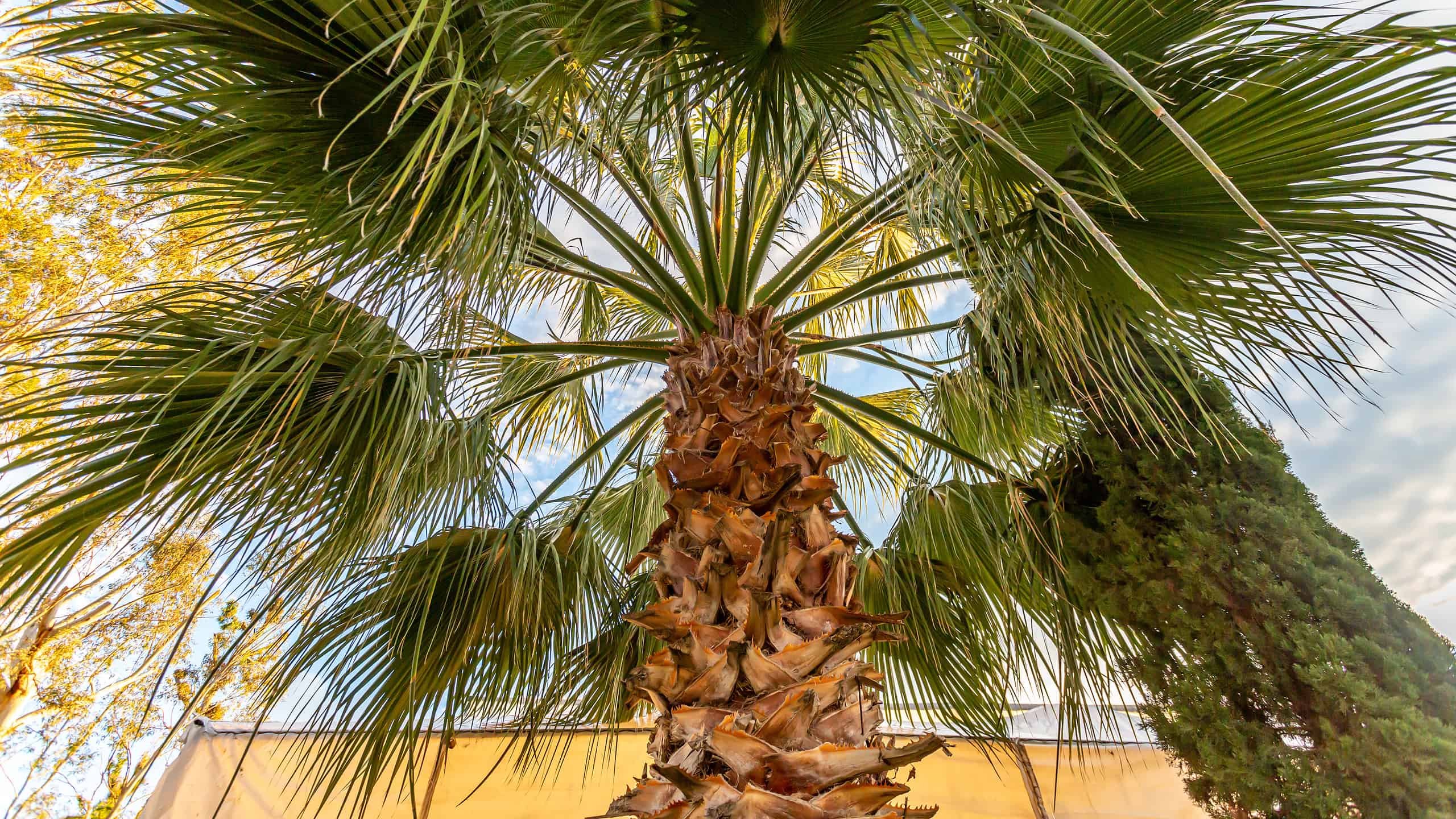

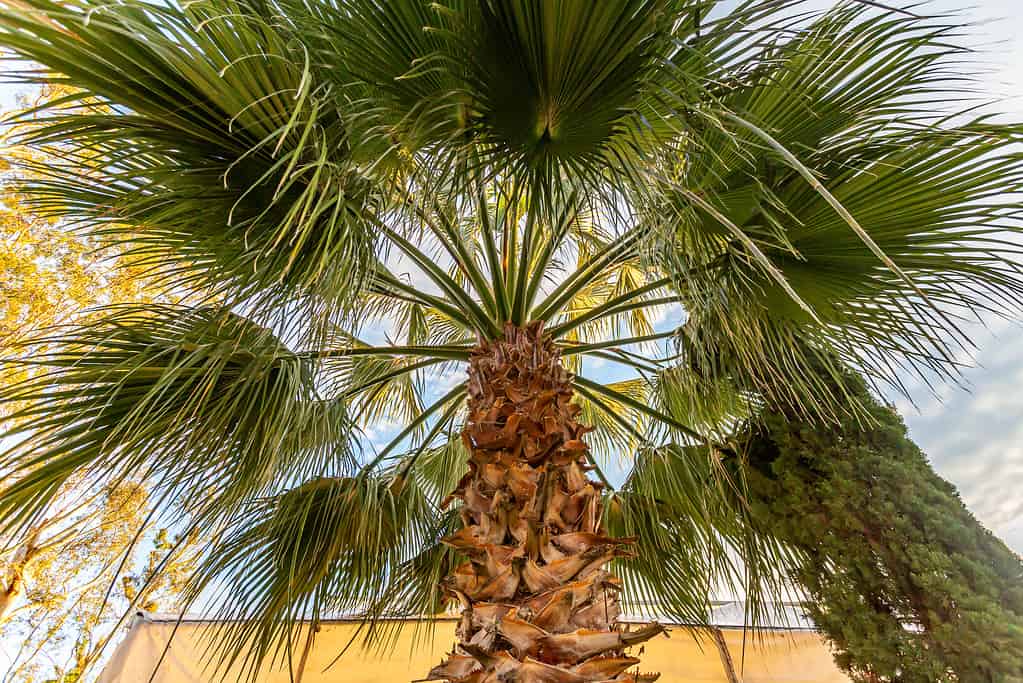
The Chinese fan palm makes for a decorative addition to the warm-weather landscape. Compared to other palms, its beautifully unique fronds lend a softer, more peaceful feel to outdoor living spaces. This plant provides privacy when young and shade as the tree becomes taller with age. At any stage of its life, its wide, cascading crown is sure to catch the attention of passersby.
If you’d like to grow your Chinese palm at home, the information in this guide will help get you started on the right foot.
| Botanical Name | Livistona chinensis |
| Common Name | Chinese fan palm, fountain palm |
| Sunlight | Full sun is best but will grow in light shade. |
| Water | Can tolerate drought, but regular watering is ideal. |
| Soil Conditions | Well-draining, high organic matter content. Slightly acidic to neutral pH. Fairly tolerant of salt spray |
| Hardiness | USDA zones 9-11. Down to ~20°F |
| Indoors or Outdoors? | Outdoors |
| Special Considerations | Considered invasive in multiple U.S. states |
What Is a Chinese Palm?
Chinese palm trees are hardy and able to withstand temperatures as low as 20 degrees F.
©Foto Para Ti/Shutterstock.com
The Chinese fan palm, Livistona chinensis, is a true palm that is native to southern Japan, Taiwan, and southeastern China. Because it produces flowers instead of cones, it is considered a true palm rather than a cycad. It is a popular cultivar in many tropical and subtropical regions of the world because of its relative cold-hardiness and unique fronds.
While these palms are ultimately considered trees (not all palms are), it can take years for them to produce their trunk. For many years of their lives, they stay close to the ground and increase the spread of their crown. They are often used as private shrubs or as groundcover during this period. Eventually, however, they begin to develop a single, slender trunk and rise to mature heights of about 40 feet.
In the meantime, the plant expends much of its energy producing its large, evergreen, fan-shaped fronds. When young, frond stalks have spines. However, as the palm ages, it tends to produce fronds with fewer spines or none at all. The leaflets are unique in their morphology and are the primary reason that these palms are sought after as ornamental plants. Each frond is a compound and consists of, on average, about 70 narrow leaflets that all droop downward at the tip. These tips are thin and ribbon-like and wave in the breeze. The result is a beautiful, cascading effect, which earns this plant another name, the fountain palm.
How Do Chinese Palms Reproduce?
The Chinese palm is monoecious, which means that each plant produces both male and female flower parts and is thus able to self-fertilize. Each palm may produce several large inflorescences from within its canopy in the spring and early summer. These reproductive structures can grow up to 6 feet long and may be difficult to see. However, as its small flowers give way to large clusters of heavy, black, or blue fruits, they tend to sag below the leaves and into view.
The Chinese palm is incredibly prolific — Hundreds of fruit may appear on a single inflorescence. It can produce enough weight in fruit to split apart its crown. Each of its edible, fleshy fruits contains viable seeds that will germinate fairly quickly for a palm. In just two months, they may begin to grow into new plants.
Because of its abundant seed production and quick germination, the Chinese fan palm easily establishes itself in new environments. Additionally, many species of birds take advantage of this palm as a food source and subsequently drop the seeds far and wide. Due to this, it is considered invasive in Hawai’i, Florida, and Bermuda, as well as other warm, tropical environments outside of its native range.
How to Grow a Chinese Palm
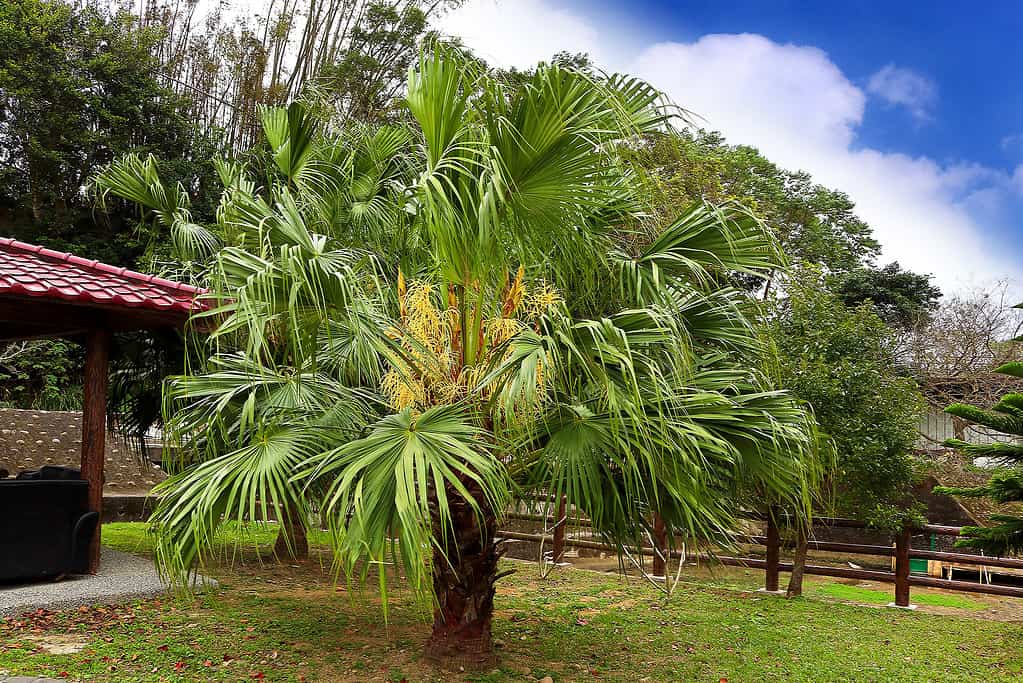
The Chinese palm has both male and female parts and self-fertilizes.
©topimages/Shutterstock.com
If you’d like to have a Chinese fan palm at home, know that these plants are easy to cultivate. Although they can tolerate some cold weather, they will fare best in climates that do not experience sub-freezing temperatures. In very cold weather, fronds may be frost-burned and killed back. However, if the palm survives the freeze, it will produce new leaves.
Sunlight
The Chinese palm does best in full sun but can also grow in light shade. This makes it a great candidate for indoor growing, as the bright, indirect light from a south-facing window will be more than enough to sustain its growth. Indoors, your palm will likely top out at about 8 feet in height.
Outdoors, you will want to ensure that your palm has plenty of space to spread out its fronds. Fronds that are unobstructed by buildings, hardscaping, or other plants guarantee that your palm has the best possible access to sunlight.
Water
This fan palm can tolerate drought conditions and relatively infrequent watering. However, a regular watering routine is beneficial. It is best to water these palms when the first couple of inches of soil dry out. Be careful not to overwater, however. Puddles of standing water that remain for long periods prevent oxygen from reaching your plant’s roots. When soil becomes anaerobic, it allows for the growth of pathogens that cause root rot and weakens your plant’s ability to defend itself.
If you’re growing your palm indoors, be certain that your plant’s container has one or more drainage holes at the bottom. If it has a drip tray, be sure to empty it frequently. Low levels of humidity indoors may cause your plant’s leaves to dry out. You can prevent this by lightly misting them every day or so.
Soil Conditions
Whether you’re growing your Chinese palm indoors or outdoors, you must make sure that your plant’s soil drains well. Luckily, this species tolerates various soil types as long as its roots stay well-oxygenated. In overly sandy soils, you should keep an eye on your plant’s leaves and watch for discoloration, as it could indicate a nutrient deficiency.
No matter your soil type, disturbing it as little as possible and covering it with mulch when you are finished planting is crucial. Adding a couple of inches of mulch aids in water retention prevents erosion, and keeps your soil cooler. It also shelters populations of soil microbes that are vital to your plant’s health. As a general rule, the more soil is disturbed, the more its structure is damaged.
Fertilization
This palm species is less susceptible to many of the common nutrient deficiencies that palms experience. However, your palm may struggle for nutrients in sandy or rocky, weathered soils. If this sounds like your soil, you must fertilize your palm to ensure it gets the nutrients it needs.
Once or twice a year, you may apply slow-release fertilizers designed especially for palms. These fertilizers focus mostly on nitrogen and potassium and should contain micronutrients as well. This should supply your palm with everything it needs. For most deficiencies, it should be enough to bring your plant back to health. However, repeated application of only chemical fertilizers can worsen long-term soil health. In addition, you should incorporate some composted organic matter into the loose soil when planting your palm. This will help increase your soil’s nutrient-holding capacity. Later on, you can add top dressings of compost or well-rotted animal manure. Over time, these are further broken down and release nutrients back into your soil.
Pruning Your Chinese Palm
All evergreen plants eventually shed their leaves; your palm is no exception. When a frond becomes spent, your palm will begin to reabsorb its nutrients. This will cause the frond to start yellowing. While it may seem unsightly, this re-absorption of nutrients is important to your plant’s health and, if possible, should not be interrupted. In addition, open wounds from early pruning can encourage infestation by insect pests.
Once the frond has died completely, you can prune it back with little risk. Be sure to make your cut at the base of the palm, close to the trunk.
Pests and Disease
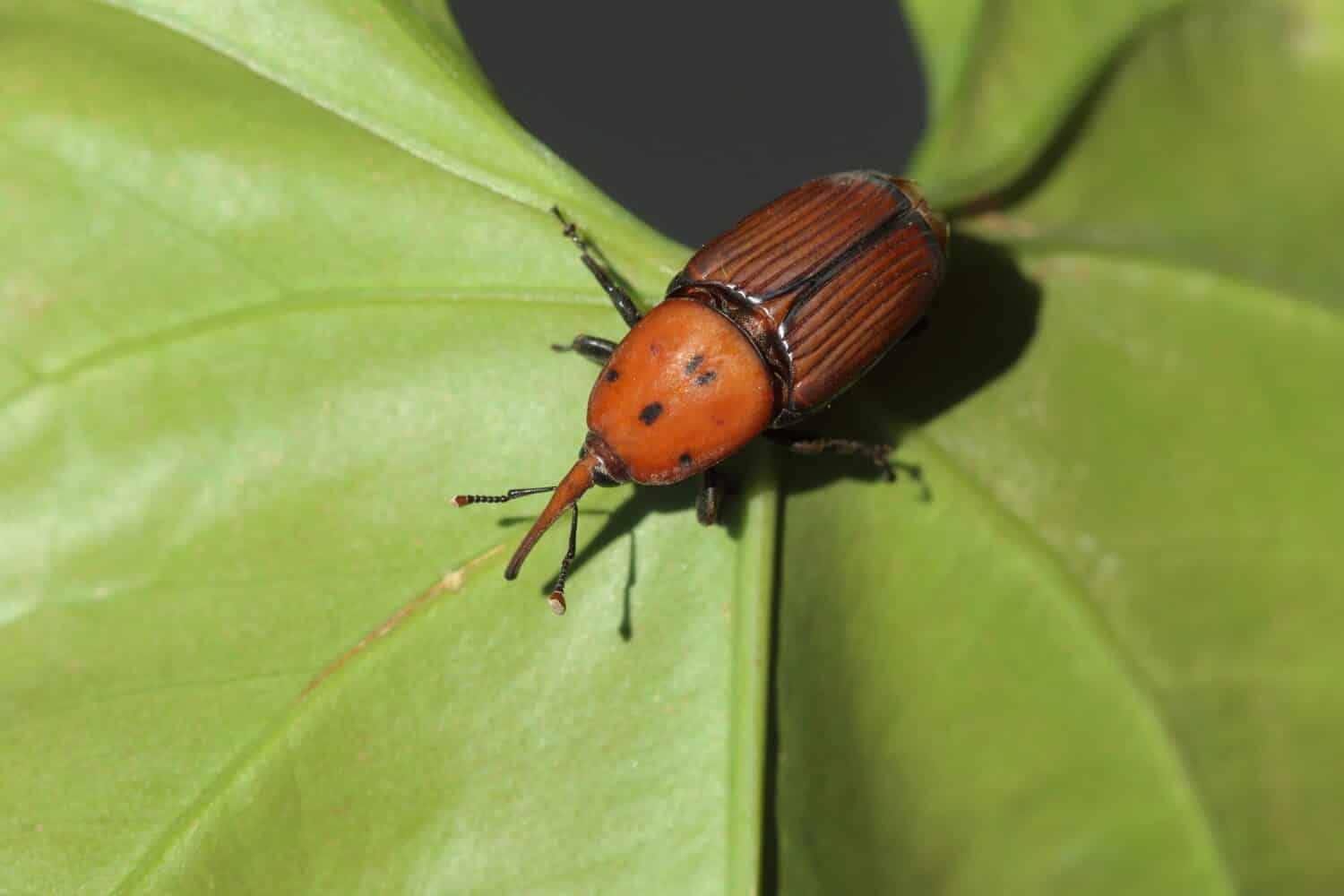
The red palm weevil is one of the pests that may affect your plant.
©Uunal/Shutterstock.com
Your palm may struggle with some common pests and diseases, whether indoors or outdoors. Below, we’ll talk about a couple of organisms that can cause your plant serious problems. Remember, stressed plants are less able to defend themselves. The best way to help your plant ward off problems is to supply it with everything it needs to stay healthy.
Spider Mites (Tetranychus sp.)
Although they can occur outside, you are also likely to encounter spider mites indoors, where the air tends to be drier. When humidity is low and insufficient air movement, your plant’s leaves may begin to dry out and collect dust. These are ideal conditions for spider mites.
You can prevent these tiny arachnids from feasting on your plant by regularly misting your palm’s leaves. If you already have an infestation, the first thing to try is a more directed water spray. This will knock the mites off your plant and remove webbing and debris that shelter them. Make sure you spray beneath the leaves. Don’t forget to allow your plant to dry after you’re done, as excess water on foliage can cause mildew problems.
Ganoderma Butt Rot (Ganoderma zonatum)
This fungal infection is caused by a soil-borne Ganoderma fungus that is closely related to the reishi mushroom. Over time, this fungus digests the lignin inside the lower portion of the palm’s trunk. This can cause the trunk to become weak and unstable and can, in turn, cause the entire palm to fall over.
Infection by this fungus may cause the palm’s leaves to wilt and turn yellow. However, the only outward symptom that can confirm a Ganoderma infection is the presence of a brown and white, shelf-like fruiting body at the base of the tree. Unfortunately, by the time this fruiting body appears to confirm the infection, the tree will soon die. There are no early detection methods for this disease, and it cannot be cured once it has begun.
If your palm succumbs to Ganoderma butt rot, it must be disposed of as soon as possible. Because the fungus is present in the palm’s trunk, it should not be reused for any purpose. Using the trunk as mulch will spread the fungus across your landscape’s soil and will likely cause other palms to become infected. In addition, you should remove the fruiting body of this fungus as soon as you notice it to decrease the spread of spores.
Red Palm Weevil (Rhynchophorus ferrugineus)
The red palm weevil is a large beetle that bores into the tissue of a plant to obtain food, shelter, and space to reproduce. Each insect, male or female, has an elongated, snout-like structure called a rostrum that protrudes from its head. Because they may exhibit a range of coloration, these weevils may be difficult to positively identify. They are usually variegated, primarily black with red markings or red with black markings. However, if you encounter an insect with a rostrum, you will know that you may have some weevil infestation and should closely examine your palms.
These particular weevils are considered invasive pests in many parts of the world, having been inadvertently distributed across the globe via the palm trade. They are difficult to detect once they have begun to infest a plant and cause extensive damage. Early infestations will likely produce no symptoms in your palm. Later on, however, as the beetles have tunneled through the inside of the crown and trunk, the host palm will stop growing healthy leaves. Older leaves will begin to turn yellow or brown and eventually begin to droop. There will likely be frass, or insect droppings, around the bases of each frond.
If you notice any symptoms of weevil infestation, it is important to contact an arborist as soon as possible. Although you may not be able to save the infested tree, early removal and control of pest insects by professionals can help protect surrounding palms.