B
Species Profile

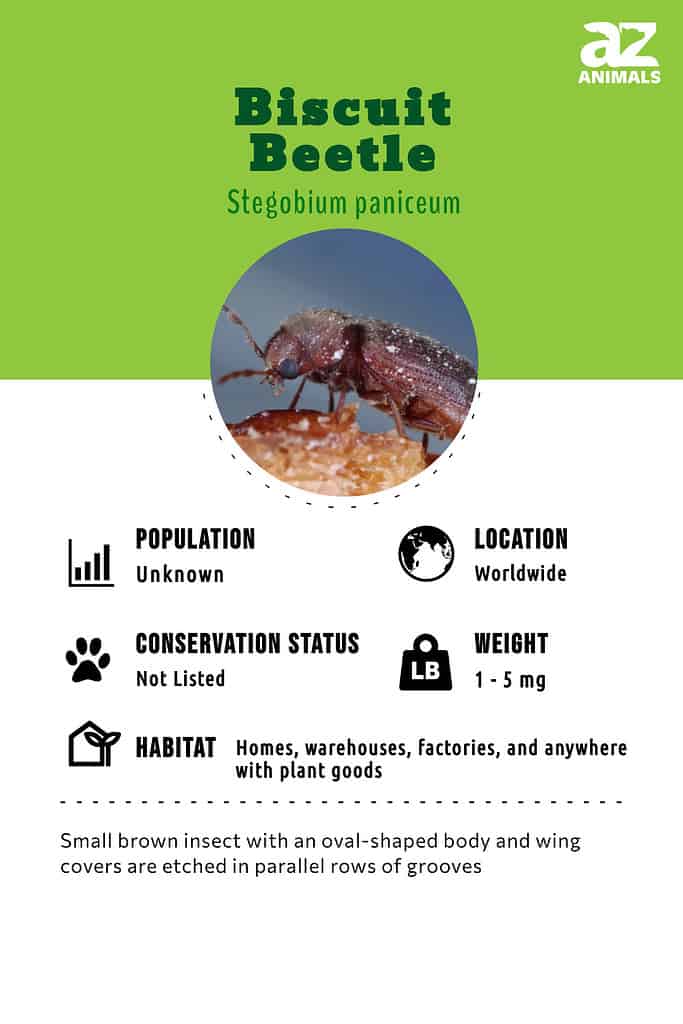
Biscuit Beetle

Stegobium paniceum

Small beetle, big pantry problem.
Tomasz Klejdysz/Shutterstock.com

Biscuit Beetle Distribution

Click a location to explore more animals from that region

Invasive Species
Origin Location

This map shows the native origin of the Biscuit Beetle. As a cosmopolitan species, they are now found worldwide.

Loading map...

At a Glance

Found Worldwide
Also Known As Bread beetle, Bakery beetle, Pantry beetle, Pantry pest, Stored-product beetle
Activity Nocturnal+
Lifespan 4.5 years
Status Not Evaluated
Did You Know?

Adults are only ~2-3.5 mm long, yet the larva can grow to ~4-5 mm before pupating (reported in stored-product entomology manuals).

Scientific Classification

A small brown pantry beetle whose larvae bore through and feed on a wide range of dried stored products; adults are commonly found in kitchens, food storage areas, and warehouses.

Kingdom
Animalia
Phylum
Arthropoda
Class
Insecta
Order
Coleoptera
Family
Ptinidae
Genus
Stegobium
Species
paniceum

Distinguishing Features

  • Small (typically ~2–3.5 mm), oval, brown beetle associated with stored foods
  • Adults have longitudinal striations (grooves) on the wing covers (elytra)
  • Larvae are C-shaped grubs that can tunnel into packaged goods

Physical Measurements

Length
0 in (0 in – 0 in)

Appearance

Primary Colors
Secondary Colors
Skin Type Hard, sclerotized beetle exoskeleton (elytra and pronotum) with fine surface pubescence; larvae are soft-bodied (grub-like) with a hardened head capsule; pupae are exarate (appendages free) and pale.
Distinctive Features
  • Very small adult beetle: typically about 0.2-0.35 cm long; oval-cylindrical and hump-backed in profile due to the hood-like pronotum that conceals the head from above.
  • Elytra with obvious longitudinal rows of punctures/striations (key diagnostic vs. cigarette beetle).
  • Antennae end in a distinct 3-segmented club (key diagnostic vs. cigarette beetle's serrate antennae).
  • Larvae are C-shaped, cream/tan, and capable of boring through/into many dried stored products (flour, spices, pet food, dried herbs, pharmaceuticals, etc.), often leaving powdery frass and irregular feeding tunnels.
  • Complete metamorphosis (egg-larva-pupa-adult) occurs in or next to dried food; eggs on food, larvae do the damage, pupae form in/near food, adults leave small exit holes.
  • Adults are commonly encountered walking on pantry shelves/windowsills and can fly; infestations are primarily a contamination/spoilage and product-loss issue rather than a direct health threat.

Did You Know?

Adults are only ~2-3.5 mm long, yet the larva can grow to ~4-5 mm before pupating (reported in stored-product entomology manuals).

A female typically lays ~20-100 eggs (often cited around ~75) directly on/near dry food; newly hatched larvae immediately burrow in.

The drugstore beetle's elytra show distinct longitudinal grooves (striations)-a key ID clue vs. the similar cigarette beetle.

It can infest an unusually wide menu: flour, spices, dried herbs, pet food, birdseed, cacao, pasta, and even medicinal drugs-hence "drugstore beetle."

Larvae often pupate in a silken cocoon reinforced with food dust/fragments, so the "case" looks like the product itself.

Commercial monitoring commonly uses the species' sex pheromone (stegobinone) in sticky traps to detect infestations early.

Adults are strong fliers for their size and are frequently found at windows/lights after emerging from hidden food sources.

Unique Adaptations

  • Broad diet aided by microbial symbionts: Stegobium paniceum is known to harbor symbiotic microorganisms that help it thrive on nutrient-poor, very dry foods (notably providing vitamins), a classic stored-product adaptation reported in entomological literature.
  • Low-moisture survival: larvae can develop in very dry commodities by obtaining water metabolically and from limited moisture in the food matrix-one reason they persist in pantries.
  • Protective pupation: the larval cocoon is strengthened with food particles, camouflaging it and reducing desiccation and disturbance risk.
  • Packaging exploitation: small body size plus strong mandibles allow entry via tiny gaps, seams, and weak points; infestations may start from minute openings rather than obvious tears.
  • Chemical communication: adults use a species-specific pheromone (stegobinone) that enables targeted monitoring and helps explain why traps can reveal hidden sources.

Interesting Behaviors

  • Egg-larva-pupa-adult life cycle occurs inside/within dry stored products: eggs are placed on food, larvae feed and tunnel, pupation occurs in a cocoon, then adults emerge and disperse.
  • Larval boring behavior: larvae chew into items (including compacted foods like biscuits/crackers and sometimes paperboard packaging), producing fine, gritty frass and "shot holes."
  • Hiding and dispersal: adults often remain concealed near the food source, but many fly toward light and accumulate on windowsills-useful for locating infestations.
  • Thanatosis (drop/feign behavior) is commonly observed in ptinid pantry beetles when disturbed-adults may tuck legs and remain still briefly.
  • Continuous breeding indoors: in heated buildings with steady food, overlapping generations can occur, so multiple life stages may be present at once.
  • Warehouse/pantry "hot spots": infestations often concentrate where dust and spillage accumulate (under shelving, bag seams, pallet edges), then radiate outward.

Cultural Significance

Stegobium paniceum (biscuit beetle, drugstore beetle) lives with people, getting into biscuits, crackers, dry goods and old medicines. In museums, libraries and herbaria it can eat dried plant specimens and starchy or animal materials, so sealed storage and cleaning are vital.

Myths & Legends

The common name 'drugstore beetle' (Stegobium paniceum) came from early infestations in pharmacies, where these beetles were found in dried plant drugs and medicines, so the name stuck.

In parts of Britain and Europe, people linked tapping beetle sounds to bad omens. Pantry beetles like Biscuit beetle (Drugstore beetle) (Stegobium paniceum) were sometimes lumped in, though they don’t make the deathwatch knock.

Old stories called small house beetles 'bookworms', including the Biscuit Beetle (Drugstore beetle, Stegobium paniceum). Pantry beetles found near papers or herbs appear in moral tales about neglect, not a true myth cycle.

Conservation Status

NE Not Evaluated

Has not yet been evaluated against the criteria.

Population Unknown

Life Cycle

Birth 75 larvas
Lifespan 5 years

Lifespan

In the Wild
2–9 years
In Captivity
2–4 years

Reproduction

Mating System Promiscuity
Social Structure Aggregation Group
Breeding Pattern Transient
Fertilization Internal Fertilization
Birth Type Internal_fertilization

Behavior & Ecology

Social Aggregation (infestation) Group: 40
Activity Nocturnal, Crepuscular
Diet Detritivore starchy cereal products-especially wheat flour and bread/biscuit-like dried foods (basis of the common name "drugstore/biscuit beetle"; reported as highly suitable substrates in stored-product entomology studies)
Seasonal Hibernates

Temperament

Non-aggressive; no social defense (ptinid stored-product beetle)
Cryptic/thigmotactic: prefers tight harborage in cracks, packaging seams, and within bored food material (Rees, 2004)
Disturbance response often includes immobility/thanatosis-like behavior typical of many ptinids (general Ptinidae behavior; summarized in Cox & Bell, 1991)
Resource-driven aggregation tolerance: multiple larvae can develop in close proximity in the same product without overt territoriality (Rees, 2004)

Communication

sex pheromone communication: females emit a long-range attractant used by males; the female-produced pheromone is known as stegobinone Identified in chemical ecology studies of S. paniceum; e.g., Tsuchiya et al., 1980s-era literature
short-range contact cues during courtship: antennation and tactile contact typical of small coleopterans during mating interactions General coleopteran mating behavior; summarized in stored-product entomology texts such as Rees, 2004
chemical/kairomonal orientation to host materials: adults orient to food/commodity volatiles and odors from infested material Stored-product pest ecology; Rees, 2004
substrate-borne cues via frass/infestation odor: individuals are often found concentrated where frass and damaged product accumulate, consistent with arrestment/retention by local chemical cues Stored-product pest ecology; Cox & Bell, 1991; Rees, 2004

Habitat

Biomes:
Temperate Forest Temperate Grassland Mediterranean Tropical Rainforest Tropical Dry Forest Savanna Desert Hot Desert Cold Boreal Forest (Taiga) Tundra Alpine +5
Terrain:
Coastal Island Plains Hilly Mountainous Plateau Valley Riverine Rocky Sandy +4
Elevation: Up to 8202 ft 1 in

Ecological Role

Detritivore/decomposer in human-modified environments (synanthropic stored-product decomposer) and major stored-product pest.

breakdown and recycling of dried organic matter (especially plant-based detritus) where infestations occur secondary decomposer role by consuming moldy/yeast-contaminated stored materials prey resource for predators/parasitoids associated with stored-product ecosystems (e.g., parasitoid wasps used in biocontrol)

Diet Details

Other Foods:
Dried cereal products Whole grains and seeds Processed dry staples Dried plant materials Dried fruits and nuts Tobacco and dried botanicals Stored dried animal-derived products Starch- and protein-based household materials Mold +3

Human Interaction

Domestication Status

Wild

Not domesticated. The biscuit (drugstore) beetle, Stegobium paniceum, is a synanthropic, cosmopolitan stored-product pest found in pantries, warehouses, mills and pharmacies. It spreads mainly on infested goods and packaging. Adults are tiny (2.0–3.5 mm) and move through buildings; larvae bore into dry foods and some packaging (paperboard, sometimes thin foil).

Danger Level

Low
  • Does not bite or sting; no venom.
  • Food contamination/quality loss: presence of insects, frass, and webbing/boring damage can render products unacceptable.
  • Potential allergen exposure similar to other stored-product insects (inhalant/contact allergens in dust-contaminated environments) reported for stored-product pest complexes; risk highest in heavily infested facilities.
  • Economic/operational harm in homes and food/pharma facilities due to rapid population growth under warm conditions and hidden larval feeding inside products/packaging.

As a Pet

Not Suitable as Pet

Legality: Generally not regulated as a 'pet' animal, but commonly treated as a pest species; intentional keeping/transport may be restricted by facility rules and can violate food-safety and quarantine/pest-control regulations when it risks infestation of stored products.

Care Level: Expert Only

Purchase Cost: Up to $10
Lifetime Cost: Up to $50

Economic Value

Uses:
Negative economic impact (stored-product pest) Public health / food-safety quality issue (contamination) Pest management / monitoring industry Research/teaching specimen (stored-product entomology)
Products:
  • damages/infests dried stored foods (e.g., flour, cereal, bread/biscuits, spices, dried herbs, seeds, pet/bird food)
  • infests pharmaceuticals and botanicals (hence the name 'drugstore beetle')
  • can damage non-food dry goods (e.g., museum specimens, book bindings/paper products in some contexts)
  • drives costs for inspection, sanitation, exclusion, pheromone/light monitoring, fumigation/heat treatments, and product disposal/recall

Relationships

Predators 6

Pteromalid wasp Lariophagus distinguendus
Pteromalid parasitoid wasp Anisopteromalus calandrae
Pteromalid parasitoid wasp Theocolax elegans
Warehouse pirate bug Xylocoris flavipes
Common house spider
Common house spider Parasteatoda tepidariorum
House centipede Scutigera coleoptrata

Related Species 6

Cigarette beetle Lasioderma serricorne Shared Family
White-marked spider beetle Ptinus fur Shared Family
Common furniture beetle
Common furniture beetle Anobium punctatum Shared Family
Deathwatch beetle
Deathwatch beetle Xestobium rufovillosum Shared Family
Smooth spider beetle Gibbium psylloides Shared Family
Golden spider beetle Niptus hololeucus Shared Family

Ecological Equivalents 5

Animals that fill a similar ecological role in their ecosystem

Cigarette beetle Lasioderma serricorne Occupies the same pantry and warehouse pest role, attacking dried foods, spices, herbs, and packaging. Adults are small (~2–3.5 mm) and larvae bore into and feed on stored products. Often confused with the drugstore beetle (Stegobium paniceum).
White-marked spider beetle Ptinus fur Both species live with people in kitchens, pantries, and warehouses, eat a variety of dry stored foods, are members of Ptinidae, and have hidden larvae that can bore through paper or packages.
Granary weevil Sitophilus granarius Both Stegobium paniceum and Sitophilus granarius are key pests of stored cereals and processed dry foods in bins, bags, and silos. Stegobium paniceum often attacks milled products; both species breed multiple times per year in warm storage.
Red flour beetle
Red flour beetle Tribolium castaneum Co-occurs in flour mills, food factories, and household pantries; both species are classic pests of milled grain products (flour/meal). The drugstore beetle differs by frequently attacking tablets, spices, and dried botanicals, and by its larvae boring into and through packaging (Rees, 2004).
Indianmeal moth
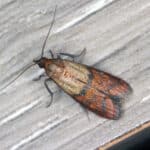
Indianmeal moth Plodia interpunctella Infests stored foods such as nuts, grains, dried fruit, and pet foods. Adults wander or fly into kitchens, while larvae damage food inside packages. Control involves thorough cleaning, excluding pests, and targeted treatments.

The biscuit beetle benefits from a symbiotic relationship with a yeast fungus (symbiosis means the relationship is mutually beneficial to both parties). The yeast produces vitamin B for the beetle because their diet is otherwise nutritionally poor. It passes on the fungus to the offspring by covering the eggs with it.

The biscuit beetle is a small, unassuming insect that many people consider to be a pest. While they do not bite people, these insects consume lots of food and destroy some property. They seem to have adapted very well to human agriculture over the last several millennia. This article will cover some interesting facts about the identification, diet, habitat, and prevention of the biscuit beetle.
Other Names

Over the centuries this species has earned many different names, including the bread beetle and the drugstore beetle. It was given the name bread beetle for its tendency to consume bread, while the name drugstore beetle comes from the fact that it commonly infested drugstores and feeds on pharmacological products.
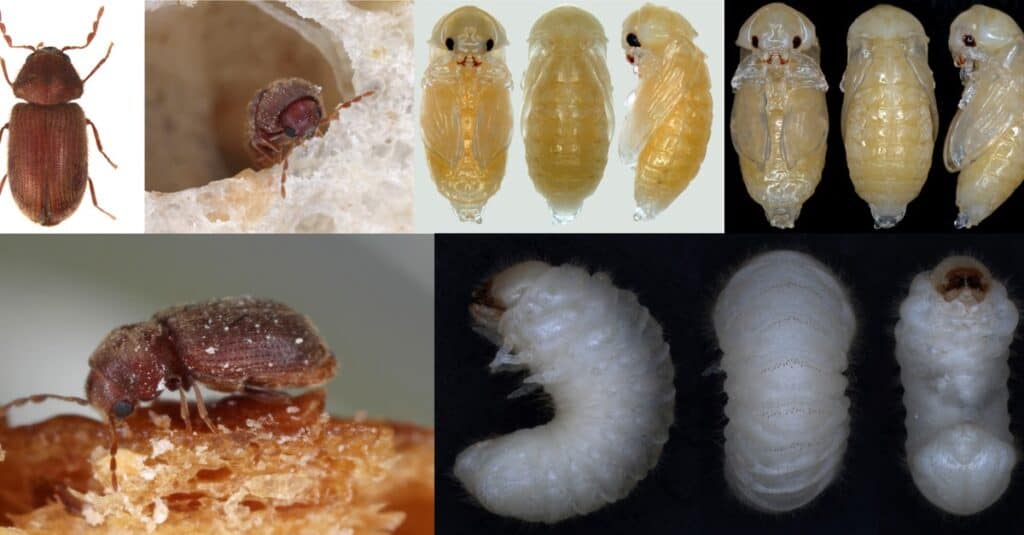
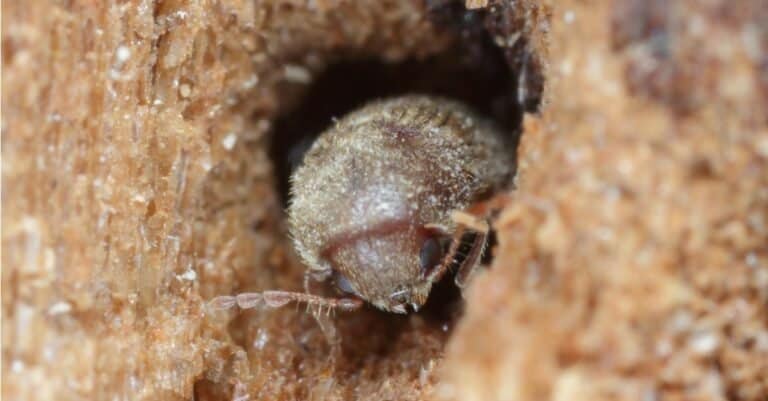
Drugstore beetle Stegobium paniceum known as bread beetle or biscuit beetle is pest in houses, stores and warehouses.

Drugstore beetle Stegobium paniceum known as bread beetle or biscuit beetle is a pest in houses, stores, and warehouses.

Species and Scientific Name

The scientific name of the biscuit beetle is Stegobium paniceum. The genus name stegobium may derive from the Greek word stege, which refers to a type of covering (like the equally descriptive name stegosaur). Paniceum comes from the Greek word panis for bread. This species belongs to the beetle family of Ptnidae, which also includes a number of wood-boring beetles and other annoying pests that infest plants.

Types, History, and Evolution

This species is the only living member of its genus, but scientists have found aged amber fossils dating back nearly 100 million years from New Jersey that contain ancient forms of the biscuit beetle. There are also fossils showing these pests in ancient Roman storehouses.
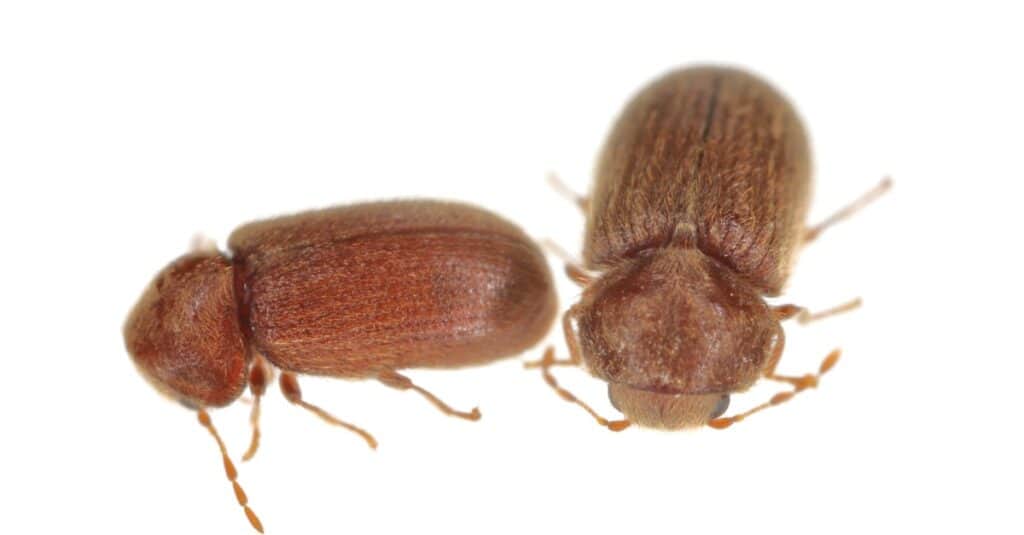
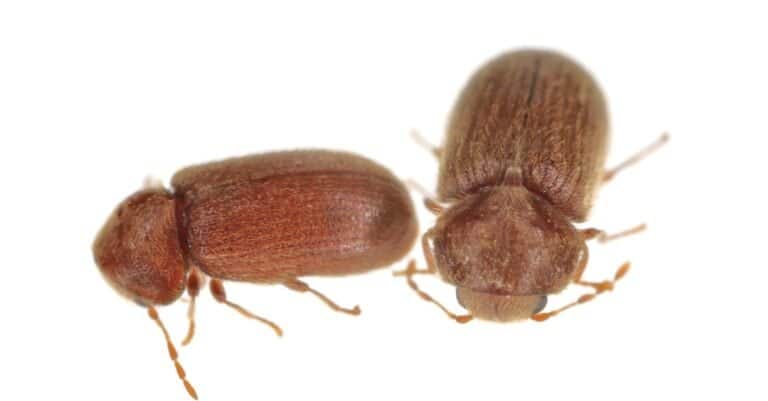
The drugstore beetles (Stegobium paniceum), also known as the bread beetle or biscuit beetle from family Anobiidae. Isolated on a white background.

The scientific name of the biscuit beetle is Stegobium paniceum.

Appearance

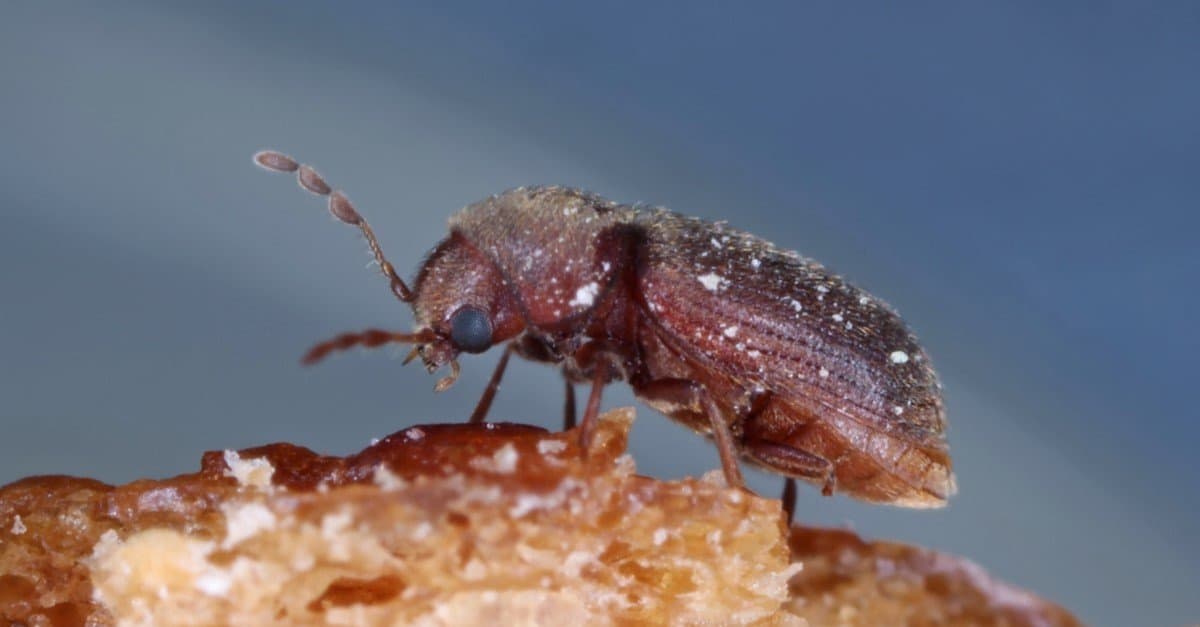
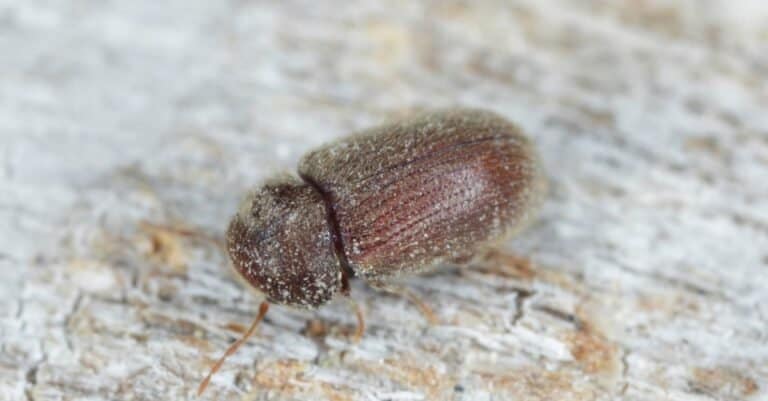
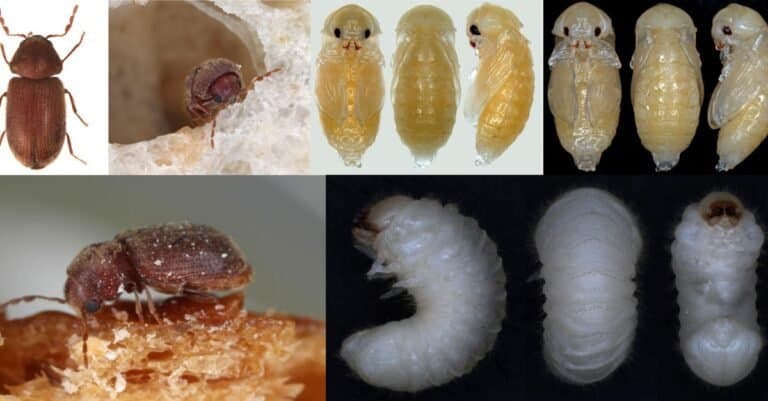
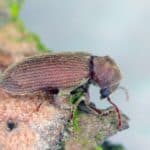
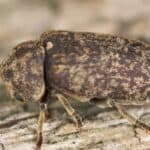
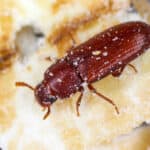
The adult biscuit beetle is a small brown insect with an oval-shaped body, measuring no more than 4 millimeters long. Perhaps the most distinctive feature is the unique wing covers. The outside of the cover is etched in parallel rows of grooves or pits, which should aid quite a bit in identification. This species is similar in appearance to the closely related cigarette beetle, but the main difference is that the cigarette beetle has a smooth shell and is overall smaller in size.

The biscuit beetle passes through several different stages in its life cycle. Before it reaches adulthood, the larvae are small white grubs with thin hairs all over the body. Just like the adults, the larvae are easy to accidentally mistake for the cigarette beetle, but the difference is that the biscuit larva has shorter hairs and red markings on the head that end in a straight line. Once it has sufficiently grown, the larva will enter the pupa stage by encasing itself in a cocoon over the entire body.
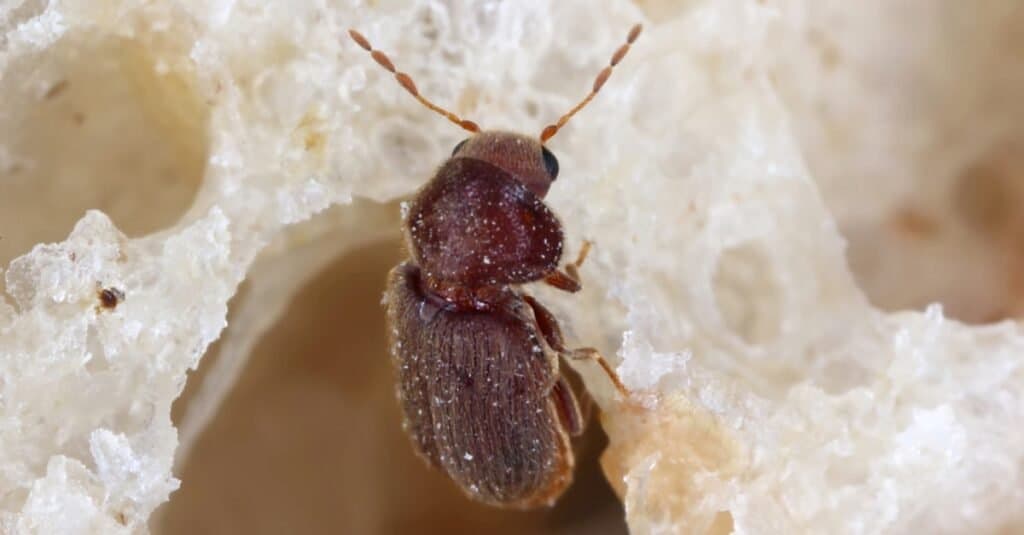
Drugstore beetle Stegobium paniceum known as bread beetle or biscuit beetle is pest in houses, stores and warehouses.

The adult biscuit beetle is a small brown insect with an oval-shaped body, measuring no more than 4 millimeters long.

Habitat

The biscuit beetle can be found all over the world from temperate to tropical regions; they seek out warm locations, especially during the winter, in order to survive. This species can infest any building where dried plant food is found, including flour mills, bakeries, factories, food plants, drugstores, and restaurants. If they infest the home, then biscuit beetle will gravitate naturally to the pantry or kitchen. The adults do have the ability to fly through the air, which helps them find new places to infest. They also hitch a ride as food is moved from factory to market and then to the home.

Diet

The biscuit beetle is an herbivore at all stages of its life cycle. This means it feeds exclusively on plant matter.

What eats them?

The biscuit beetle has several insect predators, including predatory mites, darkling beetles, and checkered beetles, as well as some larger vertebrates. They are also preyed upon by parasitoid wasps, which may lay their eggs directly on the beetle to consume it whole.

What do they eat?

True to its name, the biscuit beetle consumes all kinds of dried plant products, including flour, cereal, rice, seeds, beans, pasta, tea, tobacco, chocolates, and spices. One of the more interesting facts is that they can derive nutrients from non-food products such as books, leather, horns, and fur. Most of the food is consumed during the larval stage because they need to grow to sufficient size before reaching adulthood. The adults feed far less often and sometimes may not feed very much at all.
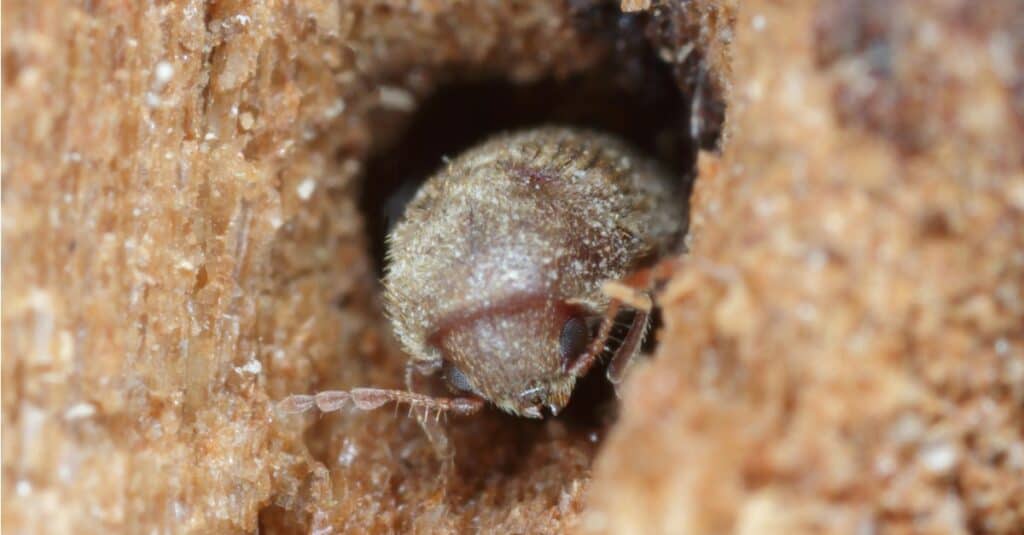
Drugstore beetle Stegobium paniceum known as bread beetle or biscuit beetle is pest in houses, stores and warehouses.

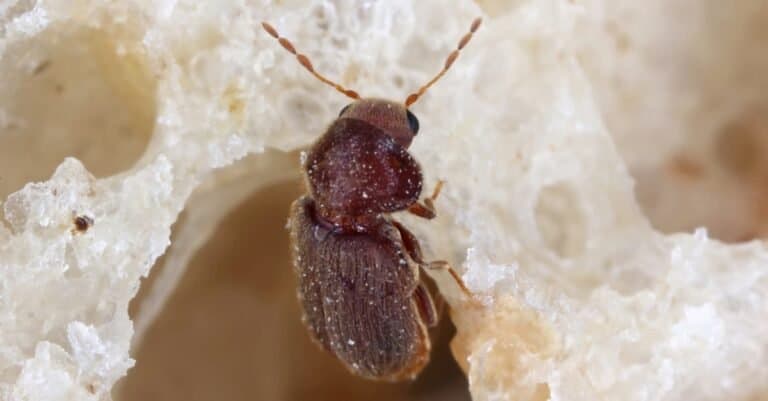
The biscuit beetle eats lots of dried plant products, including flour, cereal, rice, seeds, beans, pasta, tea, tobacco, chocolates, and spices.

Prevention: How to Get Rid of them

While it doesn’t bite or attack people, the biscuit beetle is still considered to be an annoying pest that causes plenty of damage to food goods. The good news is it’s relatively straightforward to eliminate. Signs of an infestation include holes in packaging or small debris left behind around the food storage area. You can also sometimes see adults flying or lingering around a food source. Kitchens and pantries are almost always the targets of this species. If you suspect there’s an infestation in your home, then you can use a trap to monitor the adult beetle activity. Many commercial traps will use the insect’s own sex pheromones to lure it in and capture it. However, this strategy works less well as a prevention measure, because it only lures in the adult male beetles. It has little effect on adult females or larvae.

In order to prevent an infestation from occurring, you should immediately get rid of any food items that show signs of beetle activity. You should then secure all future food items in a suitable container; the beetles can bore straight through cardboard or aluminum, but plastic usually works well. You should also immediately clean up any spills or crumbs and never leave food out for long. Insecticides and sprays should almost never be used except as a last resort. Chemicals from sprays may contaminate food and make people sick. Fortunately, proper food storage and management are usually sufficient to get rid of an infestation. The bad news is you will need to be thorough because the biscuit beetle can feed on just about any plant-based good.
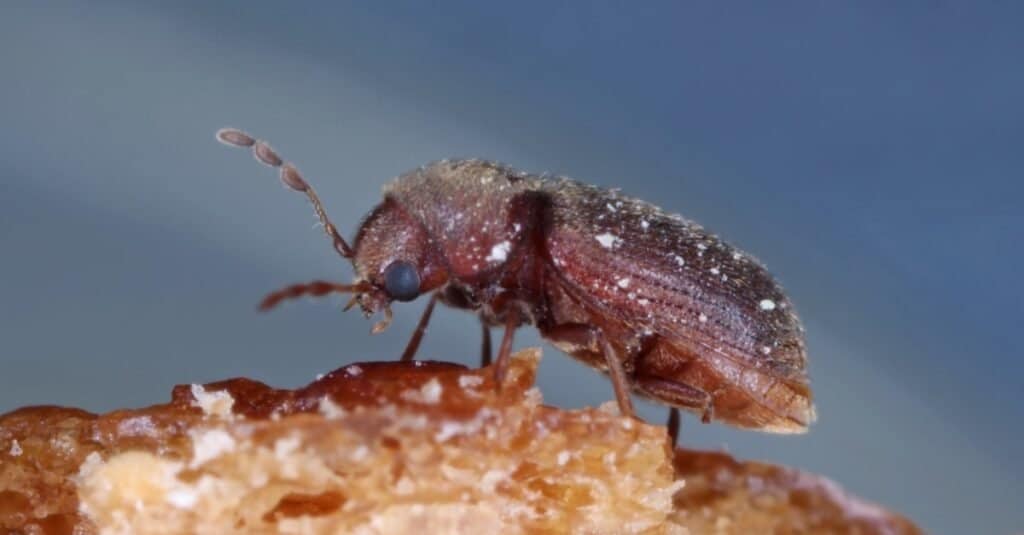
Signs of a biscuit beetle infestation include holes in packaging or small debris left behind around the food storage area.

View all 453 animals that start with B

Sources

  1. Orkin / Accessed January 1, 2022
  2. University of Florida / Accessed January 1, 2022
Heather Ross

About the Author

Heather Ross

Heather Ross is a secondary English teacher and mother of 2 humans, 2 tuxedo cats, and a golden doodle. In between taking the kids to soccer practice and grading papers, she enjoys reading and writing about all the animals!

Thank you for reading! Have some feedback for us?


Biscuit Beetle FAQs (Frequently Asked Questions)

No, this species is not dangerous; it doesn’t even bite people. But it can infest food sources and cause significant economic damage.