Quick Take
- Several Dark-Eyed Junco subspecies were classified as completely separate species for years, a view that changed entirely once one particular behavior was observed. See the subspecies history →
- The 'Snowbird' nickname turns out to be misleading, though not for the reason you'd expect. Check the migration details →
- Female Dark-Eyed Juncos migrate farther than males, but that advantage comes with a hidden cost. Female migration costs explained →
- The Dark-Eyed Junco's mating system defies what most people assume about birds. Males guard nests, but loyalty isn't part of the deal. Explore the mating behavior →
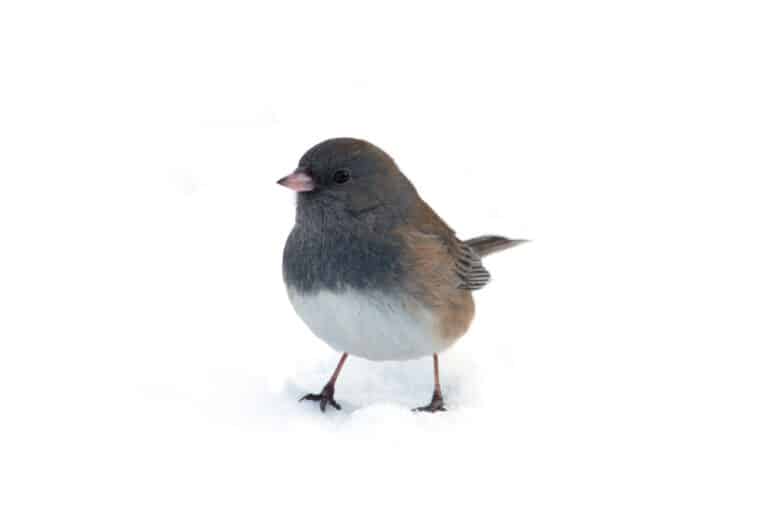
The Dark-Eyed Junco is also known as the Snowbird in the United States. They’re in the sparrow family, and the resemblance is clear, though they’re smaller than most sparrows. It has an extensive list of subspecies found in various regions, and their range of colors is quite diverse as well. You can find them in various shades, spread throughout the country. They often reappear in the winter, which is why they are called the Snowbird.

4 Amazing Dark-Eyed Junco Facts
- The oldest Dark-Eyed Junco to date, found in 2001 in Virginia, was around 11 years and 4 months old.
- They are most common in the continent of North America.
- The reason they are called Snowbirds is that they usually emerge in the winter season. But that is not true for all of its subspecies, since some are found in all seasons.
- It has quite a range of subspecies. There are around 15 in number, out of which 5 were regarded as different species for a very long time.
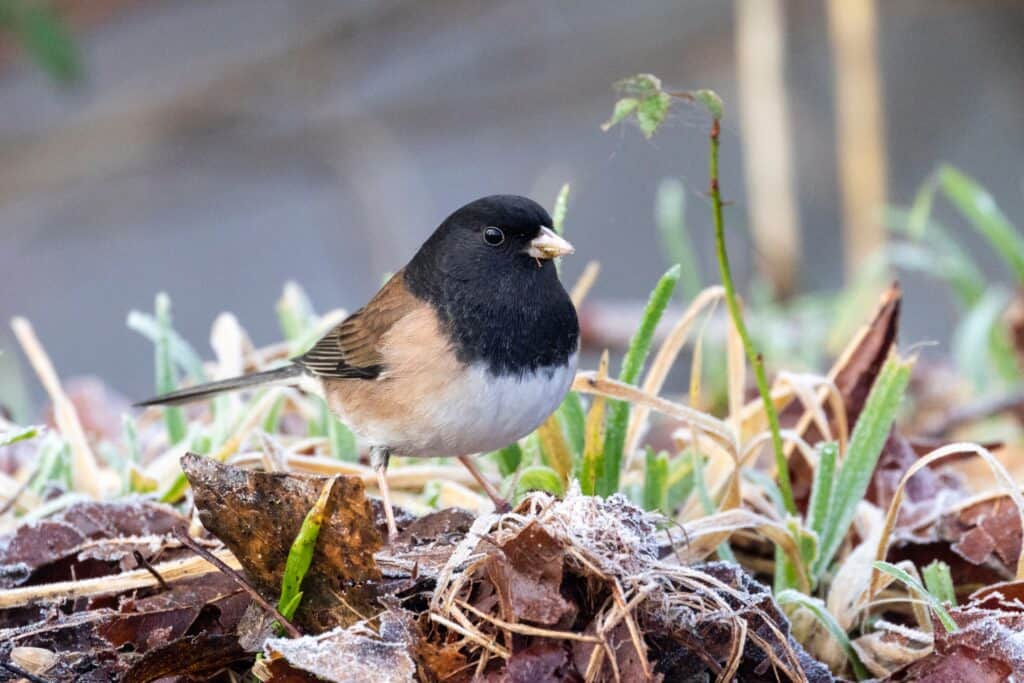
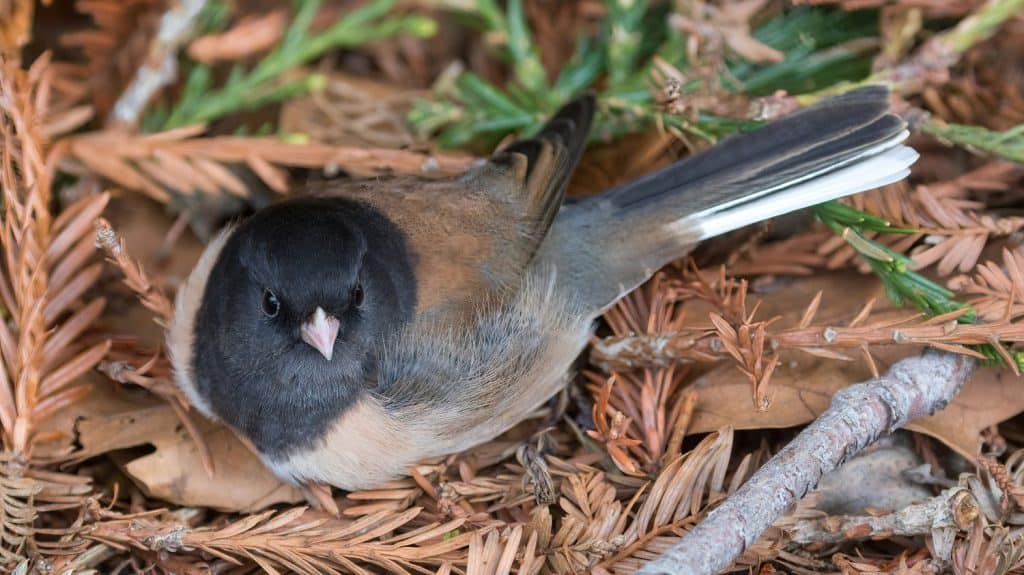
Dark-eyed juncos measure up to 6.3 inches in length and weigh up to 1.1 ounces.
©Feng Yu/Shutterstock.com
Where to Find Dark-Eyed Juncos?
If you are seeking a Dark-Eyed Junco, the ideal location is the forests that are spread across North America. However, you may find them in various woodland areas. To be more specific, you will need to explore the coniferous forests and the deciduous forests. These forests include pine, Douglas-fir, spruce, fir, aspen, cottonwood, oak, maple, and hickory trees.
A common way to identify these birds is by their white outer-tail feathers. They frequently perch atop trees or are found high up in the sky, at an elevation of 11,000 feet above sea level. But you can also spot them walking on the ground. All you need to do is listen out for their twittering call. The noise is a high-pitched but sweet trill that seems similar to a Chipping Sparrow.
You might not even have to pick up your bags for a hike in the forests. If you are lucky, you can find them in parks, roadsides, gardens, and even fields during the winter season. But the best time to find them is during October when they are together in flocks.
Nests
The nest of the Dark-Eyed Junco is created by the female but guarded by the male. It is made up of fine grass, weeds, leaves, and sometimes, hairs and feathers. You will have to do a bit of work to find them because they are always well-hidden. Either the nest is behind hanging grass, tucked away in shallow holes, or behind rocks. However, in some rare cases, you may find the nest in buildings or a tree, but it won’t be much higher than 10 inches above the ground.
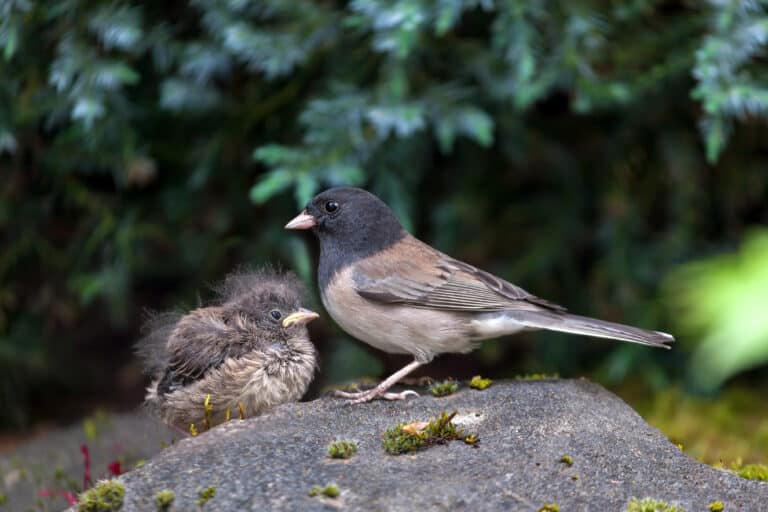
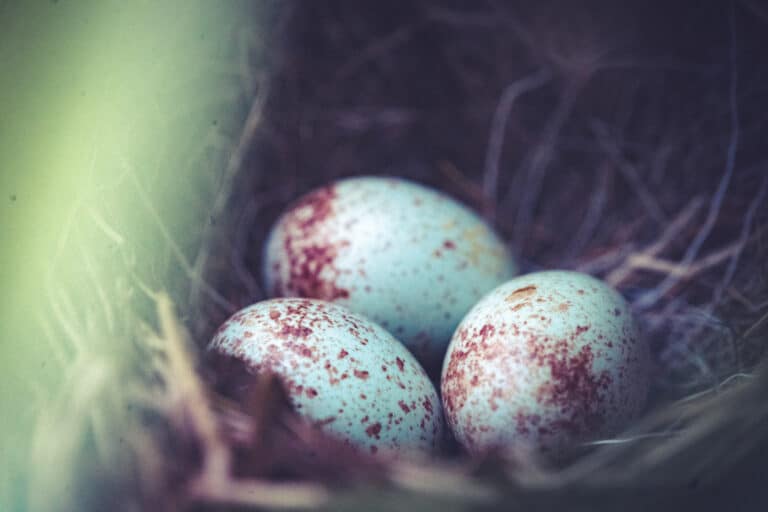
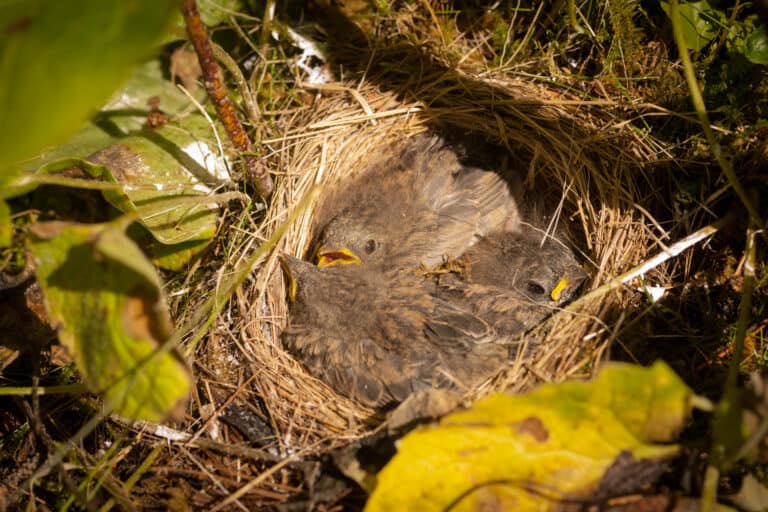
They generally lay 3 to 6 eggs that have a whitish, grayish, or pale bluish appearance. The eggs hatch after 11 to 13 days of incubation, and the young are protected and fed by both parents.
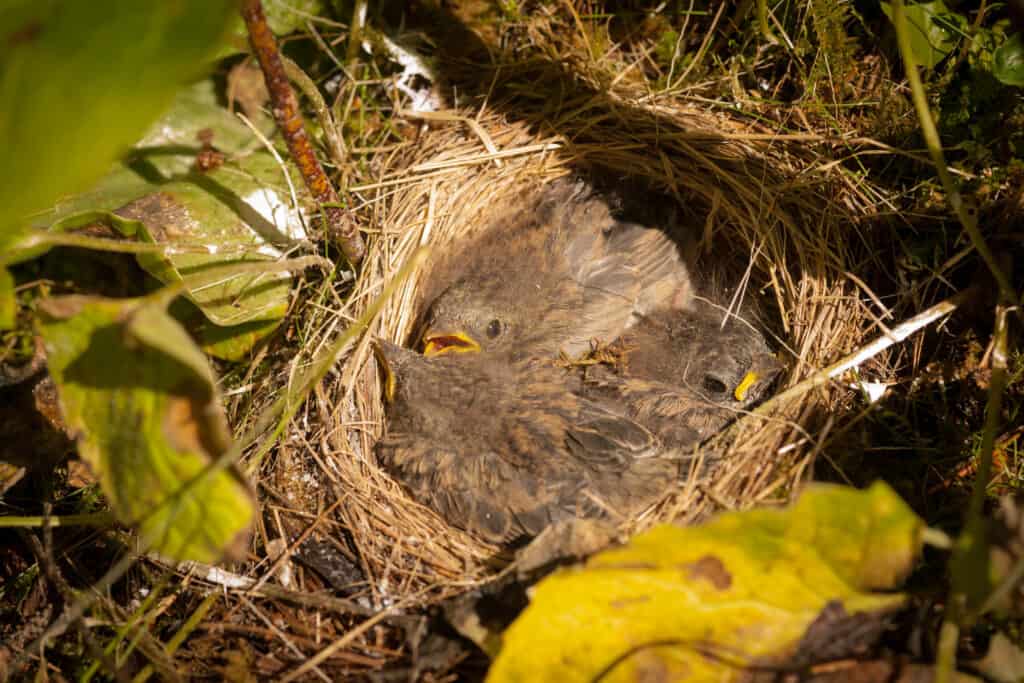
Both parents feed their fledgling Dark-Eyed Junco babies.
©Stefan Schug/Shutterstock.com
Scientific Name
The Dark-Eyed Junco, also known as the Snowbird, was previously named Fringilla hyemalis. But since 1831, it has been called the Junco hyemalis, which is Spanish in origin. It belongs to the Class Aves and the Family Passerellidae.
It has several subspecies; 14 or 15 are recognized. Out of them, six were regarded as different species until they were found mating. There are five main groups: the White-winged group, the Oregon group, the Red-backed group, the Grey-Headed group, and the Brown-Backed group. Here is the list of the subspecies of the Dark-Eyed Junco:
- Slate-Colored Dark-Eyed Junco (J. h. hyemalis)
- Carolina Dark-Eyed Junco (J. h. carolinensis)
- Cassiar Dark-Eyed Junco (J. h. cismontanus)
- White-Winged Dark-Eyed Junco (J. h. aikeni)
- Oregon Group Dark-Eyed Junco (J. h. oreganus)
- Montana Dark-Eyed Junco (J. h. montanus)
- Nevada Dark-Eyed Junco (J. h. mutabilis)
- Oregon Dark-Eyed Junco (J. h. oreganus)
- Point Pinos Dark-Eyed Junco (J. h. pinosus)
- Laguna Hanson Dark-Eyed Junco (J. h. pontilis)
- Shufeldt’s Dark-Eyed Junco (J. h. shufeldti)
- Thurber’s dark-eyed junco (J. h. thurberi)
- Townsend’s dark-eyed junco (J. h. townsendi)
- Pink-sided dark-eyed junco (J. h. mearnsi)
- Gray-Headed Dark-Eyed Junco (J. h. caniceps)
- Red-Backed Dark-Eyed Junco (J. h. dorsalis)
Size, Appearance, and Behavior
These birds resemble a medium-sized sparrow that has a short head and body but a long and slender tail. It measures up to 5.5 to 6.3 inches in length and weighs around 0.6 to 1.1 ounces. As for its wingspan, it may spread up to 7.1 to 9.8 inches.
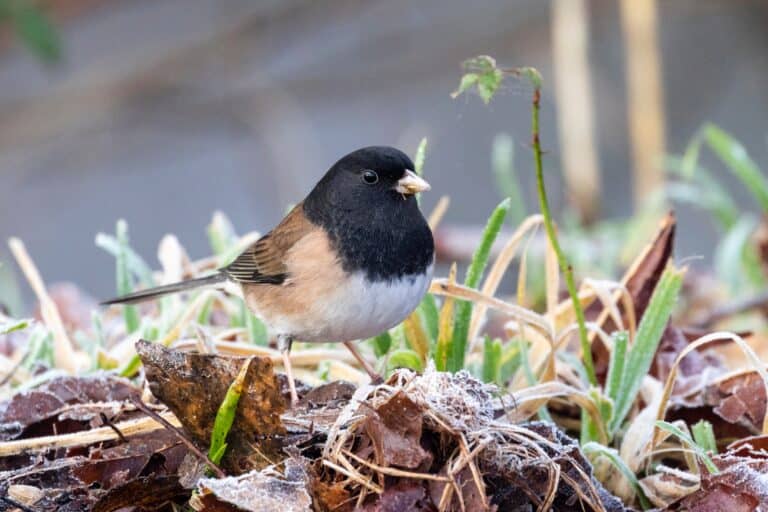
It is present all over the continent in various colors, but the most common is the one that is gray with a white stomach. There is no obvious difference between males and females, but the latter is somewhat paler than the former. They are easily identifiable due to the white feathers on their tails. However, its tail opens up during flight, which the average person may not notice.
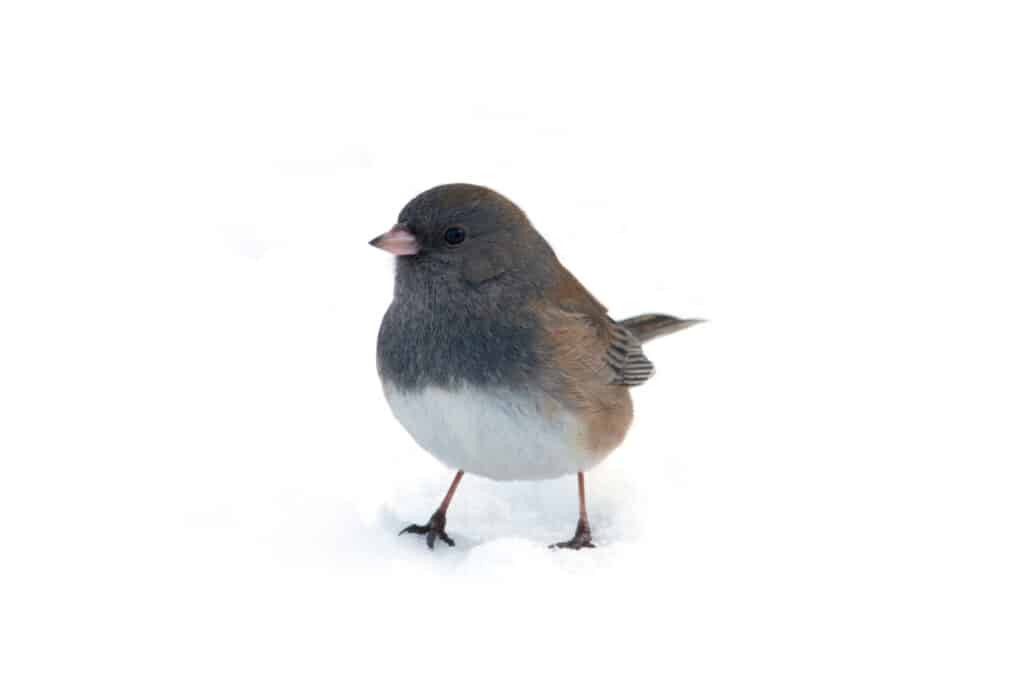
Dark-eyed juncos are often called snowbirds because some species reappear in the winter.
©Gerald A. DeBoer/Shutterstock.com
Migration Pattern and Timing
The migration season begins around October and lasts till March or April. It is usually carried out at night, so it might be harder to spot. But one thing that remains a fact is that females tend to migrate longer distances than males. The mortality rate, however, is more or less the same because females do survive the migration season with ease, but are unable to cope during the winter.
They often travel in flocks during migration, and it is common to see groups of juncos flying together as they move between breeding and wintering grounds.
Diet
The diet of a Dark-Eyed Junco mainly includes seeds and insects. Like any other sparrow, the diet and foraging behavior are almost similar. The foraging methods include gleaning, pecking, and scratching.
What Does Dark-Eyed Junco Eat?
During the breeding season, you will find these birds gobbling up seeds from grassy plants, small fruits, and grains. But during the breeding season, they prefer to eat arthropods like spiders and other insects, depending upon availability. They do this to maximize protein intake for stronger babies.
What Eats the Dark-Eyed Junco?
These little birds have many predators. Some of them are sharp-shinned hawks, shrikes, and owls. But cats, either domesticated or wild, also have a liking for eating Dark-Eyed Juncos.
Predators, Threats, and Conservation Status
The Dark-Eyed Junco does not face any current threats to its population size. It belongs to the Least Concern category in its conservation status.
Reproduction and Young
The mating is usually done on the ground by a little dance of hopping around here and there. The males usually end up singing to attract the females.
The mating behavior of the Dark-Eyed Junco is quite different. Neither gender pairs and mates with just one partner. Rather, females breed with neighboring males that stand guard on nests. Males will also mate with other females and are also found protecting babies that are not their own.
The Dark-Eyed Junco lays three to five eggs per breeding season. Very rarely, you will find a sixth egg in the bunch, too. They are white to blue or grey in color and hatch after 11 to 13 days of incubation.
After hatching, the young may be reliant upon both parents for food. The male stands guard near the nest. The young leave the nest after 9 to 12 days after hatching.
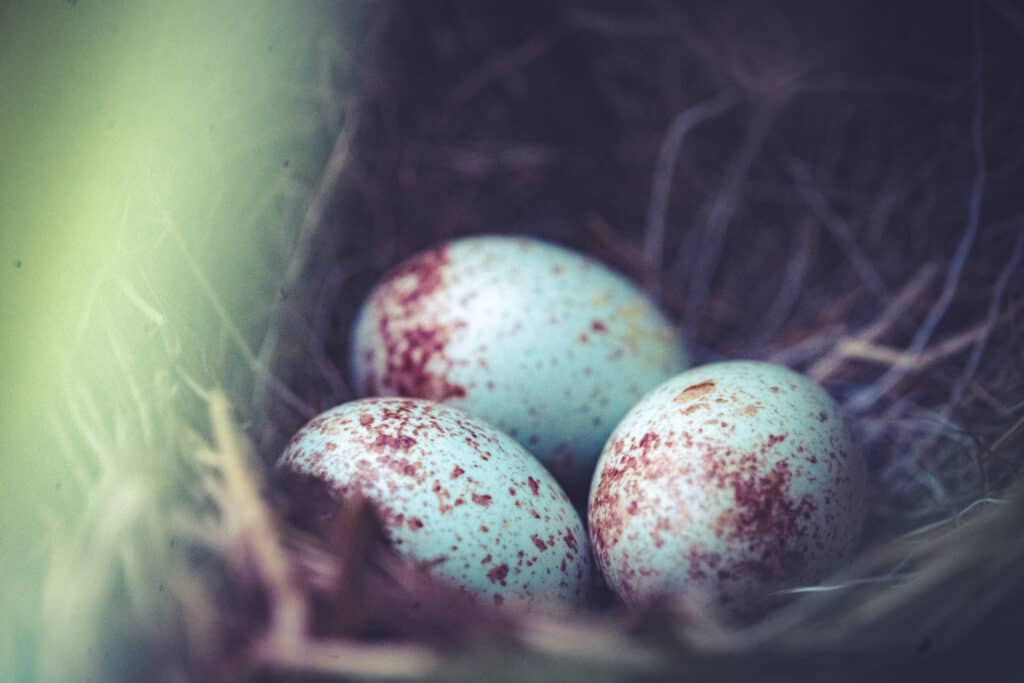
Dark-eyed juncos typically lay from 3 to 5 eggs, though sometimes they will lay a 6th.
©Adeline Weyland/Shutterstock.com
Population
The population size of the Dark-Eyed Junco, at an estimate, stands at 220 million mature individuals. They are also classified in the Least Concern category. They are one of the most common birds in North America and are found all over, either migrating or residing in forests and woodland areas.
Dark-Eyed Junco Pictures
View all of our Dark-Eyed Junco pictures in the gallery.

Feng Yu/Shutterstock.com
Sources
- Audubon / Accessed July 21, 2022
- Boreal Birds / Accessed July 21, 2022
- Wikipedia / Accessed July 21, 2022
- All About Birds / Accessed July 21, 2022
- ABC Birds / Accessed July 21, 2022