
Quick Take
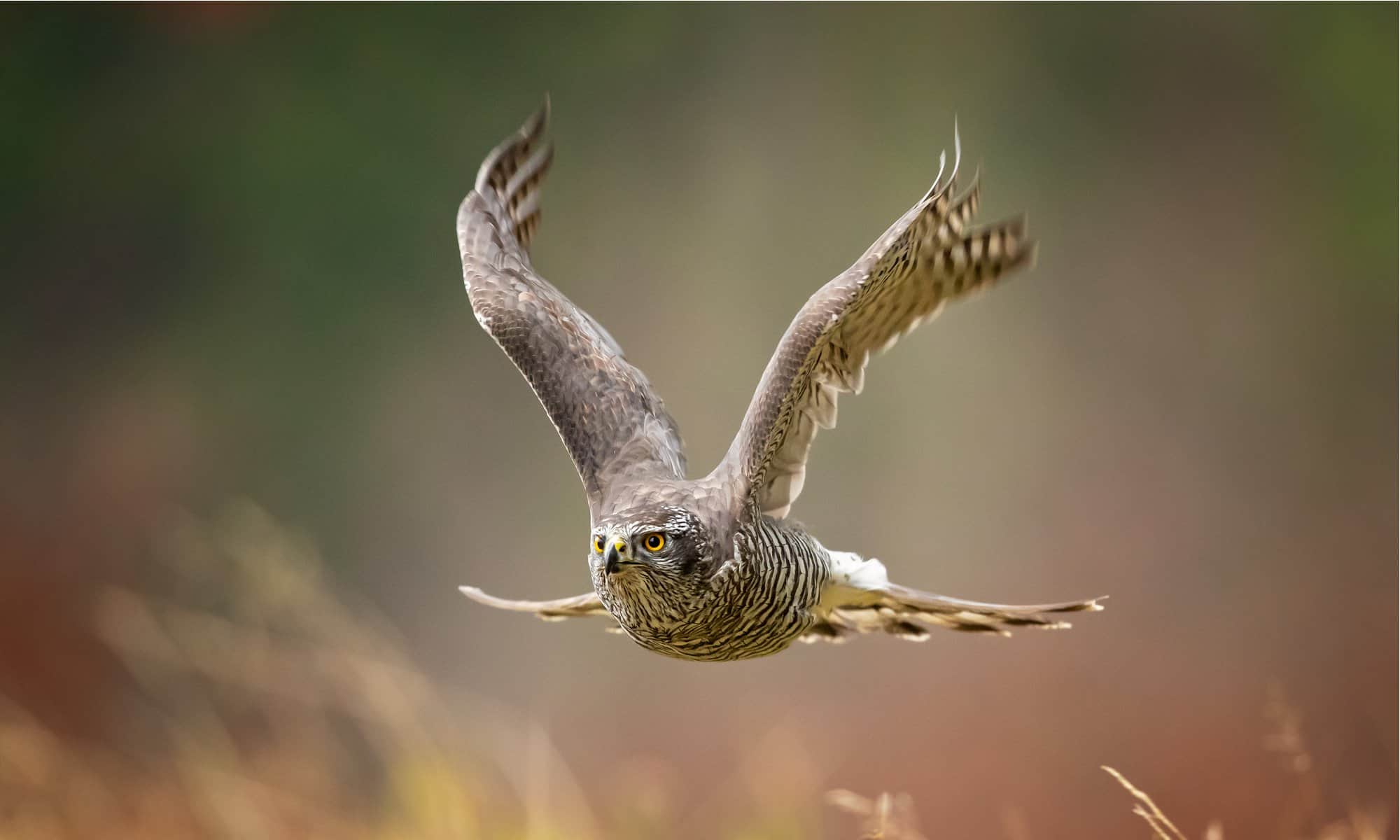
- One hawk in Maine is called the fiercest bird of prey in the state, and its behavior around intruders is exactly what earns it that reputation. Maine's most aggressive raptor →
- Maine's most commonly spotted hawk has a single feature so distinctive you can identify it from a moving car. Spot it by its red tail →
- One of these hawks breeds on arctic tundra yet turns up in Maine year-round, and its feathered legs explain why. Feathered legs and arctic origins →
- The smallest hawk in Maine hunts in a way that's the complete opposite of what you'd expect from a tiny bird. Maine's smallest hawk explained →
Hawks are widely distributed birds of prey in the order Accipitriformes. They vary in behavior, habitat, shape, size, and color. There are more than 200 species of hawks globally, all of which are classified as raptors or birds of prey.
Hawks are powerful birds. They have sharp, curved talons for catching prey and hooked beaks for tearing it apart. They also have an excellent sense of hearing and some of the sharpest vision in the entire animal kingdom; their visual acuity is estimated to be several times sharper than that of humans.
Hawks thrive in coastal regions, mountains, grasslands, forests, prairies, and marshes. Whether you’re driving, hiking in the woods, or relaxing in your backyard, spotting a hawk is always a treat. Continue reading to learn about hawks in Maine and where to find them.
Let’s take a look!
Red-shouldered Hawk
| Scientific name | Buteo lineatus |
| Color | Dark, white, red |
| Weight | 1-1.7 pounds |
| Height | 15-24 inches |
| Wingspan | 37.0–43.7 inches |
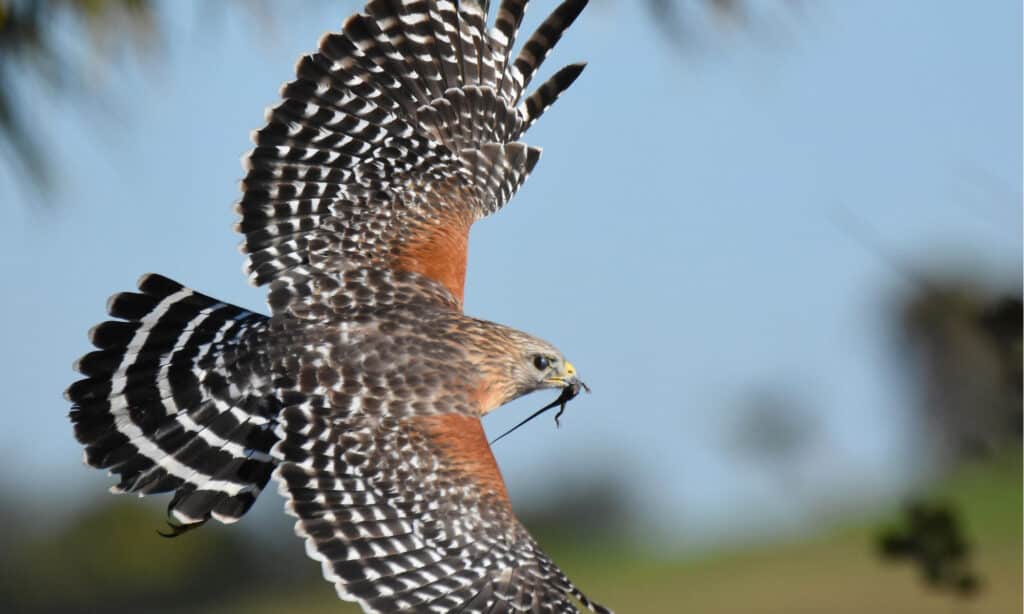
Red-shouldered hawks are commonly sighted in Maine’s woodlands, swamps, and forests.
©MTKhaled mahmud/Shutterstock.com
Known as the hawks of woodlands, red-shouldered hawks (Buteo lineatus) are best known as the hawks of woodlands. They are typically heard before they are seen, due to their distinct calls. Red-shouldered hawks are medium-to-large birds that have rich red barring on their underparts and chests. They have broad, rounded wings with white-and-black checkered patterns.
Red-shouldered hawks are commonly sighted in Maine’s woodlands, swamps, and forests, especially during the spring and summer months of their breeding season. They build their nests at the base of large branches in deciduous trees, and sometimes in conifers. Females lay three to four eggs that hatch in roughly 32 to 40 days.
The red-shouldered hawk’s diet consists of small birds, large insects, mice, snakes, crayfish, frogs, and occasionally carrion. They hunt by flying low in open areas or watching for prey from a raised perch.
Broad-winged Hawk
| Scientific name | Buteo platypterus |
| Color | Black, white, reddish-brown |
| Weight | 9.3 ounces – 1.23 pounds |
| Height | 13.4-17.3 inches |
| Wingspan | 29.0-39.0 inches |
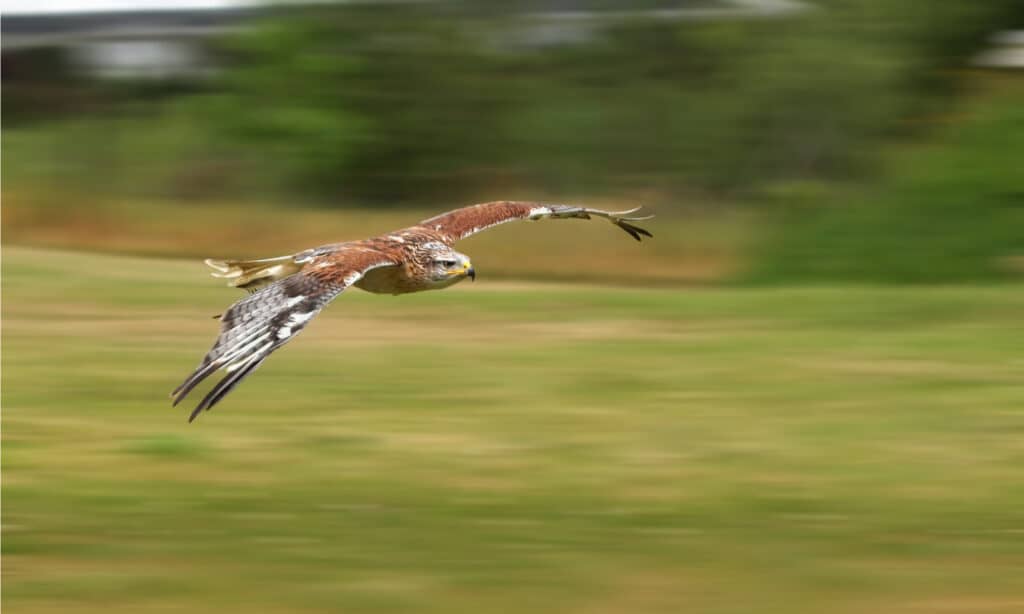
Broad-winged hawks are well-known for their large, pointed wings.
©pr2is/Shutterstock.com
Recognized by their broad, pointed wings, broad-winged hawks (Buteo platypterus). They are common in Maine during spring and summer. The best time to watch for them is during their migration in the fall. They have unique markings on their underparts, black-and-white banded tails, and reddish-brown heads.
Broad-winged hawks inhabit groves and woods. They nest in either mixed coniferous-deciduous forests or pure deciduous forests. Females lay two to three eggs that hatch in around 28–31 days.
Broad-winged hawks consume squirrels, voles, mice, small birds, lizards, snakes, frogs, young turtles, large insects, and many other small mammals. They hunt from a perch or occasionally fly through the woods in search of prey.
Cooper’s Hawk
| Scientific name | Astur cooperii |
| Color | Brown, grey, white |
| Weight | 7.8-14.5 ounces |
| Height | 14-20 inches |
| Wingspan | 24.4- 35.4 inches |
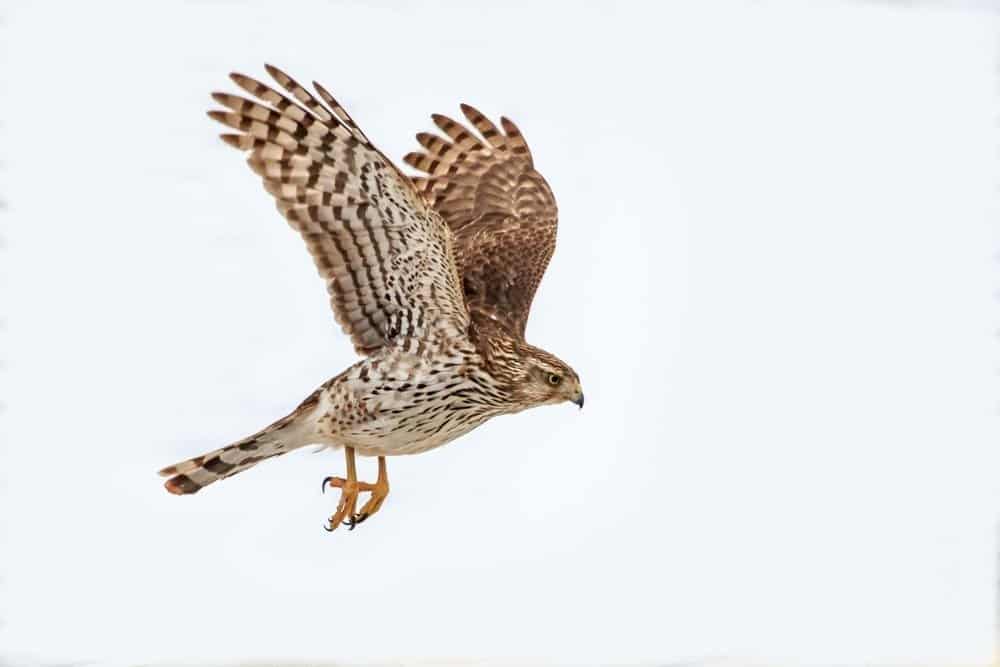
Cooper’s hawks mainly feed on medium-sized birds, mice, ground squirrels, chipmunks, insects, and reptiles.
©Richard G Smith/Shutterstock.com
About the same size as a crow, Cooper’s hawks (Astur cooperii) are medium-sized raptors. They have long, narrow tails and broad, rounded wings. They are blue-gray on top with red-orange barring on their underparts.
These hawks are generally found along river groves, open woodlands, forests, and wood edges. They are sighted in Maine between March and July during their breeding season. They build their nests in dense woodlands where females typically lay two to six eggs.
Cooper’s hawks feed on medium-sized birds, mice, ground squirrels, chipmunks, insects, and reptiles. They hunt either from their perches or by flying low over the ground, searching for prey.
Northern Harrier
| Scientific name | Circus hudsonius |
| Color | Gray, white, black, and brown |
| Weight | 11-27 ounces |
| Height | 21-25 inches |
| Wingspan | 41-46 inches |
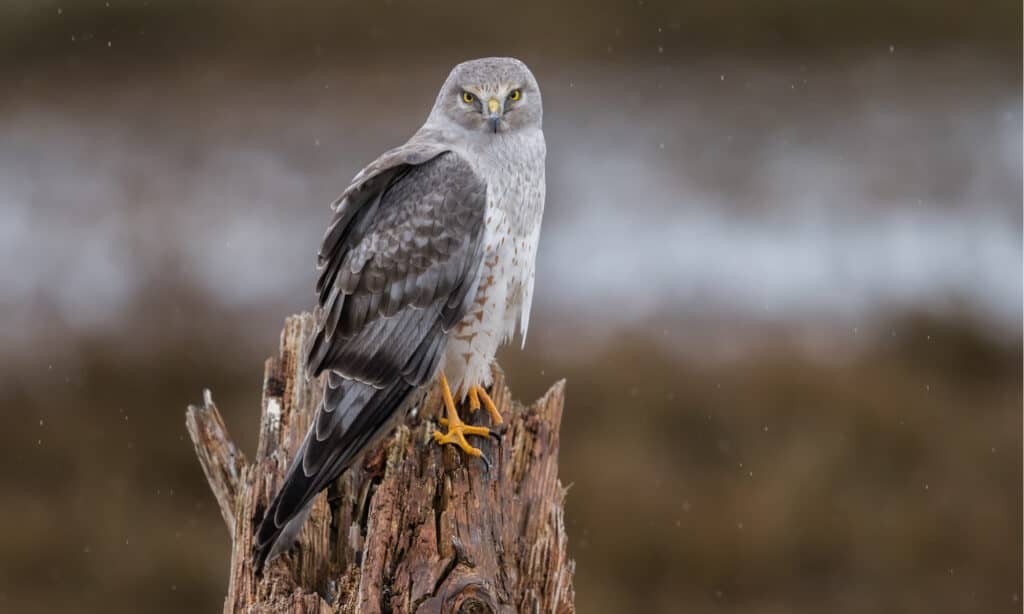
Northern harriers can be seen in fields, prairies, and marshes.
©Harry Collins Photography/Shutterstock.com
Distinctive medium-sized birds of prey with long wings and long tails, Northern harriers (Circus hudsonius) are considered a migratory species in Maine. Male Northern harriers are gray on top with very dark feathers at their wingtips. Immature Northern harriers and females have brown-streaked feathers. They are often sighted in Maine, especially in the late autumn months.
Northern harriers are found in many types of terrain. They can be seen in fields, prairies, and marshes. They often nest in marshes, though they sometimes prefer nesting in open fields. Females typically lay four to five eggs that hatch in about 28-36 days.
The Northern harrier’s diet consists of small birds, rats, voles, lizards, frogs, and large insects, among other small mammals. They hunt by hovering over dense cover or open fields, scanning the ground and tree lines to locate prey.
Northern Goshawk
| Scientific name | Astur atricapillus |
| Color | Brown, grey, red, black, and white |
| Weight | 1.4-3.4 pounds |
| Height | 18-27 inches |
| Wingspan | 43-50 inches |

The American Northern goshawk has the agility to navigate thick forests while hunting prey.
©Raju Creative pro/Shutterstock.com
Northern goshawks (Astur atricapillus) are large raptors commonly found in Maine. They are often called Maine’s fiercest birds of prey because they are highly aggressive when defending their territory. They are pale-grayish above with a white-streaked underside. Immatures are streaked brown.
Northern goshawks are solitary raptors restricted to wooded areas. They are normally found in dense coniferous and mixed forests. They nest in pure stands of coniferous trees. Females lay two to four eggs that hatch in 28–38 days.
Northern goshawks eat snowshoe hares, rabbits, squirrels, medium-sized birds, snakes, insects, and rodents. They hunt inside forests or along the edges, moving from one perch to another in search of prey. Northern goshawks fly in short, powerful bursts, often crashing and twisting between branches as they pursue their prey.
Sharp-shinned Hawk
| Scientific name | Accipiter striatus |
| Color | Blue-gray, red-orange, brown, and dark |
| Weight | 2.9-7.7 ounces |
| Height | 9.1-15 inches |
| Wingspan | 17-27 inches |
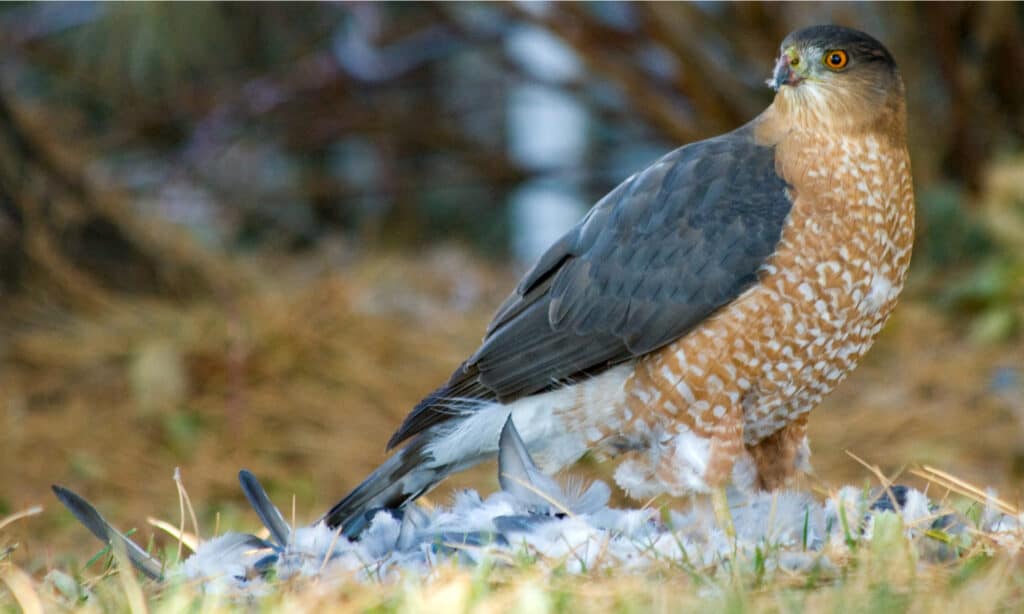
Sharp-shinned hawks primarily feed on small birds, rodents, squirrels, large insects, frogs, lizards, and snakes.
©Wyatt W/Shutterstock.com
The smallest hawk species, the sharp-shinned hawk (Accipiter striatus) can be found in Maine during the breeding season from March to June. They are gray on top with red-orange underparts. Their wings are short and rounded.
They are usually sighted along coastlines and mountain ridges during their migrations. They prefer nesting in forests and woodlands during their breeding season. Females lay between four and five eggs, which take around 30-35 days to hatch.
Sharp-shinned hawks primarily feed on small birds, rodents, squirrels, large insects, frogs, lizards, and snakes. They hunt by watching for prey movement from a raised perch or fly rapidly among trees, taking unsuspecting prey by surprise.
Red-tailed Hawk
| Scientific name | Buteo jamaicensis |
| Color | Brown, pale, cinnamon-red, and dark |
| Weight | 1.5-3.5 pounds |
| Height | 18-26 inches |
| Wingspan | 43-56 inches |
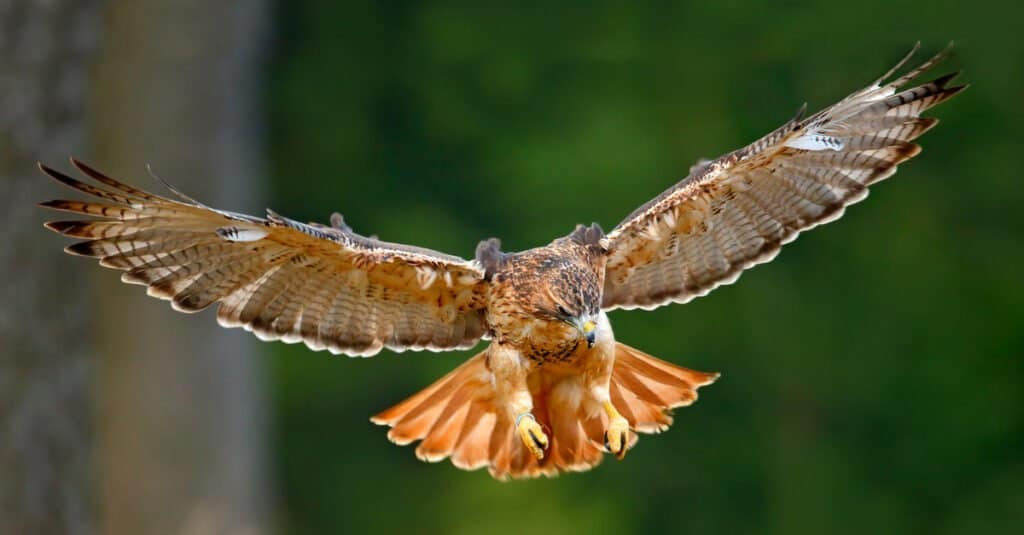
Red-tailed hawks mainly feed on small birds, snakes, voles, rabbits, ground squirrels, toads, frogs, and large insects.
©Ondrej Prosicky/Shutterstock.com
The most commonly sighted hawk in mMINE, Red-tailed hawks (Buteo jamaicensis) are among the largest hawks in the state. They have striking red tails that distinguish them from other raptors.
Red-tailed hawks are often spotted along roadsides, in woodlands, mountains, prairie groves, and plains. They nest on tall trees, cliff ledges, and artificial structures. Females lay two to three eggs that hatch in about 28–35 days.
Red-tailed hawks feed on small birds, snakes, voles, rabbits, ground squirrels, toads, frogs, and large insects. They hunt by flying over fields, watching for prey movement below. They also watch for prey from a perch.
Rough-legged Hawk
| Scientific name | Buteo lagopus |
| Color | Dark-brown |
| Weight | 1.32-3.66 pounds |
| Height | 18-24 inches |
| Wingspan | 52-54 inches |
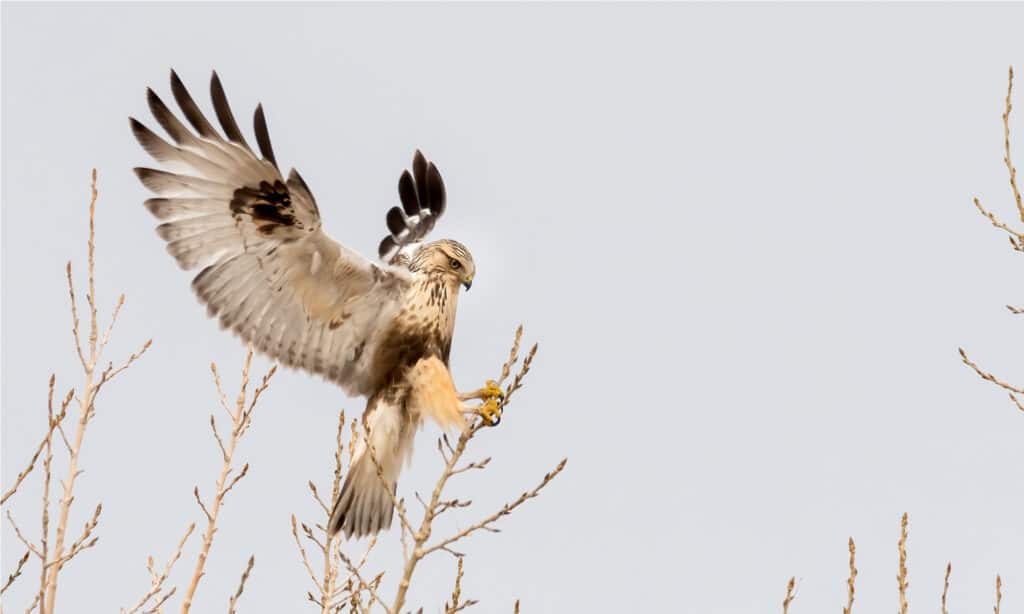
Rough-legged hawks live on arctic coasts and tundra escarpments.
©Eivor Kuchta/Shutterstock.com
Best known for their feathered legs, rough-legged hawks (Buteo lagopus) are generally found in Maine all year. They are medium-sized birds of prey with a wide range of color patterns. They have dark bands on their white underparts. Their wings are long but notably thin.
These hawks are tied to cold climates. They breed on arctic coasts and tundra escarpments, but spend winters in open fields, coastal prairies, marshes, dunes, and grasslands. They nest on slopes or high cliffs. Females lay three to five eggs. The incubation period lasts for about 31 days.
Rough-legged hawks feed on rodents such as lemmings and voles. They also eat small birds, ground squirrels, and other small mammals. They hunt by watching for prey from a perch or by kiting over fields to spot prey on the ground.