M
Species Profile

Muskox

Ovibos moschatus

Underwool-cloaked guardians of the tundra
Fitawoman/Shutterstock.com

Muskox Distribution

Click a location to explore more animals from that region

Loading map...

Size Comparison

Human 5'8"
Muskox 4 ft 3 in

Muskox stands at 75% of average human height.

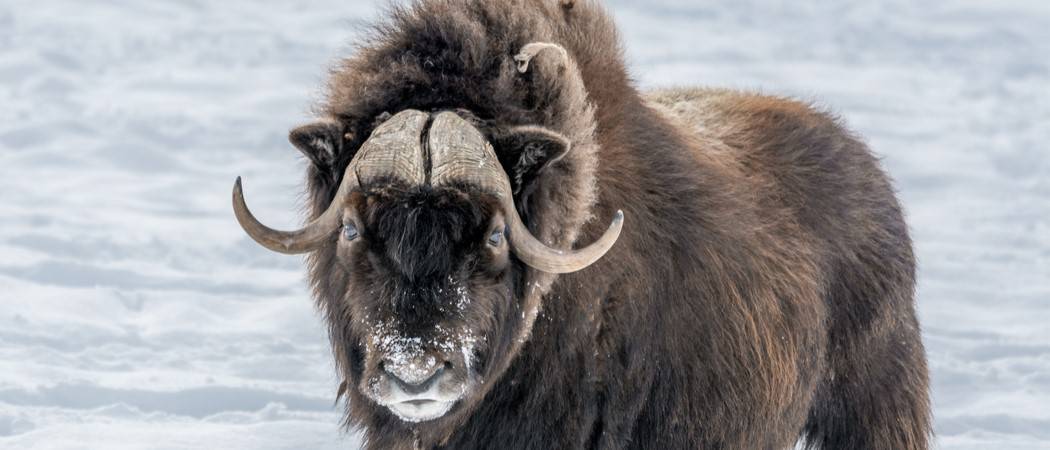
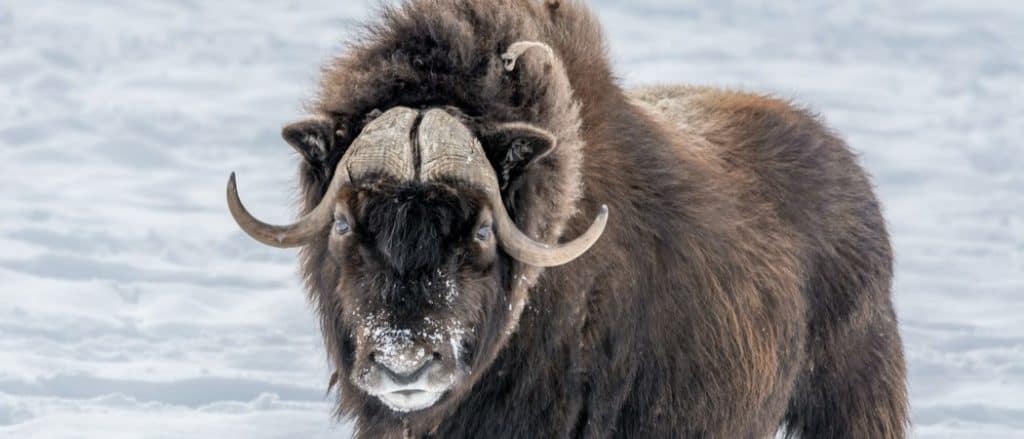
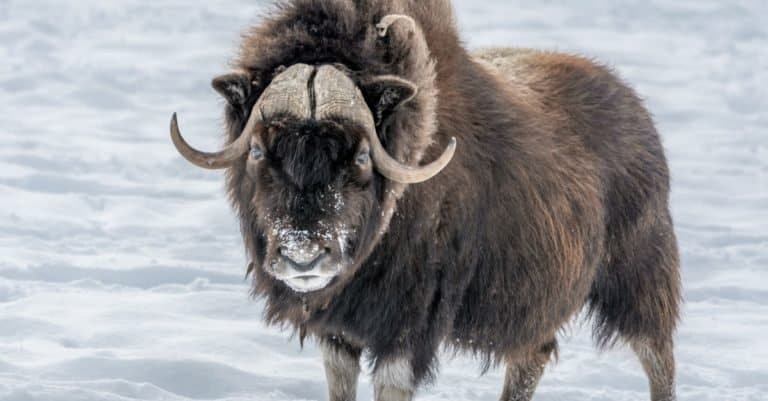
Muskox standing in the snow

At a Glance

Wild Species
Also Known As Umingmak, Ovibos, Musk ox
Diet Herbivore
Activity Diurnal+
Lifespan 14 years
Weight 410 lbs
Status Least Concern
Did You Know?

Adults are stocky: head-body length about 190-230 cm; shoulder height about 110-150 cm; adult mass typically males 270-363+ kg, females 200-275 kg (varies by population).

Scientific Classification

The muskox (Ovibos moschatus) is a large, cold-adapted Arctic bovid known for its long shaggy coat (qiviut underwool), strong social herding behavior, and defensive formations against predators.

Kingdom
Animalia
Phylum
Chordata
Class
Mammalia
Order
Artiodactyla
Family
Bovidae
Genus
Ovibos
Species
moschatus

Distinguishing Features

  • Long, shaggy outer hair with dense qiviut underwool
  • Both sexes typically have horns with a broad boss at the forehead
  • Stocky build and short legs adapted to cold, windy tundra
  • Herding behavior; forms defensive circles/lines against predators

Physical Measurements

Males and females differ in size

Height
4 ft 5 in (3 ft 11 in – 4 ft 11 in)
3 ft 9 in (3 ft 7 in – 3 ft 11 in)
Length
1 in (1 in – 1 in)
7 ft 9 in (6 ft 11 in – 8 ft 8 in)
Weight
882 lbs (661 lbs – 904 lbs)
496 lbs (397 lbs – 551 lbs)
Tail Length
5 in (4 in – 6 in)
5 in (4 in – 6 in)
Top Speed
37 mph
running

Appearance

Primary Colors
Secondary Colors
Skin Type Thick mammalian skin with extremely dense soft underwool beneath long guard hairs.
Distinctive Features
  • Double coat: fine soft underwool plus long guard hairs hanging near ground.
  • Stocky, compact body with short tail (~5-10 cm) reducing heat loss.
  • Adult size: head-body length ~190-230 cm; shoulder height ~110-150 cm.
  • Adult mass: males ~200-410 kg; females ~140-280 kg (range varies by population).
  • Both sexes horned; horns sweep down then up with a central forehead boss.
  • Cloven hooves and broad dewclaws aid traction on snow and tundra.
  • Cold adaptation: thick coat and compact build support Arctic thermoregulation.
  • Social defense behavior: herd forms tight circle/line with adults facing outward.
  • Seasonal foraging: primarily sedges and grasses; also willow and other shrubs.
  • Typical longevity: ~12-20 years in the wild; up to ~24 years in captivity.

Sexual Dimorphism

Males are substantially heavier and develop thicker, broader horn bosses and heavier horns. Females are smaller with narrower bosses; both sexes share the shaggy underwool and guard-hair coat and outward-curving horn shape.

  • Heavier body mass (commonly 200-410 kg).
  • Broader, thicker horn boss across forehead; heavier horns.
  • Stronger musky odor during rut from scent glands/urine signaling.
  • Lighter body mass (commonly 140-280 kg).
  • Narrower horn boss with more slender horns.
  • Typically slightly smaller overall frame and shoulder height.

Did You Know?

Adults are stocky: head-body length about 190-230 cm; shoulder height about 110-150 cm; adult mass typically males 270-363+ kg, females 200-275 kg (varies by population).

The underwool is extremely fine (about 18-20 micrometers fiber diameter) and is shed each spring, then snagged on shrubs for collection.

Defense is cooperative: herds often form a tight circle/line with horns outward and calves in the center when threatened by wolves.

Breeding (rut) peaks late summer (often Aug-Sep); calves are usually born in spring (commonly Apr-May) after ~8 months gestation (~240-270 days).

Muskoxen are not true oxen: they are bovids in the goat-antelope subfamily, closer to goats and sheep than cattle.

They can persist on very low-quality winter forage, digging ("cratering") through snow to reach sedges, grasses, and dwarf willows.

Besides native Arctic Canada and Greenland, self-sustaining introduced populations exist in places like Norway (Dovrefjell) and parts of Russia and Alaska (reintroduced).

Unique Adaptations

  • Underwool + guard hair system: dense underwool insulates; long guard hairs (often hanging nearly to the ground) shed wind and moisture.
  • Compact, low surface-area build: short legs and a barrel-shaped body reduce heat loss in extreme Arctic cold.
  • Reduced extremity heat loss: small ears and tail minimize exposed surface area in subzero temperatures.
  • Seasonal coat molt timed to spring: insulation is highest through winter; shedding prevents overheating during warmer months.
  • Energy strategy: ability to maintain body condition on fibrous tundra plants, aided by ruminant fermentation in a large, efficient gut.
  • Herd-based anti-predator adaptation: collective defense reduces individual risk from wolves compared with solitary flight.

Interesting Behaviors

  • Defensive formation: adults pack tightly and face outward; individuals may rush ("charge-and-return") at predators, then rejoin the wall.
  • Seasonal foraging shifts: summer diets emphasize grasses and forbs; winter diets rely heavily on sedges, grasses, and woody browse like dwarf willow.
  • Rut behavior: males compete via displays and high-speed clashes (head-butting) using enlarged horn bases; dominant bulls guard estrous females.
  • Group living: herds commonly include mixed ages/sexes outside the rut; spacing and cohesion tighten under predation risk or harsh weather.
  • Cratering: individuals use hooves and muzzles to break crusted snow and access buried vegetation; herds may reuse foraging craters.
  • Calf protection: calves often remain centrally positioned in moving groups; adults orient bodies to block wind during storms.

Cultural Significance

Muskox (Ovibos moschatus) give Arctic people meat and hides; their soft underwool makes warm clothing and crafts. The Inuit name means 'the bearded one.' Underwool gathering and knitting help local makers, and muskoxen are a symbol of tundra conservation and northern tourism.

Myths & Legends

Muskox (Ovibos moschatus): English name comes from the strong musky smell of males during the mating season. Inuit names often mean "the bearded one" in hunting stories and oral history.

Exploration-era anecdote that entered popular tradition: 19th-early 20th century Arctic expedition accounts frequently describe muskox herds "standing their ground" in circles-stories that became part of northern frontier lore about endurance and communal defense.

Dovrefjell origin story (Norway): the well-known local narrative links today's wild muskoxen in Norway to animals introduced in the 20th century, a human-mediated "re-wilding" tale now woven into regional identity and tourism storytelling.

Conservation Status

LC Least Concern

Widespread and abundant in the wild.

Population Stable

Protected Under

  • Canada: territorial/provincial wildlife legislation and harvest management (e.g., Nunavut Wildlife Act; NWT Wildlife Act; Yukon Wildlife Act)
  • Greenland (Kingdom of Denmark): Government of Greenland hunting regulations and quota-based management in managed areas
  • United States (Alaska): state wildlife regulations and management on state/federal lands; hunting seasons/permits where allowed
  • Protected areas across parts of the range (national parks, wildlife refuges, and territorial conservation areas) provide additional habitat protection

Life Cycle

Birth 1 calf
Lifespan 14 years

Lifespan

In the Wild
10–20 years
In Captivity
12–24 years

Reproduction

Mating System Polygyny
Social Structure Harem Based
Breeding Pattern Seasonal
Fertilization Internal Fertilization
Birth Type Internal_fertilization

During the late-summer rut (typically Aug-Sep), dominant bulls win head-butting contests and temporarily herd/guard groups of females, mating polygynously via internal fertilization. Females gestate ~8-8.5 months and usually bear a single calf; no helpers.

Behavior & Ecology

Social Herd Group: 15
Activity Diurnal, Crepuscular, Cathemeral
Diet Herbivore Sedges (Carex spp.)

Temperament

Strongly gregarious; high cohesion reduces predation risk via collective defense (defensive ring/line).
Generally calm/slow-moving when undisturbed; can be highly defensive at close range to threats.
Rut increases male aggression and dominance interactions (late summer; head/neck displays, clashes).
Most populations herd year-round; group size often smaller in summer and larger in winter, varying with forage availability and disturbance.
Wild longevity commonly ~12-20 years; calves show high dependence on maternal protection during first year (species accounts: Nowak).

Communication

low grunts/contact calls within herd
snorts/exhalations as alarm signals
roars/bellows by males during rut
calf bleats/distress calls to mother
visual threat displays Head-lowering, horn presentation, lateral postures
tactile contact (nose-touching, body rubbing) for cohesion
scent/chemical cues Urination; glandular odors important during rut
group-level signaling via coordinated movement into defensive circle/line formation

Habitat

Terrain:
Plains Plateau Hilly Mountainous Valley Coastal Island Riverine Rocky +3
Elevation: Up to 6561 ft 8 in

Ecological Role

Large Arctic primary consumer (megaherbivore) that structures tundra plant communities and links primary production to higher trophic levels.

Regulates tundra vegetation through selective grazing and browsing (influencing graminoid vs. shrub abundance) Accelerates nutrient cycling via dung/urine inputs and physical disturbance from trampling and snow-cratering Creates localized disturbed patches that can facilitate plant regeneration and alter microhabitats Contributes to energy flow as an important prey/food resource for Arctic predators and scavengers (indirectly via carcasses)

Diet Details

Other Foods:
Sedges Cottongrass Arctic grasses Willows Dwarf birch Dwarf shrubs Forbs Mosses Lichens +3

Human Interaction

Domestication Status

Wild

Muskox (Ovibos moschatus) is a wild Arctic bovid, not domesticated like cattle or sheep. People manage muskox with regulated harvest, translocations and reintroductions (for example to Alaska and Norway), and limited captive care for qiviut, research, education, and display. Indigenous subsistence harvest and regulated or commercial hunting also occur.

Danger Level

High
  • Defensive aggression: herds can form a defensive line/circle; adults may charge perceived threats, especially cows with calves and bulls during rut.
  • Physical injury from blunt-force impact or goring: adults are large (commonly ~180-410 kg) with heavy bases and sharp horns; close-range encounters can result in serious trauma.
  • Human-wildlife conflict risk increases where animals are habituated near settlements/roads or approached for photography; safe standoff distance and avoidance of calves/rutting males are key mitigation measures.

As a Pet

Not Suitable as Pet

Legality: Muskox (Ovibos moschatus) are usually not legal as household pets. Where allowed, they are kept as exotic hoofstock, needing permits, inspections, disease control, special housing, and limits on moving them; U.S. rules vary.

Care Level: Expert Only

Purchase Cost: $5,000 - $20,000
Lifetime Cost: $50,000 - $250,000

Economic Value

Uses:
Subsistence and cultural value Regulated hunting (meat/trophy) in parts of range Fiber production (qiviut) Conservation translocation and wildlife tourism/education
Products:
  • meat (subsistence/regulated commercial where permitted)
  • hides/leather
  • qiviut (high-value underwool; collected by combing/shedding or from hides in managed contexts)
  • trophies (horns/skulls) where legal

Relationships

“A male muskox can weigh up to 900 pounds.”

Musk oxen have physical adaptations that allow them to live in the harsh Arctic climate year-round. They are herbivores eating grass, roots, flowers, lichen, moss, and other plant life. Musk oxen live in groups called herds. These large mammals can live up to 20 years.

5 Incredible Muskox Facts!

  • These mammals have a double coat of fur. The wool layer of hair next to their skin is called qiviut
  • These animals use their strong hoofed feet to dig into the icy ground for grass and plants growing on the tundra
  • They are more closely related to goats and sheep than oxen
  • A male musk ox’s horns are connected and form a browband, or boss, on its head
  • Many musk oxen live on nature preserves so they are protected
Scientific Name

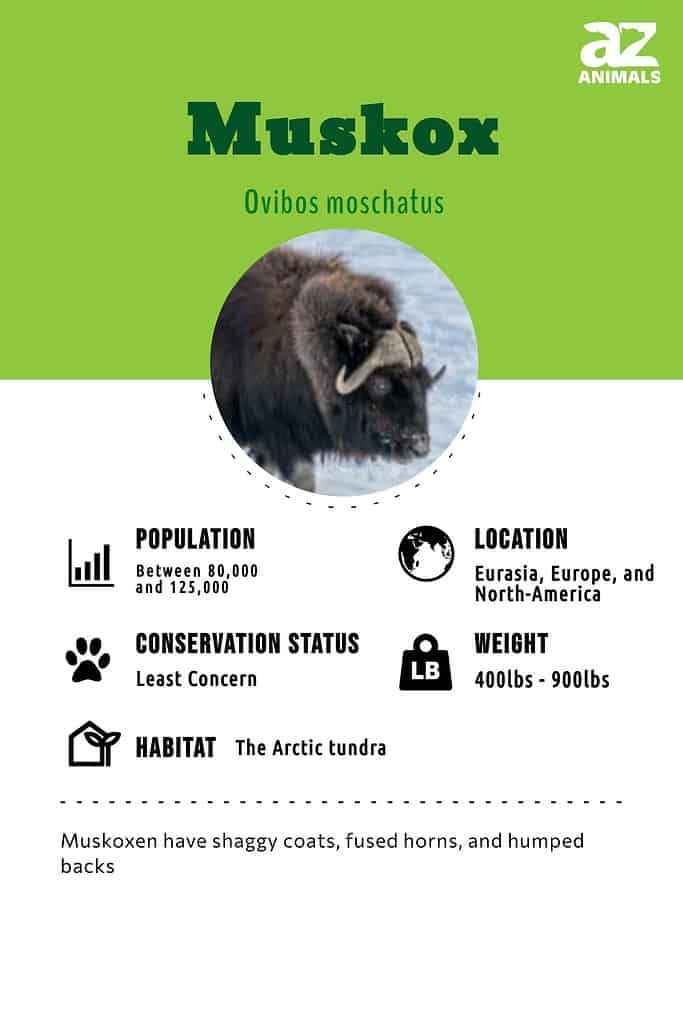
Ovibos moschatus is the scientific name for a musk ox. The Latin word Ovibos means sheep-ox and moschatus means musky. These mammals are called Oomingmak (the bearded-one) by the Inupiaq people in Alaska.

Musk oxen belong to the Bovidae family and are in the Mammalia class.

The two subspecies of musk ox include:

  • Greenland Musk Ox
  • Barren Ground Musk Ox

Evolution

Muskoxen belong to the family Bovidae which emerged on the evolutionary scene 20 million years ago during the early Miocene.

The Caprinae also came into existence during this period however it was during the latest ice ages that the specialization of certain constituent species for harsh climates and habitats would occur.

The membership of muskoxen in this group makes them more closely related to goats and sheep, rather than bison, and buffaloes.

Along with takins which live in the eastern Himalayas, these massive bovids are the largest members of the family.

Appearance & Behavior

Musk oxen have a double-layer coat of long dark brown fur. Some musk oxen have a coat that is so dark it looks almost black. They have a layer of wool next to their skin and a top layer of long, guard hairs that block moisture as well as the wind. Both males and females have two horns as well as four sturdy hooves. A male’s horns are larger than a female’s horns. Furthermore, the horns of a male musk ox form a browband, or boss, on the top of its head. A male’s browband is larger and thicker than a female’s browband. This mammal has a hump on the upper area of its back.

Male musk oxen are about five feet tall at the shoulder while females are about 4 feet tall. Males weigh from 600 to 900 pounds while females weigh from 400 to 500 pounds. A 900-pound musk ox weighs about the same as an adult horse. A 500-pound female musk ox is half as heavy as a grand piano! A five-foot-tall male musk ox is one-fourth the height of an adult giraffe while a four-foot-tall female is two-thirds the height of a refrigerator. The record for the longest horn of a musk ox comes in at just under 30 inches.

The physical adaptations of a musk ox allow it to survive in the harsh climate of the Arctic tundra. One physical adaptation of this animal has to do with its hoofed feet. They use their tough hooves to break and dig through the ice to find grass and other vegetation. Also, their sturdy hooves allow them to walk on the ice and snow for months at a time without hurting their feet. If you look closely, you’ll see the musk ox has eyes with horizontal pupils. The design of their eyes provides protection from the sun’s glare as it reflects off the snow and ice. This is important, especially because these animals are always on the lookout for predators.

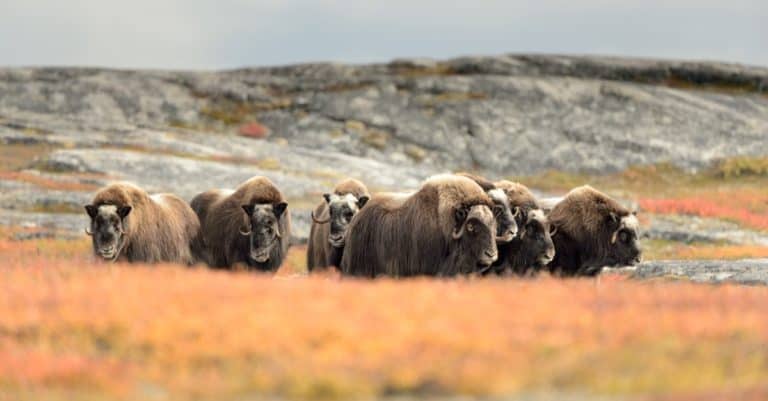
Musk oxen live in groups also called herds with an average of 18 members. Living in a herd serves as some protection from predators. Adult musk oxen are able to kick at predators with their hoofed feet and try to hit them with their sturdy horns. Otherwise, musk oxen are passive animals until the mating season arrives and males begin to compete for the attention of females.
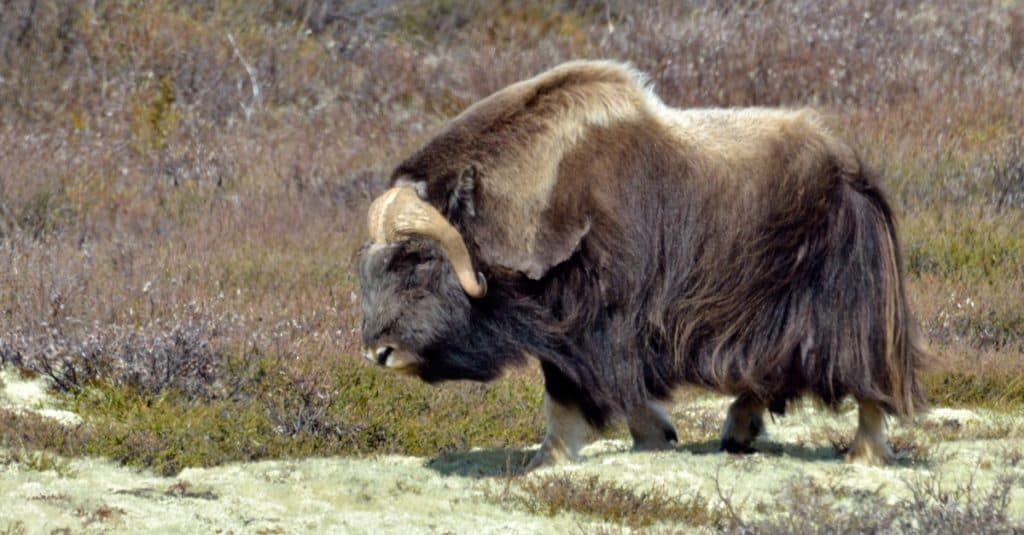
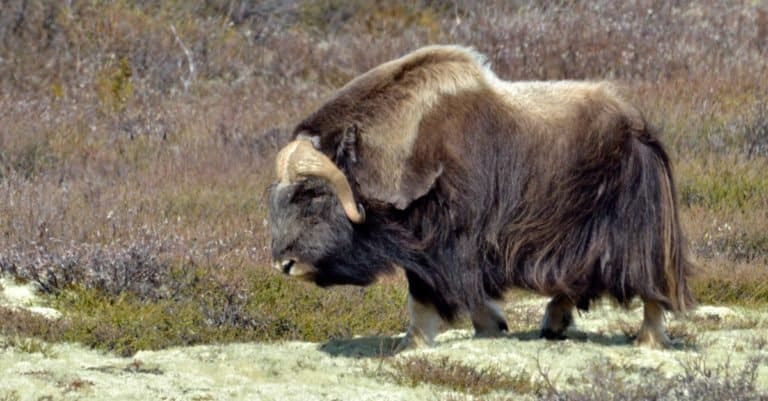
Muskox - Ovibos moschatus - in natural habitat

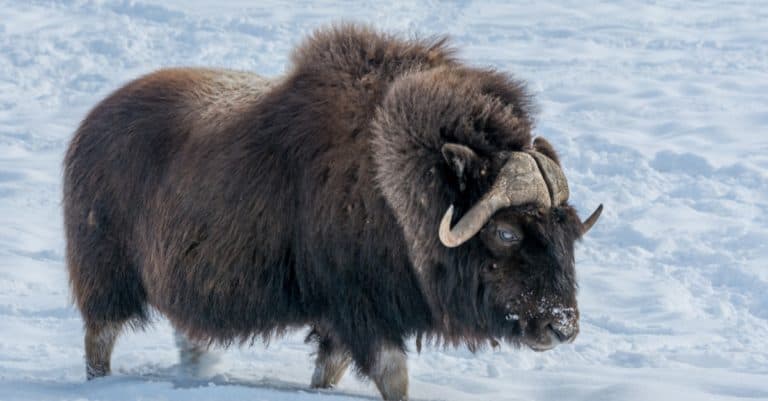
Muskoxen have a light layer of wool close to their skin and a layer of guard hair to keep out the snow, water, and wind

The Thick Coat of the Muskox

The double coat of a musk ox allows it to live in its frigid, windy environment. Their top layer of guard hairs repels water, snow, and wind. The layer next to the ox’s skin is made of light wool called qiviut. This layer helps to keep the musk ox warm. Musk oxen shed their qiviut, pronounced kee-vee-ut, in the warm summer months. It grows back once again with the approach of the winter months.

Habitat
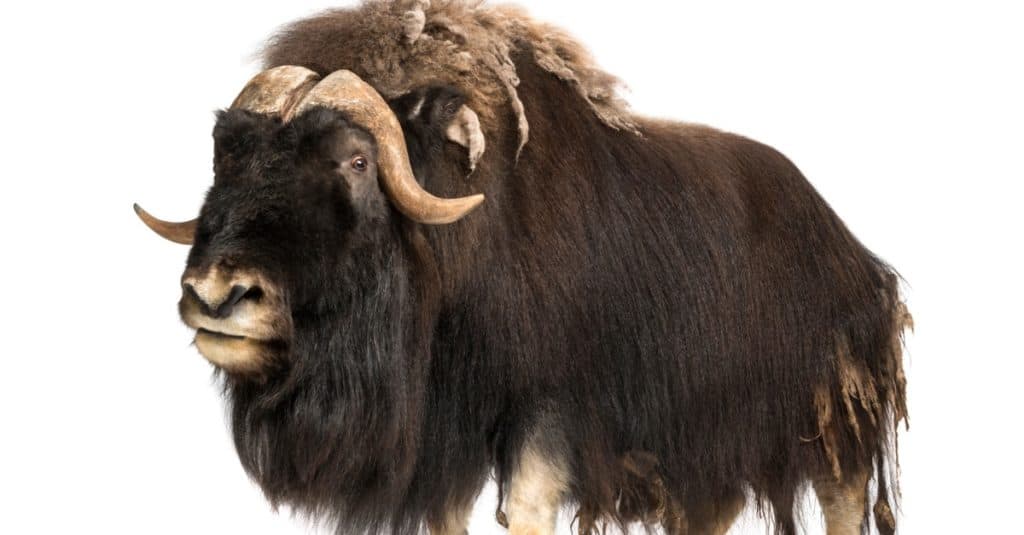
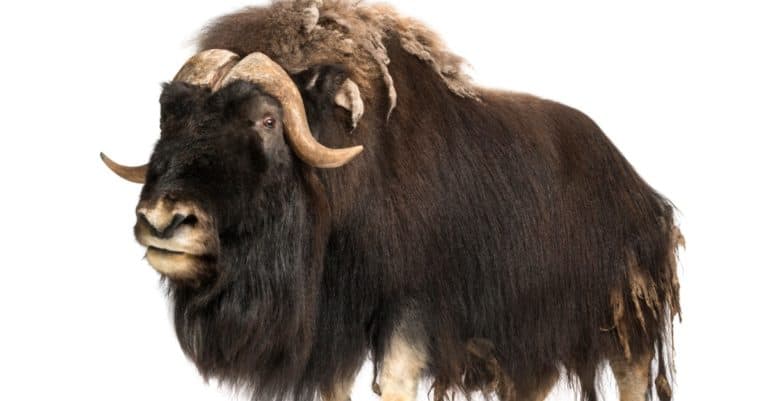
Muskox isolated on white background

Muskoxen prefer higher elevations in winter where access to food is easier

Muskoxen are found in Alaska, Greenland, Canada, Russia, and Norway. They live on the Arctic tundra throughout the year. This habitat has frigid temperatures and a layer of snow and ice in the wintertime. In the summer, there is an increase in the vegetation available and temperatures are warmer.

In the wintertime, musk oxen move to higher elevations including hillsides where it’s a little easier to retrieve vegetation from beneath the snow and ice. The snow is less deep on hillsides. In the early spring and throughout the summer months, they live in river valleys where they graze near a stream or river.

Predators and Threats
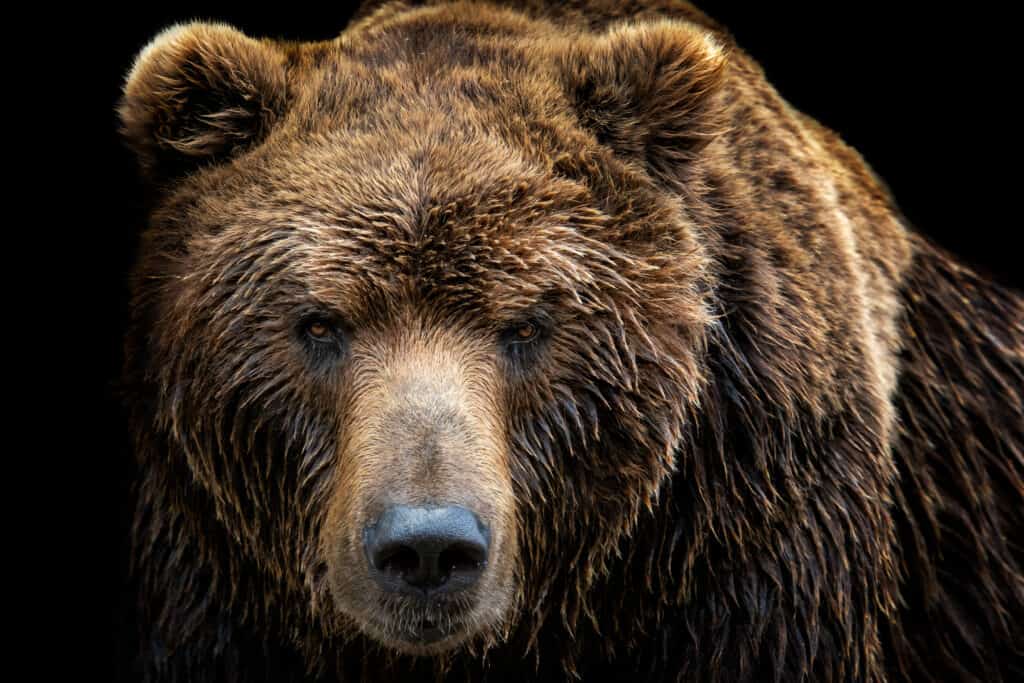
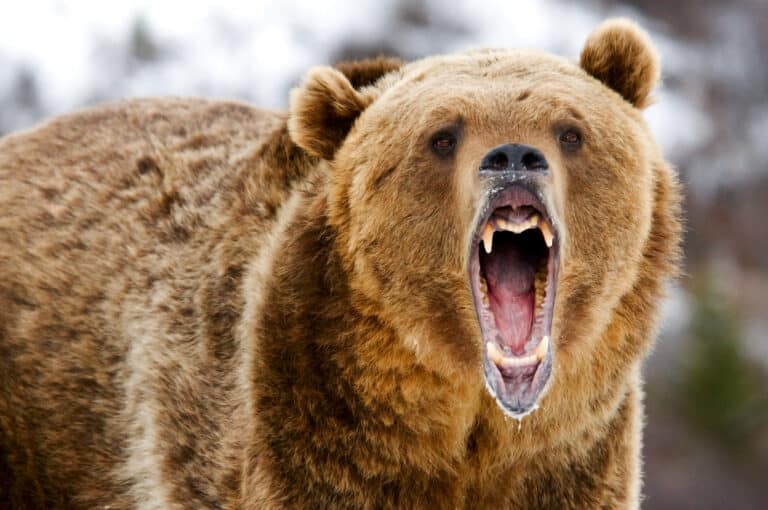
Bear staring into camera

Grizzly bears may attack calves or older muskoxen but will be unable to face down a herd protecting their calves

Arctic wolves are natural predators of musk oxen. Grizzly bears have also been known to attack musk oxen.

Wolves move around the environment in packs and stalk a herd of musk oxen from different directions. If they can get the herd moving, the wolves work together to separate a calf or older ox from the herd. An adult ox can defend itself with its horns or by kicking with its powerful hoofed feet. A wolf that is kicked by an adult musk ox is likely to be seriously hurt or even killed. This is why wolves usually go after calves or older, less powerful oxen.

A lone Grizzly bear may go after a calf or an older musk ox if the herd is moving. However, though a Grizzly bear is a large and powerful mammal, it is still outmatched by a herd of adult musk oxen positioned in a circle, protecting their calves.

Humans are another threat to the musk ox. They are hunted for their meat as well as their qiviut. Fortunately, there are now hunting laws in some areas that protect musk oxen from being hunted for their meat, horns, etc. Also, many of these mammals live on nature preserves where they are protected.

Despite these threats, the conservation status of the musk ox is Least Concern with a stable population.

Musk oxen are herbivores eating different types of plants during different seasons of the year. They build up their body fat in the summertime to tide them over when plant life isn’t as abundant during the winter. This is comparable to a polar bear building up fat during the warm weather months. But, a musk ox doesn’t hibernate!

Changes in climate are a threat to musk oxen. These changes can result in reduced vegetation growth.

What do musk oxen eat?

In the summertime, musk oxen eat grass, flowers, forbs, and sedge. In the wintertime, their diet includes roots, lichen, and moss.

What eats a Muskox?
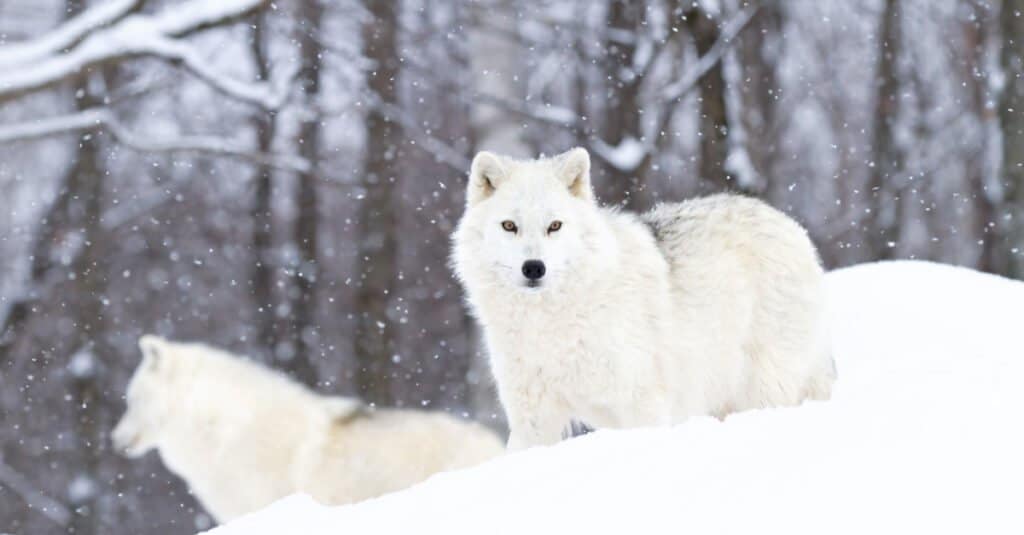
tibetan mastiff vs wolf

Arctic wolves are one of the main predators of muskoxen

The predators of musk oxen include Arctic wolves and sometimes Grizzly bears. Adult musk oxen are much larger than Arctic wolves and they can defend themselves with their horns. So, wolves usually attack their calves or older oxen.

Musk oxen form a physical circle around their calves to protect them when they’re being stalked by Arctic wolves. This is sometimes called, ‘circling the wagons.’ When musk oxen form this protective circle, it may persuade a pack of Arctic wolves to move on and find another herd.

In addition, some people hunt musk oxen for their meat, their horns or both.

Reproduction and Lifespan
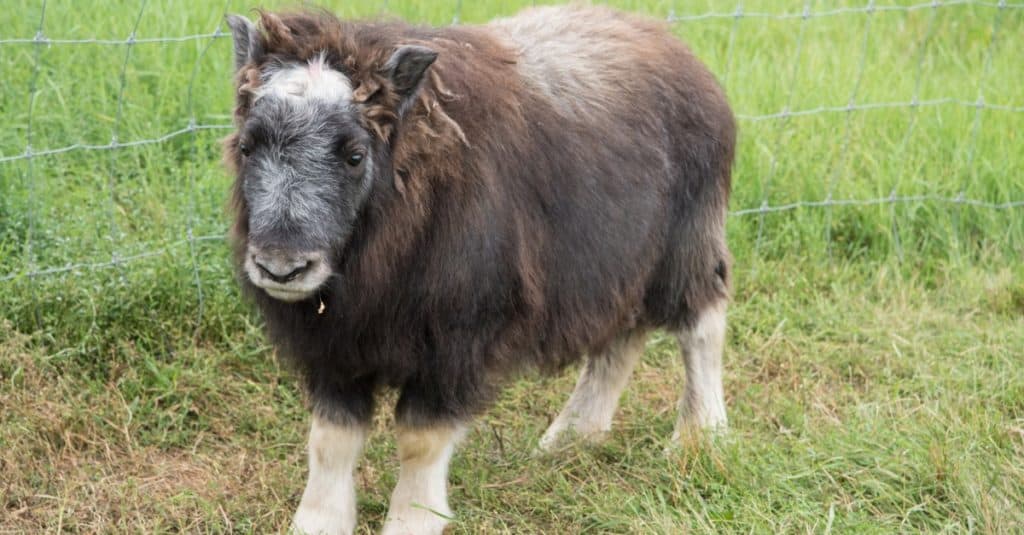
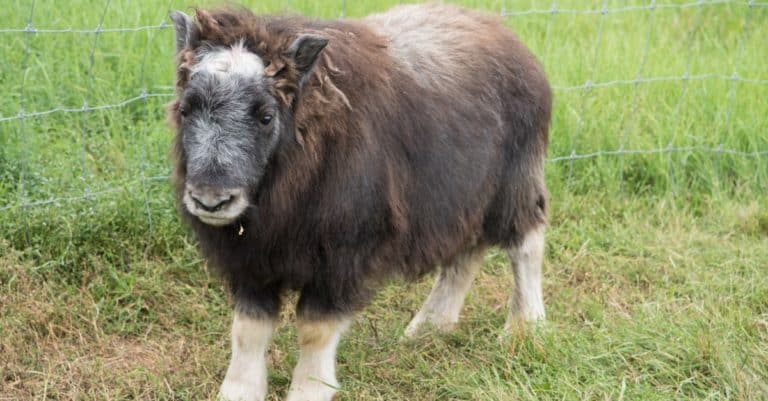
Muskox calf in pasture in Alaska

Muskoxen calves weigh about 20 lbs when they are born and are weaned at about 10 months

Breeding season for musk oxen begins in late summer and runs into autumn. Male musk oxen release a musky smell during mating season which is how this animal got its name. Males compete for females in the herd by charging one another and bashing horns together. They can sometimes run at each other at speeds of up to 25 mph! Eventually, one of the males becomes worn out and moves away. Though this is a very loud and powerful show of aggression, the male oxen are usually not injured.

The gestation period of a female musk ox is about 8 months. She gives live birth to one baby also called a calf. Sometimes female musk oxen give birth to two calves, but that’s a very rare occurrence. A calf weighs around 20 pounds at birth but gains weight quickly with each passing day. Musk ox calves are standing and moving with the herd an hour after they are born. This makes sense because a calf that is on the ground or moving slowly is especially vulnerable to attack by wolves. A baby ox nurses from its mother for the first 8 months of life. Calves are weaned at about 10 months old and can live independently at 2 years of age.

Musk oxen can live for as long as 20 years.

Population

According to the IUCN Red List, the total population of the musk ox is between 133,914 and 136,914 mature individuals. In terms of the region:

  • An estimated 75,400 mature individuals live in the northwestern territories of Canada
  • An estimated 3,714 mature individuals live in Alaska
  • Approximately 9,500 to 12,500 musk oxen live in Greenland
  • Approximately 35,000 live on the Arctic islands

The conservation status of the musk ox is Least Concern with a stable population.

View all 329 animals that start with M

Sources

  1. Wikipedia / Accessed April 4, 2021
  2. University of Alaska Fairbanks / Accessed April 4, 2021
  3. Britannica / Accessed April 4, 2021
A-Z Animals Staff

About the Author

A-Z Animals Staff

AZ Animals is a growing team of animals experts, researchers, farmers, conservationists, writers, editors, and -- of course -- pet owners who have come together to help you better understand the animal kingdom and how we interact.
Connect:

Thank you for reading! Have some feedback for us?


Muskox FAQs (Frequently Asked Questions)

Musk oxen live in Alaska, Greenland, Canada, Norway, and Russia. Their habitat is the Arctic tundra. They are large mammals known for their long, shaggy coat and horns. Their coat can be dark brown to almost black. They are herbivores that have several physical adaptations that allow them to live in their frigid habitat.