R
Species Profile

Red-Shouldered Hawk

Buteo lineatus

The whistling hawk of wooded wetlands
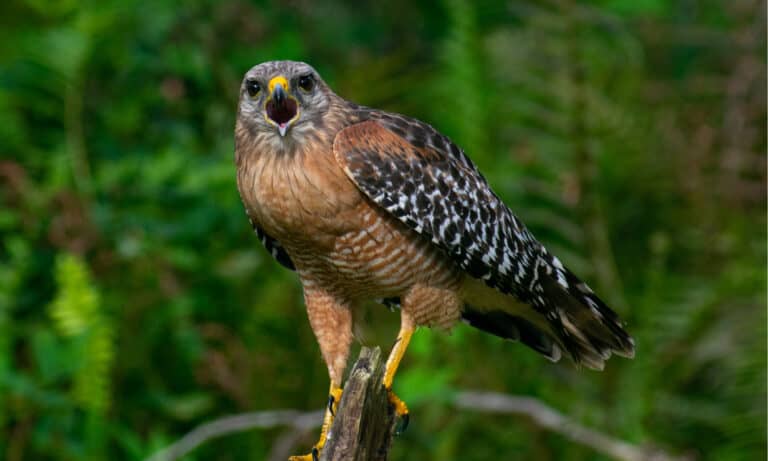
MTKhaled mahmud/Shutterstock.com

Red-Shouldered Hawk Distribution

Click a location to explore more animals from that region

Loading map...
red shouldered hawk vs cooper's hawk

At a Glance

Wild Species
Diet Carnivore
Activity Diurnal+
Lifespan 7 years
Weight 1.09 lbs
Status Least Concern
Did You Know?

Size (adult): length 43-61 cm; wingspan 94-111 cm; mass 0.486-0.862 kg (Cornell Lab of Ornithology, All About Birds).

Scientific Classification

A medium-sized North American raptor (a ‘buteo’) known for its reddish shoulders and strongly barred black-and-white tail; often associated with wooded habitats and wetlands and frequently heard giving a clear, whistled call.

Kingdom
Animalia
Phylum
Chordata
Class
Aves
Order
Accipitriformes
Family
Accipitridae
Genus
Buteo
Species
lineatus

Distinguishing Features

  • Reddish ‘shoulders’ (scapulars) and warm rufous barring on the underparts (adults)
  • Longer, more strongly black-and-white banded tail than many other Buteo hawks
  • Pale, translucent crescents near the wingtips visible in flight
  • Often found in/near wet woods; frequently vocal (clear whistled ‘kee-ah’ type calls)

Physical Measurements

Males and females differ in size

Length
1 ft 4 in (1 ft 3 in – 1 ft 6 in)
1 ft 8 in (1 ft 5 in – 1 ft 11 in)
Weight
1 lbs (1 lbs – 2 lbs)
2 lbs (2 lbs – 2 lbs)
Tail Length
8 in (7 in – 9 in)
Top Speed
35 mph
flying

Appearance

Primary Colors
Secondary Colors
Skin Type Feathered body; bare cere and legs with scaly yellow tarsi and feet.
Distinctive Features
  • Medium-sized buteo: length 43-61 cm; wingspan 90-127 cm (Sibley 2014; Wheeler 2003).
  • Mass: males ~0.486-0.774 kg, females ~0.701-1.365 kg (Dunning 2008).
  • Tail shows multiple narrow black-and-white bands (not a single red tail) separating it from Red-tailed Hawk.
  • Adult underparts show rufous barring across breast/belly; Red-tailed typically has a darker belly band.
  • Upperwing often shows pale, translucent crescent "windows" near wingtips in flight.
  • Favours wooded wetlands/riparian forests; often perches low-to-mid canopy edges to hunt.
  • Hunting biology: sit-and-wait from perches and slow soaring; takes small mammals, amphibians, reptiles, birds.
  • Vocal behavior: distinctive clear, whistled 'kee-aah' call, frequently given near nests/territories.
  • Longevity record: 19+ years in the wild from banding recoveries (e.g., USGS Bird Banding Laboratory reports).

Sexual Dimorphism

Sexes are similar in plumage, but females average noticeably larger and heavier. Size dimorphism is typical of Accipitridae and is most evident in mass and wing chord rather than coloration.

  • Smaller body and slimmer tarsi on average.
  • Lower average mass within species range (about 486-774 g).
  • Larger overall size with broader wings and larger feet.
  • Higher average mass within species range (about 701-1,365 g).

Did You Know?

Size (adult): length 43-61 cm; wingspan 94-111 cm; mass 0.486-0.862 kg (Cornell Lab of Ornithology, All About Birds).

Longevity: the oldest banded Red-shouldered Hawk recorded lived 19 years 11 months (USGS Bird Banding Lab record as summarized by Cornell).

Typical clutch: 2-5 eggs; incubation ~32-34 days; young fledge about 42-49 days after hatching (Cornell).

Diet is notably "wetland-flavored" for a buteo: small mammals plus frogs, snakes, crayfish, and other streamside prey-often hunted from perches along riparian corridors.

Key field mark vs. Red-tailed Hawk: a strongly black-and-white banded tail (not a solid red adult tail) and more uniformly barred, rufous-toned underparts; often found in wooded wetlands rather than open fields.

Often one of the most vocal North American buteos; pairs call frequently near nests and territories, giving a clear, ringing 'kee-aah' that carries through bottomland forests.

Populations vary in movement: many eastern birds are partial migrants, while some (e.g., parts of the Southeast and coastal California) are more resident-tracking local prey and weather rather than strict long-distance routes.

Unique Adaptations

  • Broad, rounded wings plus a relatively long tail improve maneuverability through cluttered riparian forest-an advantage over more open-country buteos.
  • Exceptionally strong grip and sharply curved talons allow secure capture of slippery prey such as amphibians and crayfish.
  • High-acuity vision adapted for detecting small movements from a shaded perch-critical in wooded wetlands with patchy light.
  • Bold tail banding and high-contrast underwing pattern aid rapid in-flight recognition between mates and rivals in dense habitat.
  • A loud, piercing whistle-like call that transmits well through humid bottomland woods, enhancing communication where lines of sight are short.

Interesting Behaviors

  • Perch-and-pounce hunting: commonly sits quietly on a mid-canopy limb over a stream, ditch, or forest edge, then drops quickly onto frogs, small mammals, or crayfish.
  • Soaring and scanning: uses broad wings to circle above woods and floodplains, then re-perches to hunt-typical energy-saving flight behavior of hawks and eagles.
  • Territorial vocal advertising: frequent calling (especially in breeding season) functions as long-range territory signaling in dense forest where visibility is limited.
  • Nest reuse and refurbishment: pairs often return to the same wooded territory and may reuse or rebuild large stick nests high in deciduous trees near water.
  • Nest defense/mobbing: will vigorously defend the nest area, calling repeatedly and sometimes diving at intruders; also participates in mobbing larger raptors and corvids.
  • Courtship flights: paired birds may circle together above the forest canopy while calling; aerial displays intensify before egg-laying.
  • Prey handling: typically pins prey with powerful feet and uses the hooked bill to tear; may cache food near the nest during the nestling period.

Cultural Significance

Red-shouldered Hawk, Buteo lineatus, lives in mature moist deciduous forests, wooded wetlands, riparian corridors, and some wooded suburbs. Its loud, repeated kee-aah call is common. It needs trees near water and eats frogs, snakes, and small mammals.

Myths & Legends

Indigenous North American stories often call hawks (for example, the Red-shouldered Hawk, Buteo lineatus) sharp-eyed messengers or protectors, giving warnings and serving as watchful spirit beings.

Plains traditions (pan-regional motif): hawk feathers and hawk imagery are commonly associated with scouts and alertness in storytelling and ceremonial symbolism, reflecting the bird's watchful hunting style and sharp vision.

Classical Mediterranean augury: in Greco-Roman traditions, the appearance and flight of raptors (including hawks) could be read as signs; raptors' circling/soaring behavior made them prominent "message-bearers" in omen interpretation.

Medieval European falconry lore: hawks were entwined with status and symbolism in aristocratic culture (manuals and social customs around hawking), contributing to the long-standing association of hawks with nobility, discipline, and trained skill.

Name-origin anecdote (scientific tradition): the species name means "lined" or "striped," referencing the strongly barred plumage-especially the black-and-white tail bands that remain a classic identification hallmark in North American field lore.

Conservation Status

LC Least Concern

Widespread and abundant in the wild.

Population Stable

Protected Under

  • U.S. Migratory Bird Treaty Act (1918)
  • Canada Migratory Birds Convention Act (1994)
  • CITES Appendix II

Life Cycle

Birth 3 chicks
Lifespan 7 years

Lifespan

In the Wild
1–19.8 years
In Captivity
5–24 years

Reproduction

Mating System Monogamy
Social Structure Socially Monogamous
Breeding Pattern Long Term
Fertilization Internal Fertilization
Birth Type Internal_fertilization

Red-shouldered Hawks form territorial, socially monogamous pairs that often reunite across breeding seasons. Courtship includes soaring and calling; they reuse nests. Typical clutch is 2-4 eggs, incubated ~33 days; young fledge about 42-49 days.

Behavior & Ecology

Social Kettle (when soaring in groups); otherwise pair Group: 2
Activity Diurnal, Crepuscular
Diet Carnivore Frogs (Lithobates/Rana spp.)
Seasonal Migratory 932 mi

Temperament

Strongly territorial during breeding; calls and chases intruders along well-defined territory boundaries (Dykstra et al. 2008).
Typically solitary or in pairs; tolerance can increase locally in winter or during migration thermals.
Aggressive nest defense; dive-bombing and loud alarm calling near nest are common (Bent 1937; Dykstra et al. 2008).
Cooperative parental care: both sexes provision young; post-fledging family association lasts several weeks (Dykstra et al. 2008).
Reproductive timing: incubation 32-35 days; fledging 42-49 days (Dykstra et al. 2008).
Maximum recorded longevity 19 years 11 months (USGS Bird Banding Laboratory longevity record).

Communication

Clear whistled 'kee-aah/kee-yer' territorial call, often repeated; carries far in woods Dykstra et al. 2008
Rapid, sharper alarm/scold notes near nest; increases with perceived threat level Bent 1937
Juvenile begging calls during post-fledging dependence; stimulates food deliveries Dykstra et al. 2008
Aerial display flights Circling/undulating 'sky-dance') during courtship and territorial advertisement (Dykstra et al. 2008
Visual signaling via posture: tail fanning, wing droop, and direct staring during aggressive encounters.
Food-transfer behavior (prey presentation) used in pair bonding and incubation-period feeding.
Soaring and exaggerated flight strokes can function as long-distance territorial advertisement over canopy openings.

Habitat

Biomes:
Temperate Forest Temperate Rainforest Mediterranean Wetland Freshwater
Terrain:
Coastal Hilly Plains Riverine Valley
Elevation: Up to 6889 ft 9 in

Ecological Role

Mid-level raptorial predator (mesopredator) in forest-wetland and riparian ecosystems.

Regulates populations of small mammals (e.g., rodents) and other small vertebrates, influencing prey community structure Links aquatic and terrestrial food webs by frequently consuming amphibians and crayfish in wetland/riparian habitats May reduce localized pest/injury pressures by preying on rodents and large insects Provides carrion/food resources indirectly via prey remains for scavengers and decomposers near plucking/perch sites

Diet Details

Main Prey:
Small mammals Amphibians Reptiles Birds Crayfish Large insects and other invertebrates

Human Interaction

Domestication Status

Wild

Red-shouldered Hawk (Buteo lineatus) is a wild North American hawk with no domestication history. People use it only in limited ways: wildlife rehabilitation, education, and rarely falconry under permit. It breeds in wooded wetlands and riparian forests, is very territorial, gives a clear whistle, and faces habitat loss, illegal killing, collisions, and poisoning.

Danger Level

Low
  • Nest defense: during breeding season adults may dive/strike or closely pass humans near nests; injuries are usually minor but talons can cause lacerations if contact occurs.
  • Handling risk (rehabilitation/falconry contexts): raptors can inflict punctures/cuts with talons and beak if improperly restrained.
  • Zoonotic risk is low; standard wildlife-handling hygiene is recommended for any wild bird.

As a Pet

Not Suitable as Pet

Legality: Red-shouldered Hawk (Buteo lineatus) is generally illegal to keep as a pet. Protected by the Migratory Bird Treaty Act; having one needs federal or state permits (wildlife rehab, scientific/educational, or some state falconry).

Care Level: Expert Only

Purchase Cost:
Lifetime Cost: $15,000 - $45,000

Economic Value

Uses:
Ecosystem services (predation/pest regulation) Ecotourism and wildlife viewing Environmental education (permitted ambassadors) Research value (banding/telemetry, contaminant monitoring)
Products:
  • No commercial products are ethically/legalistically derived from this species in modern regulated contexts; value is primarily non-consumptive (viewing, education) and indirect (ecosystem services).

Relationships

Predators 6

Great Horned Owl Bubo virginianus
Barred Owl
Barred Owl Strix varia
Red-tailed Hawk Buteo jamaicensis
Bald Eagle
Bald Eagle Haliaeetus leucocephalus
Raccoon
Raccoon Procyon lotor
American Crow Corvus brachyrhynchos

Ecological Equivalents 4

Animals that fill a similar ecological role in their ecosystem

Broad-winged Hawk Buteo platypterus Most like the Broad-winged Hawk: both occur in forests, hunt from perches or by soaring, and eat small vertebrates. The Broad-winged Hawk is smaller and more forest-interior, while the Red-shouldered Hawk favors riparian woods and wetlands (size 38–58 cm, wingspan 90–117 cm, mass 486–774 g).
Red-tailed Hawk Buteo jamaicensis A Buteo found in edge and woodland areas that overlaps with the Red-tailed Hawk; both hunt by soaring and from perches. The Red-tailed Hawk prefers open country and mammals, while the Red-shouldered Hawk uses riparian areas and eats more amphibians and crayfish.
Cooper's Hawk
Cooper's Hawk Accipiter cooperii Both are mid-to-large woodland hawks that perch and chase from trees, nest in mature trees, and take medium-sized birds and squirrels. Cooper's hawk (an Accipiter) is better adapted to hunting birds and maneuvering in dense woods than Buteo.
Barred Owl
Barred Owl Strix varia Nocturnal ecological analog in riparian and deciduous forest landscapes. Both are sit-and-wait predators that take small mammals, amphibians, and reptiles, partitioning primarily by time of activity (day vs. night). Habitat and diet overlap is widely documented in North American raptor accounts, including Cornell Lab species accounts.

Quick Take

  • Crows and Red-Shouldered Hawks are fierce rivals, yet they regularly team up against a common enemy. The dynamic between these species is far stranger than a simple feud. See the crow rivalry →
  • This hawk performs an aerial courtship ritual so dramatic that it continues even after a mate is secured, and the reason why reveals something unexpected about how pairs bond. See the sky-dance courtship →
  • Fewer than half of Red-Shouldered Hawks survive their first year, yet the population is actively growing. Something about how this species reproduces doesn't add up. Until it does. See the survival stats →
  • One pair of these hawks held the same nesting territory for 16 years, and how they chose that site in the first place is something scientists still can't fully explain. Explore nesting site loyalty →

The Red-Shouldered Hawk has a ‘frenemy’ relationship with crows. While crows and hawks often fight, they also team up against owls.

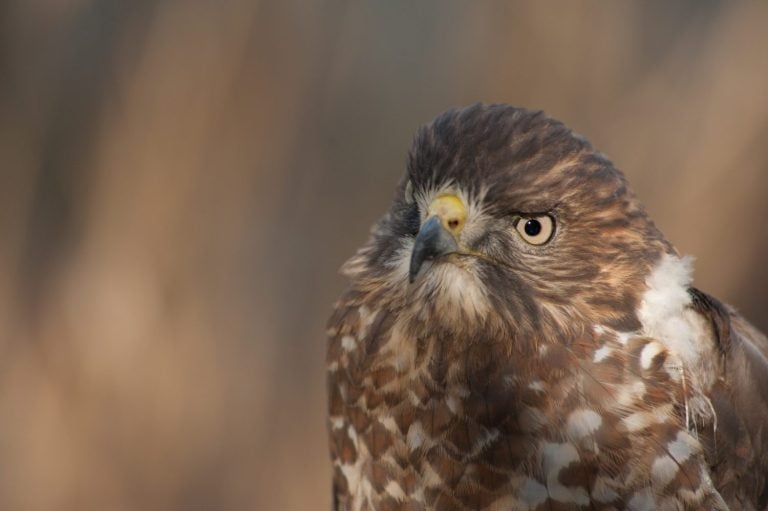
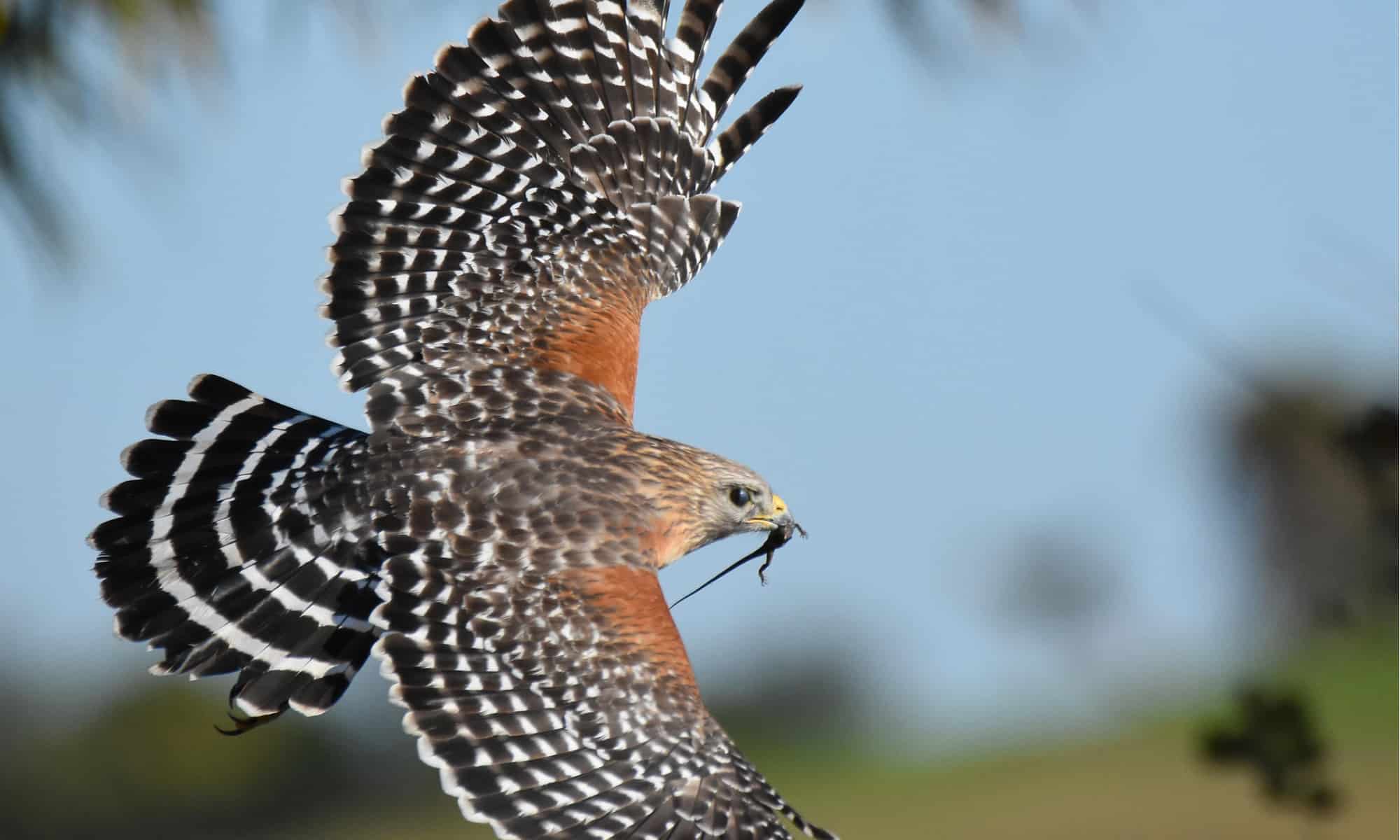
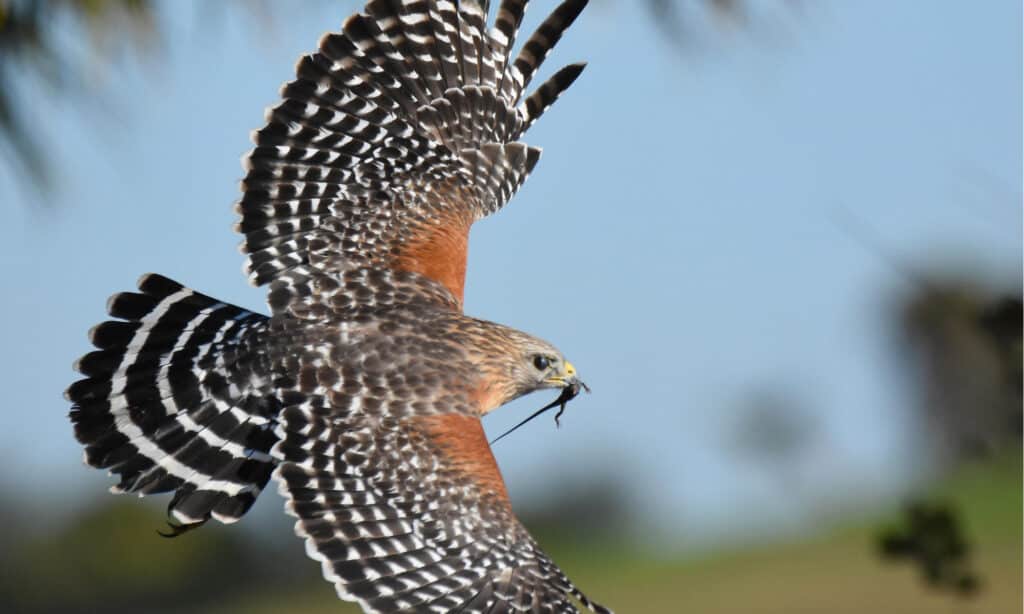
The red-shouldered hawk flies over developed woods and water. This is one of the most distinctively marked hawk species, which makes them quite easy to identify. The upper part of their body is reddish-peach, almost as if they had rolled in red mud.

Their unique whistle also makes them easy to locate, making them well-loved by birdwatchers. Their wings form translucent crescents in flight, allowing you to identify them from a distance.

An educational infographic about the Red-Shouldered Hawk, showing its physical markings, nesting habits, and a map of its North American range.
They feud over food, but when a common predator strikes, these natural enemies form one of the bird world's most unlikely alliances. © A-Z Animals

4 Amazing Red-Shouldered Hawk Facts

  • Feud: The red-shouldered hawk is often mobbed by crows. However, the relationship is not one-sided, as these hawks steal food from crows when possible.
  • And Another Feud: These hawks are also commonly seen attacking (and being attacked by) Great Horned Owls. Each species is known to steal and eat the nestlings of the other.
  • Home Sweet Home: These birds return to the same nesting site each year, though they won’t necessarily use the same nest. One pair of birds was observed holding the same nesting territory for 16 years.
  • Long-Lived: The oldest known red-shouldered hawk was at least 25 years old. However, older hawks have likely existed; we just can’t age hawks from a distance.

Where to Find Red-Shouldered Hawks

Red-shouldered hawks have a very distinctive whistle that makes them easy to locate from a distance. Once you know this whistle, you can often find them around streams or ponds, where they hunt for perch.

In the spring, you may also see them circling their nesting area. Their wing shape and coloration make them pretty easy to ID from afar.

Geographically speaking, these birds are found year-round in the eastern United States. They also migrate into some northern areas of the United States and into southern Canada. They may also migrate into Mexico, but they do not breed in these areas.

Nests

Red-shouldered hawks are one of the few birds that will reuse nests from previous years. We don’t know how the nesting site is chosen. However, once one is chosen, you can expect birds to come back to it each year if they are able.

Usually, the male arrives at the site first and will defend it. The female arrives later.

In most cases, the nest is placed in a broad-leaved tree below the forest canopy. Usually, they place it on the crotch of the main trunk. For hunting purposes, the nest will usually be near a pond, lake, or stream.

Both genders help build the nest or repair the previous year’s nest. Sticks are the main component of these 2-foot nests, though they are lined with soft materials like bark and moss. Fresh green leaves are added throughout the nesting season.

Classification and Scientific Name

The red-shouldered hawk is a member of the genus Buteo. This genus contains medium-sized raptors (aka hawks), which have large bodies and broad wings. In Europe, members of this genus are usually called “buzzards”—not “hawks” like they are in North America.

This genus is classified in the larger Accipitridae family. This family varies considerably. However, it contains small to large birds with hooked bills. Beyond that, their morphology varies, as each species is specialized to hunt specific prey.

Size, Appearance & Behavior

These hawks are medium-sized birds with rounded, broad wings. Their tails are medium-length and fan out behind them when they fly. Usually, they glide more than they flap, which can help you ID them from a distance.

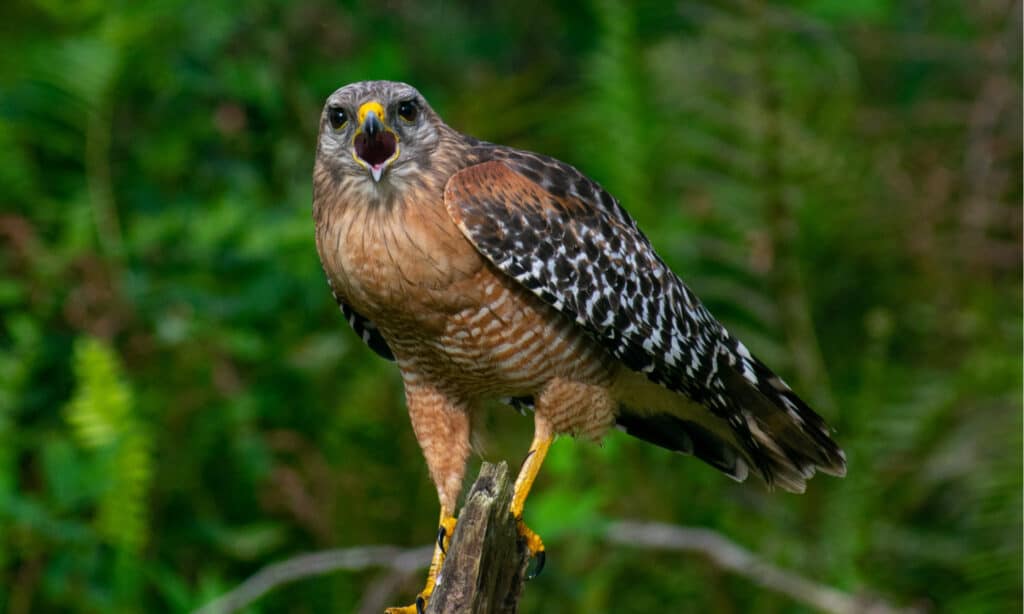
Adult red-shouldered hawks have a very rich, red coloration on their “shoulders” and chest. Their tail and wings are black with narrow, white bands. However, younger hawks are typically brown instead of red or black. Their coloring is far more muted.

These birds are usually seen flying above forests or perching on tree branches. While flying, they often whistle—a call unique to this species. Therefore, if you can ID this whistle, you can often find them pretty easily.

When hunting, these birds perch near a body of water and watch for prey below. In wilder areas, they flush easily and retreat into cover. However, in populated areas, they become more tolerant of humans and may even be approachable.
red shouldered hawk vs cooper's hawk

Red-shouldered hawks have a unique whistle, which makes them easy to identify.

Diet

Like all hawks, red-shouldered hawks eat small mammals. However, this species also consumes large quantities of fish, which is why they commonly nest near bodies of water.

What Does a Red-Shouldered Hawk Eat?

For the most part, their diet is made up of small mammals and amphibians. They will also consume snakes and lizards if given the chance. They are opportunistic predators, which means that they will typically take the opportunity to eat something even if it doesn’t fit their “normal” diet.

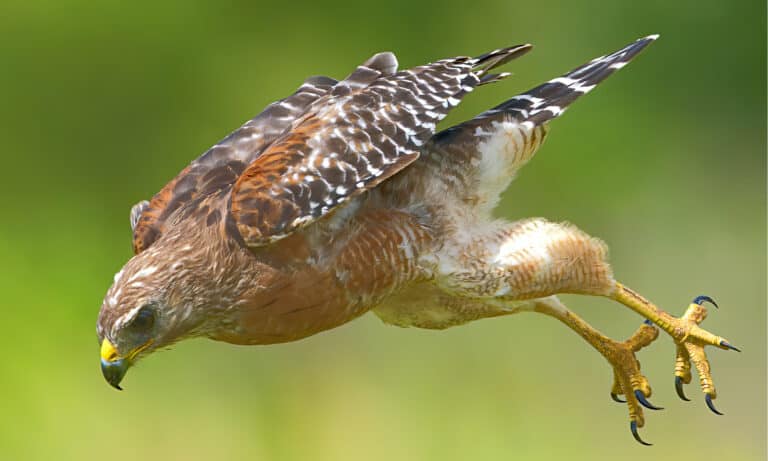
These birds will hunt from perches above shallow water or in the forest. They will sit until they catch sight of a prey item below. Then, they will descend swiftly and catch the unlucky creature below.

Occasionally, the hawks will eat other birds. However, this appears to be less common than predation on small mammals, perhaps because birds are harder to catch.

Predators, Threats, and Conservation Status

The red-shouldered hawk currently falls in the least concern category. The estimated breeding population is currently 1.9 million. The population is currently increasing by approximately 2% per year. However, the biggest threat to their population is the clearing of wooded habitat, which these birds rely on.

What Eats the Red-Shouldered Hawk?

The red-shouldered hawk is typically at the top of the food chain. Therefore, they are rarely preyed upon by other animals. However, they do have a competitive relationship with owls and crows, which may rarely end in the death of a hawk.

Raccoons, snakes, and similar animals may prey on young hawks and their eggs. However, they are not common predators of adult birds.

Reproduction, Babies, and Lifespan

Red-shouldered hawks are monogamous and territorial. They will defend their nesting territory during the breeding season.

To attract a mate, males perform a “sky dance” that involves steep dives and spirals. These dances may continue even after the male has mated with a female. Mated pairs will soar together in wide circles and dive towards each other.

Their mating season is between April and June. The breeding pair builds a nest and then lays three to four eggs. The eggs are blotchy, brown or lavender in color. The incubation period ranges from 28 to 33 days. However, not all the eggs hatch at the same time. The first hatchling may hatch a week before the last.

The female feeds the hatchlings almost constantly for 40 days. The male mostly captures food, but there are reports of males incubating. The young leave the nest at around 6 weeks. However, they remain dependent on the parent until 17 to 19 weeks old.

Even young birds that are no longer dependent often stay near the nest until the following breeding season. Sexual maturity is usually attained around one to two years of age, but birds rarely mate in their first year.

Overall nesting success is often below 30%, and while these birds can live up to 20 years, fewer than half survive their first year.
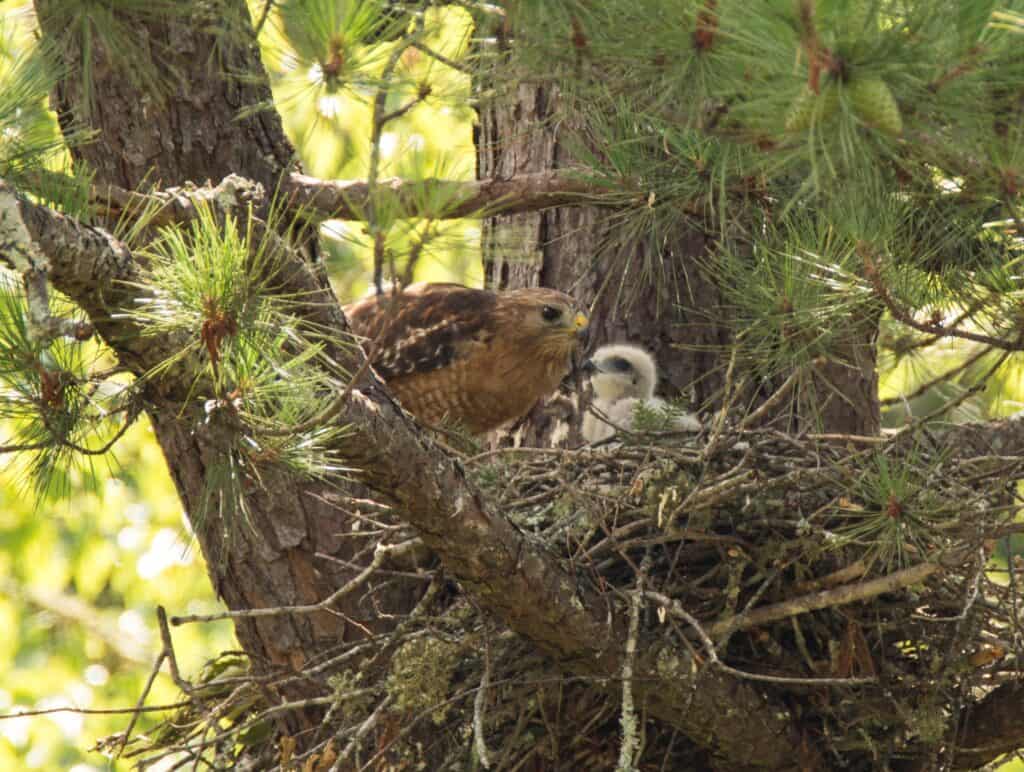
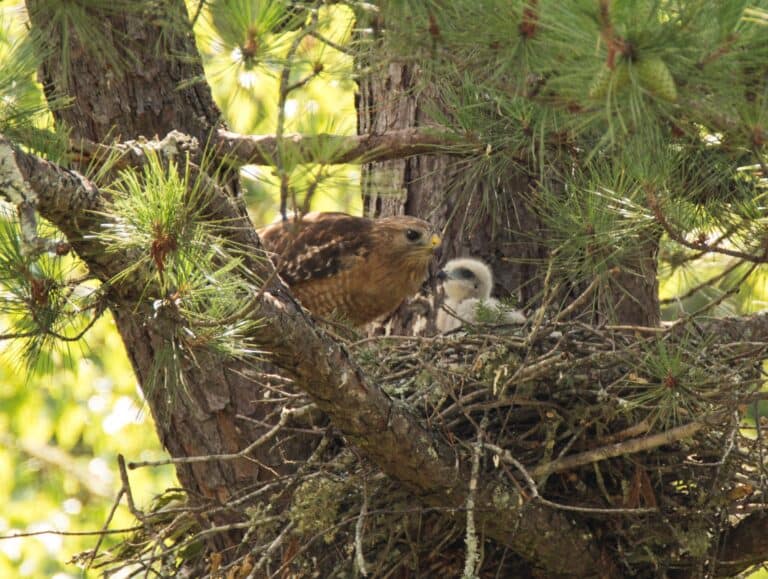
Red shouldered hawk and baby in nest in tree

Red-shouldered hawk young leave the nest at around 6 weeks.

Population

The current breeding population is around 1.9 million, with the population increasing by about 2% each year. This species is not endangered, and its conservation concern rating is low.

View all 181 animals that start with R

Sources

  1. USDA Forest Service Eastern Region/John & Eugene Jacobs / Accessed September 1, 2022
  2. Birds of the World/C. R. Preston and R. D. Beane / Accessed September 1, 2022
  3. Birds Outside My Window/Kate St. John / Accessed September 1, 2022
  4. Texas Parks and Wildlife / Accessed September 1, 2022
  5. Hawk Mountain Global Raptor Conservation / Accessed September 1, 2022
Kristin Hitchcock

About the Author

Kristin Hitchcock

Kristin is a writer at A-Z Animals primarily covering dogs, cats, fish, and other pets. She has been an animal writer for seven years, writing for top publications on everything from chinchilla cancer to the rise of designer dogs. She currently lives in Tennessee with her cat, dogs, and two children. When she isn't writing about pets, she enjoys hiking and crocheting.

Thank you for reading! Have some feedback for us?


Red-Shouldered Hawk FAQs (Frequently Asked Questions)

Not usually. There are some populations that migrate, but this isn’t very common.