
Quick Take
- Florida has a turtle whose name comes from what it tastes like, and its history on dinner tables is stranger than you'd expect. Discover the chicken turtle →
- The world's largest non-crocodilian reptile visits Florida's coast, and most people would be surprised to learn how long it can hold its breath. Meet the largest reptile →
- Two turtles in this list share nearly the same name but couldn't be more different in size, a fact that matters because confusing them in the wild has real consequences. Compare the two loggerheads →
The Sunshine State is home to a wide range of fascinating reptiles, and its turtle population is especially diverse. From tiny softshell turtles and fearsome snapping turtles to massive 500-pound sea turtles, there are approximately 30 different types of turtles in Florida. Turtles are found throughout the state of Florida, inhabiting its coastal marine waters, freshwater rivers, lakes, and terrestrial habitats. Continue reading to learn about 14 turtles that live in Florida.
Florida Softshell Turtle
The Florida softshell turtle (Apalone ferox) has many unique traits, the most unusual being its long, snorkel-like snout and smooth, cartilaginous shell. True to its name, its dark brown shell has no distinct ridges or scutes, making it flat and soft to the touch. The Florida softshell is actually one of the largest softshell turtle species, with males ranging from 6 to 12 inches and females from 11 to 24 inches in shell length.
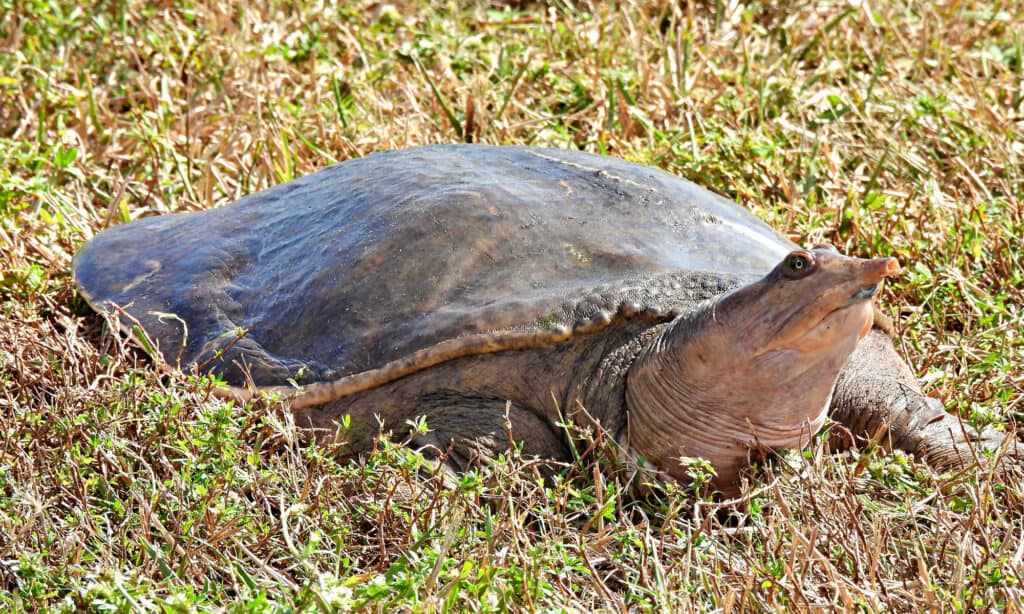
The Florida softshell turtle can be easily identified by its long, narrow snorkel-like snout and flat, smooth shell.
©iStock.com/passion4nature
This turtle is almost fully aquatic, preferring muddy, shallow bodies of water like ponds and slow-moving streams. Its thin snout helps it breathe while staying partially submerged in search of prey (or while hiding from predators). Its dark brownish-grey body color helps it camouflage itself in the muddy substrate and leaf litter. Meanwhile, the turtle’s webbed feet and clawed toes make it well-suited to a mostly aquatic lifestyle.
This species’ native range extends throughout most of Florida as well as parts of southern Georgia. It’s an opportunistic omnivore, usually feeding on small aquatic insects, fishes, and amphibians.
Leatherback Sea Turtle
The leatherback sea turtle (Dermochelys coriacea) is the largest of all turtle species in the world, and the largest non-crocodilian reptile. Leatherbacks can weigh over 700 pounds and average 5 to 6 feet in length. Some especially large individuals can weigh more than 1,000 pounds.
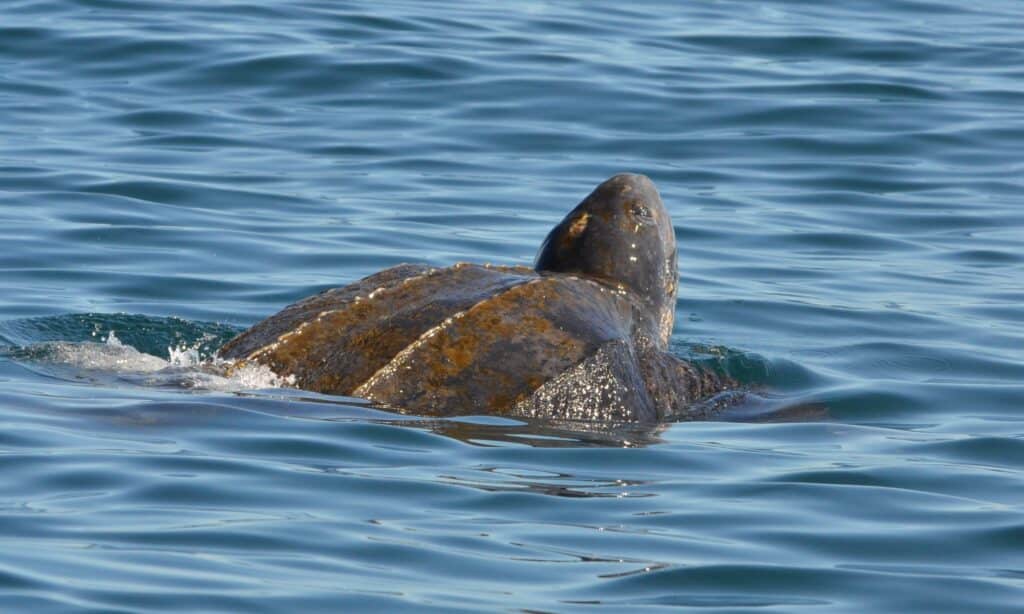
Leatherback sea turtles are the largest non-crocodilian reptiles on the planet.
©iStock.com/jtstewartphoto
Leatherbacks are dark grey to black, with small, irregular white and beige splotches throughout. Like most other sea turtles, they have long, strong, flat flippers instead of clawed toes.
As a sea turtle, the leatherback is essentially entirely aquatic, only surfacing briefly to breathe and lay eggs. It can swim at speeds exceeding 20 miles per hour and can dive as deep as 4,000 feet. What’s more, leatherback sea turtles can hold their breath for over 30 minutes at a time. Though they have plenty of options for food, they mainly feed on soft, gelatinous invertebrates like jellyfish.
The leatherback’s geographic range is very wide, extending throughout much of the Atlantic and Pacific Oceans. Sadly, this range is becoming smaller, as the species has been critically endangered since the 1970s. This is primarily due to coastal land development, pollution, and human activity in general.
Loggerhead Sea Turtle
Loggerhead sea turtles (Caretta caretta) are absolutely massive. The carapace alone can range from 28 to 41 inches long, and loggerheads commonly weigh between 155 and 397 pounds. Some individuals have even been recorded topping 1,000 pounds.
Because it is almost entirely aquatic, the loggerhead sea turtle has long, strong flippers instead of clawed feet. Its skin is usually light beige in color with darker brown spots along the head, legs, and flippers. The shell is brown to reddish-brown in color with large, wide scutes. Males generally have thicker tails and shorter plastrons (belly shells) than females.
Their jaws and beaks are strong and sharp, giving them lots of options when it comes to prey. They mainly eat small aquatic invertebrates, though.
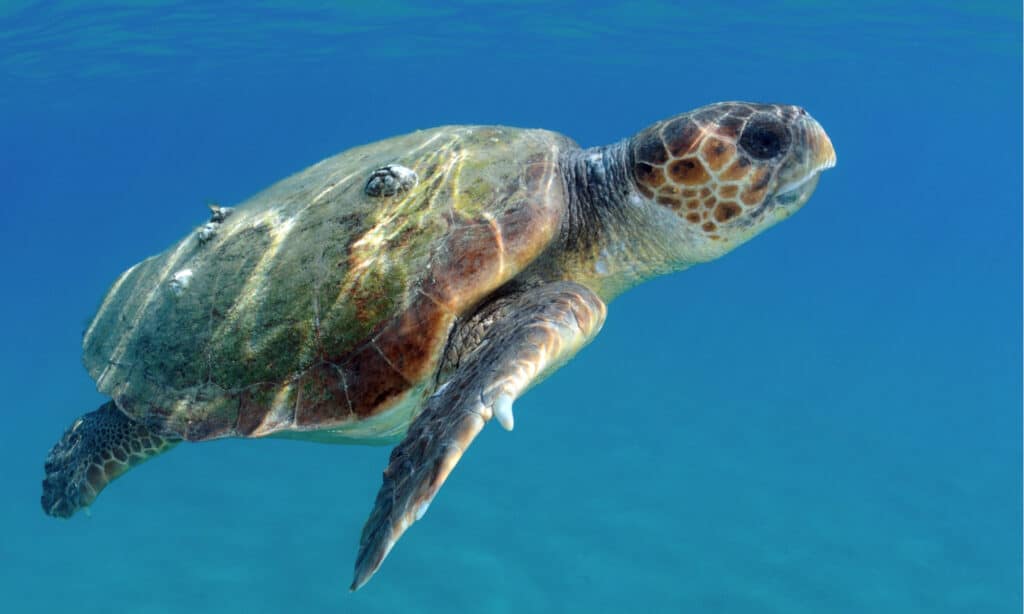
Loggerhead sea turtles can weigh up to 1,000 pounds.
©Matteo photos/Shutterstock.com
The loggerhead’s geographic range extends throughout much of the warmer regions of the Atlantic, Indian, and Pacific Oceans, and the Mediterranean Sea.
Amazingly, this massive reptile can live for up to 67 years. However, the species is currently listed as vulnerable due to human interference and increasing coastal land development.
Loggerhead Musk Turtle
The loggerhead musk turtle (Sternotherus minor) is smaller and less aquatic than the loggerhead sea turtle. Found in northern and western Florida, loggerhead musk turtles live in shallow bodies of water like ponds and slow-moving streams.
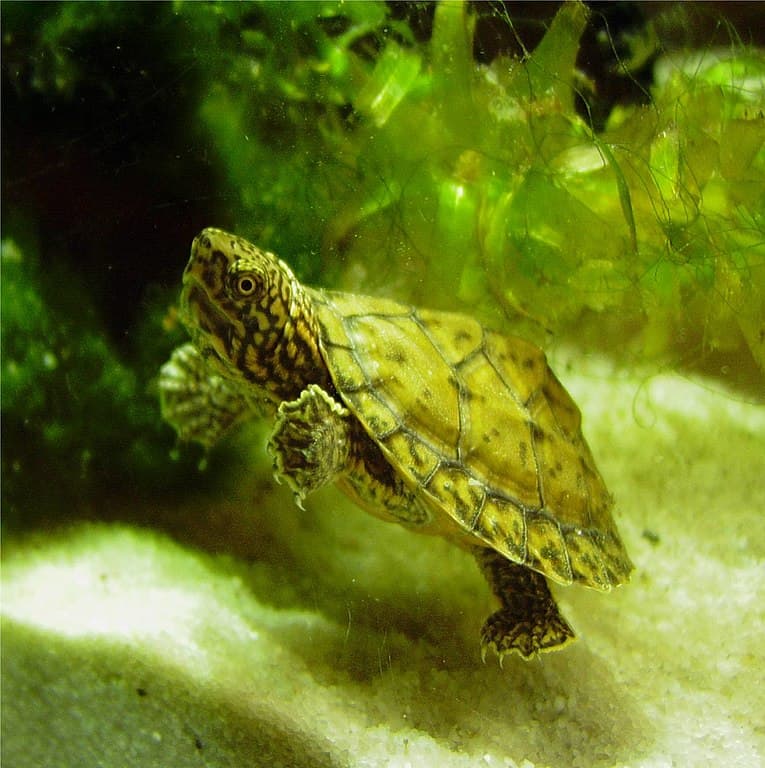
The loggerhead musk turtle has a large, bulky head compared to its fairly small body size.
The loggerhead musk turtle’s large, bulky head makes it easy to tell apart from most other musk turtles. They average 3 to 5 inches in length when fully grown.
The loggerhead musk turtle’s skin ranges from light brown to tan, with small dark brown splotches throughout the head and body. The carapace is dark brown and somewhat flat.
As a semiaquatic species, this turtle has webbed feet with claws at the end of each toe. It mainly feeds on small, aquatic inverts like clams and snails.
Florida Mud Turtle
The Florida mud turtle (Kinosternon steindachneri), native to much of Central and South Florida, looks like a typical small, semi-aquatic mud or musk turtle. Small in size, it typically measures a mere 3 to 5 inches in length. Its long, rounded dark brown shell has an orange-ish brown underside. Its webbed feet and clawed toes help it navigate shallow, muddy bodies of water like ponds and marshes.
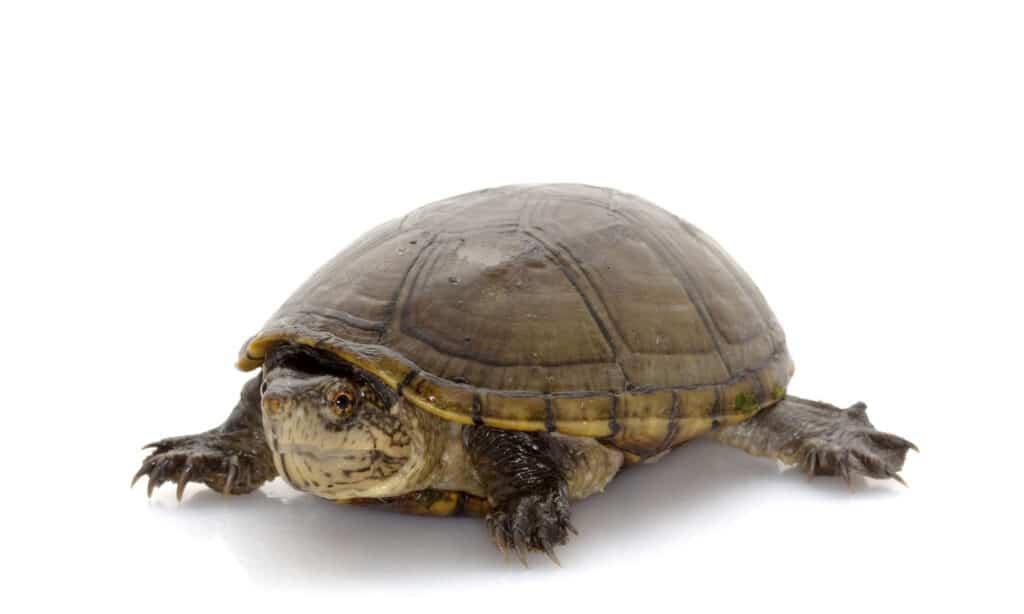
The Florida mud turtle was once thought to be a subspecies of the Eastern mud turtle. Today, it is classified as its own distinct species.
©fivespots/Shutterstock.com
Florida Chicken Turtle
The Florida chicken turtle (Deirochelys reticularia chrysea) name is a reference to its long, bird-like neck and because its meat is said to taste like chicken.
An average Florida chicken turtle measures between 6 and 10 inches long and has webbed, clawed feet typical of most semiaquatic turtles. Females are generally larger than males.
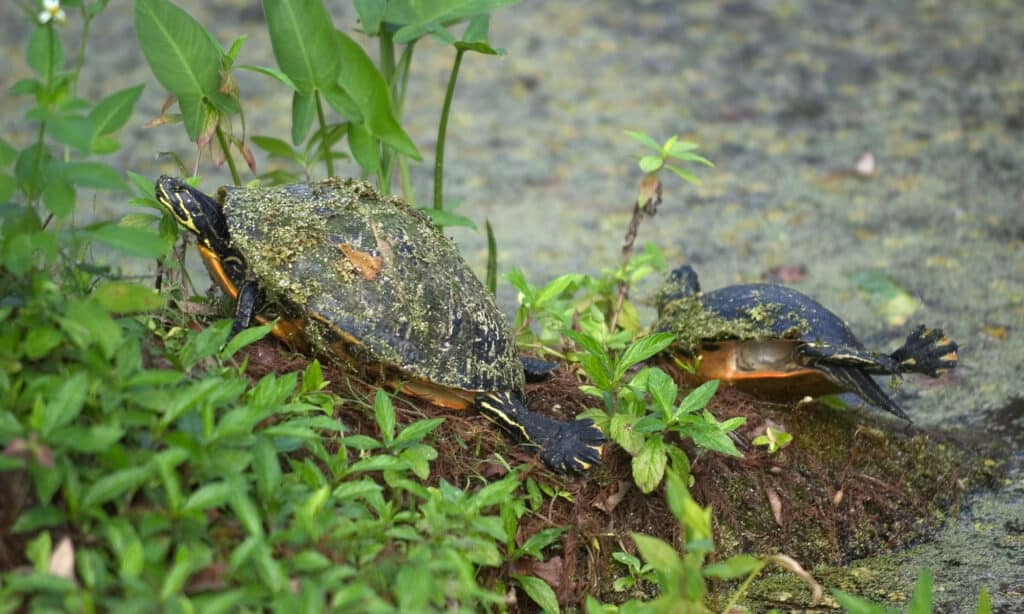
Semi-aquatic Florida chicken turtles were historically gathered and sold in Southern U.S. food markets for meat and turtle soup during the 19th and early 20th centuries.
©J. Norman Reid/Shutterstock.com
The Florida chicken turtle has a dark brown carapace with a thin, light yellowish net pattern. Its skin is typically greenish-brown with thin, yellow striping.
The Florida chicken turtle is found in shallow, muddy bodies of water like marshes and slow-moving streams. It is quite hardy and well adapted to moving in the water and on land. Notably, it has a fairly short lifespan compared to other similar turtle species — only around 20 to 25 years.
Florida Box Turtle
The Florida box turtle (Terrapene carolina bauri) is one of six subspecies of the common box turtle. The only other box turtle subspecies found in Florida is the Gulf Coast Box Turtle (T. c. major), which is found in Florida’s Panhandle.
The average Florida box turtle is 2-4 inches long, and males are slightly larger than females. Its dome-like shell is mostly dark brown with bright yellow irregular striping throughout. The turtle’s skin is a mottled dark brownish-grey with random yellow splotches.
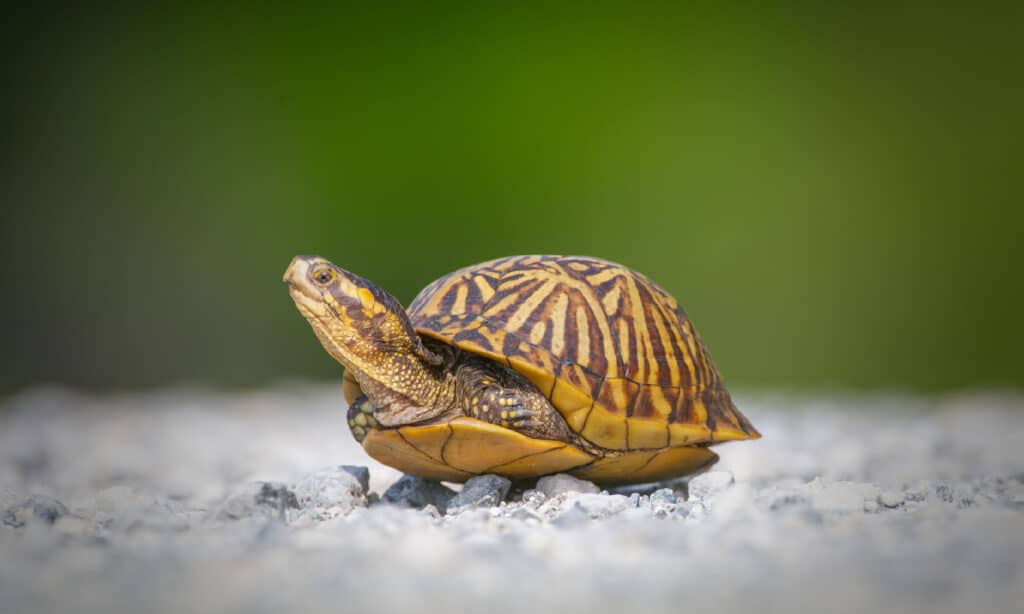
The Florida box turtle has vibrant yellow patterning atop its carapace.
©iStock.com/Dan Rieck
As a semiaquatic species, Florida box turtles are found in swampy habitats with lots of moist soil and leaf substrate for burrowing. The Florida box turtle is quite hardy, with webbed feet and clawed toes to allow it to easily traverse both land and water. The Florida box turtle is an opportunistic omnivore, feeding on a wide range of invertebrates, small fishes, and amphibians.
Common Snapping Turtle
The common snapping turtle (Chelydra serpentina) is the most widespread species of snapping turtle in the United States. This hardy turtle’s geographic range covers much of the Midwestern and Eastern United States. It can be found throughout Florida, but it fares best in Central and Northern Florida, particularly near the panhandle region.
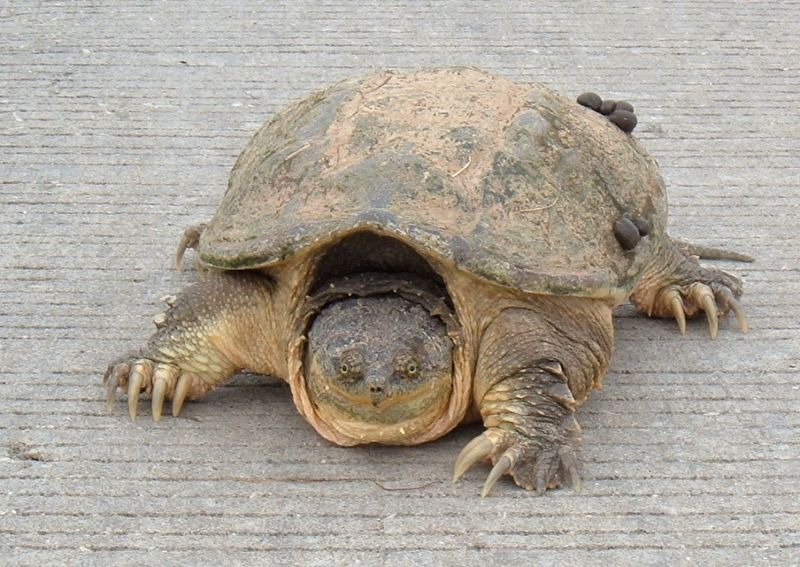
The common snapping turtle’s long claws and sharp beak make it a powerful predator.
©Willy Logan / Creative Commons – Original
In addition to being the most widespread snapping turtle species, it’s also one of the largest and heaviest freshwater turtles in the world. Common snapping turtles typically weigh between 10 and 30 pounds, but it isn’t uncommon for them to exceed 40 pounds. The species’ lifespan is also impressive, estimated to be more than 100 years.
The common snapping turtle is easily identified by its bulky build, craggy, textured carapace, and sharp, prominent beak. The carapace scutes are raised and pronounced, giving the shell its uneven, mountainous look. Males are typically larger and heavier than females.
As an ambush predator and omnivore, the common snapping turtle will munch on almost anything it can get into its massive mouth. It cleverly camouflages itself just under the muddy water’s surface, where it strikes any fish, amphibians, rodents, lizards, insects, or even birds that happen to cross its path.
Although they aren’t particularly aggressive, all snapping turtles have a painful bite.
Alligator Snapping Turtle
The alligator snapping turtle (Macrochelys temminckii) has a craggy, rough-textured carapace, a bulky head, and an incredibly sharp, powerful beak.
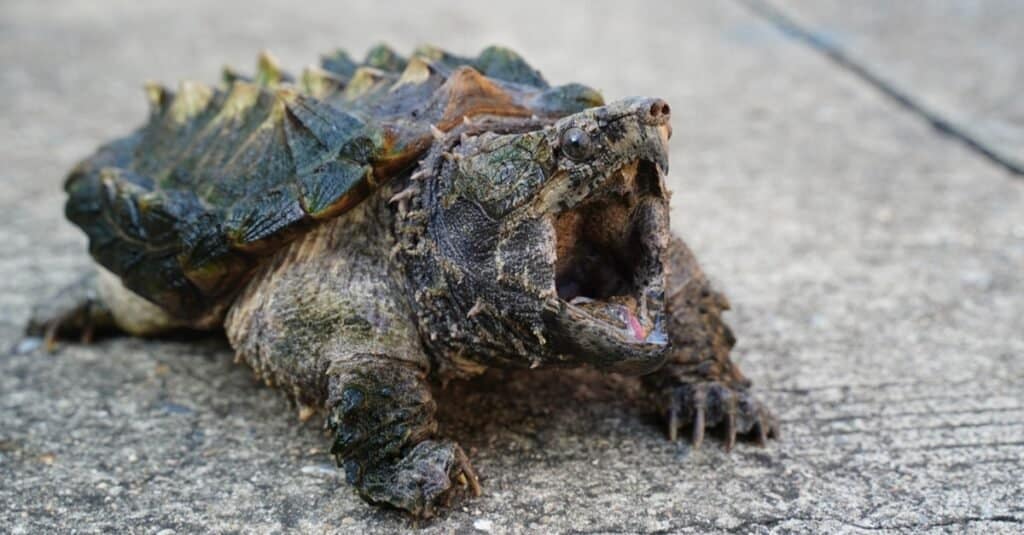
The alligator snapping turtle’s distribution is limited to Florida’s Panhandle.
©Sista Vongjintanaruks/Shutterstock.com
As one of the largest freshwater turtles in the world, the alligator snapping turtle can weigh well over 150 pounds, with average weights ranging from as little as 30 pounds to 170+ pounds. Individuals can measure up to 29 inches long, though 20 to 25 inches is a more typical range.
although they appear sluggish, alligator snapping turtles are actually surprisingly fast in the water and on land as an ambush predator.
Alligator snapping turtles are dark brown to olive green in color with yellow patterning around the head and eyes.
The alligator snapping turtle is a fierce predator, using its worm-like tongue and cavernous mouth to lure in unsuspecting fish and amphibians. It is almost entirely carnivorous and, like all snapping turtles, has a painful bite.
Suwannee Alligator Snapping Turtle
The Suwannee alligator snapping turtle (Macrochelys suwanniensis) is a prehistoric-looking reptile exclusively found in the Suwannee River basin spanning Southern Georgia and Northern Florida. As one of the largest freshwater turtles in North America, adult males can be 25.5 inches long and weigh more than 125 pounds. However, females rarely exceed 48 pounds.
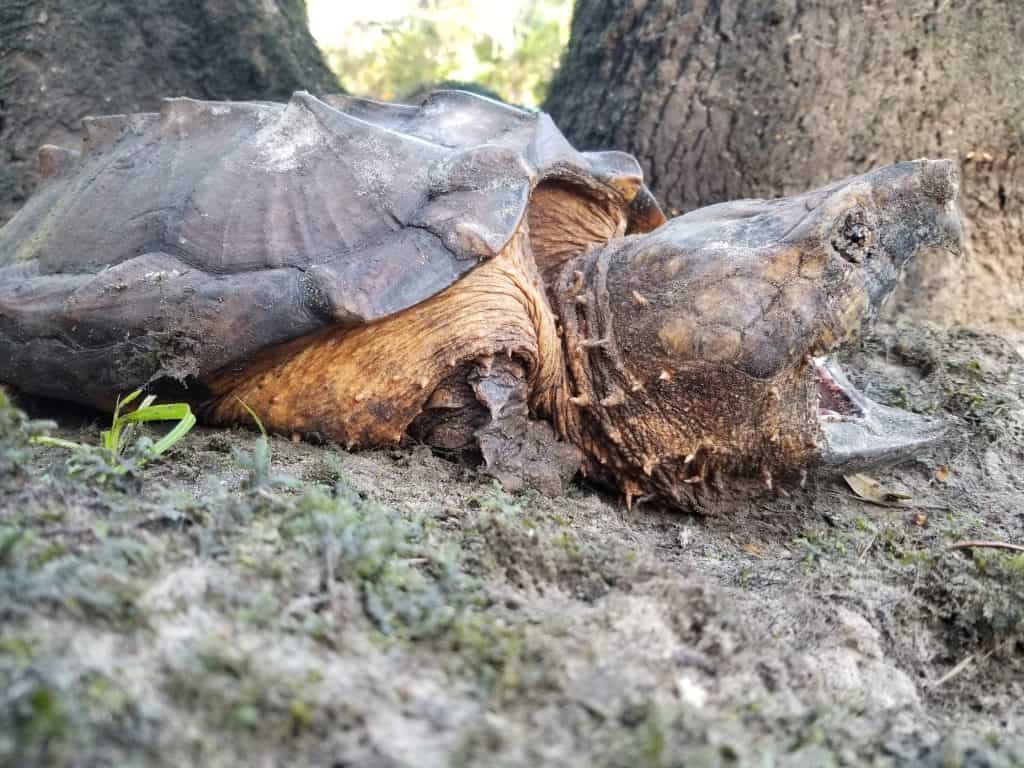
The Suwannee alligator snapping turtle is only found in the Suwannee River basin in Georgia and Florida.
Suwannee alligator snapping turtles are characterized by a massive, blocky head, powerful jaws with a sharply hooked beak, and a rough, dark brown shell featuring three prominent, spiked ridges running down the back. Although they are non-aggressive and prefer to lie motionless at the bottom of riverbeds, they will bite if handled or threatened. Because their incredibly powerful jaws are capable of snapping through bone, the Suwannee alligator snapping turtle should never be approached or handled in the wild.
Florida Red-Bellied Cooter Turtle
The Florida red-bellied cooter (Pseudemys nelsoni) is found throughout Florida. It has a bright reddish-orange plastron (bottom shell) and a dark brown carapace (top shell). The Florida red-bellied cooter averages around 8 to 15 inches long, with females usually being slightly larger than males.
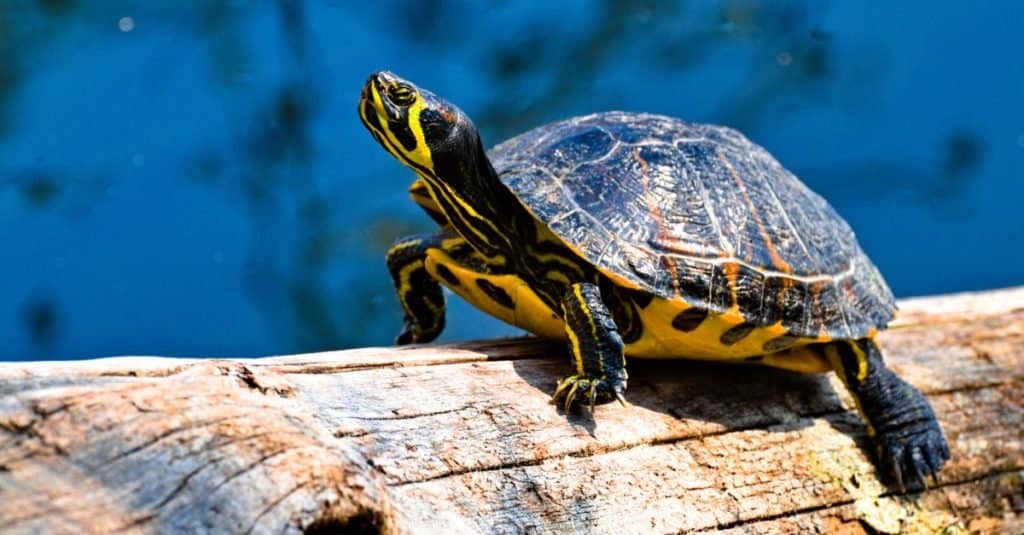
The Florida red-bellied cooter spends a lot of time basking in the sun on partially submerged logs and rocks.
©Marco Fine/Shutterstock.com
Although it is a freshwater species, the Florida red-bellied cooter is quite hardy and can tolerate brackish water well. While similar turtles eat aquatic invertebrates, the Florida red-bellied cooter eats aquatic plants like duckweed and algae.
Coastal Plain Cooter
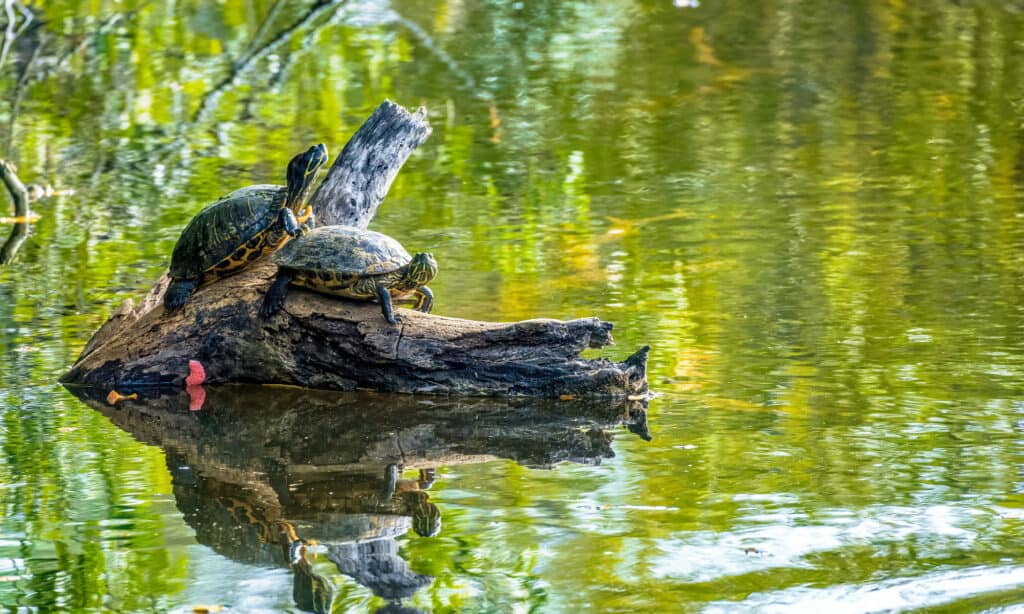
The Coastal plain cooter (Pseudemys floridana or Pseudemys concinna floridana) is a large, freshwater turtle native to the Southeastern coastal plain of the United States, including Florida. These turtles have an average shell length of 9 to 13 inches, though large adult females can grow up to a maximum length of 15.6 inches.
©iStock.com/Sunshower Shots
Coastal plain cooters have an elevated, moderately domed dark brown or black carapace (upper shell) adorned with complex yellow or orange markings, a plain yellow plastron (lower shell) with no dark pattern, and dark skin with yellow or cream-colored stripes running along the neck and limbs.
Coastal plain cooters are generally gentle and highly unlikely to bite, preferring to retreat into the water when startled. They are predominantly herbivorous baskers. However, like any wild animal, they can bite in self-defense if handled carelessly; their strong, sharp jaws — designed for shearing aquatic vegetation — can make such a bite quite painful.
Barbour’s Map Turtle
The Barbour’s map turtle (Graptemys barbouri) is a freshwater turtle native to the Apalachicola River basin, which spans parts of Florida. These turtles exhibit extreme sexual dimorphism, with females growing to lengths of up to 13 inches, whereas males of the species only grow to about 5.5 inches long.
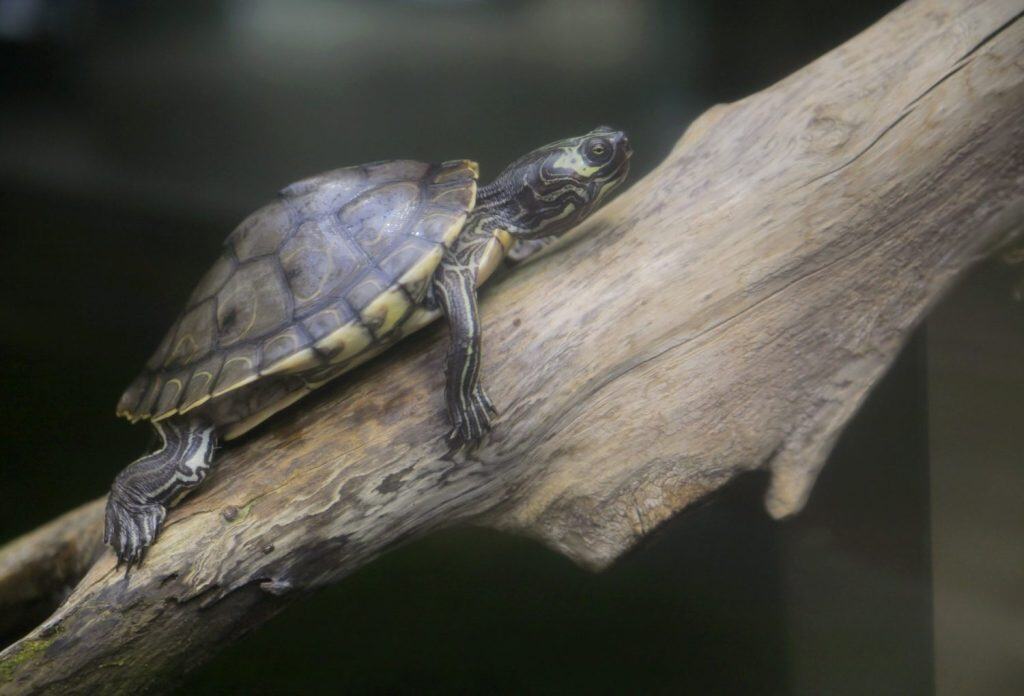
Barbour’s map turtles are freshwater turtles found in Florida’s panhandle.
©Matt Antonino/Shutterstock.com
Barbour’s map turtles have an olive, dark brown, or black upper shell with map-like markings along the edges. Their skin is dark with contrasting yellow-green stripes, and large, mature females develop massively enlarged heads and crushing jaws specifically adapted for eating mollusks and snails. Barbour’s map turtles can and will bite if handled or cornered. Because of their powerful jaw strength, especially in adult females, their bite can be quite painful and is fully capable of breaking the skin.
Gopher Tortoise
The Gopher Tortoise (Gopherus polyphemus) is a moderate-sized terrestrial reptile distributed across the dry, sandy uplands of the Southeastern United States, including Florida. Adults typically measure between 9 and 15 inches long and weigh between 8 and 15 pounds.
Gopher tortoises have a domed, oblong carapace of tan, brown, or gray-black, and a yellowish plastron. They have stout hind feet and flattened, shovel-like front legs covered in heavy scales that are adapted for digging extensive underground burrows. Gopher tortoises are remarkably docile and are not aggressive toward humans, and virtually never bite unless mishandled or cornered.
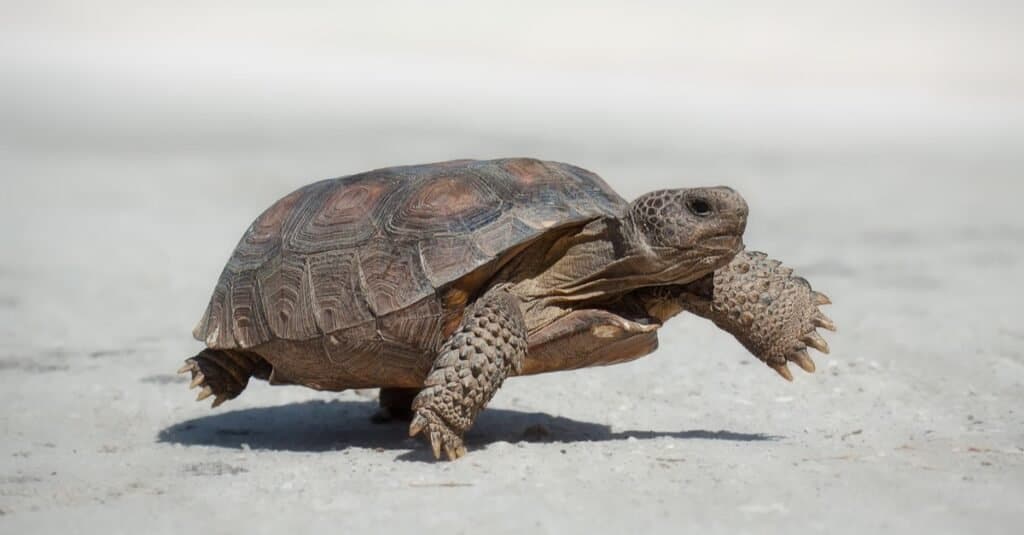
Gopher tortoise walking in the road.
©Kristian Bell/Shutterstock.com