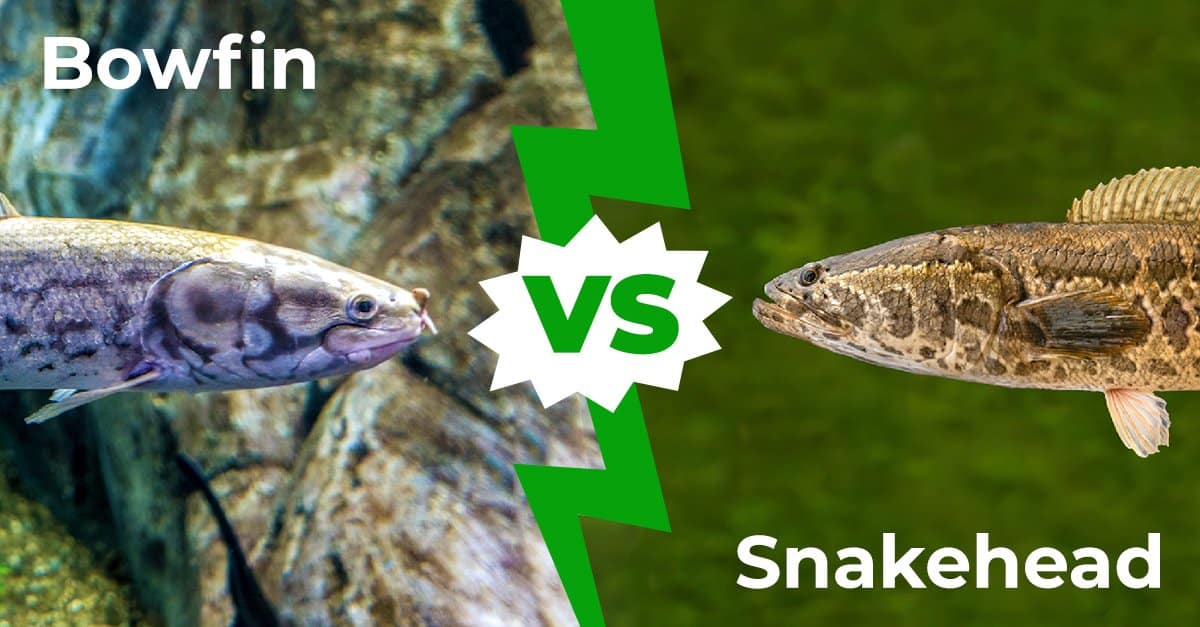

The bowfin and snakehead are both predatory freshwater fish that look superficially similar to each other because of their long bodies and big dorsal fins. People in the eastern United States often mistake them for each other because they happen to overlap here. However, when we compare the bowfin and snakehead, whereas the bowfin is a native of North America, the snakehead is actually an invasive species originating from Asia and Africa.
This article will cover the main differences between the bowfin and the snakehead. While they are not closely related at all, the differences and similarities between them are interesting and instructive.
Comparing Bowfin vs. Snakehead
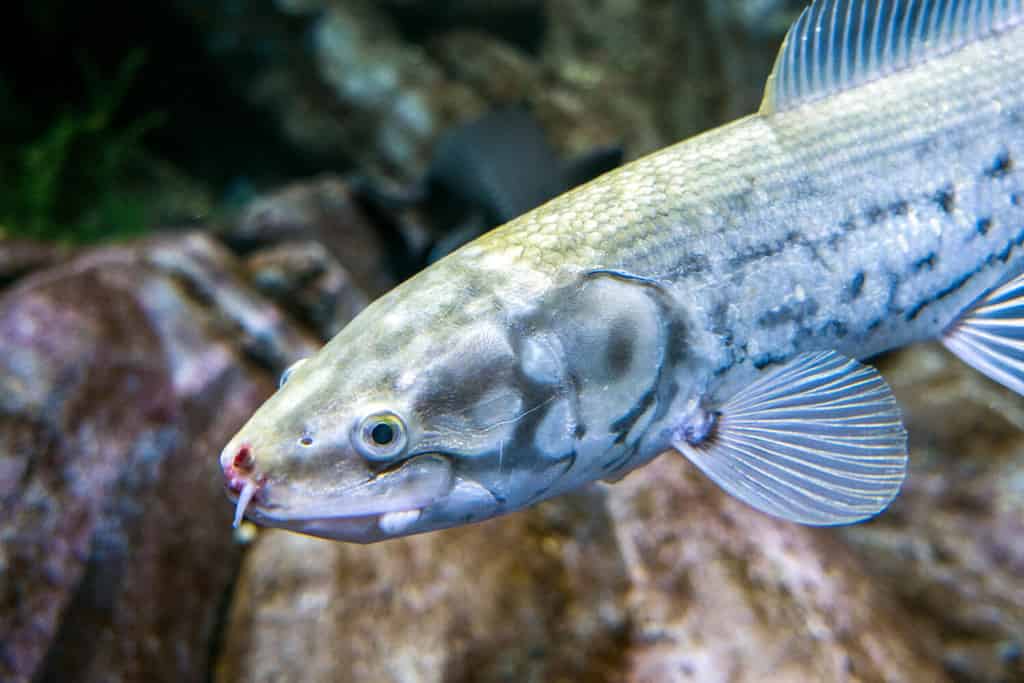
There is only one species of bowfin, while there are multiple snakehead species.
©Miroslav Halama/Shutterstock.com
| Long body with a short anal fin and an eyespot | Snakehead | |
|---|---|---|
| Size | 20 to 43 inches (50 to 109 cm) | 5 to 40 inches (13 to 101 cm) |
| Distribution | Eastern United States | Africa and Asia (also introduced into the United States) |
| Habitat | Slow-moving rivers, lakes, swamps, and brackish water | Rivers and lakes; can also briefly migrate over land |
| Number of Species | Just one | Around 25 |
| Body Shape | Long body with short anal fin and an eyespot | Long body with large anal fin and no eyespot |
The 5 Key Differences between Bowfins and Snakeheads
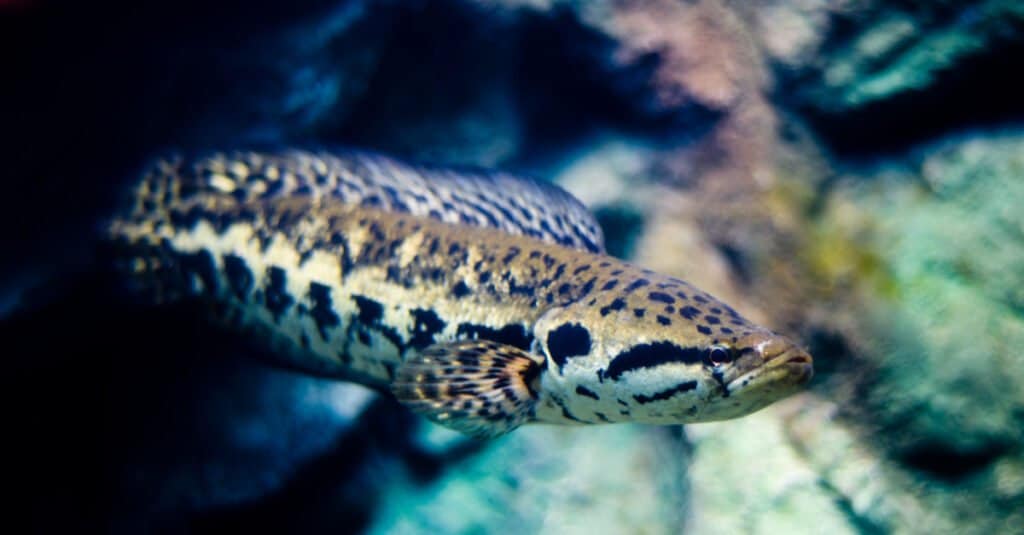
Bowfins have an eyespot, while most snakeheads do not.
©Narongchut/Shutterstock.com
Despite their superficially similar appearance, bowfins and snakeheads are not closely related at all. From an evolutionary perspective, they are actually quite distinct. The bowfin is a member of the order Amiiformes (and the only living species within it). It is actually more closely related to the gars, a long, freshwater, or brackish order of fish native to North America. The snakeheads (which include around 25 species in total) are members of the order Anabantiformes. They are more closely related to a group of fish called the gourami; these are round-bodied Asian fish with the ability to partially breathe the air because they swim in oxygen-poor waters.
Here is a breakdown of all of the differences between these two fish.
1. Bowfin vs. Snakehead: Location

The habitats of the bowfin and snakehead differ.
©demerzel21/iStock / Getty Images Plus via Getty Images
The bowfin is native to the eastern United States, while the snakehead is primarily native to Asia, with a few species found in Africa. Their habitat ranges do not overlap except where the snakehead was intentionally introduced into the eastern United States and became an invasive species.
2. Bowfin vs. Snakehead: Eyespot
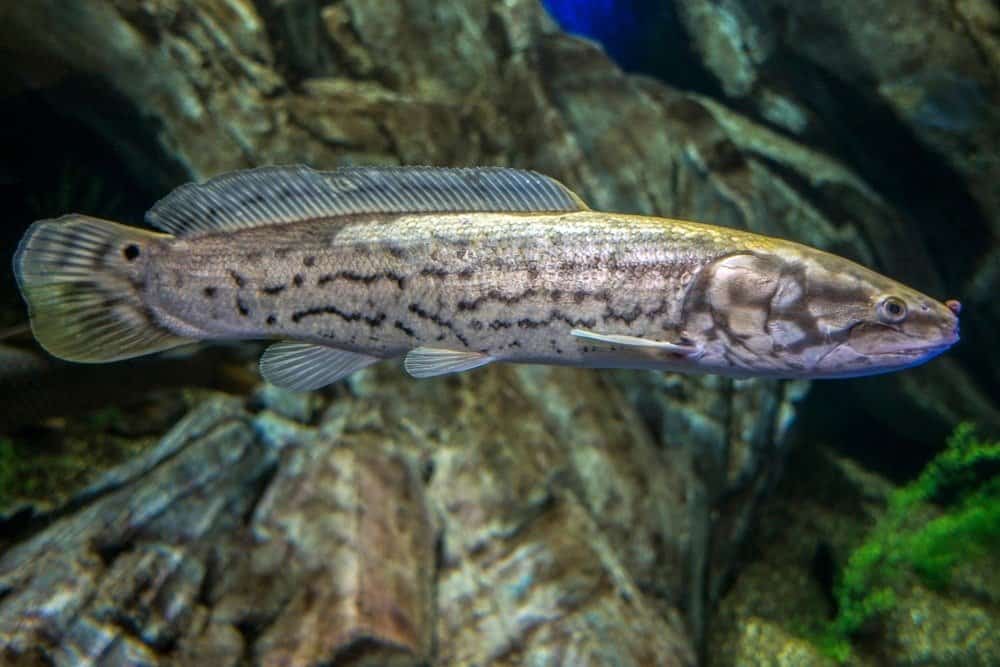
The snakehead has a longer anal fin compared to the bowfin.
©Miroslav Halama/Shutterstock.com
The male or juvenile bowfin (and rarely the adult female bowfin) has a black eyespot surrounded by an orange or yellow border near the back tail, which resembles an eye. This eyespot is intended to confuse or distract predators, so the fish can make a quick escape. While some species of snakeheads also have an eyespot (or even two eyespots) somewhere on their bodies, this is not the case for the northern snakehead, the most common invasive species in the United States.
3. Bowfin vs. Snakehead: Anal Fin
As the name suggests, the anal fin is located on the bottom of the fish, near the anus and stomach. It helps to provide the fish with some stability while swimming. The bowfin has a relatively short anal fin, while the snakehead has a much longer anal fin — nearly half the length of the entire body.
4. Bowfin vs. Snakehead: Pelvic Fin
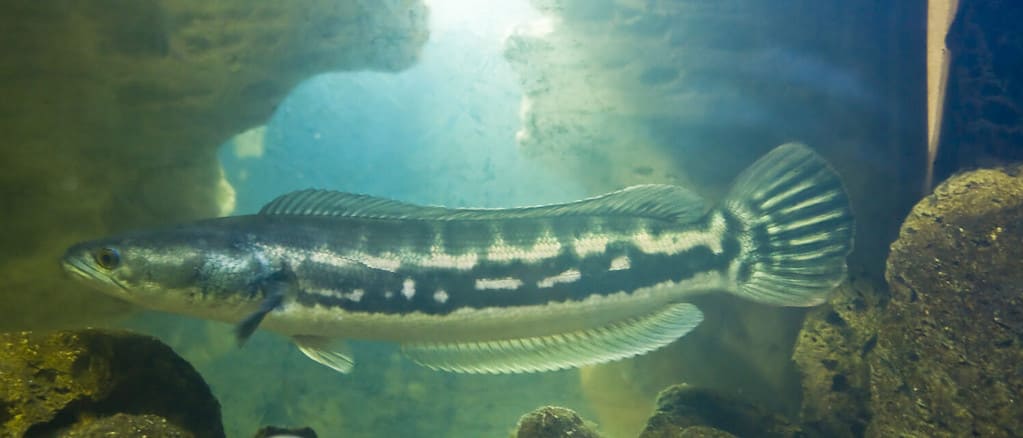
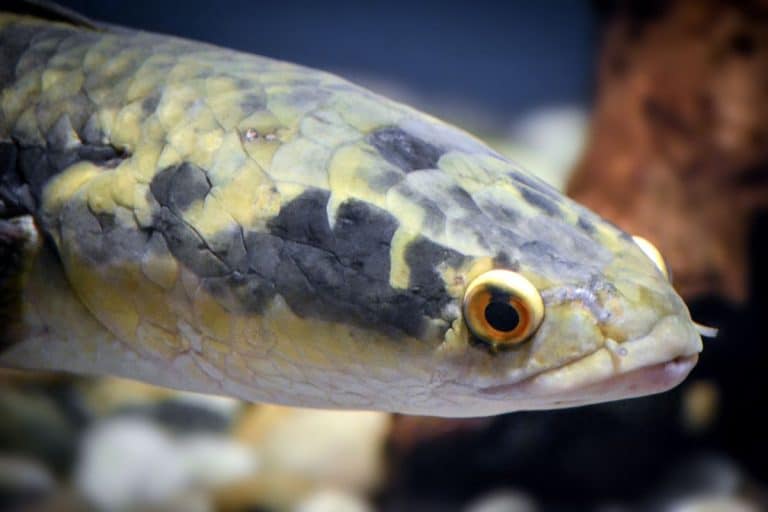
Snakehead fish have a different head structure compared to bowfin fish.
©Irina Afonskaya/Shutterstock.com
The pelvic fin is also located on the bottom of the fish, just in front of the anal fin. For the bowfin, it’s located exactly in the center of the body. But in the snakehead, it’s located much closer to the head. It’s probably shifted forward to accommodate the full length of the anal fin.
5. Bowfin vs. Snakehead: Composition of the Head
While it may not be evident at a quick glance, the bowfin has a bony plate between the lower jawbones. The snakehead completely lacks this feature. Instead, it has large scales on the head. The name of the fish kind of gives it away. Whereas the snakehead resembles a snake, the bowfin’s head resembles a more traditional fish.