P
Species Profile

Pool Frog

Pelophylax lessonae

Small frog, big role in wetlands
iStock.com/Matthew Smith
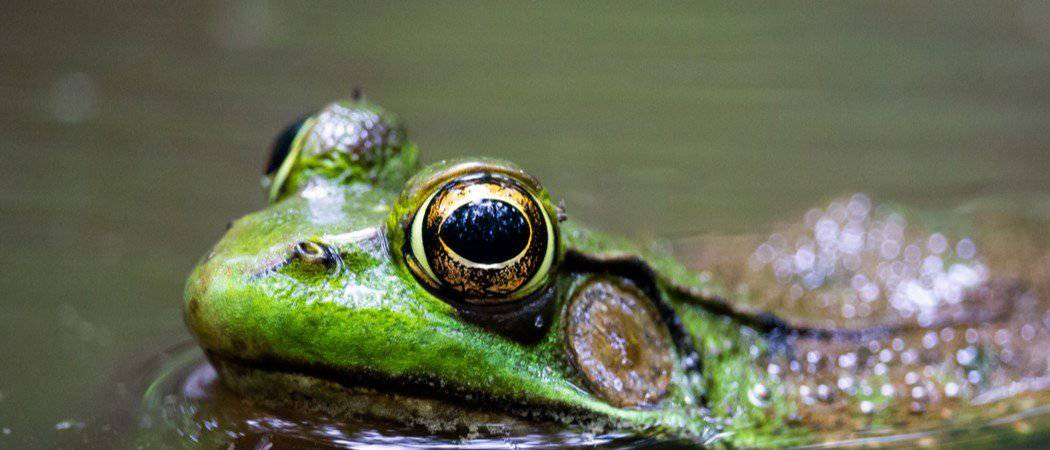
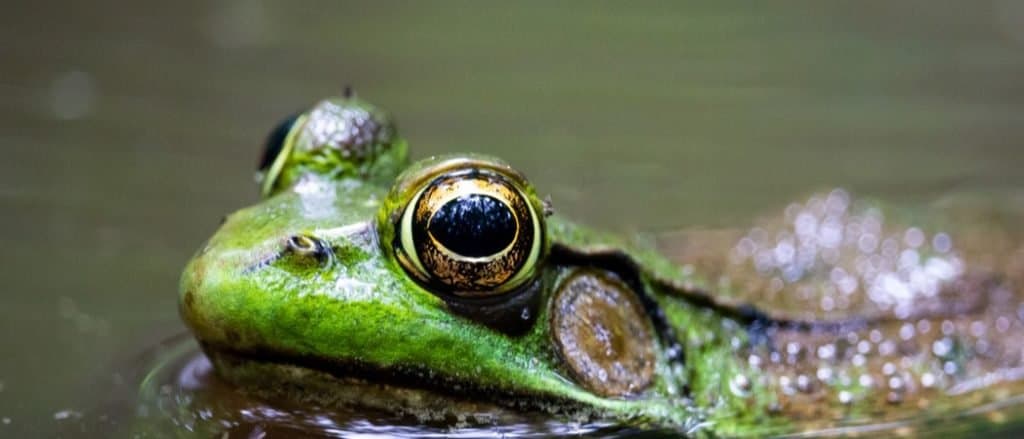
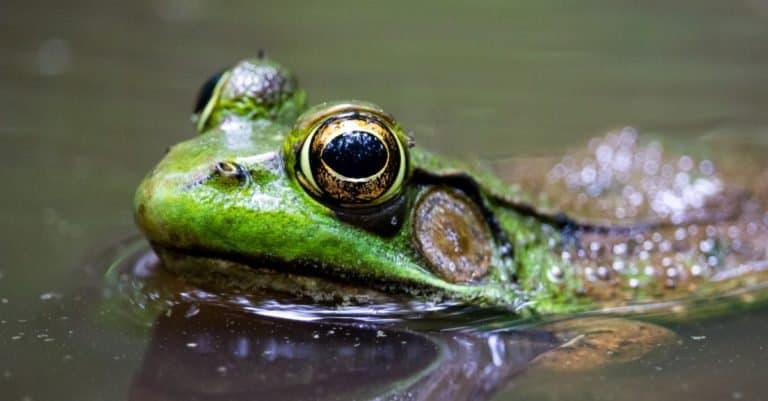
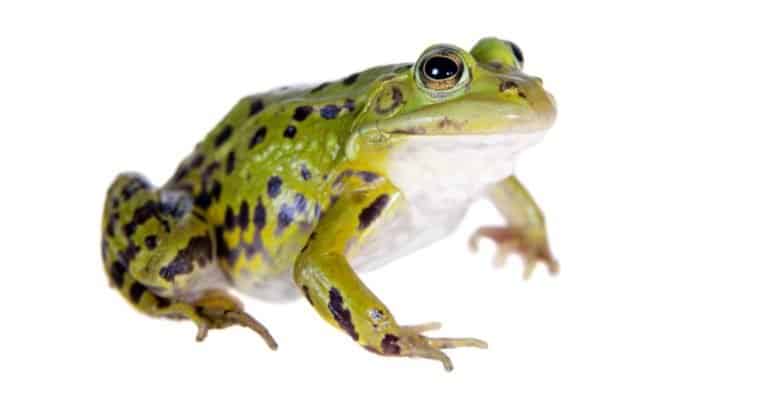
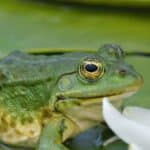
A Green Frog relaxing in the water

At a Glance

Wild Species
Also Known As Lessona's frog, Pond frog
Diet Omnivore
Activity Diurnal+
Lifespan 6 years
Weight 0.03 lbs
Status Least Concern
Did You Know?

Adults are typically 4-8 cm snout-vent length (males smaller; females can reach ~8 cm).

Scientific Classification

A medium-sized European ‘water frog’ associated with sunny, well-vegetated still or slow-moving freshwater habitats; part of the Pelophylax water-frog complex and often involved in systems with hybrid edible frogs.

Kingdom
Animalia
Phylum
Chordata
Class
Amphibia
Order
Anura
Family
Ranidae
Genus
Pelophylax
Species
lessonae

Distinguishing Features

  • Green to brown dorsum often with a pale mid-dorsal stripe
  • Dorsolateral folds typical of ranid frogs
  • Relatively smaller size and more ‘graceful’ build than marsh frog
  • Strong association with small, vegetated water bodies

Physical Measurements

Males and females differ in size

Weight
♂ 0 lbs (0 lbs – 0 lbs)
♀ 0 lbs (0 lbs – 0 lbs)
Top Speed
1 mph
swimming
Poisonous

Appearance

Primary Colors
Secondary Colors
Skin Type Smooth, moist skin with slight granulation on flanks; prominent glandular dorsolateral folds typical of ranid frogs.
Distinctive Features
  • Adult snout-vent length typically 4.5-7.5 cm (commonly reported across European herpetological references); compact water-frog build.
  • Dorsum usually bright green with dark blotches; pale dorsolateral folds often highlighted, giving a striped impression.
  • Hind legs long and muscular with clear dark barring; strong swimming adaptations for still/slow waters.
  • Tympanum evident; head generally less massive than Pelophylax ridibundus, but overlap is substantial in mixed populations.
  • Males have paired external vocal sacs (often gray), producing a rapid chuckling call used for field separation from similar Pelophylax.
  • In the Pelophylax water-frog complex, external appearance can overlap strongly with P. esculentus (hybrid) and P. ridibundus; call characteristics and (in many regions) genetics are often needed for confident identification.
  • Habitat association: sunny, well-vegetated ponds, fens, ditches, and slow streams; typically favors warm, shallow, fish-poor waters with abundant emergent plants.
  • Conservation-relevant threats often linked to habitat change: pond shading/succession, drainage, eutrophication, fish stocking, and fragmentation; in some systems, persistence is affected by hybrid dynamics with P. esculentus.

Sexual Dimorphism

Males are usually smaller and develop paired external vocal sacs and dark nuptial pads on the first finger during breeding. Females average larger-bodied, lack vocal sacs, and appear more robust when gravid.

♂
  • Paired external vocal sacs, often gray, conspicuous when calling.
  • Dark nuptial pads on inner thumb/first finger in breeding season.
  • Typically slightly smaller SVL than females within the same population.
♀
  • Typically larger, more robust body; abdomen may distend when gravid.
  • No external vocal sacs; throat generally less inflated during vocalization.
  • Nuptial pads absent.

Did You Know?

Adults are typically 4-8 cm snout-vent length (males smaller; females can reach ~8 cm).

Males have paired external vocal sacs that inflate like two pale "balloons" at the mouth corners during calling.

It's one of the two parental species that can generate the hybrid edible frog (Pelophylax esculentus) with the marsh frog (P. ridibundus).

Eggs are laid in gelatinous clumps attached to submerged plants; clutches are commonly on the order of hundreds to a few thousand eggs.

Tadpoles can metamorphose in the same summer (often ~2-3 months), but in cooler conditions some overwinter as tadpoles.

In the UK it became famous through conservation: the native pool frog was lost and later re-established via carefully planned reintroduction from Scandinavia.

Unique Adaptations

  • Hybrid-system relevance (Pelophylax complex): its genetics can participate in hybridogenesis with P. esculentus, where hybrids can transmit one parental genome clonally-an unusual reproductive system among vertebrates.
  • Paired vocal sacs: increase call volume/propagation over water, improving mate attraction in open pond habitats.
  • Aquatic locomotion toolkit: long, webbed hind feet for fast acceleration and underwater escape; powerful jump launches from floating plants.
  • Skin and gland defenses: permeable skin for cutaneous respiration plus granular skin glands that can deter some predators (a common ranid trait).
  • Warm, shallow-water specialization: strong association with sunlit, well-vegetated still/slow waters helps optimize growth and breeding in temperate climates (but makes it vulnerable to pond shading and succession).

Interesting Behaviors

  • Basking-and-bolt strategy: adults often sit in sunlit, plant-fringed shallows and dive instantly when disturbed, then hide among submerged stems.
  • Breeding chorus behavior: males call from the water surface or floating vegetation; choruses intensify in warm, calm evenings.
  • Territorial spacing (seasonal): calling males often keep short distances between one another in prime microhabitats, with brief chases and splashy disputes.
  • Sit-and-wait predation: feeds mainly on small invertebrates (insects, spiders, aquatic larvae), striking quickly at close range.
  • Seasonal activity: largely diurnal in warm weather (especially basking), with increased crepuscular/nocturnal calling during breeding.
  • Metamorph "shoreline drift": newly metamorphosed froglets concentrate in dense marginal vegetation where humidity is high and predators are fewer.

Cultural Significance

The pool frog (Pelophylax lessonae) appears in folk tales about wetlands, rain, and change. In conservation it is a symbol of healthy ponds and fens. Often confused with other Pelophylax and hybrid P. esculentus, it needs correct ID, sunny clean ponds with many plants, few fish, and UK reintroductions.

Myths & Legends

In many parts of Europe, frogs calling loudly from ponds were traditionally taken as signs of approaching rain or changes in weather-wetland "weather prophets" linked to seasonal cycles.

European folktales frequently connect pond frogs to transformation motifs (the best-known being "The Frog Prince"), reflecting a wider cultural idea of frogs as liminal creatures between water and land.

In some rural traditions across Central and Eastern Europe, harming frogs near wells or ponds was taboo because frogs were seen as guardians of water sources and the living health of the village's waters.

In parts of Europe, eating frog legs made people call water frogs 'edible frogs.' That folk name led to stories that the 'edible frog' was a natural hybrid involving the pool frog, Pelophylax lessonae.

Modern conservation folklore in Britain: the pool frog's disappearance and return became a widely told "lost native" narrative-often recounted as proof that carefully restored sunny, vegetated ponds can bring back missing wetland wildlife.

Conservation Status

LC Least Concern

Widespread and abundant in the wild.

Population Stable

Protected Under

  • EU Habitats Directive (listed for strict protection in much of the EU range; commonly treated under Annex IV provisions in national transposition)
  • Bern Convention on the Conservation of European Wildlife and Natural Habitats (commonly protected under Appendix III in range states)
  • National and regional amphibian protection laws across many European countries (collection, killing, and breeding-site damage often prohibited)

Life Cycle

Birth 1500 tadpoles
Lifespan 6 years

Lifespan

In the Wild
2–11 years
In Captivity
3–15 years

Reproduction

Mating System Promiscuity
Social Structure Aggregation Group
Breeding Pattern Transient
Fertilization Substrate Spawning
Birth Type Substrate_spawning

During April-July, males form calling choruses in vegetated ponds; females choose and may mate with multiple males. Axillary amplexus leads to external fertilization of 700-3,000 eggs in clumps attached to plants; no parental care (e.g., Günther 1996).

Behavior & Ecology

Social Chorus Group: 25
Activity Diurnal, Crepuscular, Nocturnal
Diet Omnivore Small arthropods-especially abundant flying/edge-of-water insects (commonly flies and small beetles)
Seasonal Migratory, Hibernates 1 mi

Temperament

Predominantly solitary outside breeding; temporary, non-cohesive choruses form at suitable ponds; size varies strongly.
Generally wary; rapid dive-and-hide response when approached; strong site fidelity to favored ponds.
Males are locally territorial at calling perches, using spacing and calls more than physical fights.
Interspecific interactions common in water-frog complexes; mate choice can be influenced by call traits and local community.

Communication

Advertisement call (male breeding call): loud, repeated series used for mate attraction and spacing within choruses.
Release call: emitted when clasped by another frog, reducing mistaken amplexus.
Distress call: short scream-like call when seized by predators/handled Reported across ranids including Pelophylax
Acoustic spacing: call timing and call-rate adjustments to avoid overlap in dense choruses.
Tactile cues: amplexus (male grasping) and physical displacement at calling perches.
Visual cues: body inflation and posture during calling; short movements to maintain distance at perches.
Chemical cues: aquatic pheromonal/olfactory cues likely support mate and species recognition, though data are limited.

Habitat

Biomes:
Freshwater Wetland Temperate Forest Temperate Grassland
Terrain:
Plains Valley Riverine Muddy
Elevation: Up to 3280 ft 10 in

Ecological Role

Mesopredator (adult) and primary-consumer/detritivore-like grazer (larva) linking aquatic and terrestrial food webs in vegetated still/slow freshwater habitats.

Regulates insect and other invertebrate populations around wetlands (biocontrol) Transfers energy/nutrients between aquatic larval production and terrestrial/aerial prey webs via metamorphosis and adult foraging Contributes to nutrient cycling in ponds through larval grazing on algae/biofilm and detritus processing Serves as prey for higher trophic levels (e.g., fish, wading birds, snakes, mustelids), supporting wetland biodiversity

Diet Details

Main Prey:
Flies and mosquitoes Beetles True bugs Ants and small wasps Spider Dragonfly and damselfly larvae Caddisfly larvae Aquatic crustaceans Earthworms Small snails Leeches Small fish and amphibian larvae +6
Other Foods:
Periphyton Biofilm and detritus Decaying plant material

Human Interaction

Domestication Status

Wild

Pelophylax lessonae (Pool Frog) is wild, not domesticated. It lives in sunny, well-vegetated still or slow freshwater and in managed conservation ponds. Adults are ~5–8 cm, females larger, and live about 10–11 years. Breeding in warm shallows; males call in spring–summer. Humans interact through conservation, research, invasive control, and mixed-species/hybrid issues (e.g., P. ridibundus, P. kl. esculentus).

Danger Level

Low
  • Minor skin/eye irritation possible from handling (amphibian skin secretions; rinse hands and avoid mucous membranes).
  • Zoonotic pathogen risk typical of amphibian handling (e.g., Salmonella exposure from contaminated surfaces/water); mitigated by hygiene.
  • Allergic reactions are uncommon but possible with repeated exposure.
  • No venom of medical significance; biting is rare and not dangerous.

As a Pet

Not Suitable as Pet

Legality: Pool Frog (Pelophylax lessonae) is often protected in its native range; collecting wild frogs is usually banned or needs permits. Not CITES-listed. Laws vary elsewhere; import and wild-caught keeping are often restricted.

Care Level: Experienced

Purchase Cost: $50 - $250
Lifetime Cost: $600 - $2,500

Economic Value

Uses:
Ecosystem services (insect predation) Biodiversity indicator / monitoring value Education and outreach Scientific research (genetics, hybridogenesis, ecotoxicology, bioacoustics) Conservation management value
Products:
  • ecosystem service: consumption of aquatic and terrestrial invertebrates (local pest/insect reduction)
  • research value: model system contributions to studies of hybridogenesis in the Pelophylax complex
  • non-consumptive value: nature tourism/education centered on amphibian-rich wetlands

Relationships

Predators 9

Grass Snake
Grass Snake Natrix natrix
Dice snake Natrix tessellata
Grey Heron
Grey Heron Ardea cinerea
Black-crowned Night Heron
Black-crowned Night Heron Nycticorax nycticorax
White Stork Ciconia ciconia
Northern Pike Esox lucius
European Perch Perca fluviatilis
European Otter Lutra lutra
American Mink
American Mink Neogale vison

Related Species 8

Marsh Frog
Marsh Frog Pelophylax ridibundus Shared Genus
Edible Frog
Edible Frog Pelophylax kl. esculentus Shared Genus
Iberian Water Frog Pelophylax perezi Shared Genus
Balkan Water Frog Pelophylax kurtmuelleri Shared Genus
Levant Water Frog Pelophylax bedriagae Shared Genus
Common Frog
Common Frog Rana temporaria Shared Family
Agile Frog Rana dalmatina Shared Family
Moor Frog Rana arvalis Shared Family

Ecological Equivalents 6

Animals that fill a similar ecological role in their ecosystem

Edible Frog
Edible Frog Pelophylax kl. esculentus Occupies similar lowland pond and slow-water habitats and is frequently syntopic with P. lessonae. Many populations are maintained by hybridogenetic systems in which P. lessonae co-occurs with hybrids and often P. ridibundus; reproduction in these systems is tied to the presence or absence of the parental species.
Marsh Frog
Marsh Frog Pelophylax ridibundus Overlaps in niche in warm, well-vegetated standing and slow waters. A larger-bodied Pelophylax species that commonly shares breeding sites and influences community structure through competition and hybrid-system dynamics with Pelophylax lessonae and the klepton Pelophylax kl. esculentus.
Common Frog
Common Frog Rana temporaria Often shares landscapes and freshwater breeding sites—ponds, ditches, and slow streams—but typically tolerates cooler, shadier, and more temporary waters. Ecological overlap is strongest in mixed pond networks where both species breed and forage along vegetated margins.
European Tree Frog Hyla arborea Similar reliance on sun-exposed, fish-poor, vegetated still waters for breeding. Both use pond-edge vegetation for calling and perching and have overlapping insect prey bases in warm wetland mosaics.
Smooth Newt Lissotriton vulgaris Co-occurs in small, still or slow, vegetated freshwater habitats; shares use of ponds for aquatic breeding and overlaps in aquatic invertebrate prey (especially larvae), while differing in foraging mode and trophic role.
Fire-bellied Toad
Fire-bellied Toad Bombina bombina Shares a preference for warm, shallow, well-vegetated standing waters in lowlands; overlaps in breeding habitat selection and faces many of the same aquatic predators (fish, wading birds) in pond complexes.
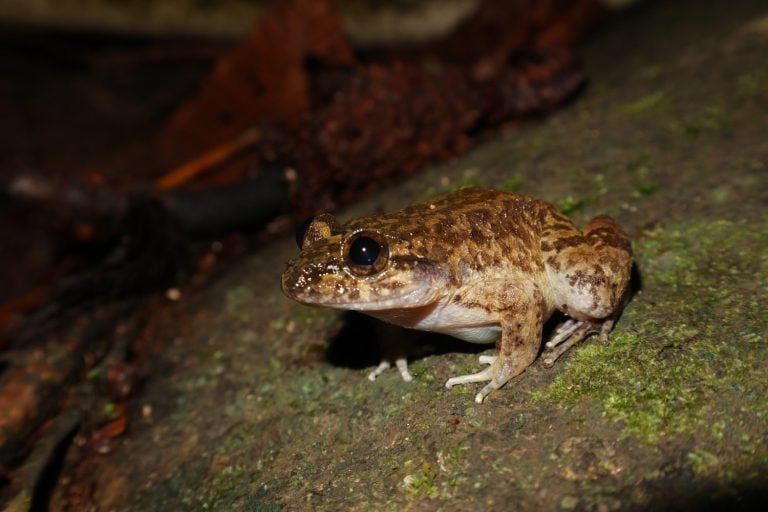
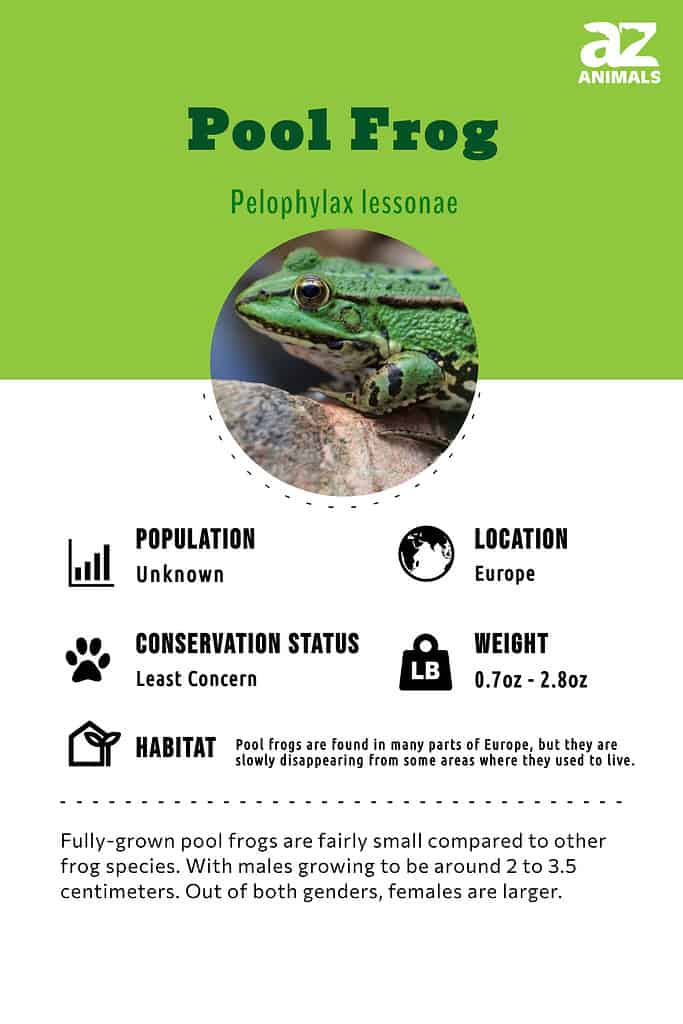
Fully-grown pool frogs are fairly small compared to other frog species.

The pool frog has a wide range across much of Europe, but it appears to be in steady retreat across some parts of its former territory.

The heaviest toll appears to have fallen on the native pool frog populations of Britain. The UK frogs went completely extinct in the mid-1990s and had to be reintroduced from Sweden. The culprit for this demise appears to be pollution and habitat loss to which these frogs are particularly vulnerable.

As the name suggests, this species has an affinity for small pools of water, and when the weather turns frosty, it hibernates for the winter.

3 Incredible Pool Frog Facts!
Fear of Animals: Ranidaphobia

The pool frog is scientifically known as Pelophylax lessonae.

  • One of the more interesting facts is that the pool frog has the ability to interbreed with the closely related marsh frog to produce a hybridized animal called the European edible frog. These male and female edible frogs can in turn produce viable offspring with the pool and marsh frogs, but if they try to mate with each other, then only infertile offspring will tend to result. The edible frog has green and yellow colorations with black stripes and splotches over its body.
  • Like most other amphibians, the pool frog has highly porous skin that can absorb oxygen and exchange gasses. In other words, it can quite literally breathe through its skin. This means it needs to be constantly moist to exchange gasses. However, the porous skin is also very susceptible to pollution.
  • The pool frog’s camouflage colors allow it to blend in with the environment and evade hungry predators.

Scientific Name
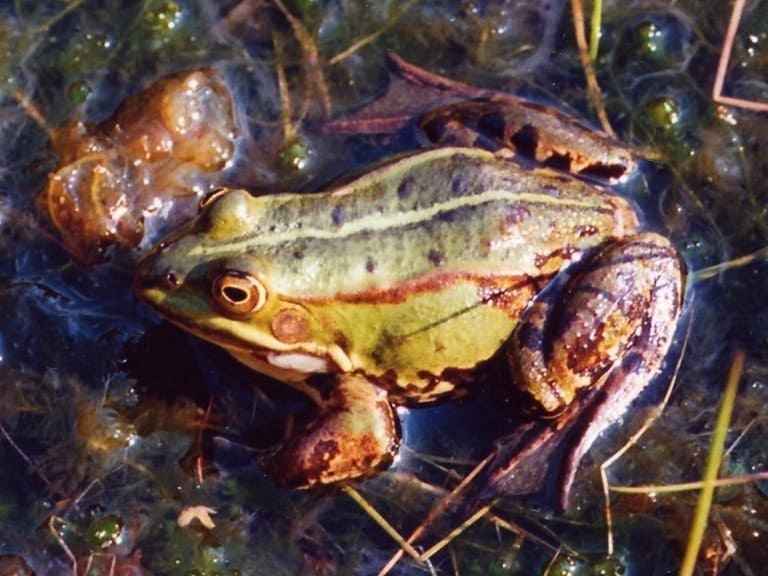
Pool frogs are native to parts of Europe, including the United Kingdom, and they prefer freshwater habitats like ponds, ditches, and marshes.

The scientific name of the pool frog is Pelophylax lessonae. This species was named in honor of the 19th-century Italian zoologist Michele Lessona, who specialized in amphibians. The pool frog was formerly a member of the genus Rana (the pond frogs), which also includes the European common frog, but it was later moved to the genus Pelophylax, or the water frogs of Europe and Asia. The name Pelophylax appears to be the combination of two Greek words meaning mud (pelos) and sentinal (phulax).

There is a closely related species called the Italian pool frog, which occupies Italy, Sicily, Corsica, Sardinia, and Elba. Both of these species are a member of the same genus, Pelophylax, but they’re distinct enough from each other to warrant different species classifications.

Evolution and Origins
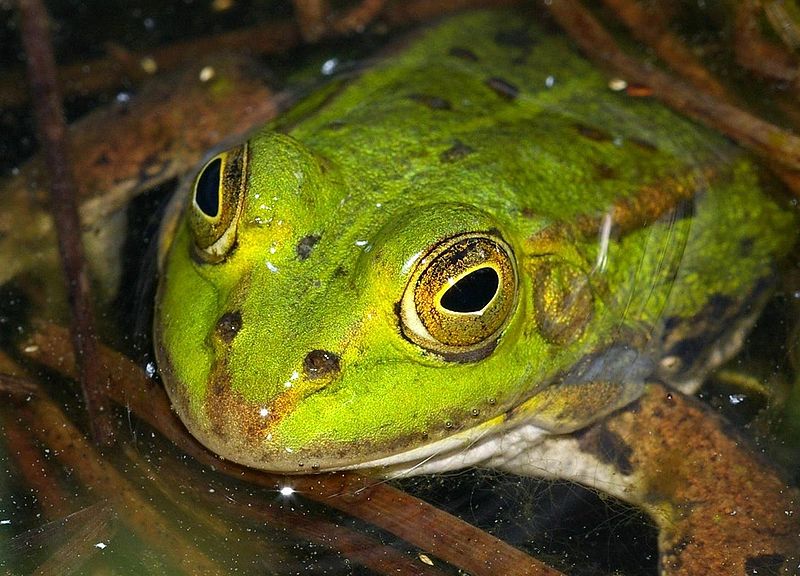
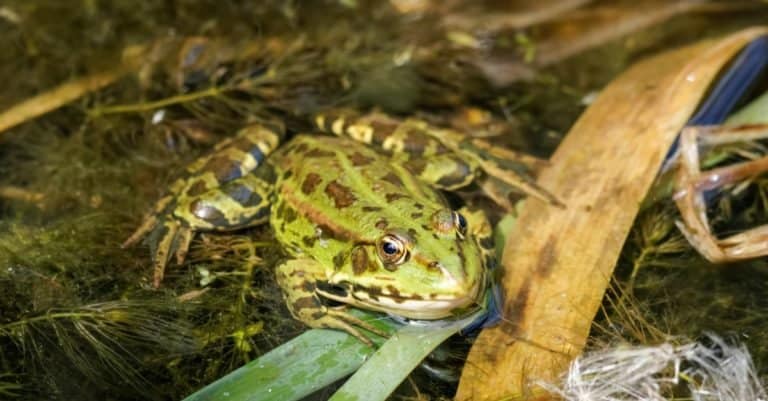
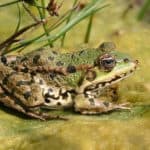
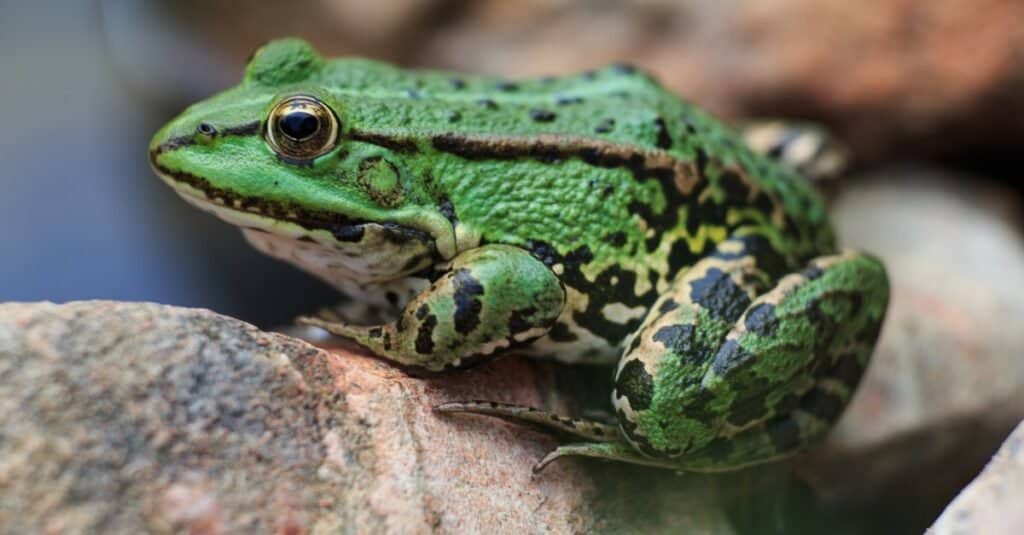
Pool frogs have greenish-brown skin with darker spots. This helps them blend into their watery environments.

The oldest known fossil of a “proto-frog,” Triadobatrachus, originates from the Early Triassic period in Madagascar. However, based on molecular clock dating, their origins from other amphibians may date back even further to the Permian period, which was approximately 265 million years ago.

In fact, the first larger groups of amphibians began to appear about 370 million years ago during the Devonian period. They came from fish with leg-like fins, sort of like today’s coelacanth and lungfish.

These ancient fish had fins with joints and digits that helped them crawl on the sea floor. These fish then evolved into different types of fish and frogs that we know today.

Appearance
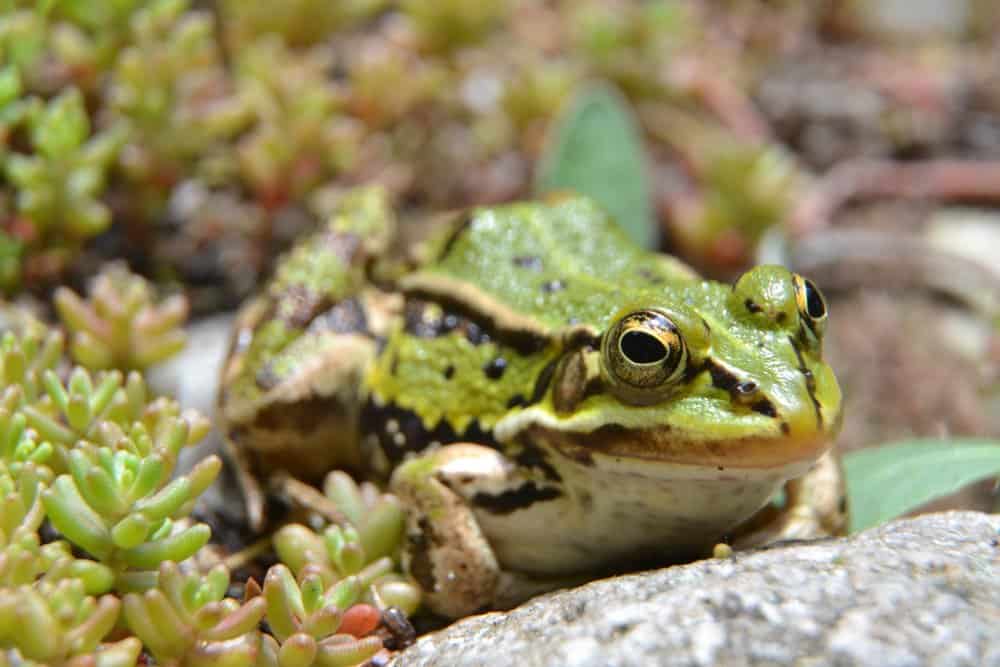
Adult pool frogs are relatively small, with males growing to around 2 to 3.5 centimeters. Females are larger.

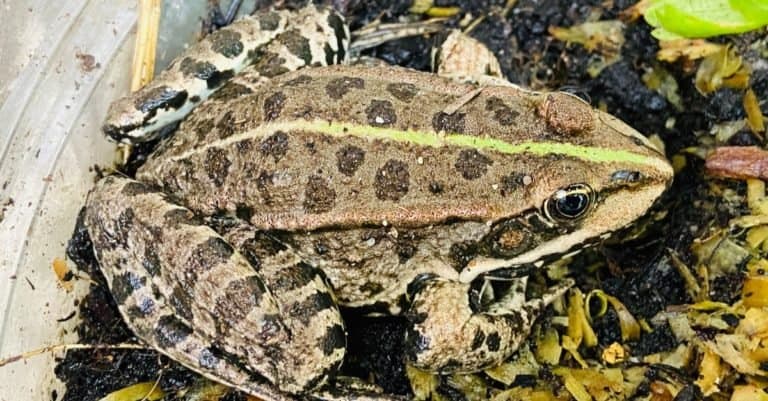
Like many other species of frog, the pool frog has a pointed head, long legs, webbed hind feet, and horizontal pupils, but the easiest way to identify them is their color. They have a brown or green body color with big dark blotches, a white stomach, and a light yellow or green stripe running straight along the back. The exact arrangement of colors and patterns varies between populations and even individuals.

The pool frog is a very small creature that measures not much more than 2.3 to 3 inches in size. Males are slightly smaller than females and have two big inflatable vocal sacs on the side of their heads. These sacs serve as a means to amplify the male’s mating call when it is time to breed.

Pool Frog vs. Common Frog
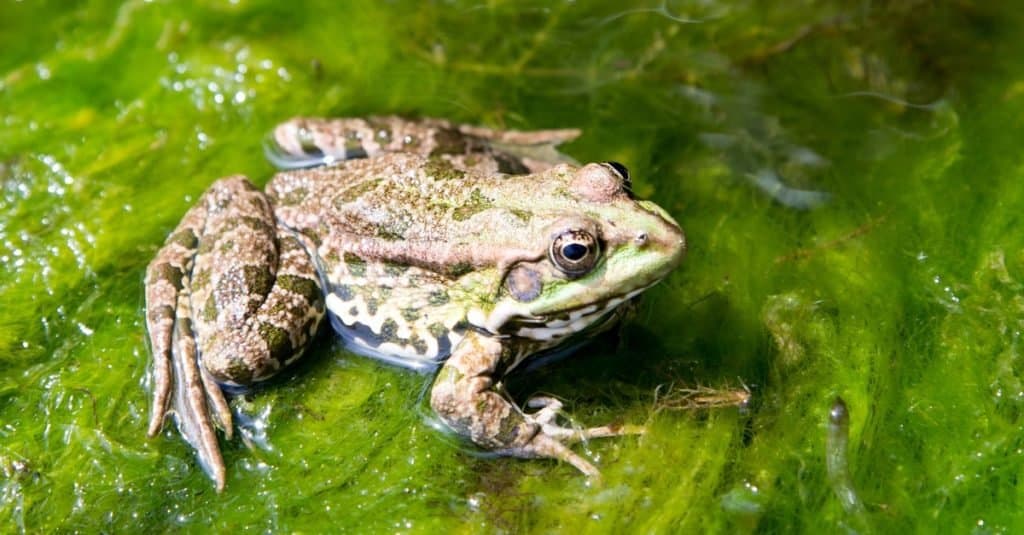
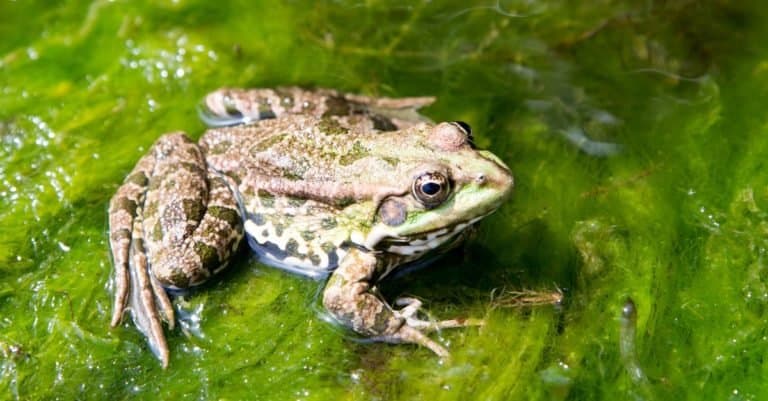
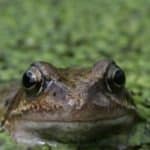
Frog in the algae

During the breeding season, male pool frogs emit a distinctive, resonant “purring” call to attract females.

The pool frog and common frogs are sometimes mistaken for each other due to their similar size and appearance and their overlapping range in Europe. The main differences are that the common frog has a more rounded head, shorter legs, and a more pronounced brown or even yellow coloration around the body.

Lacking the large pouches on the sides of the head, the common frog produces more of a purring sound in the breeding months of February to March. The pool frog has a later breeding season in May or June.

Behavior

Breeding typically occurs in the spring, and female pool frogs lay their eggs in shallow water.

The pool frog is a solitary animal that lives and hunts on its own. The only time it intermixes with members of its own species is in the May to June breeding season when the male frog makes a quacking-like sound at night to attract a suitable female. By passing air between the lungs and the air sac, the frog creates a vibrating sound in the throat that can carry long distances. The downside of this approach is that it can alert predators to the frog’s location. That is why it only croaks when absolutely necessary.

As a cold-blooded amphibian, the pool frog is unable to maintain a consistent internal body temperature. Instead, the body temperature fluctuates in response to the surrounding conditions. Its behavior is oriented around the daily seasonal fluctuations in the temperature of its environment. For instance, in order to escape the extreme cold, the pool frog hibernates between the months of October and April under logs or inside tree hollows.

Habitat

The pool frog has an extensive range across much of Europe as far east as Russia. However, they appear to be declining in parts of northern Europe, including Norway and Sweden. They were once widespread across the United Kingdom as well before disappearing completely from the island in the 1990s. Based on fossil studies and genetic analysis, it is believed that these UK populations were entirely unique to Britain and dated back to Saxon times in the early Middle Ages. These UK populations were closely related to the Scandinavian pool frogs.

The pool frog lives in permanent puddles, ponds, or marshlands with plenty of dense vegetation. It sometimes likes to take up residence in places where there are streams or rivers nearby. The frog spends a great deal of its life in or around these bodies of water, especially in the summer.

Diet
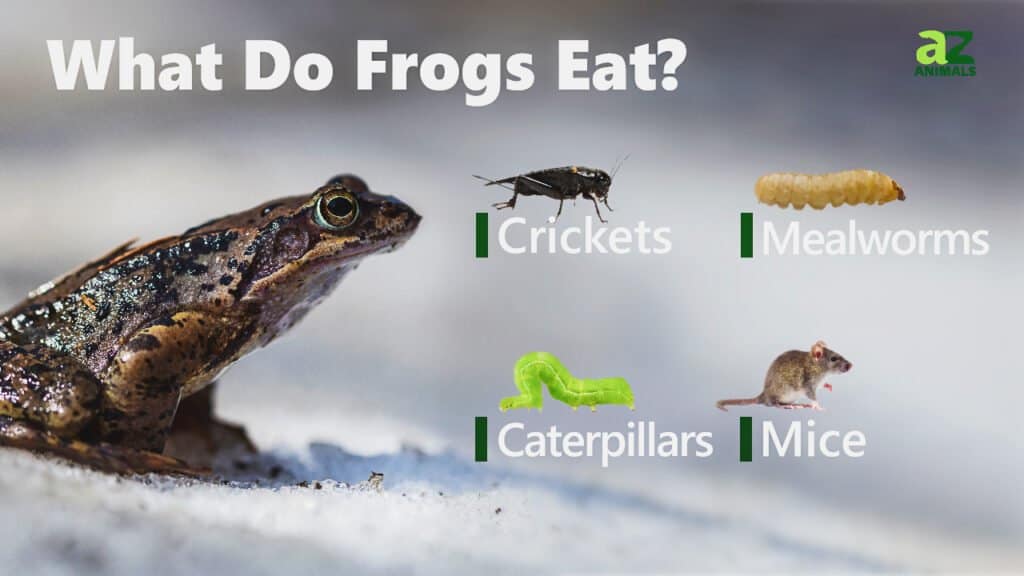
What Do Frogs Eat
Frogs eat crickets, mealworms, caterpillars, and even mice!

Wherever it’s found, these frogs play an important role in the ecosystem by limiting the number of small pests in the environment. Their leaping ability and long tongue are the main means of capturing prey.

What does the pool frog eat?

As a young tadpole, the frog’s diet consists of algae and decaying organic material. After undergoing its metamorphosis, the juveniles graduate to flies and their larvae. An adult pool frog feeds primarily on insects, worms, and other small invertebrates.

Predators and Threats

These frogs face several threats from pollution, drainage, diseases, and habitat loss from agriculture or residential development. These factors have caused numbers to decline throughout parts of its natural range.

What eats the pool frog?

An adult frog is preyed upon by foxes, snakes, herons, otters, and other carnivorous animals. The tadpoles are preyed upon by some insects and fish.

Reproduction, Babies, and Lifespan

The frog’s breeding season begins with the onset of the warmer months in May or June. As mentioned previously, the male makes a raucous quacking sound with its big cheek pouches to attract an appropriate mate. After mating, the female will lay a cluster of 400 to 4,000 brown and yellow eggs near the surface of the water. The exact number depends upon several factors such as the temperature of the surrounding environment.

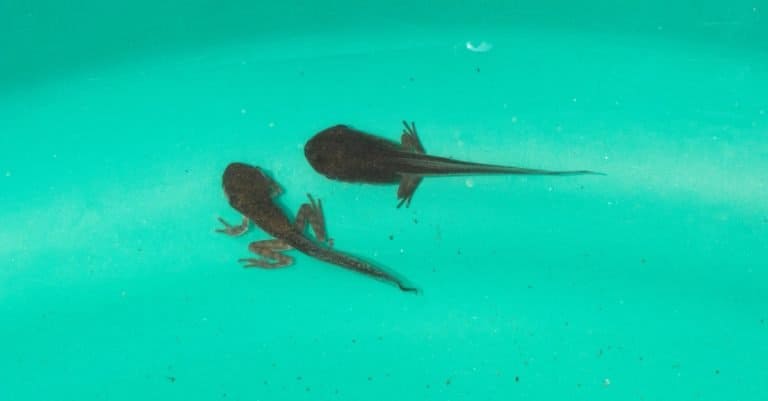
The tadpole is the first stage of the frog’s development. With its external gills and long tail, the tadpole is adapted to survive the aquatic pond or pool from which it originally spawned. Since the parents invest almost no time and effort into raising the young, the tadpoles must begin feeding immediately to survive. Many of them are eaten early by predators and don’t survive this initial stage.

Around August or September, the tadpoles undergo their remarkable transformation into full adulthood. Their gills are covered up, they lose their tails, and they become full adult frogs. However, it takes about two or three years before the frogs can begin to reproduce on their own. They have a life expectancy of about six to 12 years in the wild.

Population

According to the IUCN Red List, these frogs are considered to be a species of least concern. It is very difficult to estimate the number of pool frogs remaining in the wild. However, the facts suggest that local populations have been in decline throughout parts of Europe due to pollution and habitat loss. The United Kingdom once had its own distinctive population of pool frogs, but after a huge decline in numbers throughout the 19th and 20th centuries, the pool frog finally disappeared from Britain in 1994 or 1995.

In order to revive this species in the UK, conservationists collected some Swedish pool frogs between 2005 and 2008 and introduced them to two Norfolk sites. The Forest Commission made special efforts to restore special ponds in which the frogs could thrive. Once these populations were firmly established, conservationists then introduced them to other sites in the UK so they could repopulate the country. These frogs are very well-protected under UK law, which makes it an offense to kill, injure, sell, or trade this species.

Zoos

These frogs are not exhibited at any American zoo.

View all 247 animals that start with P

Sources

  1. Discover Wildlife / Accessed February 9, 2021
  2. Amphibian and Reptile Conservation / Accessed February 9, 2021
  3. Britannica / Accessed February 9, 2021
  4. BBC News / Accessed February 9, 2021
Rebecca Bales

About the Author

Rebecca Bales

Rebecca is an experienced Professional Freelancer with nearly a decade of expertise in writing SEO Content, Digital Illustrations, and Graphic Design. When not engrossed in her creative endeavors, Rebecca dedicates her time to cycling and filming her nature adventures. When not focused on her passion for creating and crafting optimized materials, she harbors a deep fascination and love for cats, jumping spiders, and pet rats.
Connect:

Thank you for reading! Have some feedback for us?


Pool Frog FAQs (Frequently Asked Questions)

Pool Frogs are Carnivores, meaning they eat other animals.