Quick Take
- This species successfully secured a ranking among the world’s top 20 healthiest foods for human consumers.
- Maintaining 2°C water temperatures causes a significant 17-day delay in the hatching cycle.
- It is counterintuitive that scientific classification now identifies this fish as a true cod.
- Intensive fall foraging is necessary to ensure survival through the winter metabolic shifts.
The Alaskan Pollock lives in the North Pacific and the Arctic Ocean and is the national fish of Korea, where it has over 31 names. Caught from Alaska to northern Japan every year, this fish species is the world’s second most important total catch after Peruvian anchoveta (a type of anchovy). Alaskan pollock is consistently among the top species by volume in U.S. commercial fish landings. It’s the most commonly eaten wild-caught whitefish in the world and is among the most commonly eaten fish in the United States.

5 Alaskan Pollock Facts
- It is caught wild in Alaska.
- Fishing for Alaskan pollock fuels the Alaska economy and supports the North Pacific Fishing Fleet, with economic benefits also extending to Washington.
- Wild populations are sustainably harvested and responsibly managed, with the fishery maintaining Marine Stewardship Council certification as of 2026.
- It is one of the top 20 healthiest foods in the world, being a great source of protein, vitamin B12, and omega-3 essential fatty acids.
- Delicious, versatile, and popular, it is used in many different recipes, including fish and chips, fish sandwiches, fish tacos, imitation crab, and pollock roe sandwich spread.
Classification and Scientific Name
This fish species is a member of the class Actinopterygii, which includes the ray-finned fishes. It is a member of the order Gadiformes, and the family Gadidae of the true codfishes, which includes cod, haddock, pollock, and whiting, with 12 genera. It is in the cod genus Gadus, of which there are four species. Common names are walleye and walleye pollock, while alternate names are snow cod, bigeye cod, copperline cod, and lesser cod. The scientific name Gadus chalcogrammus comes from the Latin word gadus, meaning “cod” (from the Greek khalkós meaning “copper”) and the Greek word grammí meaning “line.”
This fish’s scientific name used to be Theragra chalcogramma. There is one species of Alaskan pollock. Norwegian pollock (Theragra finnmarchica) is believed to be the same species as the Alaska pollock, differing only in its geography.
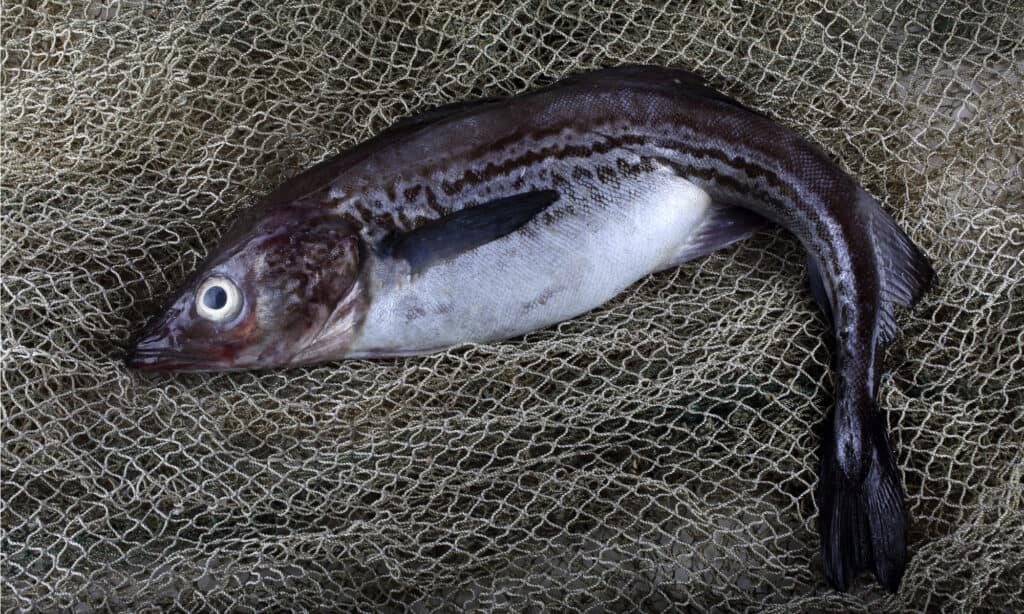
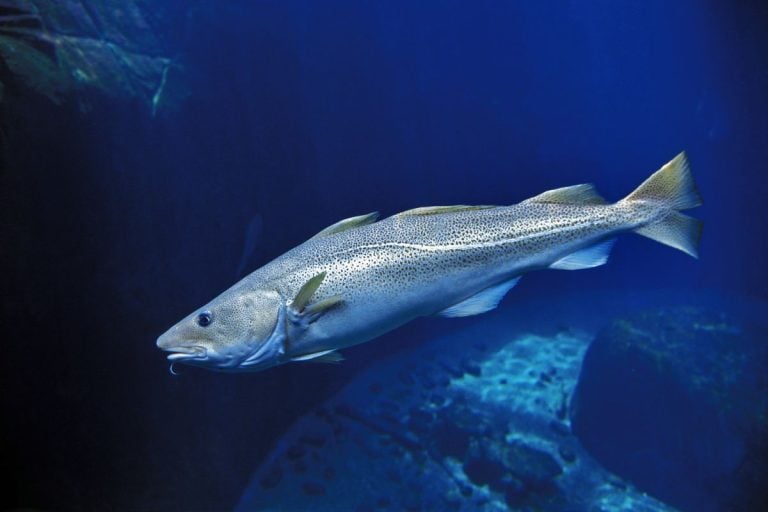
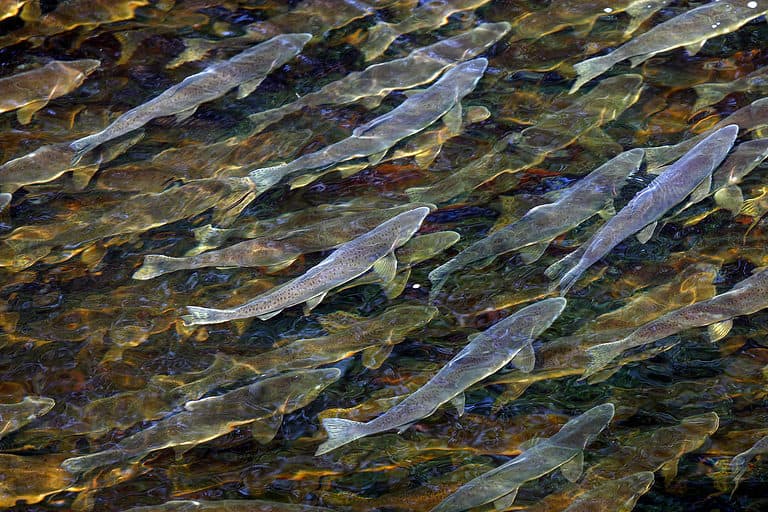
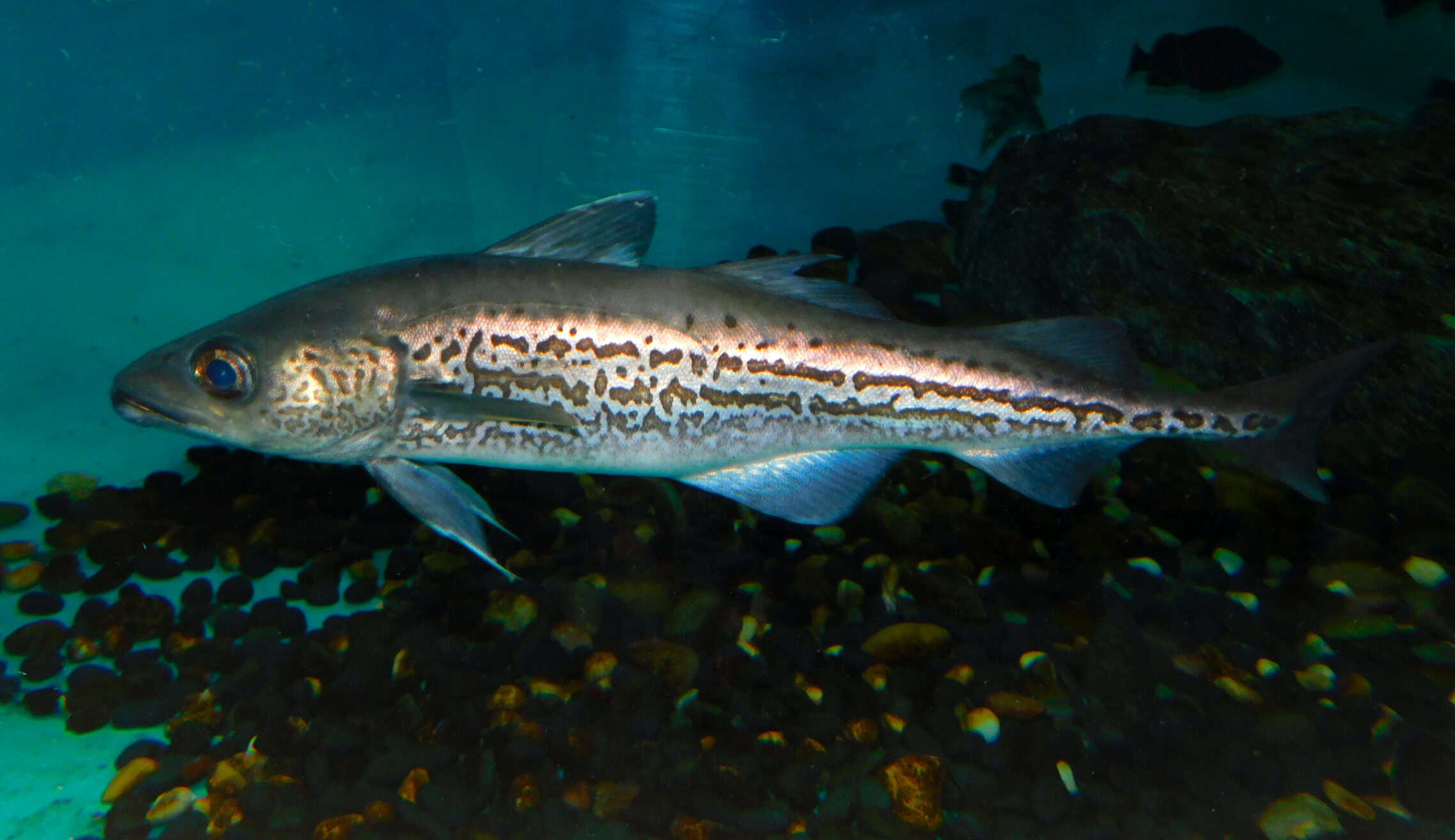
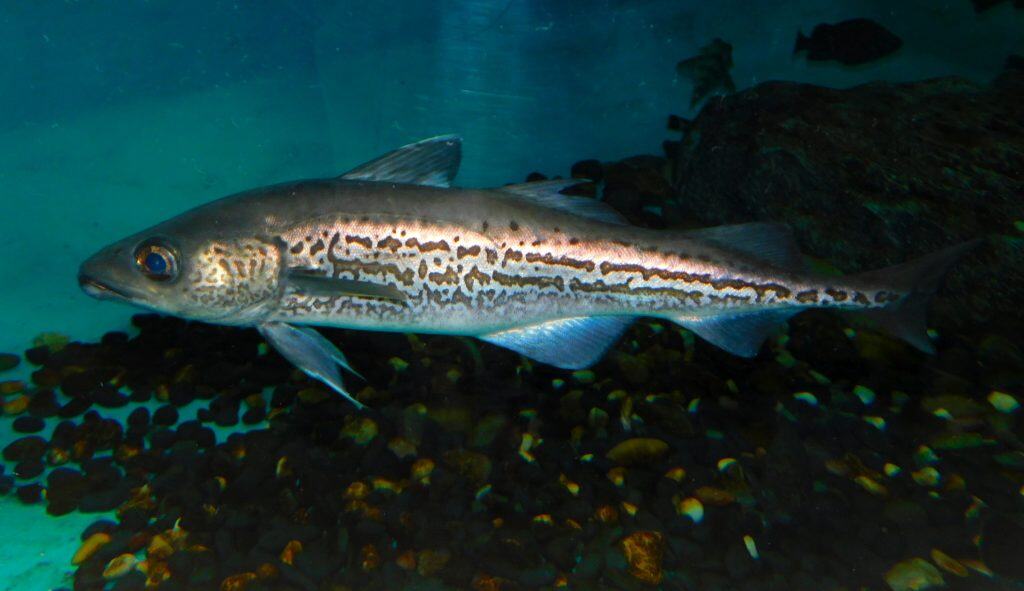
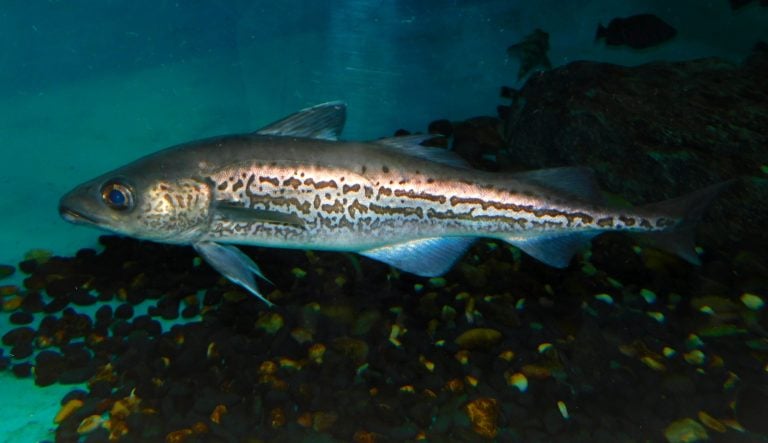
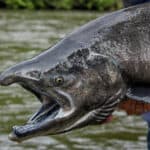
The Alaska pollock has black and yellow spots that serve as camouflage.
©Alex Coan/Shutterstock.com
Appearance
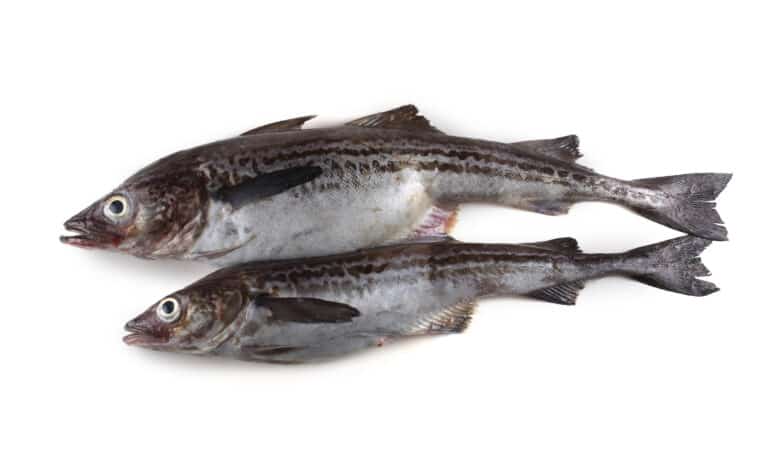
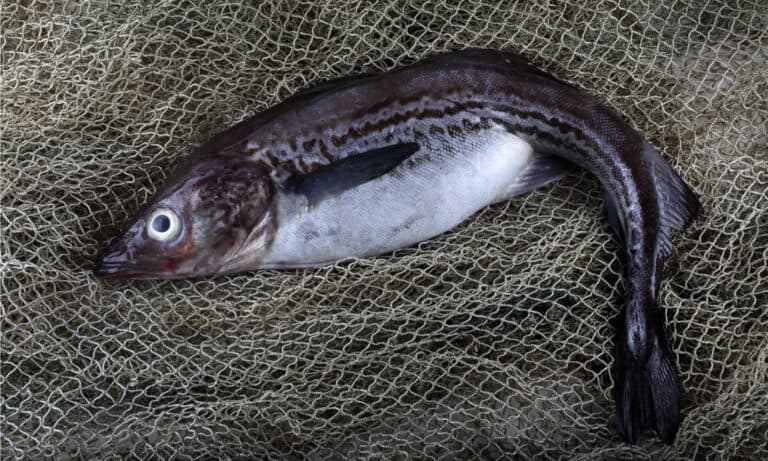
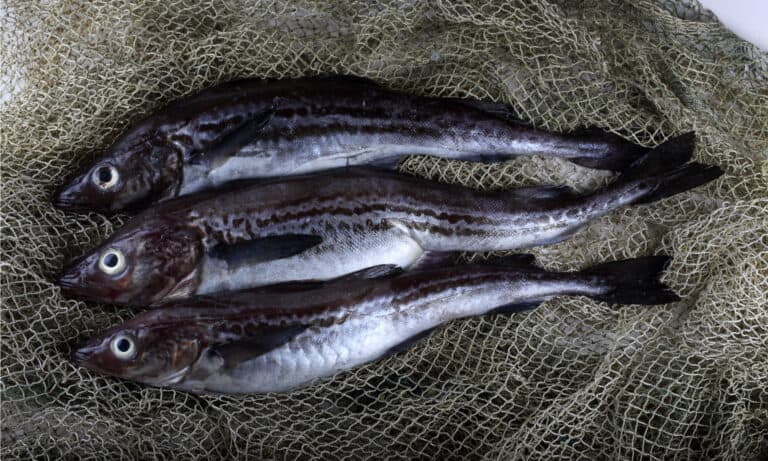
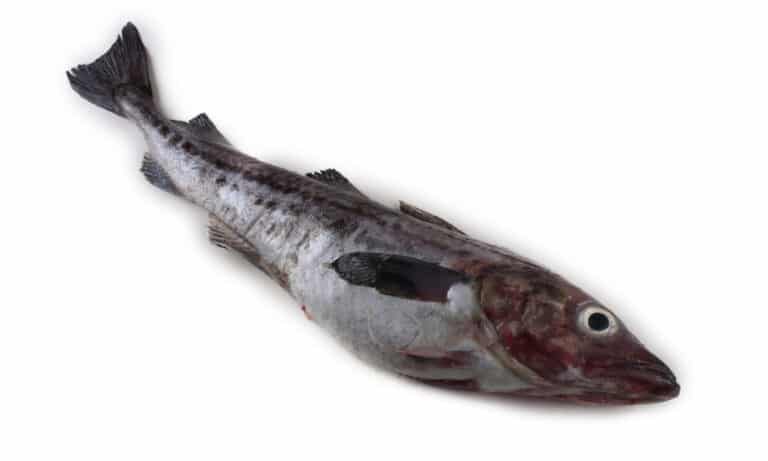
On average, Alaskan pollock measures 12 to 20 in long and weighs 1 to 3 lbs, but can reach 3 ft in length. Its body is slender and resembles that of cod and haddock. Black and yellow spots serve as camouflage to avoid predators on the ocean floor.
Alaskan Pollock vs. Pacific Cod
This fish is closely related to Pacific cod, and so they are often confused with each other. However, the main difference is that its chin barbel is either very small or entirely absent. It also has more pronounced fins, a narrower tail, a shorter lifespan, and earlier sexual maturity. Their habitats overlap in the Bering Sea and the Gulf of Alaska, but cod also live in northern California waters and the Sea of Japan, both of which are slightly warmer. Alaskan pollock meat is flakier and more tender, and can lose its shape quickly when overcooked.
Alaskan Pollock vs. Haddock
Alaskan pollock is also related to haddock, and they may be confused with each other. However, pollock has a greenish tint and a white lateral line, firmer flake, and stronger flavor, whereas haddock has a black lateral line, a black thumbprint on its side, finer flake, and milder flavor. Their habitats are also different, with haddock living in the North Atlantic.
Distribution, Population, and Habitat
The Alaskan pollock’s primary habitats are the coastal areas of the Northern Pacific, Alaska, Russia, Korea, and Japan. It lives in the Gulf of Alaska, the Aleutian Islands, the Eastern Bering Sea, the Western Bering Sea, and the Sea of Okhotsk. However, its main populations are most concentrated in the eastern Bering Sea.
The waters this fish lives in are marine and brackish, with a depth range of up to 1,280 m. It lives at the benthopelagic level, being on or near the sea bottom, mid-water, and near-surface depths, and is non-migratory, although it moves vertically in search of food. This fish’s population is above target levels according to the NOAA. Globally, Alaskan pollock is not considered threatened by the IUCN Red List, though it may be listed as Near Threatened in some regions, such as Europe.
Where to Find Alaskan Pollock and How to Catch It
This fish is usually 30 to 400m deep. You can find it in the north Pacific waters off Alaska, California, and the Sea of Japan. During the spring, you will find pollock migrating inshore to shallow water to feed and breed, and in deeper, warmer waters in the winter months. It is during the fall that they are near the bottom of the ocean floor. However, it is usually caught at 50 to 300 m deep. The typical fishing method is trawling. Bait that work best are sand eels and imitation minnows with lures between 15 and 25 cm long.
Predators and Prey
The Alaskan pollock has a carnivorous diet. It is a forager and will even eat other pollock. During the winter, the larger pollock don’t need to forage because they can better store energy and will consume more calories during the fall to prepare for it, while their smaller counterparts work on getting larger in size.
What does Alaskan pollock eat?
The juvenile Alaskan pollock eats zooplankton and small fish. The adult fish eats other fish, juvenile pollock, copepods, and krill, which are two types of small crustaceans.
What eats Alaskan pollock?
Other fish, sea lions, and sea birds are two of several predators that eat Alaskan pollock. Humans also eat Alaskan pollock.
Reproduction and Lifespan
This fish reproduces by spawning and lays eggs. It breeds every year. The incubation time depends on temperature, with the period being 10 days at 10 °C and up to 27.4 days at 2°C. The larvae are 3.4 to 4.4 mm long when hatched and float upside-down at the water surface, absorbing their yolk sacs once they reach 7 to 7.5 mm or 22 days at 2°C. The juvenile (young) pollock are sexually mature at 3 to 4 years. This fish has a lifespan of 12 years and a maximum lifespan of 28 years.
Fishing and Cooking
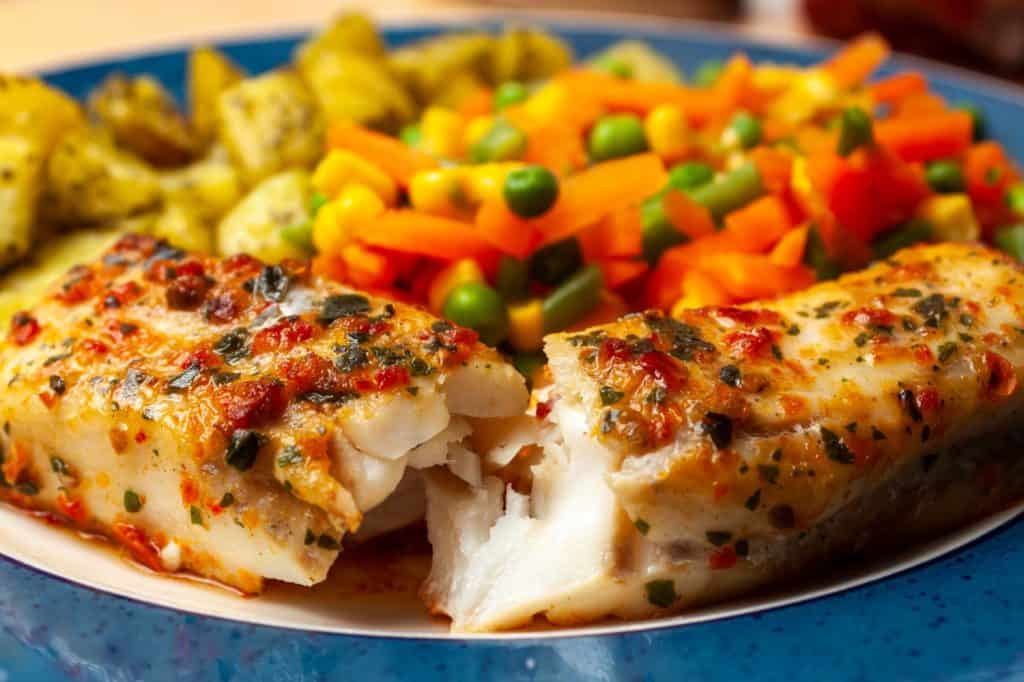
Alaskan Pollock fish chargrill covered with a tomato and herb sauce on a plate with mixed vegetables and potatoes.
©RCH Photographic/Shutterstock.com
This fish has tender, flaky, mild, white meat with a low oil content. Its nutritional content is low in fat, high in protein, vitamin B12, and omega-3 essential fatty acids. It’s also mercury safe compared to other wild fish because it is harvested in the remote, clean waters of Alaska. Common Alaskan pollock recipes people purchase at stores or at fast-food restaurants are frozen breaded and battered fillets or fillet sandwiches and fresh surimi, including imitation crab, although, like other fish, it is best eaten freshly prepared at home or at a restaurant. In Russia, people commonly enjoy it as a pollock roe sandwich spread, which is just one of several possible recipes. It can be baked, poached, grilled, deep-fried, or pan-fried.
Some popular Alaskan pollock recipes showcasing the versatility of this fish are:
Alaskan Pollock Pictures
View all of our Alaskan Pollock pictures in the gallery.

Alex Coan/Shutterstock.com
Sources
- Wikipedia / Accessed April 23, 2022
- Fishbase / Accessed April 23, 2022
- NOAA Fisheries / Accessed April 23, 2022
- Port of Seattle / Accessed April 23, 2022
- Bird's Eye / Accessed April 23, 2022
- Fishing Booker / Accessed April 23, 2022
- Sea2Table / Accessed April 23, 2022
- Wikipedia / Accessed April 23, 2022
- Alaska Department of Fish and Game / Accessed April 23, 2022
- Palm / Accessed April 23, 2022
- Foods For Anti Ageing / Accessed April 23, 2022