
Quick Take
- Female black-headed weavers have a ruthless mate selection method that comes down to a single, very specific skill. See the nest-building test →
- The world's heaviest flying bird prefers to stay grounded, and its parasite-control strategy is unlike any other bird on the continent. Explore the Kori bustard's habits →
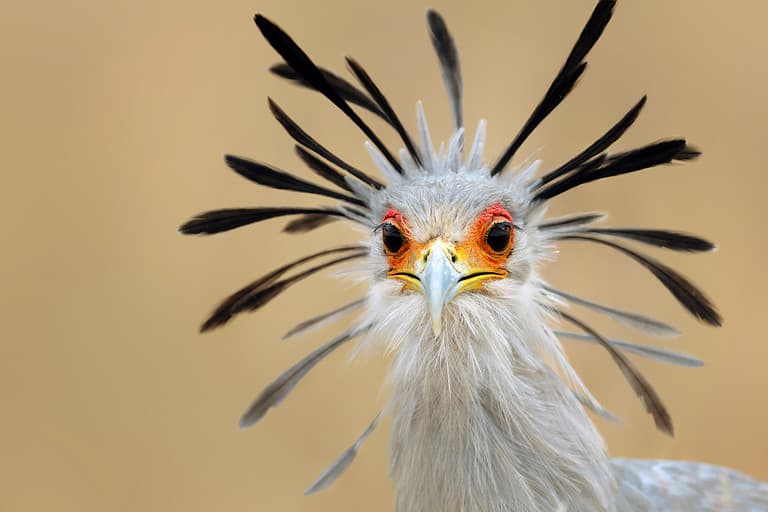
- One African raptor hunts in a way shared by only one other bird on the entire planet, and that other bird does not even live on the same continent. Discover the secretary bird's hunt →
Africa is home to more than 2,500 different bird species. African birds can be found in a wide variety of sizes, forms, and colors, ranging from tiny, vividly colored sunbirds and tenacious little bee-eaters to ominous marabou storks. When many people think of Africa, animals one might see on safari first come to mind. However, these magnificent birds deserve equal attention. Read on to learn more about some of the fascinating birds of Africa.
1. Black-Headed Weaver Bird
The black-headed weaver (Ploceus cucullatus) is found throughout most of the continent south of the Sahara desert. They are often found in villages, wooded areas, and parks, and they prefer to be near water. During the breeding season, the males are vividly colored to attract females. They have black heads, bright yellow bodies, and brownish patches on their wings and tail feathers.
The male black-headed weaver constructs a complex nest out of grasses, petals, and twigs in an effort to entice a mate. The females only go to the males that can build the nicest nests. When the nest is finished, the male hangs upside-down beneath it, flapping and singing in a courtship display.
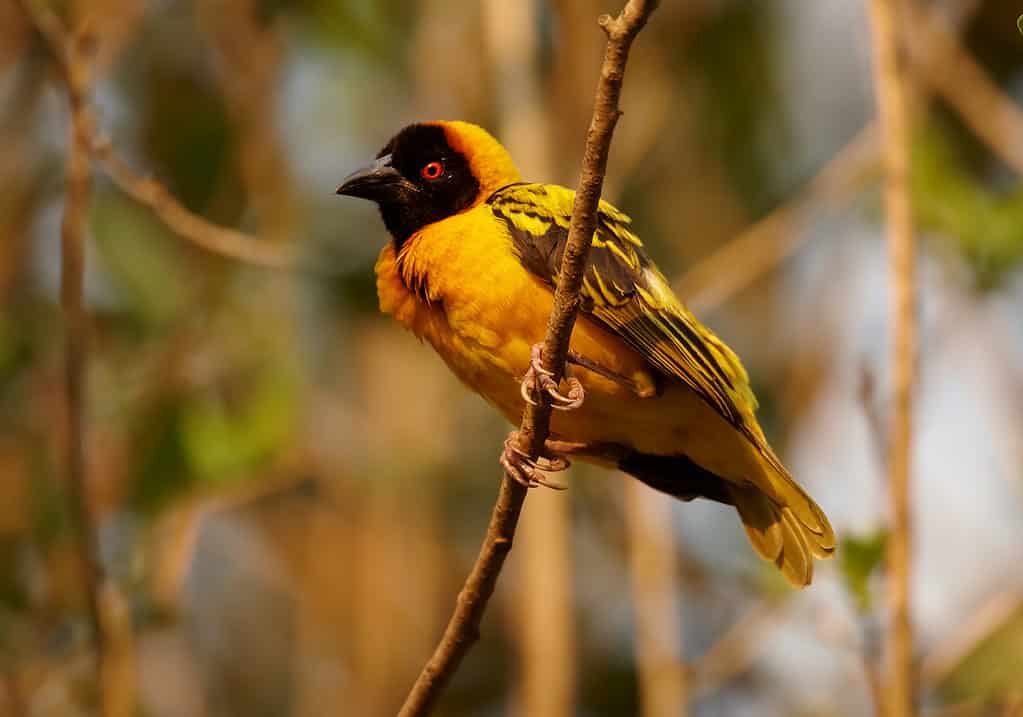
The black-headed weaver is found in most of Africa south of the Sahara Desert.
©Martin Mecnarowski/Shutterstock.com
2. Grey Crowned Crane
Also known as the crested crane, the grey crowned crane (Balearica regulorum) grows to a height of around 3 feet and has a wingspan of nearly 7 feet. The vivid red neck pouch, white face, blue eyes, and striking gold feather crown make it one of the easiest African birds to identify. It is one of just two types of cranes that can roost in trees.
The grey crowned crane’s range runs from the eastern part of the Democratic Republic of Congo to Uganda, Kenya, and southeastern South Africa. It is Uganda’s national bird and is depicted in the center of the nation’s flag. They are generally found in grasslands that are close to water. These cranes are monogamous and appear to mate for life. During courtship, both birds participate in an elaborate dance that includes bobbing, bowing, and jumping.
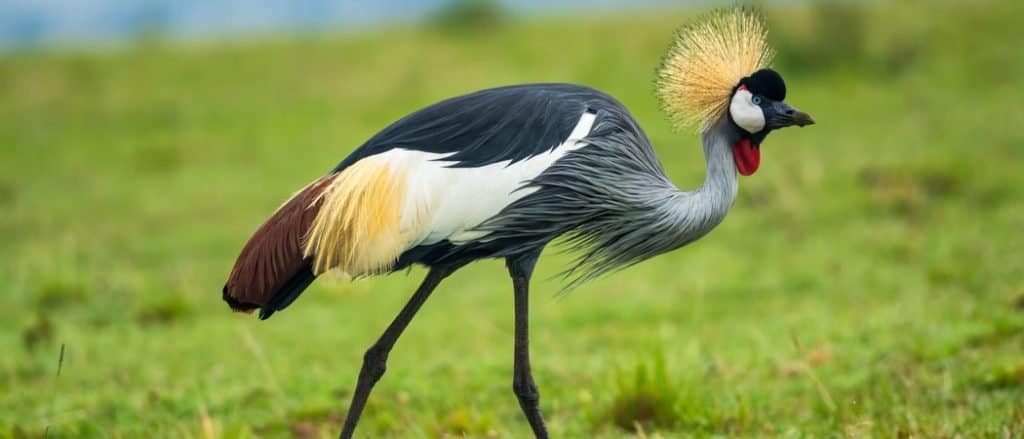
The grey crowned crane is Uganda’s national bird.
©iStock.com/Nick Fox
3. Shoebill Stork
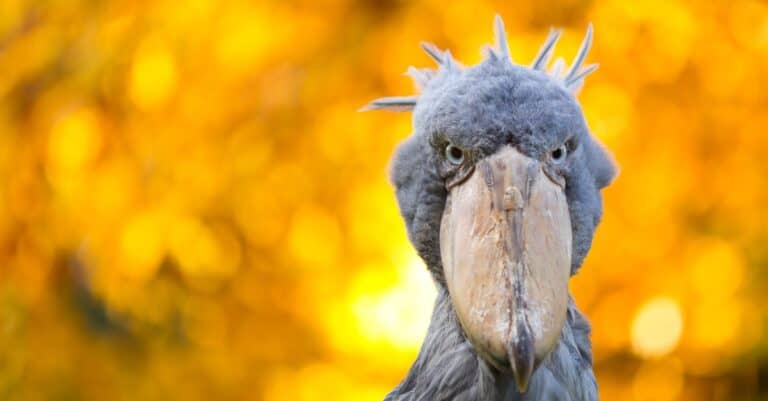
The shoebill stork (Balaeniceps rex) is not actually a stork. It is now in a class of its own. This solitary bird inhabits the wetlands and marshlands of Central and East Africa where it hunts for fish, amphibians, and water snakes. Their feathers are shades of grey and they have white bellies.
The shoebill is enormous, standing up to 4.5 feet with an 8-foot wingspan. Its large bill reaches over 7 inches long and is said to resemble a Dutch wooden shoe. Although they are primarily silent, they use this enormous bill to communicate with other birds by making loud, clattering noises.
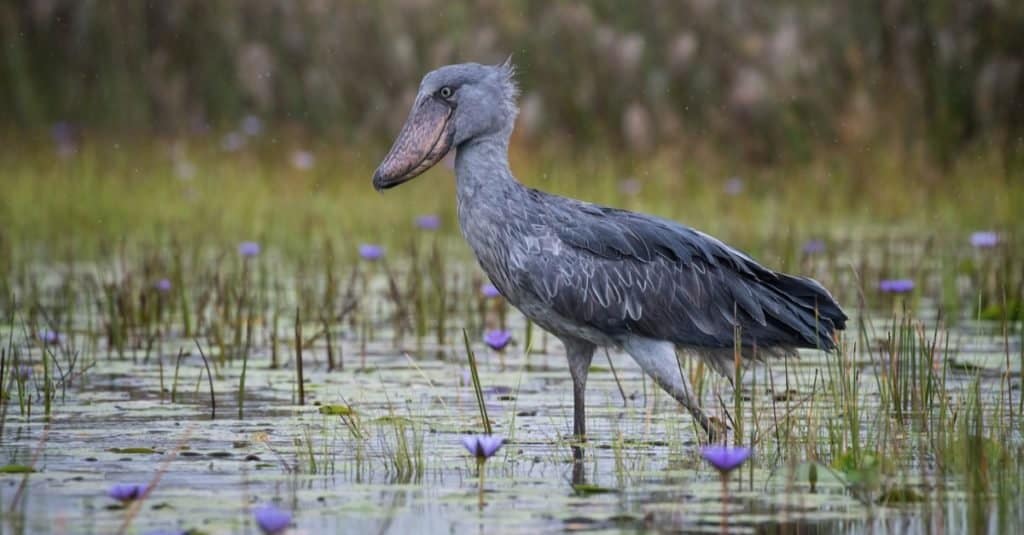
The shoebill stork grows up to 4.5 feet tall.
©Petr Simon/Shutterstock.com
4. Common Ostrich
The common ostrich (Struthio camelus) is widespread throughout eastern and southern Africa. Because of their size, they favor grasslands and savanna regions like the Serengeti and Maasai Mara. Adult males have black feathers with white tails, while females are primarily brown.
Standing at over 9 feet and weighing 200-300 pounds, the ostrich is the largest living bird and the fastest bird on land. Although far too large to fly, it can run at a top sprinting speed of over 40 miles an hour and cover up to 16 feet in one stride. They produce giant eggs comparable in size to around two dozen hens’ eggs — the largest eggs of any living bird.
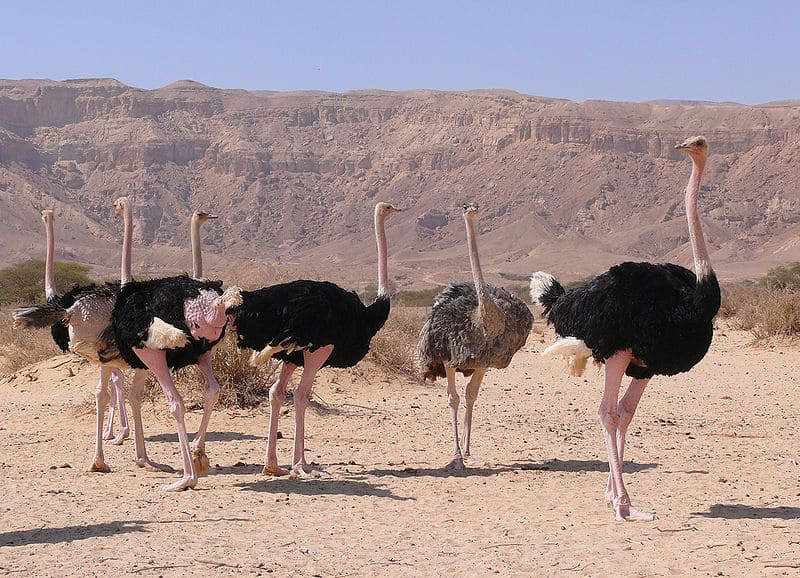
The ostrich is the fastest bird on land and can run at speeds of over 40 miles an hour.
©MathKnight / Creative Commons – Original
5. Saddle-Billed Stork
The saddle-billed stork (Ephippiorhynchus senegalensis) is the tallest stork in the world, reaching nearly 5 feet tall. Its colorful beak, which has brilliant red stripes and a bright yellow frontal shield, or “saddle,” gives this bird its name. It also has a distinctive red and yellow spot on its breast. This is called the “brood patch,” which is a region of exposed skin densely supplied with blood capillaries, used during mating season to transfer body heat between the parent and the egg.
These birds live alone or in pairs, in contrast to marabou storks, which establish colonies. They can be found all over sub-Saharan Africa, especially in Gambia, Senegal, and Chad in the west and Kenya, Tanzania, and Uganda in the east. They can also be found in South Africa, where these birds are thought to be endangered.
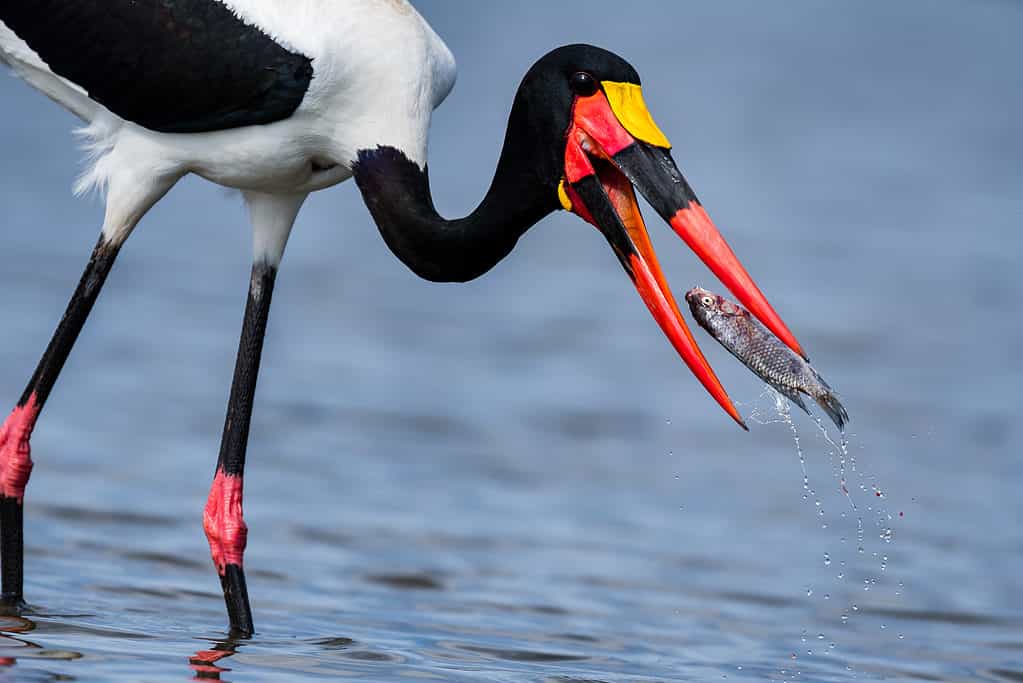
The saddle-billed stork’s colorful beak has brilliant red stripes and a bright yellow frontal shield.
©Matrishva Vyas/Shutterstock.com
6. Kori Bustard
The Kori bustard (Ardeotis kori), one of Africa’s biggest and heaviest flying birds, spends much of its time sitting on the ground. It only flies to avoid predators and lands as quickly as possible. They can grow to a height of up to 4 to 5 feet. It is said that male kori bustards are the heaviest flying birds in the world at a weight of up to 40 pounds. Their feathers are brown and grey with fine black and white patterns.
These birds can be found throughout eastern and southern Africa, particularly in Botswana, Namibia, and Tanzania. They frequently accompany herds of zebras or antelopes in search of insects and small animals startled by the hooves. Kori bustards are primarily found in open grasslands and savannas. They occasionally take “dust baths” because, unlike other African birds, they lack a preening gland that secretes oil to keep their feathers free of parasites.
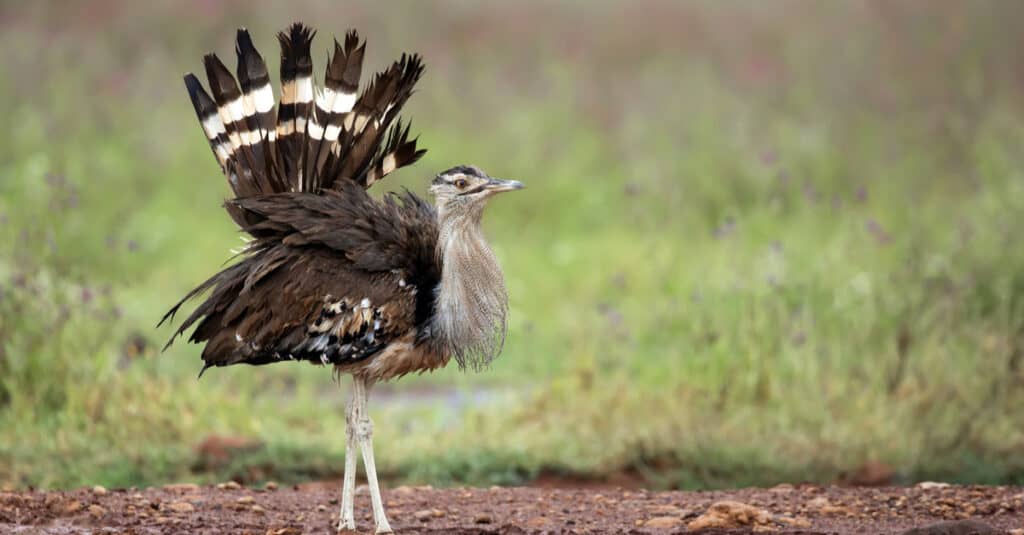
Kori bustards are believed to be the heaviest flying birds in the world.
©zahorec/Shutterstock.com
7. Secretary Bird
One of the African birds with the most striking appearances is the secretary bird (Sagittarius serpentarius). This largely ground-dwelling bird of prey is almost 5 feet tall with a wingspan of nearly 7 feet. It is easily identified by its long pink legs, naked red face, and pointed, curved yellow beak. The secretary bird is most frequently seen in the broad plains and brush of the sub-Saharan region, from Somalia and southward to South Africa.
The name is believed to have originated from the belief that this bird somewhat resembles a 19th-century clerk or secretary. The knee-length black feathers resemble pants, the dark wings resemble a coat, and the feathers on their heads resemble quill pens that secretaries used to carry behind their ears. The secretary bird is one of only two species of raptors (the other is the South American caracara) that forage on the ground rather than from the air.
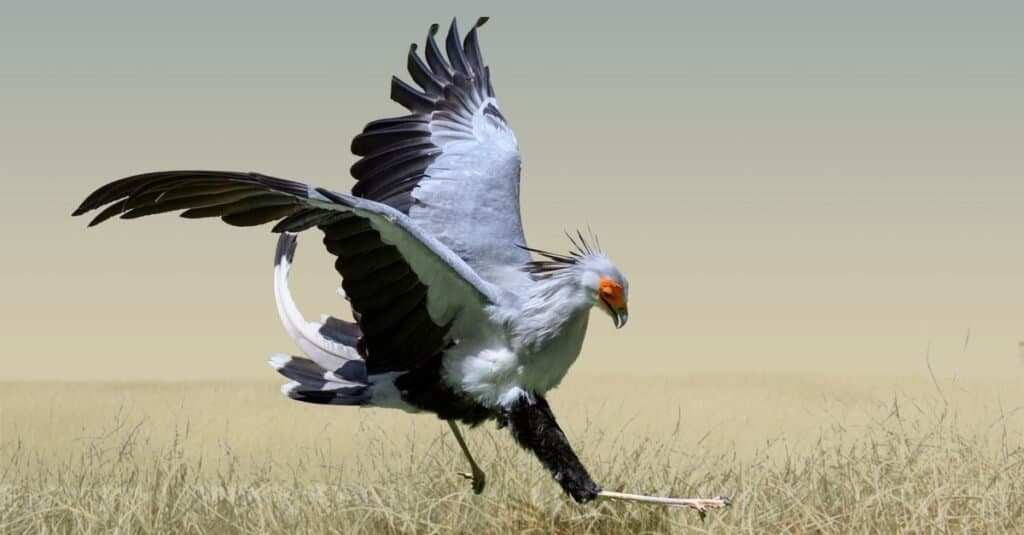
The secretary bird can deliver precise and powerful kicks with a force five times its own body weight.
©Barbara Ash/Shutterstock.com
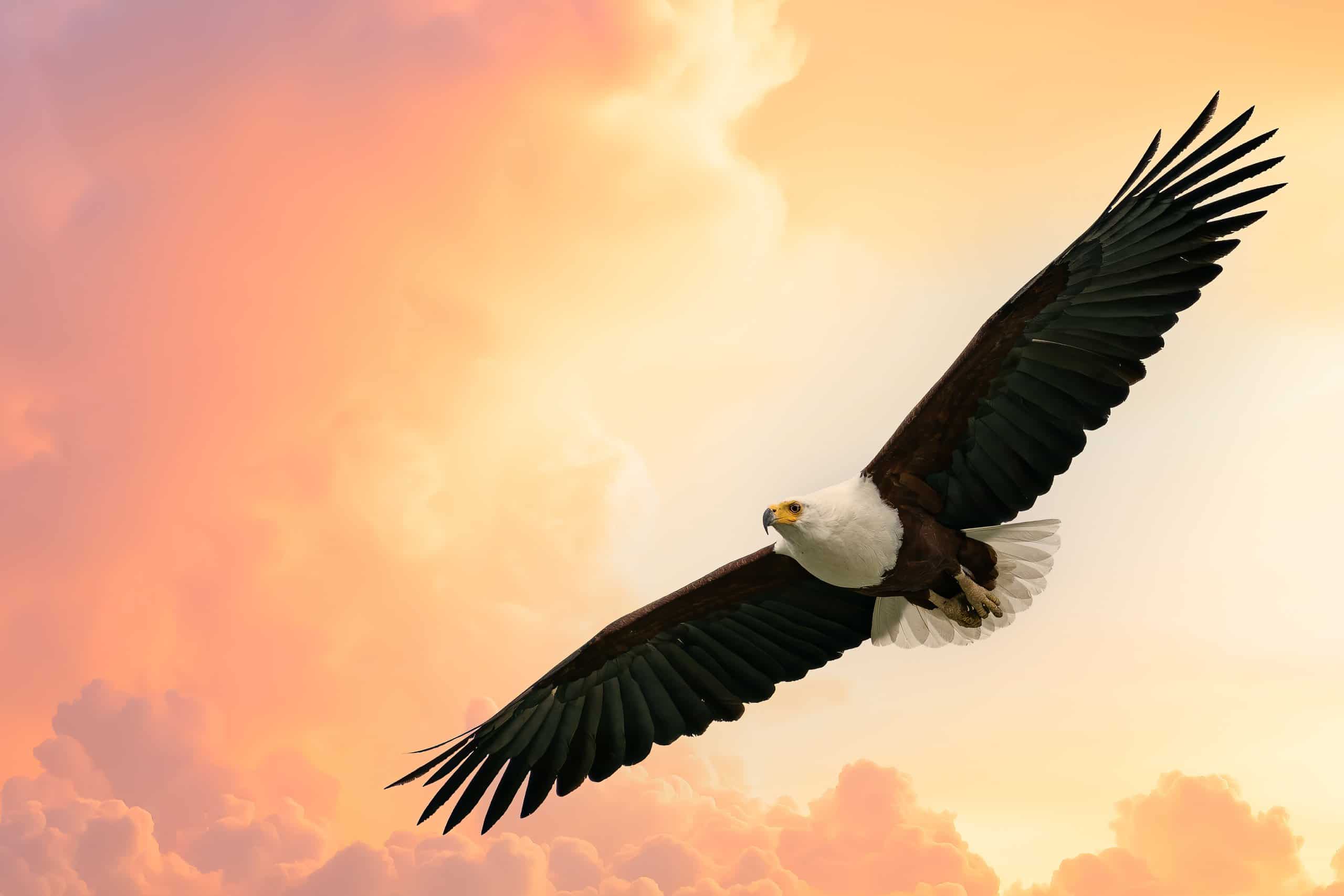
8. African Fish Eagle
With a wingspan that can measure up to an amazing 8 feet, the African fish eagle (Haliaeetus vocifer) is one of the most recognizable of all African birds of prey. It is also one of the largest African eagles. The African fish eagle has a vast range and may be found all over sub-Saharan Africa. It is the national bird of Malawi, Namibia, Zambia, and Zimbabwe.
Since fish makes up the majority of its diet, it is frequently seen sitting close to lakes and rivers. They can be spotted near Lake Victoria, parts of which are in Tanzania, Uganda, and Kenya. These eagles have dark brown to black and white plumage. They have rough soles and pointed spikes on their toes so they do not lose their grip on slippery fish.
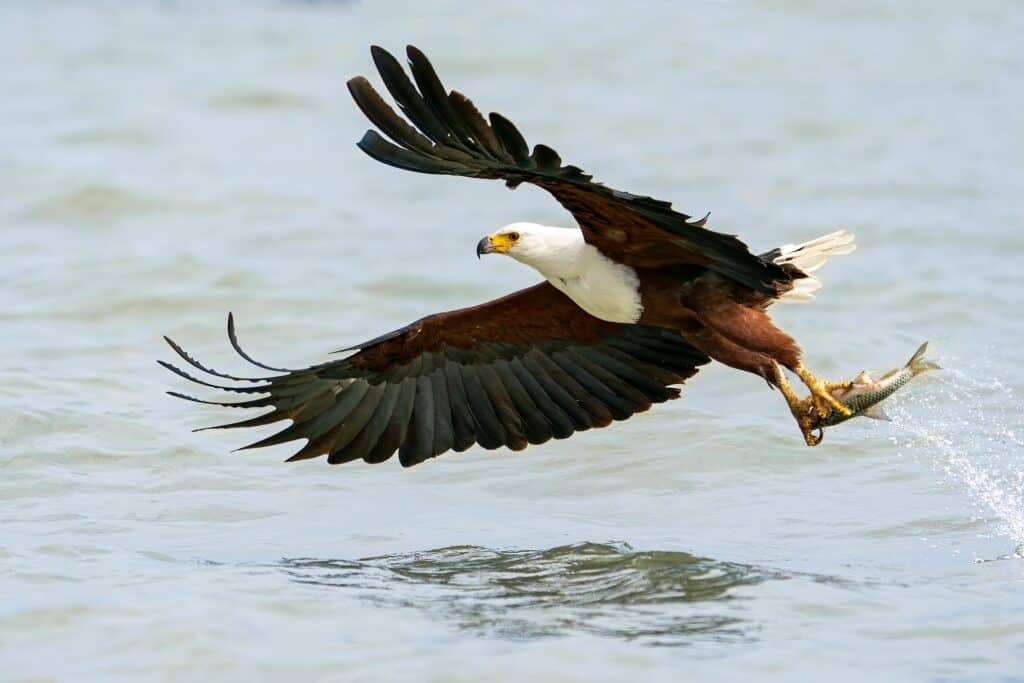
African fish eagles have rough soles and pointed spikes on their toes so fish don’t slip out of their talons.
©Tomas Drahos/Shutterstock.com
9. Yellow-Billed Kite
The yellow-billed kite (Milvus aegyptius) is a moderate-sized bird of prey. These birds can reach a height of nearly 2 feet and have a 5-foot wingspan. These birds have vivid yellow beaks, yellow feet, and forked tails. Their bodies are reddish-brown with darker brown wings.
Kites are swift flyers with the ability to accelerate suddenly. Their forked tails help maneuver during flight. They can also catch and devour insects while in the air. These birds are common in the woodlands, savannas, and even urban areas in sub-Saharan Africa, Madagascar, and Egypt.
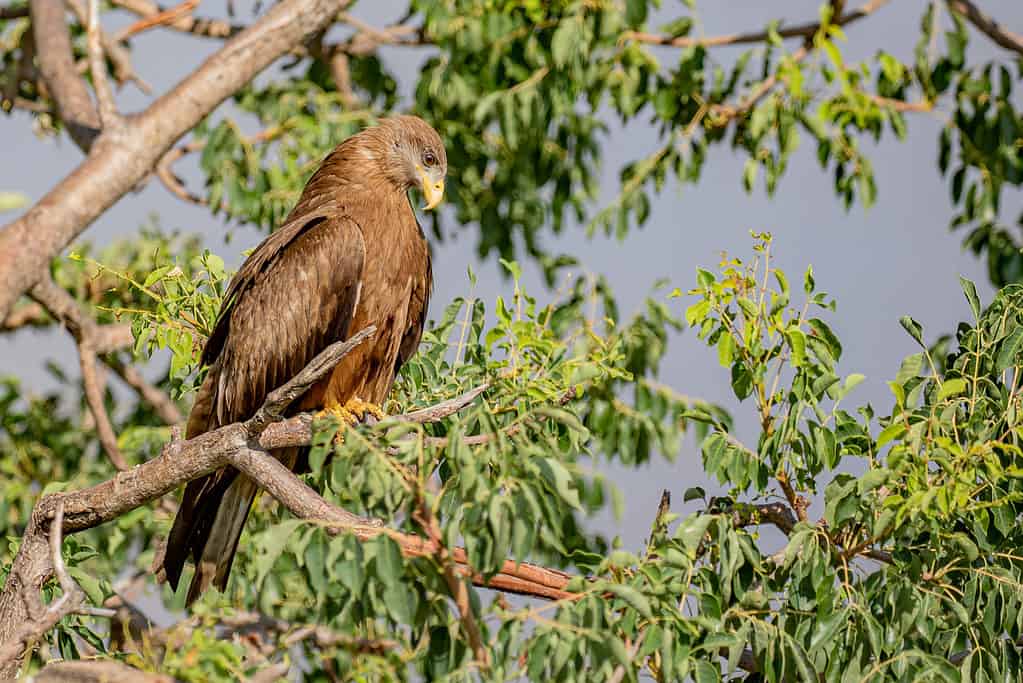
Kites are swift and speedy flyers with the ability to accelerate suddenly.
©Morne Grobler/Shutterstock.com
10. Lilac-Breasted Roller
One of the most beautiful and colorful African birds is the lilac-breasted roller (Coracias caudatus). As its name indicates, it has a lilac-colored breast, a turquoise crown, rusty cheeks, and bright blue and tan wings. These birds exhibit side-to-side rolling during their display flights, which gives them the other part of their name.
These birds can be found in eastern and southern Africa. They can frequently be seen sitting alone as well as in pairs on high, exposed branches, scanning the air for bugs and beetles. These birds are generally found in woodlands and grasslands with scattered trees.
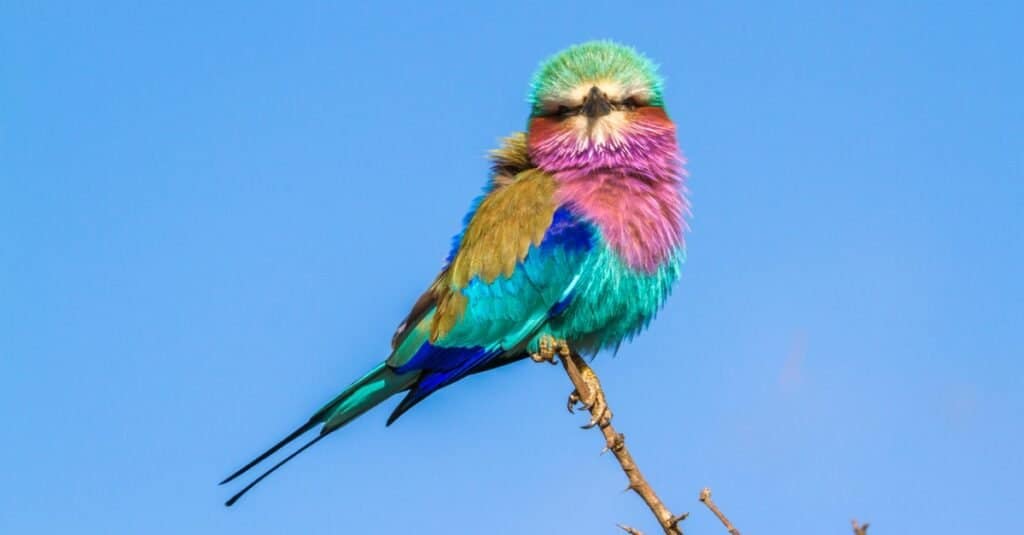
Lilac-breasted rollers build their nests in very high places.
©iStock.com/Utopia_88