C
Species Profile

Canada Warbler

Cardellina canadensis

The necklace warbler of the boreal
Agami Photo Agency/Shutterstock.com
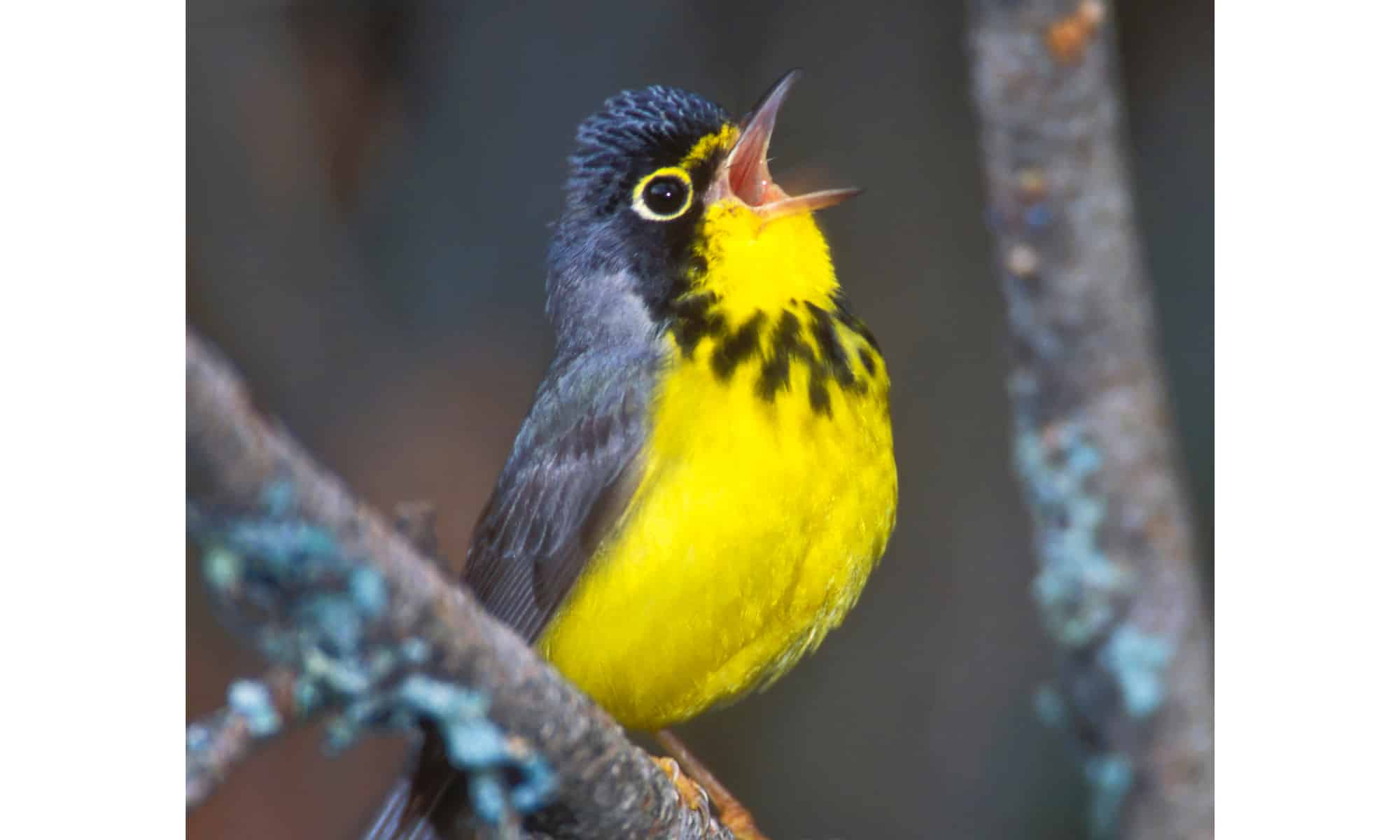
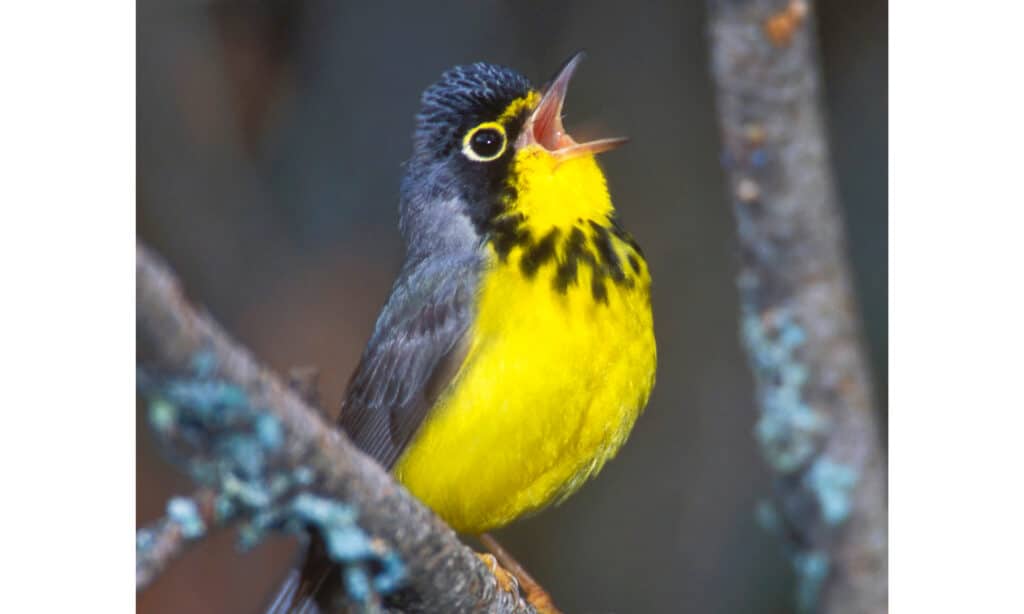
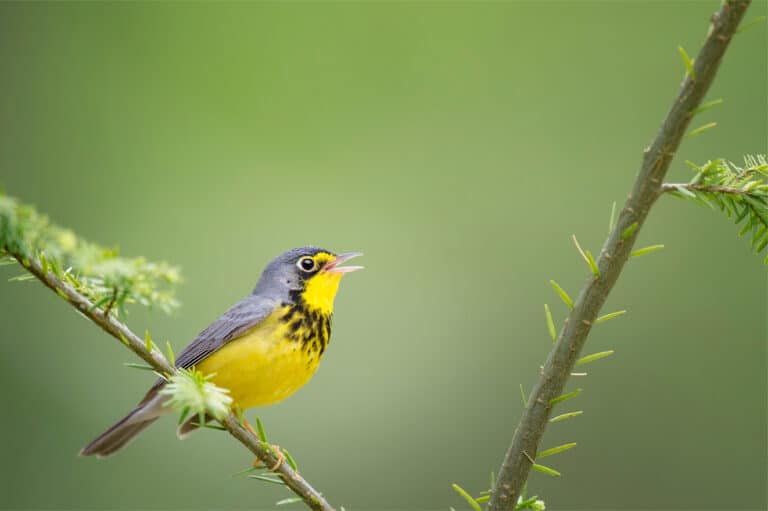
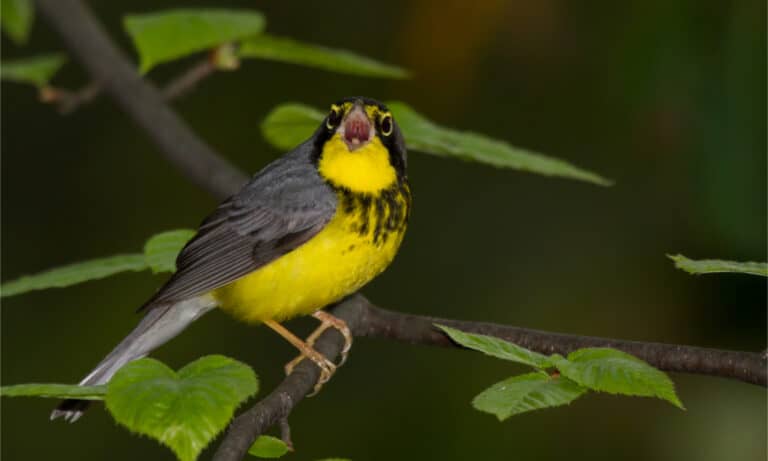
A male Canada warbler singing on a bare tree branch

At a Glance

Wild Species
Activity Diurnal+
Lifespan 2 years
Weight 0.013 lbs
Status Least Concern
Did You Know?

Size: 12-15 cm long, 18-22 cm wingspan; 0.009-0.013 kg (Cornell Lab, All About Birds).

Scientific Classification

A small Nearctic-Neotropical migratory songbird (New World wood-warbler) that breeds primarily in boreal and mixed forests of Canada and the northeastern United States and winters in northern South America.

Kingdom
Animalia
Phylum
Chordata
Class
Aves
Order
Passeriformes
Family
Parulidae
Genus
Cardellina
Species
Cardellina canadensis

Distinguishing Features

  • Slate-gray upperparts with bright yellow underparts
  • Bold dark streaking forming a necklace-like band across the upper chest (especially in males)
  • Strong white eye-ring/eye arcs giving a ‘spectacled’ look
  • Often forages low in dense understory, frequently near water

Physical Measurements

Length
5 in (5 in – 5 in)
Weight
0 lbs (0 lbs – 0 lbs)
Top Speed
25 mph
About 40 km/h (proxy)

Appearance

Primary Colors
Secondary Colors
Skin Type Feathered body (contour feathers and flight feathers); exposed skin limited to bill and eyes; legs/feet covered in scales typical of passerines (Aves).
Distinctive Features
  • Small parulid warbler with compact passerine build; adult typically shows gray upperparts, bright yellow underparts, and a conspicuous black 'necklace' across the upper breast (diagnostic field mark).
  • Frequent tail flicking/pumping behavior often noted while foraging in dense understory (commonly reported in species accounts; Birds of the World).
  • Measurements (species-level): total length 12-15 cm; body mass ~0.009-0.014 kg; wingspan ~19-22 cm (reported in standard references such as All About Birds / Cornell Lab of Ornithology).
  • Long-distance Nearctic-Neotropical migrant: breeds mainly in boreal/mixed forests of Canada and the northeastern U.S. and winters primarily in northern South America (species accounts: Birds of the World).
  • Maximum recorded longevity from banding records reported at ~8 years (USGS Bird Banding Laboratory longevity records; cited in secondary summaries).

Sexual Dimorphism

Sexes are broadly similar in structure and overall pattern, but males average brighter yellow underparts and a higher-contrast, more complete black necklace; females are typically duller with a weaker/less extensive necklace and slightly browner/grayish tones (Birds of the World).

  • Brighter yellow underparts on average.
  • Necklace (black spotting/streaking across upper breast) typically darker, more extensive, and more contrasting.
  • Head/upperparts often cleaner bluish-gray in breeding season (less brownish cast).
  • Yellow underparts typically duller/greener-tinged compared with males.
  • Necklace usually reduced, paler, or less sharply defined (spots/streaks fewer or lighter).
  • Upperparts can look slightly browner/less cleanly gray, especially outside peak breeding plumage.

Did You Know?

Size: 12-15 cm long, 18-22 cm wingspan; 0.009-0.013 kg (Cornell Lab, All About Birds).

Its bold black chest "necklace" is a key field mark-strongest in adult males; females/immatures show a paler version.

Ground/low nester: nests are typically built on or near the ground in dense shrub cover (e.g., ferns, saplings) in moist forests (Birds of the World).

Clutch usually 4-5 eggs (reported range 3-6); incubation about 12 days; young fledge roughly 8-10 days after hatching (Birds of the World).

A true long-distance migrant: breeds in Canada and the NE U.S., winters mainly in northern South America along the Andes and adjacent regions (Birds of the World).

In Canada it is listed as Threatened under the Species at Risk Act (SARA), reflecting significant population declines tied to habitat change across its range.

Unique Adaptations

  • High-contrast "necklace" plumage: likely functions in rapid species/sex recognition and signaling in dim, cluttered understory where clear visual badges can be advantageous (behavioral interpretations summarized in Birds of the World).
  • Ground/low nesting architecture: nest placement tucked into moss, ferns, roots, or hummocks helps camouflage eggs/young in boreal forest floor structure (Birds of the World).
  • Long-distance migration physiology: like many parulid warblers, it rapidly deposits fat before migration to support multi-day flights between stopovers (general warbler migration physiology; species-level notes in Birds of the World).
  • Flexible foraging: primarily insectivorous but can incorporate small fruits during migration/winter, aiding energy balance when insect availability fluctuates (Birds of the World).

Interesting Behaviors

  • Understory specialist: forages actively in dense shrubs and lower tree layers, gleaning caterpillars and other insects from leaves and twigs; also makes short sallies to snatch flying insects (Cornell Lab; Birds of the World).
  • Male song display: males sing persistently from low-to-mid perches in breeding territories; song delivery often increases at dawn and during territory defense (Birds of the World).
  • Nest secrecy: adults approach ground nests cautiously through cover, reducing visual cues to predators-an important tactic for a low-nesting forest songbird (Birds of the World).
  • Migration pacing: during migration it frequently uses shaded, brushy stopover habitats (riparian thickets, second growth), where it refuels on insects and fruit when available (Birds of the World).
  • Posture/field mark behavior: when alert, it often holds the tail slightly fanned and flicks it while moving through tangles-helpful for breaking up its outline in cluttered understory (field observations summarized in species accounts).

Cultural Significance

Canada Warbler (Cardellina canadensis) is a key species for protecting boreal and northern hardwood understory. Its Threatened status (SARA) helps guide plans (keep dense understory, protect moist ravines and streamside thickets). Birders call it the 'necklace' wood-warbler and a symbol of the Nearctic–Neotropical link to winter areas in the Andes.

Myths & Legends

No widely documented traditional myth is specific to the Canada Warbler itself; cultural references are mostly historical and naming-based.

Naming origin: the species was first formally described by Carl Linnaeus (1766) with the epithet canadensis ("of Canada"), reflecting early European natural-history collecting tied to New France/Canada-era specimens.

Historic vernacular names in older North American literature include "Canadian Flycatcher," reflecting its insect-catching foraging style and past confusion in early taxonomy before modern warbler classification stabilized.

In North America, phenology calendars and traditions mark migratory songbirds' return to northern forests as a sign of spring. Canada Warbler (Cardellina canadensis) is a later-arriving boreal migrant, a cultural link not a single legend.

Conservation Status

LC Least Concern

Widespread and abundant in the wild.

Population Decreasing

Protected Under

  • Canada - Species at Risk Act (SARA): Threatened (national legal status; species is listed under SARA)
  • Canada - Migratory Birds Convention Act, 1994 (general protection from harm/possession for migratory birds)
  • United States - Migratory Bird Treaty Act of 1918 (general protection from take/possession for migratory birds)

Life Cycle

Birth 4 chicks
Lifespan 2 years

Lifespan

In the Wild
0–8.9 years
In Captivity
1–11 years

Reproduction

Mating System Monogamy
Social Structure Socially Monogamous
Breeding Pattern Seasonal
Fertilization Internal Fertilization
Birth Type Internal_fertilization

Behavior & Ecology

Social Flock Group: 2
Activity Diurnal, Nocturnal, Crepuscular
Diet Insectivore caterpillars (Lepidoptera larvae)
Seasonal Migratory 3,418 mi

Temperament

Breeding season: strongly territorial and competitive (especially males); social interactions are dominated by song-based spacing and defense rather than group cohesion (Loewen et al., 2020, Birds of the World).
Nonbreeding season: more socially tolerant; commonly forages in proximity to other species within mixed-species flocks, with flexible spacing and reduced territoriality relative to breeding (Loewen et al., 2020).
Typically skulks/forages in dense understory and shrub layer; tends to move deliberately with frequent short hops and brief sallies after insects-behavior conducive to loose flock association in winter (Bent, 1953; Loewen et al., 2020).
Canada Warbler (Cardellina canadensis) sings on territories at dawn and early morning, feeds by day, and migrates mostly at night, stopping in daytime to feed during migration.

Communication

Primary song: a rich, rapid series of loud notes often rendered as a variable, accelerating phrase Used for mate attraction and territory defense; described in Loewen et al., 2020, Birds of the World
Call notes: sharp chip/tsip-like contact notes used at close range E.g., within vegetation or during agitation), including higher-intensity scolds near nest/fledglings (Bent, 1953; Loewen et al., 2020
Visual displays: posture/orientation during countersinging and territorial encounters; close-range threat displays typically include body posturing and rapid movements through cover Loewen et al., 2020
Spatial signaling: territory establishment/maintenance primarily via singing from within/near defended areas Acoustic spacing), reducing need for persistent physical contact among neighbors (Loewen et al., 2020
Parent-offspring signaling: fledglings use begging postures and calls; adults respond with provisioning movements and alarm behaviors when disturbed Bent, 1953; Loewen et al., 2020

Habitat

Forest Coniferous Forest Deciduous Forest Woodland Wetland Bog Swamp Marsh River/Stream Mountain +4
Biomes:
Boreal Forest (Taiga) Temperate Forest Wetland Tropical Rainforest
Terrain:
Mountainous Hilly Valley Riverine
Elevation: Up to 9842 ft 6 in

Ecological Role

Understory insect predator in boreal and mixed forests; links forest arthropod production to higher trophic levels and can contribute minor seed dispersal when taking berries.

suppression of forest arthropod populations via predation (notably caterpillars and other foliage-associated insects) energy transfer from invertebrates to avian predators (as prey for raptors and other predators) potential incidental seed dispersal from soft fruits/berries consumed during migration/winter

Diet Details

Other Foods:
Small berries and soft fruits

Human Interaction

Domestication Status

Wild

Canada Warbler (Cardellina canadensis) is a wild Nearctic–Neotropical migratory songbird with no history of domestication. It eats insects, forages in the understory, and nests on or near the ground in boreal and mixed forests, making it poor for captivity. Size 12–15 cm, 0.009–0.013 kg. Human links: conservation, migration hazards (light, glass), birdwatching, research; captivity is rarely legal.

Danger Level

Low
  • Negligible direct physical risk (small passerine; minor peck/scratch risk only if handled).
  • As with wild birds generally, potential (low) zoonotic/hygiene risk when handling sick/injured individuals or contaminated feces (e.g., Salmonella spp.); standard wildlife-handling precautions mitigate this.
  • Indirect risks are primarily to the bird, not humans (stress/injury from improper handling; nest disturbance).

As a Pet

Not Suitable as Pet

Legality: Canada Warbler (Cardellina canadensis) cannot be kept as a pet in most places. US MBTA and Canada laws ban taking, buying, selling, or moving without permits; only rehab, science, or education permits. Local rules may add limits.

Care Level: Expert Only

Purchase Cost:
Lifetime Cost:

Economic Value

Uses:
Ecosystem services (insect predation) Birdwatching/ecotourism Conservation funding and stewardship value Scientific research value (migration ecology, bioacoustics, forest management indicators)
Products:
  • No commercial products; not a livestock/game species and not legally traded as a commodity in typical markets.

Relationships

Predators 7

Sharp-shinned Hawk
Sharp-shinned Hawk Accipiter striatus
Cooper's Hawk
Cooper's Hawk Accipiter cooperii
Merlin Falco columbarius
Eastern Screech-Owl Megascops asio
Blue Jay
Blue Jay Cyanocitta cristata
American Red Squirrel Tamiasciurus hudsonicus
Common Garter Snake
Common Garter Snake Thamnophis sirtalis

Related Species 8

Wilson's Warbler Cardellina pusilla Shared Genus
Red-faced Warbler Cardellina rubrifrons Shared Genus
Red Warbler Cardellina rubra Shared Genus
Pink-headed Warbler Cardellina versicolor Shared Genus
American Redstart Setophaga ruticilla Shared Family
Mourning Warbler
Mourning Warbler Geothlypis philadelphia Shared Family
Common Yellowthroat
Common Yellowthroat Geothlypis trichas Shared Family
Chestnut-sided Warbler
Chestnut-sided Warbler Setophaga pensylvanica Shared Family

Ecological Equivalents 4

Animals that fill a similar ecological role in their ecosystem

Mourning Warbler
Mourning Warbler Geothlypis philadelphia Very similar breeding niche: a low-understory, shrub-layer insectivore of dense, regenerating or border habitats. Like Canada Warbler, it forages close to the ground by gleaning and short sallies, and tends to place nests on or near the ground in concealed vegetation.
American Redstart Setophaga ruticilla Overlaps strongly in boreal and mixed-forest breeding landscapes and in insectivorous diet. Both are active foliage-foragers that capture arthropods by gleaning and by short aerial sallies, and both can co-occur along edges, in gaps, and in riparian thickets during migration.
Black-throated Blue Warbler Setophaga caerulescens Shares a forest-understory insectivore role in northeastern North American breeding systems, especially in mature mesic stands with dense understory. It overlaps in prey type (caterpillars and other arthropods) and foraging strata (shrub and understory), making it a close functional analogue where ranges overlap.
Connecticut Warbler Oporornis agilis Ecological near-match as a ground- or low-understory warbler of dense, often boggy or thicketed boreal habitats. Both are secretive insectivores that commonly forage near the forest floor and are vulnerable to similar nest-predation pressures due to their ground-proximate nesting habits.

Quick Take

  • Surviving a 3,000 mile trek from South America is a mandatory achievement for the Canada warbler.
  • A 5 day limit on nest construction creates exposure problems for females dwelling on the ground.
  • Hopping in the underbrush is a counterintuitive behavior that contradicts standard assumptions about bird tree-top safety.
  • The September arrival in South America is a necessary stage to survive the winter climate.

The Canada warbler’s bright yellow feathers make it a standout in the world of birds. It’s a carnivore, or more specifically, an insectivore, eating mosquitoes, flies, moths, and caterpillars. It’s known for its cheerful, trilling song full of ‘chip-chips’ and ‘seep-seeps’. The lifespan of the Canada warbler goes up to seven years.

A comprehensive infographic about the Canada Warbler, detailing its 3,000-mile migration, ground-nesting habits, and distinctive yellow and gray plumage.
A 3,000-mile odyssey from South America ends in a high-stakes race for survival on the forest floor. Meet the bird that defies tree-top safety for a life in the shadows. © A-Z Animals

3 Canada Warbler Amazing Facts

  • The oldest Canada warbler was eight years old.
  • It builds its nest on or near the ground.
  • The white ring around each eye makes this bird look like it’s wearing glasses.

Where to Find a Canada Warbler

The Canada warbler is found in North America and South America. These birds spend their breeding season in a temperate climate in Canada or the northeastern part of the United States.

This bird is most visible in the late springtime. Birdwatchers who want to spot a Canada warbler have several things working in their favor. For one, this bird’s bright yellow feathers make it easy to see in its habitat. Second, male Canada warblers sing a beautiful song to attract females. In addition, these birds are known to hop around in the underbrush. So, they’re easier to see, unlike other types of birds that remain high in the treetops.

In late summer, Canada warblers start their migration south through Texas, Mexico, and then into South America. They arrive in South America in September or October, where they stay for the winter.

One of the most interesting facts about this bird is the length of its migratory path. Its flight from South America back to its breeding ground in the northern United States or Canada adds up to 3,000 miles or more.

Nests

In the springtime, female Canada warblers build a nest by weaving together grass, twigs, leaves, and even bark. The interior of the nest is covered with animal hair or feathers, so each baby bird has a soft place to rest. Hollow logs, rotting tree stumps, and sphagnum hummocks are all appealing places for a female Canada warbler to build a nest. Of course, a female chooses an area near the ground that’s hidden by plant life. Nest construction can take a female as long as five days.

Migration Pattern and Timing

In April or May, the Canada warbler breeds in Canada and the northeastern part of the United States. Then, in late summer, Canada warblers migrate south, flying through the United States to the northwestern part of South America. They arrive at their destination in September or October. These birds travel 3,000 plus miles during their migration period.

Classification and Scientific Name

Cardellina canadensis is the scientific name of the Canada warbler. The Italian word Cardellina means goldfinch, and the Latin word canadensis translates to Canada. It’s also called a necklaced warbler because of the ring of black feathers around its neck. It belongs to the Parulidae family and the class Aves.

Size, Appearance, and Behavior

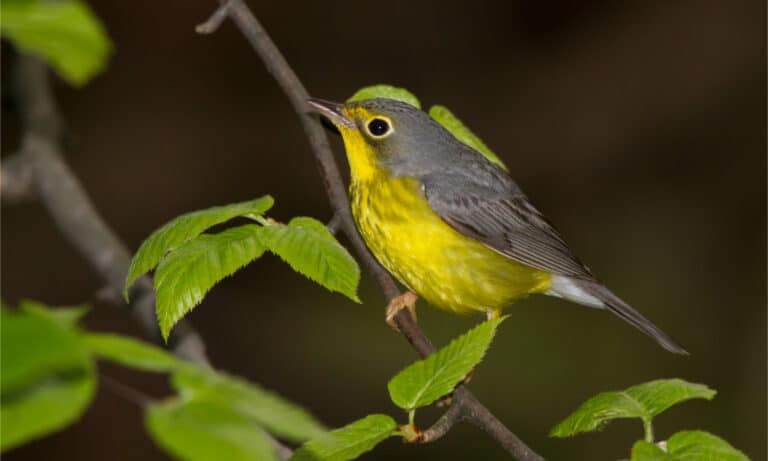
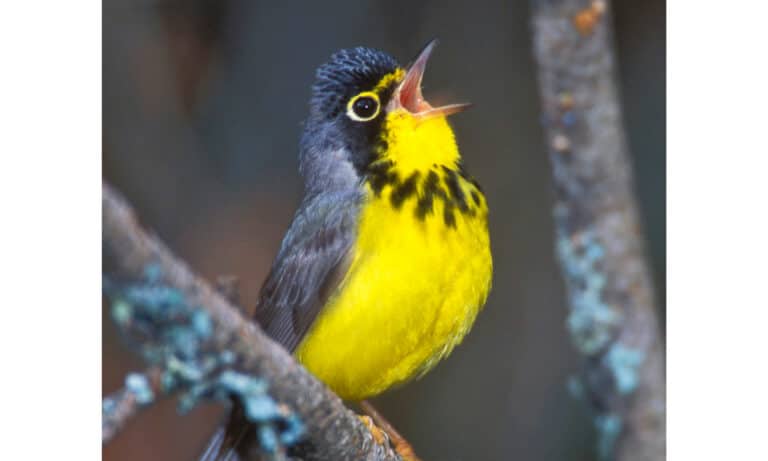
Bright yellow feathers cover the breast and throat of the Canada warbler. Its wings are gray along with the top of its head. A ring of black feathers decorates its neck. This bird has two small black eyes, each surrounded by a white circle.

Its size range is 4.7 to 5.9 inches long, and it’s three to four inches tall. This is a tiny bird weighing from 0.32 to 0.46 ounces. The wingspan of the Canada warbler is seven to nine inches.

This animal’s bright yellow feathers make it difficult for this bird to blend into its forest or shrubland habitat. So, its main defense against predators is its speed. One of the most amazing facts about this bird is that it can fly at a speed of 25mph.
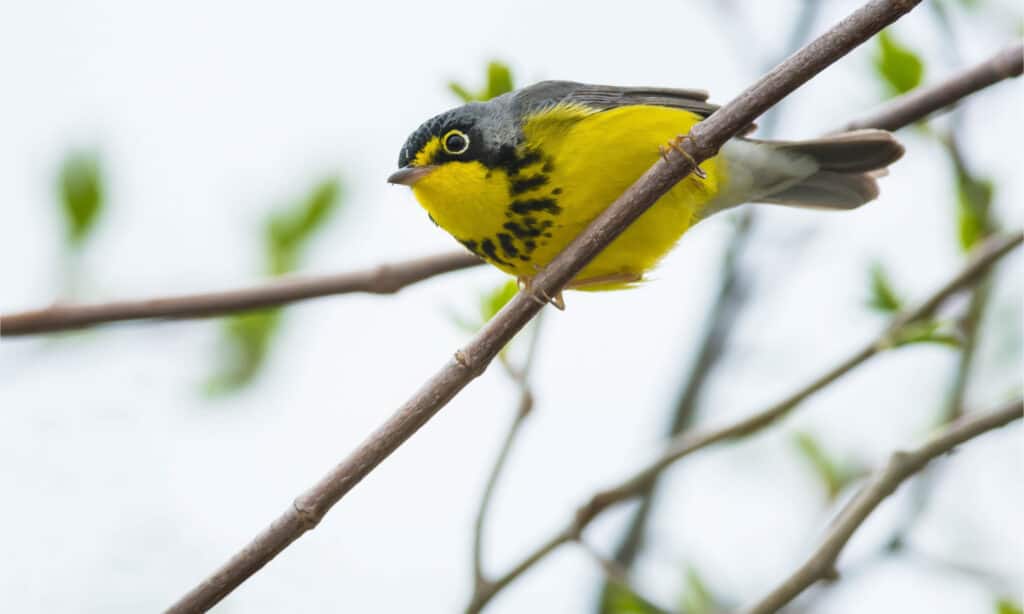
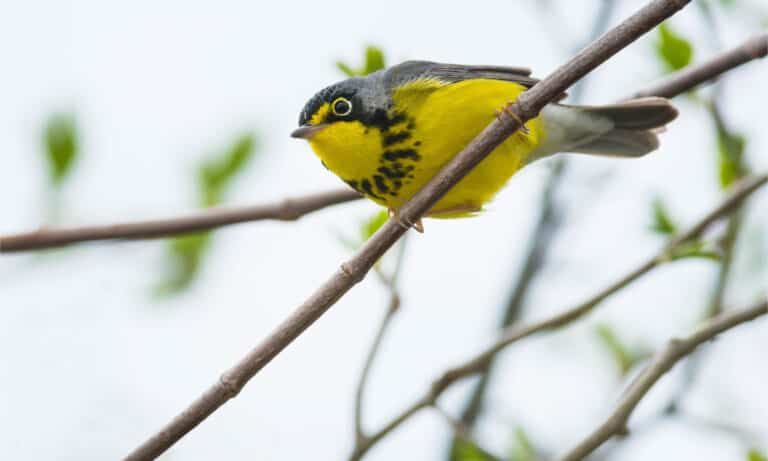
Canada warbler sitting on a branch

Canada warblers are easy to identify from their bright yellow undersides, their “necklace” of black feathers, and the white circle of feathers around their eyes.

Diet

Canada warblers are generally known as carnivores. But biologists sometimes refer to them as insectivores due to their diet of insects.

What does a Canada warbler eat?

Beetles, moths, flies, and caterpillars are all foods of the Canada warbler.

Predators, Threats, and Conservation Status

It’s not surprising that this little bird is vulnerable to many larger animals. Sometimes it’s not fast enough to escape predators.

What eats the Canada warbler?

Snakes, hawks, and cats are all predators of the Canada warbler. Snakes sometimes prey on baby Canada warblers in the nest. Hawks are known for their excellent vision and speed, so they can easily capture a Canada warbler. Cats are also fast and able to take down a Canada warbler with very little effort.

Reproduction, Young and Molting

In April or May, male Canada warblers use their cheerful song to attract female birds. Biologists believe these birds form monogamous pairs at least for a single breeding period.

The female lays three to five white eggs with brown spots. The female sits on the eggs and is fed by the male. The eggs hatch in approximately eight to 12 days. The baby Canada warbler, also called a chick, comes out of the egg with no feathers and its eyes closed. The male and female care for the baby birds.

In ten days, the chicks leave the nest, but they stay in the area for two to three weeks. During this time, they are fed and watched over by their parents until they are strong fliers and can find food on their own.

The lifespan of these warblers goes up to seven years.

Population

The population of this bird is reported at 2,600,000 adults. The loss of some of its forest habitat is a threat to this tiny bird, and, unfortunately, its numbers are thought to be decreasing. However, the IUCN Red List of Threatened Species lists the Canada warblers’ status as Least Concern.

View all 395 animals that start with C

Sources

  1. Wisconsin Department of Natural Resources / Accessed May 23, 2022
  2. Wikipedia / Accessed May 23, 2022
  3. Ontario / Accessed May 23, 2022
  4. IUCN Red List / Accessed May 23, 2022
  5. Tennessee Wildlife Resources Agency / Accessed May 23, 2022
  6. Illinois Department of Natural Resources / Accessed May 23, 2022
  7. Field Guide Montana / Accessed May 23, 2022
A-Z Animals Staff

About the Author

A-Z Animals Staff

AZ Animals is a growing team of animals experts, researchers, farmers, conservationists, writers, editors, and -- of course -- pet owners who have come together to help you better understand the animal kingdom and how we interact.
Connect:

Thank you for reading! Have some feedback for us?


Canada Warbler FAQs (Frequently Asked Questions)

Yes. Canada warblers migrate from Canada and the northeastern United States to South America and back again.