
Quick Take
- One of North Carolina's brown snakes looks so much like a deadly venomous species that thousands are killed every year by mistake. Can you tell them apart? See the lookalike species →
- North Carolina has a brown snake so perfectly camouflaged it's practically invisible underfoot, and this same species is responsible for most accidental bites in the state. Meet the camouflaged biter →
- Not all venomous brown snakes in NC are obvious about it. One species hides its fangs in the back of its mouth, and its venom works in a way most people wouldn't expect. Explore the rear-fanged snake →
- The world's largest rattlesnake once roamed North Carolina, and its status in the state today might surprise you. Check its NC status →
With stunning mountain ranges, flat coastal plains, and the rolling fields of the Piedmont plateau region, North Carolina has a wide variety of habitats for thousands of different animals. Among these animals are snakes. There are 37 species that call the state home, of which six are venomous. While snakes often come in bright colors and patterns, some of them use their appearance to remain hidden. The best-camouflaged snakes are brown snakes that can hide among the leaf litter and soil, as well as underneath logs and rocks. In fact, some blend in so well, you might not even notice them. Join us as we discover the brown snakes of North Carolina.
1. Cottonmouth
Also known as water moccasins, cottonmouths (Agkistrodon piscivorus) are one of the most venomous pit vipers. Most adult cottonmouths in the state range 3–4 feet, but some large individuals can reach 6 feet, with males being larger than females. Cottonmouths are usually dark brown, olive, or black. They have dark brown crossband markings with olive or brown centers and cream or tan bellies. These snakes are heavy-bodied with heads that are wider than their necks. When threatened, they open their jaws wide, exposing the white insides of their mouths.
Cottonmouths are semi-aquatic snakes and live in shallow streams, ponds, and swamps. They occur only rarely in deeper bodies of water but can sometimes be found up to one mile from water in forests and prairies. Cottonmouths are active both during the night and the day, and they feed on a wide range of birds, snakes, fish, amphibians, and mammals. They usually stand their ground rather than fleeing when threatened and vibrate their tail as a warning. Cottonmouth snakes are mostly found in the eastern half of the state throughout the Coastal Plain and the Sandhills.
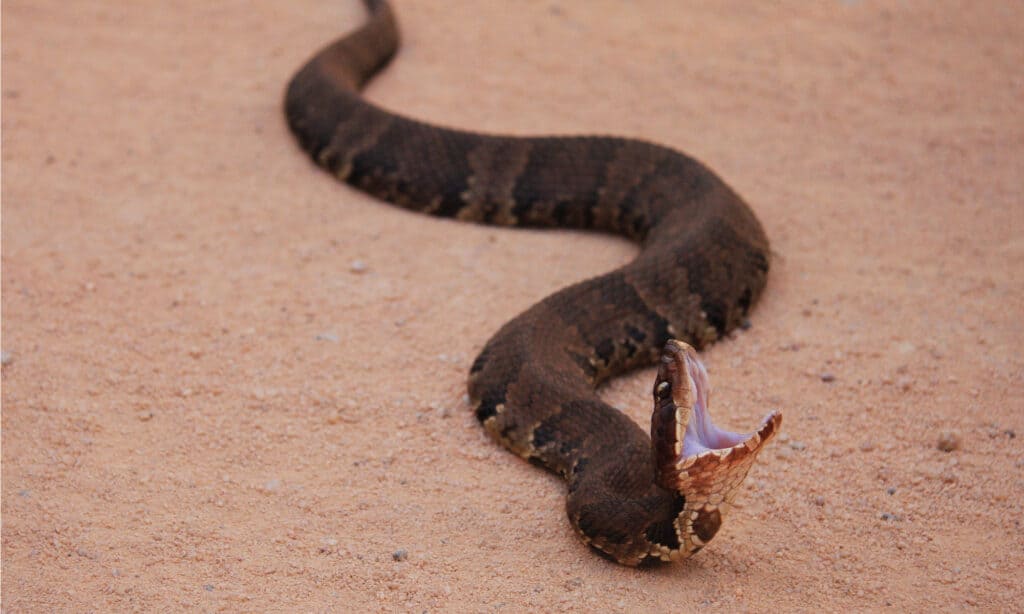
Cottonmouths are semi-aquatic and live near shallow bodies of water.
©Nathan A Shepard/Shutterstock.com
2. Brown Water Snake
The most common species of water snake throughout the Southeast is the brown water snake (Nerodia taxispilota). Brown water snakes live mainly in swamps and streams in lower coastal regions in North Carolina, where they feed predominantly on juvenile catfish. They can bite when threatened, but they are not venomous, nor are they seriously dangerous to humans.
Brown water snakes are almost completely brown, with the exception of around 25 black or dark brown markings down their back. Their belly is yellowish with dark blotches. They have thick, heavy bodies and large, flat heads wider than their necks. Brown water snakes are also often mistaken for cottonmouths due to their resemblance, and many are killed every year as a result.
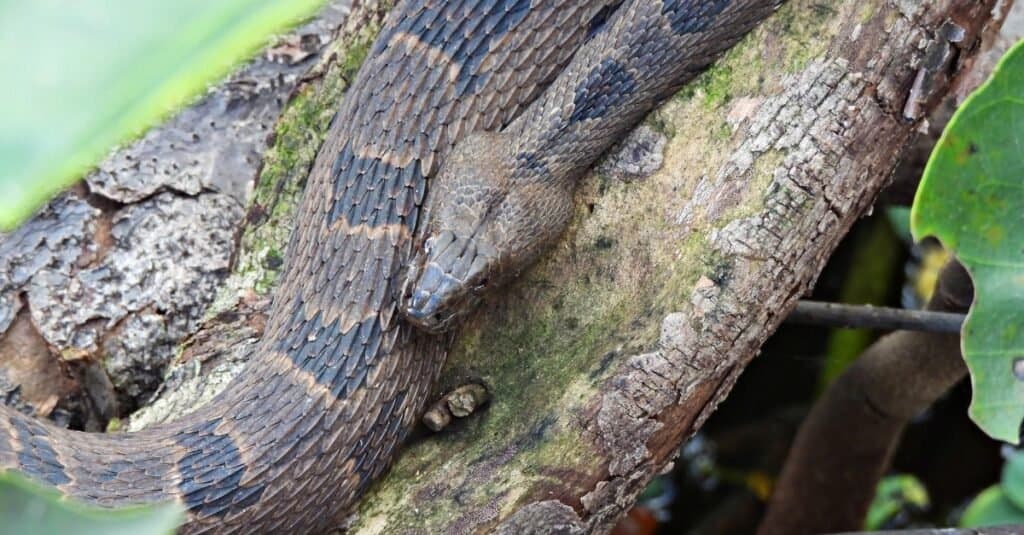
Harmless brown water snakes have a similar appearance to venomous cottonmouths.
©iStock.com/passion4nature
3. Eastern Diamondback Rattlesnake
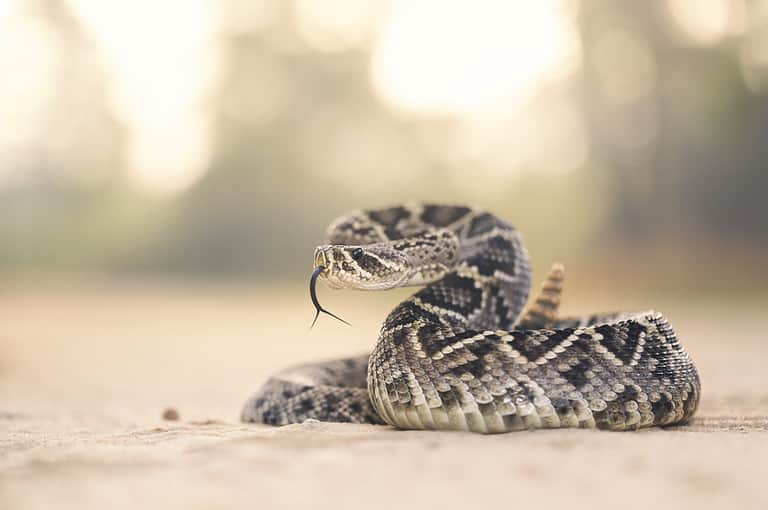
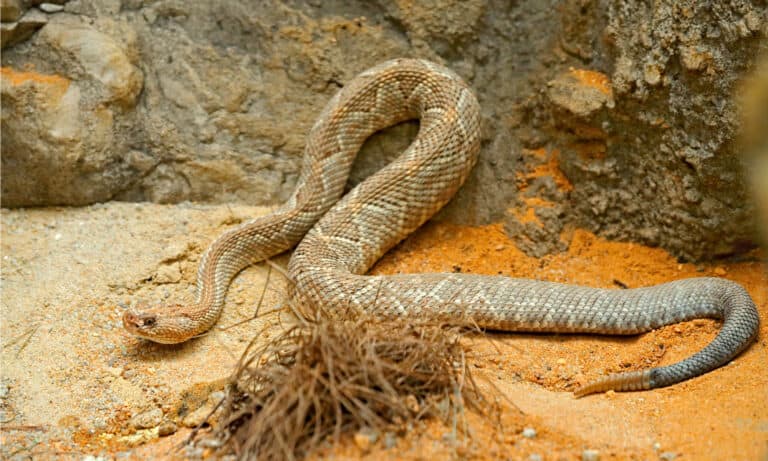
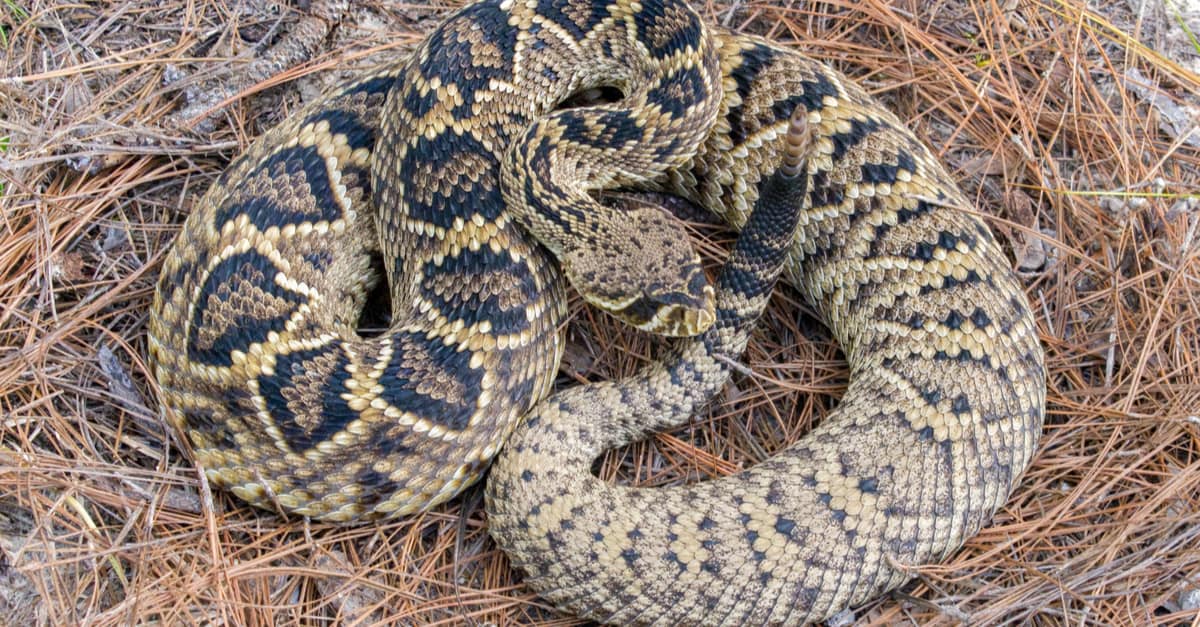
While the eastern diamondback (Crotalus adamanteus) historically ranged into the southeastern Coastal Plain, it is now considered extremely rare there. These are the largest rattlesnakes in the world, averaging 3-6 feet long, with the largest recorded snake measuring around 8 feet. These heavy-bodied rattlesnakes have brownish-grey or tan bodies overlaid with a pattern of diamonds. The diamond markings are usually black or brown but have cream-colored borders. The markings become crossbands closer to the tail.
Eastern diamondbacks live in woodlands, forests, and swamps, and they often inhabit the burrows of gopher tortoises. They are ambush predators and feed mainly on birds, rodents, and other small mammals. Eastern diamondbacks are incredibly dangerous, as they have the largest fangs of any rattlesnake and can inject a large amount of venom due to their size. Fortunately, they are reluctant to bite and would rather remain hidden or escape when threats are near.
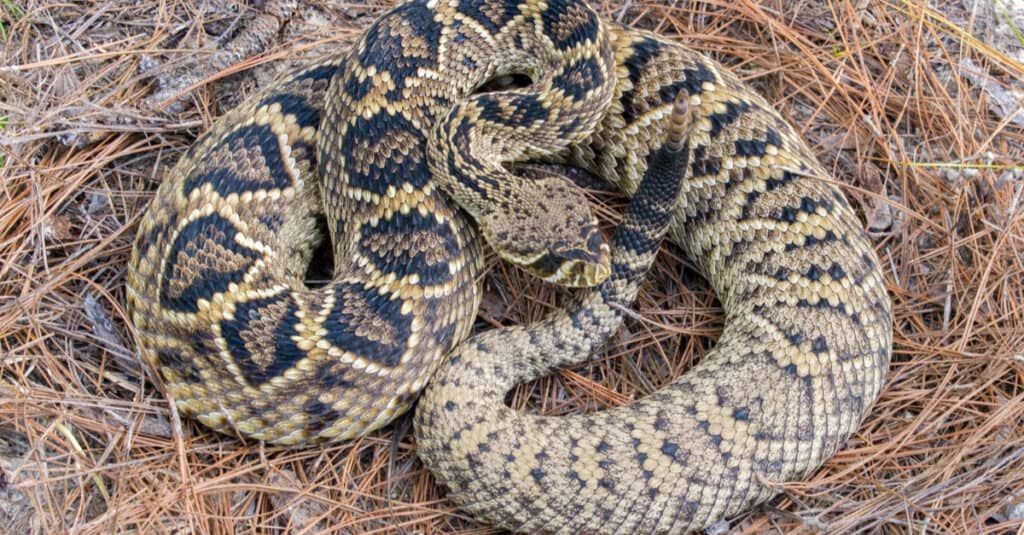
The eastern diamondback rattlesnake’s pattern often fades towards their tail.
©Chase D'animulls/Shutterstock.com
4. Mole Kingsnake
The mole kingsnake (Lampropeltis rhombomaculata) is an incredibly secretive snake. They are 30 to 42 inches long and are typically light brown with reddish-brown spots down their bodies. However, these spots fade as the snake becomes older, so it is common for the oldest snakes to have no markings at all.
Mole kingsnakes prefer to live in fields on the edge of forests where there is plenty of loose soil for them to burrow into. They are particularly abundant in the Coastal Plain and Piedmont region. Mole kingsnakes are not venomous and prey on rodents, lizards, and frogs.
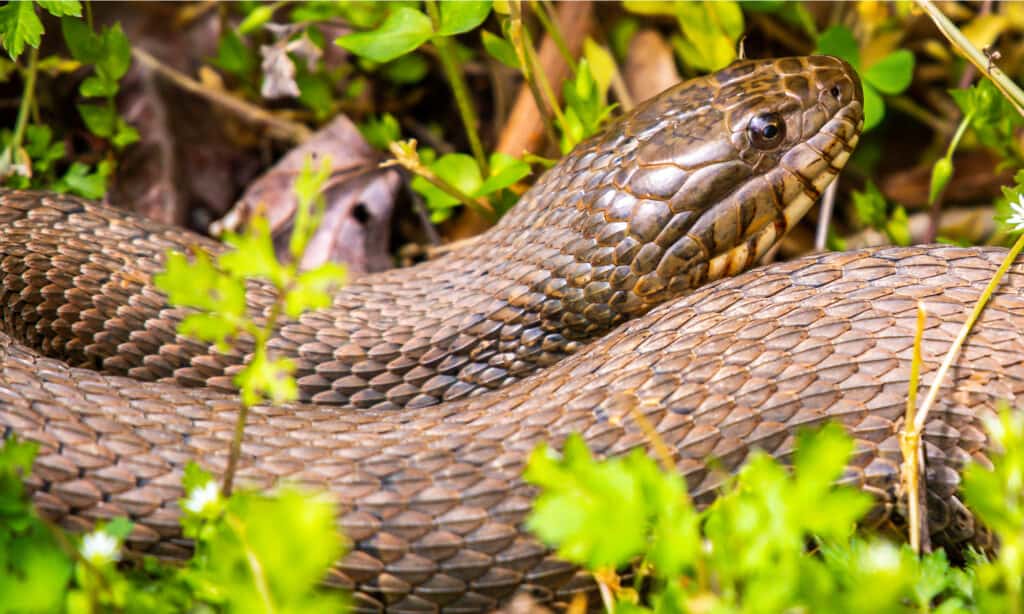
The mole kingsnake’s pattern fades as it gets older.
©Krumpelman Photography/Shutterstock.com
5. Rough Earth Snake
One of the smallest brown snakes in North Carolina is the rough earth snake (Haldea striatula), measuring only 7 to 10 inches long. Rough earth snakes have slender bodies and are typically brown or reddish-brown with cream or yellow bellies and no markings on them. They have a small, pointed snout and keeled dorsal scales, which give them a rough texture and help to distinguish them from smooth earth snakes.
Rough earth snakes live in both forests and urban areas, where they are one of the most abundant snakes. In both habitats, they prefer to hide away underneath logs and rocks or burrow into loose soil or leaf litter. They mainly eat earthworms, and they have many predators due to their small size. Rough earth snakes are completely harmless to humans and very rarely, if ever, bite.
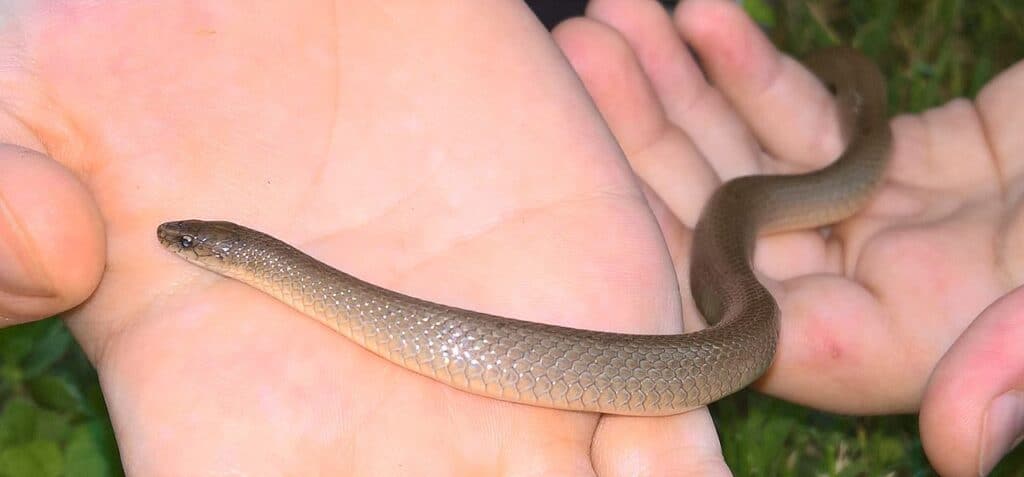
Rough earth snakes are typically brown with white or yellowish bellies.
6. Pine Woods Snake
Also known as the brown-headed snake, the pine woods snake (Rhadinaea flavilata) are 10 to 13 inches long and reddish-brown. Pine woods snakes live in damp woodlands and pine forests in scattered coastal regions. Recent sources list this snake as rare in North Carolina, confined to the southeastern Coastal Plain and considered of conservation concern. They are secretive snakes and often hide in leaf litter or underneath logs.
Pine woods snakes have a small set of fangs at the rear of their mouth and are mildly venomous to their prey, though not to humans. Their diet consists of frogs, lizards, and salamanders. They have several predators, including other snakes such as kingsnakes and southern black racers.
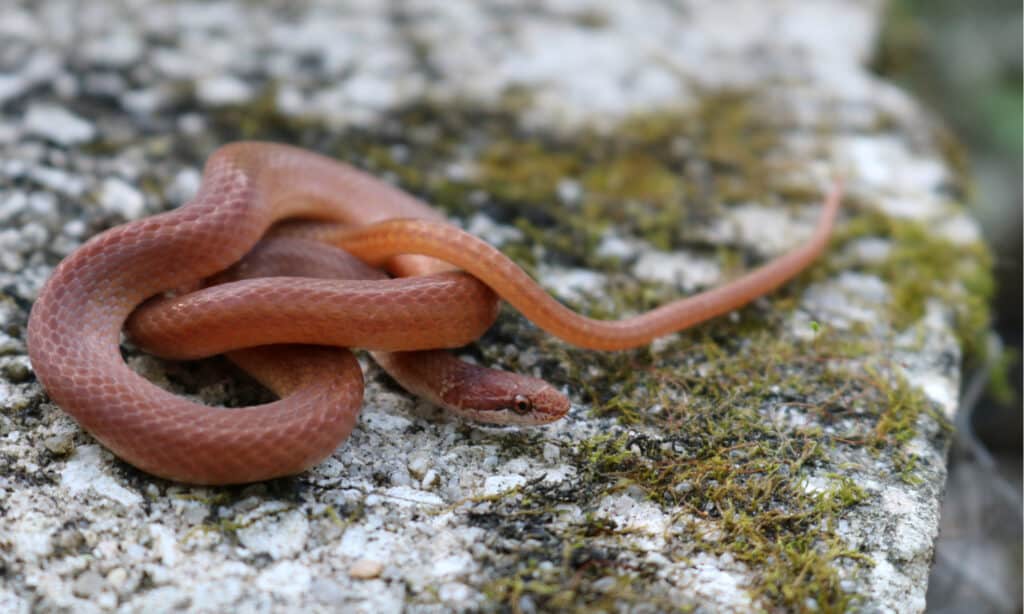
Pine woods snakes live in coastal forests where they can blend in with the leaf litter.
©Andrew Jeffries/Shutterstock.com
7. Southeastern Crowned Snake
Another small snake is the southeastern crowned snake (Tantilla coronata), which is 8 to 10 inches long. As the name indicates, Southeastern crowned snakes are endemic to the Southeast. They are light brown or greyish-brown with brown or black heads. Present in most of the state except at higher elevations, these secretive snakes thrive in woodland habitats in areas where there is loose and sandy soil and plenty of leaf litter for them to burrow into when they are threatened.
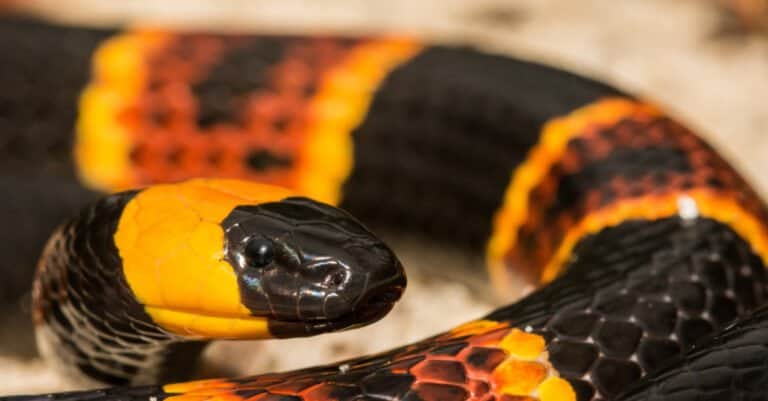
Although they are not harmful to humans, southeastern crowned snakes are nonetheless mildly venomous to their prey and possess a set of small rear fangs with which to inject it. Their diet mainly consists of small prey such as worms, spiders, and centipedes. They have numerous predators, although their main ones are coral snakes and kingsnakes.
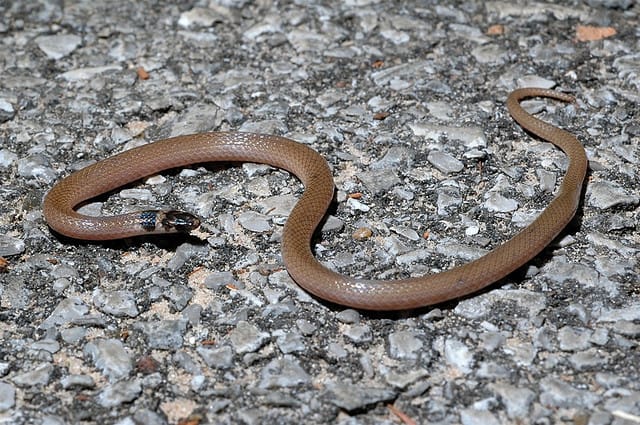
Southeastern crowned snakes are not aggressive toward humans.
8. Pine Snake
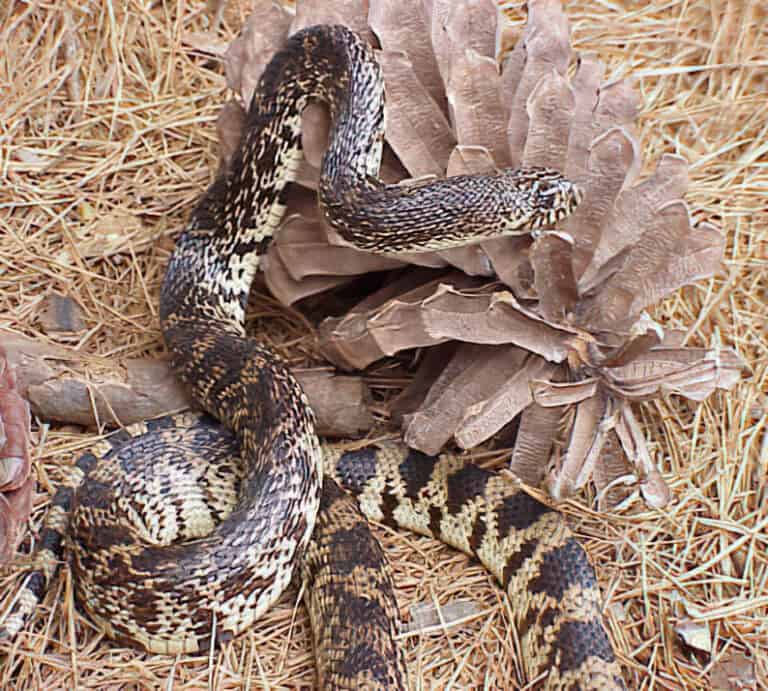
There are three recognized subspecies of pine snakes (Pituophis melanoleucus), all of which are endemic to the Southeast. Pine snakes are 48 to 90 inches long and have small heads with powerful bodies. They are usually brown or greyish-brown with brown or black blotches. Pine snakes live in a range of habitats. In North Carolina, pine snakes occur mostly in the Coastal Plain, Sandhills, and the lower Piedmont. Their preferred habitats are pine flatwoods and woodlands as well as prairies and fields with plenty of sandy soil for them to lay their eggs.
Pine snakes are not venomous, but they vibrate their tails as a warning before striking when they are threatened. Their diet mainly consists of rodents, and they often enter rodent burrows in search of food. The main predators of pine snakes are foxes and skunks.
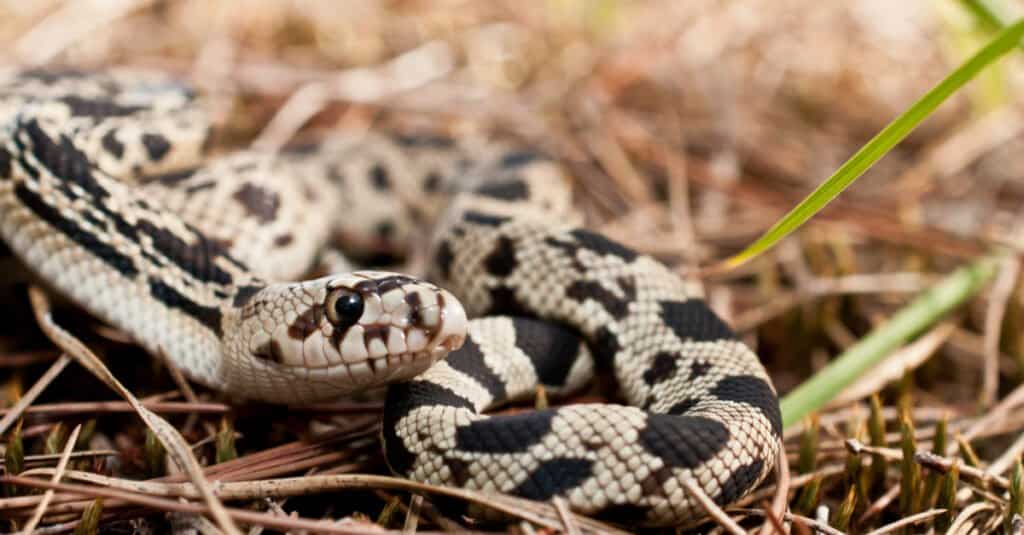
The spots on a pine snake are generally darker toward the head and lighter toward the tail.
©Jay Ondreicka/Shutterstock.com
9. Eastern Copperhead
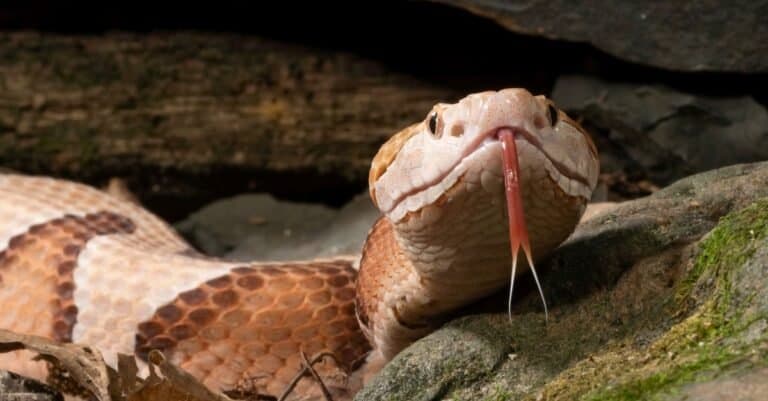
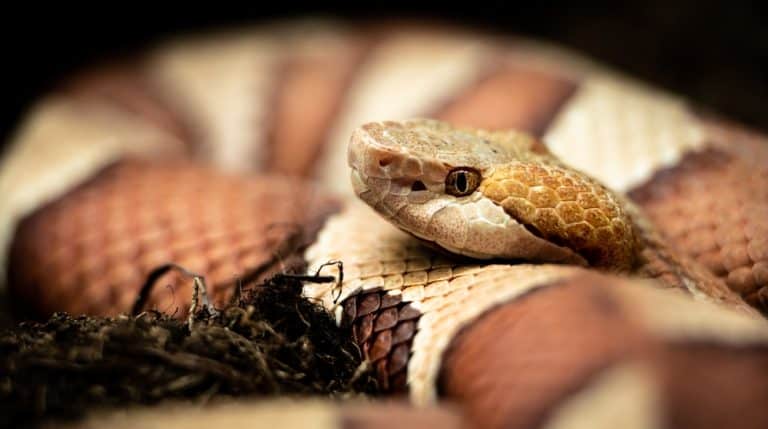
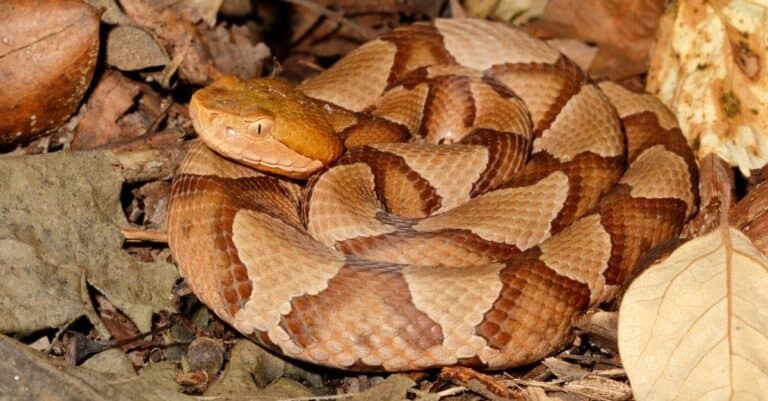
Another venomous brown snake in North Carolina is the eastern copperhead (Agkistrodon contortrix). Eastern copperheads are 2-3 feet long, but some may reach up to 4 feet. They are light brown to pinkish-tan with darker, hourglass-shaped crossbands. They have triangular-shaped copper-colored heads. Eastern copperheads live in deciduous forests, woodlands, and at swamp edges. Their pattern is excellent camouflage among the leaves and makes them incredibly difficult to spot. This is why most bites occur when the snake is accidentally stepped on. They usually freeze or flee when disturbed, and fortunately, their venom is not as potent as that of a rattlesnake or cottonmouth.
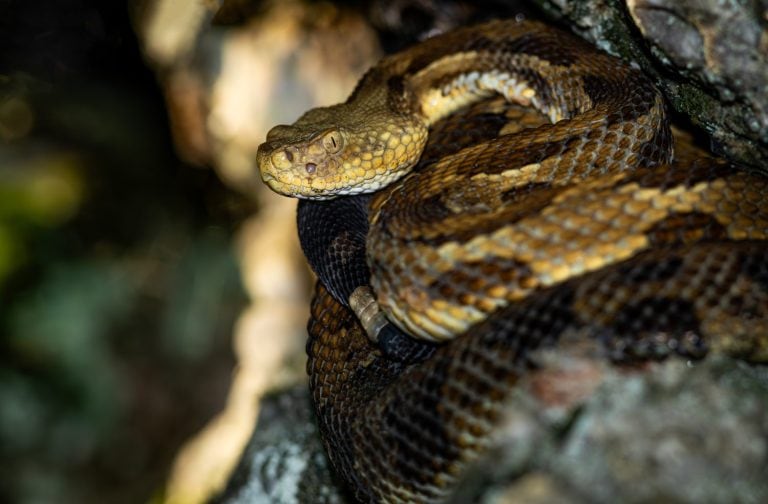
Eastern copperheads are nocturnal during the summer months but are active during the day in spring and fall. In the winter, they may hibernate in dens. Though copperheads are not social hibernators by choice, they do occasionally share a hibernacula with other species, such as timber rattlesnakes or rat snakes.
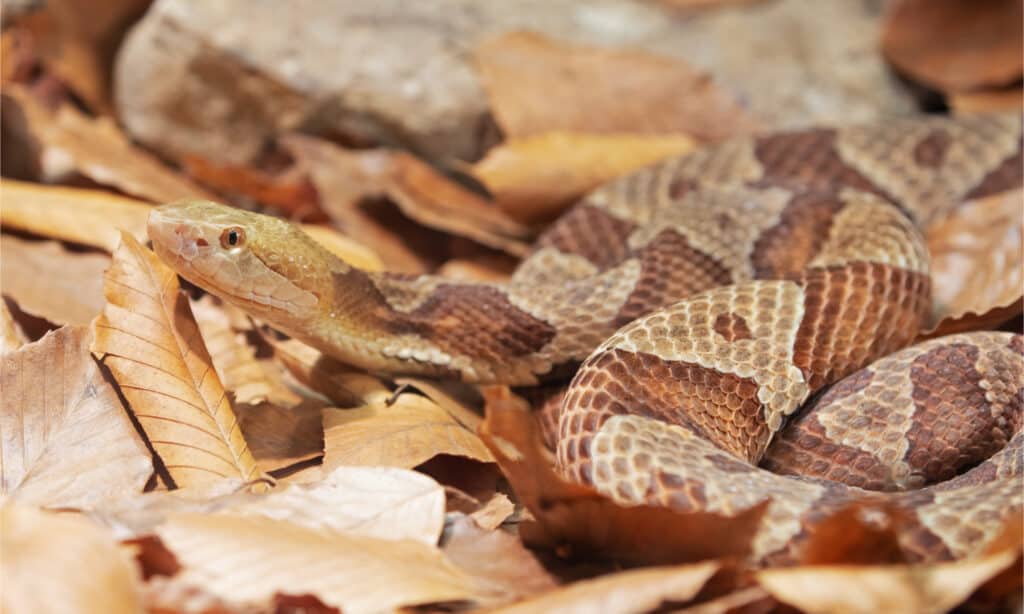
Most bites occur when the copperhead is accidentally stepped on because they hide in leaf litter.
©DnDavis/Shutterstock.com