
Quick Take
- Hunted to extinction in under three decades, this creature's downfall had a twist most don't expect. Its population may have already been on the brink before humans ever found it. See the population data →
- Its own body was its biggest survival handicap, and the bizarre physical quirk that made this massive animal completely unable to hide is well worth discovering. Discover the blubber problem →
- Scientists had to guess this animal's weight from two estimates so wildly different they could each describe an entirely different creature. Explore the size estimates →
- Long before it reached the freezing Bering Sea, this animal lived somewhere you'd never expect, and the Ice Age forced a transformation that changed everything about it. Trace its tropical origins →
Steller’s sea cow was a huge, aquatic animal that closely resembled a manatee or dugong. This fascinating creature was first documented in 1741 by the German naturalist Georg Wilhelm Steller. Its valuable meat, skin, and fat caused humans to hunt it into extinction by 1768.

Steller’s Sea Cow Facts
- Other than soft snorts, this animal was completely mute.
- The Steller’s sea cow was hunted into extinction within 27 years of its initial discovery.
- The dugong is the closest living relative of the Steller’s sea cow, and it is currently listed as a vulnerable species.
- This animal had such a thick layer of blubber that it could not fully submerge itself in the water.
Evolution
It is thought that before the Ice Age, ancient ancestors of the Steller’s Sea Cow lived in tropical mangrove forests much like modern-day manatees, and when the cold set in, these creatures were able to adapt perfectly to survive in the frosty environment. They achieved this by developing massive fat stores and an incredibly thick hide that provided buoyancy, warmth, and protection from predators. When the Ice Age ended and climates around the world became more temperate, the Steller’s Sea Cow is believed to have migrated northward to its known habitat of the Bering Sea between Alaska and Russia.
Other traits believed to have evolved around the time of the Sea Cow’s great migration were their loss of teeth in favor of keratin bristles and the loss of phalanges (finger bones) in their forelimbs. These traits, along with their downward-facing snout, likely evolved to aid in the consumption of kelp, which was made difficult by their inability to fully submerge themselves, owing to the natural buoyancy of their extensive blubber.
Classification and Scientific Name
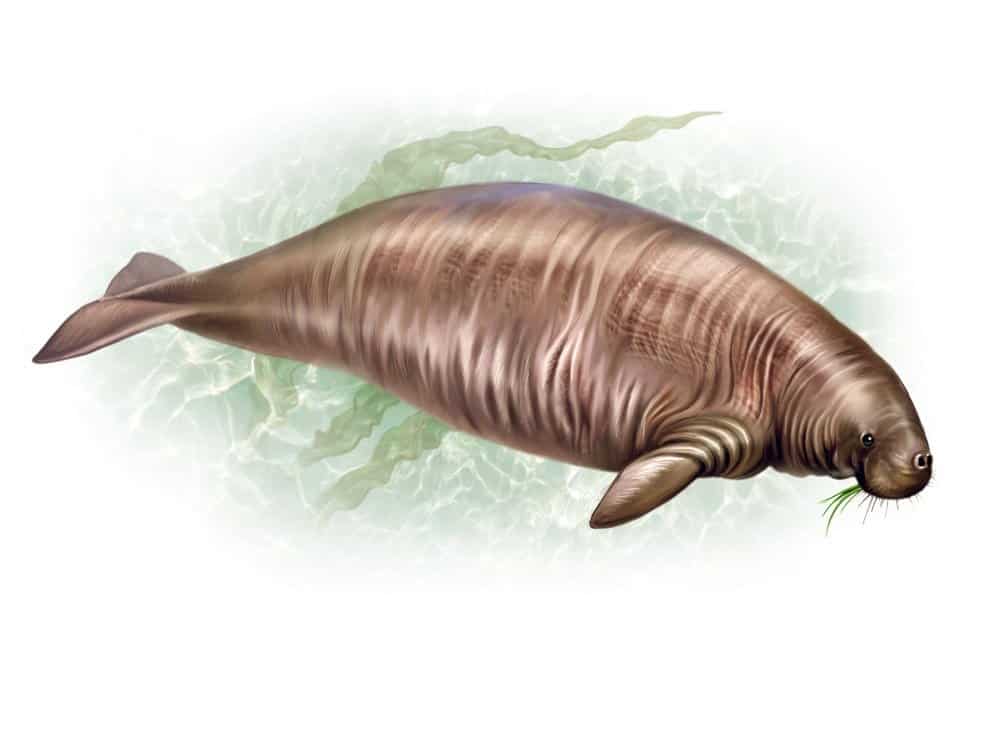
Steller’s Sea Cow’s scientific name roughly translates to “giant water cow.”
©Liliya Butenko/Shutterstock.com
The scientific name for Steller’s sea cow is Hydrodamalis gigas. It is part of the order Sirenia, which also includes several manatee species and the taxonomic family Dugongidae. The Dugongidae family used to be quite diverse, but its only surviving member now is the dugong.
The name “Hydrodamalis” is a combination of the Greek prefix “hydro-,” or “water,” and the Greek word “damalis,” which means “heifer” or “young bull.” Gigas is also an ancient Greek word that means “giant.” This means that the scientific name roughly translates to “giant water cow.”
The common name of this creature comes from the fact that these animals were first encountered and documented by the German naturalist Georg Wilhelm Steller.
Appearance
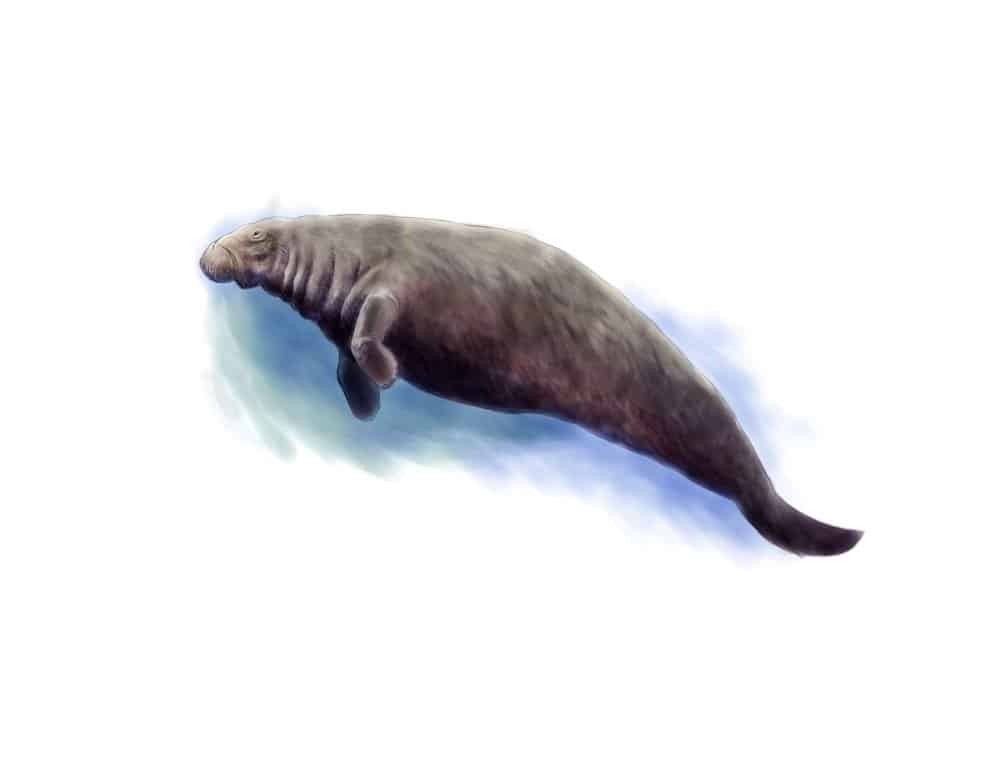
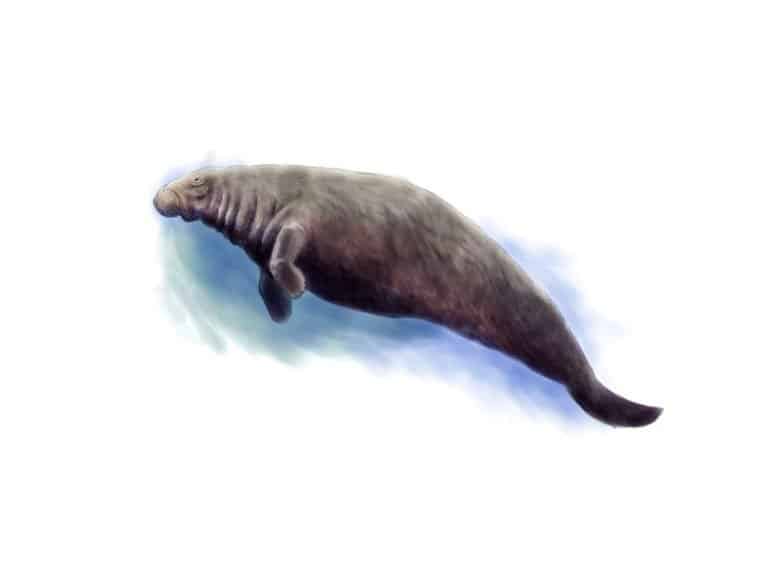
There are very few depictions of the Steller’s Sea Cow from when these creatures were alive.
©Nicolas Primola/Shutterstock.com
Like many other species that survived from the Pleistocene era, the Steller’s sea cow was a giant among its taxonomic family.
While there are no fully preserved specimens of these fantastic creatures, there are descriptions, illustrations, and skeletal remains that can be studied for information.
Fully grown, these creatures typically reached about 30 feet in length. For comparison, a fully grown adult manatee typically reaches only up to 10 feet in length.
Scientists do not know exactly how much an adult of this species weighed. Georg Steller recorded two very different weight estimates: the first was about 4 metric tons or 8,800 pounds (4.4 short tons), and the second was about 24.3 metric tons or 53,600 pounds (26.8 short tons). To help you visualize the difference, one adult hippopotamus weighs about 3,500 pounds, and four fully grown elephants together would weigh about 52,000 pounds. In reality, experts estimate that the actual size of the Steller’s sea cow fell somewhere in the middle of those estimates at about 10 metric tons or about 22,000 pounds. That is nearly equal to three adult hippopotamuses.
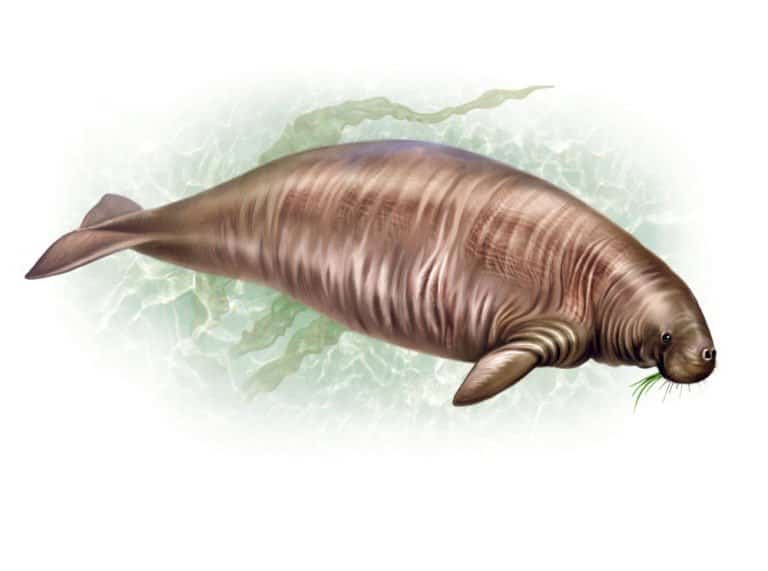
They had thick, dark skin that was brownish-black in color, rough to the touch, and deeply pockmarked. They had very little body hair, but the insides of their flippers were covered in a layer of tough bristles.
Like other animals in the order Sirenia, these creatures had small, squat heads with broad upper lips, small eyes, and downward-pointing snouts. They also had stumpy front flippers and forked tail flukes like the dugong.
One interesting feature of this animal is that it did not have teeth like the manatee species that exist today. Instead, they had a layer of stiff, dense white bristles on their upper lips and two tough, scaly plates inside their mouths to help with tearing and chewing plant matter.
Behavior
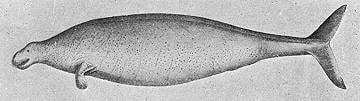
Steller’s Sea Cows were described as extremely social creatures loyal to their families.
©J.F. Brandt – Public Domain
Nearly everything that scientists know about these creatures comes from the observations of Georg Steller.
He noted that they were extremely social creatures that lived in small family pods. They were observed helping injured family members, and they also exhibited protective behaviors like placing the young in the safest position among other herd members. Dolphins and elephants also show these types of behaviors.
They were also monogamous, and mating typically happened in early spring. Based on his observations, Steller estimated that female sea cows only birthed one calf at a time, and he believed that gestation took just over a year. In keeping with their social, family-oriented nature, Steller observed parental care for new calves, with the entire herd working together to protect offspring.
Habitat
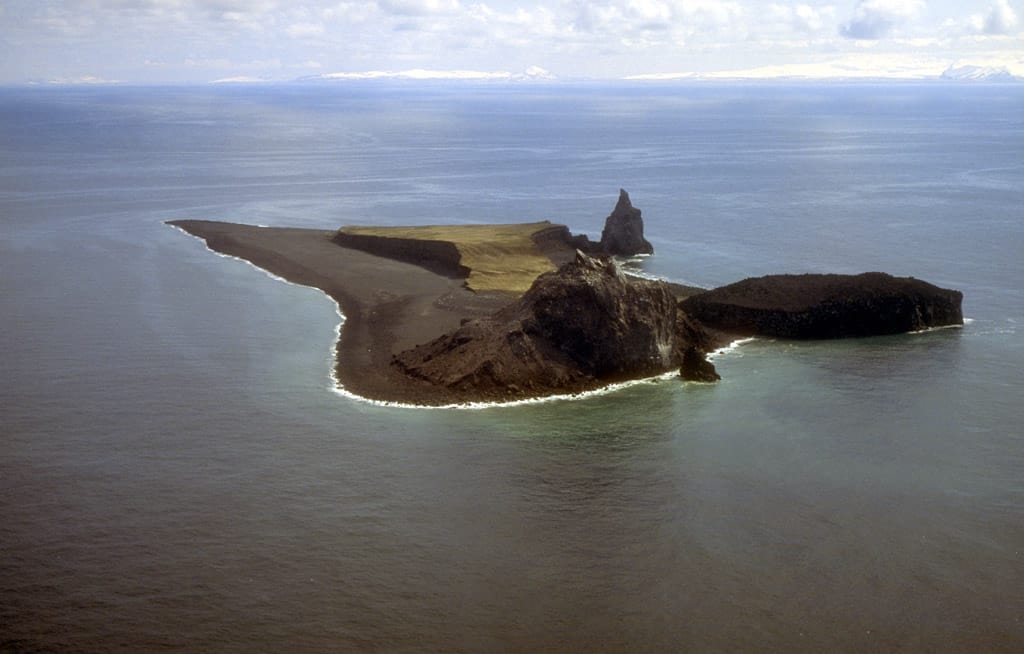
The Bering Sea is the only known location of the Steller’s Sea Cow.
©T. Keith, U.S. Geological Survey / This image is in the public domain in the United States because it only contains materials that originally came from the United States Geological Survey, an agency of the United States Department of the Interior. For more information, see the official USGS copyright policy. – Original
This animal was first discovered in 1741 in a small portion of the Bering Sea, which is frigid nearly year-round. During the Pleistocene era, they would have likely been found much further out into the Arctic and Pacific waters.
Their icy living conditions caused them to have a much thicker layer of fat than most manatee species today, as well as a thicker outer layer of skin. The average Steller’s sea cow had a tough hide about an inch thick and a blubber layer up to 4 inches (10 cm) thick.
Such a thick layer of fat made them very buoyant, so they had to live on the surface of the Bering Sea and could not totally submerge themselves.
Diet
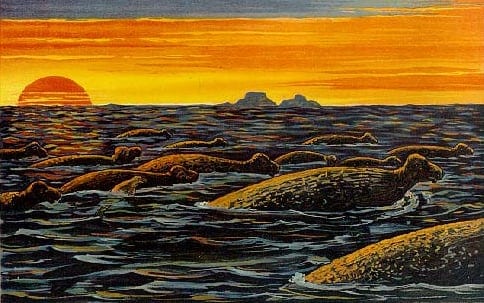
Steller’s Sea Cow primarily ate kelp.
©F. John – Public Domain
Like all other related species, these creatures were herbivores. They survived on a diet of kelp and typically spent the majority of their days grazing. They needed to lift their heads out of the water only every few minutes to breathe before returning to grazing on various species of kelp that grew near the surface of the water.
Predators and Threats
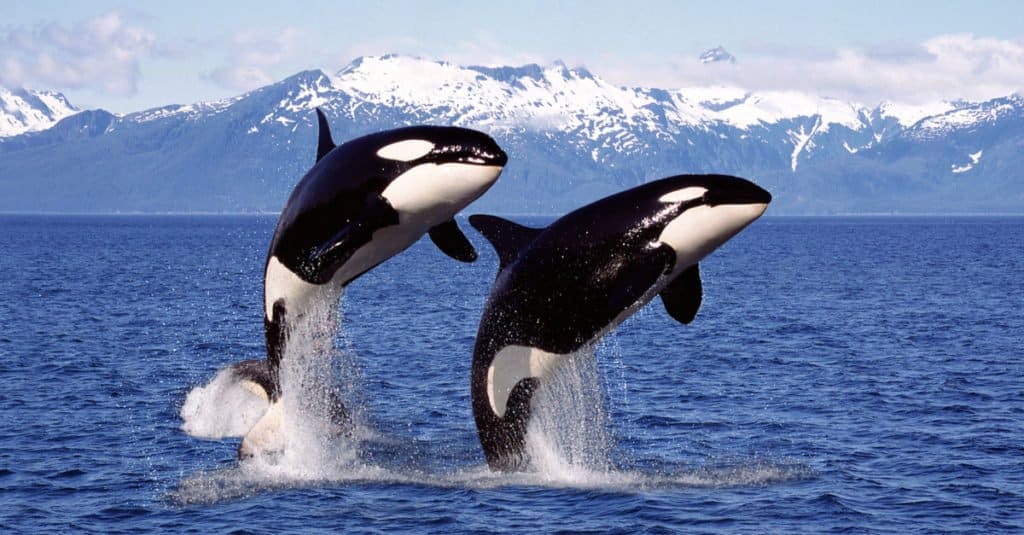
It is theorized that orcas may have hunted Steller’s Sea Cow, but humans were their biggest threat by far.
©slowmotiongli/Shutterstock.com
While Steller noted that adult sea cows guarded their young against harm, he did not say whether or not they had any natural predators. Experts think it could be possible that killer whales or sharks may have tried to prey on the sea cows, but it would have been difficult for either creature to successfully kill one.
Sadly, the threat that caused them to go extinct came from humans. They were quickly recognized as extremely valuable commodities and were heavily hunted for their meat, hides, and blubber.
Some experts believe that the population was already dangerously low when they were initially discovered, so they were hunted into extinction incredibly quickly.
The last sighting of a Steller’s sea cow in the wild came from a group of fur hunters in 1768, just 27 years after they were first discovered.
Reproduction, Babies, and Lifespan
Georg Steller observed that female sea cows only had one set of mammary glands, so he concluded that they only gave birth to one calf per pregnancy. He noted that mating and copulation took place in early spring, underwater. He observed that male sea cows used their front flippers to hold onto the females during copulation.
Though none exist today, researchers think that the average lifespan of a Steller’s sea cow was 50 to 80 years. The Florida manatee can live more than 60 years, so this would be a reasonable estimate.
Population
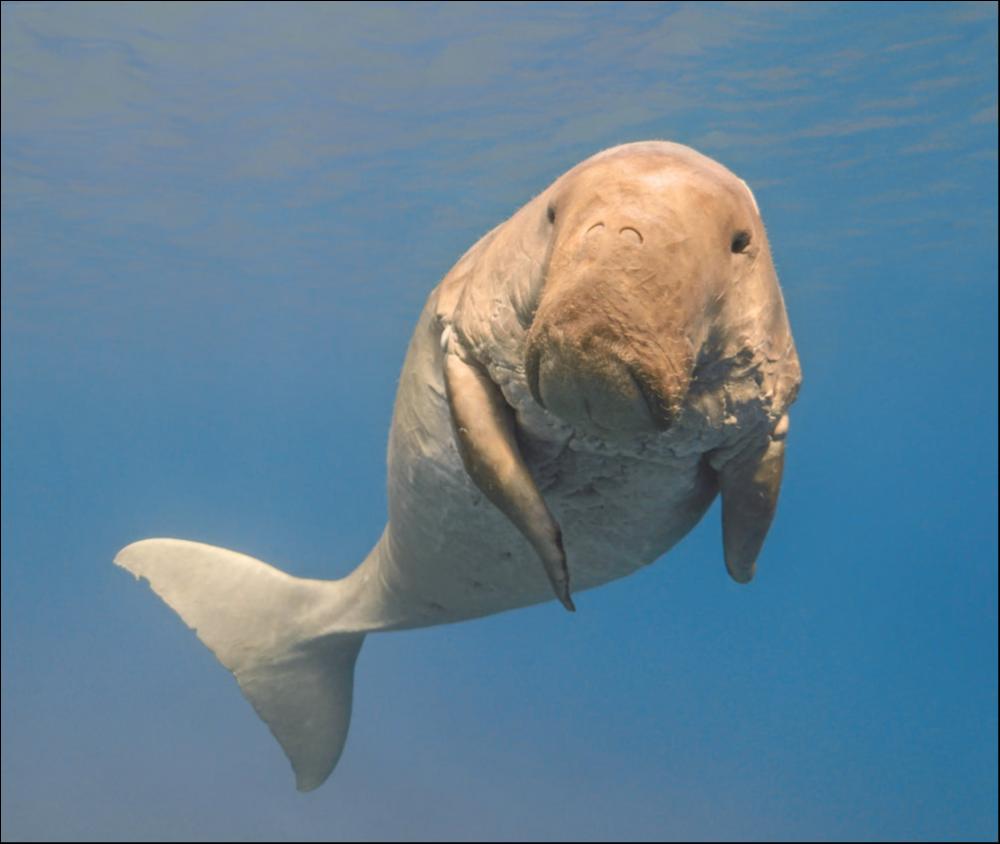
The dugong is the closest living relative of Steller’s Sea Cow.
©vkilikov/Shutterstock.com
The Steller’s sea cow has been extinct since 1768 because of uncontrolled human hunting. At the time of its initial discovery in 1741, experts believe that there were only about 1,500 sea cows left in the Bering Sea.
Steller’s Sea Cow Pictures
View all of our Steller’s Sea Cow pictures in the gallery.

Nicolas Primola/Shutterstock.com
Sources
- Wikipedia / Accessed November 8, 2019
- Brittanica / Accessed November 8, 2019
- Bluebulb Projects / Accessed November 8, 2019
- The Atlantic / Accessed November 8, 2019
- EverythingWhat / Accessed November 8, 2019
- Merriam-Webster / Accessed November 8, 2019