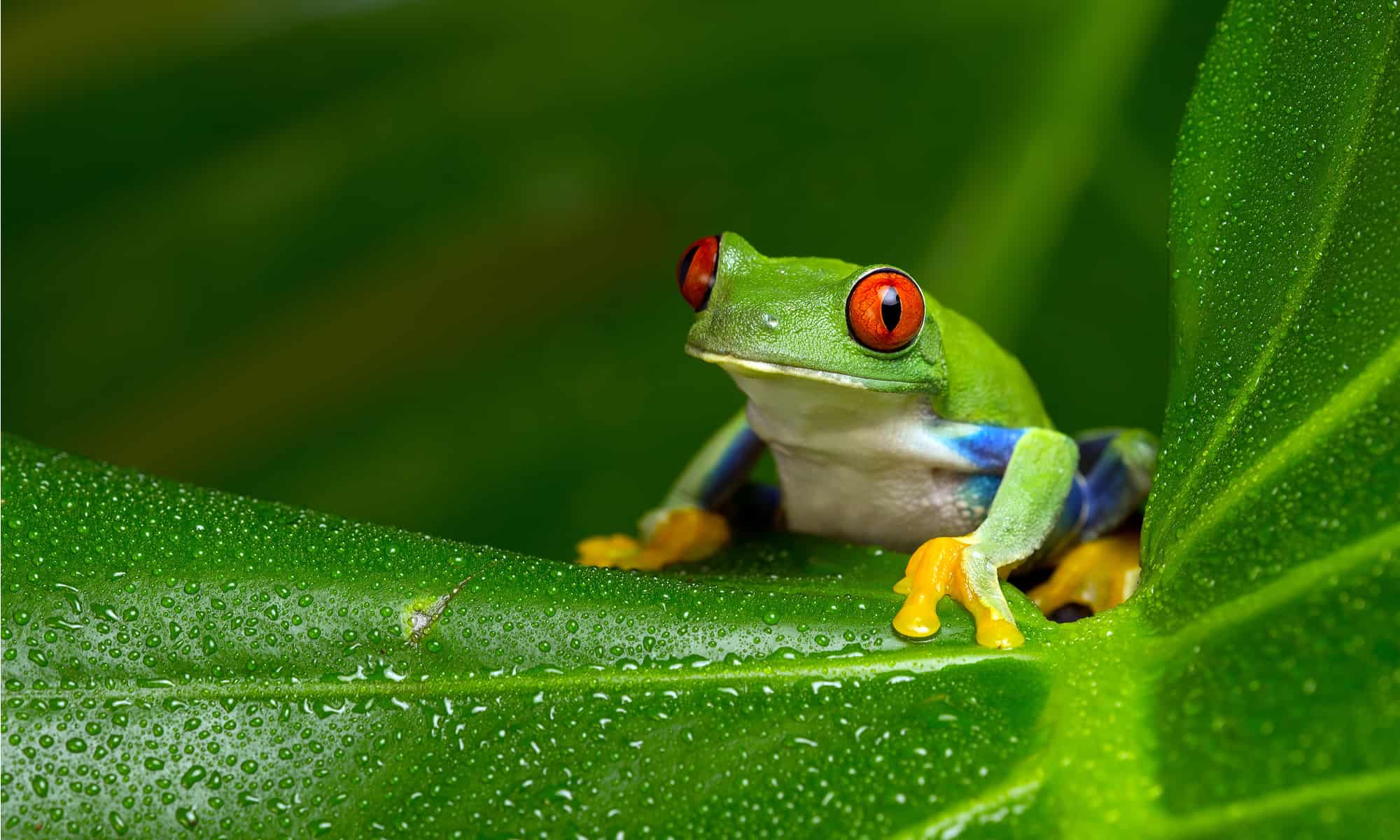

Rainforests are among the world’s oldest living ecosystems. Some of them are tens of millions of years old. There is plenty of rainfall to support the tall and mostly evergreen trees, and, in turn, these provide a home to a rich and diverse range of creatures. Over half of all the plant and animal species on the Earth call the rainforest home, and here you will spot some of the most vibrantly colorful animals you will ever see. The combination of a stable, warm, and wet climate and the layered structure provides an ideal habitat for life to thrive. What’s more, nutrients are rapidly recycled, and large areas remain untouched by human development. Let’s meet some of the most spectacular rainforest animals and discover why they have evolved to have such bright coloration.
Why Are Rainforest Animals So Colorful?
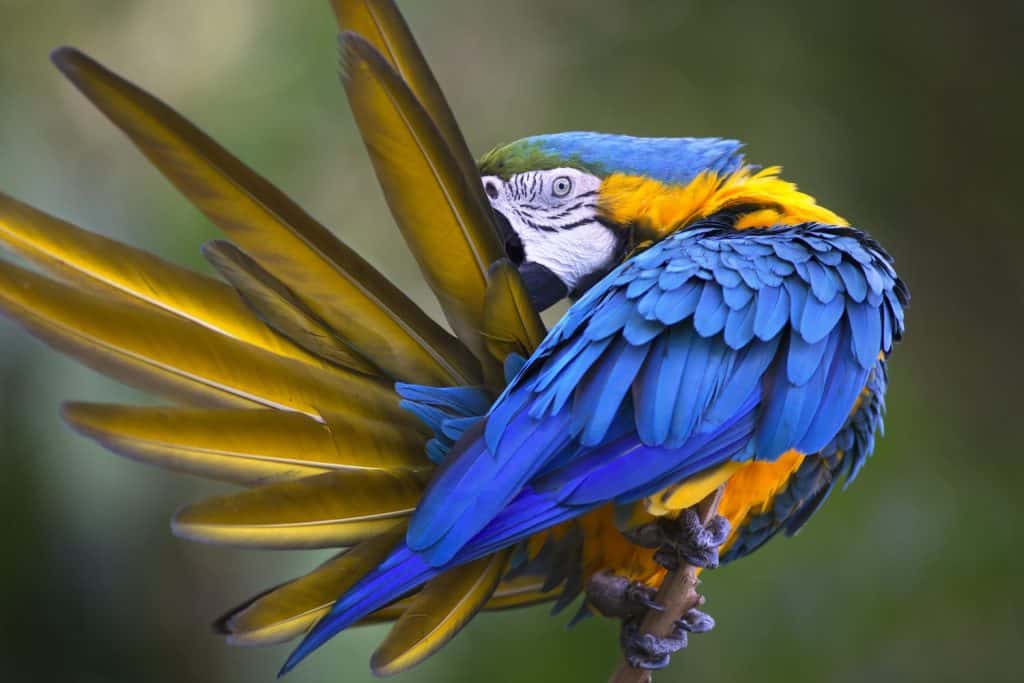
Colors can be important for breeding rituals.
©Papa Bravo/Shutterstock.com
Researchers at the University of Arizona investigated why some land vertebrates had such bright colors. They found a link between the activity pattern of an animal’s ancestors and their coloration. Typically, vividly colored lizards and birds use their appearance as a sexual signal to attract a mate. Colored amphibians, however, use it as a warning to predators that they should stay away because they are poisonous. When this was linked to the activity of the animal’s ancestors, some interesting patterns were revealed. Sexual coloration is seen in animals whose ancestors were active during the day. Warning coloration, on the other hand, is seen in animals whose ancestors were active at night. These animals would have been resting during the day and needed a strategy that would make predators stay away from them. There is no point in being poisonous if your attacker does not realize that until after they have eaten you! Advertising your poisonous, or at least unpalatable, status is vital!
But why is there such a concentration of vibrancy in rainforests? The bird population may give us a clue. Scientists have discovered that, on the whole, birds living in the tropics are more brightly colored than their northern and southern counterparts. This may be because the low light conditions mean that you need to be highly colored to get noticed. It may also be because of the structural complexity of the environments or other factors that have not been discovered.
Evolution of Color
Most colorful rainforest animal species originally had drab and very ordinary coloration. Over time, those who were born with bright colors (as a result of a genetic mutation) had an advantage over their relatives. Either they were better at attracting a mate (because they looked so amazing) or because they were less likely to get eaten by a predator. The bright colors became established and passed down through generations. Warning coloration is even found in species with no eyes! Their color keeps them safe even though they cannot see it themselves.
Nature’s Mimics and Camouflage
There are other reasons why some animals are so colorful. Nature is very good at taking a genius idea and copying it! There are no patents in the natural world. So, some non-poisonous animals adopt the same coloration as a poisonous species. If a predator were to eat them, they would not be harmed. But the predator does not know that! This is called Batesian mimicry.
Blending in (camouflage) is another defense mechanism. If an animal lives in a colorful environment, they can hide away by adopting the same colors as that environment. It makes them far less likely to be spotted by a predator or by prey that they are trying to sneak up on.
Vibrant Invertebrates
Of course, the rainforests are not just home to vertebrates. A staggering variety of invertebrates also make the rainforest their home. Similar to vertebrates, they also use color to either attract a mate or to warn off enemies. Others use it to blend in so that they can either hide from their predators or ambush their prey. Let’s look at some examples of brightly colored rainforest animals and the reasons for their vibrant coloration.
Red-Eyed Tree Frog
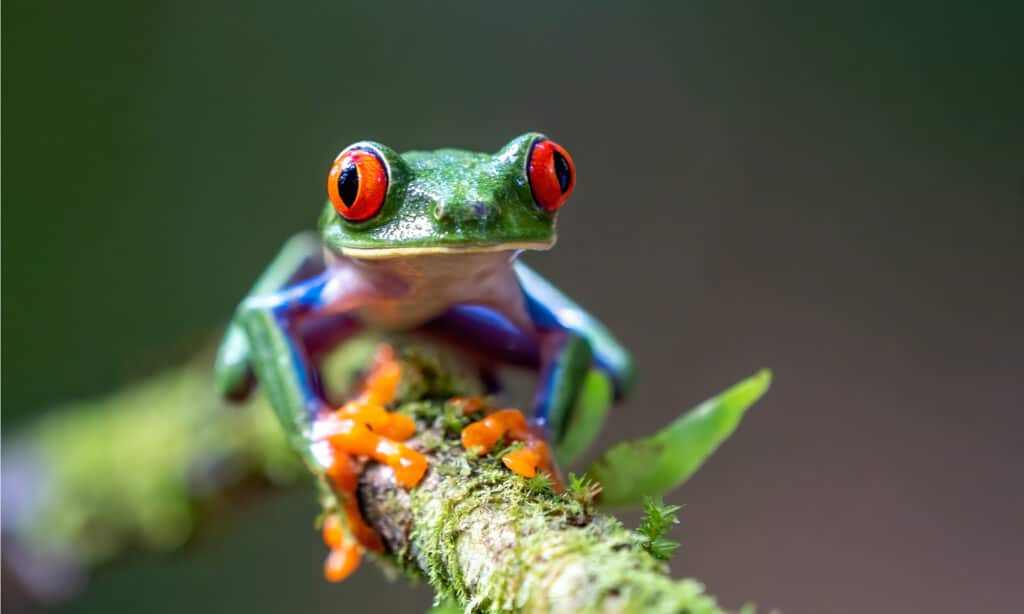
Red-eyed tree frogs overstimulate attackers with color.
©Vaclav Sebek/Shutterstock.com
The red-eyed tree frog (Agalychnis callidryas) is an iconic species found in the Neotropical rainforests of Central America, although some are also seen in South America. Their habitats are tropical lowland and montane forests near rivers and ponds.
This species is nocturnal and hunts at night. During the day, they sleep on the underside of leaves. These frogs are not poisonous. They use their bright coloration to overstimulate their attacker’s eyes. This particular coloration technique is called deimatic behavior.
Poison Dart Frog
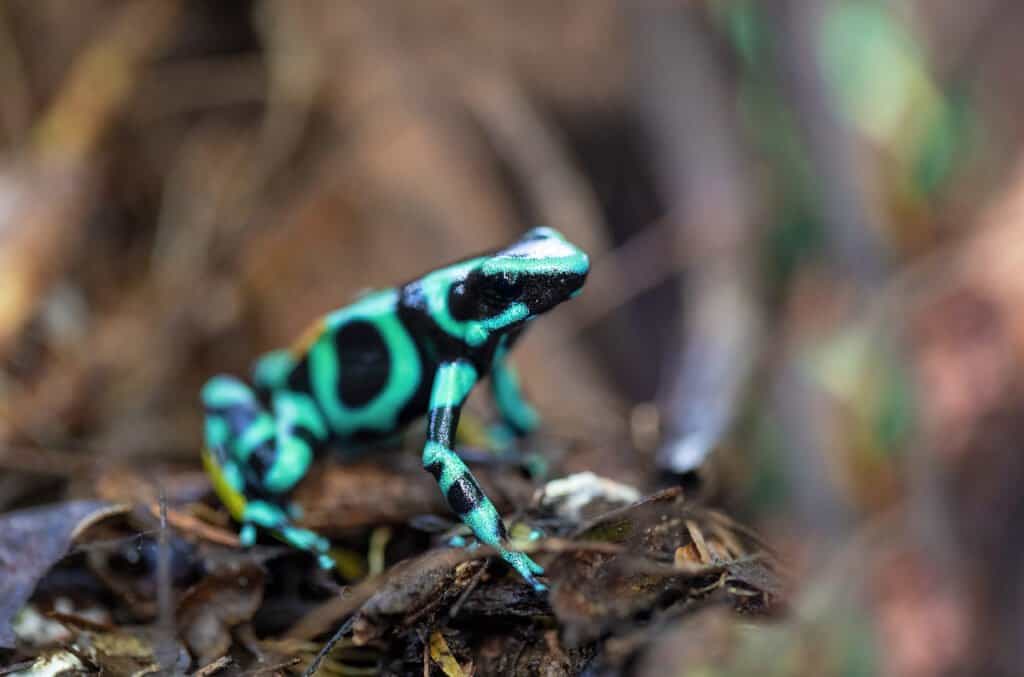
Poison dart frogs warn of their toxicity.
©iStock.com/Artush
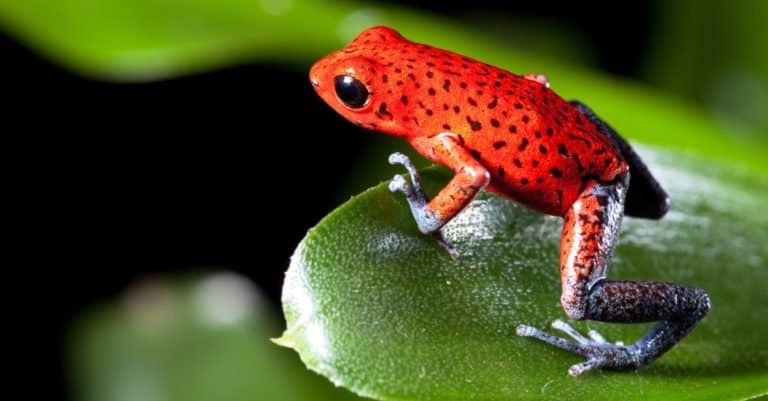
There is no single color scheme when it comes to poison dart frogs. They live in the rainforests of Central and South America and, unusually for amphibians, they are diurnal (active in the day). Among the many species, you will see vibrant blues, yellows, greens, and reds.
These bright warning colors are justified. The poison dart frogs secrete several different toxins through their skin. They can do this by consuming toxic arthropods and reusing their toxins! The toxin is so off-putting that the frogs can actively hunt alongside their predators during the day. The most well-documented predator with resistance to poison dart frog toxins is the snake Erythrolamprus epinephalus (formerly known as Leimadophis epinephelus), though some evidence suggests other snakes may also have partial resistance.
Emerald Tree Boa
Emerald tree boas are long snakes (up to 6 feet in length) that live in the rainforests of South America. As their name suggests, they are a bright green color, which allows them to blend in perfectly with the vivid green foliage of their habitats. These snakes feed on small mammals, and they need to sneak up on them or lie in wait for their victims to approach. Blending in with the environment is vital for this type of hunting.
Blue and Yellow Macaws
These macaws (Ara ararauna) are found in tropical and subtropical rainforests in South America. They prefer swampy and riparian areas. Macaws are large birds that can reach 3 feet in length and have a vibrant plumage. Specifically, they have bright blue plumage on their backs and wings with yellow bellies. Other parts of their bodies are yellow-orange and green.
Most blue and yellow macaws are socially monogamous and pair for life. Prior to pairing, the female will be looking for a vigorous male to father her offspring. Having bright and vibrant plumage is one way in which the male impresses the female during courtship rituals.
Blue Morpho Butterflies
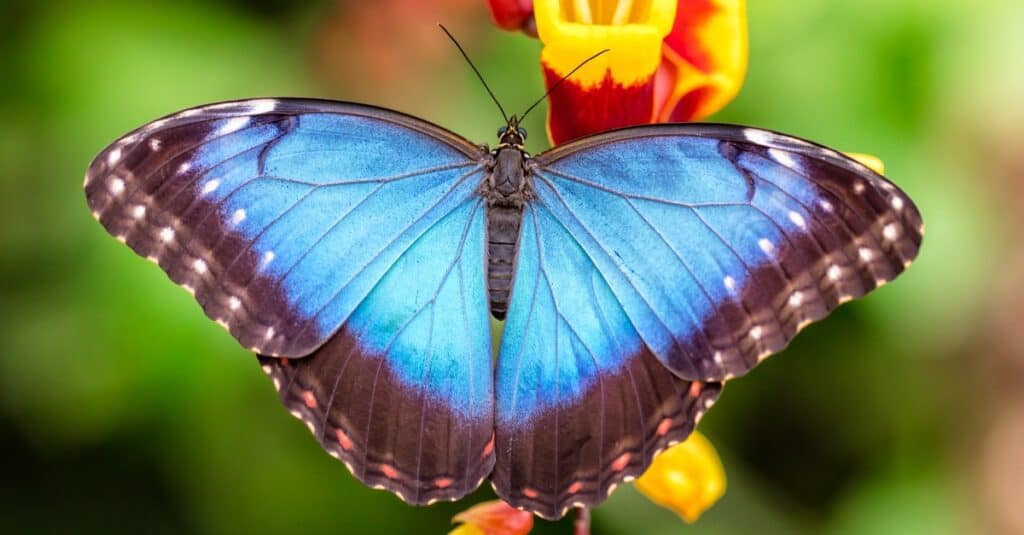
When the Blue Morpho butterfly sleeps, it folds its wings to reveal a pattern that helps to ward off predators.
©Jag_cz/Shutterstock.com
Thanks to the way these butterflies create color, they use the power of light to virtually disappear and conceal themselves from predators. They are a native species of the rainforests of Mexico, South America, and Central America. An example species is Morpho peleides, which is a bright blue color. However, the vibrant appearance is not provided by a pigment. Instead, their scales are made up of several layers that repeatedly reflect the light waves, creating an intense color. This is known as structural color and makes the morpho butterflies very hard for the predators to spot.
King Vulture
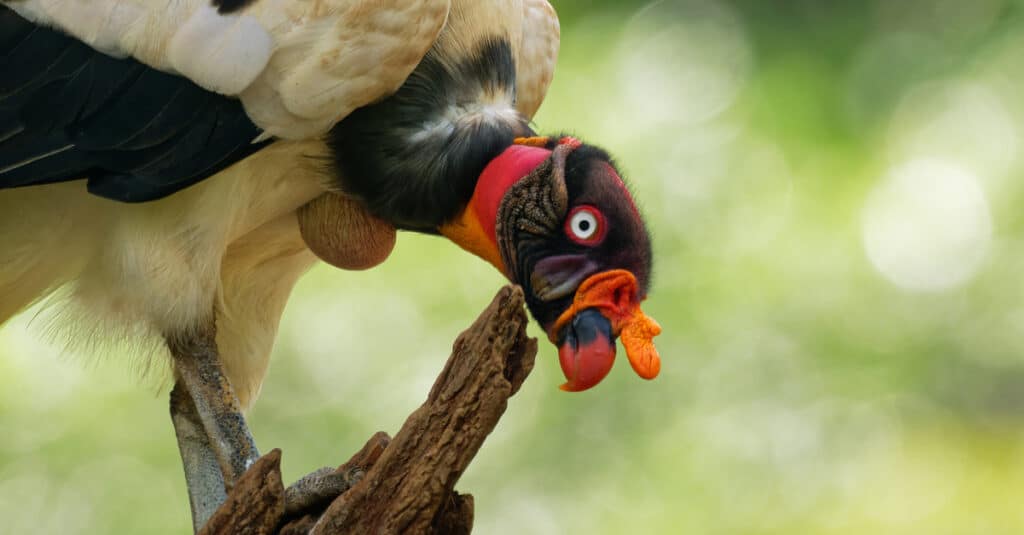
King vultures have bright faces.
©Martin Pelanek/Shutterstock.com
Vultures are not known for being very vibrantly colored birds, but the king vulture is an exception! King vultures live in Central and South America, where they are found in tropical lowland forests. These are large birds that can grow to 32 inches long.
Their plumage may be monochromatic gray and black, but their faces are bright red, yellow, and blue. Interestingly, both males and females have this color patterning, which is unusual in the avian world. The bright colors may have evolved because they are used to communicate health and breeding status to prospective mates. Alternatively, the color may be associated with social status. Younger birds are at the bottom of the social hierarchy, and they have the plainest and darkest heads. Older, dominant birds have brighter colors and more developed wattles and carbuncles. It takes a king vulture around five years to attain its full, vibrant plumage.