





L
Species Profile

Leatherback Sea Turtle

Dermochelys coriacea

Leathery shell, ocean-spanning traveler
iStock.com/caronB

Leatherback Sea Turtle Ocean Range

Marine Species

Leatherback Sea Turtle (Dermochelys coriacea) is a highly migratory, open-ocean turtle found from tropical to subpolar waters in all major oceans. Adults travel long distances (often thousands, sometimes >10,000 km) to feed on jellyfish in temperate and cold seas and return to tropical/subtropical sandy beaches to nest. They dive deep (to ~1,280 m) and live many decades.

Loading ocean map...

Ocean Regions 16

atlantic_ocean north_atlantic south_atlantic caribbean_sea gulf_of_mexico pacific_ocean north_pacific south_pacific indian_ocean coral_sea south_china_sea sea_of_japan tasman_sea bering_sea mediterranean_sea north_sea

At a Glance

Ocean Species
Also Known As Leatherback, Leathery turtle, Tortuga laúd, Tortue luth
Diet Carnivore
Activity Cathemeral+
Lifespan 45 years
Weight 900 lbs
Status Vulnerable
Did You Know?

Adults commonly measure ~1.3-1.7 m curved carapace length (CCL); the largest verified individuals approach ~2 m total length and ~900 kg.

Scientific Classification

The leatherback sea turtle is the largest living turtle and the only extant member of the family Dermochelyidae, distinguished by a flexible, leathery carapace rather than a hard bony shell. It is a highly migratory pelagic species found across tropical to subpolar oceans, specializing on gelatinous zooplankton (especially jellyfish).

Kingdom
Animalia
Phylum
Chordata
Class
Reptilia
Order
Testudines
Family
Dermochelyidae
Genus
Dermochelys
Species
coriacea

Distinguishing Features

  • Large size (often >1.5 m curved carapace length; can exceed 500 kg)
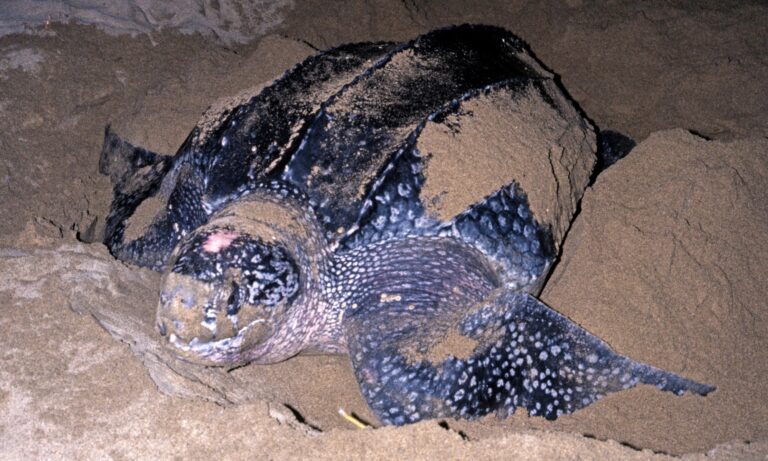
  • Leathery, ridged carapace with longitudinal keels; lacks hard scutes typical of other sea turtles
  • Dark bluish-black with pale spotting
  • Long foreflippers adapted for long-distance oceanic migration
  • Diet strongly focused on jellyfish and other soft-bodied gelatinous prey

Did You Know?

Adults commonly measure ~1.3-1.7 m curved carapace length (CCL); the largest verified individuals approach ~2 m total length and ~900 kg.

Unlike other sea turtles, it has no hard scutes-its carapace is leathery skin over a mosaic of tiny bones, with 7 longitudinal ridges.

It holds the deepest confirmed dive for any turtle: ~1,280 m, and can remain submerged for over an hour (reported up to ~85 min).

Leatherbacks can forage in cold, subpolar waters by generating and retaining body heat (regional endothermy) while swimming continuously.

A single nest often contains ~60-110 yolked eggs plus additional smaller "yolkless" eggs (commonly ~20-40), which may help with gas exchange and nest structure.

They are among the most migratory reptiles: satellite-tracked individuals regularly travel thousands of kilometers, with basin-scale movements >10,000 km documented.

Their throat has backward-pointing keratin spines (esophageal papillae) that help grip slippery jellyfish and keep prey from escaping.

Unique Adaptations

  • Leathery carapace (no scutes): flexible shell reduces weight and may improve hydrodynamics for long-distance swimming and deep diving.
  • Gigantothermy + counter-current heat exchange: large body size and physiological heat retention help maintain higher core temperatures than surrounding water in cool seas.
  • Extreme oxygen management: high blood volume and elevated myoglobin stores support long dives; can tolerate low oxygen during extended submergence.
  • Esophageal papillae: dense, rear-facing spines line the throat/esophagus-an adaptation for gripping gelatinous prey and expelling seawater.
  • High-latitude foraging ability: can exploit prey-rich, cold waters where other sea turtles rarely feed.
  • Streamlined, powerful front flippers: adapted for efficient cruising in open ocean; adults are built for sustained travel rather than maneuvering on reefs.
  • Pressure tolerance at depth: flexible shell and body design reduce issues associated with compressive forces during very deep dives.

Interesting Behaviors

  • Pelagic lifestyle: adults spend most of their time in open ocean, coming to land mainly for nesting.
  • Long-distance navigation: undertake transoceanic migrations between temperate feeding grounds and tropical nesting beaches; movements are strongly shaped by ocean currents and jellyfish blooms.
  • Deep-diving foraging: performs repeated dives with extended surface intervals; dive depth and duration shift with prey layers and water temperature.
  • Jellyfish specialization: targets gelatinous zooplankton (especially scyphozoan jellyfish); feeding often peaks where fronts and upwellings concentrate prey.
  • Mass nesting in some regions: females typically nest multiple times per season, returning to the same broad region/beach area (natal homing tendency).
  • Nest-site selection: chooses upper beach zones above typical high tide but still vulnerable to storms and erosion; females camouflage nests with vigorous sand throwing.
  • Hatchling "swim frenzy": after emerging, hatchlings rapidly swim offshore for many hours to reach safer pelagic habitat.

Cultural Significance

Leatherback sea turtle (Dermochelys coriacea) is a symbol of strength and safe travel. On nesting beaches (Trinidad, Gabon, French Guiana, Costa Rica) it supports ecotourism and local beach protection. Its scientific name means leathery in Latin; some call it lute-like for its ridged, long back.

Myths & Legends

Coastal folktales from the Caribbean and West Africa often tell of an ancient, ocean-traveling turtle whose persistence and tough 'armor' outlast stronger animals. Tales call 'the turtle,' matching the leatherback (Dermochelys coriacea).

In parts of Island Southeast Asia and the Pacific, old stories call turtles messengers between sea and shore or guides that bring fishers home, tied to turtles' repeated returns to nesting beaches and ocean journeys.

The leatherback is often called the "lute turtle" because its long, ridged carapace resembles a lute; in several European languages the common name is a translation of "lute turtle."

The leatherback sea turtle (Dermochelys coriacea) entered European natural history early and was formally described in the 18th century (Vandelli, 1761). Its leathery shell surprised people expecting hard, scuted shells.

Conservation Status

VU Vulnerable

Facing a high risk of extinction in the wild.

Population Decreasing

Protected Under

  • CITES Appendix I (international trade prohibited except under exceptional circumstances)
  • Convention on Migratory Species (CMS) Appendices I & II
  • Inter-American Convention for the Protection and Conservation of Sea Turtles (IAC)
  • U.S. Endangered Species Act (listed as Endangered)
  • Canada Species at Risk Act (SARA) (listed as Endangered)
  • EU Habitats Directive (Annexes II and IV in EU waters; implemented through member-state legislation)

Life Cycle

Birth 110 hatchlings
Lifespan 45 years

Lifespan

In the Wild
30–50 years
In Captivity
7–180 years

Reproduction

Mating System Promiscuity
Social Structure Transient
Breeding Pattern Transient
Fertilization Internal Fertilization
Birth Type Internal_fertilization

Adults are solitary except for brief offshore courtship and copulation near nesting areas; both sexes mate with multiple partners, and genetic studies document multiple paternity in some clutches. Internal fertilization occurs, no pair bond forms, and there is no parental care.

Behavior & Ecology

Social Congregation Group: 1
Activity Cathemeral, Nocturnal
Diet Carnivore Gelatinous zooplankton-especially large scyphozoan jellyfish (commonly reported as dominant prey in gut-content studies).
Seasonal Migratory 8,078 mi

Temperament

Generally non-aggressive and avoidance-oriented; will flee or dive when approached.
Breeding-season interactions are brief and functional (courtship/mating), not social bonding.
At nesting beaches females can tolerate nearby conspecifics but show minimal affiliation.

Communication

No confirmed species-specific vocalizations reported in peer-reviewed literature.
Tactile cues during courtship/copulation Body contact, mounting, positioning
Visual cues at close range in surface waters Mate assessment, spacing
Likely chemical cue use is limited; olfaction is documented for prey-related cues in sea turtles generally, but leatherback-specific evidence remains sparse.
Hatchlings use group emergence timing and rapid seaward movement that reduces predation risk, but this is not coordinated communication.

Habitat

Open Ocean Deep Sea Seabed/Benthic Coastal Beach Estuary Rocky Shore +1
Biomes:
Terrain:
Coastal Island Sandy
Elevation: -50394 in – 16 ft 5 in

Ecological Role

Upper-level predator of gelatinous zooplankton in pelagic ecosystems (gelativore), exerting top-down pressure on jellyfish and other gelatinous plankton communities across ocean basins.

Potential suppression/mitigation of jellyfish blooms via sustained predation on medusae and other gelatinous zooplankton Trophic coupling between oceanic frontal zones and broader pelagic food webs (moving energy from gelatinous plankton into higher trophic levels) Nutrient redistribution through excretion/egestion during long-distance migrations (biological transport of nitrogen/phosphorus across regions) Indirect support of fisheries and plankton community balance by reducing gelatinous competitors/predators of fish eggs and larvae in some systems

Diet Details

Main Prey:
Scyphozoan jellyfish Hydrozoans Ctenophores Salps Pyrosomes Gelatinous zooplankton

Human Interaction

Domestication Status

Wild

Leatherback sea turtles (Dermochelys coriacea) are not domesticated and have no history of domestication or selective breeding for human use. They are a fully wild, highly migratory pelagic species. Human interaction has primarily been through exploitation (historical harvest of adults/eggs), incidental capture in fisheries, and modern conservation and research. International trade is heavily restricted (CITES Appendix I).

Danger Level

Low
  • Generally non-aggressive; may bite if handled/entangled (injury risk is typically minor but possible due to strong jaws).
  • In-water interactions can pose incidental risk to divers/boaters via accidental collision because adults are very large (adults commonly ~1.3-1.7 m curved carapace length; masses commonly ~250-700 kg; maximum reported near ~900+ kg in records), but attacks are not typical.
  • Handling/rehabilitation risks: stress to animal, flipper strikes, and standard wildlife-associated zoonotic hygiene concerns (managed with PPE and protocols).

As a Pet

Not Suitable as Pet

Legality: Leatherback Sea Turtle (Dermochelys coriacea) is not legal as a pet in most places. Listed on CITES Appendix I (and U.S. ESA), kept only with government permits for rehabilitation, research, or public display.

Care Level: Expert Only

Purchase Cost:
Lifetime Cost:

Economic Value

Uses:
Ecotourism (nesting beach tourism; wildlife viewing) Ecosystem services (jellyfish predation influencing pelagic food webs) Scientific research value (migration, diving physiology, climate impacts) Conservation employment and community-based nesting beach protection
Products:
  • No legal commercial products in most contexts due to protections; historically (now widely illegal) eggs and meat for food, oil/fat, and leather/skin-derived items were exploited in some regions.

Relationships

Related Species 6

None Shared Family
Green sea turtle Chelonia mydas Shared Order
Loggerhead sea turtle Caretta caretta Shared Order
Hawksbill sea turtle Eretmochelys imbricata Shared Order
Kemp's ridley sea turtle Lepidochelys kempii Shared Order
Olive ridley sea turtle Lepidochelys olivacea Shared Order

The giant leatherback sea turtle is the largest species of living turtle and one of seven species of sea turtles. Leatherback sea turtles do not have a hard shell and have been in their present shell-less form since dinosaurs were still in existence. Their dark gray skin is rubbery and strong, but also thin and very flexible. It has been difficult to study leatherback sea turtles up close in the ocean because they do not maintain family units and spend a lot of time in waters too deep for human researchers to dive. Leatherback sea turtles are unique from other reptiles because they are not cold-blooded, meaning they have some ability to regulate their own body temperatures. This no doubt helps them when they are thousands of feet below sea level.

Six Amazing Leatherback Sea Turtle Facts!

  • leatherback sea turtles have been known to dive to depths of as much as 4000 feet!
  • Female leatherbacks typically return to the same nesting grounds every year, while males never leave the water once they enter it unless they are captured.
  • Leatherback sea turtles are the largest living turtle species on the planet.
  • The largest leatherback sea turtle ever recorded was nearly 10 feet long and weighed over a ton
  • A leatherback sea turtle may travel up to 10,000 miles in a single year.
  • Leatherback sea turtles have a lifespan thought to be as long as 50 years.
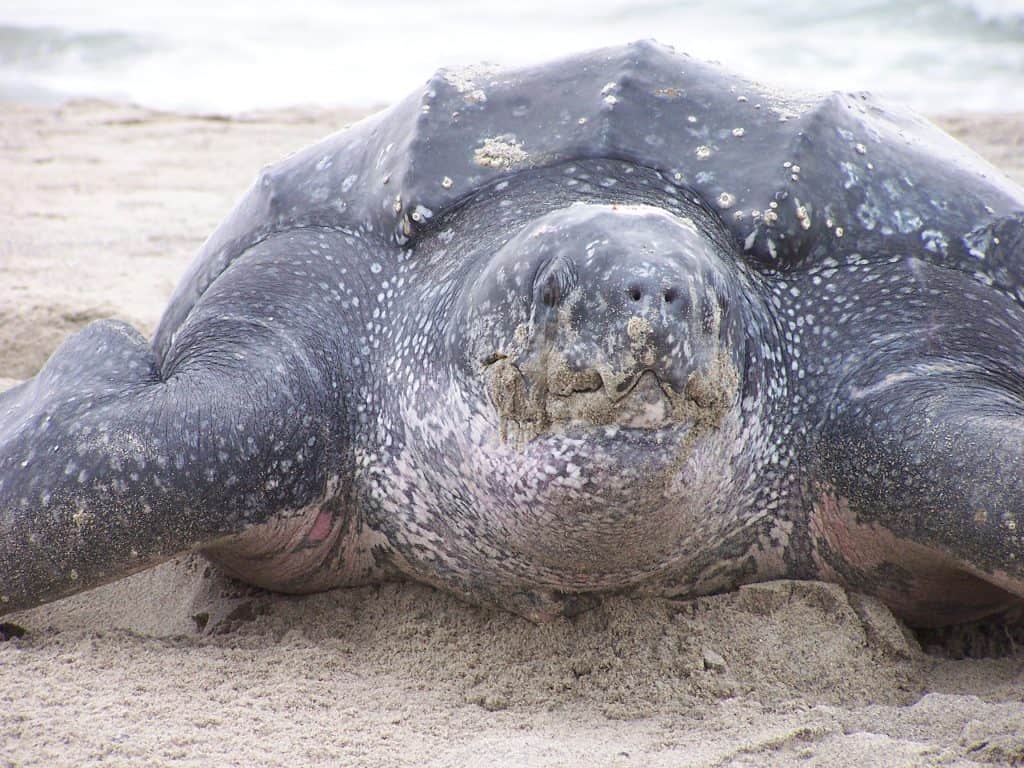
The leatherback is the largest, deepest-diving, and most migratory and wide ranging of all sea turtles.

Scientific Name

The Scientific name of the leatherback sea turtle is Dermochelys coriacea . They are also sometimes referred to as leatherbacks, leathery turtles, lutes (comparing the seven ridges that run along the turtle’s back to the strings of the instrument), or the luth. Dermochelys coriacea means “leathery turtle skin” though the exact translation is actually “skin turtle leathery.”

The leatherback sea turtle is the only species in the genus, Dermochelys, and is the only extant member of the family, Dermochelydae. The leatherback sea turtle is a relative of the family Cheloniidae, which contains the other six extant sea turtles but also has a sister taxon of the extinct family, Protostegidae, that included other species that did not have a hard carapace.

Evolution

Turtles and tortoises evolved in South Africa around 260 million years ago, from a small reptile named Eunotasaurus africanus. This strange little lizard had the makings of modern-day turtles with thick, backward curving ribs that formed an armored dome under its skin.

A reptile called Odontochelys semitestacea evolved 40 million years later in the shallow oceans of China. The Odontochelys had one trait that modern turtles and tortoises share—a plastron or bottom shell. It is believed that these tortoise ancestors developed lower shells first because sharks and other predators attacked them from below the surface of the water.

Proganochelys, or “beast turtle” lived among the dinosaurs and was armored above and below. In addition to its protective shell, this ancient turtle had bony neck spikes, leg spikes, and tail spikes. Like its modern relatives, it had a bony shell and a toothless mouth.

These three turtle ancestors diverged into the terrapin, sea turtle, and tortoise we know today.

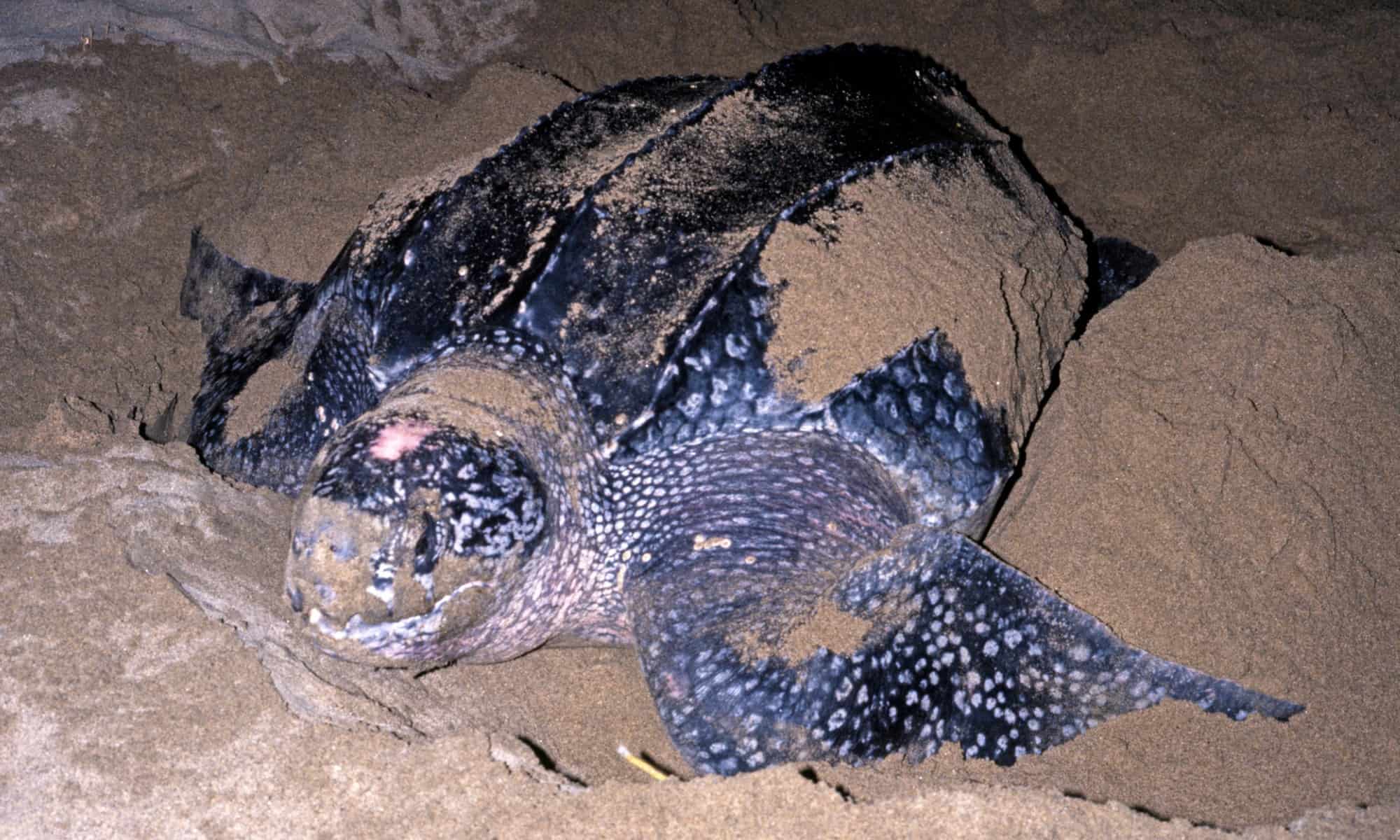
Leatherbacks have tough, rubbery medium blue-gray skin with ridges that look like strips of leather sewn together.

Appearance

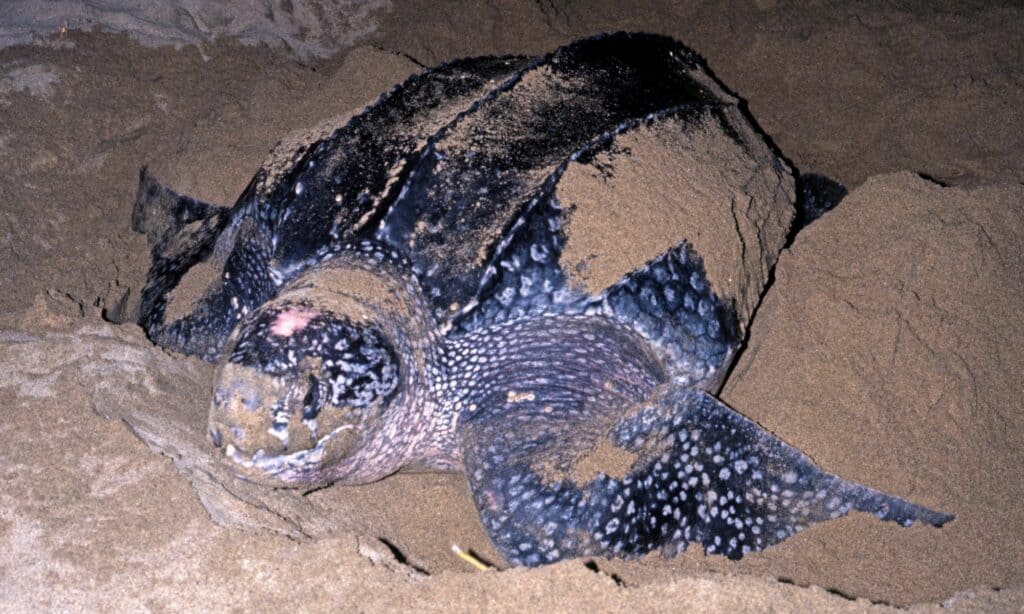
The leatherback sea turtle differs from all other sea turtles, in that it does not have a hard shell or scales. Instead, the leatherback sea turtle has seven spiny vertical ridges made of bone where the shell would be on almost any other turtle, giving it’s back the appearance of strips of leather sewn together. A leatherback’s tough rubbery skin is medium blue-gray to black, with minor pattern variations, including spots and stripes, and a whitish pink underbelly. Their front flippers reach slightly more than halfway down their bodies, while their back feet are very short, and their flippers do not have claws.

Behavior

Leatherback sea turtles are solitary animals. They rarely interact with one another or come out of the sea, except during mating season and nesting. Leatherback sea turtles are one of the deepest diving marine animals that do not live in the depths. Thoughfemale leatherback sea turtles come out of the water to lay their eggs on land, they spend the majority of their time thousands of feet underwater. They are not particularly aggressive, but if they feel threatened, they will bite. Unlucky humans who get bitten may sustain serious bruises or even broken bones because leatherback sea turtles have sharp-beaked mouths and powerful jaw muscles, in keeping with their giant size.
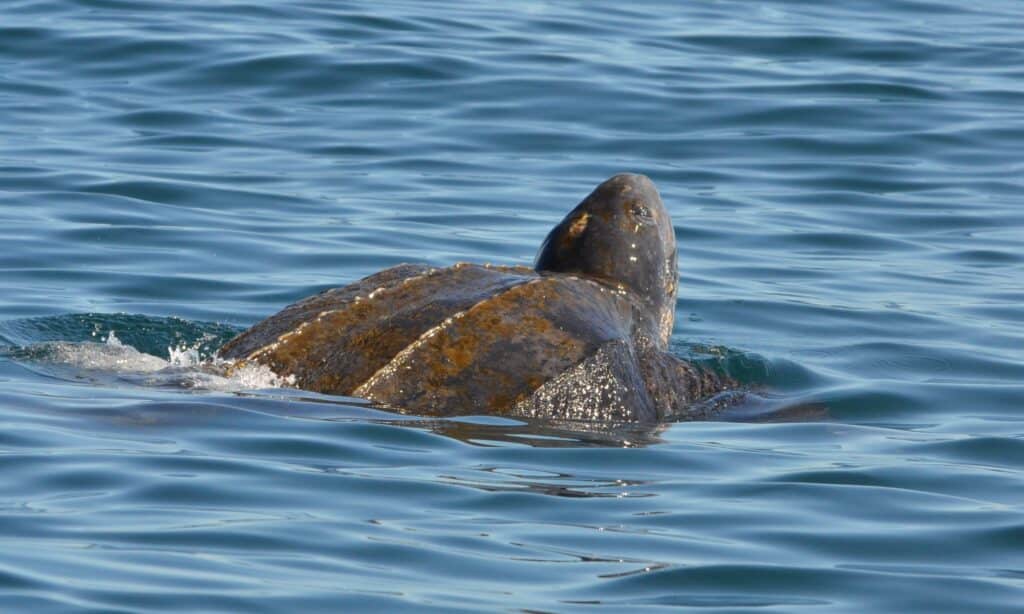
leather-back sea turtle

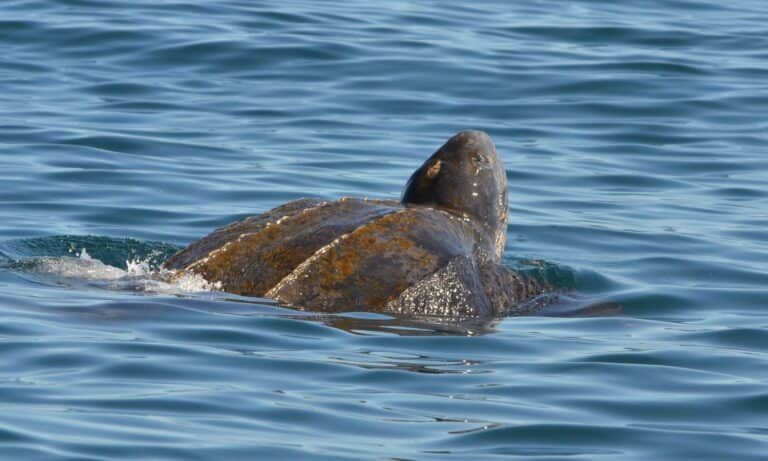
Leatherback sea turtles spend the majority of their lives underwater.

Habitat

The leatherback sea turtle can be found in the tropical and temperate ocean waters on both sides of the United States, including Hawaii, and also places like Puerto Rico, the Virgin Islands, and other parts of Indonesia, and Africa. Approximately the middle third of the globe is the leatherback sea turtle habitat. Their territory ranges from on land during mating season down to depths of 4000 feet when they dive.

Diet

The mouth of the giant leatherback sea turtle is not capable of chewing prey with hard bodies. Because of this, the leatherback sea turtle’s diet consists primarily of jellyfish, sea squirts, and other invertebrates. Leatherback sea turtles are referred to as gelatinivores. Their mouths and throats have backward-facing spines, an adaptation that helps them eat gelatinous prey. Leatherback sea turtles can consume almost their own body weight in jellyfish in a single day.
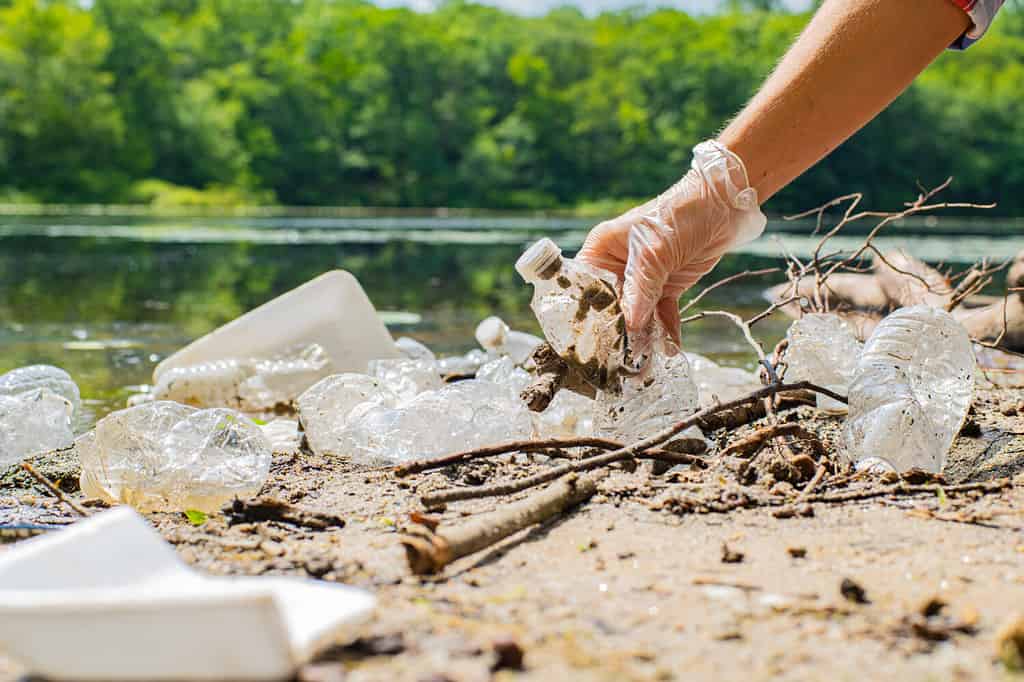
Volunteers cleaning garbage near river. Women picking up a bottle plastic in the lake, pollution and environment. Ecology concept

Sadly, leatherback sea turtles can mistake discarded plastic bags for jellyfish, causing them to get sick or die.

Predators and Threats

Adult leatherback sea turtles have few natural predators due to their size and how deeply they can swim, though raccoons, crabs, and birds often feed on their eggs and young when left unattended. Unfortunately, leatherback sea turtles still face many other threats to their lifespan and indeed the existence of their species, almost entirely from humans. Leatherback sea turtles are hunted by poachers and humans take their eggs. The Leatherbacks get sick or even die from eating human pollution in the form of fishing lines or plastic bags they mistake for jellyfish or just getting debris in their mouths. Leatherback sea turtles may even get caught in fishing nets. Climate change is also a factor in the declining numbers of leatherback sea turtles, and there are instances of them being struck by marine vehicles. Because of this, they are listed as Critically Endangered by the IUCN Red List. Conservation efforts to rescue their populations are underway and currently yielding promising results, but there is a lot of work to be done before they are out of danger, and they are at definite risk of extinction in the next few decades if things don’t improve.

Reproduction and Life Cycle

Scientists do not know exactly when a Leatherback Sea Turtle reaches the age of sexual maturity, but it is believed to be between the ages of nine and 20. The reason is it so hard to determine is because they are most easily studied on land, but once they hatch and enter the ocean, female Leatherback Sea Turtles only come out of the water to lay their eggs. Males do not leave the water at all.

Leatherback sea turtles do not lay their eggs every year either which may be partly responsible for their declining numbers. Leatherback sea turtles do however lay more than one clutch of eggs per nesting season. Every two to four years, a female leatherback will come ashore to nest after mating and will lay eggs several times that season. She will lay approximately 100 eggs in sand burrows. She will do this every eight to 12 days for a short period, laying about four to seven clutches in total, or between 400 – 700 eggs per season. After two months of incubation, the eggs will hatch into hatchlings. Their journey from nest to sea is perhaps the most perilous part of a leatherback sea turtle’s life, as this is when they are the most vulnerable to predators and poachers.
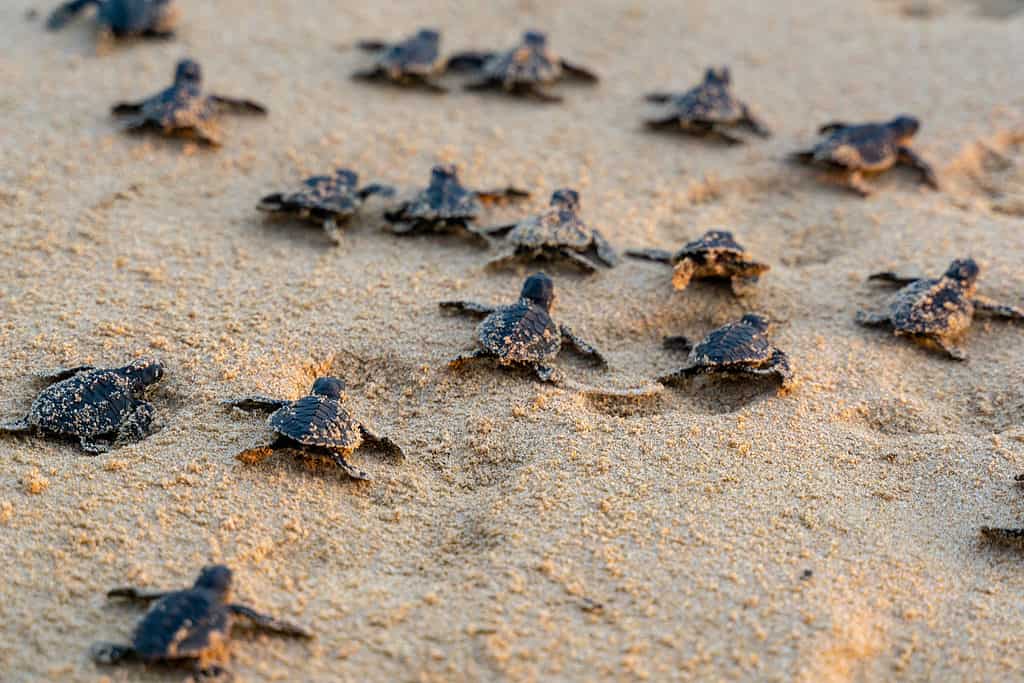
Baby sea turtles running towards ocean

Ecologists released tens of thousands of leatherback sea turtle hatchlings into the ocean in 2020 and 2021.

Population

Leatherback sea turtle numbers are in decline. In particular, the Pacific Ocean Leatherback Sea Turtle populations are declining, and they are at risk for full extinction, with fewer than 3000 adult Leatherback females believed to be in existence in that area of the ocean. In 1980, there were over 100,000 female adultleatherback sea turtles in all known areas thought to be in existence. At the most recent count, there were only around 25,000-35,000 female adults. Malaysian nesting grounds have completely disappeared, which is not a good sign. Nesting grounds in other places have severely declined, from thousands of nests down to only a handful per year.

The male population size of the Leatherback Sea Turtle is not known, but at least for the Pacific population, scientists worry that it will be below 1,000 by 2030. It is harder to study male leatherback sea turtles because they do not leave the water during mating season as the females do, and population estimates are based on the fact that about 10 percent of hatchlings are male and 90 percent are females. So, the male adult population is estimated to be about 10 percent that of the females.

There is good news, however. In 2020 and 2021, ecologists were able to successfully release tens of thousands of hatchlings into the ocean, and reduced egg poaching down to just a single percent of the total eggs. Keeping the hatchlings safe is paramount to ensuring the survival of the Leatherback Sea turtle species, so if these numbers are sustainable, it is possible that the Leatherback populations will once more be on the rise instead of the decline. Otherwise, Leatherback Sea Turtles face extinction within the next 20 years.leatherback sea turtleThere is good news, however. In 2020 and 2021, ecologists were able to successfully release tens of thousands of hatchlings into the ocean, and reduced egg poaching down to just a single percent of the total eggs. Keeping the hatchlings safe is paramount to ensuring the survival of the leatherback sea turtle species, so if these numbers are sustainable, it is possible that the leatherback population will once more be on the rise instead of the decline. Otherwise, leatherback sea turtle face extinction within the next 20 years.

View all 131 animals that start with L

Sources

  1. Reptiles of Ecuardor
  2. NOAA Leatherback Sea Turtle Information
  3. Leatherback Sea Turtle Wiki Facts
  4. World Wildlife Federation Leatherback Sea Turtle Facts
  5. Information About Sea Turtles: Leatherback Sea Turtle
  6. National Wildlife Reptiles Sea Turtles Leatherback
  7. Biological Diversity: Saving the Leatherback Sea Turtle
  8. Leatherback Sea Turtle
  9. Snappy Creations: Do leatherback sea turtles ever bite?
  10. Endangered Leatherback Sea Turtles Off West Coast May Gain Critical Habitat Protections
  11. Biological Diversity Atlantic Leatherback Sea Turtle
  12. Oceana Giant Leatherback Sea Turtle
  13. See Turtles: Leatherback Sea Turtle Lifespan Turtle Facts & Tidbits
  14. FWS Factsheet: Leatherback Sea Turtle Male Populations
  15. How many male leatherback sea turtles are there left?
  16. Time is running out for embattled Pacific leatherback sea turtles
  17. Saving Leatherback Sea Turtles during the Pandemic
  18. How Many Sea Turtles Are Left? Species Breakdown
  19. Leatherback Sea Turtles may become Extinct within 20 Years: A Study
Austin S.

About the Author

Austin S.

Growing up in rural New England on a small scale farm gave me a lifelong passion for animals. I love learning about new wild animal species, habitats, animal evolutions, dogs, cats, and more. I've always been surrounded by pets and believe the best dog and best cat products are important to keeping our animals happy and healthy. It's my mission to help you learn more about wild animals, and how to care for your pets better with carefully reviewed products.
Connect:

Thank you for reading! Have some feedback for us?


Leatherback Sea Turtle FAQs (Frequently Asked Questions)

eatherback Sea Turtles in existence, down from 110,000 in 1980.