Quick Take
- One snake on this list looks so much like a dragon that photos of it regularly fool people, and it is probably not the one you would expect. See the dragon-like viper →
- The most beautiful snake here is also one of the deadliest, and there is no antidote for its bite anywhere in the world. Discover the antidote-free killer →
- One humble backyard snake most people dismiss as boring made this list of the world's most stunning species, with coloring that rivals tropical exotics. Meet the vivid garter snake →
- A snake that "flies" through the forest canopy sounds terrifying, yet its appearance might be even more jaw-dropping than its method of travel. See the gliding snake →
There are more than 4,000 different species of snakes on our planet, and they make up an incredibly diverse group of fascinating (albeit often tragically misunderstood) animals. Narrowing down the most beautiful snakes in the world is no easy task, but the 10 species we’ve listed here are some of the most visually stunning. As beauty is subjective, the following snakes are in no particular order. Take an up-close look at the most beautiful, colorful, vivid, unique, and overall unforgettable species within the absolutely massive Serpentes suborder.
1. Sunbeam Snake
We start our list off with the stunning and aptly-named sunbeam snake. There are two or three species within the Xenopeltis genus, collectively known as sunbeam snakes, with the exact number subject to ongoing taxonomic discussion. Both species are native to Southeast Asia and its surrounding islands. The better-known species, Xenopeltis unicolor, primarily inhabits countries like Myanmar, southern China, Laos, Vietnam, Malaysia, and Thailand. Adult snakes typically average around 3 feet in length.
Sunbeam snakes primarily owe their beauty to the iridescent scales that cover their entire bodies. While their main body color is a drabber gray, black, or brown, this color shifts wildly in direct sunlight. These snakes can be reclusive, as they are fossorial (burrowing) and typically found in underground burrows. However, when these snakes come up to the surface to hunt for food in the evenings and early morning hours, they’re a truly unforgettable sight. Tiny rainbows dance across their scales in the sun as they slither about.

These iridescent snakes are stunning in direct sunlight, hence their bright and sunny name.
©MP cz/Shutterstock.com
2. Rainbow Snake/Eel Moccasin
The rainbow snake (Farancia erytrogramma), also known as the eel moccasin, the red-lined snake, the red-sided snake, and the striped wampum, is another species with a name that suits it perfectly. These mostly aquatic snakes have a truly mesmerizing coloration, particularly on their sides and bellies, with alternating scale colors of bright red, yellow, black, brown, and orange. There were originally two subspecies, though one of them is unfortunately extinct as of 2011.
As far as snakes go, it is quite large, heavy-bodied, and muscular, averaging between around 3-4 feet. However, despite its size, it is non-venomous and mostly harmless to anything larger than a frog or toad. Like many of the beautiful snakes on this list, the eel moccasin is highly reclusive. It usually stays hidden in the water amongst the dense plant growth in the marshes and swamps of its native habitats throughout the southeastern United States.
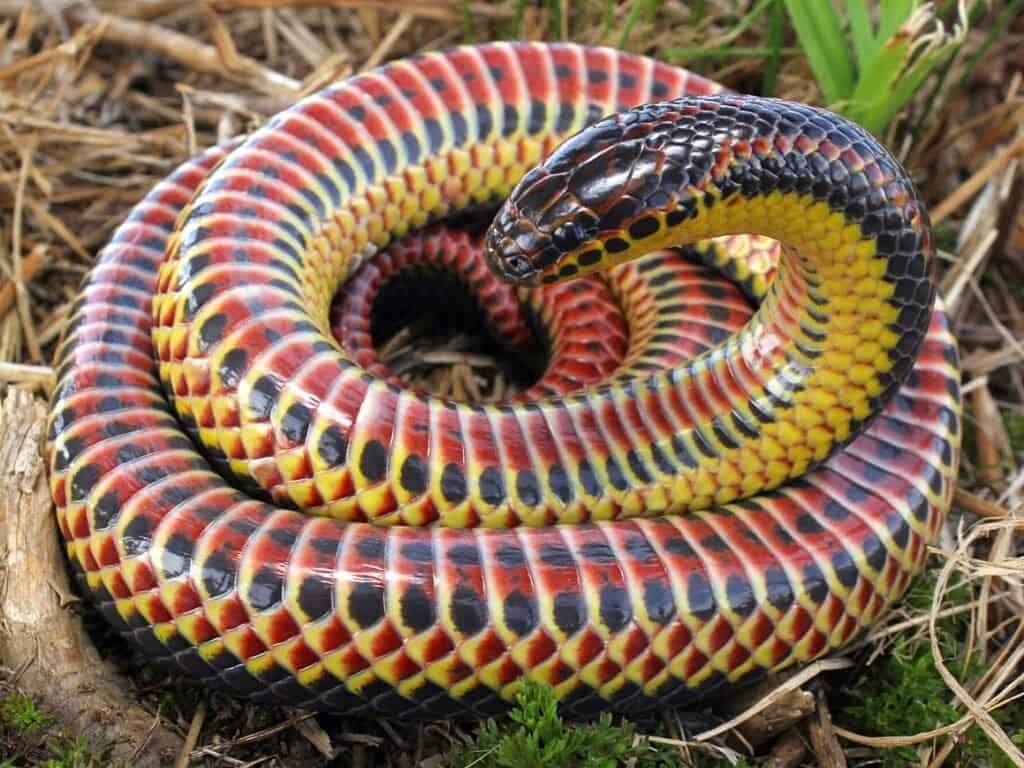
The rainbow snake’s underside is beautifully patterned in shades of yellow, red, black, and brown.
3. Eyelash Palm Pit Viper
One of the most notable and beautiful members of the Viperidae family is the eyelash palm pit viper (Bothriechis schlegelii). This fearsome, usually electric-yellow snake has protruding, eyelash-like scales just above its large eyes. These snakes mostly inhabit low-elevation, heavily shaded, and densely forested areas close to water in Central and South America. Researchers currently believe the viper’s “eyelashes” help it to better camouflage itself by making its outline more difficult to make out when the snake hides among dense plant growth.
It is one of the smallest venomous snakes in Central America at only 2.5 feet in length, but this ambush predator are highly accurate, expert hunters. Despite their venomous nature and extremely sharp fangs, they aren’t very aggressive toward humans. In fact, eyelash vipers are reclusive and tend to avoid us at all costs. They primarily feed on small animals like frogs, rodents, lizards, and occasionally birds.
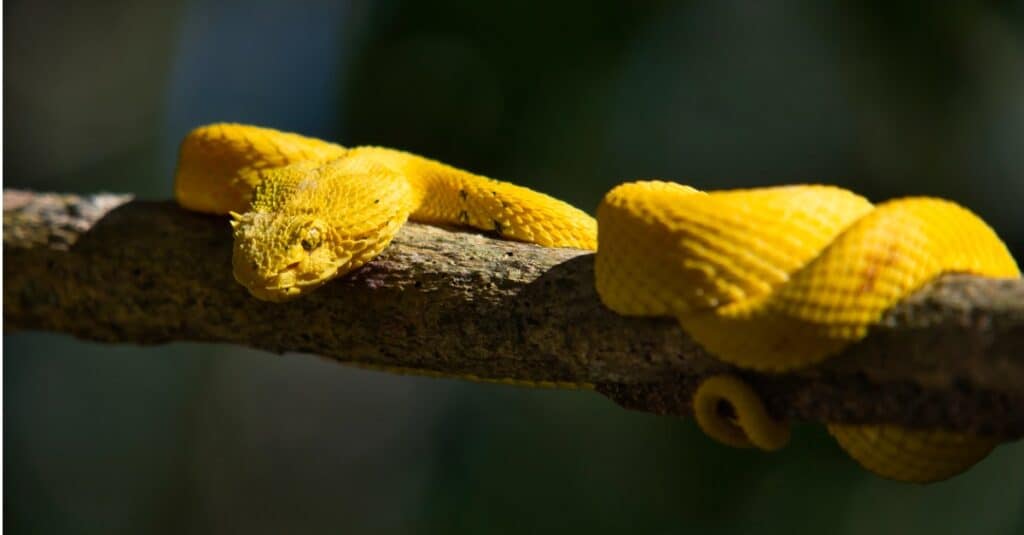
Eyelash palm pit vipers are beautiful, both for their bright coloration and their unique “eyelash” scales.
©Fabrice Mieville/Shutterstock.com
4. Paradise Flying Snake
A flying snake is many an ophidiophobe’s worst nightmare! Don’t worry, though, these snakes don’t so much fly rather than glide short distances from tree to tree. Still, the paradise flying snake (Chrysopelea paradisi) gliding overhead is a truly incredible sight, not only for the unique way the species stretches its ribs out and flattens its body to make itself lighter and more aerodynamic, but also its gorgeous, vivid coloration.
There are several different species in the Chrysopelea genus, but the paradise tree variety is the most beautiful by far. Its scale patterning varies from individual to individual. Typically, though, this snake has a spotted appearance, with alternating colors of green, orange, yellow, and red. The snake’s head typically has horizontal striping in addition to the tiny spots. Paradise flying snakes are highly arboreal and mainly live in humid forests throughout southeastern Asia. They typically measure 3–4 feet in length.
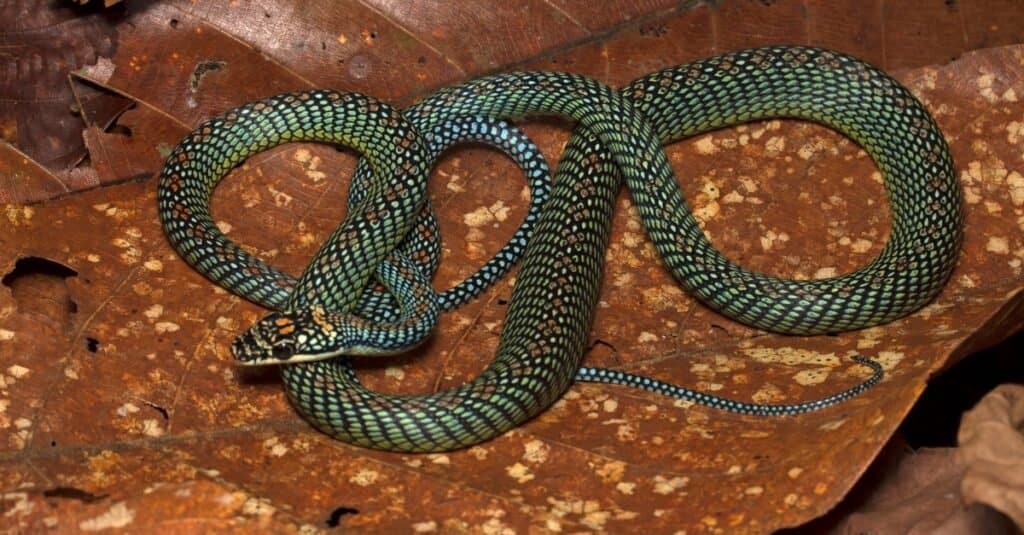
There are several species of flying snakes, but the paradise flying snake is the most visually striking.
©Vince Adam/Shutterstock.com
5. Blue Malayan Coral Snake
As their name indicates, these beautiful yet highly venomous snakes are native to Southeast Asia. Their coloration is absolutely stunning, with bright, blood-red heads and tails, bluish-black bodies, and thin, sky-blue stripes running down the snakes’ sides. Blue Malayan coral snakes (Calliophis bivirgatus) can be hard to find and properly document, as they are reclusive and semi-fossorial. These snakes spend most of their time burrowing in the dirt and leaf litter in their heavily forested, mountainous habitats.
While they aren’t particularly aggressive, blue Malayan coral snakes can occasionally kill humans with their cytotoxic venom. These snakes have long venom glands that measure up to one-third of their bodies. These snakes can reach nearly 6 feet long. Fortunately, bites are rare, and humans are most certainly not on their menu. Notably, they mostly feed on other, smaller snakes. If you’re lucky — or, perhaps, unfortunate — enough to see one of these snakes in the wild, it’s best to admire them at a safe distance. There is currently no antidote or antivenom to treat their powerful bite.

The blue Malayan coral snake’s bright red head contrasts beautifully with its bluish-black body.
©reptiles4all/Shutterstock.com
6. Hairy/Rough-Scaled Bush Viper
The next snake on our list is the rough-scaled bush viper (Atheris hispida), also sometimes known as the hairy bush viper. It is unique for its bizarre yet beautiful outward-pointing, keeled scales that give it a strikingly dragon-like appearance. Like most vipers, these particular snakes are brightly colored with flat, broad heads, short snouts, and large, protruding eyes. This snake reaches around 2-2.5 feet in length.
This snake’s coloration varies from bright greens and yellows to oranges, browns, and greys. It mainly inhabits hot, humid rainforests in Western and Central Africa in countries like Cameroon, Nigeria, Uganda, Kenya, and Ghana. There are a few subspecies, all of which are similar in appearance, size, color, and geographical range. Though the bush viper isn’t very aggressive towards humans, its hemotoxic venom is quite potent. However, only a few isolated human deaths have been attributed to the species.
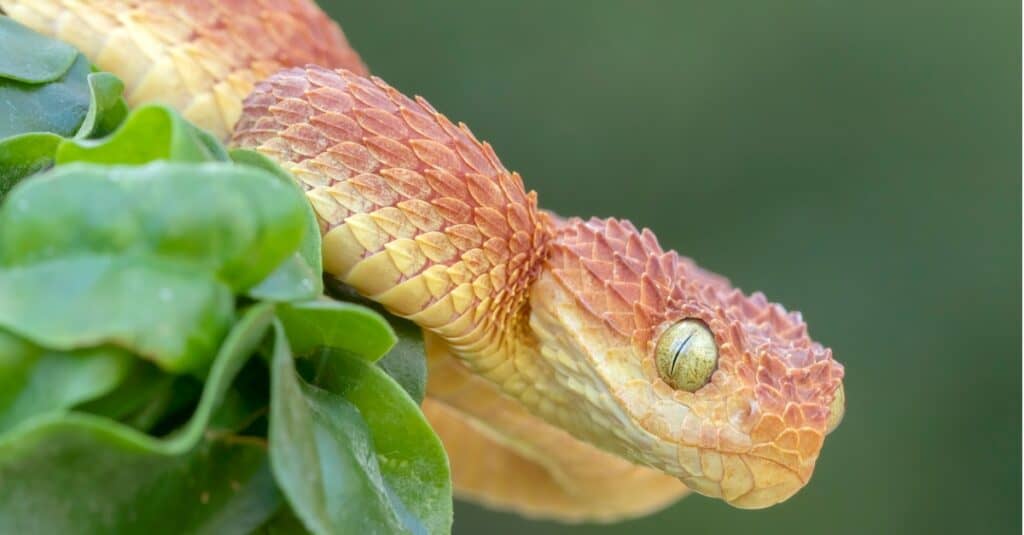
At a glance, bush vipers almost look more like fearsome dragons than snakes.
©iStock.com/Mark Kostich
7. Indian Cobra
The Indian cobra (Naja naja) is perhaps the most well-known and recognizable of all “true” cobras (the king cobra is not a ”true” cobra) within the Naja genus. It has a few additional common names, such as the Asian cobra or, more notably, the spectacled cobra, due to its strange, spectacle-shaped eye markings on its hood. As the name suggests, it’s native to India, as well as a few surrounding countries like Pakistan, Nepal, and Sri Lanka. This species is also one of the larger cobra species, often reaching up to 5 feet in length and being quite heavy-bodied overall.
Though the Indian cobra’s coloration is made up of somewhat drab shades of grey and brown, its scale patterning, massive hood, and large size make it visually remarkable. Indian cobras are hardy and highly adaptable and can thrive in a wide variety of different habitats, including urban areas. However, it most often lives near water, spending much of its time hidden away in rocky outcrops, termite mounds, and hollowed-out trees. The snake’s venom is powerful and deadly, as it is both neurotoxic and cardiotoxic. It is one of the famous “big four” snakes that cause the most bites and human deaths in India.
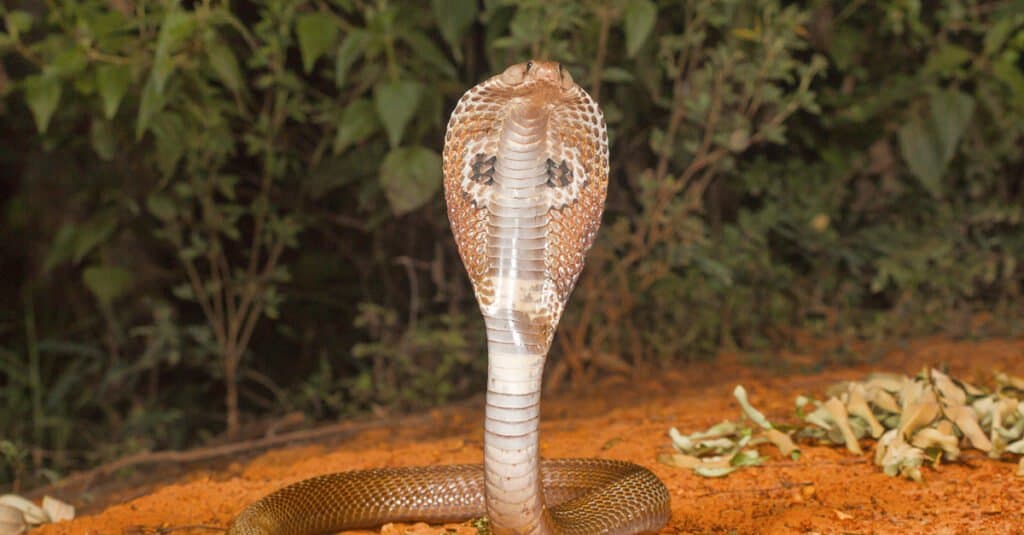
Indian cobras are large, imposing snakes with beautiful patterning on their hoods.
©RealityImages/Shutterstock.com
8. California Red-Sided Garter Snake
Did you expect to see the humble garter snake on this list? It turns out, there are actually three distinctly colorful subspecies of the common garter snake. The California red-sided garter snake (Thamnophis sirtalis infernalis), however, is perhaps the most beautiful, with either vivid blue or yellow stripes stretching across its brightly-colored red body. The snake’s head is typically bright red as well, making it stand out against the drab, swampy habitat in which it lives.
As its name suggests, this beautiful snake mostly lives throughout California, usually along the coast in low-lying swamplands and marshes, never far from water. Like most typical garter snakes, they’re strong swimmers and skilled hunters. They primarily feed on small amphibians, fish, rodents, and occasionally birds. Aside from its unusually vivid coloration, the California red-sided garter snake is a standard garter snake. Its very mild venom is not harmful to humans, and the snake itself is not very aggressive towards humans anyway. They’re also quite small, maxing out at around 2 feet in length.

The stunning California red-sided garter snakes are more brightly-colored than your typical garter snake.
©Simone O/Shutterstock.com
9. Butterfly Viper
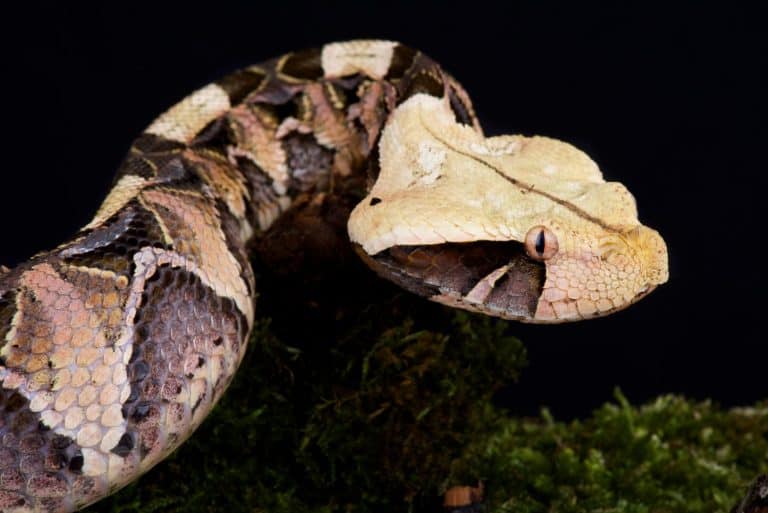
We come now to yet another viper on this list: the highly venomous yet visually stunning rhinoceros viper (Bitis nasicornis). This short yet heavy-bodied snake measures around 2-3 feet in length. It is both colorful and gorgeously patterned, with ornate bluish-green diamond and hourglass-shaped markings running down the length of its brown and olive-green body. On the top of its head is a black diamond-shaped or triangular splotch, with the trademark “horns” at the tip of its nose.
Butterfly vipers live only in West and Central Africa, mainly in countries like Ghana, Sudan, Cameroon, and Uganda. More specifically, it resides in densely forested areas near water, where it hides amongst the foliage and leaf litter on the forest floor during the day and comes out to hunt at night. Its venom is both hemotoxic and neurotoxic, a deadly and potent combination that it uses to take down prey with incredible efficiency. Fortunately, an antivenom does exist, but you still definitely want to avoid this beautiful snake if it crosses your path.

The rhinoceros viper’s patterning is ornate, colorful, and truly mesmerizing.
©reptiles4all/Shutterstock.com
10. Sunda Island Pit Viper
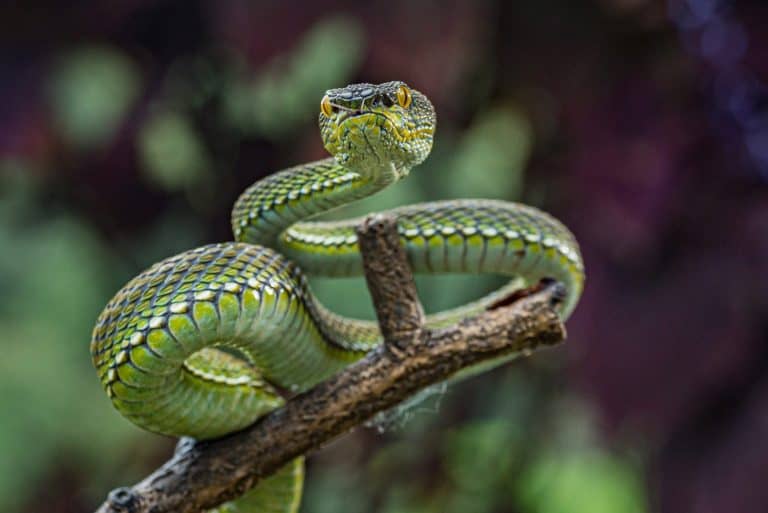
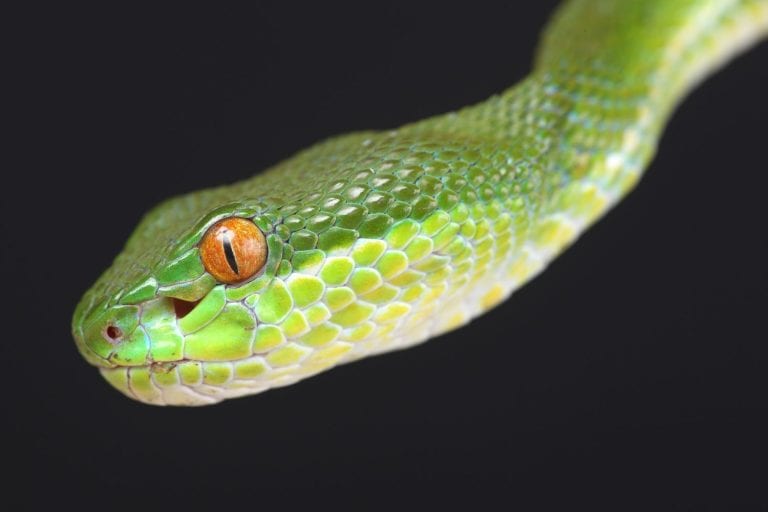
Located in the Lesser Sunda Islands and Java in Indonesia, the Sunda Island pit viper (Trimeresurus insularis), also known as the white-lipped island pit viper is a stunning snake that can be a vibrant blue-green color. While most of these pit vipers are a bright green or yellow, these snakes can range from a pale sky-blue to electric blue to a jewel-toned teal. Their tails are typically reddish or orange. They generally reach 2-3 feet in length.
The blue morphs of the Sunda Island pit viper are typically found on the islands of Komodo and Padar. These snakes are an arboreal species favoring dry monsoon forests, bamboo forests, and thickets. They are frequently found on tree branches near rivers. Their diet generally consists of small vertebrates such as lizards, skinks, amphibians, birds, small rodents, and other snakes. These snakes have a potent hemotoxic venom that can cause hemorrhaging, as well as necrosis at the site of the bite.

The Sunda Island pit viper can be a vibrant turquoise color.
©iStock.com/Cavan Images