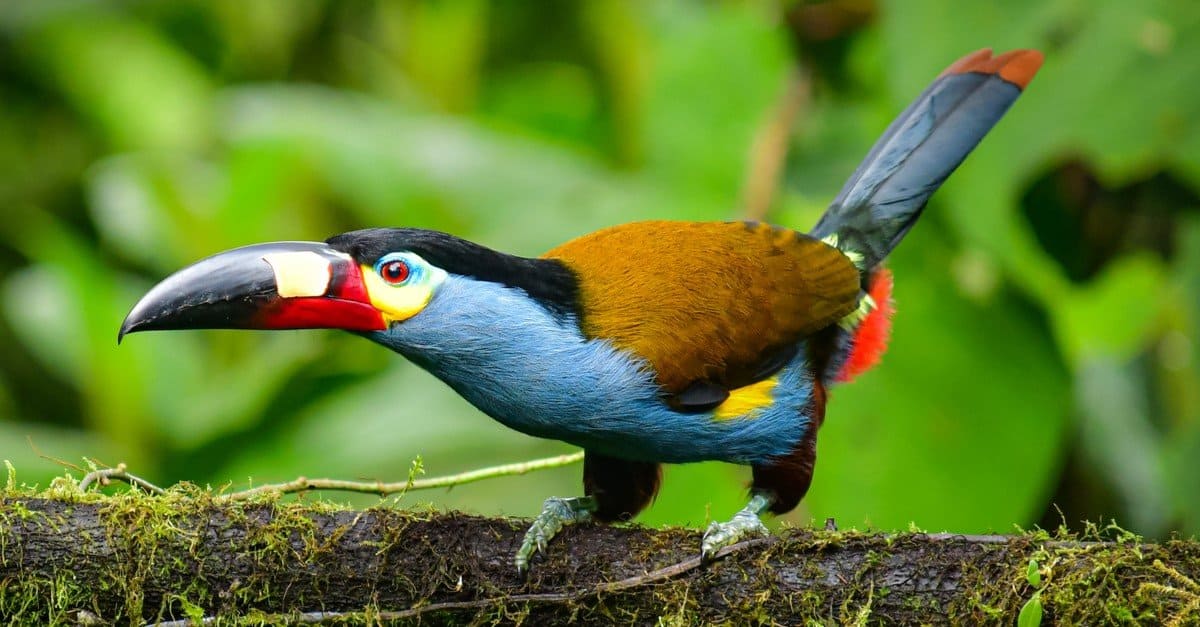
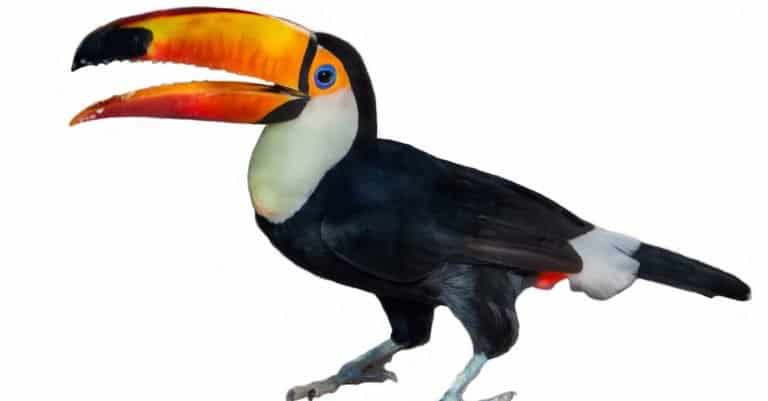




A toucan bird’s curved, colorful beak makes it hard to overlook. They are omnivores that eat insects, eggs, and fruit. These birds can live up to 12 to 20 years, with the higher end of this range more commonly reached in captivity than in the wild. They inhabit the tropical forests of South America and Central America.
4 Amazing Toucan Facts
- Toucan birds are poor fliers
- A toucan’s beak is hollow
- A toucan’s tongue is similar to a feather that pushes food down its throat
- Five or six toucans can huddle together in one hollow tree
Where to Find the Toucan
Toucan birds are found in tropical forests in South America and Central America. Specifically, they live in Bolivia, Brazil, Argentina, French Guiana, Peru, Paraguay, Uruguay, Guyana, and Suriname. The channel-billed toucan lives in Trinidad. These birds inhabit warm climates with high rainfall. Normally, they remain in the highest parts of the trees, called the canopy. They can live in mountainous areas as well.
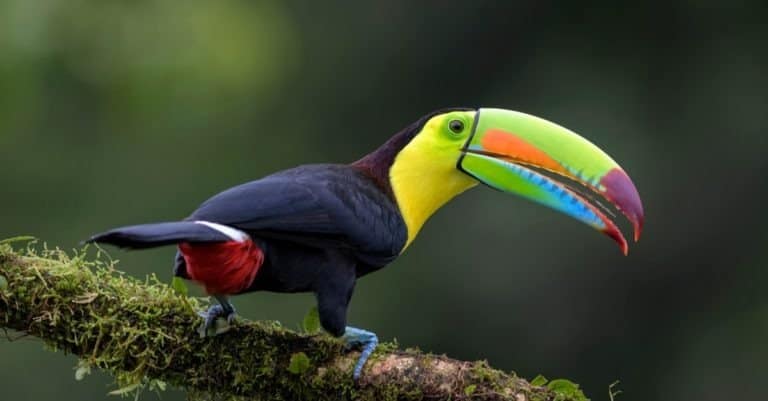
Costa Rica is a popular place for bird lovers to observe these birds. The keel-billed toucan, scientific name Ramphastos sulfuratus, can be seen in the Cartago, Turrialba, and Monteverde mountains. They are usually found at an elevation of 1600 to 5000 feet.
Carara National Park, Cano Negro Wildlife Refuge, and Tortuguero National Park are other places to see keel-billed toucans and other species of this colorful bird at any time of the year.
Having an experienced, local guide along can help you tour spots that are most likely to have gatherings of toucans.
Nests
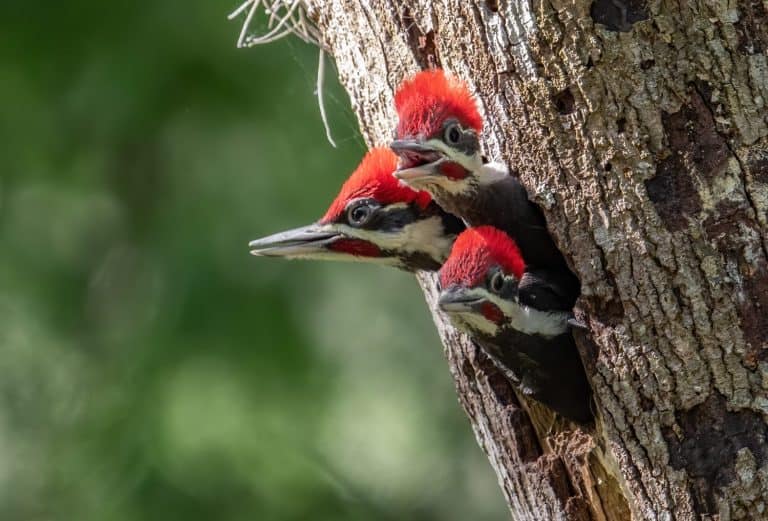
Toucan birds make nests in small holes high up in hollow trees. They sometimes put a thin layer of grass or regurgitated seeds inside the hole as a lining for the nest. Toucans don’t make holes in trees. Instead, they make their nests in holes created by woodpeckers or other animals.
Scientific Name

One of the more than 40 species of toucan is the keel-billed Toucan (Ramphastos sulfuratus).
©.supernova. / Creative Commons – Original
The toucan is classified in the family Ramphastidae. The word comes from the scientific genus name Ramphastos and is derived from the Greek word “ramphos”, meaning “bill”. The family includes five genera and over 40 different species. Genera in the family are: Andigena, Aulacorhynchus, Pteroglossus, Ramphastos, and Selenidera.
Evolution
Interestingly, there are no known fossils of toucans (Ramphastidae) except for some remains found of a toco toucan, which date to the Pleistocene Epoch, about 2.6 million to 11,700 years ago. Toucans are believed to share an ancient ancestor with barbets.
Species of toucans developed during times when dry forests and tropical forests expanded. As these habitats grew, some animals formed rapidly while others disappeared.
Toucans are believed to have undergone convergent evolution, where distantly related species independently evolve similar traits.
Types of Toucans
There are over 40 species of toucan, with 22 of them appearing below:
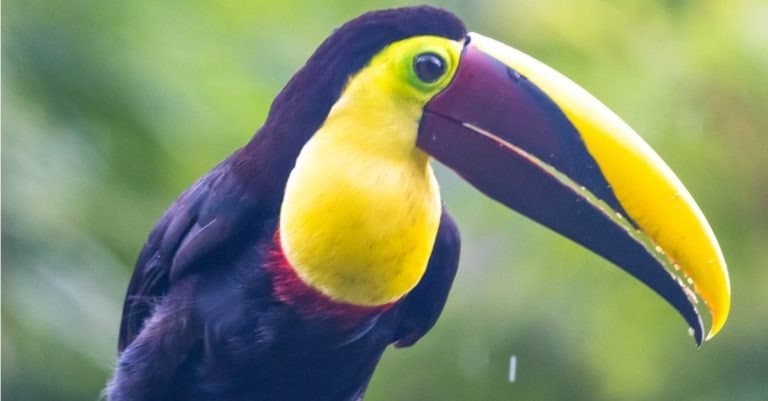
- Yellow-throated toucan (Ramphastos ambiguus): This toucan bird calls the Andes’ eastern slopes home, and can be found in Colombia, Ecuador, Peru, and Venezuela. It is rather adaptable and at home in tropical and subtropical forests. It has glossy black abdominal, head, and lower chest feathers, bright yellow feathers on its throat (which extend to the front of its face), and a diagonally slashed beak in the same brilliant yellow above black. This lends to an especially striking appearance (which is further enhanced by the bright green mask around its eyes). The yellow-throated toucan is very fond of fruit, although it will not turn its beak up at small reptiles, rodents, or insects. This bird is listed as Least Concern.
- Channel-billed toucan (Ramphastos vitellinus): Found in Bolivia, Brazil, and even the Caribbean (Trinidad), this toucan bird can be recognized by the splash of rich yellow on its chest with a paler halo around it, which extends up to its face. There, the paleness morphs into a brilliant blue that extends to the base of its beak. In addition to a fondness for warm, wet environments, it is also rather partial to fruit despite being an omnivore — just like its yellow-throated cousin. This bird is listed as Least Concern.
- Chestnut-mandibled toucan (Ramphastos ambiguus swainsonii): This colorful bird happens to call Colombia, Ecuador, and Honduras home. It is rather similar to the yellow-throated toucan, albeit with less vivid coloring. However, it has the same yellow chest, although its feathers tend to be the color of egg yolk, with swirls of paler coloring. The yellow of its upper beak is richer yet, while its lower beak is chestnut rather than a gleaming black. Considered to be especially talkative, the chestnut-mandibled toucan is mostly frugivorous, although it also enjoys sampling eggs, frogs, and lizards.
- Toco toucan (Ramphastos toco albogularis): Native to Bolivia, Argentina, Paraguay, and Brazil.
- Toco toucan (Ramphastos toco toco): Native to Brazil, Paraguay, Bolivia, and Argentina.
- Red-billed toucan (Ramphastos tucanus tucanus): Native to Venezuela, Guyana, Bolivia, and Brazil.
- Cuvier’s toucan (Ramphastos tucanus cuvieri): Native to Colombia, Venezuela, Brazil, and Bolivia.
- Black-mandibled toucan (Ramphastos ambiguus abbreviatus): Native to Peru, Ecuador, Colombia, Venezuela.
- Black-mandibled toucan (Ramphastos ambiguus ambiguus): Native to Colombia, Venezuela, and Peru.
- Keel-billed toucan (Ramphastos sulfuratus sulfuratus): Native to Mexico, Belize, and Guatemala.
- Keel-billed toucan (Ramphastos sulfuratus brevicarinatus): Native to Central America, Colombia, and Venezuela.
- Channel-billed toucan (Ramphastos vitellinus vitellinus): Native to Venezuela, Brazil, Bolivia, and Trinidad. Its upperparts, belly, tail, and most of the bill are black, with the uppertail and undertail coverts red. The bare eye-patch and bill base are blue, and the throat is white.
- Yellow-ridged toucan (Ramphastos vitellinus culminatus): Native to Brazil and Bolivia. The base of its bill is yellow, the skin around the pale blue eye is red, and the entire throat and chest are orange.
- Ariel toucan (Ramphastos vitellinus ariel): Native to Brazil and Bolivia. It has a yellow base of the upper mandible and culmen, orange-yellow upper tail coverts, and the throat and breast are white.
- Citron-throated toucan (Ramphastos vitellinus citreolaemus): Native to Colombia and Venezuela. It has a clear yellow tinge to the throat, a green tinge to the otherwise blue culmen that’s yellow at the tip, and a blue base to both the upper and lower mandible.
- Choco toucan (Ramphastos brevis): Native to Ecuador and Colombia. It has a long yellow and black beak, a yellow bib, white upper tail coverts, red undertail coverts, and green ocular skin.
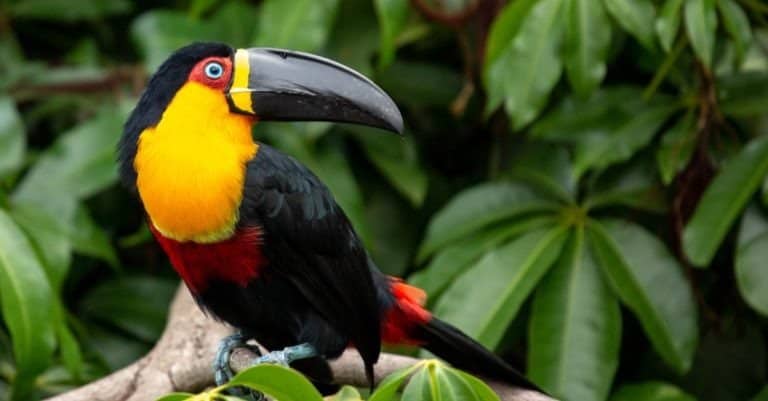
- Green-billed toucan (Ramphastos dicolorus): One of the smallest species of toucan. Its breast is orange with yellow at the sides. The beak is pale greenish-horn.
- Grey-breasted mountain toucan
- Plate-billed mountain toucan
- Hooded mountain toucan
- Black-billed mountain toucan
- White-throated toucan
Size, Appearance & Behavior
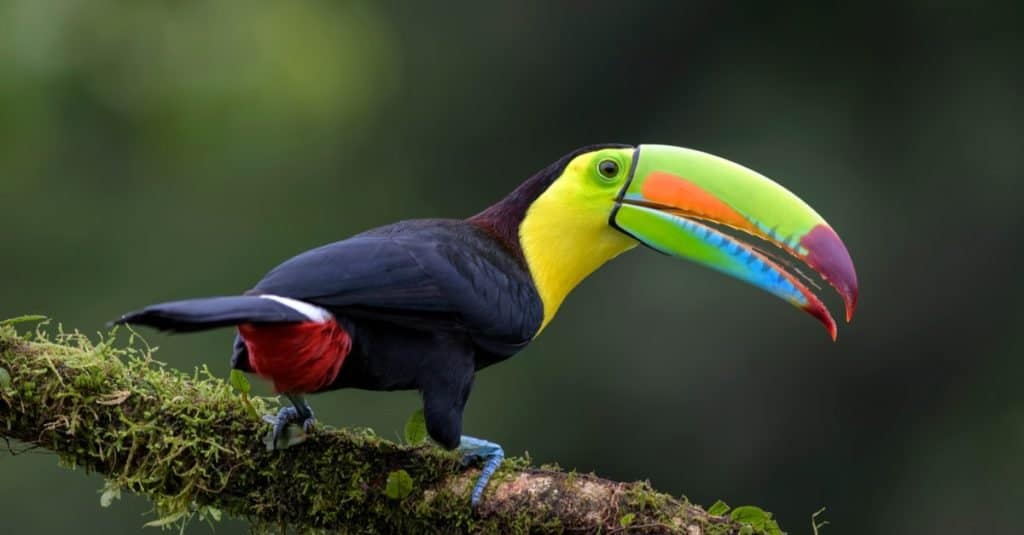
The pointy edges of the toucan’s beak allow it to bite into tough fruit and other items of food.
©David Havel/Shutterstock.com
The most notable feature of the bird is its beak. One look at this bird’s skeleton reveals a hollow beak with thin bones supporting it. Furthermore, it has pointy edges like a serrated kitchen knife. This allows toucans to bite into tough fruit and other items of food. In terms of color, this bird’s beak can be a mixture of yellow, orange, green, blue, red, and black, depending on its species. A smaller predator seeing this bird’s large and colorful beak may not want to approach it.
The feathers on this bird’s body are mostly black with splashes of blue, yellow, and red in different areas. As an example, a keel-billed toucan has black feathers on most of its body, a yellow chest, and red tail feathers. Plus, their feet are blue! As a note, the bird has two toes pointing forward and two facing backward. This design helps them hang onto branches. Plus, their unique feet allow them to easily jump from one branch to the next.
These birds can measure up to 25 inches long with a beak that can be 7.5 inches in length. Study the skeleton of the average-sized toucan and you’ll see its beak is equal to about one-third of the size of its body. Some species of this bird weigh up to 9 pounds. Their wingspan runs from 43 to 60 inches.
It may seem like its brightly colored beak and feathers would make this bird vulnerable to predators in a forest habitat. However, tropical vegetation can be colorful as well. Consequently, these birds can blend into their habitat and avoid predators.
Migration Pattern and Timing
These birds don’t migrate. They are called resident breeders, meaning their breeding season takes place in the same region where they live year-round. Breeding for these birds takes place in the spring.
Diet
These birds are classified as omnivorous, but some scientists refer to them as frugivores because their main diet is fruit.
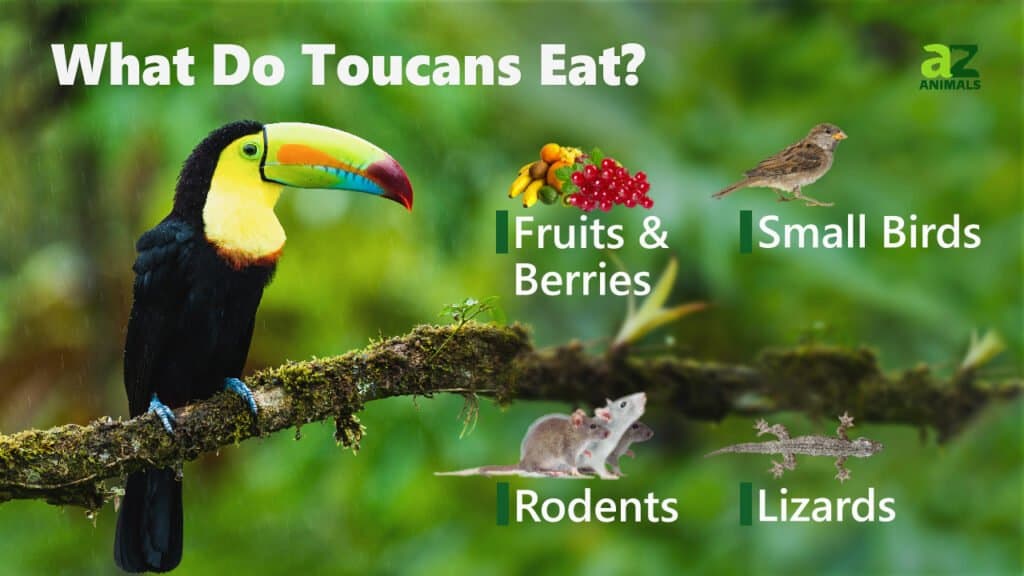
What do toucans eat?
Along with fruit, they eat insects, amphibians, and small reptiles. Also, toucans are known to eat eggs and hatchlings stolen from the nests of other birds. This stealing behavior classifies them as opportunistic feeders. When they see the opportunity to take food, they do!
Due to their diet of fruit, these birds play an important role in the ecosystem. After eating fruit, they leave behind seeds in their waste, causing more vegetation to grow.
Predators and Threats
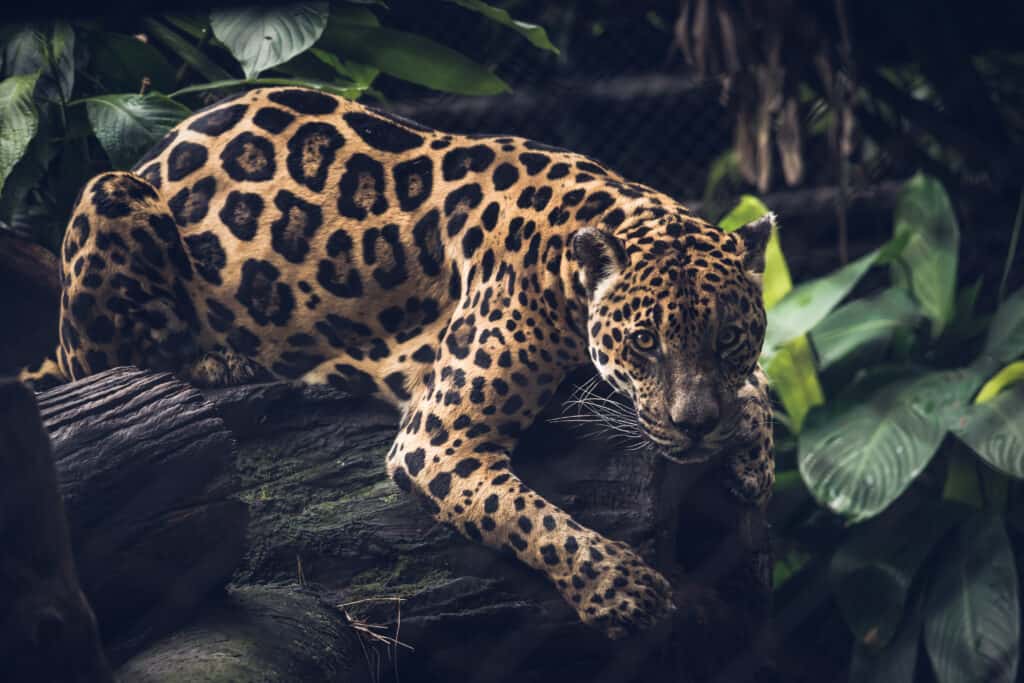
The Jaguar is one of the main predators of toucans.
©George Arenas/Shutterstock.com
Though its beak is large, this is a relatively small bird, which means it has a collection of predators in its habitat.
What eats toucans?
Jaguars, coatis, snakes, and eagles are predators of the bird. Not coincidentally, all of these animals have access to the treetops where toucans live.
Another threat faced by these birds is habitat loss due to deforestation. Plus, they are sometimes captured as pets. These animals usually die when kept in households as pets. They need special care and were never meant to be pets.
Reproduction, Babies, and Lifespan
The breeding season of these birds takes place in the spring. One of the most interesting facts about this bird is its mating ritual. This ritual involves a male and a female tossing a piece of fruit to each other.
The birds lay from 2 to 4 eggs per year. The mother and the father take turns sitting on the nest. The incubation period of the eggs ranges from 15 to 18 days. The babies, also called chicks, are born without feathers and are unable to see. Their eyes open at about 3 weeks old. The chicks stay with their parents for 6 to 8 weeks.
These birds are sexually mature at 2 to 4 years old, depending on the species, and can live up to 20 years in captivity.
Habitat
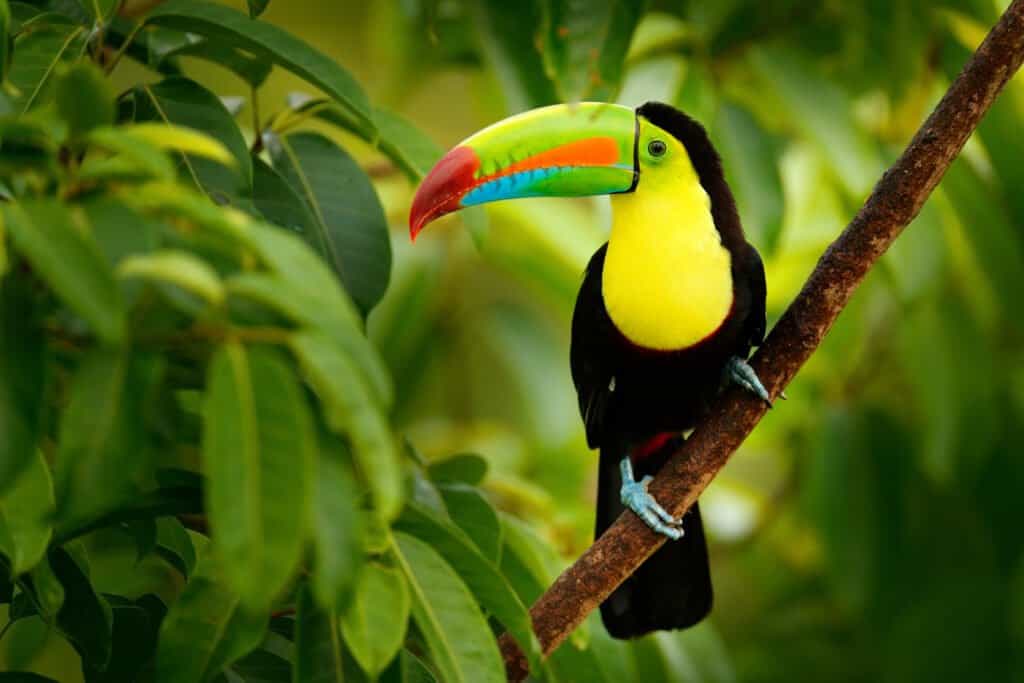
Toucans inhabit tropical rainforests and woodlands, savannas, and semi-open habitats.
©iStock.com/Ondrej Prosicky
Toucans are native birds to the Neotropics in Southern Mexico through Central America. They can also be found in South America and south to northern Argentina. They mostly live in the lower tropics, but the mountain species from the genus Andiegena can sometimes reach higher altitudes in the Andes and can be found in taller trees.
For the most part, toucans are a species of bird found in the forest and are usually restricted to primary forests. They will sometimes enter secondary forests to forage and find food, but are limited due to their breeding grounds being inside of those large forest trees with holes big enough to breed in.
The only non-forest living toucan is the toco toucan, which can be found in the savannah in patches of forests and woodlands.
Population
The population of these birds is unknown. However, according to the IUCN Red List of Threatened Species, this bird is described as ‘fairly common’ in its environment.
The conservation status of the toco toucan is Least Concern with a decreasing population.
Toucan Pictures
View all of our Toucan pictures in the gallery.

Miguel Lincango/Shutterstock.com
Sources
- Animal Diversity Web / Accessed January 2, 2021
- Sea World / Accessed January 2, 2021
- Wikipedia / Accessed January 2, 2021