




Quick Take
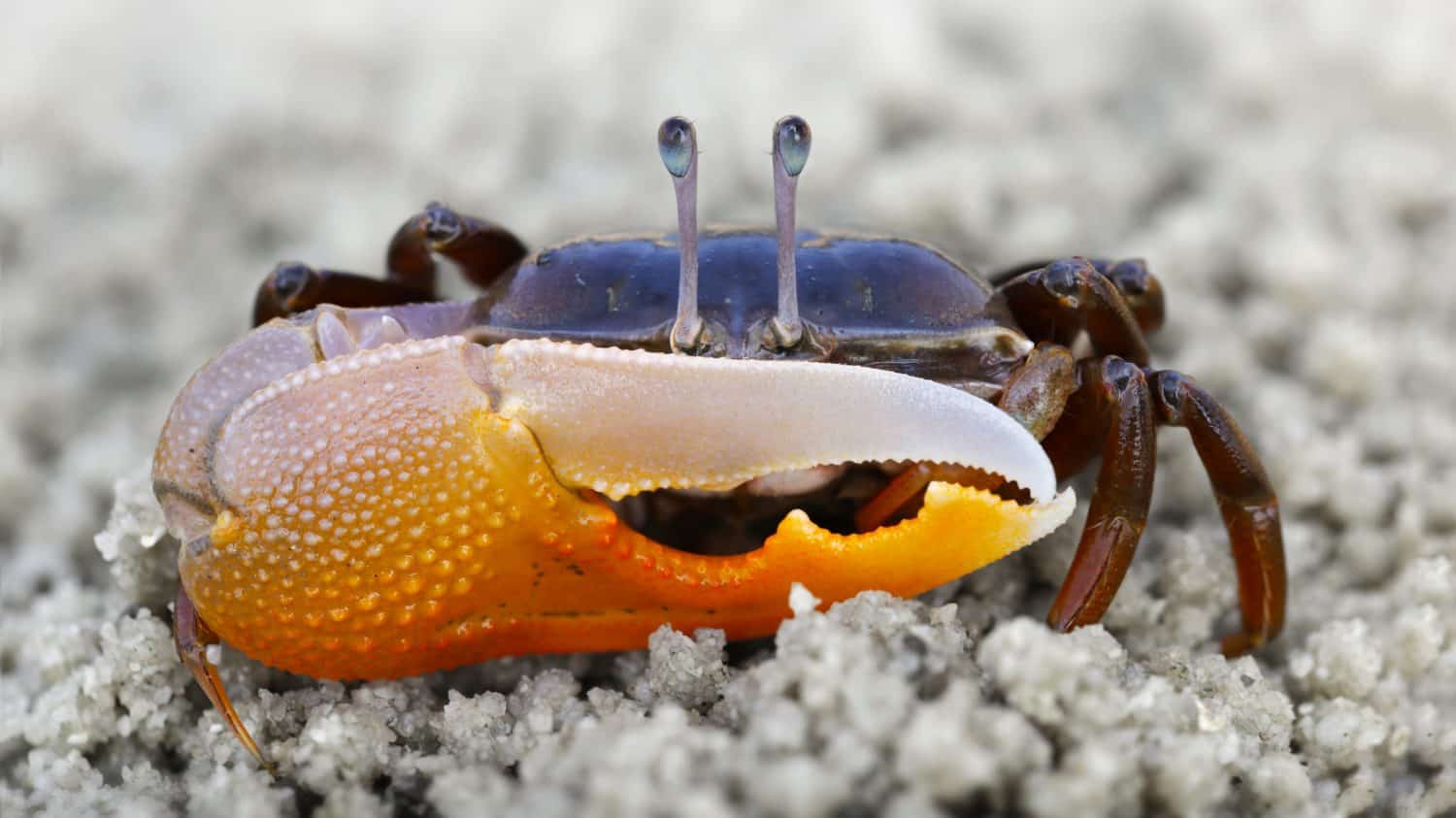
- The male fiddler crab's most prized feature is also a daily handicap, one that costs him every time he tries to eat. See the oversized claw →
- She's not just picking the biggest claw. There's a second factor that can override it entirely. Explore mate selection →
- One fiddler crab species defies a pattern shared by all the others, and the difference comes down to which side they favor. Discover claw dominance facts →
- When predators close in, fiddler crabs use their burrows in a way most people wouldn't expect. See their burrow defense →
The fiddler crab is one of over 100 species of crabs that live on both land and sea. Most often found along intertidal areas of lagoons and mudflats, they can also be found on sandy beaches. While some tolerate saltwater, most prefer brackish water along the intercoastal areas.

4 Incredible Fiddler Crab Facts
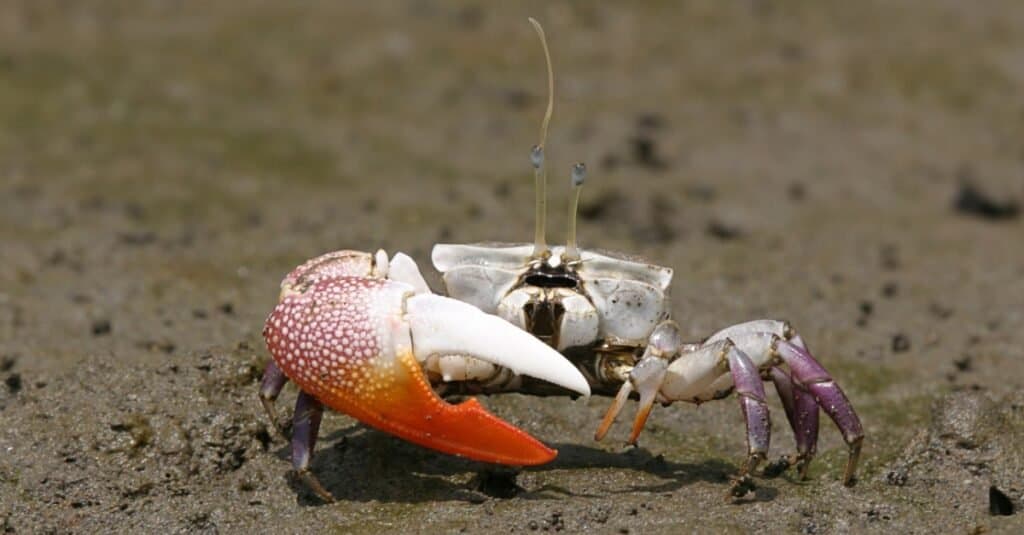
The male fiddler crab earns its name from the distinctive “fiddling” movement it performs to court a female partner.
©iStock.com/craykeeper
- The fiddler crab gets its name from the “fiddling” motion the male makes to attract a mate.
- Most species of fiddler crab have a 50-50 split on whether their right or left claw is enlarged. However, in one species, Uca vocans vomeris, the majority of the males are right-claw dominant.
- The female chooses her mate based on the size of the enlarged claw as well as the way he performs with it.
- The fiddler crab can temporarily seal its burrow from high tides and predators, breathing air trapped in the burrow.
Classification and Scientific Name
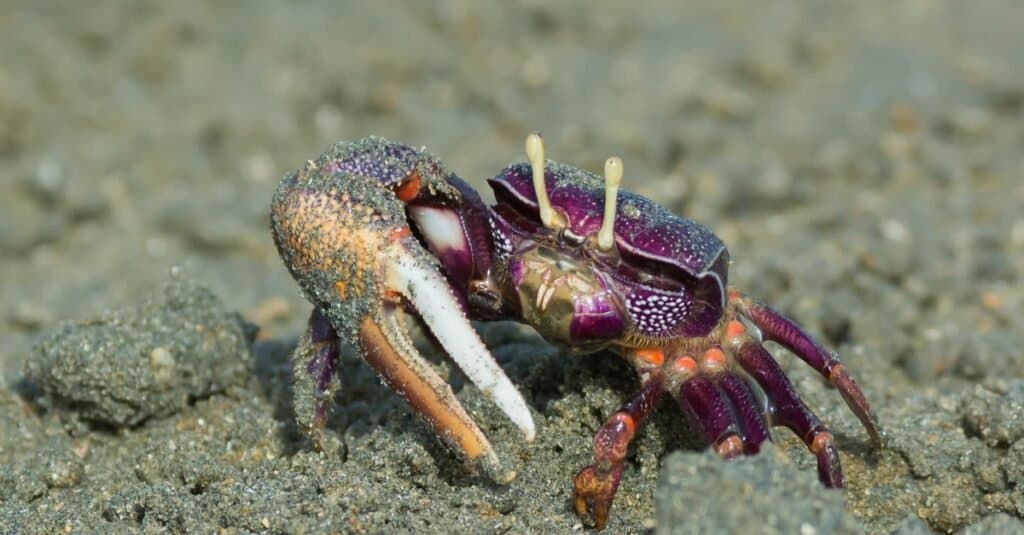
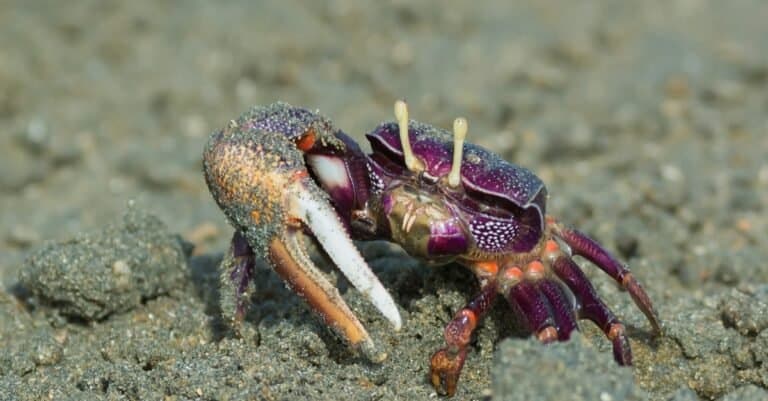
Fiddler crabs have been classified into 107 different species.
©Dave Montreuil/Shutterstock.com
The fiddler crab is in the phylum Arthropoda, subphylum Crustacea, class Malacostraca, order Decapoda, Infraorder Brachyura, family Ocypodidae, and genus Uca. There are 107 recognized species of fiddler crabs. Also known as calling crabs, they are most closely related to ghost crabs.
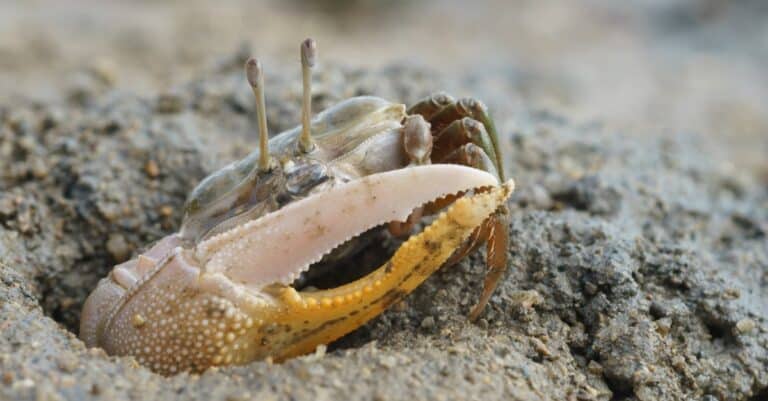
One of the adaptations that all fiddler crab species share is the enlarged claw of the male. While this claw is useful for attracting a mate, it makes him less efficient than the females when sifting through the sand for meals.
Evolution and Origins
Fiddler crabs are widespread, ranging from the Gulf of Mexico to South America, and are abundant in salt marshes, where they fulfill a significant ecological function.
Fiddler crabs, also known as calling crabs, are a group of around 107 species in the genus Uca belonging to the Decapoda order of Crustaceans, and they’re called “fiddler” due to the enlarged claw of males, resembling a violin, while females have relatively smaller claws.
Fiddler crabs have adapted well to life on land and display remarkable behavioral complexity for an invertebrate, with their mass-waving displays serving as a means of communication, and their specialized stalked eyes being well-suited for vision in a flat environment.
Species
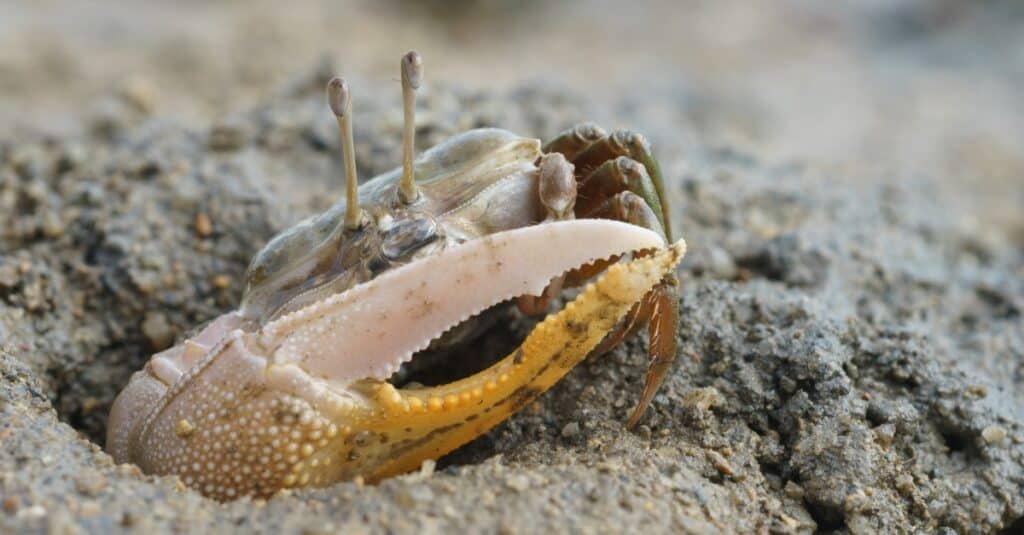
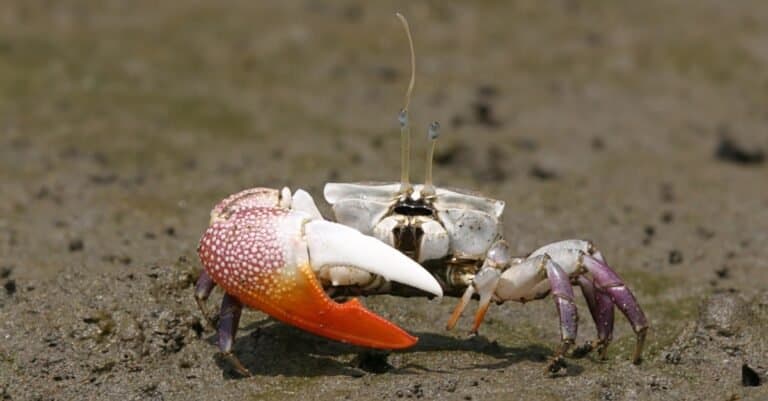
Among the 107 identified species of fiddler crabs, some of the most prevalent ones include the freshwater fiddler, spined fiddler, and panacea sand fiddler.
©abcwildlife/Shutterstock.com
Of the 107 species of the fiddler crab, a few of the most common are the freshwater fiddler, spined fiddler, and Panacea sand fiddler. The freshwater fiddler, also known as the red-jointed fiddler’s range extends from Massachusetts to the central part of eastern Florida.
It also extends from the western central coast of Florida to Louisiana. Its body, or carapace, can reach 33 mm in width. It prefers freshwater marshes and areas of low salinity and is most commonly found near the mouths of rivers.
The spined-fiddler crab lives along the Gulf of Mexico, from Tabasco, Mexico, into the United States, as far east as Alabama. Their carapace can reach a width of 23 mm. They prefer fresh to brackish water and prefer areas with clay, mud, or a mixture of clay and sand substrata. They are most commonly found in marshes and intertidal banks.
The Panacea sand fiddler lives along the Gulf of Mexico, from Panacea, in the Florida panhandle, to the Tabasco-Campeche border in Mexico. Their carapace can reach up to 18 mm in width. They are found in intertidal salt marshes and sand flats.
Appearance
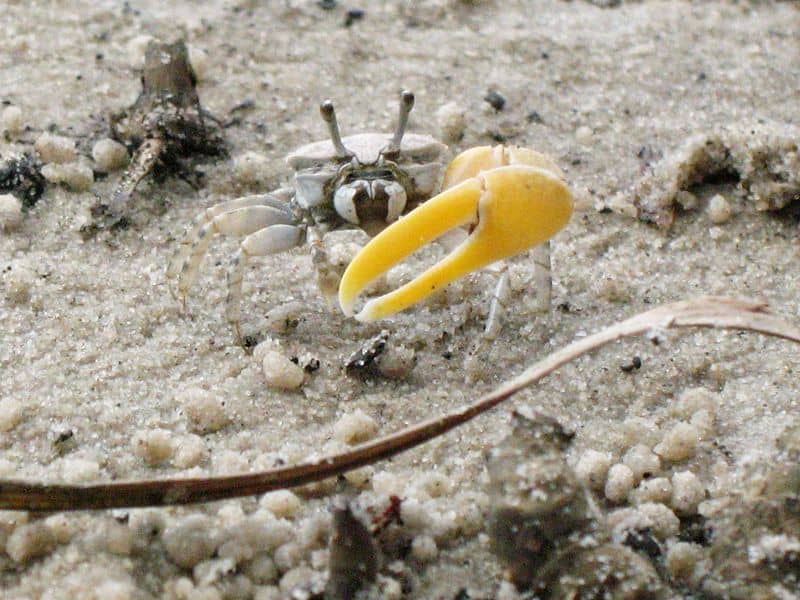
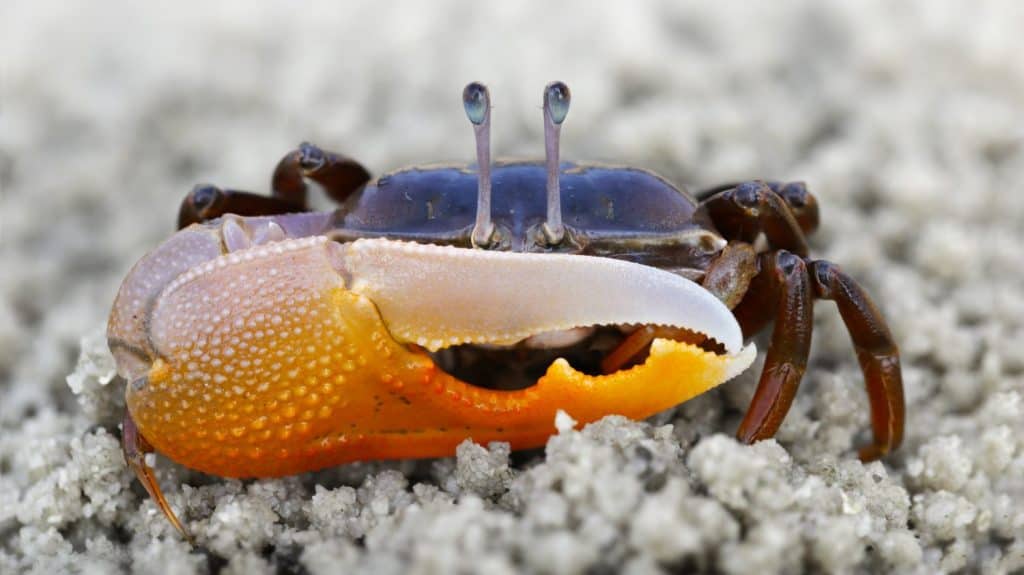
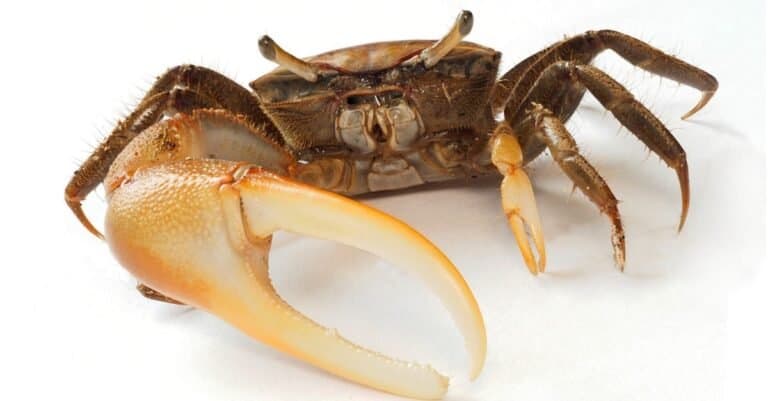
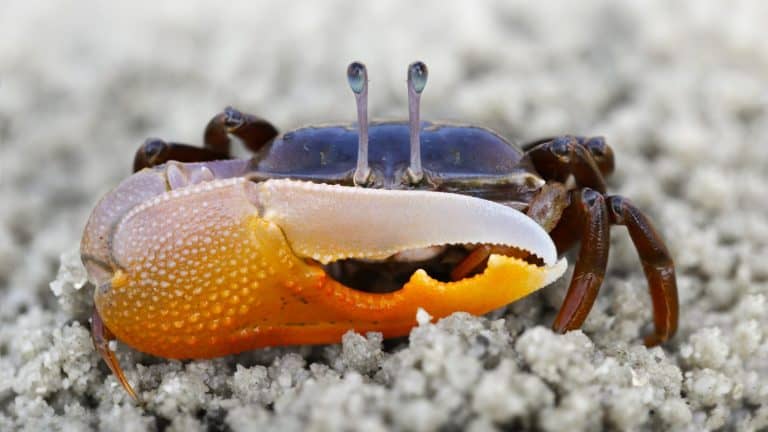
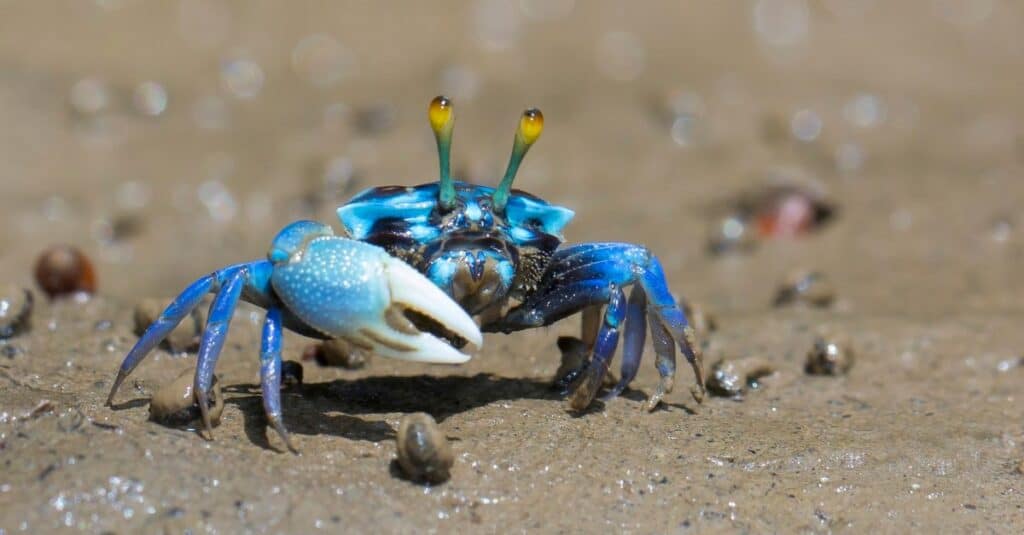
The most distinctive feature of the fiddler crab is the extreme size difference between the two claws on the male.
©Denise Chan / Creative Commons – Original
The most distinctive feature of the fiddler crab is the extreme size difference between the two claws on the male. The male waves the enlarged claw back and forth rapidly when attempting to impress a female. The female selects her mate based not only on the size of the claw but also on his “fiddling” display.
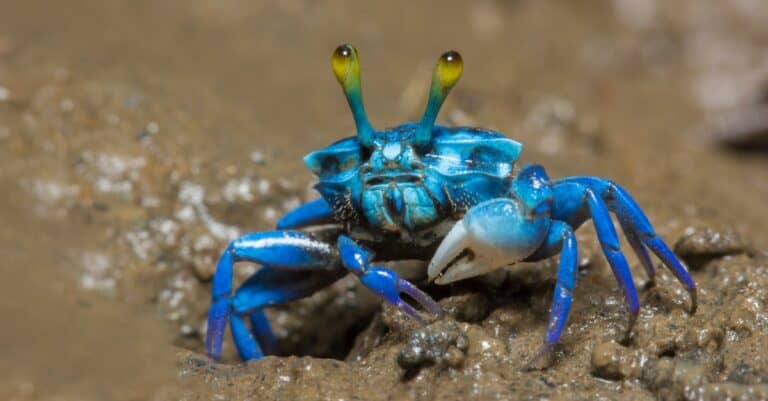
The male of the species has a brighter body, or carapace, than the female. It is typically blue to purple-gray, with brown or black spots. The females have more subdued brown or black carapaces.
The crabs have a square-shaped body, a smooth carapace, and long, slender eyestalks. The different species of fiddler crabs range from one to two inches long.
Distribution, Population, and Habitat
Fiddler crabs can be found in numerous locations worldwide, including the eastern seaboard of North America, the Gulf of Mexico, and the western coast of the Pacific Ocean.
©aDam Wildlife/Shutterstock.com
The fiddler crab lives in many areas throughout the world. In North America, they live along the eastern seaboard (the western Atlantic), the Gulf of Mexico, and the west coast (eastern Pacific). They also live in the Indo-Pacific, parts of the Portuguese coast, and West Africa.
Fiddler crabs live in areas with sandy soil or a combination of sand and clay soil. They cannot live in areas with dense clay soil, as they need to filter through the soil for food. Most prefer brackish water, which is a combination of fresh and saltwater, although some species do live in areas of pure salt or freshwater. They are most prevalent along intertidal areas in marshes and flats that provide protection and an abundant source of food.
Predators and Prey
Although raccoons will catch and eat fiddler crabs, the biggest threat to these animals comes from the sky. Egrets, herons, terns, and other waterfowl all consider the fiddler crab an excellent food source.
One of the adaptations the fiddler crab has is its ability to close off its burrow with a small scoop of mud or sand. This allows the crab to hide from predators until the threat passes. While fiddler crabs are generally territorial, when hiding from danger, they will take advantage of the nearest burrow.
Other animals do not need to worry about being eaten by the fiddler crab. Their diet is made up of bacteria, decaying plants, and algae. They use their claws and mouths to sift through the mud and sand for food.
Reproduction and Lifespan
In preparation for mating, the male fiddler crab builds a burrow. He then stands by the opening, waving his enlarged claw to attract attention from females. If the female shows interest, the male will run between her and the burrow several times until she follows him in or leaves the area.
After mating, the female remains in the burrow for two weeks, incubating eggs. At the end of this period, she leaves the burrow and releases the eggs into the water. There, they hatch and mature.
During the summer, the fiddler crabs mate every two weeks. The average lifespan of the fiddler crab is between 1 ½ and 2 years.
Male vs Female
Only the male has an enlarged claw on one side. The male is also more brightly colored than the female.
Fishing and Cooking
While this crab is edible, it is so small that it doesn’t provide much meat. Preparing the crab for eating is more trouble than it is worth. They are a good bait choice when fishing for inshore fish, such as redfish and black drum.
Fiddler Crab Pictures
View all of our Fiddler Crab pictures in the gallery.

Dave Montreuil/Shutterstock.com
Sources
- University of Southern Mississippi / Accessed October 16, 2021
- Fidler Crabs / Accessed October 16, 2021
- Kiddle / Accessed October 16, 2021