Quick Take
- One hawk in Pennsylvania makes a 4,000-mile journey every autumn, and its departure creates a sky spectacle unlike anything else in the state. See the 4,000-mile journey →
- Not all Pennsylvania hawks are migrants. Some species actually increase in number during winter, and the reason why is counterintuitive. Explore winter hawk numbers →
- One rare hawk only appears in Pennsylvania when something goes wrong far to the north, and on those occasions it arrives in waves. Learn about irruptive arrivals →
- One of these nine hawks is considered an accidental visitor, and yet it pulls off one of the longest migrations of any raptor on Earth. Discover this accidental migrant →
Pennsylvania serves as a crossroads for North American raptors, hosting a variety of resident, breeding, and migrant hawk species throughout the year. In the autumn, Pennsylvania becomes a virtual highway for thousands of migratory hawks, making the state a popular hawk-watching destination. Continue reading to learn about nine hawk species found in Pennsylvania.
Red-tailed Hawk
| Scientific name | Buteo jamaicensis |
| Color | Brown, pale, cinnamon-red, and dark |
| Weight | 1.5-3.5 pounds |
| Height | 18-26 inches |
| Wingspan | 43-56 inches |
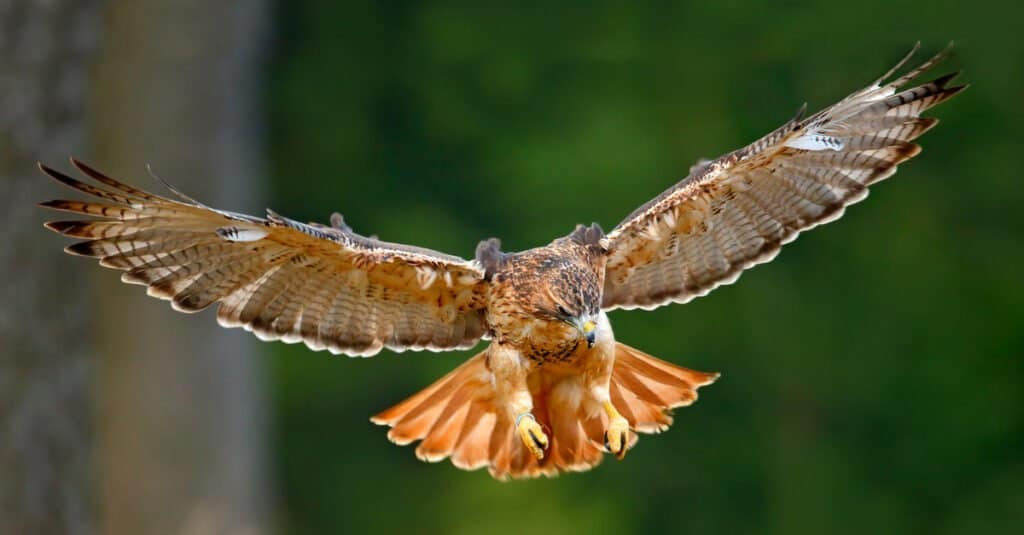
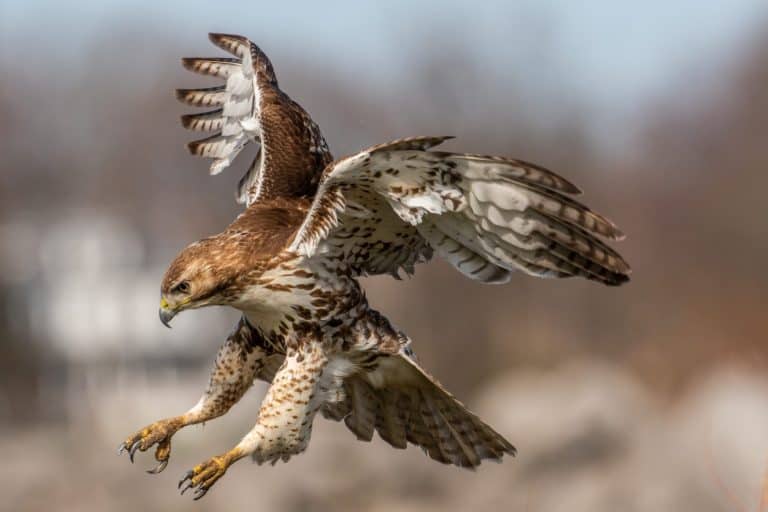
Red-tailed hawks are named for their rusty-red tails.
©Ondrej Prosicky/Shutterstock.com
Although they are permanent, year-round residents of Pennsylvania, red-tailed hawk populations fluctuate with the seasons. While local adult pairs typically defend and maintain their home territories through the winter, the state also serves as a flyway and a destination for northern travelers. During the late autumn months, red-tailed hawks from Canada migrate south into Pennsylvania to escape harsher weather, temporarily boosting the local population.
Red-tailed hawks feed on lizards, rabbits, rodents, and small animals. Upon spotting prey, the red-tailed hawk swoops down at a very high speed and grabs its meal using its talons.
Red-tailed hawks are very secretive nesters who prefer living in dense hardwood forests away from their potential predators like humans, great-horned owls, and bobcats. The female red-tailed hawk lays between one and five eggs. Both male and female red-tailed hawks take turns incubating the eggs. Young red-tailed hawks leave the nest at around six weeks old.
Broad-winged Hawk
| Scientific name | Buteo platypterus |
| Color | Black, white, reddish-brown |
| Weight | 9.3 ounces – 1.23 pounds |
| Height | 13.4-17.3 inches |
| Wingspan | 29.0-39.0 inches |
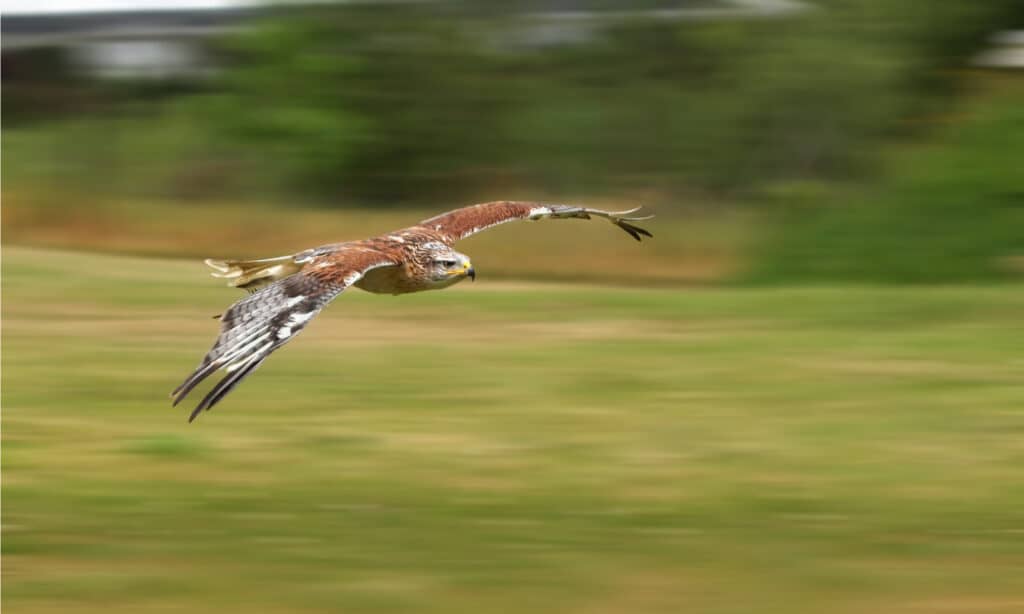
Pennsylvania is a breeding ground for broad-winged hawks.
©pr2is/Shutterstock.com
Unlike the adaptable red-tailed hawk, the entire North American population of broad-winged hawks leaves the region every autumn. Broad-winged hawks spend approximately four months in Pennsylvania during the spring and summer, breeding. By early fall, these broad-winged hawks take an incredible 4,000-mile journey south to spend the winter in the tropical forests of Central and South America. Their mass departure creates the famous, brief autumn spectacle when thousands of broad-winged hawks gather and swirl together in aerial kettles before flying south.
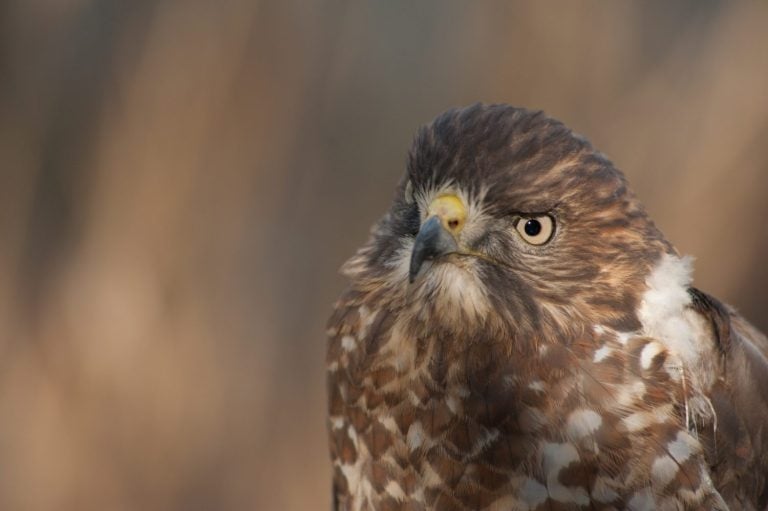
Broad-winged hawks are small and stocky. Adults have a pale underneath and a dark brown back with a dark gray to black tail. They also have broad wings, just as their name suggests. Young broad-winged hawks are whiter on their belly and chest compared to their parents.
Broad-winged hawks have a diet that changes with the seasons. They eat what is available, but their diet consists of crabs, frogs, snakes, lizards, voles, shrews, and other small birds. However, these hawks are also susceptible to predation by great-horned owls, black bears, porcupines, and raccoons.
Both males and females participate in nest building just before the breeding season. The female lays 1-4 bluish, whitish, or pale cream eggs. The female also takes care of the eggs until they hatch, which takes about a month.
Northern Goshawk
| Scientific name | Astur atricapillus |
| Color | Brown, grey, red, black, and white |
| Weight | 1.4-3.4 pounds |
| Height | 18-27 inches |
| Wingspan | 43-50 inches |

Northern goshawks are rare, year-round residents of Pennsylvania.
©Milan Zygmunt/Shutterstock.com
Pennsylvania marks the southern edge of the northern goshawk’s eastern breeding range. A small population of northern goshawks lives year-round in Pennsylvania’s northern hardwood and coniferous forests.
In years when prey populations of ruffed grouse and snowshoe hares crash in the north, northern populations of northern goshawks stage massive migrations known as irruptions. During these irruptive years, a large wave of northern goshawks flies south into the United States, significantly spiking the number of goshawks spotted across Pennsylvania woodlands.
Northern goshawks are generally bigger and more aggressive than other hawks, like sharp-shinned hawks. Their diet consists of snowshoe hares, rabbits, squirrels, crows, and other small mammals. They fly low through woods in search of prey or may opt to perch quietly in trees while listening and watching for prey.
Northern goshawks build their nests in the crotches of deciduous trees in mixed forests. Females lay 2-4 whitish, blue eggs. Males provide food as the female incubates the eggs, which may take up to 32-38 days to hatch.
Rough-legged Hawk
| Scientific name | Buteo lagopus |
| Color | Dark-brown |
| Weight | 1.32-3.66 pounds |
| Height | 18-24 inches |
| Wingspan | 52-54 inches |
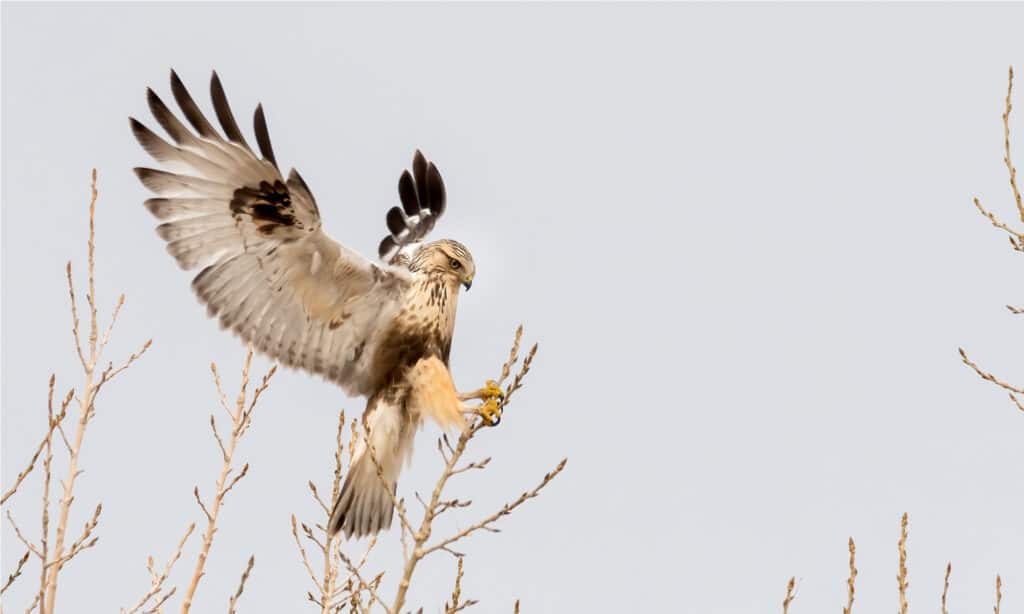
Rough-legged hawks spend summers in Alaska and Canada.
©Eivor Kuchta/Shutterstock.com
Non-breeding winter migrants, rough-legged hawks begin moving through Pennsylvania in mid-to-late October. Many choose to stay in the state throughout the winter months, before returning to their northern breeding grounds in Canada and Alaska in early spring. Rough-legged hawks are medium-sized birds of prey with wide wings. They are usually spotted in open fields and marshes. They are dark brown and boldly patterned, with dark tail tips. These hawks often hover against the wind while hunting.
Rough-legged hawks feed on voles, shrews, mice, rabbits, and ground squirrels. Raptors such as eagles and other large falcons prey on rough-legged hawks of almost all ages. Female rough-legged hawks lay two to five eggs per clutch.
Red-shouldered Hawk
| Scientific name | Buteo lineatus |
| Color | Dark, white, red |
| Weight | 1-1.7 pounds |
| Height | 15-24 inches |
| Wingspan | 37.0–43.7 inches |
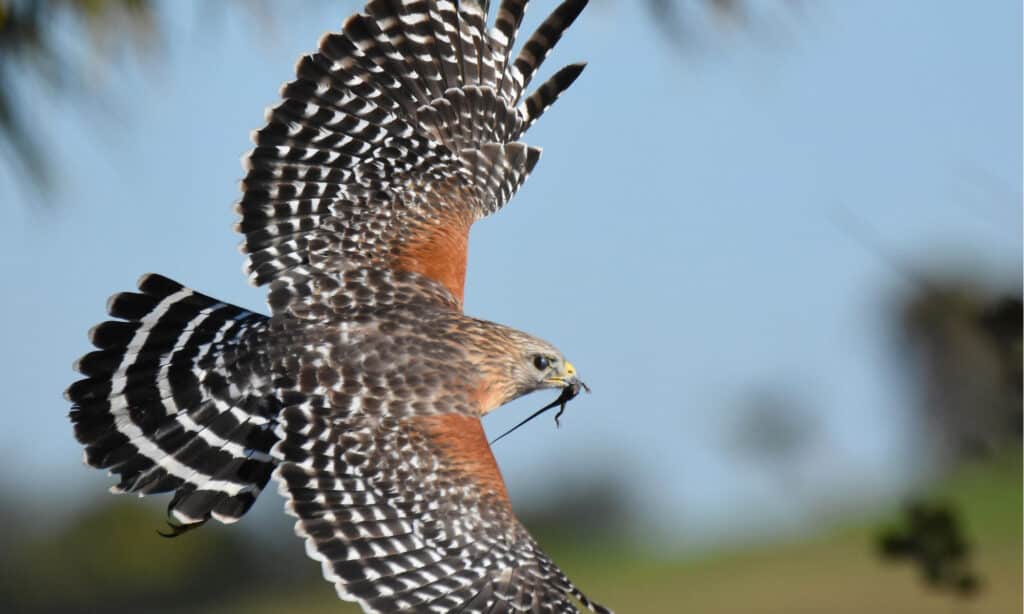
Breeding pairs of red-shouldered hawks will use the same nest year after year.
©MTKhaled mahmud/Shutterstock.com
Red-shouldered hawks are sighted in Pennsylvania year-round, hovering over swamp forests and riverine parks. They are typically found near tall trees and water. They prey mainly on mice, snakes, and frogs.
Red-shouldered hawks have distinctive reddish barring on their breasts and a strongly banded tail. They also have dark and white checkered wings. Immature red-shouldered hawks are brown on top and white underneath.
Red-shouldered hawks often reuse their nests built in deciduous forests near swamps and rivers. Females lay between two and five eggs.
Sharp-shinned Hawk
| Scientific name | Accipiter striatus |
| Color | Blue-gray, red-orange, brown, and dark |
| Weight | 2.9-7.7 ounces |
| Height | 9.1-15 inches |
| Wingspan | 17-27 inches |
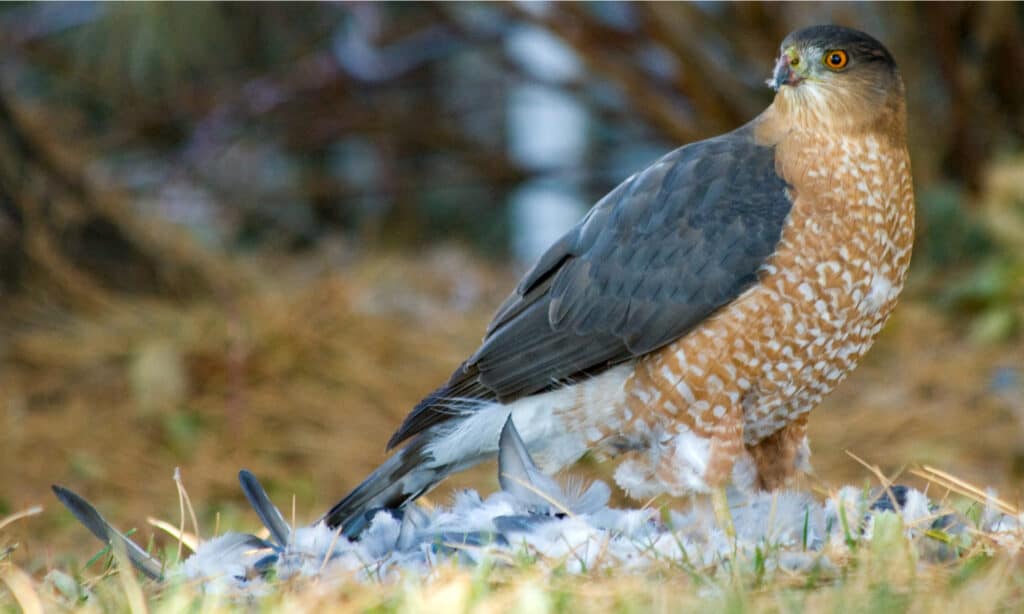
Year-round residents of Pennsylvania, sharp-shinned hawks have small heads.
©Wyatt W/Shutterstock.com
Sharp-shinned hawks are very small, long-tailed hawks with round wings. They can be sighted in Pennsylvania year-round. They have small heads that do not protrude beyond their wings. Adult sharp-shinned hawks are grayish-blue above and red-orange on their breasts. Young sharp-shinned hawks are brown with broad dark bands across their long tails, similar to adults.
Sharp-shinned hawks eat large insects, snakes, frogs, lizards, squirrels, bats, rodents, and mostly small birds. They speed through dense forests to surprise prey once they spot it. They may also pounce from low perches.
Sharp-shinned hawks live and breed in the deepest parts of the woods. They only come out during migrations and when hunting for prey along forest edges. Females lay between three and eight white or pale-blue speckled eggs.
Northern Harrier
| Scientific name | Circus hudsonius |
| Color | Gray, white, black, and brown |
| Weight | 11-27 ounces |
| Height | 21-25 inches |
| Wingspan | 41-46 inches |
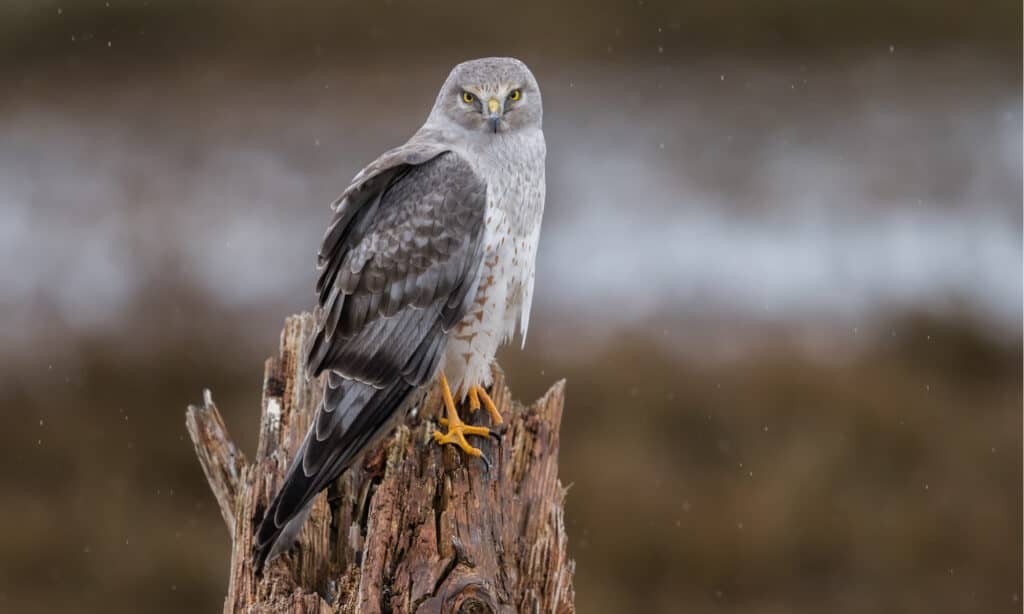
Male northern harriers are gray on top and white underneath, with a unique black-banded tail.
©Harry Collins Photography/Shutterstock.com
Northern harriers are slender, long-tailed hawks that can be found in Pennsylvania primarily during migration and winter, with only a few breeding in the state. They have a sharply hooked bill and an owl-like flattened face. They usually hover while searching for prey with their wings spread in a V-shape.
Male northern harriers are gray on top and white underneath, with a unique black-banded tail. Females have whitish undersides with brownish specks. Young northern harriers are brown with black tail tips.
Northern harriers mainly feed on smaller birds and mammals, but they can snatch bigger prey like ducks and rabbits. They live and breed in open places such as marshes, prairie grasslands, and Arctic tundra. Females lay between 4 and 5 dull white eggs.
Cooper’s Hawk
| Scientific name | Astur cooperii |
| Color | Brown, grey, white |
| Weight | 7.8-14.5 ounces |
| Height | 14-20 inches |
| Wingspan | 24.4- 35.4 inches |

The Cooper’s Hawk is one of the most widespread and common breeding hawk species across the United States.
©Aussiemandias/Shutterstock.com
Cooper’s hawks are common woodland hawks that are year-round residents in Pennsylvania. They are similar to sharp-shinned hawks, and both species are often sighted near bird feeders looking for an easy meal.
Cooper’s hawks generally eat squirrels, mice, bats, and medium-sized birds. They approach the prey through dense cover and pounce on them with a rapid, powerful flight.
These hawks build nests in beech, oak, pine, spruce, and many other tree species. Females lay 2-6 pale blue to bluish-white eggs.
Swainson’s Hawk
| Scientific name | Buteo swainsoni |
| Weight | 1.1–3.7 pounds |
| Height | 17-22 inches |
| Wingspan | 46-54 inches |

Only spotted on rare occasions in Pennsylvania, Swainson’s hawks are more often found in the central and western United States.
©Lowell Monke/Shutterstock.com
Swainson’s hawks are extremely rare visitors to Pennsylvania and are rarely sighted in the state. Their primary range is in the western and central United States, and sightings in Pennsylvania are considered accidental. Unlike the other Pennsylvania hawks described here, Swainson’s hawks are very social birds of prey that spend most of their time perched in isolated trees, fence posts, and utility wires near human dwellings. They migrate to wintering grounds in Argentina during fall. It is one of the longest migrations, offering stunning views of thousands of Swainson’s hawks soaring high in the sky.
Swainson’s hawks mainly feed on crickets, grasshoppers, and other animals they catch midair or hunt on the ground. They do not prey on other birds and are known to live harmoniously with members of their own species.
Swainson’s hawks mainly inhabit the grasslands in summer before migrating in fall. Females lay one to five eggs that take 34 to 35 days to hatch.