Quick Take
- Neon tetras' signature neon glow isn't always on, and there's a specific survival reason they switch it off entirely. See the survival reason →
- Pet store staff regularly mislabel these fish, and most buyers overlook the one key difference that tells them apart. Spot the key difference →
- Breeding Neon tetras in captivity is notoriously tricky, and most hobbyists fail because of one water condition they underestimate. Explore breeding conditions →
- You might be surprised by the scale at which Neon tetras are commercially produced and by where most of them actually come from. See the production scale →
Neon tetras are small fish that are native to clearwater and blackwater streams located in the Amazon basin in South America. This fascinating fish has a bright and reflective coloration that makes them a common choice as a pet for tropical fish keepers. You can find Neon tetras around the world in the pet trade industry, where they make great additions to tropical and freshwater aquariums with their small size, hardy temperament, and attractive coloration.
Neon tetras were first imported from South America and described by ichthyologist George S. Meyers in 1936, and were given the name ‘Neon tetras’ by William T. Innes. Although Neon tetras can be found in the wild, they are commonly distributed in the pet trade industry, where they are adored by aquarium hobbyists.

5 Facts About Neon Tetras
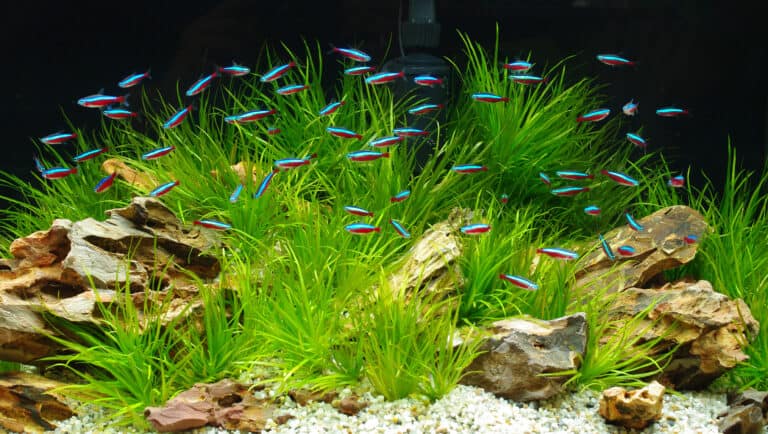
- Neon tetras are shoaling fish that do best when kept in groups of six or more. In the wild, Neon tetras can be found in very large shoals that would be difficult and expensive to replicate in the aquarium hobby.
- Neon tetras change their coloration in response to the lighting of the environment. They can dull their vibrant colors in dark waters and reactivate their coloring in well-lit environments.
- The Neon tetra is one of the most popular tropical, freshwater fish in the world in the aquarium trade industry.
- Neon tetras are often mistaken for Cardinal tetras, and these mislabeling mistakes commonly happen in pet stores. The most distinctive difference between these fish is that Cardinal tetras grow slightly larger. Since the two look so alike, it is understandable why they are often mistaken for each other.
- Neon tetras change their colors for camouflage, protection from UV radiation, and sexual selection through optical interference and chromatophore absorption on their skin cells.
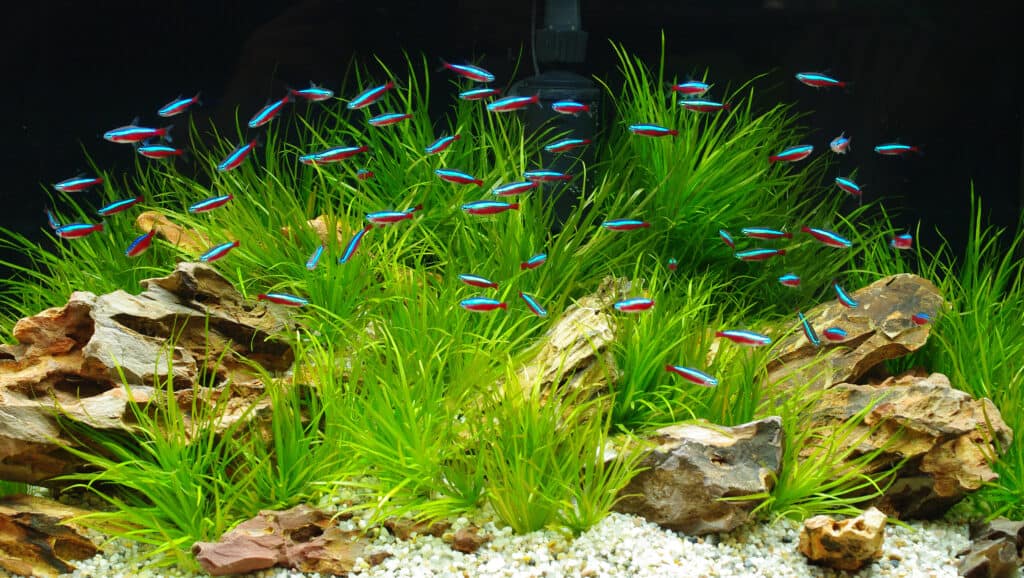
Neon tetras are shoaling fish that do best when kept in groups of six or more.
©Dobermaraner/Shutterstock.com
Classification and Scientific Name
The scientific name of the Neon tetra is Paracheirodon innesi. The genus name consists of two parts: Para, which means related to, and the genus Cheirodon. The species name, innesi, is named for the American aquarist and author William T. Innes.
Appearance
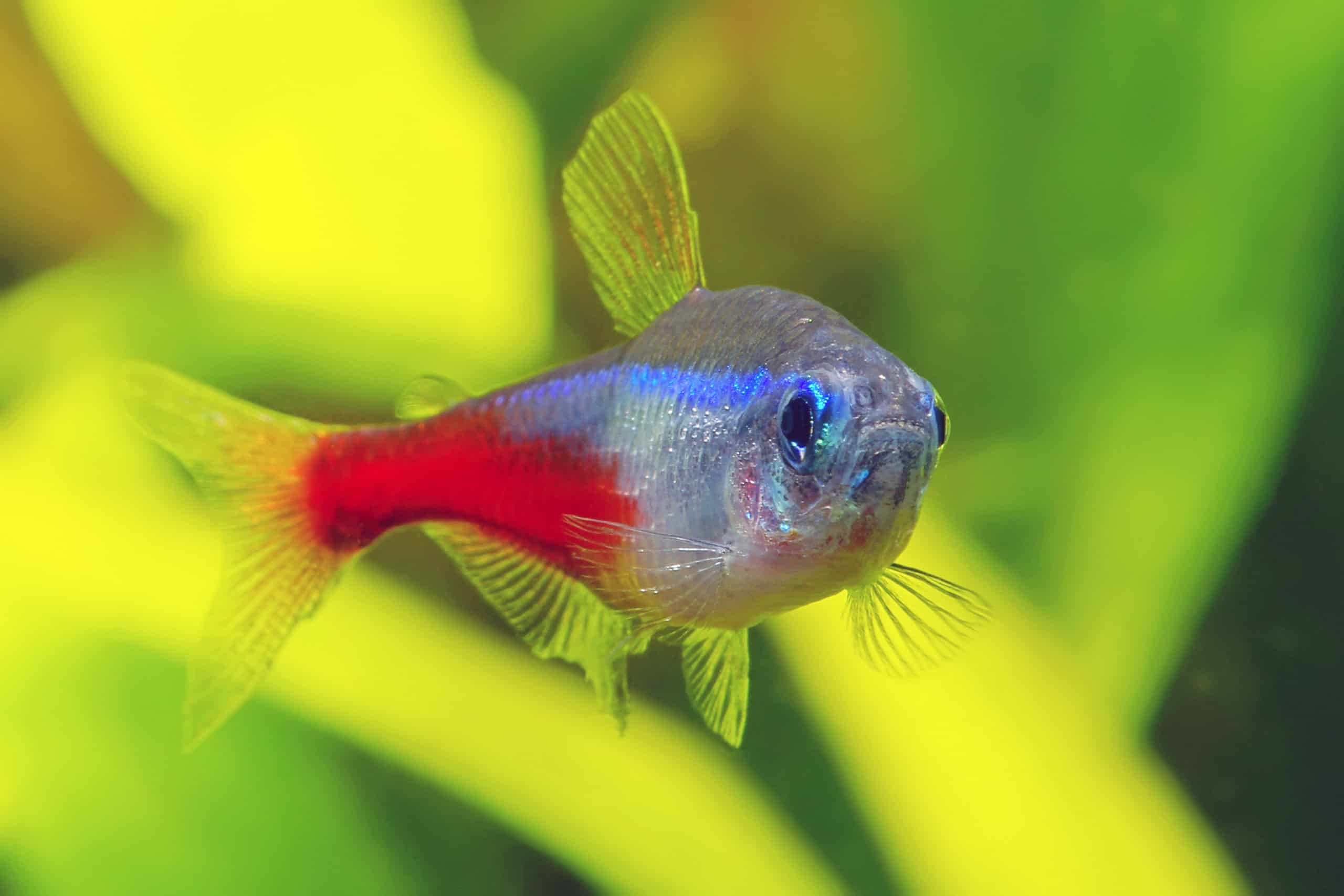
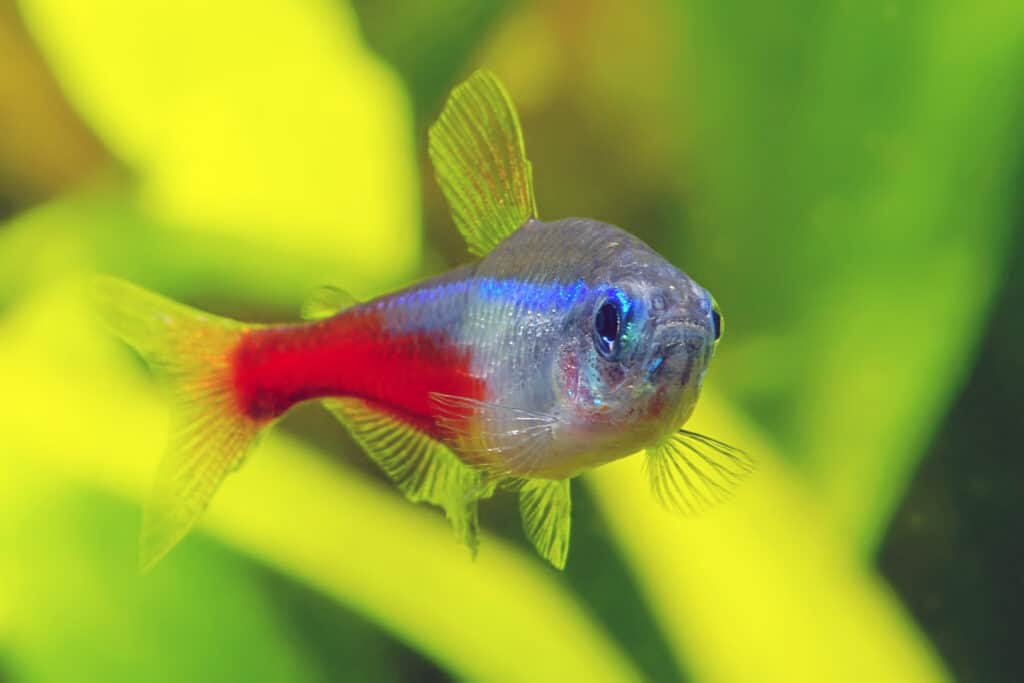
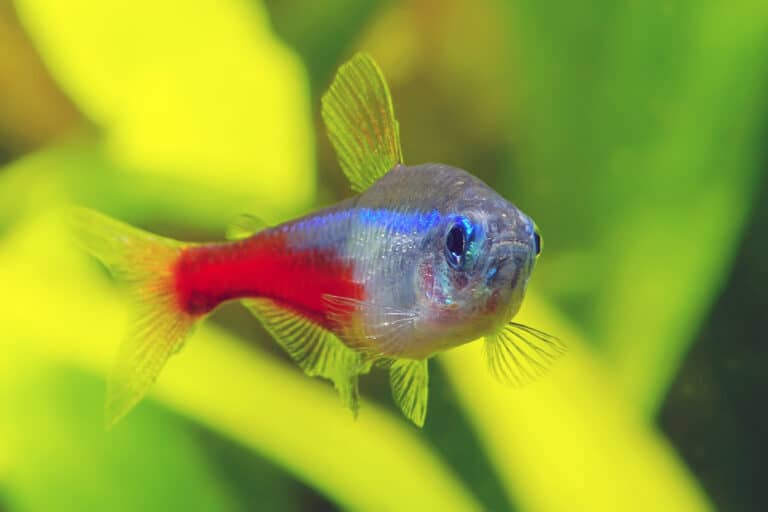
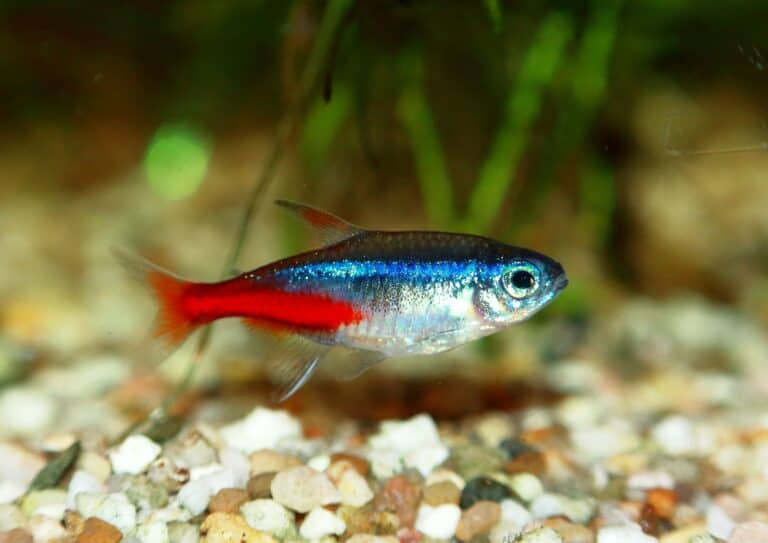
The Neon tetra has a striking appearance, which is what makes them one of the most popular aquarium fish in the aquarium trade. This fish has a small body and grows no larger than 1.5 inches (4 cm) and can come in either a long or short-fin variety. Neon tetras have a dark blue back with a silver belly, and the blue reflects light, which makes this fish appear as if it is ‘shining’.
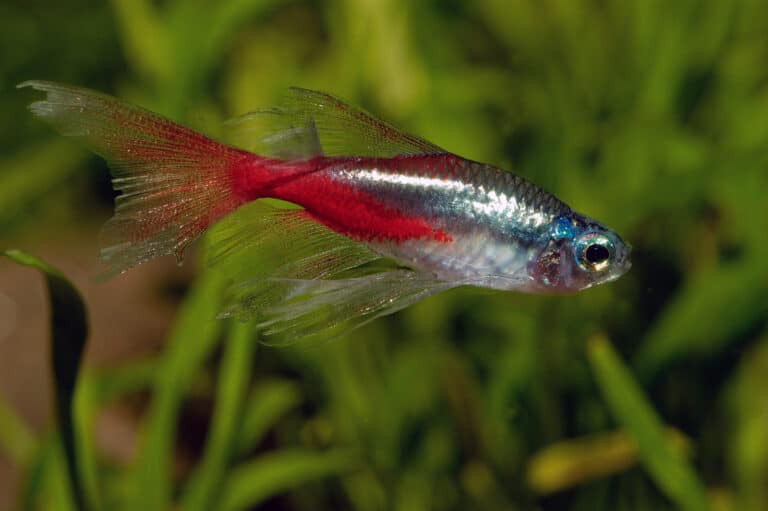
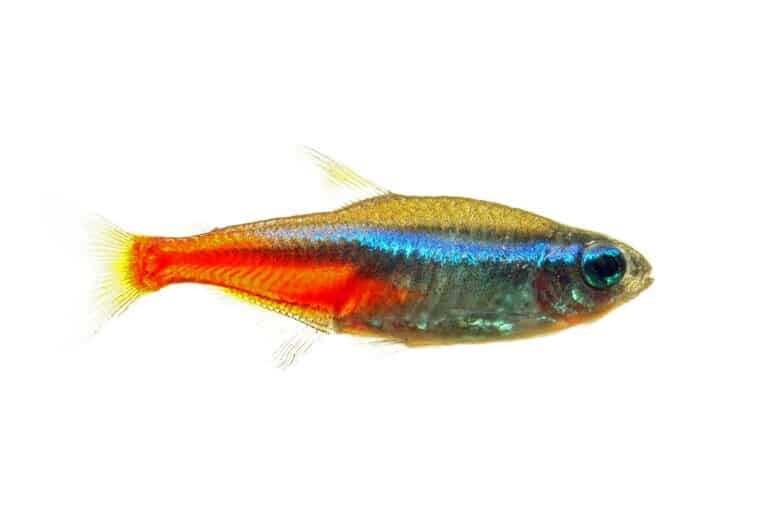
They have a distinct iridescent blue stripe that is horizontal from their head to their nose to the adipose fin. The underside of the stripe across their body is a deep ruby color, and the iridescent stripe surrounds both of the fish’s eyes, which are a deep black color. The Neon tetra gets its coloration from guanine crystals found inside their cells that reflect light.
Female Neon tetras have a slightly rounded belly in comparison to male tetras, which causes the blue iridescent stripe to appear bent. Male Neon tetras have a slim body and may appear larger.
Interestingly, the Neon tetra’s color is made more vibrant during the day, but at night the color starts to fade to a gray color so that they can blend into the darkness of the water to avoid being seen by predators. When the iridescent stripe catches the light, it appears to be blue-green, whereas in the dark it will change to a deep purplish-gray color.
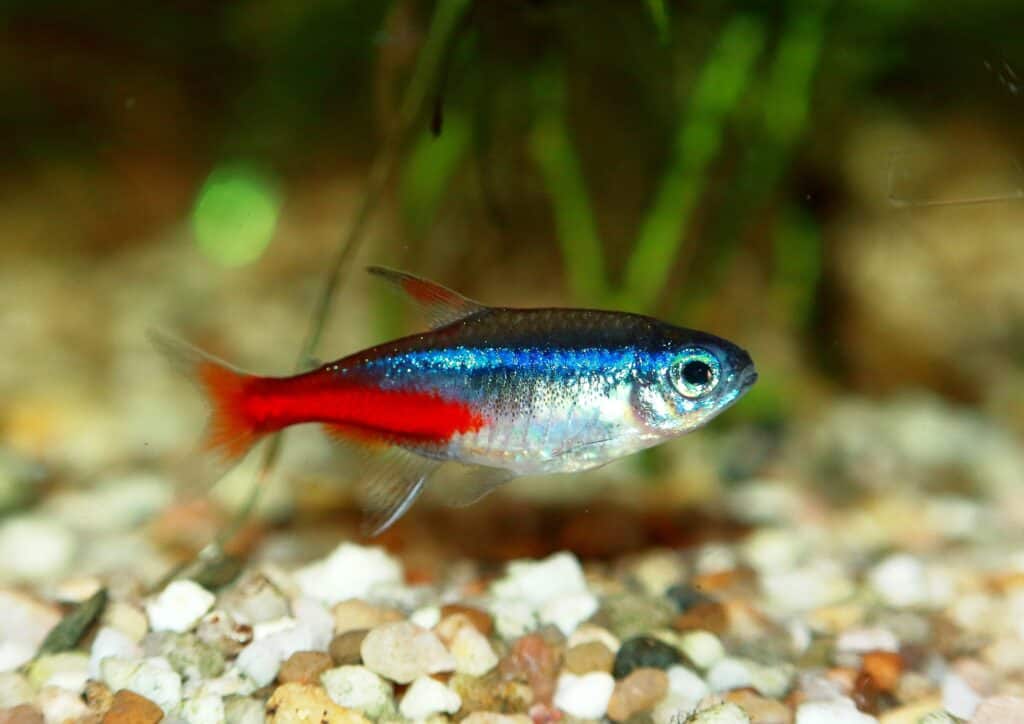
The neon tetra has a light-blue back over a silver-white abdomen and an iridescent red stripe from the middle of the body.
©Kristiana Berzina/Shutterstock.com
Distribution, Population, and Habitat
Where To Find Neon Tetras
Neon tetras can be found in both the northern and western Amazon basin, which is located in southeastern Colombia, Brazil, and Peru. Neon tetras are considered to be an introduced species in both the United States and Singapore; however, this fish species can be found worldwide because they are commonly kept as pets. Neon tetras are most commonly found in aquariums where they are bred and raised in captivity. This fish is primarily imported from large breeding facilities in Southeast Asia, where they are bred and then exported to countries worldwide.
Habitat
Neon tetras inhabit blackwater streams, and you will not find Neon tetras in whitewater streams; however, they can be found in some clearwater streams. The Amazon basin has the perfect water conditions, which are acidic and warm from 68 to 82 degrees Fahrenheit, for this fish. The Neon tetra prefers warm waters that are slightly acidic, like their natural habitat, which is why it is important to try your best to replicate their natural habitat when they are being kept in captivity.
Predators and Prey
The Neon tetra is an omnivore and eats both meat-based proteins and vegetative matter. In the wild, neon tetras will eat a variety of small worms, insect larvae, and algae. This fish will seek out food and forage through plants, woods, rocks, and substrate for any morsels of food.
Neon tetras prefer to be in shoals rather than alone, as the shoal of fish seek safety with one another and work together to find food. Being in a large shoal also helps keep these fish secure from predators, including larger fish inhabiting the Amazon basin.
They are also considered to be prey to aquarium fish in captivity, which makes it important to keep these fish with other suitable tank mates. Neon tetras will change their coloration in response to the lighting in the surrounding environment, primarily to appear less eye-catching to predators at night.
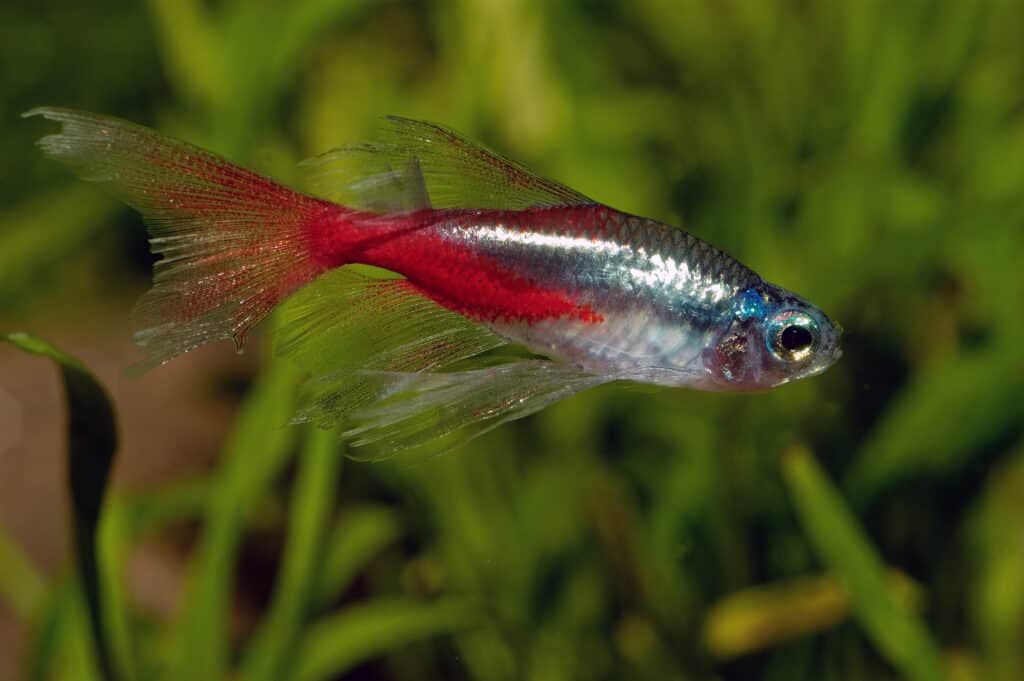
The Neon Tetra is found in the shortfin and longfin varieties.
©NERYXCOM/Shutterstock.com
Reproduction and Lifespan
Neon tetras breed best with lots of tannins in the water, acidic water parameters, and a temperature around 75 degrees Fahrenheit. This can be difficult to replicate in captivity; however, their natural habitat produces the perfect conditions for a Neon tetra to breed.
Neon tetras can breed when they are in dim-lit environments and have a water hardness that is less than one. Neon tetras in the wild and captivity can begin breeding at 12 weeks of age, once they have reached sexual maturity. Males will seek out the females, which makes it important to have a large shoal of these fish in a mixed female and male ratio if you want successful breeding behavior.
Neon Tetra Population
An estimated 1.8 to 2 million Neon tetras are sold in the United States each month, with the vast majority bred in captivity, primarily in Southeast Asia, rather than collected from the wild. Many Neon tetras found in pet stores today are bred on fish farms in Southeast Asia and then sold through the aquarium trade in the United States and other continents. Commercial-scale breeding in the United States is limited and most hobbyist breeding is on a small scale.
Neon Tetra Pictures
View all of our Neon Tetra pictures in the gallery.

Grigorev Mikhail/Shutterstock.com
Sources
- Wikipedia / Accessed July 16, 2022
- Aquarium Nexus / Accessed July 16, 2022
- Aquarium Source / Accessed July 16, 2022