
P
Species Profile

Parti Schnauzer

Canis lupus familiaris

Big beard, bold heart, bright patches.
Stephanie Frey/Shutterstock.com

Parti Schnauzer Distribution

Click a location to explore more animals from that region

Origin Location

This map shows the native origin of the Parti Schnauzer. As a domesticated species, they are now found worldwide.

Loading map...

Found in 1 country

Size Comparison

Human 5'8"
Parti Schnauzer 1 ft 1 in

Parti Schnauzer stands at 19% of average human height.

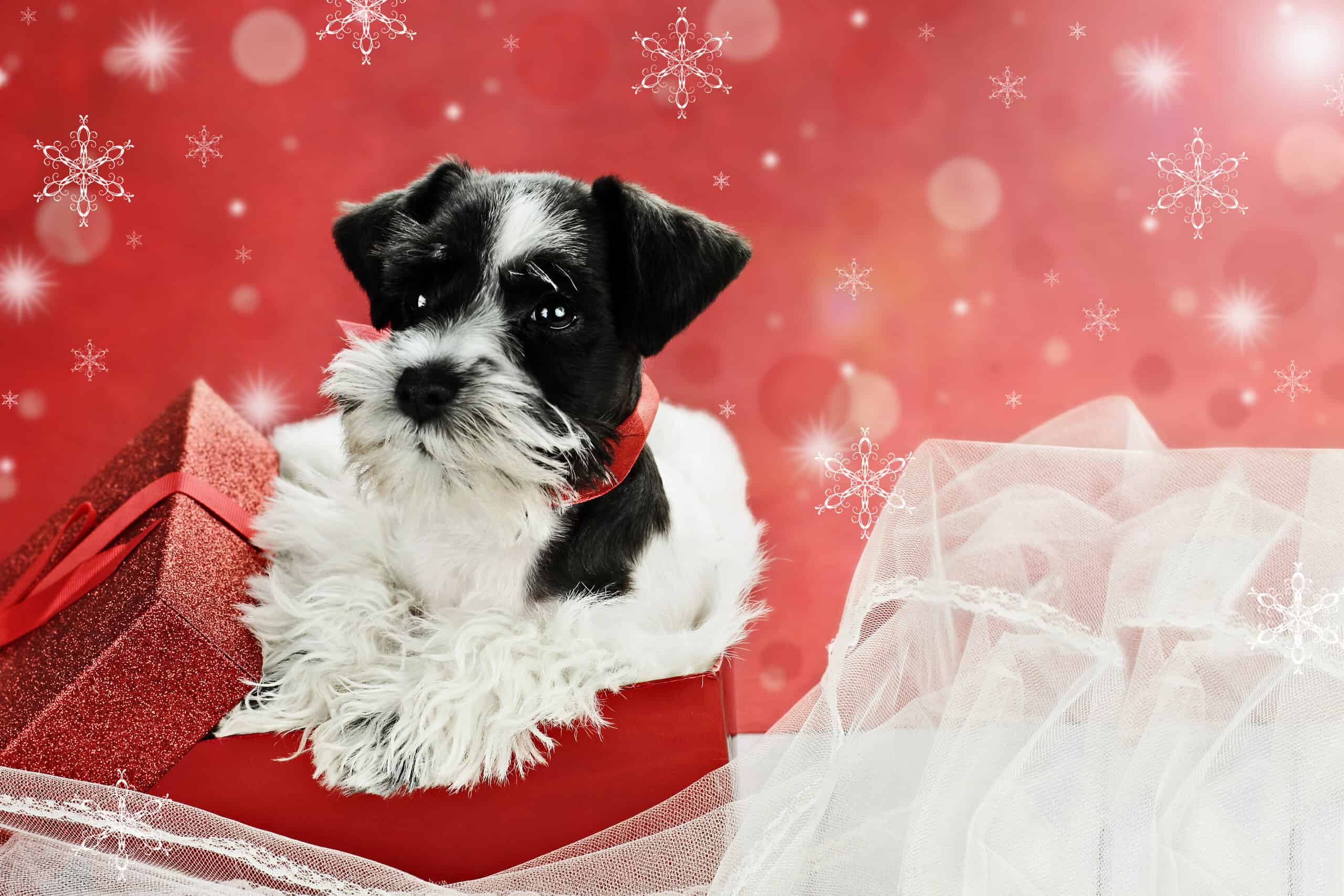
A black and white Parti Schnauzer puppy with red-wrapped gifts against a red holiday background

At a Glance

Domesticated
Diet Omnivore
Activity Diurnal+
Lifespan 13.5 years
Weight 9 lbs
Status Not Evaluated
Did You Know?

"Parti-color" means a mostly white coat with clearly defined darker patches, typically caused by piebald spotting genes.

Scientific Classification

A domestic dog (Miniature Schnauzer type) described by a parti-color coat pattern (white base with distinct darker patches). This is a coat-color descriptor used in the dog fancy/pet trade rather than a separate breed or species.

Kingdom
Animalia
Phylum
Chordata
Class
Mammalia
Order
Carnivora
Family
Canidae
Genus
Canis
Species
Canis lupus

Distinguishing Features

  • Schnauzer-type build with characteristic beard/mustache and eyebrows
  • Small-to-medium size consistent with Miniature Schnauzer
  • Parti coloration: predominantly white coat with well-defined patches of black, salt-and-pepper, or other colors
  • Typically wiry/double coat typical of Schnauzers (may vary by grooming and lineage)

Did You Know?

"Parti-color" means a mostly white coat with clearly defined darker patches, typically caused by piebald spotting genes.

Parti-colored Miniature Schnauzers are the same breed type as Miniature Schnauzers; many major registries recognize the breed but may not accept parti as a show color.

The iconic "beard" and "eyebrows" are groomed features that amplify the breed's naturally wiry facial furnishings.

Miniature Schnauzers were developed in Germany from small wire-haired farm dogs used as ratters and watchdogs-compact size was an advantage in stables and barns.

Compared with gray wolves, Miniature Schnauzers show extreme size reduction, juvenile-like social traits, and strong human-directed bonding typical of domestication.

The breed is known for a "Schnauzer alert": quick vocal signaling when something changes in their environment.

Miniature Schnauzers are among breeds predisposed to lipid disorders; diet management can be an important part of lifelong care.

Unique Adaptations

  • Wiry, low-shedding coat texture (when maintained) that offers some protection from brambles and weather-distinct from the wolf's seasonal double-coat shedding patterns.
  • Pronounced facial furnishings (beard/eyebrows) help channel water and debris away from eyes/muzzle; grooming enhances this functional "shield."
  • Compact, muscular build optimized by selective breeding for agility in tight farm spaces-contrasting the endurance-travel morphology of wolves.
  • Parti-color (white base with patches) increases visual contrast and individuality; it's a cosmetic trait valued in the pet trade rather than a working adaptation.
  • High human-social responsiveness: strong sensitivity to human cues and routines, a hallmark of domestication in domestic dogs.

Interesting Behaviors

  • Alarm-barking and "patrolling" windows/doors like a tiny sentry-classic watchdog behavior in a companion-sized dog.
  • Ratting instincts: sudden pounces, head-tilts, and intense focus on small moving objects (toys can trigger the same chase routine).
  • "Beard checking": using the whiskered muzzle to investigate scents and textures; many will nudge, sniff, then visually re-check you.
  • Owner-shadowing: following favored people room-to-room, reflecting strong social attachment typical of domestic dogs vs. wild canids.
  • Fast learning with a mischievous streak-many test boundaries unless training is consistent and reward-based.
  • Interactive vocalizations (grumbles, chirps, and barks) used to solicit attention, play, or access to guarded resources (doors, food, toys).

Cultural Significance

Parti-colored Miniature Schnauzer (Canis lupus familiaris) links to German farm dogs used for pest control and warning. Today they are bearded, groomed companions. Parti-color matters mainly to breeders and owners, showing tension between strict color rules and owner preference for variety.

Myths & Legends

Name lore in Germany ties "Schnauzer" to a German term meaning "snout/muzzle," a nod to the breed's distinctive bearded face that became its signature in stories and show-ring talk.

A frequently repeated historical anecdote credits a late-19th-century German show dog named "Schnauzer" with popularizing the breed's modern name after dog exhibitions in Germany.

Traditional European stable-dog tales often cast bearded ratters as little guardians of barns-dogs said to "keep the spirits out" by keeping vermin away and sounding the alarm at night.

Across broader European folklore about dogs (the species context Miniature Schnauzers belong to), black or watchful dogs appear as threshold guardians-creatures that warn of danger, escort travelers, or stand between home and the unknown.

In Norse tradition, the hound Garm guards the realm of the dead; such stories shaped a long-standing idea of dogs as steadfast sentinels-an image that resonates with the Schnauzer's vigilant temperament today.

Conservation Status

NE Not Evaluated

Has not yet been evaluated against the criteria.

Population Stable

Life Cycle

Birth 4 pups
Lifespan 14 years

Lifespan

In the Wild
12–15 years
In Captivity
8–16 years

Reproduction

Mating System Polygyny
Social Structure Managed Domestic
Breeding Pattern Transient
Fertilization Managed Selective
Birth Type Managed_selective

In parti-colored Miniature Schnauzers, reproduction is typically human-managed: selected studs may sire multiple females, with brief mating access and no lasting pair bond. Copulation uses internal fertilization; parental care is almost entirely maternal, with limited male involvement.

Behavior & Ecology

Social Pack Group: 3
Activity Diurnal, Crepuscular, Cathemeral
Diet Omnivore Meat-forward complete dog food (often poultry or beef-based kibble/wet food) with controlled fat and measured portions.

Temperament

Alert, people-oriented companion; typically forms intense attachment to one or two handlers.
Terrier-influenced boldness: confident, inquisitive, and quick to investigate novel sounds or movement.
High watchdog tendency; prone to frequent alarm barking without early reinforcement of quiet cues.
Playful and trainable with structure; excels at obedience, rally, scent work, and trick training.
Can be reserved with unfamiliar dogs/strangers; benefits from early, positive social exposure.
Distinguishes from base species (wolf): selected for human-directed sociability, reduced roaming, and cooperative handling.
Health concerns (breed-typical): pancreatitis risk, hyperlipidemia, diabetes, bladder stones, skin issues.
Care requirements: regular grooming/hand-stripping or clipping; consistent exercise and mental work to curb reactivity.
HUBS: commonly vigilant, vocal, and owner-focused; variation by line in sociability and prey drive.

Communication

Sharp, repetitive alert barking to announce visitors or novel noises.
Low growls for boundary-setting during handling, guarding, or rough play escalation.
Whines and yips to solicit attention, food, or access to desired spaces.
Soft grumbles/"talking" during play or when anticipating routines.
Howl-like vocalizations occasionally triggered by sirens or group excitement.
Forward posture, fixed stare, and raised hackles when suspicious; de-escalates with handler guidance.
Play bows, bouncing gait, and pawing to initiate interaction with people or dogs.
Scent marking and investigative sniffing; may mark more on walks, especially males.
Ear set and tail carriage changes signal confidence vs. uncertainty; watch for stiff, high tail.
Mouthiness on toys and gentle grabbing of sleeves/leads when over-aroused; redirect to chew/toy.

Habitat

Biomes:
Temperate Forest Boreal Forest (Taiga) Tundra Alpine Temperate Grassland Mediterranean Desert Hot Desert Cold Savanna Tropical Dry Forest Tropical Rainforest Freshwater Wetland Marine +8
Terrain:
Plains Hilly Valley Coastal Mountainous Plateau Island Riverine +2
Elevation: Up to 16404 ft 3 in

Ecological Role

Human-associated domestic omnivore and companion animal (a domesticated wolf lineage), historically also a small-game/rodent-control dog.

rodent/pest deterrence in homes and farms (behavioral/territorial presence and occasional predation) companionship and social support (therapy/service roles in some individuals) alarm/alert function (barking at intruders/novel stimuli) participation in human-managed nutrient cycles via consumption of commercial foods and occasional scavenging of human waste/food scraps

Diet Details

Main Prey:
Dog food Animal protein Carbohydrate and fiber ingredients
Other Foods:
Grains/starches Vegetables Fruits Fiber sources grass

Human Interaction

Domestication Status

Domesticated

Canis lupus familiaris (domestic dog) is a wolf subspecies shaped by long human breeding. A Parti-colored Miniature Schnauzer is a Miniature Schnauzer with a mostly white coat and dark patches, not a separate breed. Bred for small size, a friendly, alert nature, and a wiry coat; needs regular grooming and vet care.

Danger Level

Low
  • minor bite or nip risk if fearful, under-socialized, or handled roughly (common small-dog risk factor)
  • reactive barking/guarding behaviors can escalate without training and socialization
  • scratches during play or grooming handling
  • allergen exposure (dander/saliva) for sensitive individuals

As a Pet

Suitable as Pet

Legality: Generally legal as a pet wherever domestic dogs are allowed; subject to local licensing, leash laws, vaccination requirements, and housing/HOA rules. Breed-specific bans rarely target Miniature Schnauzers, but local regulations vary.

Care Level: Moderate

Purchase Cost: $800 - $3,500
Lifetime Cost: $18,000 - $45,000

Economic Value

Uses:
Companion animal ownership Breeding and sale (pet trade/dog fancy) Professional grooming services Veterinary services (preventive and chronic care) Training services Pet products and supplies
Products:
  • puppies (pet and hobby-breeder markets; parti-color often marketed as a specialty appearance)
  • grooming (clipping/hand-stripping, bathing, coat-care products)
  • training classes (basic manners, reactivity management, sports foundations)
  • veterinary screening and management (dental care, lipid panels, pancreatitis/urinary support)
  • pet insurance policies and wellness plans
  • accessories (leashes, harnesses, enrichment toys)

Relationships

Ecological Equivalents 7

Animals that fill a similar ecological role in their ecosystem

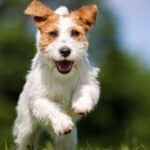
Jack Russell Terrier
Jack Russell Terrier Canis lupus familiaris Small, energetic companion with strong vermin-hunting instincts; comparable exercise and enrichment needs and a tendency toward alert, barky behavior.
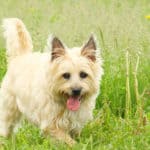
Cairn Terrier
Cairn Terrier Canis lupus familiaris Historically used for small-game and rodent control in and around farms. Shares Miniature Schnauzer–type 'ratter' behaviors (prey drive, digging, alertness).
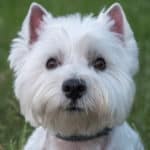
West Highland White Terrier
West Highland White Terrier Canis lupus familiaris Small companion/ratter niche. The parti-colored Miniature Schnauzer's distinctive look similarly revolves around coat appearance in the pet/fancy context — a white-based coat with darker patches — though the Schnauzer's coat is typically wiry and requires frequent grooming.
Rat Terrier
Rat Terrier Canis lupus familiaris Functional overlap as a household and barn vermin controller. Similar prey-chasing tendencies mean secure fencing, reliable leash training, and controlled introductions to small pets are important.
Poodle
Poodle Canis lupus familiaris Toy and miniature varieties. Comparable companion role and grooming commitment, including regular professional grooming, coat maintenance, and ear care. Both are highly trainable and benefit from mental stimulation such as nose work and tricks.
Domestic cat
Domestic cat Felis catus Shares the urban/suburban companion niche and overlaps in small-prey predation around homes (rodents, small birds). Practical care parallels: dental disease prevention and weight management are common concerns.
Parti-colored Miniature Schnauzer
Parti-colored Miniature Schnauzer Canis lupus familiaris A coat-color variant of the Miniature Schnauzer, not a separate breed; it shares the same size and traits as other Miniature Schnauzers. Requires regular grooming, dental care, weight control, and monitoring for increased risks of pancreatitis, diabetes, urinary stones, and eye and skin problems.

Quick Take

  • Parti Schnauzers aren't actually a breed, which is a distinction that matters more than most owners realize before they buy.
  • They barely shed, yet skipping one specific grooming step can leave your dog in serious pain. See grooming details →
  • Their friendly, trainable personality hides a hardwired instinct that makes them a threat to some household pets. Explore their prey drive →
  • A reputable breeder should hand you specific paperwork at pickup, and any refusal to do so is a red flag you need to know about. Check breeder screening advice →

Parti Schnauzers are not a specific type of Schnauzer; they are a very rare color pattern consisting of a predominant base color with white patches throughout.

The parti base colors include black, liver (chocolate), salt and pepper, and black and silver. The word “parti” can be placed in front of any other color because it literally means “with white patches.”

Their fur has two layers — a soft undercoat and a wiry topcoat — which means they don’t shed a lot, but still need frequent grooming; otherwise, their topcoat will start to tangle, which can be very painful if left unattended for too long. The breed originates from Germany but has since spread worldwide.

A detailed infographic about Parti Schnauzers featuring illustrations of different coat colors, a list of pros and cons, and charts for size, temperament, and health issues.
It’s a genetic lottery with a striking look, but owning one comes with a unique set of high-stakes health and grooming demands. Discover why this rare pattern isn't what most owners think it is. © A-Z Animals

3 Pros and Cons of Owning a Parti Schnauzer

Pros
Extremely intelligent and easy to trainThe breed is prone to liver issues
Adaptable and friendlyThey have oily skin and will need regular grooming
Doesn’t shed muchCan become obese if not fed and exercised properly

The Best Dog Food For Parti Schnauzers

Parti schnauzers are small and don’t need to eat a lot. One cup of kibble a day is all they need. However, this does vary according to their size and energy levels. So, it’s best to speak to your local veterinarian about how much food to give them.

If a raw diet is out of the question, it’s best to find a high-quality kibble. Kibble can be advantageous because it helps to remove plaque from their teeth. But nutrition is vital, so stick to dog food that is high in protein and low in carbs and fillers.

Size and Weight

SexHeightWeight
Male12 to 14 inches14 to 16 pounds
Female11 to 14 inches13 to 15 pounds

Common Health Issues

These fluff balls are generally healthy dogs; if cared for properly, they can live up to 12 to 15 years. However, parti schnauzers are prone to some health conditions, which include:

When buying a parti schnauzer from a breeder, they should provide test results that prove your pup has been screened for all these diseases. Breeders who refuse to provide you with the necessary certificates are not reputable, so always be wary.

Temperament

The Parti Schnauzer shares the same temperament as the Miniature Schnauzer. They are playful, loyal, obedient, friendly, and affectionate.

In addition, they are highly intelligent and are easy to train. Because they were originally bred to catch rodents and other pests on farms, they have a high prey drive. Parti schnauzers can be very vocal and make excellent watchdogs.

They get along well with other dogs but should be socialized from a young age. However, because they are prey-driven, they will attack other pets like hamsters, rats, mice, and rabbits.
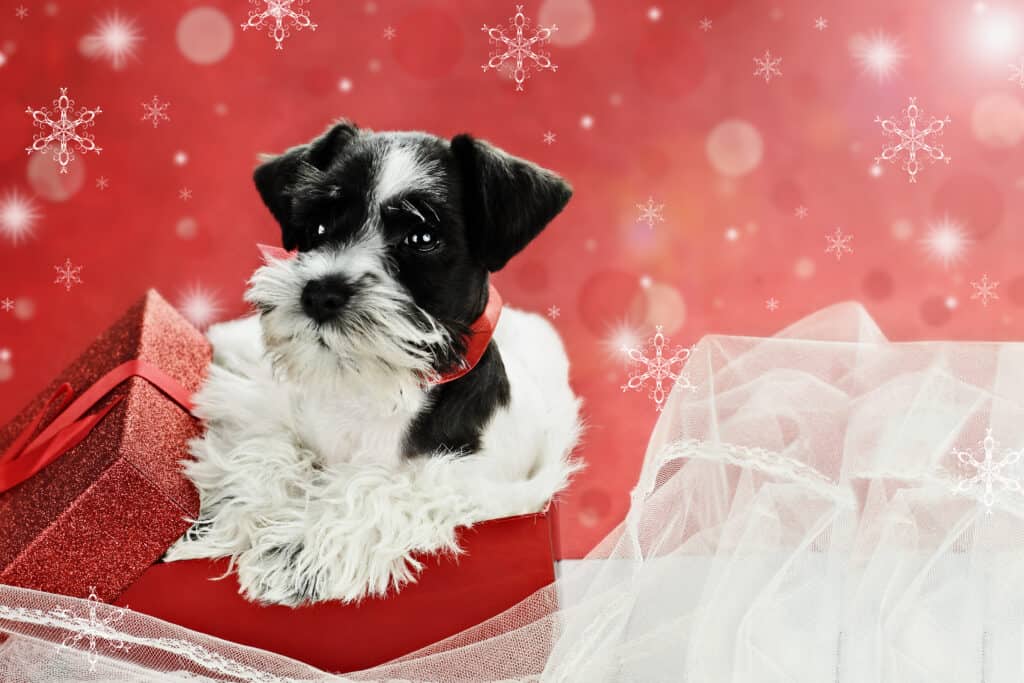
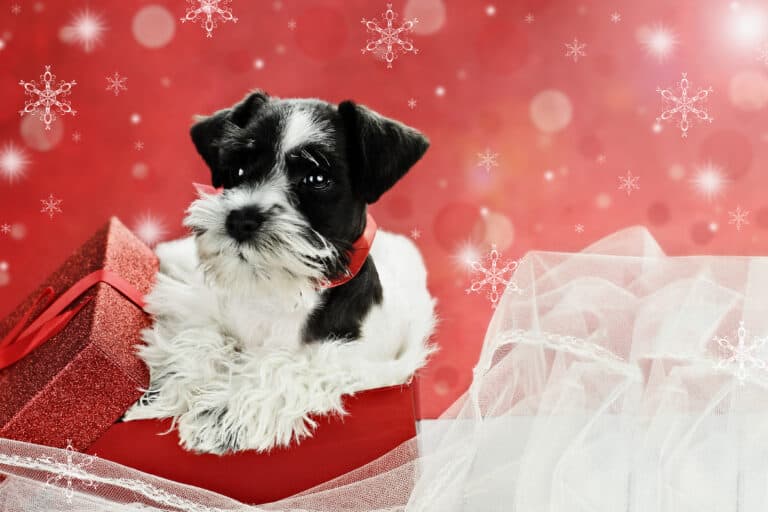
A black and white Parti Schnauzer puppy with red-wrapped gifts against a red holiday background

“Parti” is a rare color pattern with white patches between a predominant base color.

How to Take Care of Parti Schnauzers

Luckily, parti schnauzers are generally healthy dogs and don’t shed a lot. However, they do need proper care to reach old age.

Maintenance And Grooming

Just because they don’t shed a lot doesn’t mean they don’t need to be groomed. To avoid tangles and matting, they must be brushed daily.

Additionally, they require a bath at least once a month due to their oily skin. Finally, they need to have their nails clipped every 6 to 8 weeks to keep them comfortable.

Training

Because parti schnauzers are so intelligent, they are easy to train and always want to please their owners. However, they sometimes get bored with repetitive training.

Instead, consider agility training, obedience training, and rally competitions. Additionally, positive reinforcement plays a significant role in their training.

Exercise

Parti schnauzers generally have a medium energy level and must exercise daily. This could include a brisk walk, backyard playtime, or a game of fetch with a ball or Frisbee.

Puppies

Parti Schnauzer puppies are truly adorable bundles of fur. They are easy to train and get along well with other dogs. However, they can be very vocal and must be trained from a young age.

Parti Schnauzers and Children

These furballs make excellent family pets. But just because they are good with older children does not make them suitable for all families. Some people won’t be able to tolerate their big personalities and tendency to chew on anything and everything.

As with any breed, young children should be supervised around dogs, and children should be taught to treat pets gently to avoid startling or upsetting them.

Always remember that these dogs were bred to eliminate pests, so it’s important to have a secure yard, as they could escape while chasing prey.

Dogs Similar to Parti Schnauzers

Several breeds are similar in size to the Parti Schnauzer, including:

View all 246 animals that start with P

Sources

  1. The Happy Puppy Site / Accessed August 8, 2022
  2. Prefurred / Accessed August 8, 2022

Chanel Coetzee

About the Author

Chanel Coetzee

Chanel Coetzee is a writer at A-Z Animals, primarily focusing on big cats, dogs, and travel. Chanel has been writing and researching about animals for over 10 years. She has also worked closely with big cats like lions, cheetahs, leopards, and tigers at a rescue and rehabilitation center in South Africa since 2009. As a resident of Cape Town, South Africa, Chanel enjoys beach walks with her Stafford bull terrier and traveling off the beaten path.
Connect:

Thank you for reading! Have some feedback for us?


Parti Schnauzer FAQs (Frequently Asked Questions)

Parti Schnauzers are not a specific type of Schnauzer; it’s a very rare color pattern consisting of a predominant base color with white patches in between.