
Nestled between the Deep South and the Atlantic Ocean, Georgia is famous for its natural beauty. The Peach State is also home to an impressive 47 different snake species. While this may sound alarming for some, only 7 of these snakes are venomous; the rest are practically harmless to people.
That being said, there is some similarity between a few of the venomous snakes and certain non-venomous ones. This can lead to some confusion and worry, and, in rare cases, tragedy.
Even though no snake in Georgia goes out of its way to hurt humans, that chance goes down even more if one takes the time to learn about them and is cautious in the wild. We hope to aid the people of Georgia and anyone traveling, thereby giving a brief lesson on some of the snakes that call it home.
Venomous Snakes in Georgia
Georgia is home to seven venomous snake species. Venomous snake species in the state include:
- Cottonmouth
- Florida Cottonmouth
- Timber Rattlesnake
- Eastern Diamondback Rattlesnake
- Copperhead
- Pygmy Rattlesnake
- Eastern Coral Snake
While the first five of these venomous snakes are all vipers, coral snakes have a unique appearance in both color and body structure that separates them from other venomous snakes you’ll find in the state. Let’s dive into a few of the venomous snakes found throughout Georgia.
Eastern Diamondback Rattlesnake
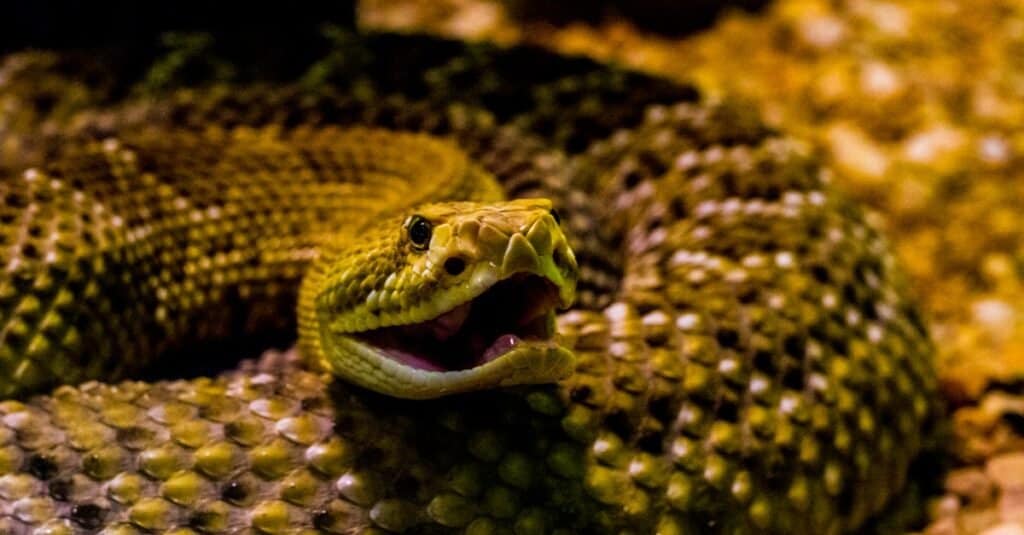
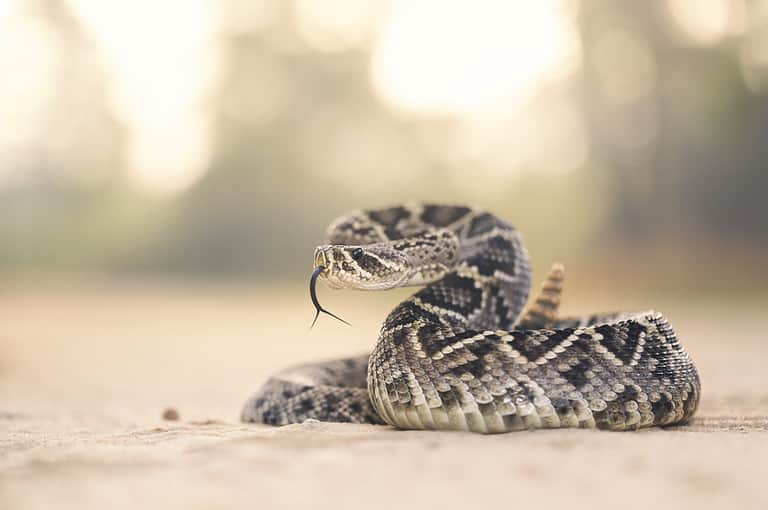
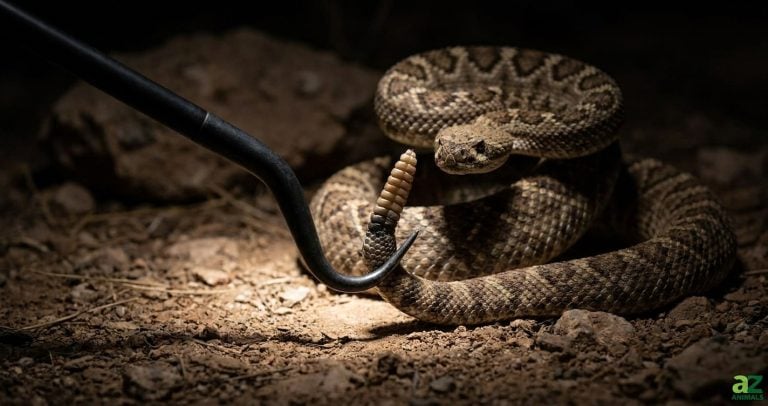
Eastern diamondbacks are the largest rattlesnake species in the world.
©iStock.com/Paulo Almeida
The first venomous snake on our list also happens to be the largest rattlesnake species in the world, reaching a maximum length of eight feet. However, most are around three to five feet. You can identify these snakes by the two light lines on their faces, their broad heads, and, most famously, the diamonds on their backs. The diamonds are brown or black, but their interiors may be the same color as their bodies, which could be yellow, tan, or brown, and the scales surrounding them will be lighter in color.
The eastern diamondback rattlesnake is a resident of the Lower Coastal Plain, which stretches from Louisiana in the west to North Carolina in the north. They inhabit dry, sandy areas, pinewoods, Flatwoods, and even coastal dunes. Their diet consists of small mammals and birds, and they are skilled hunters, capable of striking prey that is two-thirds of their body length away.
However, eastern diamondback rattlesnakes are quite shy and will only strike in self-defense if they are threatened. Therefore, listen for their rattles and keep an eye out for them during their peak hours, which are mornings and evenings in the summer months.
Pygmy Rattlesnake
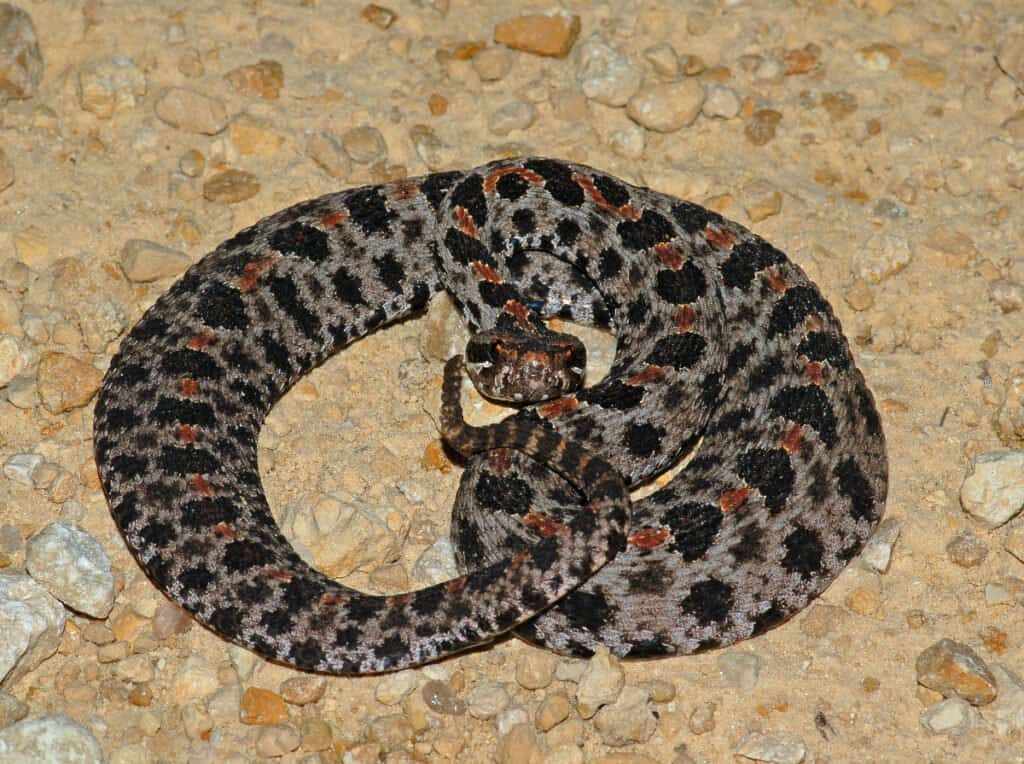
Pygmy rattlesnakes are found across nearly all of Georgia.
©Gerald A. DeBoer/Shutterstock.com
Going from Georgia’s largest rattlesnake to its smallest, the pygmy rattlesnake rarely ever exceeds two feet in length, though the record is 31 inches. Because of its small size, it can be harder for people to spot. Traditionally, it’s a good idea to look for a rattle on any snake you find, so you know whether or not it’s a rattlesnake, and listening for said rattle helps you avoid them in the wild. However, they have a very small rattle, which is quiet and difficult to hear.
Pygmy rattlesnakes can often be found under logs and in leaf piles, and they prey on animals such as lizards and mice. They can be found all over Georgia, particularly around the Coastal Plain. Their favorite habitats usually have a water source, such as marshes or creeks, but they can inhabit wet or dry areas. They may come in a variety of colors, such as gray, tan, lavender, or even orange or red.
Eastern Coral Snake
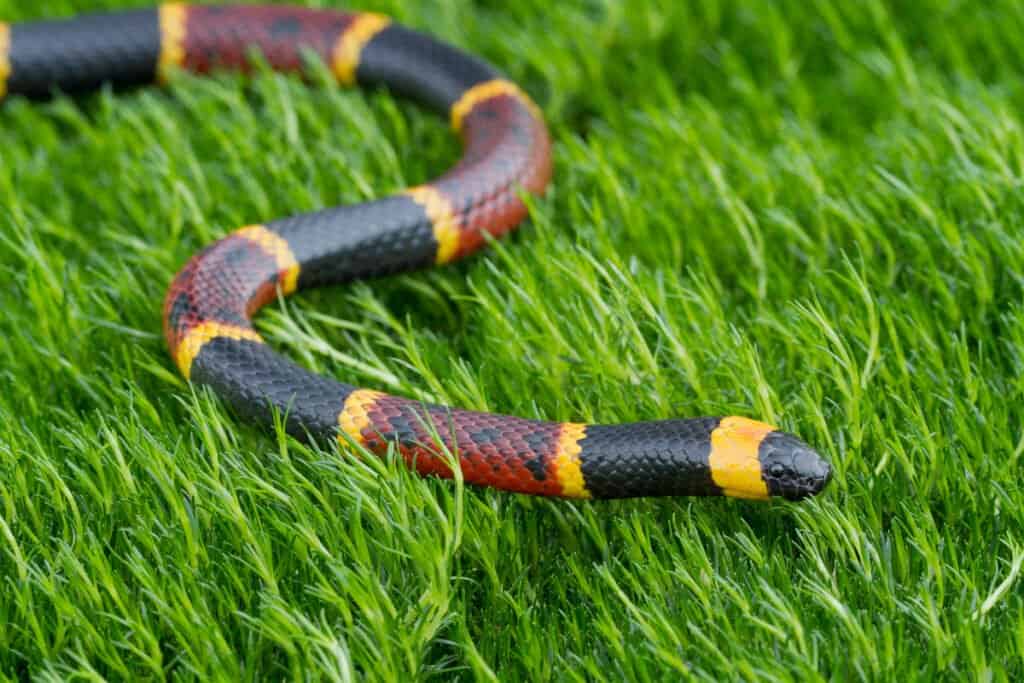
Coral snakes are only found in southern Georgia.
©Mark_Kostich/Shutterstock.com
The eastern coral snake is the first venomous snake on our list without a rattle. They are unique among the venomous snakes of Georgia, with their blunt heads and their bright colors of red, yellow, and black. They share these colors with the previously mentioned, nonvenomous scarlet kingsnake, leading to some confusion.
To help differentiate them, remember that the venomous coral snake’s red scales only ever touch the yellow ones, never the black ones. However, this is only true in coral snakes that have a normal pattern. Sometimes, snakes have what experts call an ”aberrant” pattern, leading to a snake that can be albino, solid black, or banded. Eastern coral snakes almost always have a thick band of yellow right behind their eyes and a black snout. They also aren’t the biggest snakes, reaching about three feet in length.
Despite being venomous, they don’t usually attack people except in self-defense. Their diet largely consists of frogs, lizards, and other snakes, including each other. They are sensitive to temperature, so they are most common in the spring and fall. Keep an eye open for them in Georgia’s marshes, sandy areas, coastal plains, and suburban areas.
Cottonmouth
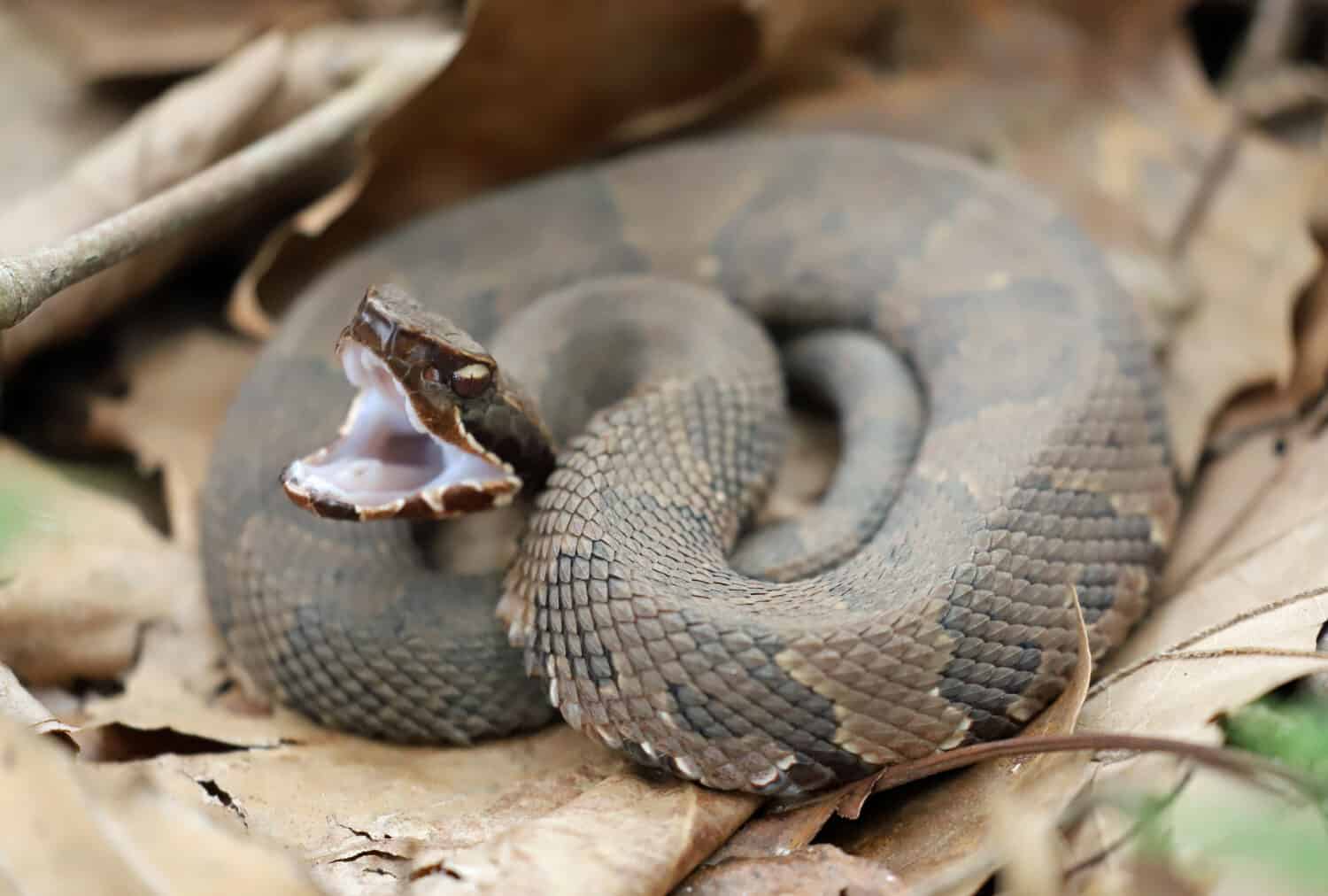
Cottonmouths are a venomous species that’s extremely comfortable in the water.
©KF2017/Shutterstock.com
There are two species of cottonmouth snake in Georgia — the cottonmouth (also known as the northern cottonmouth) and the Florida cottonmouth. Though the cottonmouth gets its name from its white-colored mouth, it is known better in Georgia as the water moccasin, which comes from its semi-aquatic nature. As a result, it is a good swimmer and can be found in swamps, floodplains, and wetlands. Cottonmouths are typically dark brown to black with dark-colored crossbands, and they are around 30 to 48 inches long.
Cottonmouths prey on small animals from both wet and dry habitats, including mammals, birds, insects, fish, amphibians, and even turtles and other snakes. Its presence is strongest in the southern half of the state and particularly around the Coastal Plain, but it has been known to move around.
Non-Venomous Snakes in Georgia
The following 40 snakes are all non-venomous snakes found across the Peach State:
- Brown Snake
- Eastern Hognose Snake
- Southern Hognose Snake
- Mud Snake
- Striped Crayfish Snake
- Glossy Crayfish Snake
- Black Swamp Snake
- Smooth Earth Snake
- Rough Earth Snake
- Florida Brown Snake
- Red-bellied Snake
- Eastern Ribbon Snake
- Common Garter Snake
- Common Kingsnake
- Black Kingsnake
- Mole Kingsnake
- Scarlet Kingsnake
- Ring-necked Snake
- Eastern Worm Snake
- Pine Woods Snake
- Rainbow Snake
- Black Racer
- Coachwhip
- Rough Green Snake
- Corn Snake
- Eastern Rat Snake
- Gray Rat Snake
- Pine Snake
- Eastern Milk Snake
- Scarlet Snake
- Southeastern Crowned Snake
- Florida Crowned Snake
- Eastern Indigo Snake
- Brahminy Blind Snake (non-native)
- Queen Snake
- Eastern Green Watersnake
- Brown Watersnake
- Plain-Bellied Watersnake
- Banded Watersnake
- Northern Watersnake
We’ll dive into more details on some of the more notable snakes you’ll want to be aware of. Many non-venomous snakes look very similar to venomous ones, so by knowing the differences, you’ll be able to tell if a snake is a cause for heightened concern or not.
Scarlet Kingsnake
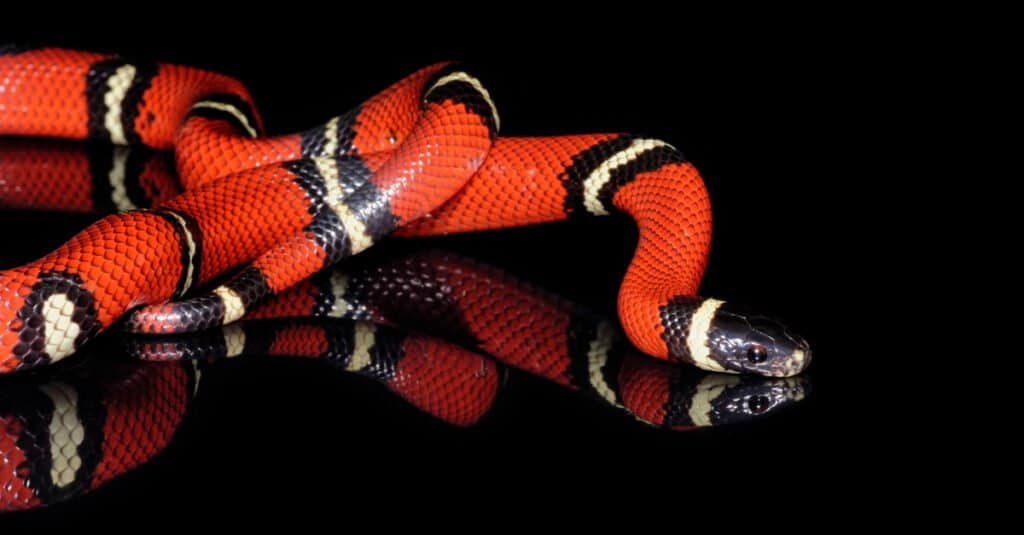
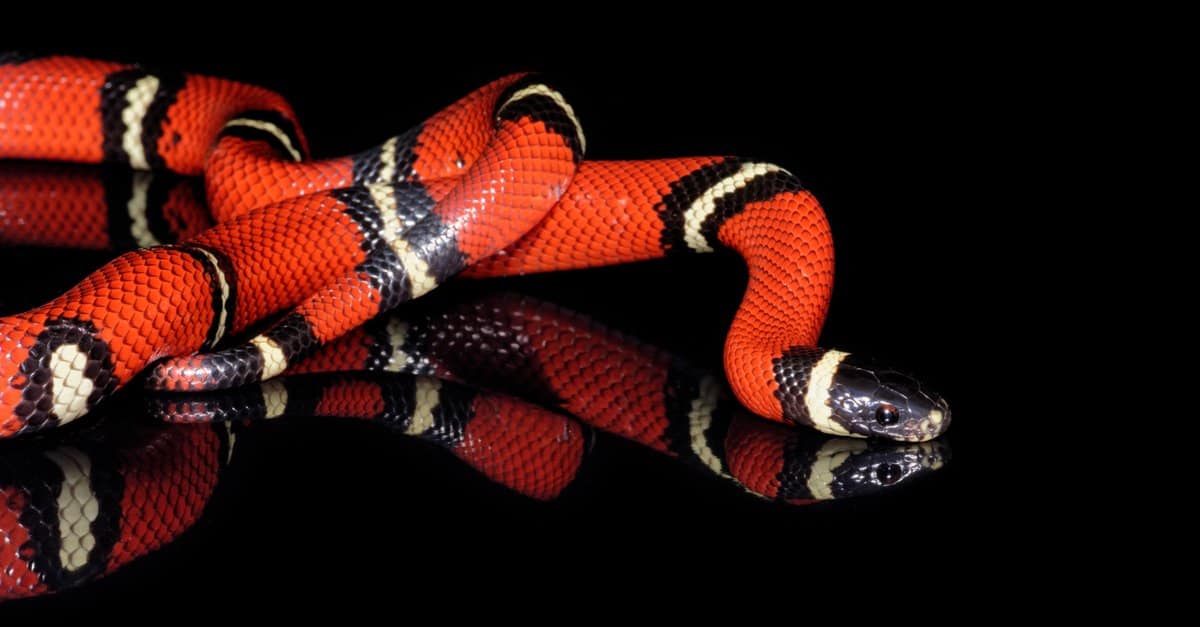
Scarlet kingsnakes have a similar appearance to coral snakes but are non-venomous.
©Valt Ahyppo/Shutterstock.com
The first of our nonvenomous snakes, the scarlet kingsnake, is especially notable. This isn’t just because of its bright, beautiful coloring, but also because it shares that coloring with a venomous, potentially deadly snake: the eastern coral snake, as both snakes have bands of black, red, and yellow.
Here’s a tip for telling them apart: the scarlet kingsnake’s red bands only touch its black ones. So if you see red and yellow scales touching each other, stay away, because it’s a dangerous coral snake. To put it differently, “Red touch yellow, deadly fellow. Red touch black, venom lack.” However, experts say that the rhyme isn’t always reliable — it only verifies that you have a normally patterned coral snake. And, it only works in the U.S. However, at 1.5 feet in length, the scarlet kingsnake is usually smaller than the coral snake.
Being able to tell these snakes apart is a valuable skill since they are both found all over the state of Georgia, particularly in the Coastal Plain. As for the scarlet kingsnake, their size and climbing ability allow them to be found at multiple elevations. They inhabit wet pinelands, so you might find them up a tree, or they may be beneath logs and rocks. You may even find them on buildings. Since they eat small mammals and lizards, some people may enjoy having them around to prevent potential mouse infestations.
Eastern Rat Snake
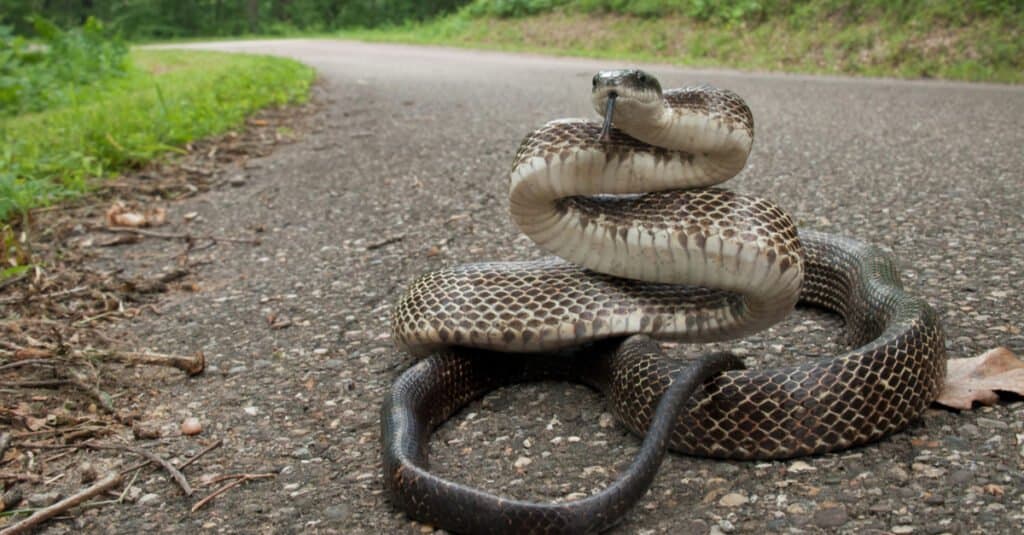
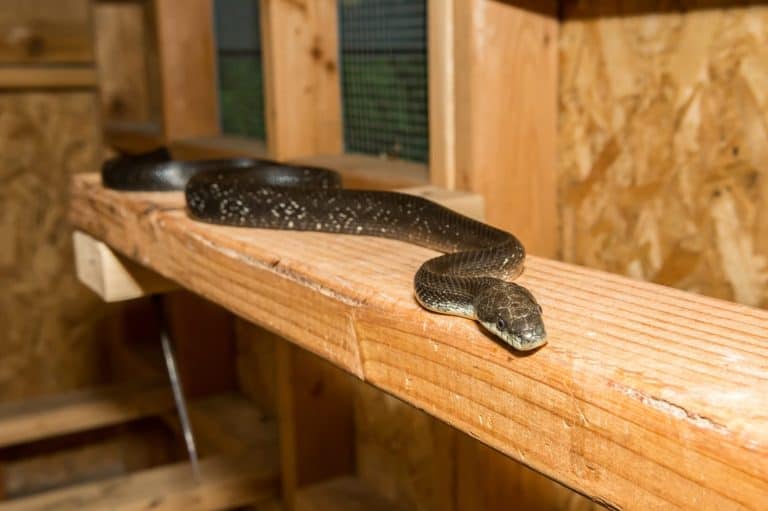
The eastern rat snake has a shiny black body with a checkerboard belly.
©Mike Wilhelm/Shutterstock.com
Georgia is home to not just one but two types of rat snakes. The gray rat snake is the only one found in the northwestern corner of the state, while the southern coastal plain of Georgia and its Atlantic coastline is home to the eastern rat snake. However, in Piedmont, you may see both species. Rat snakes can grow quite large, sometimes over six feet in length.
With their large lengths, rat snakes can be intimidating, especially since they will puff up and imitate venomous snakes. Another tactic the eastern rat snake employs is emitting a foul odor to ward away would-be threats. Rat snakes are often called “chicken snakes” because of their proclivity to hunt domesticated fowl eggs. These snakes are also often confused with racers.
Northern Water Snake
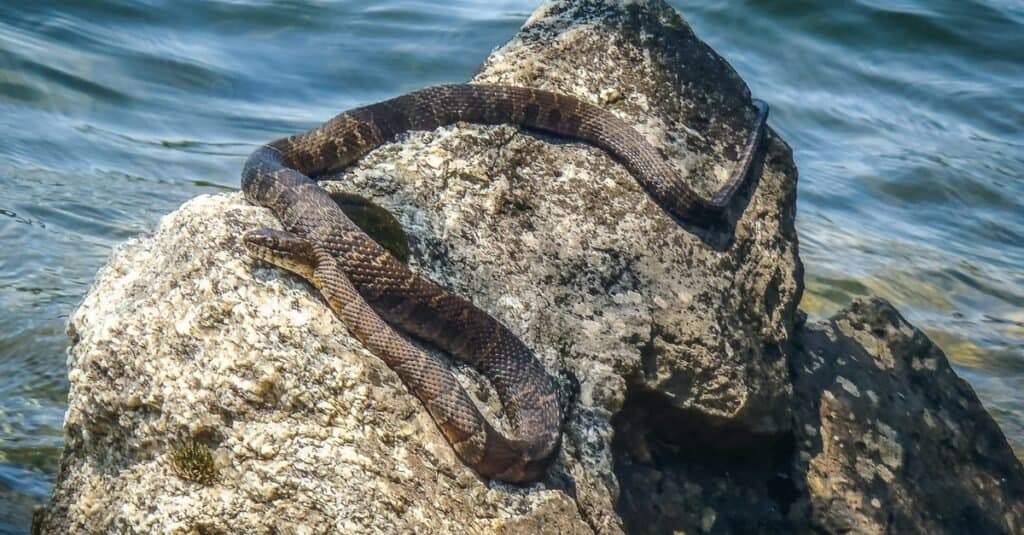
Northern water snakes are the most common water snake found in Georgia.
©jmarino/Shutterstock.com
Though Georgia is home to five different species of water snake, the northern water snake is one of the most common. All water snakes are semi-aquatic, meaning that they spend time both in and out of the water, looking for their preferred prey of fish and small amphibians. They are all adept swimmers and comfortably navigate all kinds of water bodies, including lakes, streams, marshes, rivers, and ponds. The northern water snake, in particular, is a common sight in the northern, more mountainous regions of Georgia.
Northern water snakes are around two to four feet long and have a similar appearance to the venomous cottonmouth snake, as they have a dark brown to black appearance with darker crossband markings. The northern water snake lives in the north of Georgia, while the cottonmouth prefers the south.
How Dangerous (or Deadly) Are Snakes Of The Peach State
You may hear occasional reports that snake attacks in Georgia are “on the rise.” This is largely misleading, as snake bites still only kill five or six people per year throughout the entire country, so that amount is negligible. If they are “on the rise,” it’s probably because of the warmer weather. Not only are people spending more time outdoors, but snakes are waiting longer to hibernate, meaning that we have more time to interact.
However, that doesn’t mean that snakes are any more aggressive than before. In fact, nonvenomous snakes are so harmless that killing them is illegal in Georgia. Even the venomous ones are more afraid of people than most are of them. As long as people educate themselves on these beautiful reptiles and respect their habitats, they should be able to enjoy the outdoors to their heart’s content.