
Quick Take
- The telescope fish hunts by staring upward into the darkness, a behavior whose underlying reason reveals a surprisingly clever deep-sea survival trick. See the hunting strategy →
- Despite being described as solitary, telescope fish are never found alone, and there is a specific explanation for this contradiction. Discover the group behavior →
- This fish can swallow prey larger than its own body, a feat that its anatomy makes far less bizarre than it sounds. Explore its elastic jaw →
- The genus name Gigantura traces back to Greek mythology, though the connection has nothing to do with the fish's famous eyes. Trace the Greek origin →
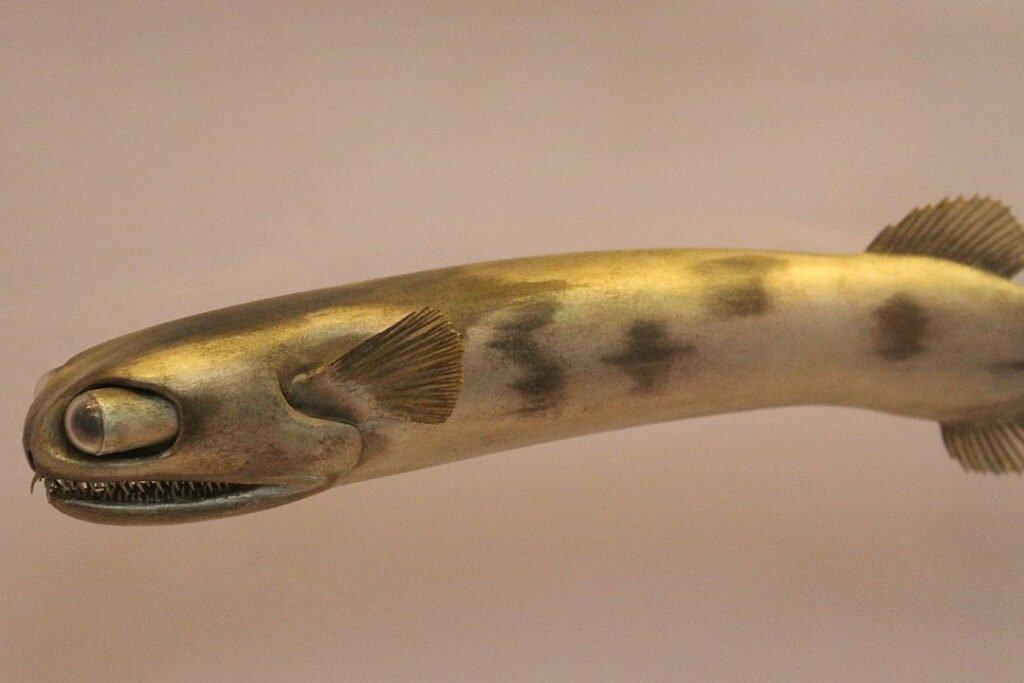
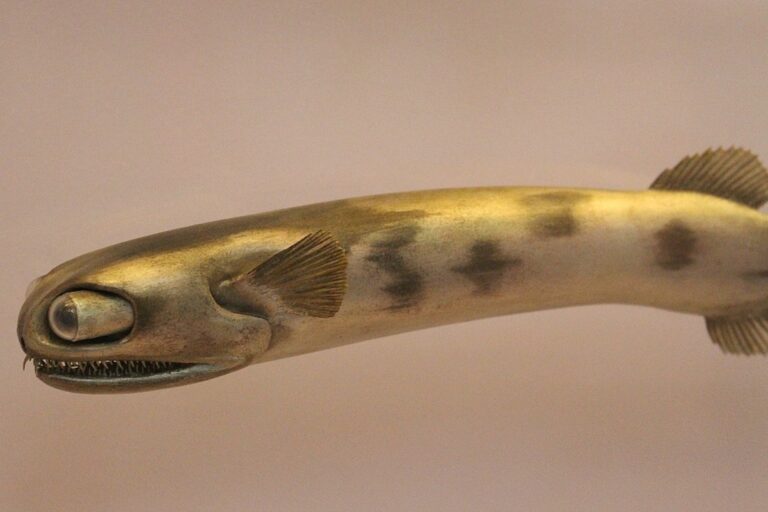
Living deep below the surface and away from natural light, these fish live in dark waters. To compensate, Mother Nature gave the telescope fish tubular eyes that jut from the skull like a pair of binoculars. The feature lets the fish see and find prey in the mesopelagic twilight zones.
The fish use their unique eyes to find food. They swim, directing their eyes up toward the surface. This allows them to spot silhouettes of their prey. It’s believed the fish move vertically in the water column to see both prey and predator.

5 Incredible Telescope Fish Facts
- Telescope fish have an extendable mouth and jaw, a great tool for snatching up prey quickly.
- Because they live largely beyond human reach, little is known about the distribution, lifespan, appearance, diet, and more of the telescope fish.
- Unlike many other marine species, there are no distinct names to differentiate between the sexes of these fish.
Classification and Scientific Name
The telescope fish is a deep-sea aulopiform fish. There are only two species. Outside of that, little information is known about them.
The genus name (Gigantura) is derived from Gigantes, a legendary group of giants in Greek mythology. That’s matched with the oura suffix, which means “end” or “tail.” So, Gigantura is a reference to the ribbon-like, elongated lower tail fin that comprises half the fish’s total length.
Types of Telescope Fish
While little is actually known about the telescope fish, we do know there are two distinct species.
Gigantura chuni
Gigantura chuni, commonly known as the telescope fish, is a deep-sea animal found in the waters of the Indian, Atlantic, and Pacific oceans. It is also found in the Gulf of Mexico. Additionally, there have been occasional sightings in South Africa.
The telescope fish has also been sighted in the waters of New Zealand, Chile, Saint Paul, Tasmania, Gough Island, and Amsterdam.
Gigantura indica
The Gigantura indica is a predatory deep-sea animal with a silvery, scaleless body. Like its cousin, Gigantura chuni, the creature has those fascinating tubular, forward-directed eyes with large lenses and a ribbon-like tail. The eyes allow them to see silhouettes of prey swimming above them in the water.
Both species are naturally adapted to a specific deep-water environment. This is why experts don’t consider the species suitable for captivity. The telescope fish fare better in temperate oceans, which cannot be easily adapted to tanks. Or rather, the cost of creating and regulating such an environment, plus the expense of acquiring the animals, is prohibitive.
Appearance
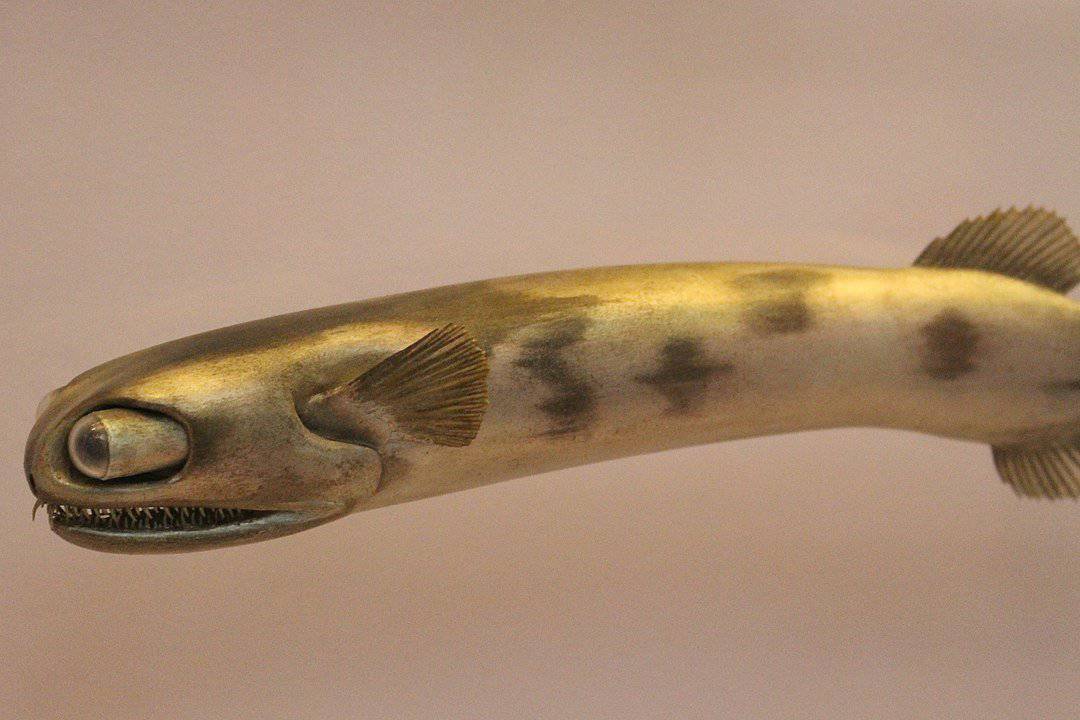
These animals have protruding eyes with small glass shields. The eyes consist of around two dozen dorsal spines. From the right angle, they also look like binoculars or, more specifically, a pair of telescopes.
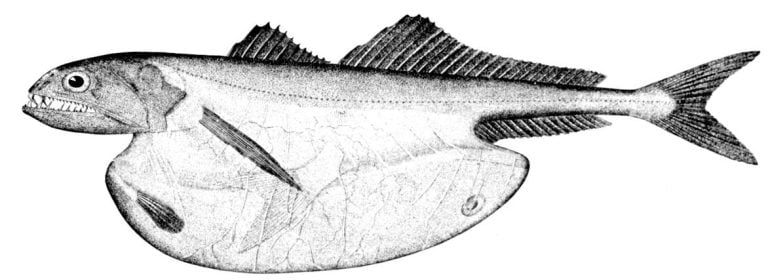
The fish have large heads and a greenish-blue color with a silvery underside. They have blue dots and small brown lines that form stripes along the sides and back. The fish have tough, slimy scales and a sharp snout. The tail makes up almost half the body.
Little is known about these fish. Tracking them is difficult, and capturing them isn’t practical, as duplicating their ecosystems would be a chore in any manmade environment. They can grow up to 16 inches in length.
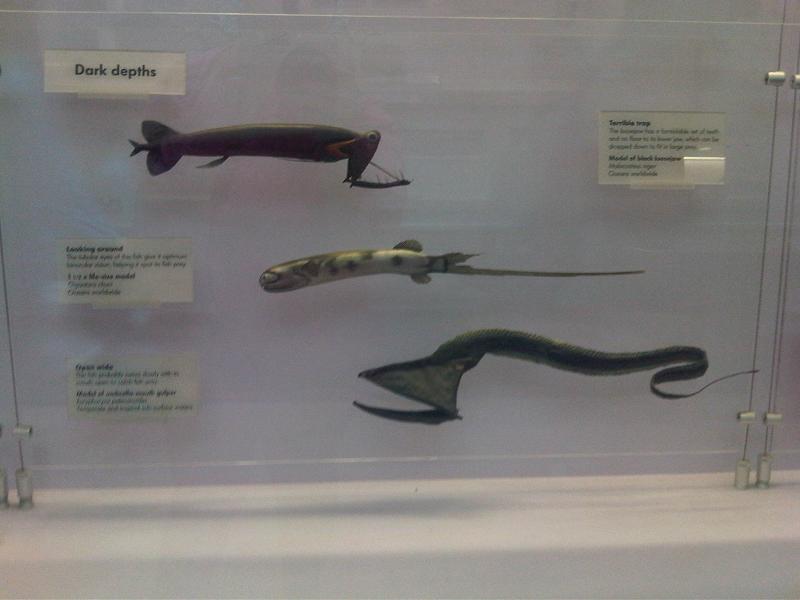
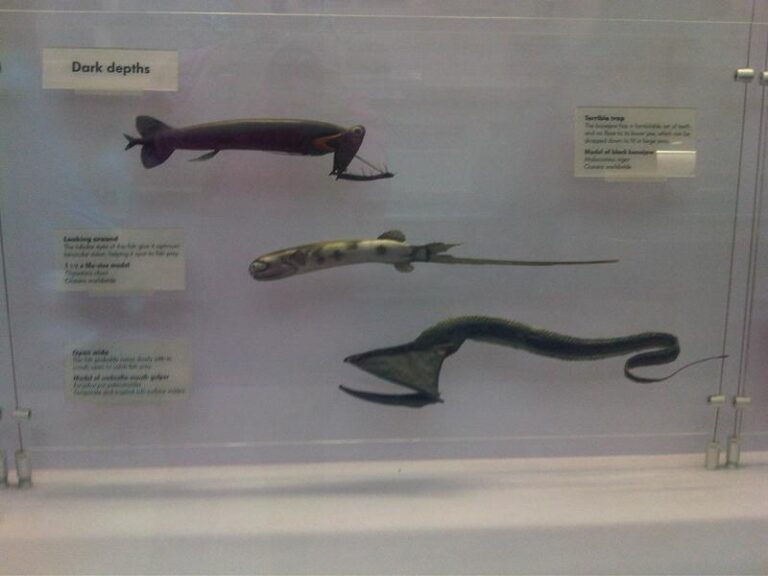
The Telescope fish in the middle, at the Natural History Museum in London, England. The fish have large heads and a greenish-blue color with a silvery underside.
©By Emőke Dénes – kindly granted by the author, CC BY-SA 4.0, https://commons.wikimedia.org/w/index.php?curid=16151233 – Original / License
Distribution, Population, and Habitat
The telescope fish lives in the waters of Tasmania, southern Chile, New Zealand, Amsterdam, Saint Paul, and Gough Island.
The population, though not closely monitored, is considered healthy and of “Least Concern” by conservationist groups. In several cases, the fish are not evaluated at all, as there’s not enough information about the numbers to generate reliable data.
The fish has a habitat range across sub-Antarctic bodies of temperate cool waters. The telescope fish is located at depths of over 66 feet within the water columns and up to 2,000 meters below the surface. They’re also found in surge channels and large low tidal pools.
While relatively solitary by nature, the telescope fish tends to travel in groups. You’ll never find a single telescope fish by itself. The groupings make for easier hunts. It’s also a good way for the animals to watch out for predators from all directions.
Predators and Prey
Like every creature on this planet, the telescope fish — as much a predator as anything — has its enemies and its preferred diet. Let’s take a look at both.
Predators: What Eats the Telescope Fish?
Telescope fish will grow up to six inches in length. That makes them relatively small fish in a big pond called the ocean. So, telescope fish are the prey of large carnivore fish and sharks that inhabit these environments.
Prey: What Does the Telescope Fish Eat?
A relatively solitary predator, this species feeds on bristlemouths, lanternfish, and barbed dragonfish. They also go after plankton.
The telescope fish swallows its prey whole, including sea creatures that are often larger than itself. But this ability to eat in such a manner is common for creatures at those depths.
The telescope fish has an extendable mouth with sharp teeth. They quickly snatch prey, usually from below, as the telescope fish is constantly looking up for food.
Reproduction and Lifespan
There is little to say about their reproduction process. But we know all fish species lay eggs during their unique breeding season. The telescope fish is no different. They lay eggs and wait for hatching.
Fish eggs are attached to plants. Otherwise, little is known about the gestation period, the species’ sexual behavior, or the number of eggs they lay.
The lifespan of the telescope fish is estimated to be between six and 25 years. It’s a surprisingly wide range, but we take into account that studies of the species aren’t extensive.
Telescope Fish in Fishing and Cooking
Considering their habitat, these are not fish easily available for capture. So, it’s not likely you’ll find the telescope fish on anyone’s menu.
Telescopefishes (Giganturids) Pictures
View all of our Telescopefishes (Giganturids) pictures in the gallery.

Sources
- Kidadl / Accessed February 8, 2022
- Ocean / Accessed February 8, 2022
- Aquariadise / Accessed February 8, 2022
- Fish List / Accessed February 8, 2022
- Oregon State University / Accessed February 8, 2022