
Animals that are a vivid, primary yellow — not tawny or orange-yellow or any of those tones and shades — are somewhat uncommon. When they are found, their bright yellow coloration adds to their beauty.
Bright yellow animals have their color not because humans find it attractive, but to warn predators that they are poisonous, to attract mates, or even for camouflage. These animals maintain their unique coloration throughout their lives, never growing out of such sunny hues.
Here are 10 of the most beautiful yellow animals you may not be aware of yet!
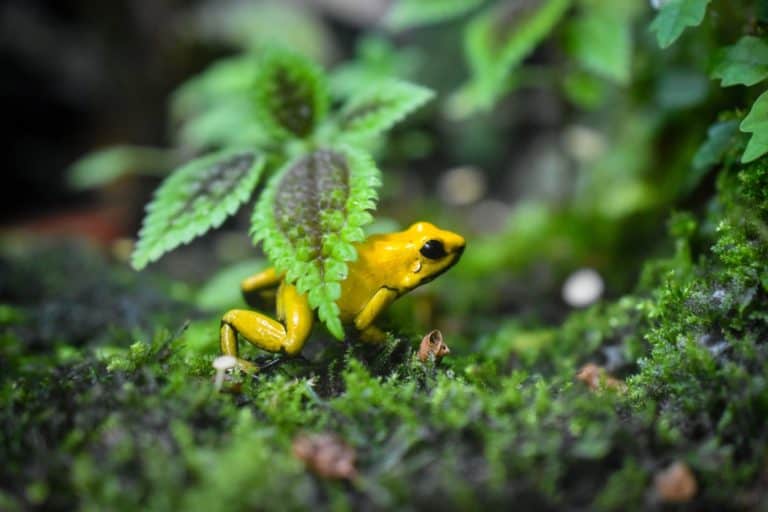
#10: Golden Poison Dart Frog
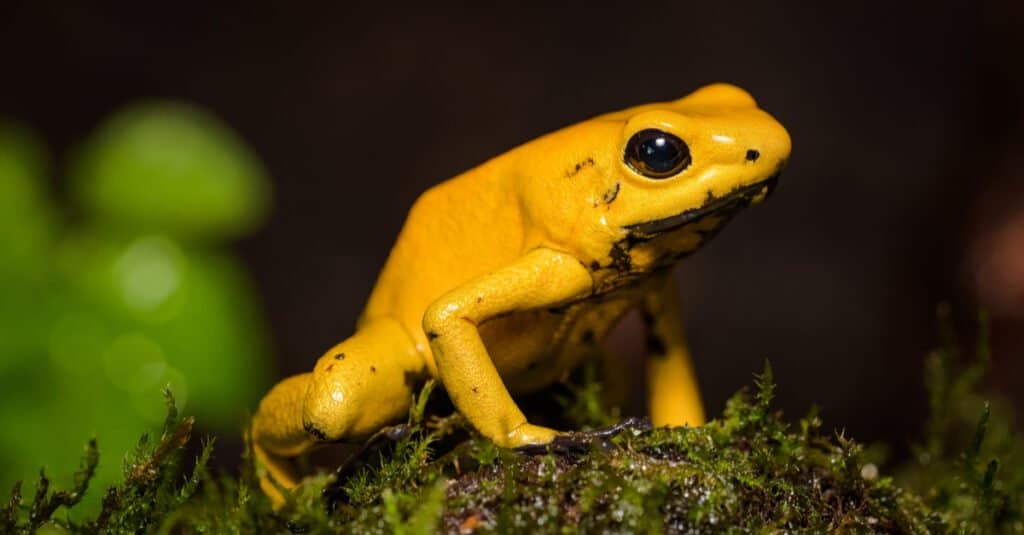
The golden poison dart frog’s vibrant color may be beautiful, but the creature is also deadly.
©Thorsten Spoerlein/Shutterstock.com
This little frog is found only in the rainforests on the Colombian coast and is now endangered. Its color ranges from a pale lemon yellow to a lush gold, and it has huge black eyes.
This makes the poison dart frog look innocuous, and it is docile, intelligent, and gregarious as well as pretty. Still, it comes by its scientific name, Phyllobates terribilis honestly.
The frog is so poisonous that it is dangerous to even pick it up with bare hands. Its skin is full of alkaloid toxins and just one milligram of it can kill as many as 20 humans.
The frog doesn’t produce the toxin itself but gets it from eating insects that contain the poison. Still, even if the golden poison dart frog is kept as a pet and fed non-toxic insects, the toxins in its skin can last for years.
In fact, the golden poison frog is considered one of the most toxic animals alive today. A single frog measuring two inches has enough venom to kill at least ten grown men.
#9: Eurasian Golden Oriole
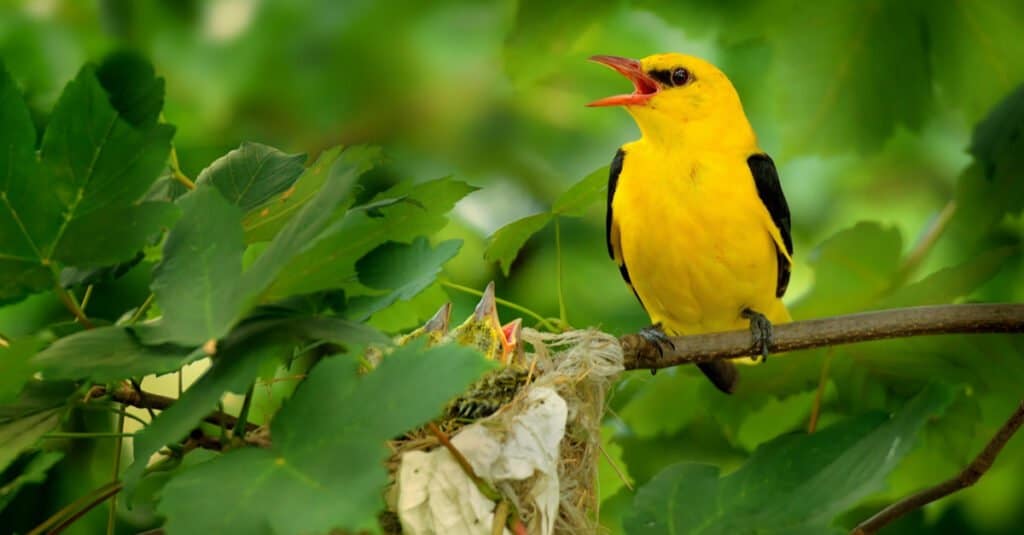
Though the female Eurasian Golden Oriole isn’t terribly colorful, the male is bright yellow with black markings.
©iStock.com/phototrip
The male of this bird of Europe, central and western Asia, and northern India is known for its vividly yellow head and body and black wings. The female, as is usual in such brilliantly colored birds, is duller.
It’s a shy bird, and even the male is fairly well camouflaged as he searches through the tops of trees for insects and fruit.
Though it has a harsh, blue jay-like call, the song of the Eurasian golden oriole is memorably sweet. These 8.5-inch-long orioles often wait until they are two or three years old to breed.
Eurasian Golden Oriole lives all year round in forests, and both males and females spend most of their time perched in tall trees where they build nests with woven grasses in a bowl-like shape.
Golden Orioles feed on insects, nectar, and fruits found in their environment. Occasionally, these birds will also eat southern flying lizards.
These birds can be found in most of India; however, in the winter months, they migrate down to the peninsula. Not only that, but they can also travel at speeds up to 26 miles per hour.
#8: Misumena vatia
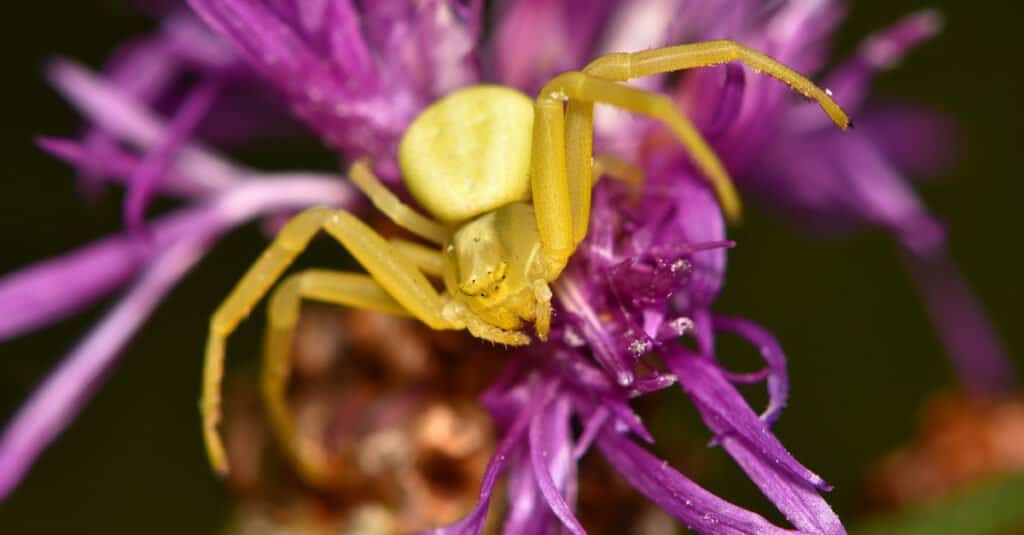
Crab spiders often match the color of their surrounding flowers, including those that turn them into a beautiful shade of goldenrod.
©Tobias Hauke/Shutterstock.com
Crab spiders are also called flower spiders, and they can change color, although slowly, to match that of the flower they wait on.
In the case of the spider Misumena vatia, the flower is often goldenrod. Like other crab spiders, M. vatia has a wide body with legs that are held crabwise, which allows it to walk sideways.
Females are much larger than males and can be 0.39 inches long as opposed to male’s 0.16 inches. Crab spiders produce powerful venom for their size and so can take insects and other arthropods that are much bigger than they are. Misumena vatia feeds on common insects, although they can eat prey much larger than themselves. However, they are harmless to humans.
#7: Orange-barred Sulphur Butterfly
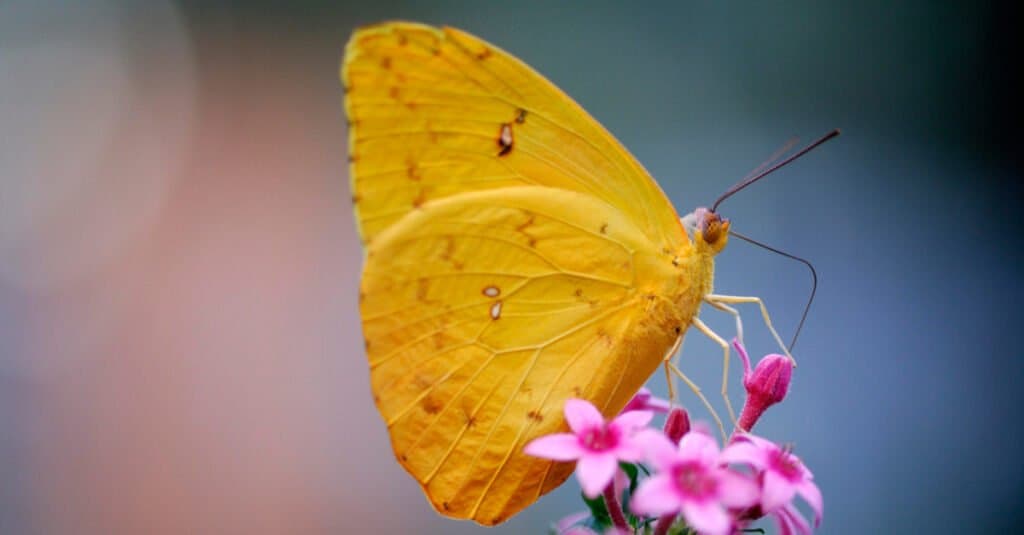
This eye-catching butterfly is also incredibly fast.
©imageBROKER.com/Shutterstock.com
Also called the yellow apricot, males of this butterfly are uniformly bright yellow above, with darker yellow triangles on the forewings and darker shadings on the edges of their hind wings. Below, they are salmon-colored or shades of purple.
The females are a bit more variegated, with reddish spots on their forewings and yellow fading to rust-red on their hindwings. When they are caterpillars, they are typically green with faint hints of yellow.
The butterfly has a 2.25 to 3.25-inch wingspan and is found in Brazil northward into Central America and southern Florida.
Not only is this butterfly stunning, but its size provides amazing speeds and control while in flight. Butterflies such as these suck the nectar out of a tube-like tongue and taste with their feet. The Orange-barred Sulphur Butterfly eats nectar from alfalfa, clover, milkweeds, and sunflowers.
#6: Eyelash Viper
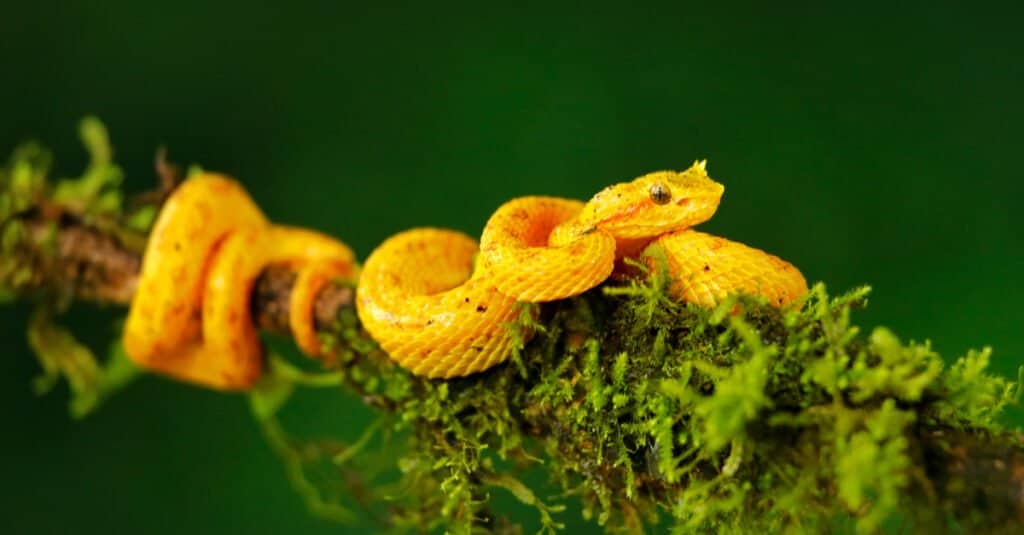
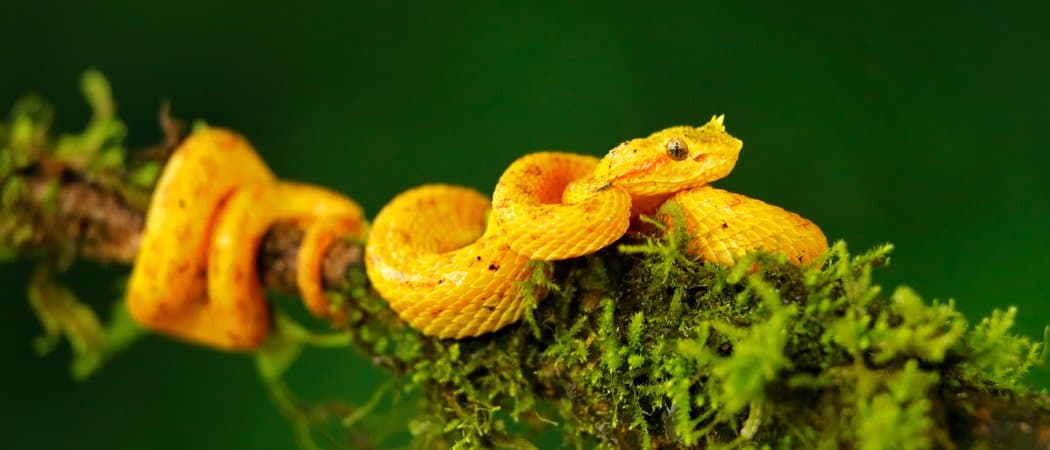
This pit viper is small and beautiful but venomous.
©Ondrej Prosicky/Shutterstock.com
This South and Central American snake gets its name because it has scales over its eyes that look like eyelashes.
This is also believed to help camouflage the snake as it moves among the trees where it lives. Its eyes are large and have vertical pupils like a cat’s.
The eyelash viper is famous for the many color variations among wild individuals, and yellow is one of them. Both males and females can be a bright shade of yellow.
The colorful snake is often found in zoos, and though it is a pit viper and is seriously venomous, it’s even kept as a pet and bred to make its brilliant colors even more brilliant.
This particular species of viper attacks quickly, injects its hemotoxic venom, and then waits for its prey to die. They have long fangs and the bite is very painful and often deadly.
Their natural habitat consists of sea-level, moist forests. The snake isn’t large and usually grows to only 32 inches long, with females being longer than males. Both males and females can live up to 10 years.
Eyelash vipers also don’t lay eggs, they are ovoviviparous which means their eggs are fertilized and incubate inside the female snake and she gives birth to live young.
#5: American Goldfinch
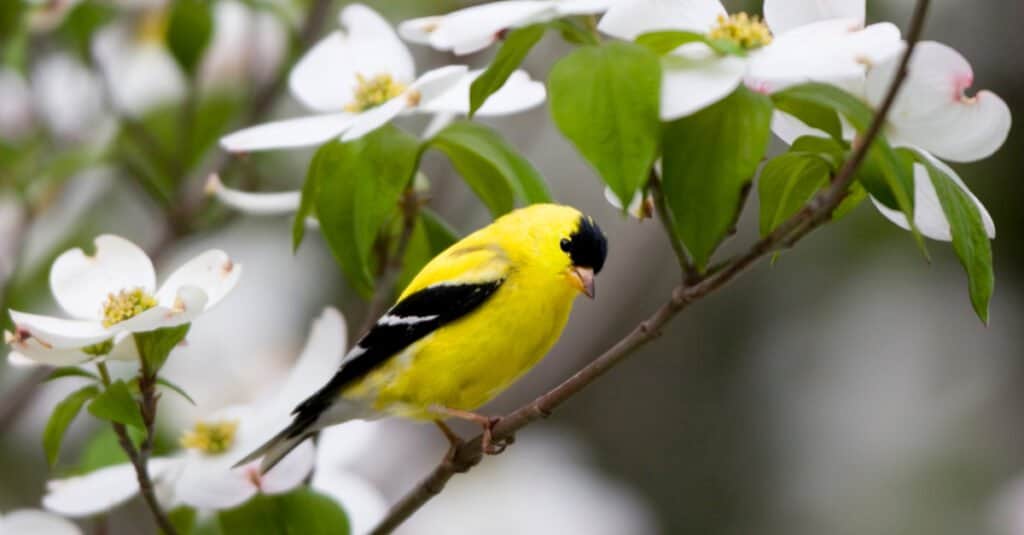
The male American goldfinch has brighter coloring in the summer to attract a mate.
©Danita Delimont/Shutterstock.com
Like the Eurasian golden oriole, the American goldfinch male has a bright yellow body and black wings, though it is a smaller and more compact bird found in North America.
The goldfinch’s natural habitats are weedy fields and floodplains. The goldfinch is most active during the day and has incredible flying skills. They fly in wavelike patterns when flying long distances.
It also has a black spot on its head. This, it must be said, is its summer breeding plumage, for in winter its plumage is more olive green. The female is yellowish-brown.
The American goldfinch has a conical beak that is made for cracking and eating seeds, though it’s not above raiding the vegetable garden for leafy greens.
It is migratory, travels in huge flocks, and adores feeding stations in backyards. It’s also attracted to land that’s been cleared of trees.
#4: Swallow-Tailed Moth
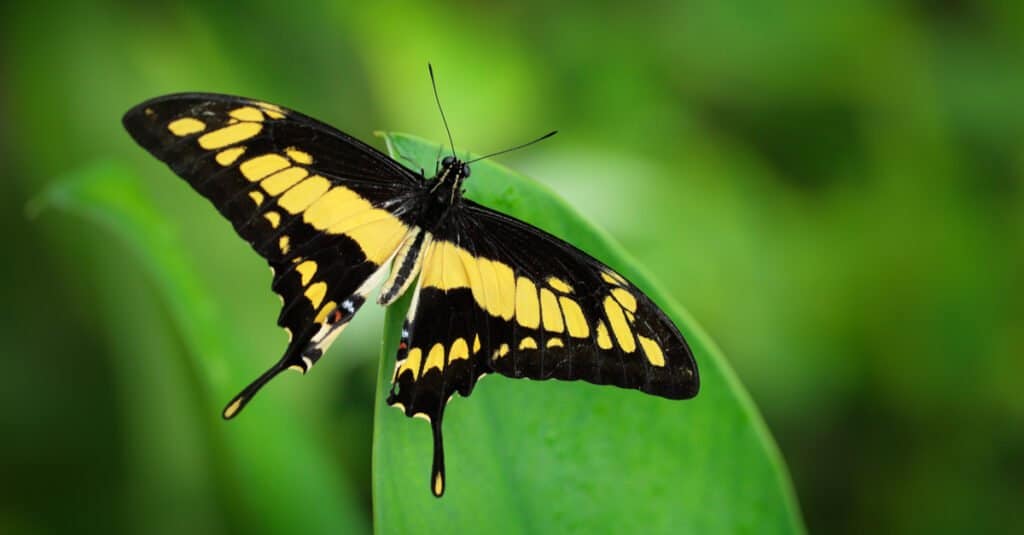
With its unique shape and coloring, the swallow-tailed moth is often mistaken for a butterfly.
©Ondrej Prosicky/Shutterstock.com
This beautiful moth of the palest yellow is found in Europe and the temperate areas of Asia.
It has tiny tails on its hind wings and darker yellow lines running across both pairs of wings. It is often mistaken for a butterfly if it’s seen during the day, but it has a robust, hairy body associated with moths.
It is active at night, drawn irresistibly to artificial light, and seen only briefly during the summer months. The caterpillar is a looper that feeds on hawthorn and ivy and overwinters.
Swallow-tailed Moths grow less vibrant with age. The older the moth, the whiter it may appear, with two dark lines crossing the wings.
These moths are often found in wooded areas, bogs, and gardens. Adults are often skittish and will attempt to flee at any sign of movement or danger. They feed on larvae on trees and shrubs.
#3: 22-Spot Ladybird
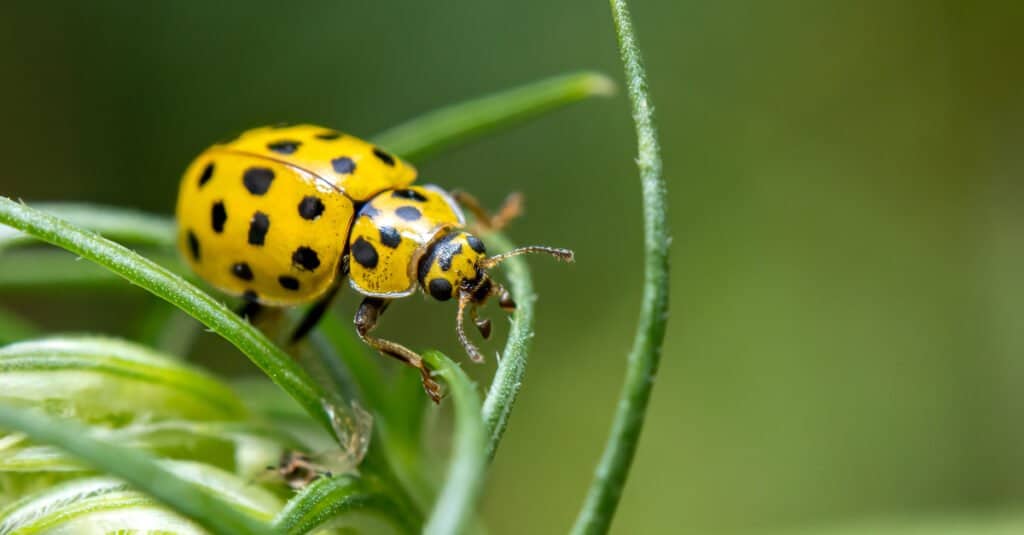
Though it bears a resemblance to a ladybug, the 22-spot ladybird is a pretty yellow beetle.
©marcinswiostek/Shutterstock.com
The person who coined the phrase “cute as a bug” must have been thinking of this tiny beetle.
Found in Europe, this 0.12- to 0.20-inch-long insect is bright yellow, and its elytra, which are the hard wings over its hind wings have exactly 22 black dots. The pronotum, a shield-like structure that covers part of its thorax, is also yellow or sometimes white and has five dots.
The 22-spot ladybird is found in Europe from the United Kingdom to Ukraine and south to Iran and Turkey. It’s best seen from spring to fall and lives in low shrubs and other plants. Interestingly, the 22-spot ladybird is not a voracious predator of insect pests like its ladybug cousins but eats mildew. Its larvae are also yellow and spotted.
#2: Banana Slug
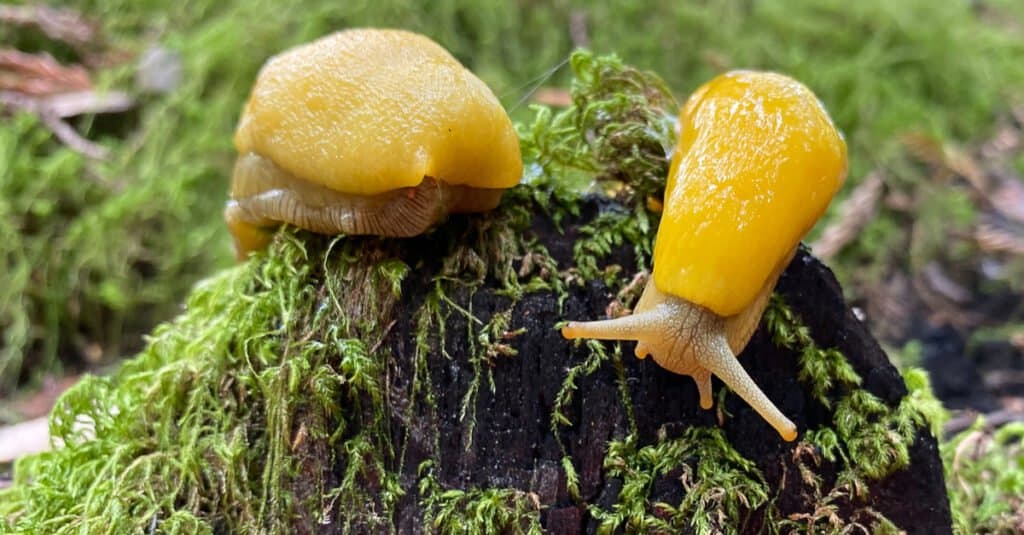
The banana slug is found in humid areas where they aren’t in danger of drying out.
©Meyta/Shutterstock.com
Its frank resemblance to a banana in both shape and color gives this giant slug its name. One type of this slug, the Pacific banana slug, can grow close to 10 inches in length and weigh a quarter of a pound.
Like other land slugs and snails, banana slugs have a radula, which is rather like a tongue equipped with rows of tiny teeth, and four tentacles. The larger pair is on top of the head and serves as eyes, and the second pair, which are found beneath the first, pick up chemical trails. This animal can regenerate its tentacles if it loses them. Banana slugs are hermaphrodites, and a couple fertilizes the eggs of the other.
This slug is famously found in the temperate rainforests of the Pacific Coast of North America, from Alaska down to California. The high humidity found in these forests is a must for these creatures, who are ever at risk of drying out. The slug eats detritus, and their excretions make for good fertilizer.
#1: Gold Lace Nudibranch
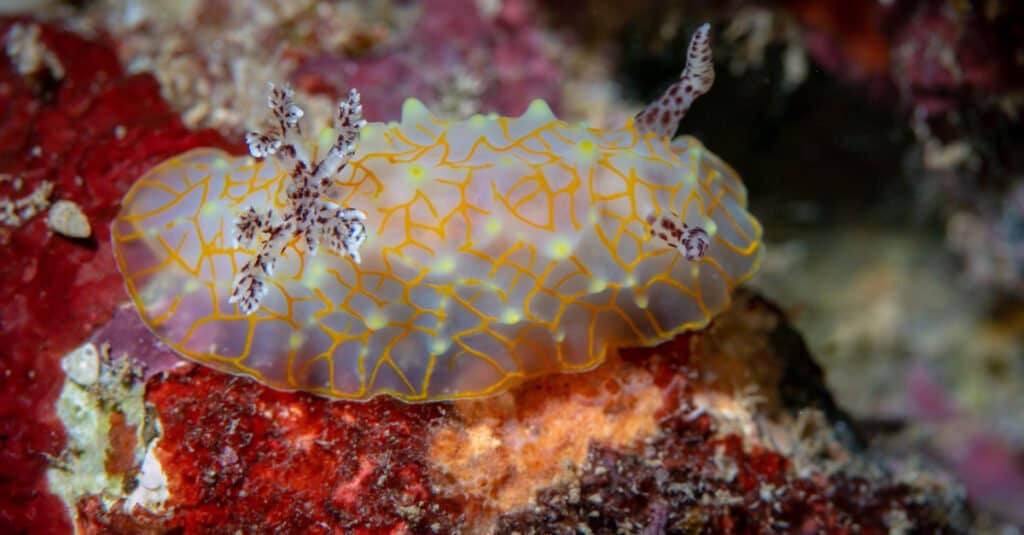
This unique-looking creature that resembles gold lace lives in warm water on rocks and the inside of caves.
©RobJ808/Shutterstock.com
Found only in the warm waters off Hawaii, this nudibranch, or sea slug looks like a 2-inch long pillow covered with golden lace. The lace is actually made up of golden lines with pale yellow tubercles. The mantle of the nudibranch also has a bright orange-yellow line, and its gills resemble black and white tree branches.
Like other “nudies,” the gold lace nudibranch is a carnivore and eats sponges, hydroids, and moss animals. It prefers to keep to the inside of caves and among rocks and doesn’t like to be seen traveling across open sand.
The gold lace nudibranch is a recent discovery. Although it’s pretty common around Hawaii, it wasn’t discovered until 1982. The epithet of its scientific name, Halgerda terramtuentis means “looking at the earth with care” in honor of the folks at the Earthwatch Institute who helped identify it.