Quick Take
- A tiny fish engineers a complex structure with a hidden functional purpose, since its geometric design plays an important role in egg survival. See the nest's design →
- Females may reject a male based on the layout of the nest, and scientists aren't sure why (though they have several ideas). Watch females evaluate nests →
- After spending over a week building one of nature's most elaborate structures, the male never uses it again, and here's why. Why nests are abandoned →
- What the male white-spotted pufferfish does after mating challenges a common assumption about which parent does the protecting. Discover who guards the eggs →
You’ve likely seen videos of artistic animals on social media. I’m talking dogs and their humans making paw print art, elephants painting using a brush held in their trunk, or even abstract masterpieces created by pigs (the priciest pig painting sold for £20,000!). But one of nature’s finest artists, the white-spotted pufferfish, actually lives and creates its works at depths of 33 to 98 feet below the surface of the ocean. In an effort to attract a mate, male pufferfish spend one week or more creating intricate geometric nests akin to underwater crop circles.
When scientists first discovered these circles on Japan’s sea floor in 1995, they were completely stumped. The circles were large, nearly seven feet in diameter, and contained beautiful peaks and ridges. Despite occasional monitoring, nobody could figure out what was making these circles appear or disappear. Then, in 2011, a research team headed by Hiroshi Kawase spotted a fish creating the pattern in the sand. After monitoring, the team realized they were looking at an entirely new species. The white-spotted pufferfish was then officially described in 2013-14, and researchers had solved a huge mystery.
What Is a White-Spotted Pufferfish?
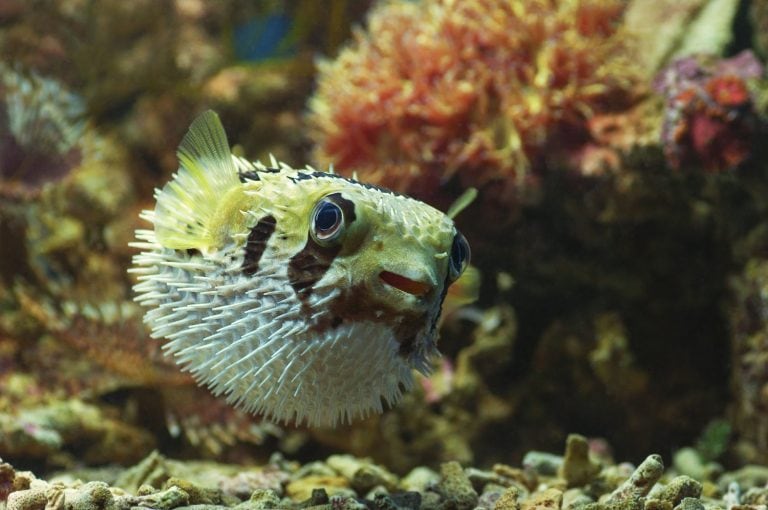
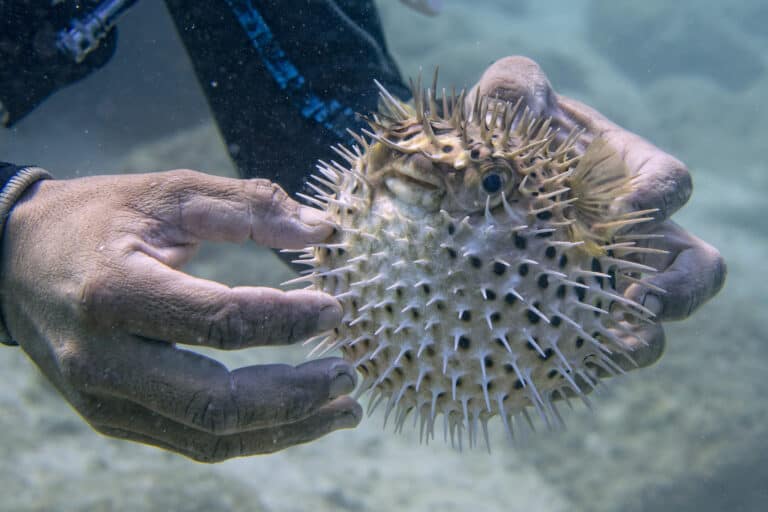
The white-spotted pufferfish (Torquigener albomaculosus) is the 20th species found within the Torquigener genus. Named for its appearance, these fish are brown on the top half of their body and silver on the bottom half and covered in white spots all over. White-spotted pufferfish are primarily found in the Ryukyu Islands.
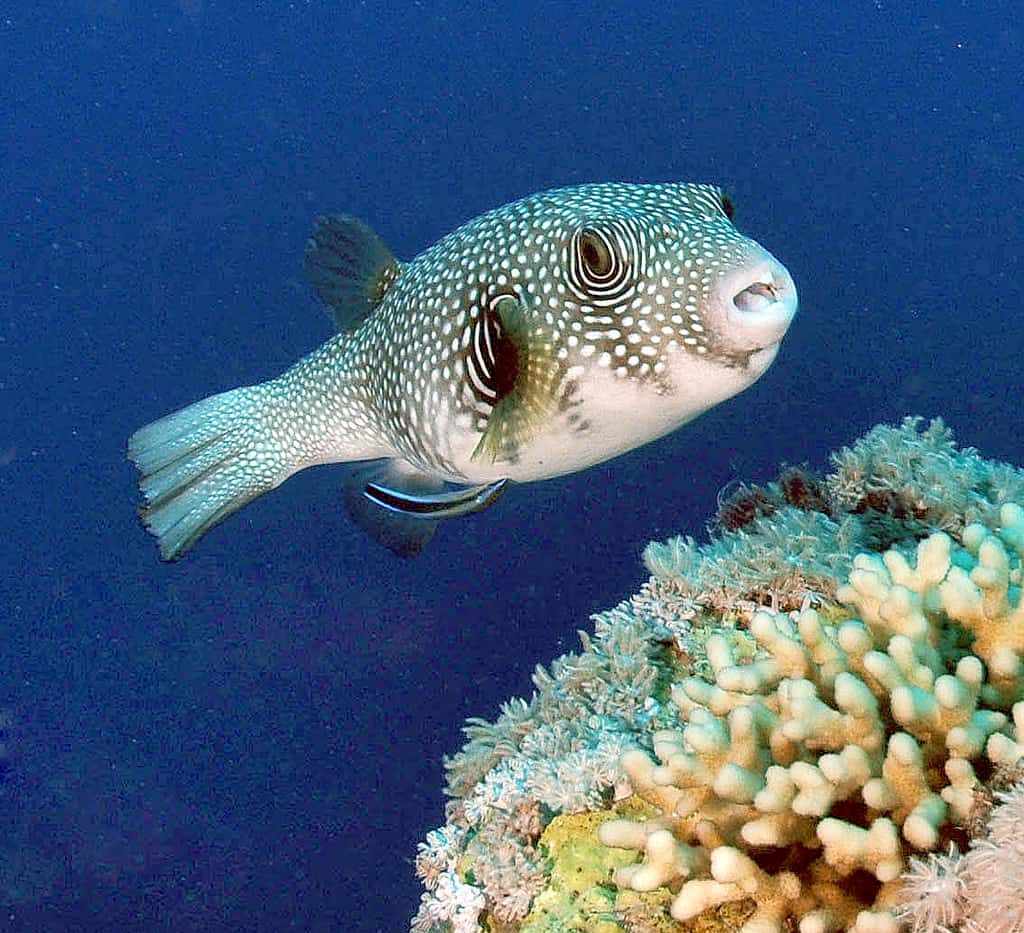
Unlike the Mbu pufferfish, a freshwater species that can grow to over two feet long, the white-spotted pufferfish is only four to five inches long.
White-spotted pufferfish are omnivorous, meaning they eat a varied diet that may include algae, mollusks, crabs, corals, sponges, and tube worms. After all, they need plenty of energy to build their sand nests.
An Intricate Mating Ritual
As mentioned above, T. albomaculosus is tiny. Yet the nests the male pufferfish build can span up to six or seven feet. On average, it takes around seven to nine days to construct the nest.
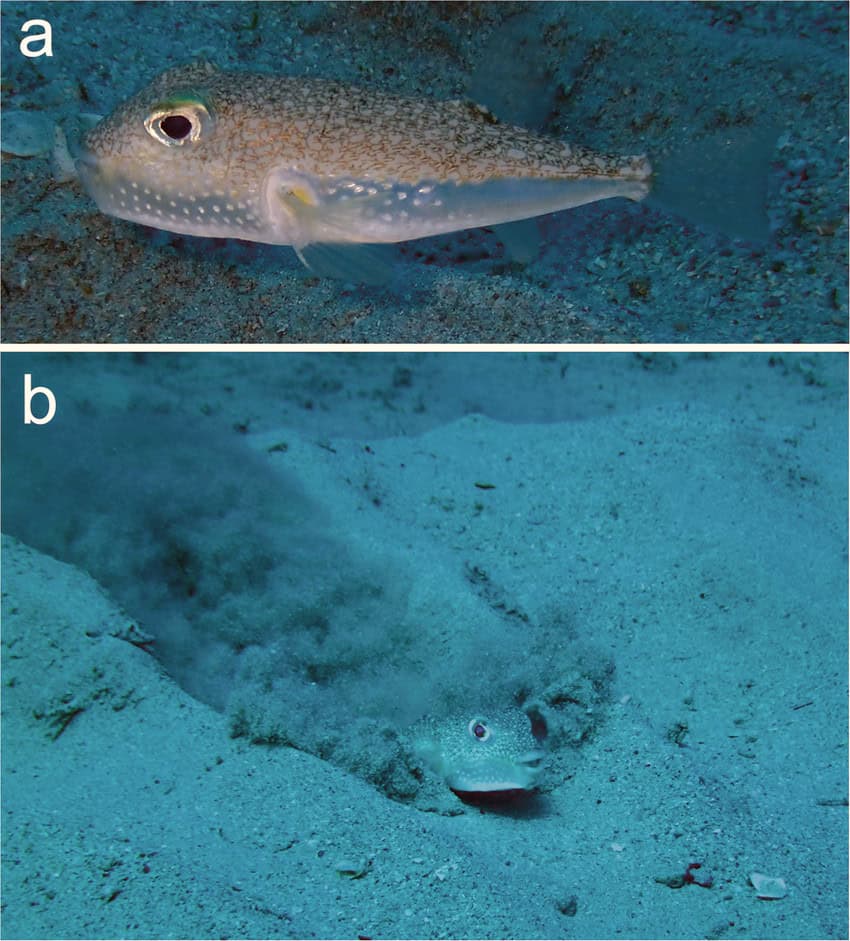
The male white-spotted pufferfish begins building the nest by dragging its body through the sand and moving its fins to create the outer ring.
According to a 2018 study published in Scientific Reports, “it [the male pufferfish] repeatedly excavates the sand with its fins and body to leave marks hundreds or thousands of times, during which the radial ditches in the outer ring region gradually appear.” On average, the outer rings contain anywhere from 24 to 32 peaks and valleys. Usually, the pufferfish begins excavating at the outer edge of the circle and works inward.
Once the outer ring area is complete, the white-spotted pufferfish begins his work on the maze-like inside of the nest. Through this design, oxygenated water flows through the nest’s soft sediment center. The flow of water is important for supporting the eggs once they are spawned. Finally, the male, white-spotted pufferfish decorates the outer layer of the nest with fragmented shells and coral.
The Females Choose Their Partners
After all that hard work, the male white-spotted pufferfish must then wait for females to check out his nest. A 2015 article published in Bulletin of Marine Science explains that males perform a courtship display when a suitable female approaches the circle. They start by stirring up sand, then swimming quickly up to the females before retreating to the edge of the design.
However, scientists don’t understand what exactly attracts the females or why certain female pufferfish are drawn to certain nests. Some hypothesize that, by inspecting the nest, females can judge a male’s body size and his potential suitability as a mate. Factors such as nest symmetry, sand particle quality, or even the arrangement and color of shells and corals could play a role.
Regardless, if the female likes the nest and the courtship display, the two fish will mate. To do so, the female moves to the nest’s center and deposits her eggs. The male then fertilizes the eggs. But that’s not the end of his job. In fact, the male waits at the nest for approximately six days to protect the eggs from predators.
For many species, protecting the young is a mother’s job. Yet male white-spotted pufferfish are just one of many male fish that protect their offspring. For example, male jawfish hold fertilized eggs in their mouths until they hatch, while male betta fish create bubble nests to care for their spawn.
Leaving the Nests Behind
Despite all the work put into nest-building, ocean currents wash away the nests after use. The males go on to create new nests during each nesting cycle.
Kawase believes this has to do with the fine sediment and sand in the nest’s center. In his 2013 study in Scientific Reports, he and his co-authors posit that the fine sediment dissipates after one nesting cycle. As a result, white-spotted pufferfish build new nests to ensure there is enough sediment to sustain the next batch of eggs. Talk about a labor of love!