Ichthyostega is a genus of aquatic animals closely related to the four-legged land vertebrates (tetrapods). The Ichthyostega lived during the Devonian Period about 370 million years ago. Initially considered an aquatic tetrapod because it possessed four limbs and fingers, paleontologists now know that it lived before the first tetrapods arrived on the scene. The Ichthyostega was one of the earliest four-limbed vertebrates in the fossil record. Studying this creature has given scientists some insights into the development of weight-bearing adaptation that made tetrapods capable of walking on land.
Description and Size
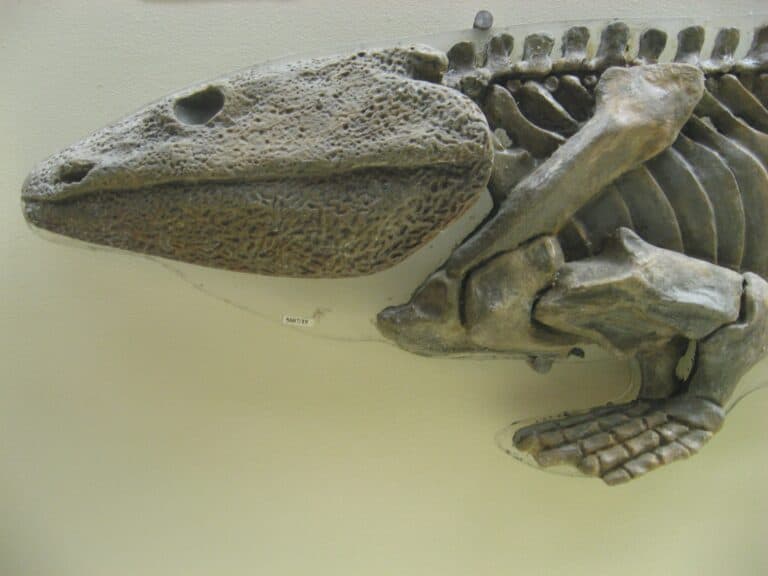
The name Ichthyostega means “fish roof.” The name is probably a reference to the low skull and relatively short snout of the creature, which resembled that of a fish. It also had a small dorsal fin along its tail which is another physical characteristic it shares with fishes.
Because it combined fish and tetrapod-like features, scientists classified Ichthyostega as a transitional fossil between both groups for several years. It is now classified as a primitive stegocephalian—a group consisting of all four-legged creatures.
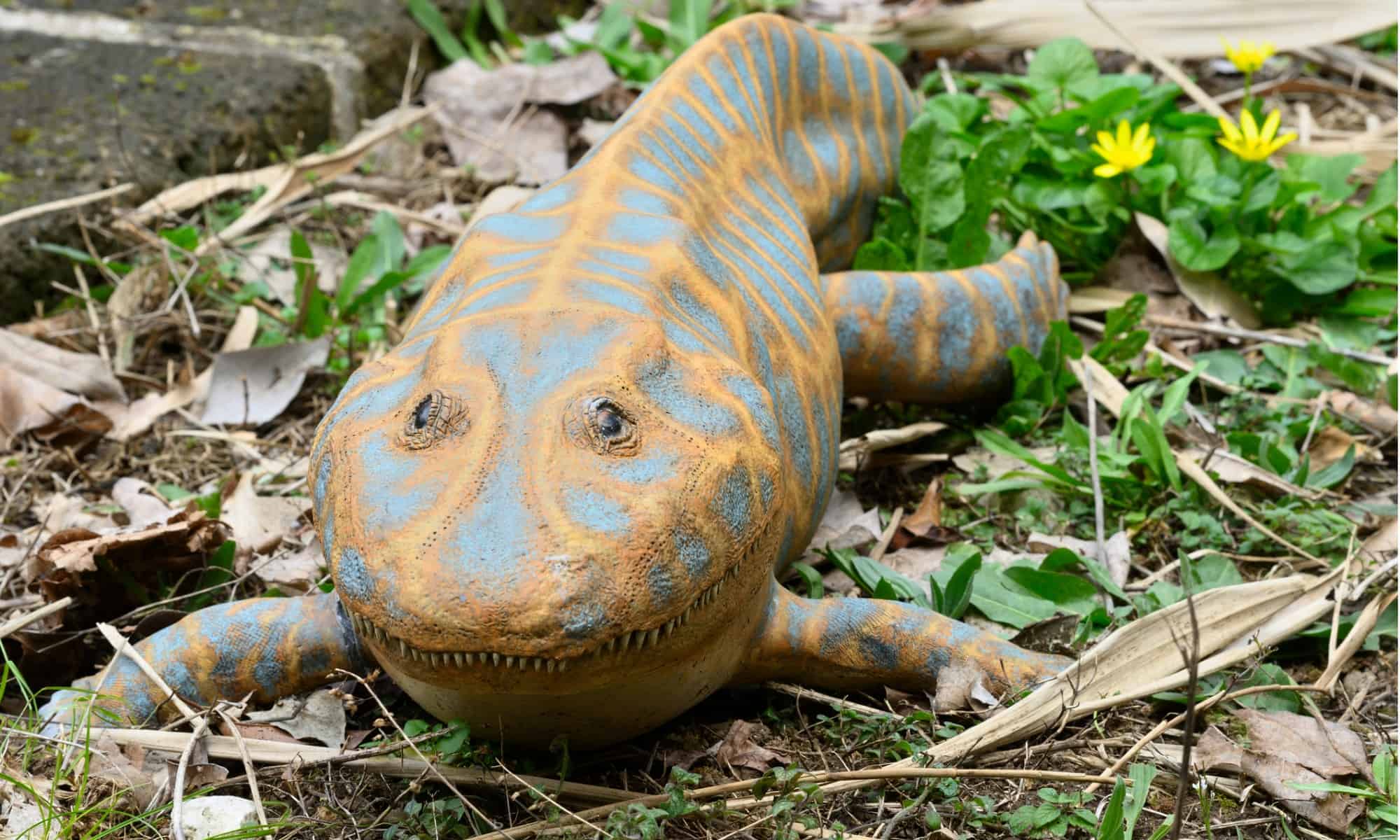
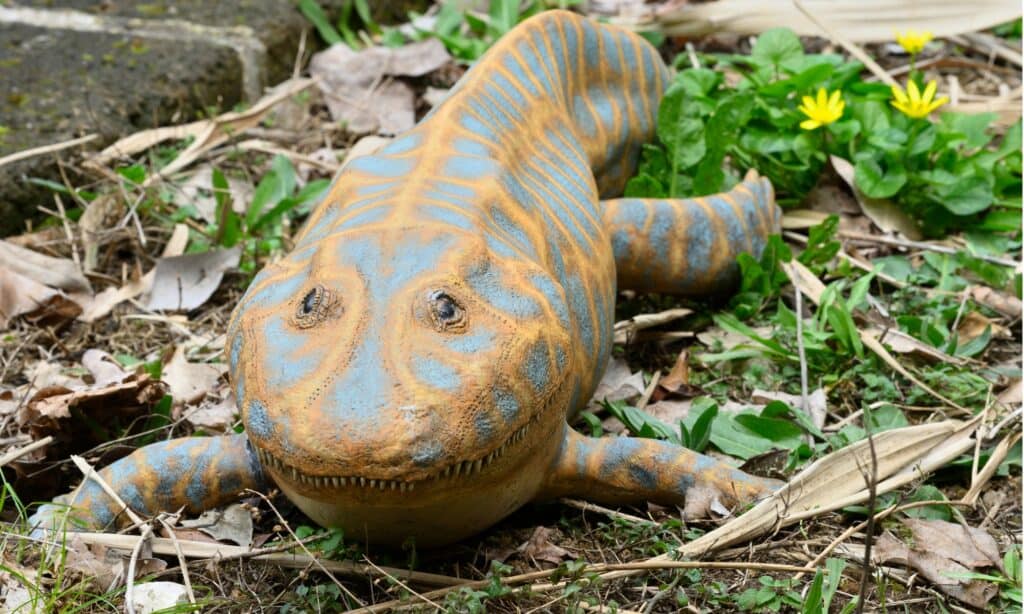
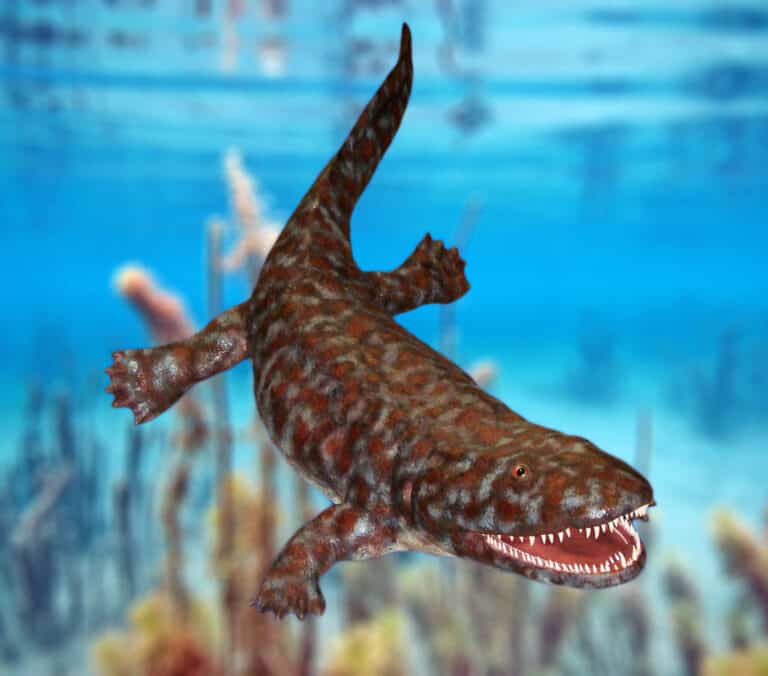
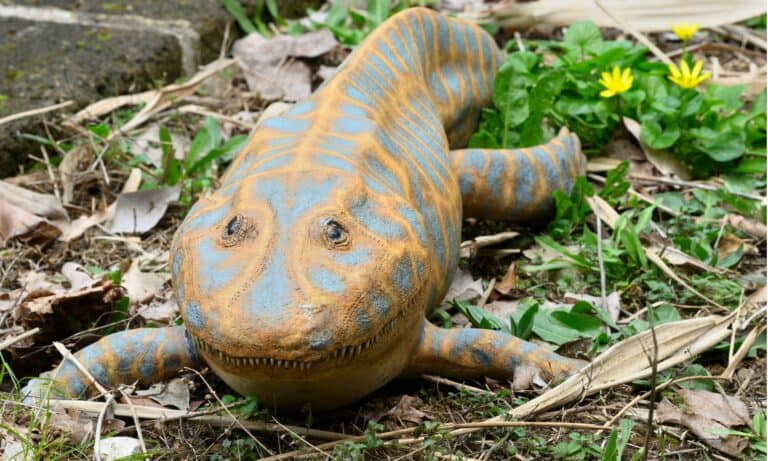
Ichthyostega was a relatively large animal. It was broadly built and might have been up to 4.9 feet long. Also, this creature had a low and narrow skull with eyes placed dorsally on the top of its head. Its dentition was similar to that of many extinct predatory amphibian species. At the posterior margin of the Ichthyostega’s head, there was an operculum that covered the primitive gills of this creature.
Perhaps the most distinct feature of the Ichthyostega were the two pairs of limbs, which were unusually large compared to that of other ancient tetrapodomorphs. Each of the hind limbs had seven digits. However, scientists are unsure of the number of digits on the forelimbs since it has never been preserved in fossil records. Experts think the Ichthyostega used the limbs like fleshy paddles rather than fins like a fish. It had a bony tail which it used to propel itself while in the water.
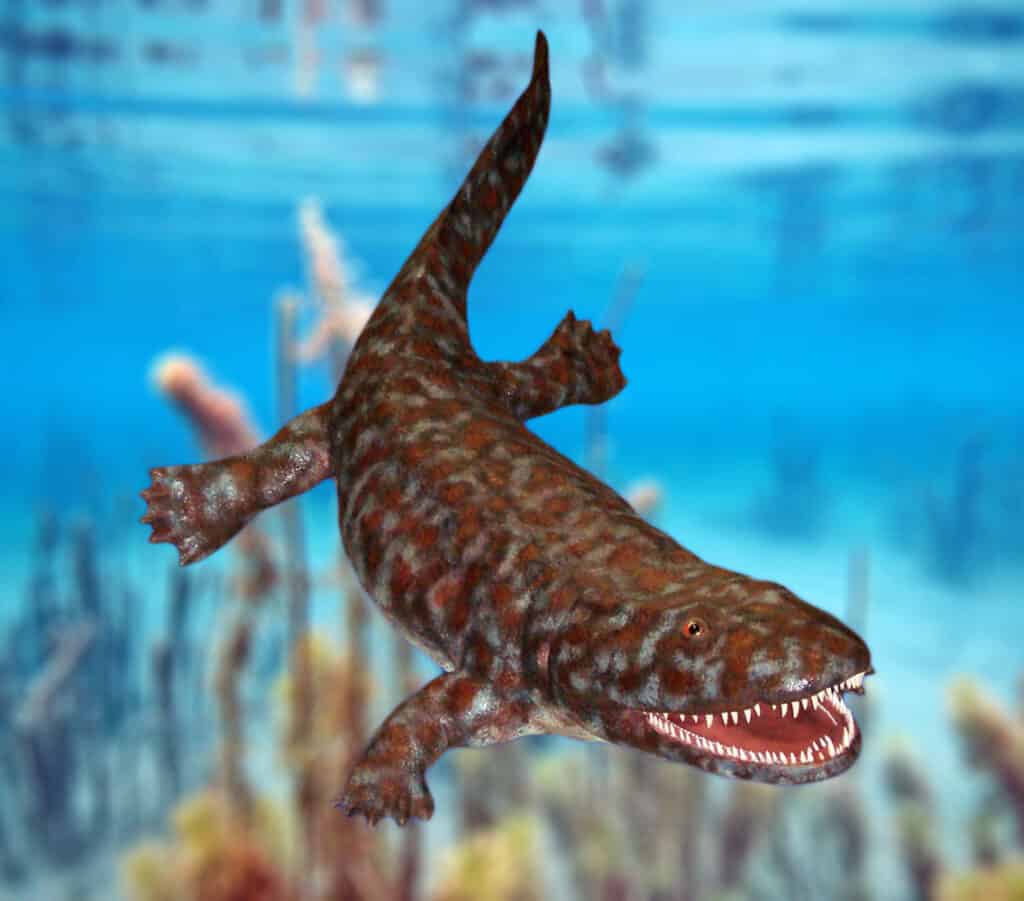
The Ichthyostega was broadly built, about 4.9 feet long and had large limbs.
©Dr. Günter Bechly, CC BY-SA 3.0 <https://creativecommons.org/licenses/by-sa/3.0>, via Wikimedia Commons – Original / License
Diet — What Did Ichthyostega Eat?
Scientists are not entirely sure of what the Ichthyostega ate. Since it was a carnivore and spent most of its time in the water, its diet would have consisted of fish. On land, it might have hunted small lizards. This creature was likely to be more sluggish on land and active in the water. Therefore, it must have hunted for most of its food in the ocean.
Habitat — When and Where Ichthyostega Lived
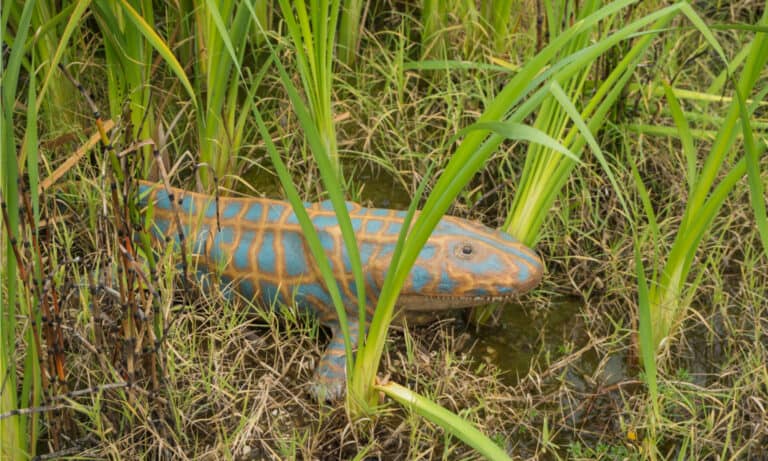
Scientists have found fossils of this creature in rocks from eastern Greenland. The rocks where it was found date back to the late Devonian Period (about 370 million years ago). One of the most remarkable facts about Ichthyostega is the fact that it was probably among the earliest aquatic animals to venture on land. Their fossils were found in lake and river deposits. However, scientists believe this animal was capable of venturing on land occasionally.
It had gills for respiration in water and would have been capable of breathing air as well (at least for short periods). This animal probably spent between 70 to 90% of its time in the water and only spent short periods on land. It was heavily built, and the limbs would not have been strong enough to bear its weight on land. Even though it had a build similar to the salamander, it would have moved more like a seal on the ground.
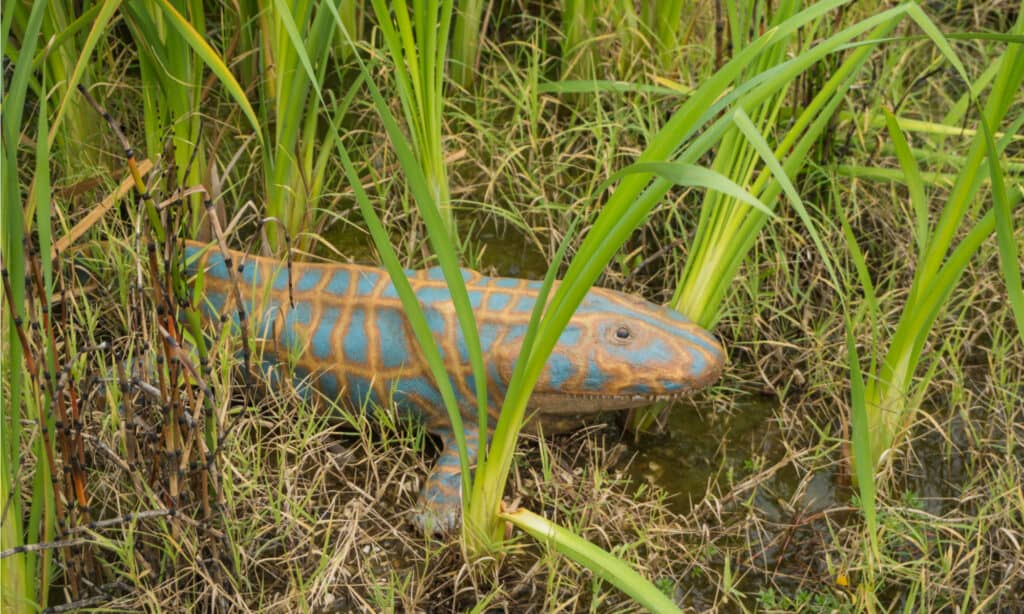
The Ichthyostega are believed to be among the earliest aquatic animals to venture on land during the Devonian Period.
©FABRIZIO CONTE/Shutterstock.com
Threats and Predators
Early tetrapods were predators themselves, preying on small fish in their aquatic homes. However, large fish in the same habitat probably preyed upon their young. Examples of likely predators include Holoptychius (a type of lobe-finned fish), dipterous, and Bothriolepis.
Discoveries and Fossils — Where Ichthyostega Was Found
The Danish East Greenland Expedition discovered Ichthyostega fossils in 1931. Gunnar Säve-Söderbergh published the first description of Ichthyostega species in 1932 based on the 14 specimens that paleontologists recovered the previous year. The fossils were from rock formations in East Greenland that date back to the Late Devonian Period. Over the years, his initial description has been reviewed, and the number of species he identified has been pruned down to one from the initial four due to their close similarity.
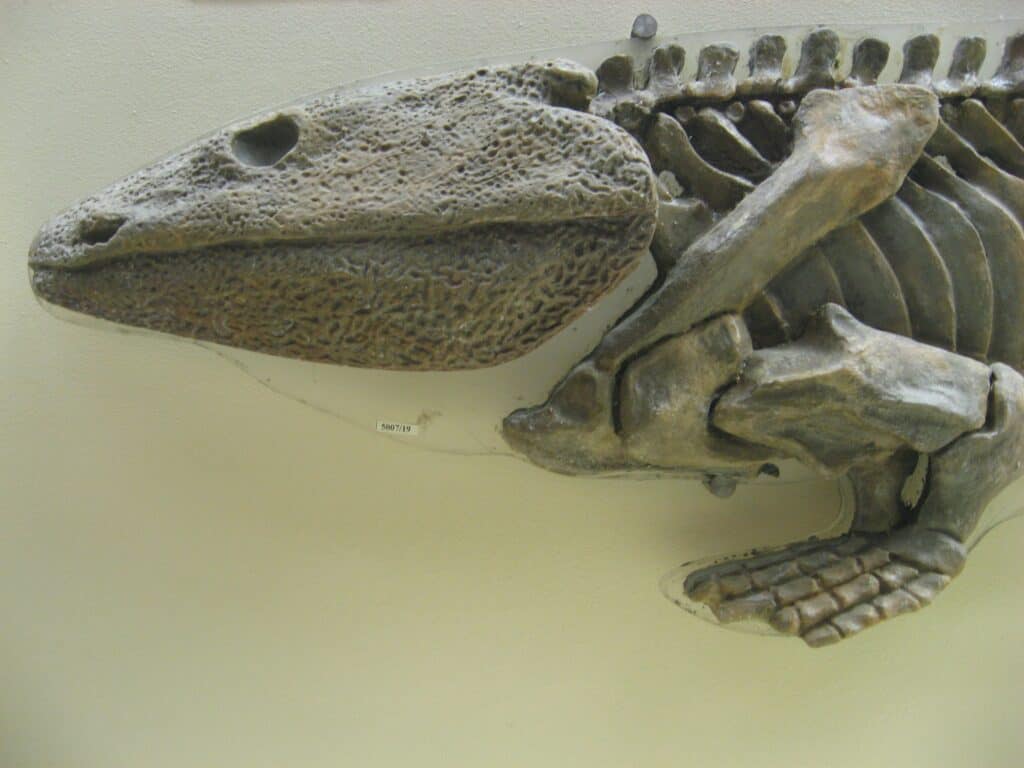
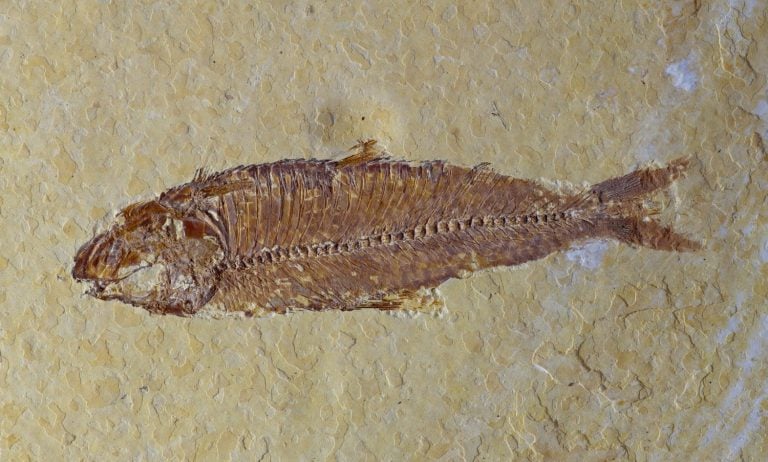
The Ichthyostega was one of the earliest four-limbed vertebrates in the fossil record.
©By OlegTarabanov – Own work, CC BY-SA 3.0, https://commons.wikimedia.org/w/index.php?curid=30408738 – Original / License
Extinction — When Did Ichthyostega Die Out?
Ichthyostega lived in the Devonian, between 370 to 362 million years ago. The extinction of this group of early tetrapods is often linked to a mass extinction event that took place roughly 360 million years ago. This extinction wiped out the majority of aquatic life forms at the time. Experts are not exactly sure of the cause of this extinction event, but they think we can blame the rapid environmental changes that occurred during the Devonian.
Similar Animals to the Ichthyostega
Similar ancient animals to the Ichthyostega include:
- Acanthostega: Acanthostega is an extinct genus of stem-tetrapod. Like the Ichthyostega, experts believe this animal was one of the first vertebrate animals to develop limbs. It lived in the Late Devonian Period, about 365 million years ago.
- Eusthenopteron: This is a genus of lobe-finned fish popular for its close relationships with the Tetrapods. The Eusthenopteron lived during the Devonian Period and shared many similarities with Ichthyostega.
- Panderichthys: This is a species of lobe-finned fish that lived in the Late Devonian. The group is transitional between early tetrapods and fish.
Related Animals
- Lungfish
- Tiktaalik
- Seymouria
Ichthyostega Pictures
View all of our Ichthyostega pictures in the gallery.

Sources
- Devonian Times / Accessed November 1, 2022
- Britannica / Accessed November 1, 2022
- Wikipedia / Accessed November 1, 2022