


C
Species Profile

Chinese Paddlefish

Psephurus gladius

Yangtze's vanished paddle-nosed giant
Alneth / CC BY-SA 4.0

Chinese Paddlefish Distribution

Click a location to explore more animals from that region

Endemic Species

This map shows coastal regions where Chinese Paddlefish are found.

Loading map...

Found in 1 country

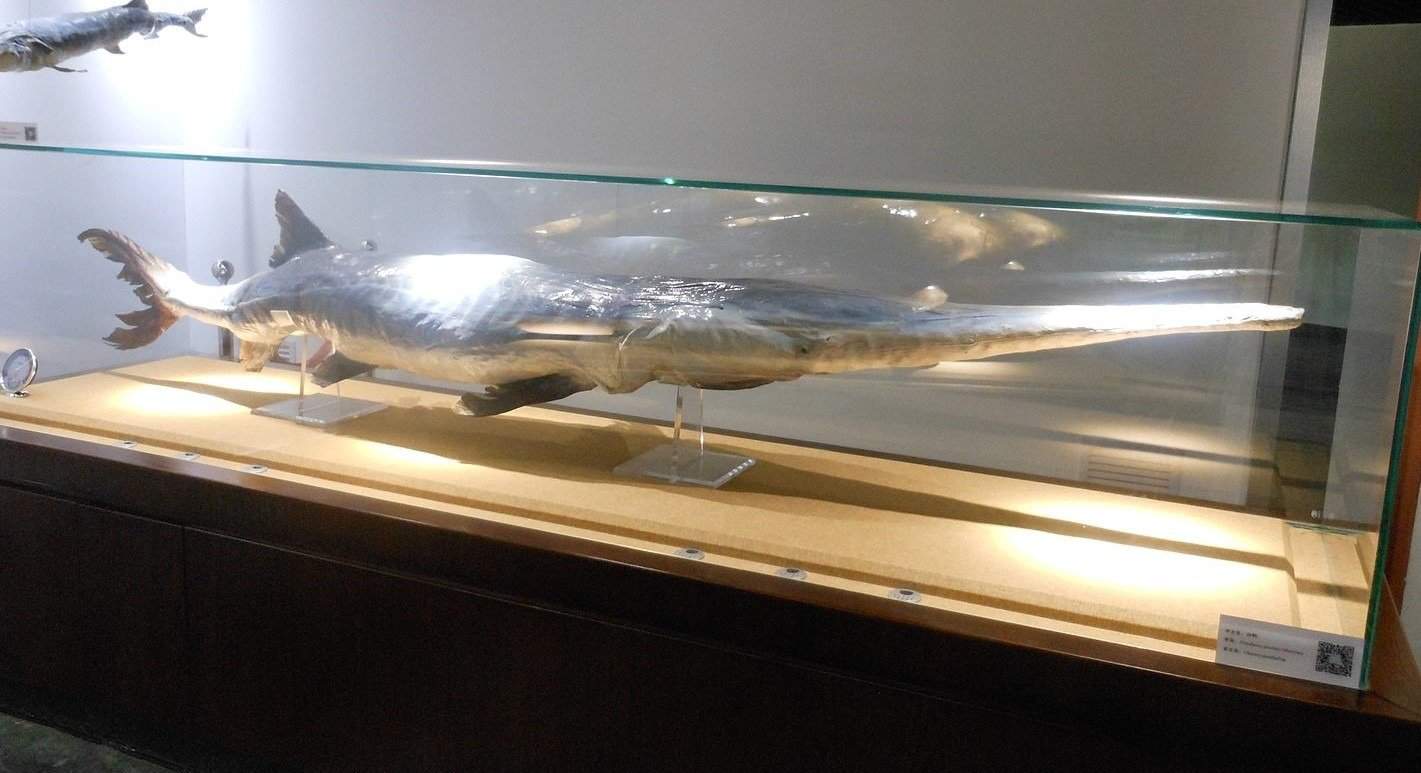
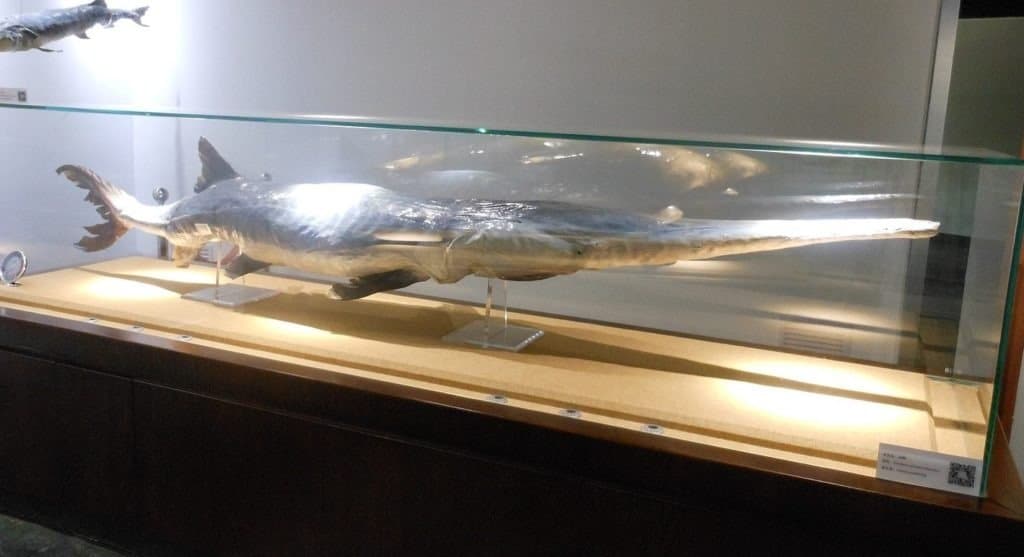
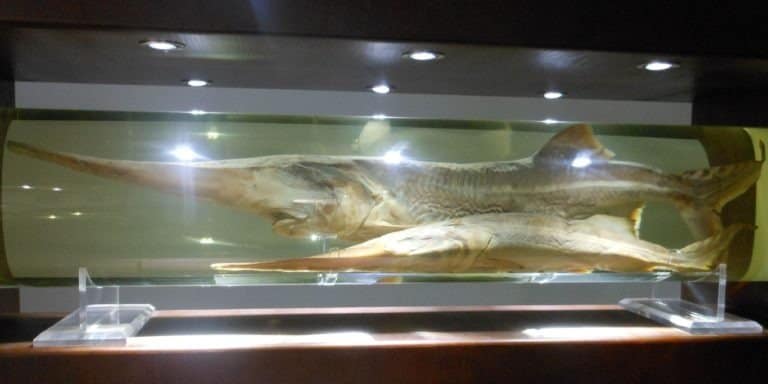
Chinese Paddlefish exhibited in the Museum of Hydrobiological Sciences, Wuhan

At a Glance

Wild Species
Also Known As Chinese swordfish, Yangtze paddlefish, Yangtze River paddlefish
Diet Piscivore
Activity Cathemeral
Lifespan 15 years
Weight 500 lbs
Did You Know?

It was among the largest freshwater fishes ever recorded: historical reports cite up to 7.0 m total length and ~500 kg mass (fishery records; IUCN accounts summarize these maxima).

Scientific Classification

A very large, plankton-feeding (and reportedly also piscivorous) freshwater ray-finned fish of the paddlefish family, characterized by an elongated paddle-like rostrum. Historically endemic to China’s Yangtze River system and associated large rivers/lakes; now considered critically endangered and widely assessed as likely extinct due to overfishing, shipping impacts, and habitat fragmentation (notably dams).

Kingdom
Animalia
Phylum
Chordata
Class
Actinopterygii
Order
Acipenseriformes
Family
Polyodontidae
Genus
Psephurus
Species
gladius

Distinguishing Features

  • Extremely long, flattened paddle-like rostrum (snout)
  • Large body size for a freshwater fish
  • Cartilaginous-like skeleton typical of Acipenseriformes
  • Planktivorous feeding adaptations (fine gill rakers) with sensory rostrum for prey detection

Physical Measurements

Length
14 ft 9 in (9 ft 10 in – 22 ft 12 in)
Weight
551 lbs (220 lbs – 1,102 lbs)

Appearance

Primary Colors
Secondary Colors
Skin Type Scaleless (naked), smooth skin; lacks the bony scutes found in many sturgeons.
Distinctive Features
  • Extremely elongated, flattened, sword- or paddle-like snout (rostrum); the rostrum functions as a sensory organ and is covered with electroreceptors that help detect prey in turbid water.
  • Very large body size: historical records report up to ~7.0 m total length and up to ~500 kg mass; commonly cited adult lengths historically ~3-4 m (values based on fisheries/field records from the Yangtze basin).
  • Large terminal mouth and streamlined, shark-like silhouette with a strongly heterocercal tail (upper caudal lobe longer), consistent with a fast-swimming river predator.
  • Endemic to China's Yangtze River system (including associated large rivers/lakes); historically a long-distance potamodromous migrant within the basin.
  • Feeding ecology historically reported as primarily piscivorous (unlike the plankton-filter-feeding American paddlefish), though some accounts suggest opportunism; morphology and reports support a predatory lifestyle in large-river channels.
  • Chinese paddlefish (Psephurus gladius) is Critically Endangered (Possibly Extinct). Likely extinct from overfishing, bycatch, ship traffic damage, and dams blocking migration (Gezhouba Dam, 1981); last record 2003.

Did You Know?

It was among the largest freshwater fishes ever recorded: historical reports cite up to 7.0 m total length and ~500 kg mass (fishery records; IUCN accounts summarize these maxima).

Endemic range: confined to China's Yangtze River basin (mainstem plus large connected lakes such as Dongting and Poyang) and historically the lower reaches of major tributaries.

Last confirmed record: a specimen captured in the Yangtze in January 2003 (it died after capture). Extensive later surveys failed to find any individuals.

A basin-wide assessment concluded the species went extinct sometime between 2005 and 2010, after years with no verified sightings (Zhang et al., 2020).

Unlike its plankton-straining North American relative (American paddlefish, Polyodon spathula), the Chinese paddlefish has long been described as primarily piscivorous (fish-eating), reflecting different gill-raker form and feeding ecology reported for the species.

Its decline closely tracks river fragmentation: the Gezhouba Dam (completed 1981) and later major Yangtze impoundments greatly reduced long-distance spawning migrations, while heavy fishing pressure persisted.

Unique Adaptations

  • Elongated paddle-like rostrum packed with sensory organs: in paddlefishes (Polyodontidae), the rostrum and head carry abundant electroreceptors used to detect prey/biological signals in murky water; Chinese paddlefish is inferred to share this key family trait.
  • Acipenseriformes "ancient fish" body plan: largely cartilaginous skeleton, heterocercal (shark-like) tail, and an extendable/protrusible mouth-features shared with sturgeons and paddlefishes that suit life in big, flowing rivers.
  • Large size with slow life history: very large-bodied, late-maturing river fishes typically have low population growth; this makes them exceptionally sensitive to added adult mortality from bycatch and targeted harvest.
  • River-lake network dependency: historically benefited from (and required) connectivity among Yangtze channels and floodplain lakes for feeding and growth-an ecological specialization that becomes a liability when connectivity is lost.
  • Hydrodynamic rostrum and body shape: the long, flattened "paddle" likely aided stable swimming and sensory scanning while cruising in strong currents, complementing ram-feeding/pursuit feeding in open water.

Interesting Behaviors

  • Long-distance potamodromous migration within the Yangtze system: historically moved between feeding areas in lower/middle reaches and upstream spawning grounds; fragmentation by dams is widely implicated in collapse of recruitment.
  • Likely pelagic/river-channel cruising: captures and accounts often place it in the main current of large rivers and at confluences-consistent with a large, wide-ranging predator in turbid water.
  • Seasonal reproductive movement: historical fisheries and biological accounts describe spring-early summer spawning runs up the Yangtze (timing varies by reach and flow conditions reported by local records).
  • Low encounter rate and apparent solitary habits: even historically, landings were sporadic for such a huge fish, suggesting naturally low density and wide home ranges-traits that heighten vulnerability to overfishing.
  • Turbidity-tolerant foraging: in the sediment-heavy Yangtze, it likely relied heavily on non-visual prey detection (consistent with polyodontid sensory biology and the function of the elongated rostrum).

Cultural Significance

The Chinese paddlefish (Psephurus gladius), once a famous Yangtze River megafauna, became a symbol of wildlife loss. As it went extinct, it and the baiji were used to show harm from overfishing and river development.

Myths & Legends

Major ichthyological references list the species' common names as "Chinese paddlefish" (and sometimes "Chinese swordfish"); "elephant-nose fish" is not documented there as a standard common name, so this folk-name claim is not reliably verifiable.

The Chinese paddlefish (Psephurus gladius) was long called "white sturgeon" in China. People grouped it with sturgeons for its shape and fame as a big Yangtze fish, a folk, not scientific, name.

Giant-catch anecdotes from the Yangtze: local accounts and newspaper-era recollections describe rare, dramatic landings of enormous individuals as once-in-a-generation events-stories often used to mark floods, exceptional fishing years, or a community's 'river luck.'

In modern China, the Chinese paddlefish (Psephurus gladius) is used as a warning — the "lost giant of the Yangtze" shown in museums, films, and programs for river protection and fishing bans.

Conservation Status

CR Critically Endangered (Possibly Extinct)

Facing an extremely high risk of extinction in the wild.

Population Decreasing

Protected Under

  • China: listed as a nationally protected wild animal (historically included on China's National Key Protected Wild Animals list; national protection measures prohibit capture/trade without authorization).
  • China: Yangtze River basin fishery closures/moratoria and broader river-protection measures (implemented to reduce fishing pressure and aid recovery of native aquatic fauna, though applied after the species' collapse).

Life Cycle

Birth 300000 frys
Lifespan 15 years

Lifespan

In the Wild
10–20 years

Reproduction

Mating System Data Deficient
Social Structure Aggregation Group
Breeding Pattern Transient
Fertilization Substrate Spawning
Birth Type Substrate_spawning

Chinese paddlefish (Psephurus gladius) is likely extinct and its spawning is not well known; based on close relatives, it likely made seasonal Yangtze runs, used external fertilization in group spawning (many males and females), and had no parental care.

Behavior & Ecology

Social Shoal Group: 1
Activity Cathemeral
Diet Piscivore small fishes (primarily cyprinids)
Seasonal Migratory 1,864 mi

Temperament

Non-territorial and generally non-aggressive; lacks known intraspecific combat structures/behaviors typical of strongly territorial fishes (no species-specific ethograms published).
Likely avoids disturbance: big river migrating Psephurus gladius probably stays deeper and moves away from boats and nets. Known mostly from fishing catches, not direct behavior tests.
Predatory/foraging temperament toward fish prey has been reported historically; the Chinese paddlefish is generally described as a primarily piscivorous predator, implying active pursuit or ambush at least opportunistically, but not social predation.

Communication

No confirmed acoustic/vocal signaling reported for Chinese paddlefish in the peer-reviewed literature; like most ray-finned fishes it may produce incidental sounds during movement or stress, but social acoustic communication is undocumented.
Electroreception Family-level trait in Polyodontidae): paddlefish rostrum bears dense electroreceptors used to detect prey; Chinese paddlefish is inferred to have used similar electroreception for prey detection and possibly orientation in turbid river conditions (well-established in Polyodontidae; species-specific mapping for P. gladius is not available
Mechanosensory detection via lateral line: likely important for detecting flow, obstacles, and nearby animals in turbid, high-discharge river habitats General Actinopterygii trait; not quantified for this species
Chemical cues (olfaction): likely used for habitat selection and possibly spawning migration cues, as in many migratory river fishes; no P. gladius pheromone or homing studies published.
Visual signaling is likely limited by turbid Yangtze conditions and the species' presumed reliance on electroreception/mechanosensation; no courtship coloration or display behavior has been described.

Habitat

Terrain:
Riverine Valley Plains
Elevation: Up to 3280 ft 10 in

Ecological Role

Large freshwater mesopredator/apex predator in the Yangtze River system (historically), linking pelagic/river-channel fish production to higher trophic levels and regulating small-fish assemblages.

Top-down control of small/juvenile fish populations in large-river and connected lake food webs Energy transfer from abundant small fishes and crustaceans to upper trophic levels (large-bodied predator production) Historically an indicator of connectivity and ecological integrity of long free-flowing river reaches (migration-dependent predator)

Diet Details

Main Prey:
Small and juvenile fishes Small pelagic and estuarine fishes Crustaceans

Human Interaction

Domestication Status

Wild

The Chinese paddlefish (Psephurus gladius) was a wild, large migratory fish in China's Yangtze River. It was never domesticated or bred in captivity. People caught it in fisheries. Overfishing, busy river traffic, and dams (especially Gezhouba Dam) caused a steep drop; it is now likely extinct and listed as Critically Endangered (Possibly Extinct).

Danger Level

Low
  • Not venomous and not known to attack humans; primary risk would have been accidental injury during handling/landing due to very large size and thrashing.
  • Occupational risk historically occurred in fisheries contexts (nets/gear entanglement and boat-side handling), not from predatory behavior toward people.

As a Pet

Not Suitable as Pet

Legality: Chinese paddlefish (Psephurus gladius) cannot be kept as a pet. In China it is highly protected and having one needs special permits; CITES controls trade, and it is likely extinct.

Care Level: Expert Only

Purchase Cost:
Lifetime Cost: $250,000 - $2,000,000

Economic Value

Uses:
Historical commercial food fish (meat) Historical local market value (large-bodied river fish) Scientific/reference value (iconic Yangtze megafauna; conservation biology) Non-consumptive cultural value (flagship species for Yangtze conservation)
Products:
  • meat (historically consumed; fishery now defunct/illegal)
  • specimens for museums/scientific study (historical, not current)

Relationships

Predators 3

Human
Human Homo sapiens
Northern snakehead Channa argus
Amur catfish Silurus asotus

Ecological Equivalents 4

Animals that fill a similar ecological role in their ecosystem

American paddlefish
American paddlefish Polyodon spathula Shares family ties and a long snout, both being very large river fish species. Psephurus gladius ate fish and crustaceans, reached about 7 m and 500 kg, was last seen in 2003, and likely went extinct between 2005 and 2010.
Chinese sturgeon Acipenser sinensis Large-bodied sturgeon (order Acipenseriformes) that historically shared the Yangtze mainstem and estuary corridor; overlaps in habitat use (large, turbid river channels), shares vulnerability to gillnetting and overfishing, and experiences severe fragmentation impacts from major dams that block migration routes.
Kaluga sturgeon
Kaluga sturgeon Huso dauricus Very large, migratory river sturgeon in East Asia. Ecological similarity is primarily niche position: a long-lived, late-maturing, large-river megafaunal species highly sensitive to overharvest and river regulation (dams and vessel traffic), paralleling the drivers implicated in the collapse of P. gladius.
Dabry's sturgeon Acipenser dabryanus Historically occupies large-river habitats in the Yangtze Basin and shares exposure to the same basin-scale pressures—habitat fragmentation, altered flow and sediment regimes, and overfishing—making it a close ecological co-occupant, even though feeding ecology differs (benthic feeder versus paddlefish's planktivory/piscivory).

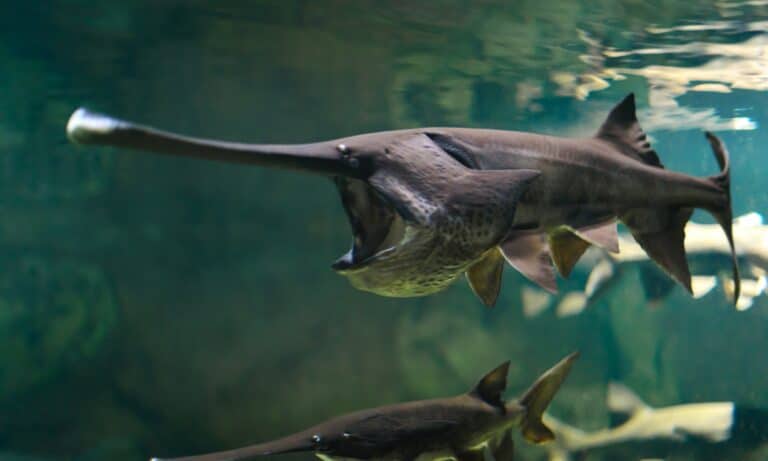
The Chinese paddlefish was a large freshwater predator, appropriately named for the paddle-shaped snout extending from the face. Large numbers of these fish once roamed the mighty Yangtze River of China. But after years of rapid decline, the Chinese paddlefish is believed to be extinct, a victim of human activity.

3 Incredible Chinese Paddlefish Facts!

  • The first paddlefish evolved about 200 million years ago. The modern paddlefish retains some “ancient” characteristics, including a highly cartilage-based skeleton and a large snout.
  • In some places, this species is called the elephant fish because the paddle resembles an elephant’s snout. It also earned the name of the “Giant Panda of the Rivers” because of its rarity.
  • The Chinese paddlefish was a solitary hunter that fed alone, except in the breeding season, when large numbers of these fish congregated together.
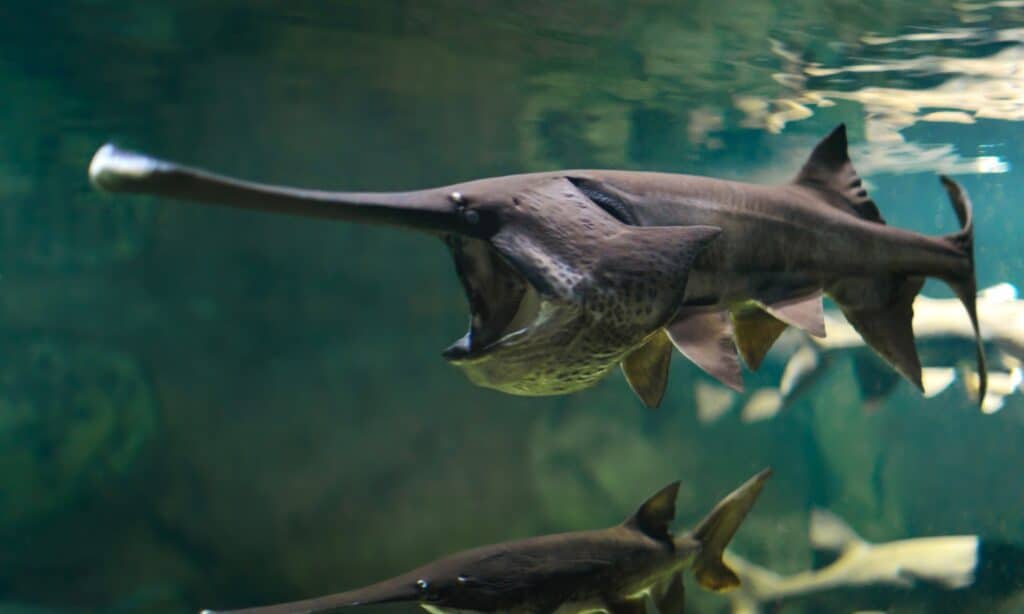
The Chinese Paddlefish was officially declared extinct by the IUCN in 2019, with the extinction widely reported in 2020.

Chinese Paddlefish Classification and Scientific Name

The scientific name of the Chinese paddlefish is Psephurus gladius. Gladius is the name of a Roman short sword, which resembles the fish’s nose. The paddlefish was the only living member of its genus and the only other member of its family besides the American paddlefish. More distantly, it occupies the same order as the sturgeon, which is another big predatory fish with a large snout.

Chinese Paddlefish Appearance

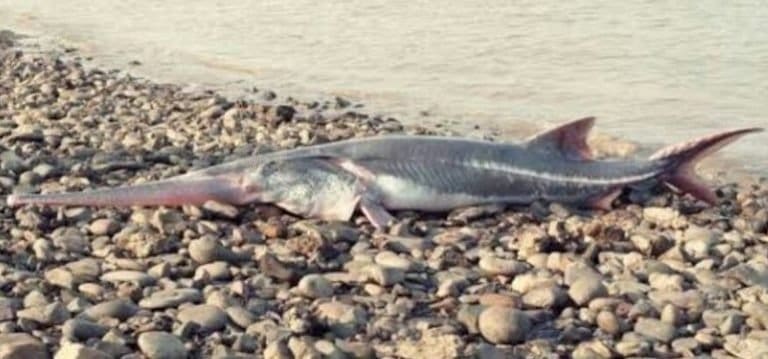
There are many facts about the Chinese paddlefish that make it unique. It was one of the largest species of freshwater fish in the world. It measured up to 23 feet (though more commonly about 10 feet) and weighed up to 992 pounds. The paddle nose alone, which is the distinguishing feature of this fish, took up a full third of the body length. It had a silver-grey back, fading to a white underbelly, with pink or red-colored fins. White ridges also extended along the side of the body. The smooth skin mostly lacked scales except near the fins.
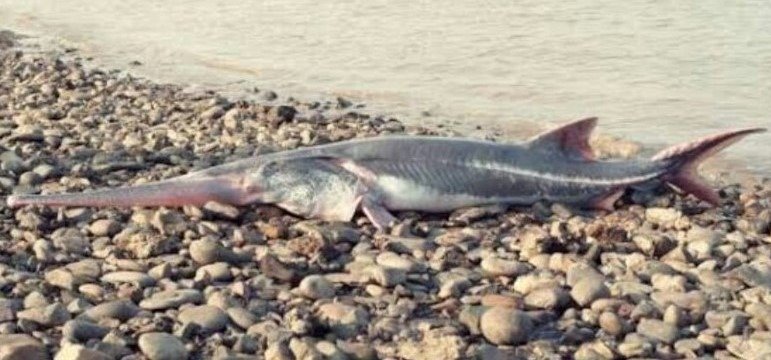
Chinese paddlefish on beach

Chinese paddlefish on a beach.

Chinese Paddlefish Distribution, Population, and Habitat

The Chinese paddlefish was once endemic to the entire Yangtze River and its tributaries and connected lakes, including the Yellow River. Running between the mountains of Western China and the East China Sea near Shanghai, the Yangtze is the third largest river in the world and contains an enormous amount of aquatic diversity. An adult paddlefish will also sometimes spend part of its life in the brackish (salty) estuaries and coastal waters of the East China Sea.

According to the IUCN Red List, the Chinese paddlefish is an extinct species. The last confirmed sighting occurred in 2003 when an adult specimen was accidentally caught, tagged, and released back into the water. However, the signal from the tag was lost within hours, and a proven sighting has not occurred since then.

This species was a victim of overfishing and dam construction. National Geographic reported that 25 tons of paddlefish were harvested every year in the 1980s, which placed enormous strains on the populations. The construction of the Gezhouba Dam, located about a thousand miles from the sea, and later the Three Gorges Dam, split the remaining population and prevented it from migrating upriver. This had the effect of driving down numbers to the point of near extinction.

Chinese Paddlefish Predators and Prey

The Chinese paddlefish was a top predator, dwarfing almost every other freshwater fish in the water. It was a strong swimmer with powerful jaws for feeding on prey.

What does the Chinese paddlefish eat?

Unlike its plankton-eating American relative, the Chinese paddlefish primarily fed on small to medium aquatic animals, including anchovies, shrimp, crab, and more. Because the American paddlefish also has electrical receptors on its snout for detecting prey, it is assumed, though not known for a fact, that the Chinese paddlefish had something similar.

What eats the Chinese paddlefish?

Due to its enormous size, the adult paddlefish had no other predators in its natural habitat. Humans were the only species that could kill an adult. However, the vulnerable eggs and juvenile fish were likely preyed upon in significant numbers by fish.
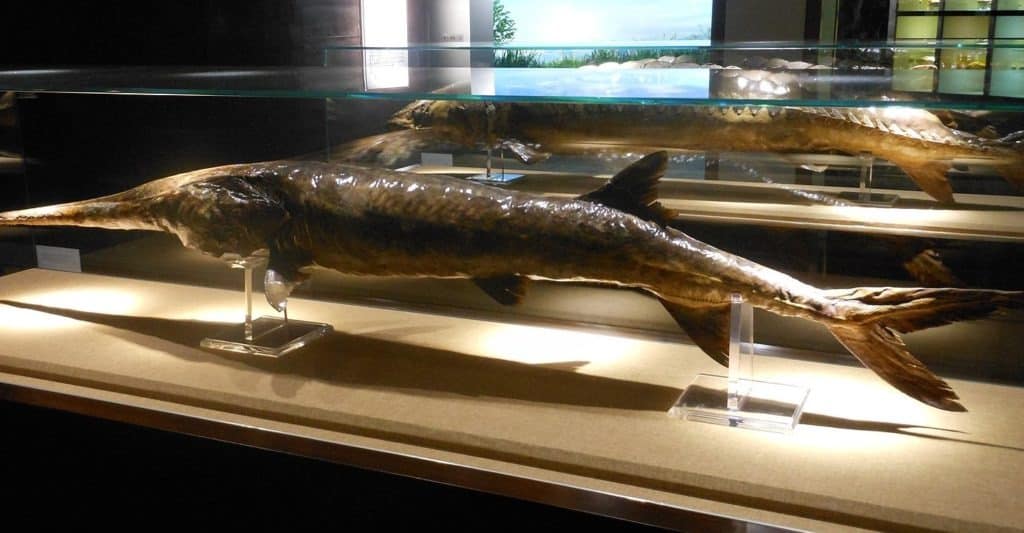
Chinese Paddlefish exhibited in the Museum of Hydrobiological Sciences, Wuhan

Chinese Paddlefish exhibited in the Museum of Hydrobiological Sciences, Wuhan.

Chinese Paddlefish Reproduction and Lifespan

The Chinese paddlefish had a spawning season that traditionally lasted between March and April. Like many freshwater fish, it migrated every year to its upriver spawning grounds, which also made it vulnerable to dam construction and fishing. Once they arrived, the males and females released their sperm and eggs into the water, which mixed and fertilized together.

The young fish hatched a few days later, small and undeveloped, and were left to fend for themselves. After a short period of growth and feeding, the paddlefish moved back downriver toward the sea to begin a new life. It takes around seven or eight years for this fish to reach full maturity. But because of its rapid decline, scientists could not study its reproductive strategies in great detail and learn any definitive facts about them. The fish’s long maturation period and lifespan interfered with the recovery once numbers began to decline rapidly.

Chinese Paddlefish in Fishing and Cooking

The Chinese paddlefish were heavily hunted in the 1970s and 1980s. Its predictable spawning behavior made the Chinese paddlefish relatively easy to catch in large nets as they swam along the river in schools toward the breeding grounds. The flesh was not the only desirable part of this fish, however. The roe (or eggs) were also considered to be a delicacy. It was made into caviar and sold at a high price.

View all 395 animals that start with C

Sources

  1. National Geographic / Accessed February 4, 2021
  2. Smithsonian Magazine / Accessed February 4, 2021
A-Z Animals Staff

About the Author

A-Z Animals Staff

AZ Animals is a growing team of animals experts, researchers, farmers, conservationists, writers, editors, and -- of course -- pet owners who have come together to help you better understand the animal kingdom and how we interact.
Connect:

Thank you for reading! Have some feedback for us?


Chinese Paddlefish FAQs (Frequently Asked Questions)

A Chinese paddlefish is a massive freshwater fish with a paddle-shaped nose. Native to the Yangtze River network up to the East China Sea, this fish has a deep ancestry dating back almost 200 million years, which also gave it a very distinctive and unique appearance compared to more modern fish.