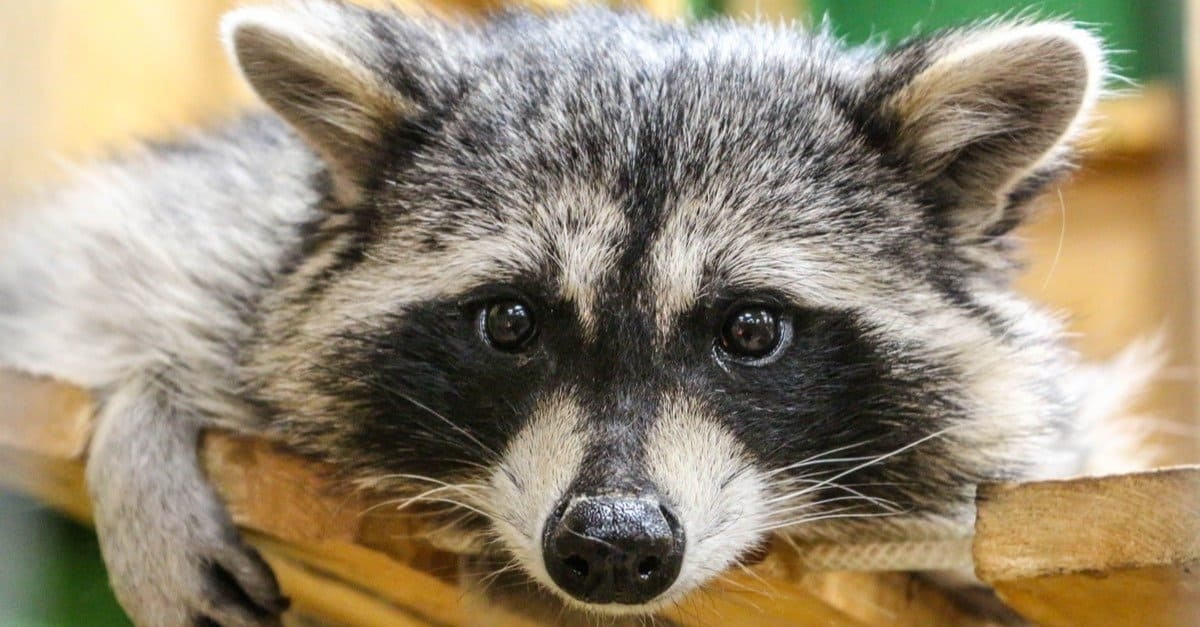
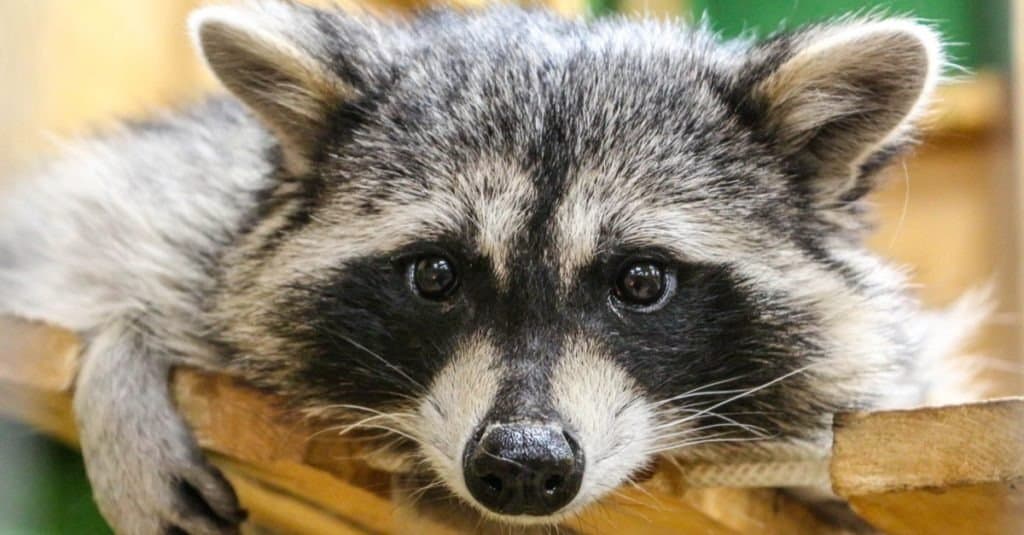
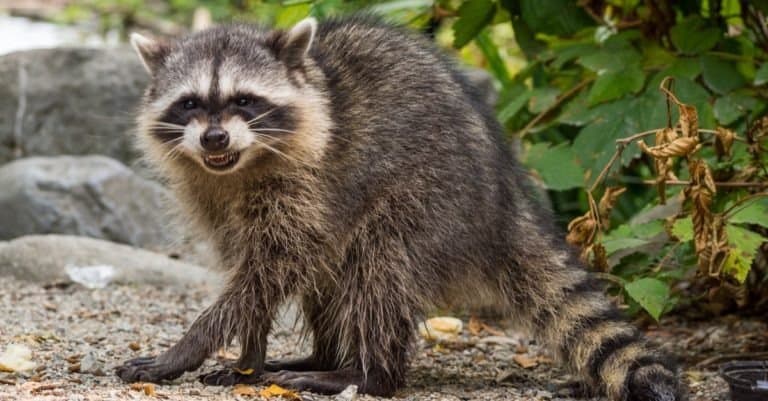
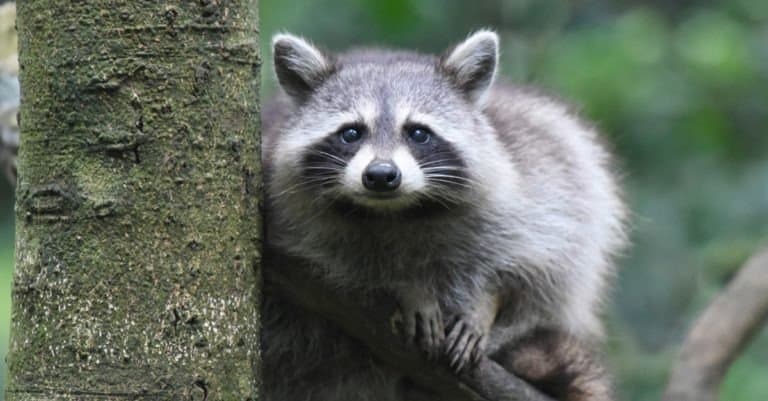




Sporting a black mask and ringed tail, the raccoon is among the most common mammals in North America.
Both vilified as a nuisance and loved for their fascinating behavior, the raccoon is an intelligent, clever animal that gets up to trouble with surprising enthusiasm and alacrity. A true survivor of the animal kingdom, it has thrived in the midst of human activity when so many other species have declined.
Learn about the smartest animals on earth here.
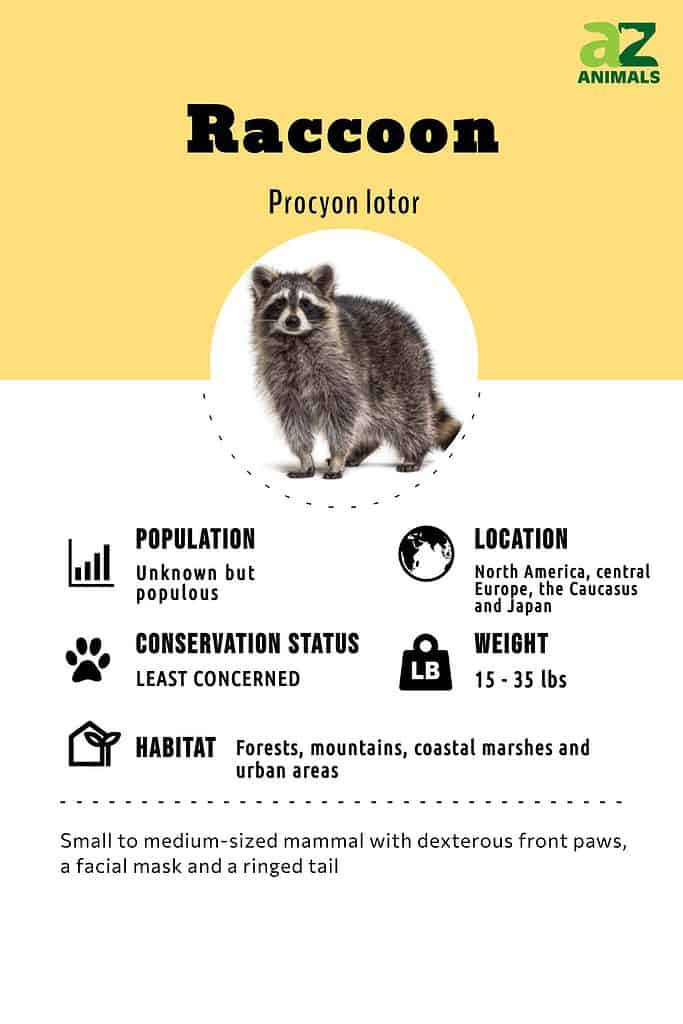
Incredible Raccoon Facts!
- The name of the raccoon is adapted from a native Powhatan term meaning “animal that scratches with its hands.” The Powhatans were native to Virginia.
- People have interacted with these animals for as long as humans settled in the Americas. Raccoons were considered to be an object of mythology. They were also a source of food for Native Americans and European settlers alike. And since their fur was fashioned into hats and coats, entire industries sprung up around trapping it.
- Raccoons are animals with exquisitely sensitive paws, which contain four to five times as many sensory cells as the rest of the body. Approximately three-quarters of the sensory part of the brain is dedicated to touching alone.
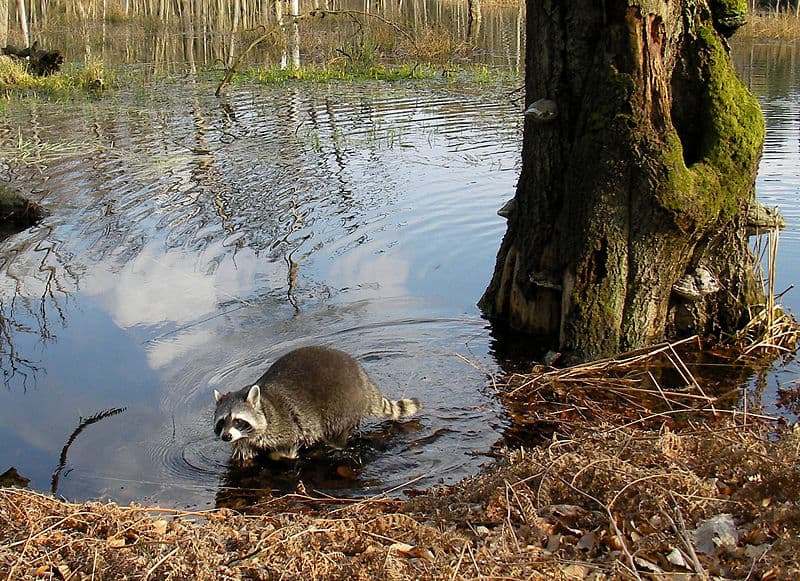
Raccoons scientific name translates from Latin to “the washer”, referring to its unusual behavior of dipping its food in water.
Scientific Name and Evolution
The scientific name of the raccoon is Procyon lotor. Procyon is a Greek term that roughly means “before the dog” or “dog-like” (it also happens to be the name of a very bright star in the constellation Canis Minor). The species’ scientific name roughly translates from Latin to the washer, referring to the raccoon’s unusual behavior of dipping its food in the water.
Raccoons are distantly related to bears (Ursidae), while the animal’s most direct ancestor probably originated in Europe some 25 million years ago. These ancestors of raccoons are believed to have crossed over the Berring Strait land bridge into the Americas, and settled in the tropics around Central or South America. Once modern raccoons evolved, they spread back north to temperate climates.
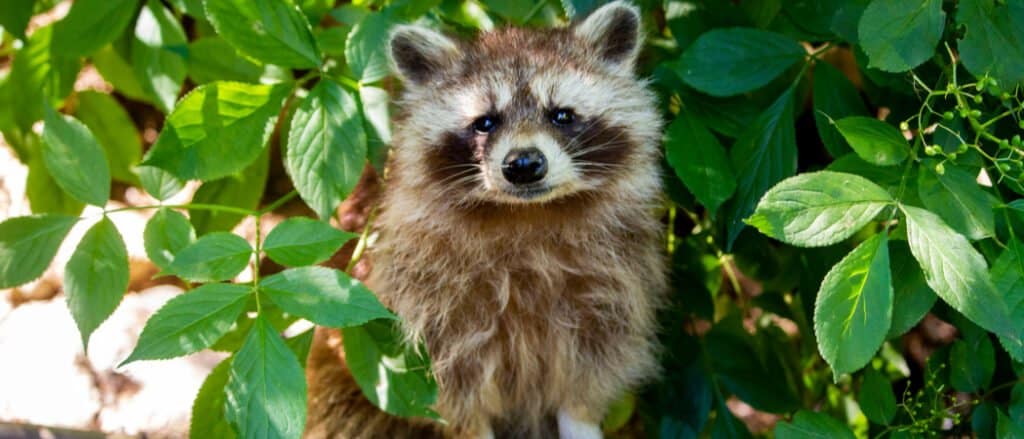
All raccoon subspecies are similar in appearance, but they do exhibit subtle differences in size, color and skull shape.
©Grinf4ce/Shutterstock.com
Species
To most people in North America, the word raccoon brings to mind only a single species, the common or northern raccoon, but there are two other species in the genus: the South American raccoon and the Cozumel raccoon. Although similar in appearance, they do exhibit some subtle differences. The Cozumel raccoon (also known as the pygmy raccoon, due to its smaller size) has a black throat band and a golden yellow tail. For the sake of identification, it’s sufficient to know that the common raccoon is the only species endemic to North America. There are more than 20 recognized subspecies of raccoon – we have listed and described them at the end of this article.
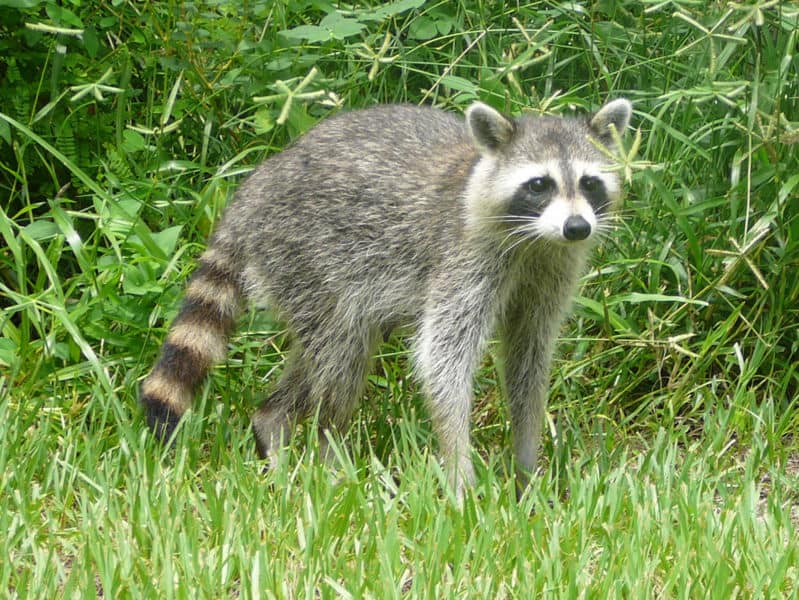
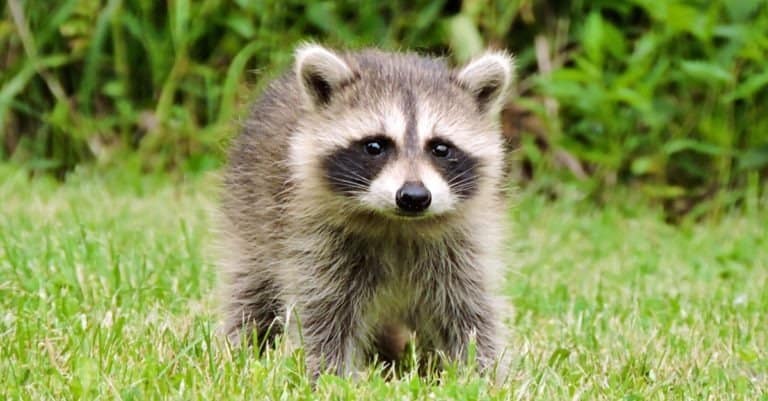
Raccoons are easily recognizable because of their masked faces and ringed tails.
©Bastique / Creative Commons – Original
Appearance
These animals are one of the most recognizable animals in North America. It has a pointed snout, a wide skull, rounded ears, sharp teeth, a big hunched back (as a result of the hind legs being bigger than the front legs), and a bushy tail with four to 10 black rings. The most distinctive characteristics are the black markings around the eyes that resemble a mask (though not every raccoon has this). The purpose of this mask is not entirely known. It might help the raccoons identify each other. Or it might enhance the raccoon’s night vision. Or maybe it evolved simply due to random chance.
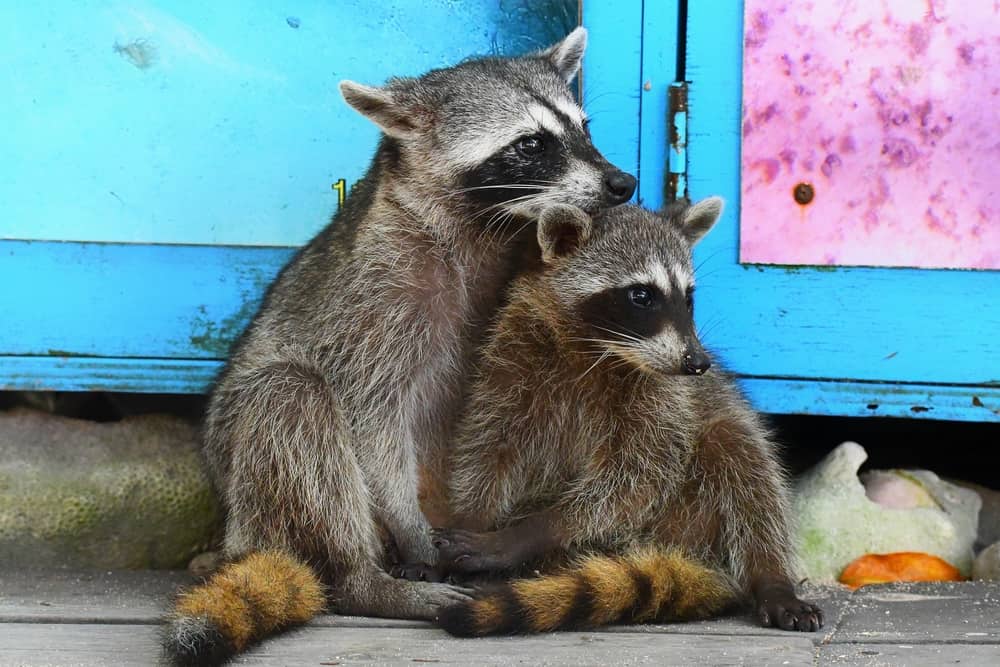
The Cozumel raccoon is smaller than the common raccoon with a golden ringed tail.
©Sebastian Schwegmann2/Shutterstock.com
Much of the animal’s coat consists of dense gray underfur to insulate it from the cold. Almost all raccoons have the same general color, but an all or mostly white albino variant does exist in nature. There is only about a one in 10,000 chance that an albino raccoon will be born and an even smaller chance they will survive long in the wild since the white color makes them stand out to predators. The elusive albino raccoon is so rare that each new report of one draws a lot of attention. In 2019, a Windsor photographer snapped a picture of two albinos together in the same family. This was estimated to be a one-in-750,000 chance meeting.
Raccoons are animals that average between 2 and 3 feet long from tail to the skull and weigh between 15 and 35 pounds, about the size of a small dog. The male boar is slightly larger than the female sow by about 10 to 30%. But regardless of sex, their body weight fluctuates widely throughout the year. They grow fatter in the winter and slimmer in the summer.
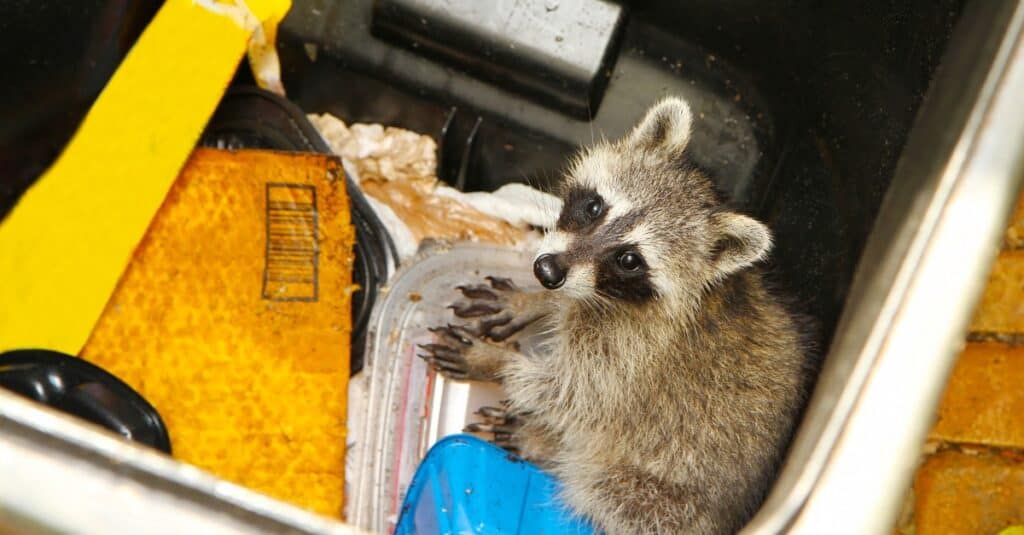
Raccoons are known to raid garbage cans for food.
©Jillian Cain Photography/Shutterstock.com
Behavior
Aided by its excellent night vision and keen eyes, the raccoon is a nocturnal predator that comes out at night to feast. It spends the remaining daytime asleep in its resident rock crevices, hollow trees, and dens, rarely leaving the immediate area unless food is unavailable. Unlike many other mammals, raccoons remain largely active during the winter seasons, when they live off their body fat, sometimes losing up to half their weight before the arrival of spring. Obviously, the northernmost populations must pack on the most pounds to survive the harsh winter.
One of the underappreciated aspects of the animal is its surprising agility. On the ground, it can run at speeds up to 15 miles per hour to evade slower predators. They are also excellent swimmers (though lacking in waterproof fur, it spends only a limited amount of time in the water). And with dexterous hands, they can clamber up trees and then leap to the ground from a distance of 40 feet without being harmed. This appears to provide a means of escape when the raccoon is under significant threat. In 2018, a particularly ambitious raccoon scaled the UBS tower in St. Paul, Minnesota, offering a showcase of the raccoon’s amazing abilities.
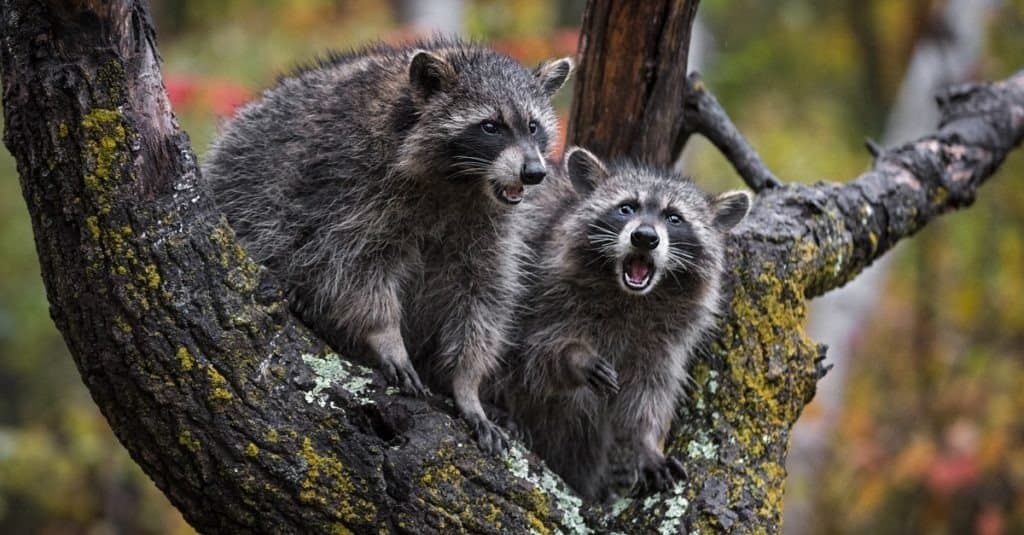
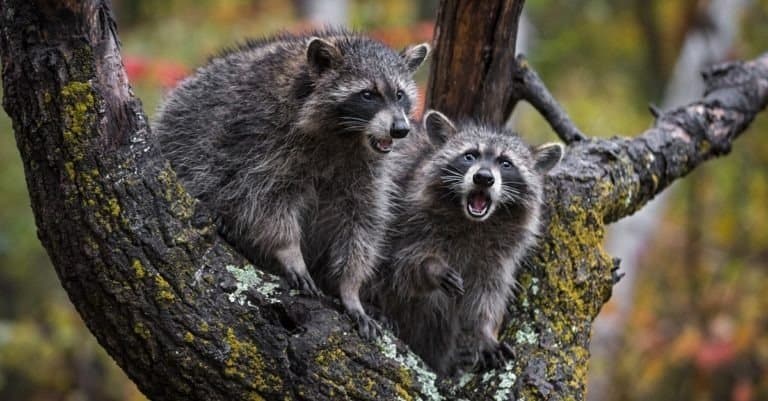
Raccoons appear to have a limited social life revolving around gender-specific groups.
©Geoffrey Kuchera/Shutterstock.com
There is a popular misconception that the raccoon is a solitary animal. But after close observation, it was revealed that they do appear to have a limited social life that revolves around gender-specific groups. When living space becomes tight, multiple animals will share a common area and meet regularly to feed and rest. They aren’t very vocal, except in the relationship between mother and kits, but it does have a set of harsh screams, hisses, growls, and snarls to warn away other animals.
As mentioned previously, the raccoon is an animal with an excellent sense of touch. Its dexterous paws are able to manipulate objects and open up shells or seeds. Raccoons also perform well in intelligence and memory tests; it has the same ability to solve complex problems as many other intelligent species.
The “washing” behavior for which the animal is named actually isn’t washing at all. Instead, they appear to be dipping their hands into the water as a way to search for food. Once they have found something, the raccoons will rub their food with their highly sensitive paws and remove any unwanted bits. Since they feed so frequently near banks and shorelines, it can contribute to the mistaken impression that the raccoon is washing its food in the water.
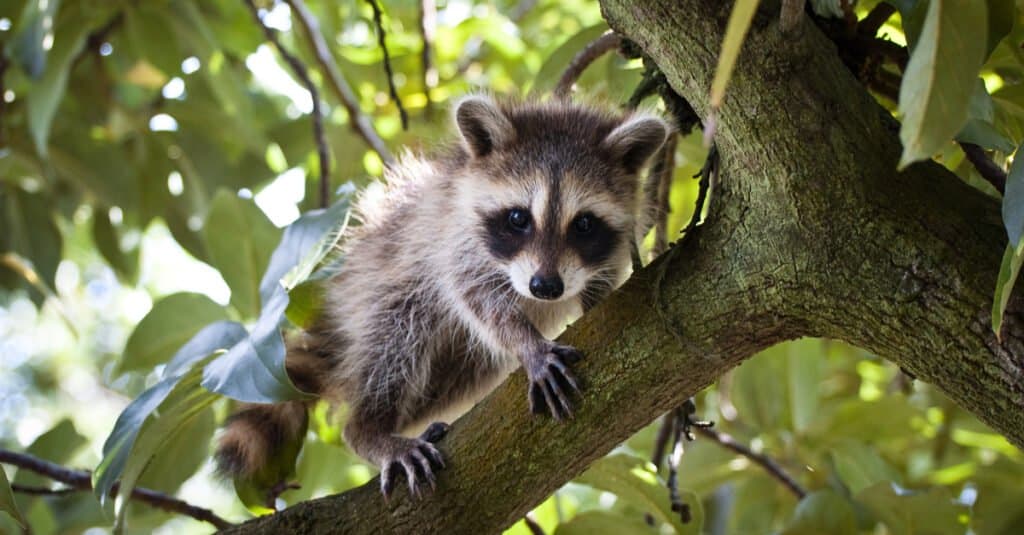
Raccoons have adapted to life in forests, mountains, coastal marshes and urban areas.
©Heiko Kiera/Shutterstock.com
Habitat
The raccoon is endemic to a large temperate and tropical habitat stretching between southern Canada and the northern part of South America, though it was later introduced into new habitats like Japan and Europe. These extremely adaptable creatures can thrive in woodlands, grasslands, suburban, and even urban areas; almost anywhere with enough water and some trees or other large structures for protection.
Diet
The raccoon’s diet can best be described as opportunistic, varying from one location to another based on food availability.
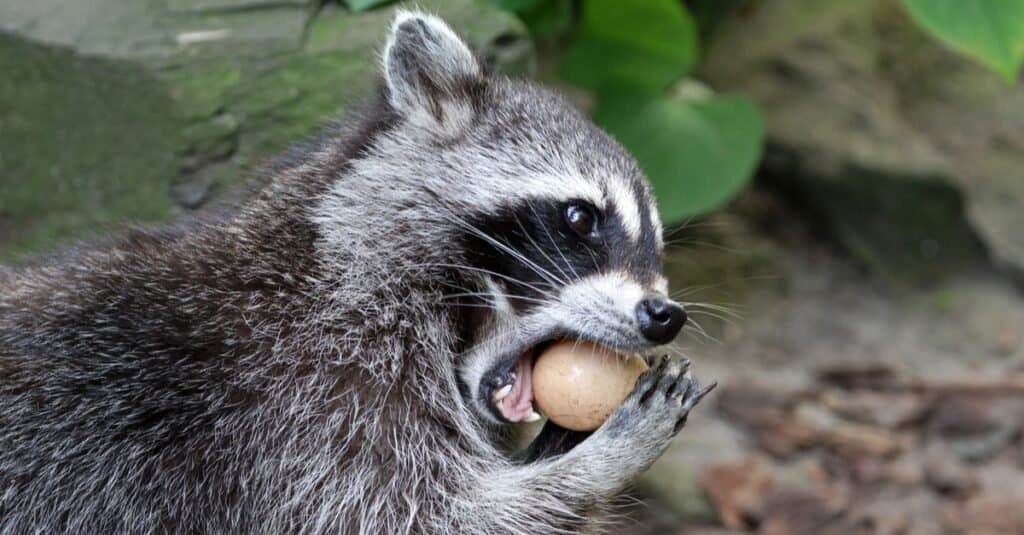
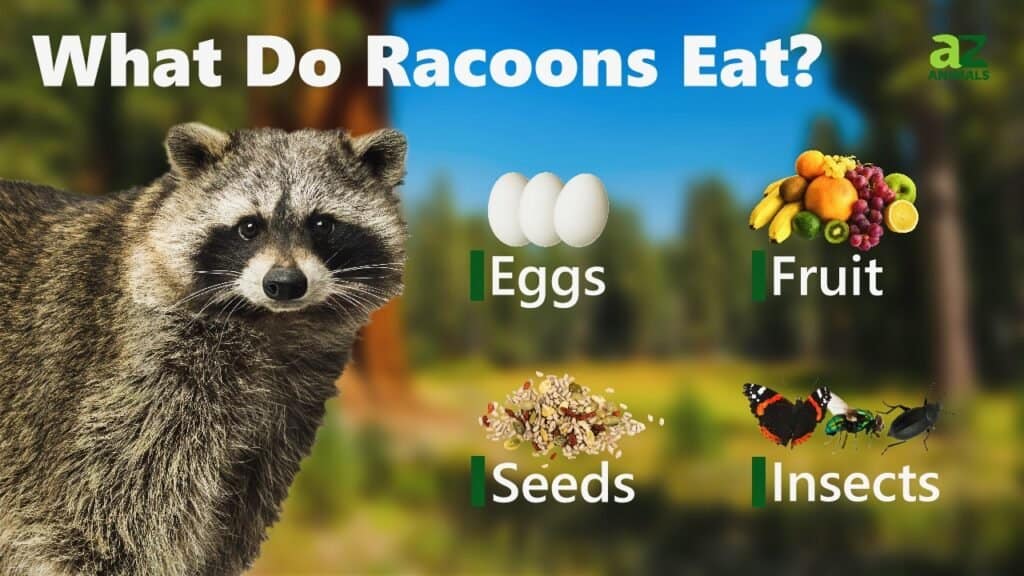
Raccoons prefer plant-based diets but will supplement with fish, eggs, insects and other small animals.
©iStock.com/Edwin_Butter
What does the raccoon eat?
The raccoon prefers a plant-based diet consisting of seeds, berries, nuts, and tubers. It will supplement this with fish, insects, eggs, crustaceans, and other small birds and mammals it finds in the water, snatches from nests, or uncovers in small holes and crevices. The raccoon can be a bit of a pest since it will also raid gardens, trash cans, pet food, and any other morsels left around unprotected. The raccoon handles the food with its hands and chews with its sharp teeth. For a complete analysis of their diet, give our ‘What Do Raccoons Eat?’ page a read!”
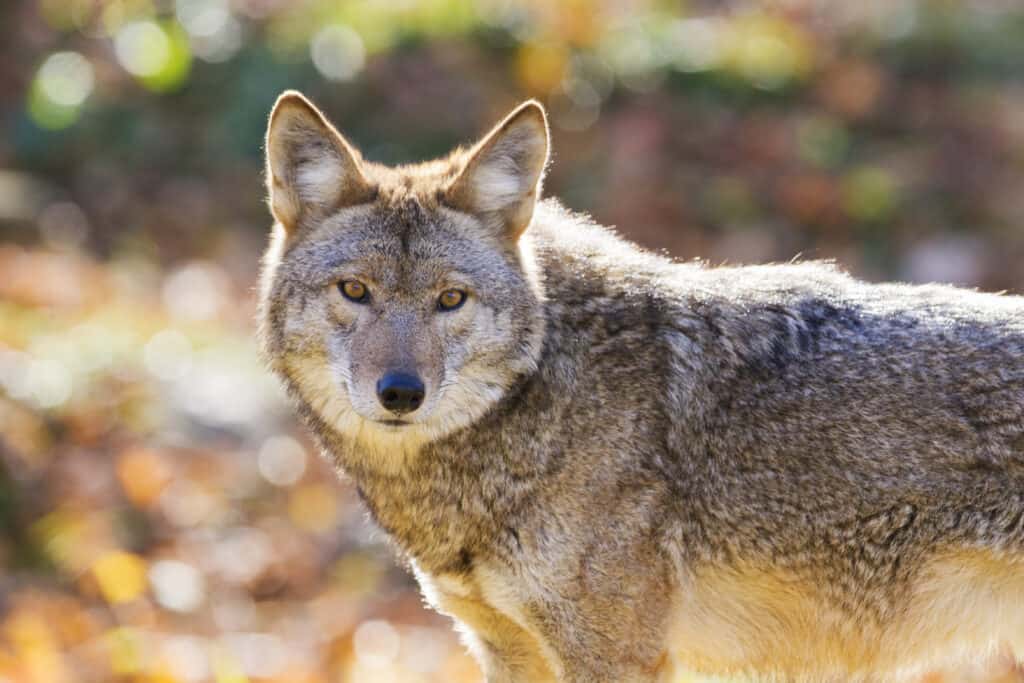
Coyotes are among the animals that prey on raccoons.
©Mircea Costina/Shutterstock.com
Predators
What eats the raccoon?
Some of the most common predators include wolves, coyotes, snakes, owls, and hawks. It is also hunted by humans but not in large enough numbers to harm population growth.
Reproduction, Babies, and Lifespan
Raccoons breed once per year in the February to June season, peaking around March. The male will sometimes expand his natural territory in search of receptive females to court during her brief conception period. Stronger males usually get first dibs on choosing a mate, but even weaker males often have the opportunity to produce offspring.
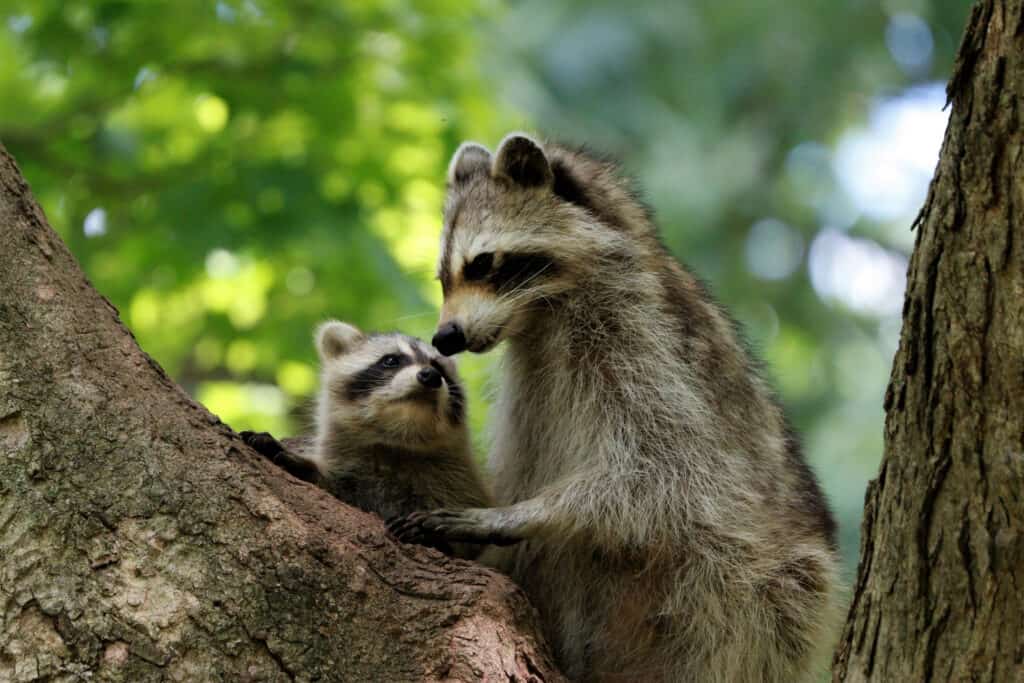
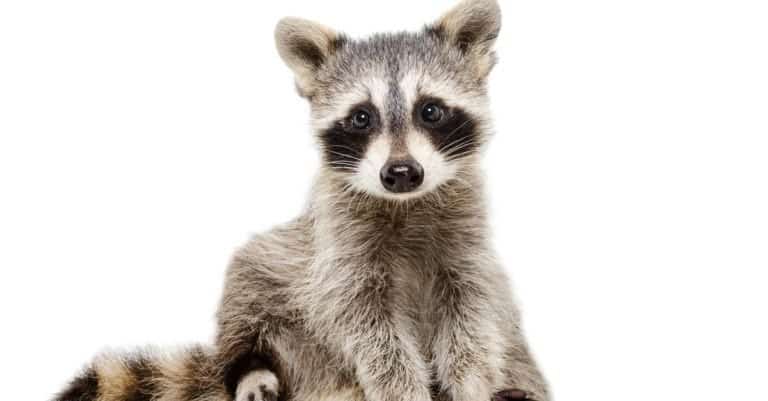
By about 20 weeks, a raccoon baby is ready to begin foraging with its mother and learn the basics of survival.
©L-N/Shutterstock.com
After a gestation period of about two months, the female will give birth to a litter of three to seven kits at a time. She bears full responsibility for protecting and feeding her blind and helpless young, while the father plays no role at all in the baby’s development. Dependent on the mother for everything, the kit’s eyes finally open after a few weeks of age. By about 20 weeks, the raccoon baby is ready to begin foraging with its mother and learn the basics of survival. Play also appears to be an integral part of the baby’s learning and development. It takes until the following spring before the raccoons are ready to live independently of their mother.
The raccoon has a very short life expectancy of two or three years in the wild because it often falls prey to predators, diseases, or fast-moving vehicles early in their lives. If they manage to survive adolescence, then the life expectancy increases to five years. When it’s completely free of threats, the raccoon can live to 20 years in captivity.
Population
According to the IUCN Red List, the common raccoon is a species of least concern (though the closely-related Cozumel raccoon is critically endangered). The exact population numbers are unknown, but they are likely to be very high. For instance, in wet lowland areas, it is estimated that raccoons have a population density of some 50 per square kilometer (almost three times that per square mile). In forested or agricultural areas, there are some 20 per square kilometer. Over larger territories, there are many millions of them. Given the raccoon’s sheer ubiquity, no specific conservation efforts are required to protect this species, but the numbers are sometimes carefully managed to prevent overpopulation.
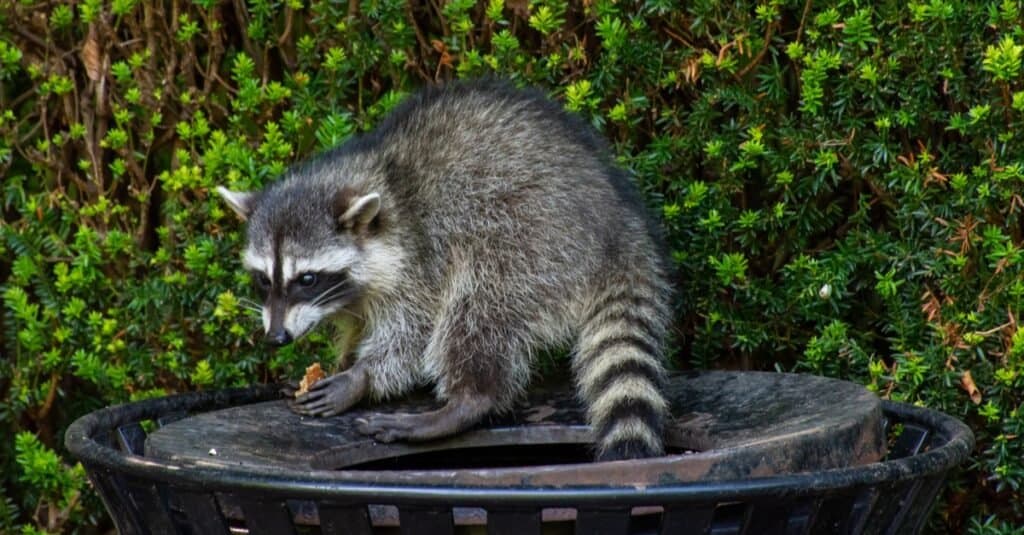
Raccoons have adapted to urban life easily – often pilfering from gardens, pet food bowls and garbage cans.
©kingma photos/Shutterstock.com
Raccoons and Humans
Raccoons have adapted to urban living like the proverbial duck to water. And why not? There’s loads of delicious food to be pilfered from the bowls of unsuspecting or petrified pets, fruit trees, and even garden tables. And when that fails all it takes is prising open a dustbin and sifting through its contents – never mind the resulting disarray once they’re done.
But how do humans feel about these wild scavenging furballs close by in their immediate vicinity? Some individuals are not averse to feeding the neighborhood wildlife a tempting tuna sandwich, or a slice of pumpkin pie. Others consider them a possible health risk and a nuisance. And with good reason too: raccoons carry several diseases, including canine distemper, infectious canine hepatitis, pseudorabies, rabies, and raccoon parvoviral enteritis.
What’s more, they’re not above attacking domestic pets.
How to keep them from rummaging through your refuse or taking on your pooch? Experts recommend the use of flashing lights and loud noises. Strong smells are also a marvelous deterrent and a mug or dish of apple cider vinegar placed at the right spot should prove rather effective.
In the Zoo
Despite how common they are in the wild, these animals are still a popular exhibit at the San Diego Zoo, the Seneca Park Zoo, the Minnesota Zoo, the Toronto Zoo, the Tulsa Zoo, the Lehigh Valley Zoo in Pennsylvania, and the Cosley Zoo near Chicago.
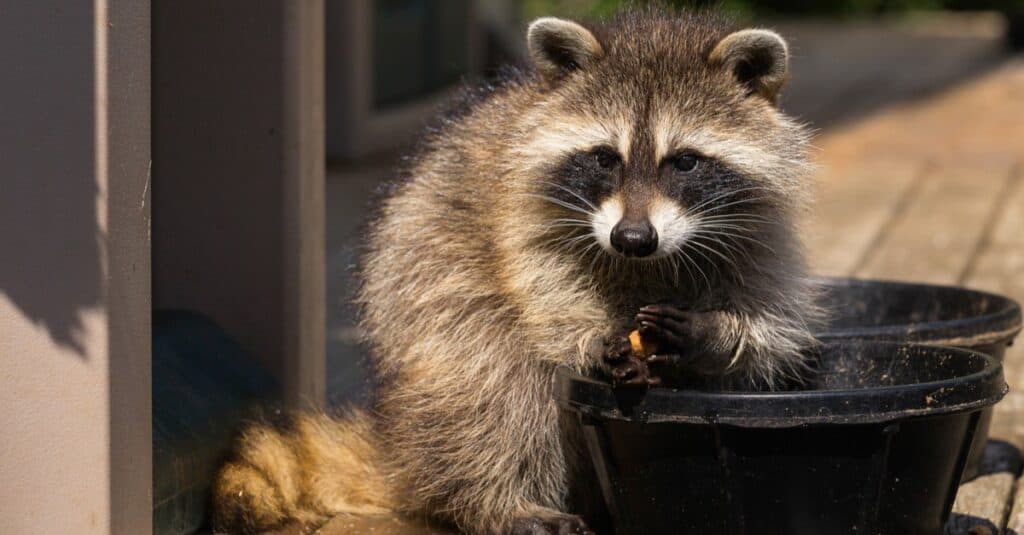
Zoos must provide water for raccoons to wash their food.
©AEWD/Shutterstock.com
Subspecies:
- Eastern raccoon (P.l. lotor), is small and dark with long, soft fur and lives in the northeastern United States and Canada.
- Key Vaca raccoon (P.l. auspicatus), very small and pale-furred, can be found on the Key Vaca keys in Florida.
- Florida raccoon ( P.l. elucus), medium-sized and dark-colored with a prominent rusty rufous nuchal patch, can be found in Florida and southern Georgia.
- Snake River Valley raccoon (P.l. excelsus), very large and pale-colored, located in the Snake River drainage in southeastern Washington, eastern Oregon, southern Idaho, Neveda and river valleys of northeastern California.
- Texas raccoon (P.l. fuscipes), large, dark grayish, can be found in Texas, Arkansas, Louisiana, Mississippi, and Mexico.
- Barbados raccoon (P.l. gloveralleni),small, dark-furred subspecies with a lightly built skull, lives in Southern Baja California.
- Mexican plateau raccoon (P.l. hernandezii), large and dark gray with a flattish skull and heavy dentition, can be found in southern Mexico.
- Upper Mississippi Valley raccoon (P.l.hirtus), large and dark-furred whose pelage is usually suffused with ochraceous buff.
- Torch Key raccoon (P.l. incautus), small with very pale fur (smallest of the Florida racoons), can only be found at Big Pine Key Group near the end of chain of Florida keys.
- Matecumbe Key raccoon ( P.l. inesperatus), small and gray with a flat skull, can only be found in Key Largo Group, Florida.
- Tres Marias raccoon (P.l. insularis), large, massive-skulled raccoon with short, course fur, can only be found on the Tres Marias Islands off the west coast of Mexico.
- Ten Thousand Islands raccoon (P.l. marinus), very small with heavy dentition, dwells in the Keys of the Ten Thousand Islands Group, Florida.
- Bahamian raccoon, (P.l. maynardi), small and slightly dark with a lightly built skull and dentition, only exists in New Providence Island, Bahamas.
- Mississippi Delta raccoon, (P.l. megalodous), medium-sized with a massive skull and pale yellow fur suffused above with black, lives in the coast region of southern Louisisana.
- Guadeloupe raccoon, (P.l. minor), small delicate subspecies with dark gray coat and a slight ochre tint on the neck and shoulders, can only be found in Guadeloupe in the Lesser Antilles Islands.
- Pacific Northwest raccoon ( P.l. pacificus), dark-furred with a relatively broad, flat, skull, habitat includes Southwestern British Columbia, Washington, western Oregon and extreme northwestern California.
- Colorado Desert raccoon (P.l. pallidus), one of the palest subspecies, large, can be found in the Corarado and Gila River Valleys and adjoining territory from the delta north to northeastern Utah, and east to western Colorado and northwestern New Mexico.
- California raccoon (P.l. psora), large and moderately dark with a broad, flat skull, can be found in California and extreme west central Nevada.
- Isthmian raccoon (P.l. pumilus), has a short, broad, flat, skull and can be founding the Panama Canal Zone.
- Vancouver Island raccoon (P.l. vancouverenis), dark furred, small subspecies, known only from Vancouver Island.
- Short-faced raccoon (P.l. simus), Pleistocene subspecies with a deep lower jaw and robust dentition, lived in California but is extinct.
Similiar Animals
Raccoon Pictures
View all of our Raccoon pictures in the gallery.

O_Medvedeva/Shutterstock.com
Sources
- Animal Diversity Web / Accessed January 14, 2021
- National Geographic / Accessed January 14, 2021
- PBS / Accessed January 14, 2021