
Quick Take
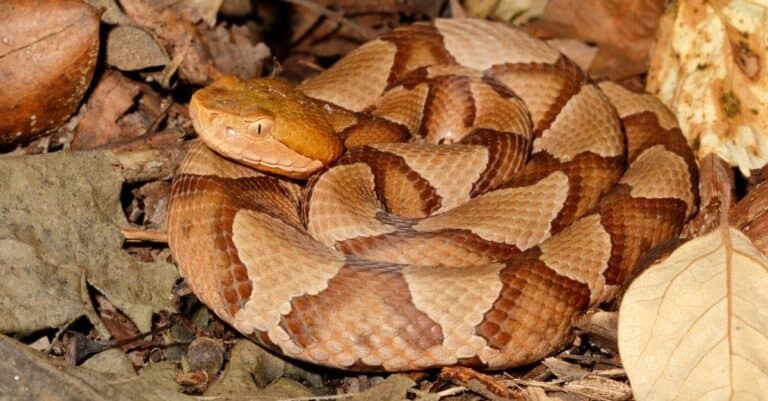
- One of Florida's orange snakes looks so much like a venomous species that people routinely kill it by mistake. Can you tell them apart? Meet the misidentified snake →
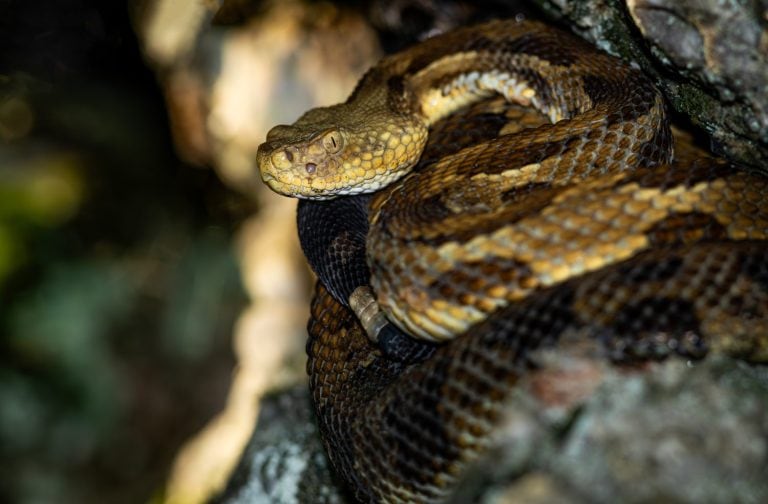
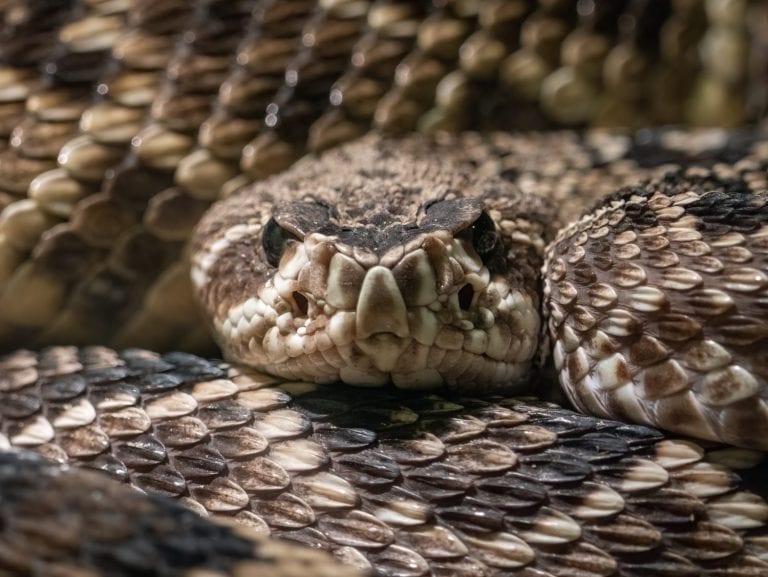
- A snake that mimics a rattlesnake's rattle, despite not actually being one, lives right in Florida's backyard. See the rattlesnake mimic →
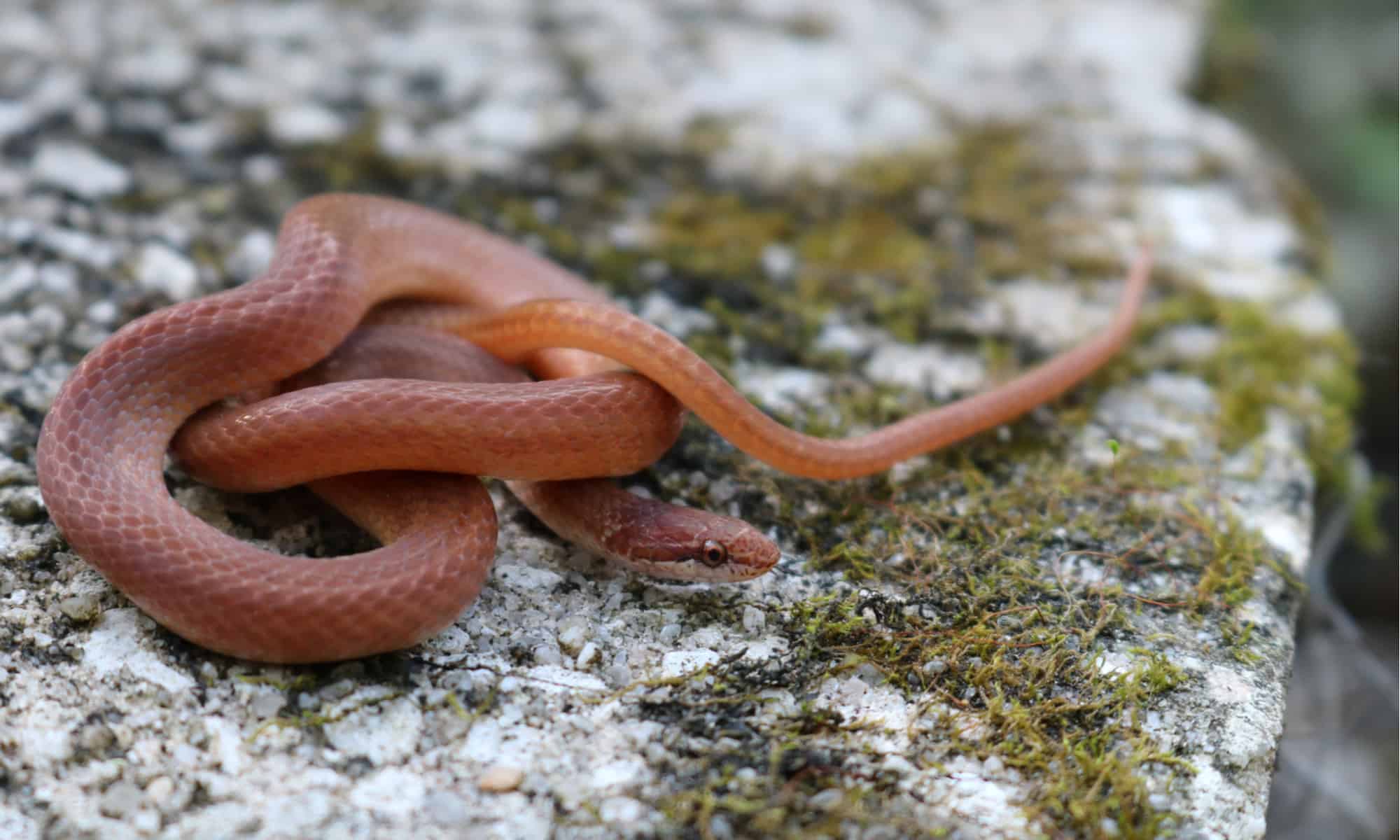
- Florida has an orange snake so tiny it fits in your palm, yet it still has a venomous trick up its sleeve. Discover Florida's tiny venomous snake →
- One of these eight snakes thrives only where land meets saltwater, and its color depends entirely on which subspecies you find. Explore the coastal subspecies →
Spanning more than 65,000 square miles and with 1,350 miles of coastline, Florida has a vast landscape. Although known for its sunny climate, Florida is much more diverse than you might expect. From rivers and swamps to rainforests and coral reefs, Florida is teeming with wildlife, and one type of animal that Florida has plenty of is snakes. Florida is home to more than 50 native snake species, of which six are venomous. Snakes are known for their wonderful colors and patterns, and one of the brightest colors is orange. Continue reading to discover eight orange snakes found in Florida.
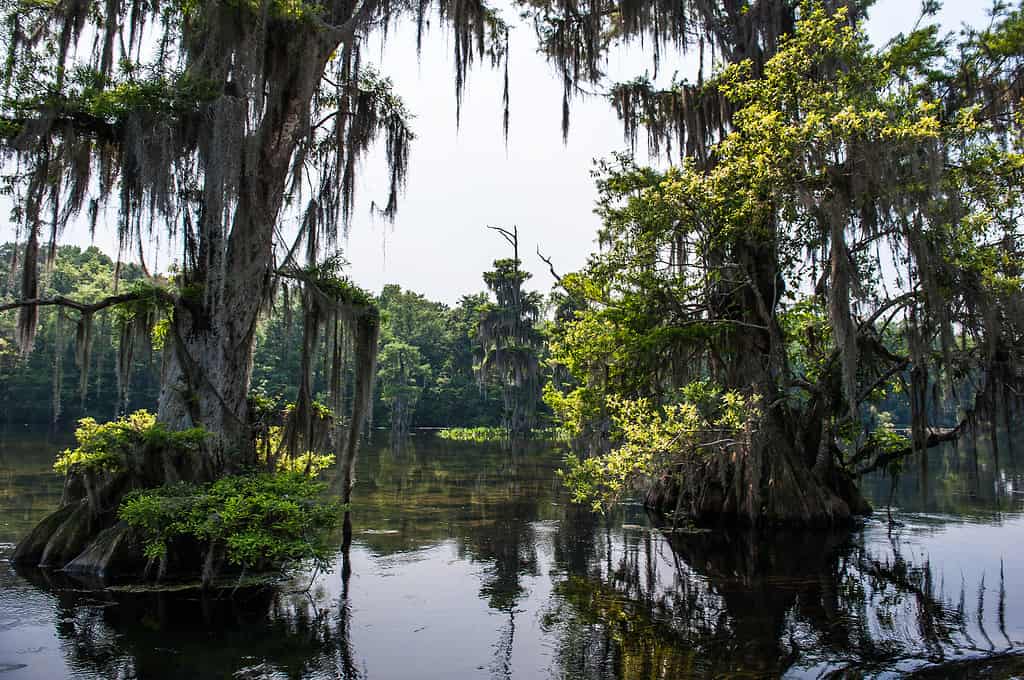
Florida’s diverse, humid climate is the perfect environment for snakes to thrive.
©Chongbum Thomas Park/Shutterstock.com
Eastern Rat Snake
Although the closely related yellow rat snake (Pantherophis quadrivittatus) is sometimes confused with them, Eastern rat snakes (Pantherophis alleghaniensis) are typically yellowish-orange or yellow with four darker stripes down their bodies. Eastern rat snakes are 42 to 72 inches long and are found east of the Apalachicola River and as far south as Key Largo.
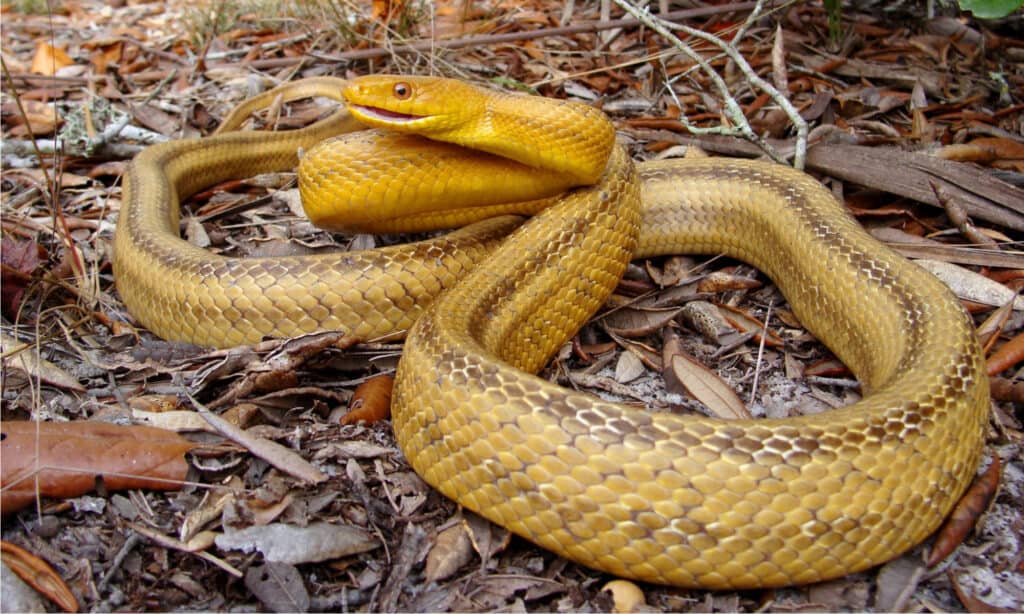
Eastern rat snakes are also known as yellow rat snakes.
©Matt Jeppson/Shutterstock.com
They are found in hardwood forests, farmland, and swamps, although some live in urban areas. However, they hibernate underground during the winter months. Eastern rat snakes are not venomous and usually flee when threatened. If they are cornered, they will vibrate the tip of their tail, creating a buzzing sound that is reminiscent of a rattlesnake’s rattle. Eastern rat snakes feed on birds, frogs, rodents, and lizards.
Plain-Bellied Watersnake
Named for the lack of markings on their underside, plain-bellied watersnakes (Nerodia erythrogaster) are a uniform reddish-orange to yellow on their bellies, necks, and lips. However, they are reddish-brown, olive green, or gray on their upper sides. Plain-bellied watersnakes (Nerodia erythrogaster) are a uniform reddish-orange to yellow on their bellies, necks, and lips. Plain-bellied watersnakes are 30 to 48 inches long and are always found near a permanent water source.
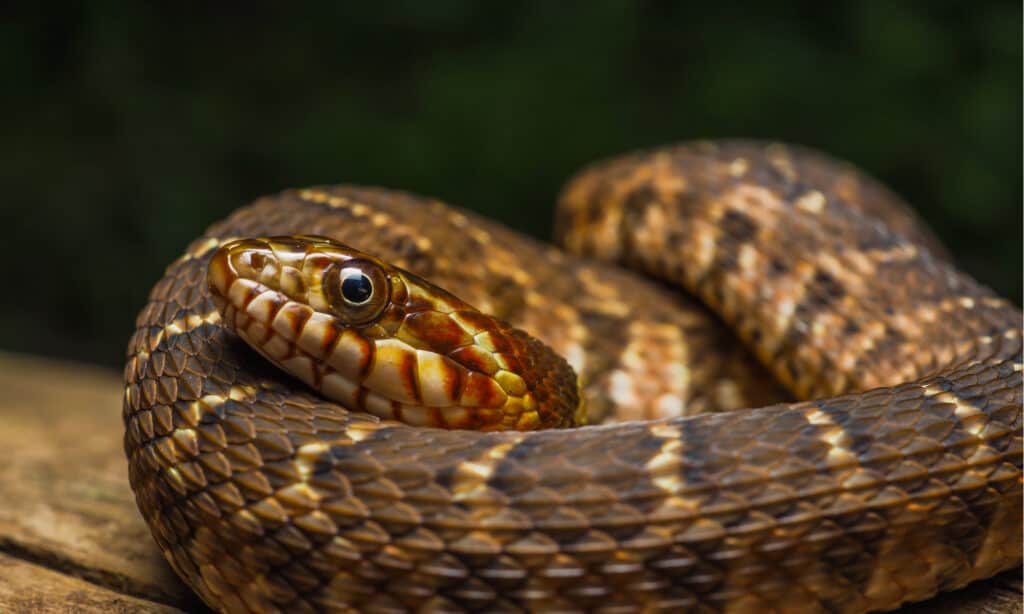
Despite their darker upper side, plain-bellied water snakes have much lighter bellies.
©Tyler Albertson/Shutterstock.com
They are found in lakes, rivers, floodplains, and swamps. Plain-bellied watersnakes are most active during the warm summer months when they spend their time either swimming or basking on logs or rocks. During the winter, they hibernate underground or underneath rocks. Plain-bellied watersnakes eat fish, frogs, and salamanders. They often wait in the water for their prey to approach them rather than actively hunting.
Eastern Hognose Snake
An unusual orange snake in Florida is the Eastern hognose snake (Heterodon platirhinos), whose color and patterns vary widely, depending on their location. The color of Eastern hognose snakes can be orange, yellow, red, brown, or black, although in Florida orange and yellow are more common.
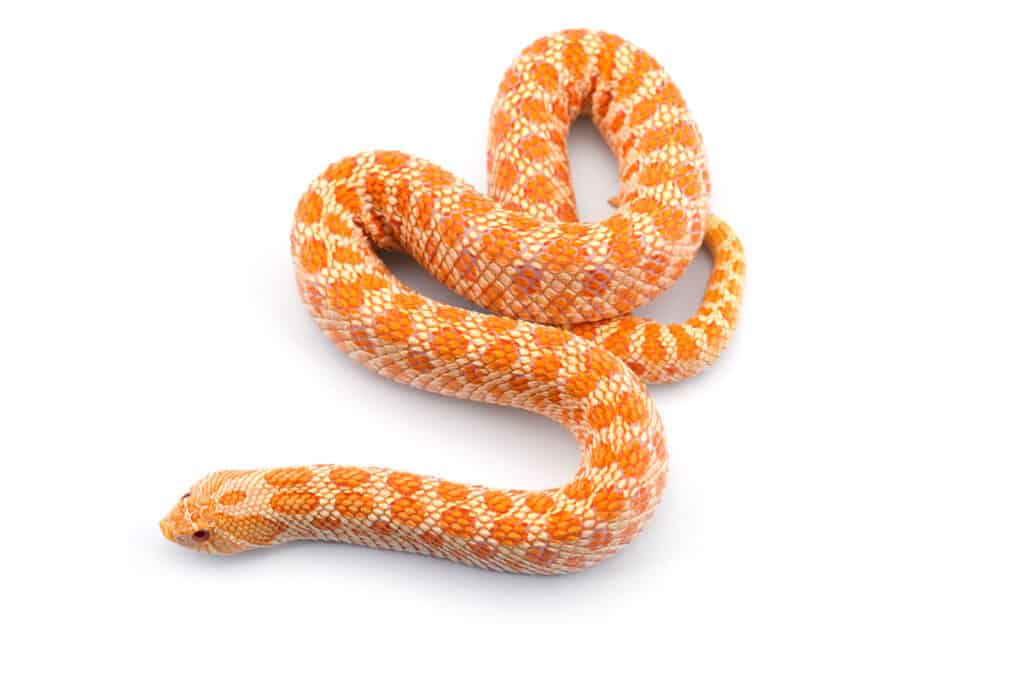
The color of Eastern hognose snakes can be orange, yellow, red, brown, or black, although in Florida orange and yellow are more common.
©PetlinDmitry/Shutterstock.com
Most Eastern hognose snakes have many irregularly shaped blotches which are a darker color. Eastern hognose snakes are usually 20 to 33 inches long and are found in pine forests and forest edges which have sandy soil. The loose soil is used for burrowing and egg-laying. Eastern hognose snakes are mildly venomous but not harmful to humans. They produce a mild venom from their Duvernoy’s gland, which they use to subdue their prey (mainly toads), injected through their enlarged rear fangs.
Eastern Corn Snake
The Eastern corn snake (Pantherophis guttatus) is often kept as a pet. Corn snakes are 24 to 72 inches long and typically have orange or orange-brown bodies with large red blotches on them. They have a strong resemblance to venomous copperheads, which often results in them being killed due to misidentification.
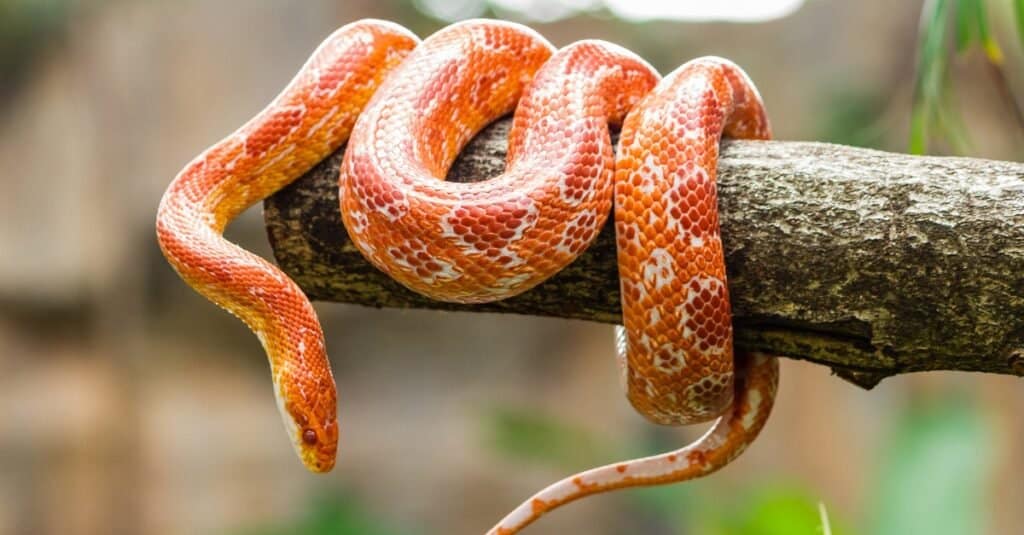
Corn snakes are bright orange with red blotches on them
©iStock.com/bugphai
They are adaptable snakes but prefer habitats such as fields, forest openings, and farms. Corn snakes are also excellent climbers and are often found in trees. Corn snakes lay their eggs in warm, hidden locations, after which the female completely abandons them. The main diet of corn snakes is rats and mice, and they are very beneficial as they keep rodent populations under control.
Ring-Necked Snake
One of the most stunning snakes in Florida is the ring-necked snake (Diadophis punctatus), which is named for the bright ring of color around its neck. Ring-necked snakes are black on their dorsal (upper) side, but their bellies are either red, yellowish-orange, or even red at one end and fading to orange and yellow at the other.
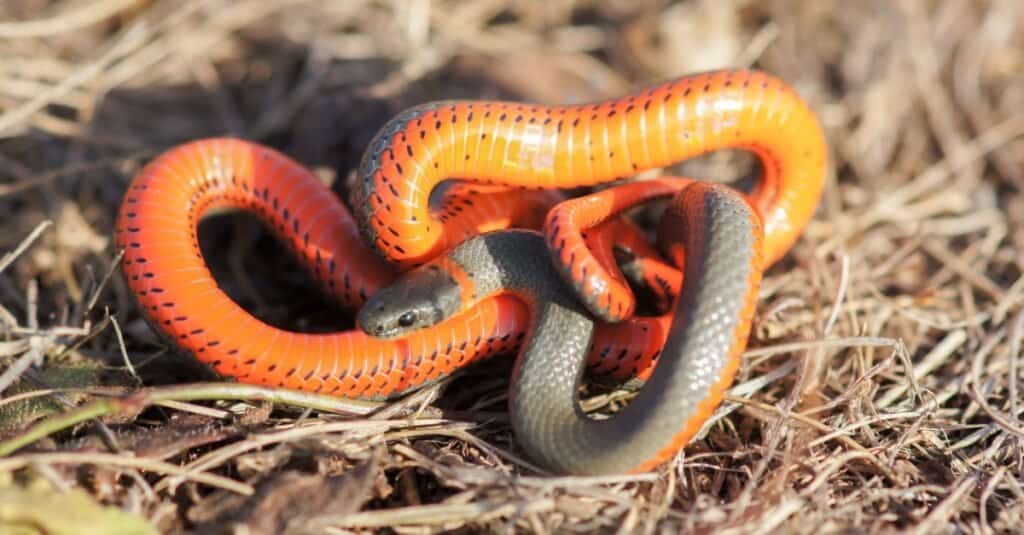
Small and colorful, the ring-necked snake is nocturnal and non-venomous.
©yhelfman/Shutterstock.com
Ring-necked snakes are adaptable and capable of living in a variety of different habitats. However, they prefer areas with plenty of vegetation for them to hide under. When threatened, ring-necked snakes coil their tail tightly and lift it off the ground to show their bright-colored belly as a warning. Ring-necked snakes are mainly nocturnal, although some are crepuscular, and they mainly eat slugs, earthworms, and salamanders.
Pine Woods Snake
One of the smallest orange snake species in Florida, the pine woods snake (Rhadinaea flavilata), only reaches 10 to 13 inches long. Pine woods snakes are reddish-orange to reddish-brown with a lighter stripe down the center of their back.
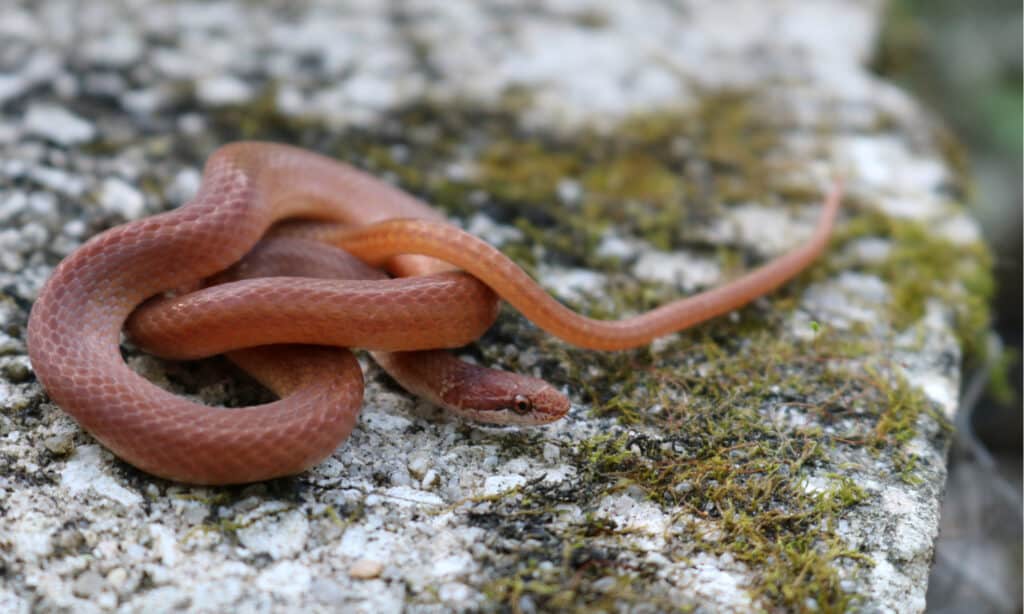
Found across most of the Florida peninsula but not in the Florida Keys, the pine woods snake is nocturnal.
©Andrew Jeffries/Shutterstock.com
Pine woods snakes are found across most of the Florida peninsula but not in the Florida Keys. Pine woods snakes live in areas with plenty of leaf litter, such as pine forests and damp woodlands. They are nocturnal snakes that eat lizards, frogs, and salamanders. Their predators include Southern black racers and kingsnakes, as well as birds and shrews.
Red-Bellied Snake
Another small orange snake found in Florida is the red-bellied snake (Storeria occipitomaculata), which is only 8 to 12 inches long. Although their name suggests that they have a red belly, they often have a bright orange or even a yellow belly.
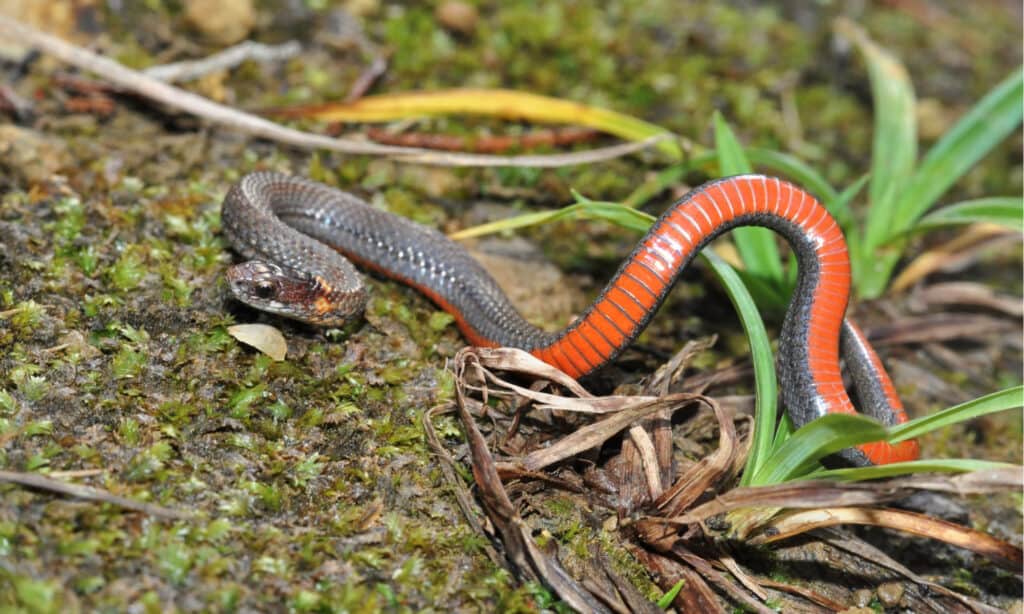
Red-Bellied snakes are brown on the top and various shades of red, orange, or yellow on their underside.
©Mike Wilhelm/Shutterstock.com
Dorsally (on top), they are reddish-brown with faint stripes down their backs, while their heads are black or dark brown. Red-bellied snakes are extremely adaptable and live in many habitats, although they prefer areas with plenty of leaves, rocks, or logs for them to shelter underneath. Red-bellied snakes are nocturnal, and their diet consists of slugs and earthworms. They are not venomous and are not aggressive.
Salt Marsh Snake
The final orange snake on our list is the salt marsh snake (Nerodia clarkii taeniata). Salt marsh snakes are usually a rusty orange or brown color with four darker stripes down their bodies.
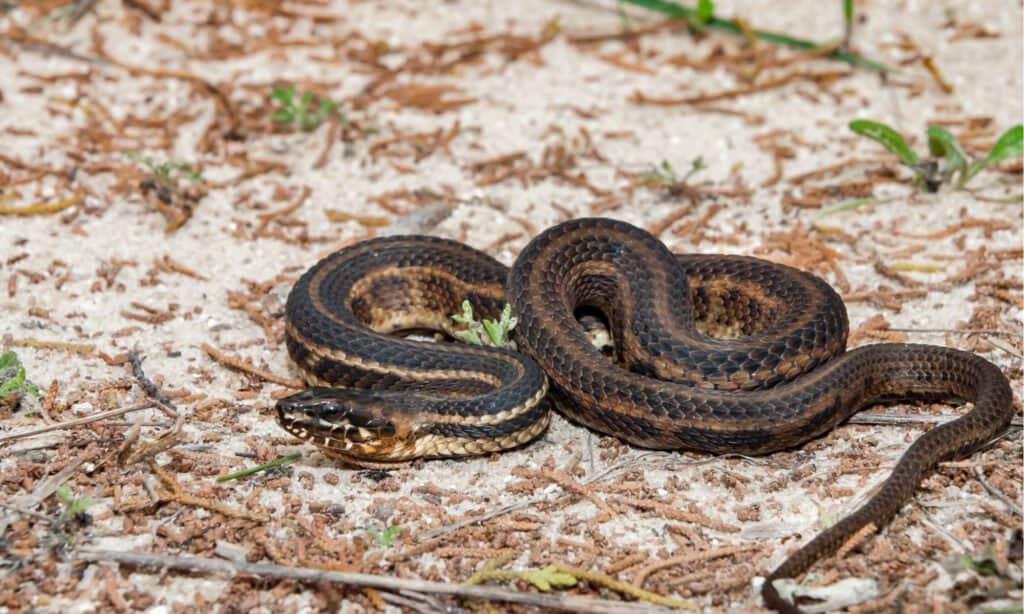
The salt marsh watersnake can be found along the coast of Florida in habitats with brackish water.
©Jay Ondreicka/Shutterstock.com
However, one subspecies, the mangrove salt marsh snake (Nerodia clarkii compressicauda), is often completely reddish-orange. Salt marsh snakes live in tidal marshes, mud flats, mangroves, and along the shoreline where they burrow into the mud and sand. They are nocturnal snakes that eat small fish, which they catch and eat in shallow water. Predators include crabs and birds such as herons.