
W
Species Profile

Western Rat Snake

Pantherophis obsoletus

The barn's best rodent patrol
Rusty Dodson/Shutterstock.com

Western Rat Snake Distribution

Click a location to explore more animals from that region

Loading map...
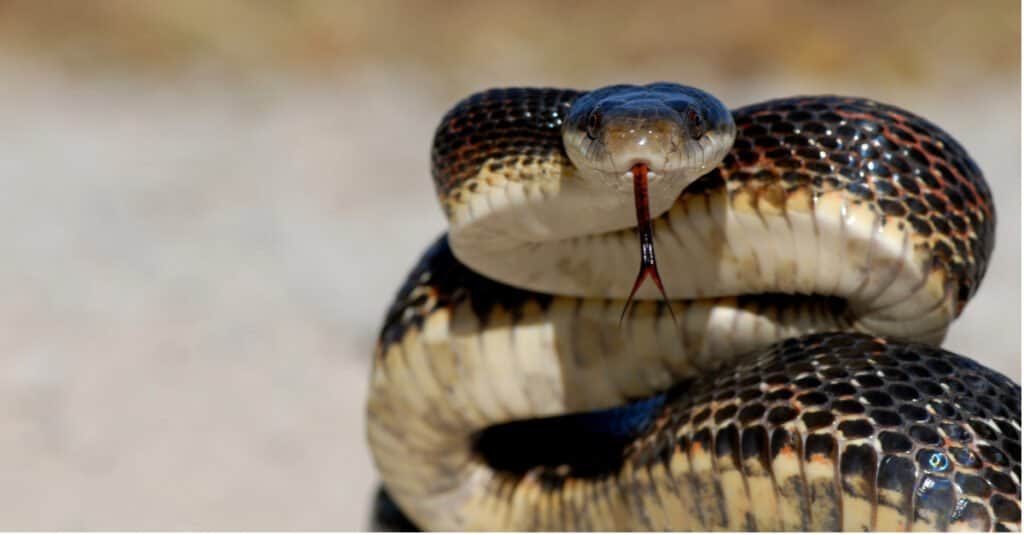
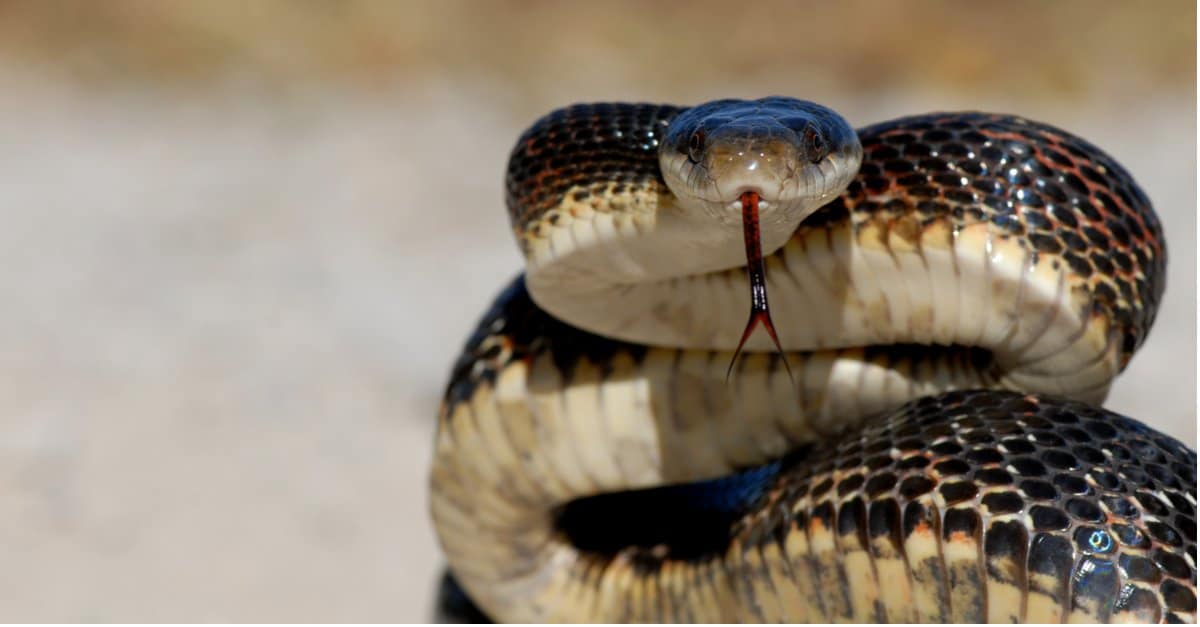
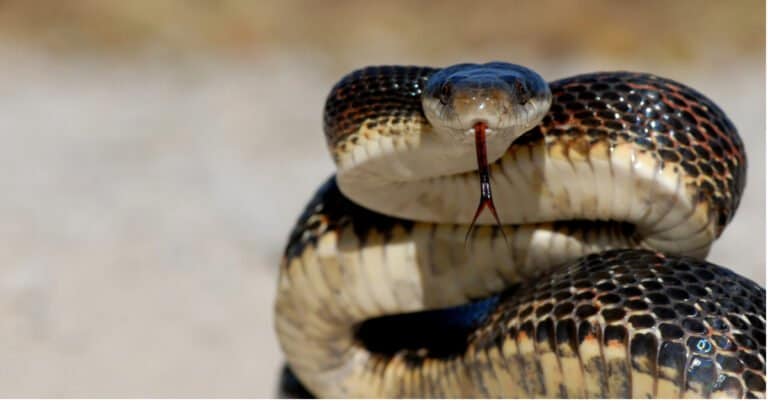
adult western rat snake in defensive posture

At a Glance

Wild Species
Also Known As Black Rat Snake, Black Snake, Rat Snake, Chicken Snake, Pilot Snake, Pilot Black Snake
Diet Carnivore
Activity Diurnal+
Lifespan 10 years
Weight 2.2 lbs
Status Least Concern
Did You Know?

Adults typically reach 106-183 cm total length; the longest documented individuals approach 256 cm.

Scientific Classification

The Western Rat Snake (Pantherophis obsoletus) is a large, nonvenomous North American colubrid that kills prey by constriction. It commonly inhabits forests, forest edges, farmlands, and human structures, where it helps control rodent populations. Color can vary, but adults are often dark with faint patterning.

Kingdom
Animalia
Phylum
Chordata
Class
Reptilia
Order
Squamata
Family
Colubridae
Genus
Pantherophis
Species
obsoletus

Distinguishing Features

  • Large, nonvenomous constrictor colubrid
  • Often dark adult coloration with faint blotches
  • Strong climber; frequently found in trees/structures
  • Keeled dorsal scales; white chin/throat common
  • Juveniles more distinctly blotched than adults

Physical Measurements

Length
4 ft 9 in (3 ft 6 in – 8 ft 5 in)
Weight
2 lbs (1 lbs – 4 lbs)
Tail Length
10 in (6 in – 1 ft 4 in)
Top Speed
1 mph
slithering

Appearance

Primary Colors
Secondary Colors
Skin Type Keeled scales
Distinctive Features
  • Adults typically gray-brown with darker dorsal blotches; juveniles are strongly blotched and usually resemble adults, though contrast may change with age.
  • Belly commonly checkered with dark spots on pale background.
  • Large colubrid: typical total length ~106-183 cm; records ~256 cm (Ernst & Ernst 2003).
  • Nonvenomous constrictor; subdues rodents and birds by coiling tightly.
  • Often climbs trees and buildings; commonly encountered around barns and attics.
  • Central and western USA; favors forest edges, fields, and human structures.
  • Head appears broader when threatened; commonly misidentified as venomous pitvipers.
  • Vibrates tail in leaf litter and releases musk when handled.
  • Longevity: ~10-15 years wild; >20 years in captivity reported (Ernst & Ernst 2003).

Sexual Dimorphism

Sexual dimorphism is subtle. Females average slightly larger-bodied, while males tend to have proportionally longer tails and higher subcaudal scale counts; coloration and pattern are otherwise similar between sexes (Ernst & Ernst 2003).

  • Proportionally longer tail; more subcaudal scales on average.
  • Slightly slimmer body at comparable total length.
  • Often larger overall body size and mass at maturity.
  • Slightly shorter tail relative to body length.

Did You Know?

Adults typically reach 106-183 cm total length; the longest documented individuals approach 256 cm.

Juveniles are gray with dark blotches; many adults darken greatly, sometimes appearing nearly solid black.

It kills prey by constriction, commonly taking rats, mice, and other small mammals around barns and fields.

Females lay about 6-44 eggs per clutch (often ~12-20), usually in summer in rotting logs or debris.

A strong climber, it regularly hunts in trees and raiding cavities for birds, eggs, and nestlings.

Wild longevity is often around 10-15 years; individuals can exceed 20 years in captivity with care.

Unique Adaptations

  • Weakly keeled dorsal scales and broad ventral scutes provide traction for climbing and moving over rough surfaces.
  • Ontogenetic color change: blotched juveniles gain camouflage on leaf litter, while darker adults blend in shadows and barns.
  • Flexible jaws and stretchy ligaments allow swallowing relatively large rodents and birds compared with head size.
  • Chemical-sensing tongue-flicking and the vomeronasal (Jacobson's) organ help track prey through complex farm and woodland habitats.

Interesting Behaviors

  • Coils tightly around prey and constricts until breathing and circulation fail, then swallows head-first.
  • Often climbs rafters, trees, and rock ledges; it uses belly scutes to grip rough surfaces securely.
  • Defends by vibrating the tail in dry leaves, flattening the body, striking, and releasing strong-smelling musk.
  • Overwinters in communal shelters (brumation) such as rock crevices, stump holes, or foundations with other snakes.

Cultural Significance

Often called a "rat" or "chicken" snake around farms, it's tolerated for rodent control yet frequently feared. It's commonly misidentified as venomous because it tail-buzzes and can look dark and heavy-bodied.

Myths & Legends

Southern U.S. "chicken snake" tales claim black rat snakes hypnotize hens and steal eggs, explaining barnyard losses.

Rural folklore in parts of North America says large "black snakes" slip into barns to drink milk from cows at night.

Appalachian and Ozark traditions sometimes treat a "black snake" living near the house as a lucky guardian that protects stores of grain.

Conservation Status

LC Least Concern

Widespread and abundant in the wild.

Population Stable

Life Cycle

Birth 14 hatchlings
Lifespan 10 years

Lifespan

In the Wild
6–15 years
In Captivity
10–33 years

Reproduction

Mating System Polygynandry
Social Structure Solitary
Breeding Season April to June
Breeding Pattern Transient
Fertilization Internal Fertilization
Birth Type Internal_fertilization

During spring breeding, solitary adults congregate briefly; males may engage in combat and court multiple females, and females may mate with multiple males (sperm competition). Females lay roughly 6-24 eggs and provide no parental care (Ernst & Ernst 2003).

Behavior & Ecology

Social Knot Group: 1
Activity Diurnal, Crepuscular, Nocturnal
Diet Carnivore mice
Seasonal Hibernates

Temperament

Secretive
Nonaggressive
Defensive
Bold

Communication

hissing
pheromones
tongue-flicking
scent trails
body postures
cloacal musk

Habitat

Biomes:
Temperate Forest Temperate Grassland Wetland Freshwater
Terrain:
Plains Hilly Valley Riverine Rocky
Elevation: Up to 3937 ft

Ecological Role

Mesopredator that suppresses small-mammal populations in forests and farmland edges.

rodent control limits crop pests reduces disease reservoirs

Diet Details

Main Prey:
Mouse Rat Vole Chipmunk Squirrel Bird eggs Nestling birds Small rabbits Lizard Frog +4

Human Interaction

Domestication Status

Wild

Not domesticated; wild North American rat snake. Common in barns/attics; across Pantherophis, often tolerated for rodent control and kept for education/pet trade. Adults 106-183 cm (max ~256 cm); wild 10-15 y, captive 15-20+ y (Ernst & Ernst 2003).

Danger Level

Low
  • Defensive bite causes bleeding punctures
  • Musk/feces when handled
  • Constriction risk to small pets

As a Pet

Suitable as Pet

Legality: Generally legal; permits may apply for native collection.

Care Level: Moderate

Purchase Cost: $50 - $200
Lifetime Cost: $1,500 - $4,000

Economic Value

Uses:
Agriculture Education Pettrade Research Tourism
Products:
  • rodent control
  • education

Relationships

Predators 7

Red-tailed Hawk Buteo jamaicensis
Red-shouldered Hawk
Red-shouldered Hawk Buteo lineatus
Great Horned Owl Bubo virginianus
Raccoon
Raccoon Procyon lotor
Virginia Opossum Didelphis virginiana
Bobcat
Bobcat Lynx rufus
Eastern Kingsnake Lampropeltis getula getula

Ecological Equivalents 5

Animals that fill a similar ecological role in their ecosystem

Gopher Snake
Gopher Snake Pituophis catenifer Rodent-focused constrictor found in fields, farms, and woodland edges.
Eastern Kingsnake Lampropeltis getula getula Overlaps in habitat and preys on rodents and other snakes.
North American Racer
North American Racer Coluber constrictor Diurnal upland generalist, frequently found near farms and forest edges.
Black Pine Snake Pituophis melanoleucus Uses burrows and preys heavily on small mammals.
Eastern Coachwhip Masticophis flagellum Active hunter in open woodlands; preys on similar small vertebrates.

Western rat snakes are one of the longest snakes in North America; the longest one on record measured 111 inches. They are long, slender, non-venomous constrictors that are terrific climbers. These snakes are members of the Colubridae family and are closely related to king snakes.

They’re a wonderful natural pest control that will seek out mice, rats, squirrels, birds, and even bats to eat. Juveniles often feed on lizards and frogs but as they mature develop a taste for rodents.

Amazing Facts About Western Rat Snakes

  • The scales on their bellies flip up and grab onto surfaces which helps them climb to astounding heights.
  • For such a large snake, they’re quite mellow. Once you’re holding one it calms down pretty quickly.
  • Some people call them chicken snakes because they will get into a chicken coop and eat both eggs and chicks.
  • They’re closely related to king snakes, and some pet breeders have bred hybrids of the two species.

Where to Find Western Rat Snakes

Western rat snakes are adaptable animals that will make a home wherever they find food. They prefer forested areas with a water supply, but happily take up residence in old barns, abandoned buildings, and under homes. These snakes are partly arboreal, and will sometimes lay their eggs high up in the hollow of a tree. They’re excellent climbers that you may find 20 feet up a tree that has no lower branches.

Their range extends west from the Mississippi River to central and northern Texas, and north to Iowa and Nebraska. Western rat snakes are long and slender, but powerful constrictors that suffocate their prey before swallowing it whole. These snakes sometimes reach 6 feet in length and darken as they mature; however, despite their size, they’re not aggressive at all.

They brumate beginning in October or November, finding a safe place to pass the colder months. as soon as the weather warms, western rat snakes become active again. Breeding takes place between April and June, the female lays her eggs in a secluded space about 4-6 weeks later. After 60-75 days the hatchlings emerge; these are excellent breeders, and females can lay up to 20 eggs at a time.

Western Rat Snake’s Scientific Name

This snake’s genus name, Pantherophis, means “Panther snake,” and it makes sense; the juveniles’ spotted pattern is reminiscent of panther, and as they develop their adult coloration the pattern is still somewhat visible on some individuals.

Types of Rat Snakes

With over 50 rat snake species occurring throughout the world, it’s often hard to keep track of them. Here are the species herpetologists know inhabit areas of the United States.

Bogertophis

Desert rat snakes occur in the Southwest United States into northern Mexico. There is a wide variety of habitats that Baja California rat snakes (Brosaliae) and Trans-Pecos rat snakes (B. subocularis) inhabit.

Pantherophis 

This genus holds most of the rat snake species in the United States. This includes the gray rat snake (P. spiloides), Eastern rat snake (P. alleghaniensis), Baird’s rat snake (P. bairdi), Great plains rat snake (P. emoryi), Eastern fox snake (P. gloydi), Western fox snake (P. ramspotti), Corn snake (P. guttatus), western (or black) rat snake (P. obsoletus), and Slowinski’s corn snake (P. slowinskii).

A few species in Pantherophis have subspecies; while others, such as the gray rat snake and western rat snake possibly hybridize near the Mississippi River. Genetically, many rat snakes are similar enough to also mate with king snakes, and a few pet breeders have done this to create new morphs.

Western Rat Snakes: Population and Conservation

There aren’t any estimates of population. However, biologists believe they have a stable population in most areas. The IUCN Redlist considers them “Least Concern.” Their main threats, after the mistaken identity issues and collection for the pet trade, are predation from other animals. Birds of prey (red-tailed hawks even hunt the larger snakes), coyotes, foxes, minks, and snakes all make being a western rat snake a dangerous occupation.

That said, in some states where they are less common, such as Minnesota, they’re listed as a species of special concern. They have only been documented in a couple of southeastern counties in the state; so in 2013, after many studies, the state of Minnesota classified it as a threatened species.

Identifying Western Rat Snakes: Appearance & Description

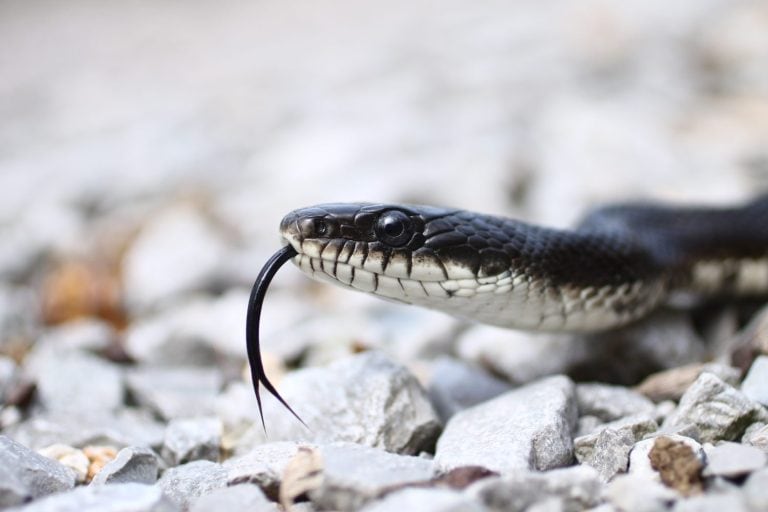
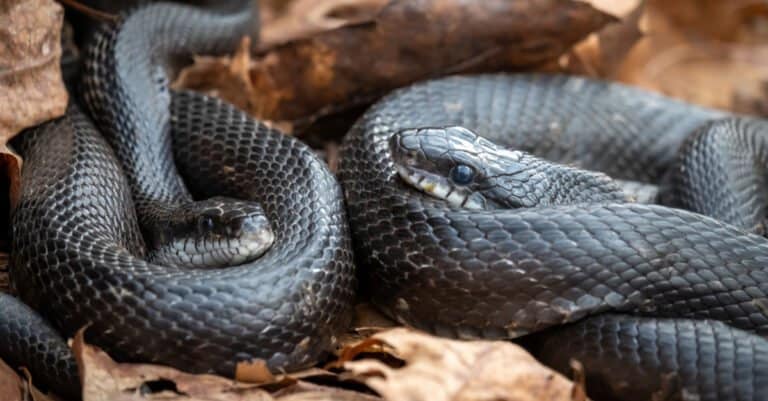
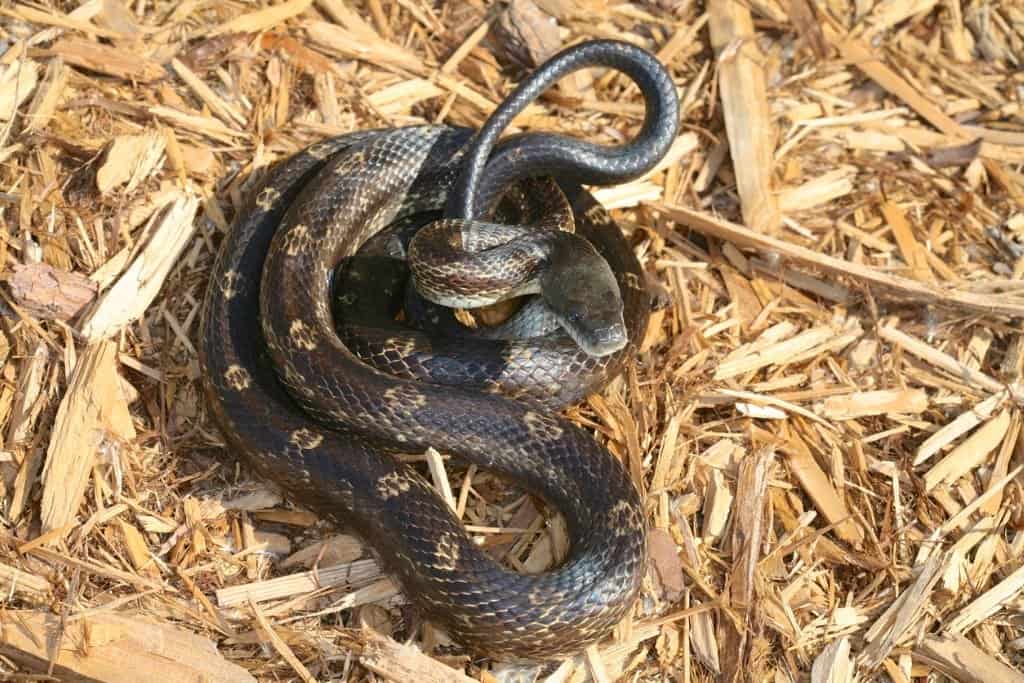
This is a fairly large snake, although it’s not very thick. Western rat snakes can reach 6 feet long, and the record was set by a wild-caught snake that measured over 8 feet (101 inches). Most snakes average from 4-6 feet. Young snakes have a bright, high-contrast pattern with a grey background and dark brown blotches on the back and sides. The blotches on their backs have slight points at the corners, and those on the sides are more irregular in shape. They darken rapidly as they mature, and many of these snakes become almost solid black on their backs but retain lighter colors with black spots on their bellies. Most of them have a white chin, but not all.

Western Rat Snakes Pictures and Videos
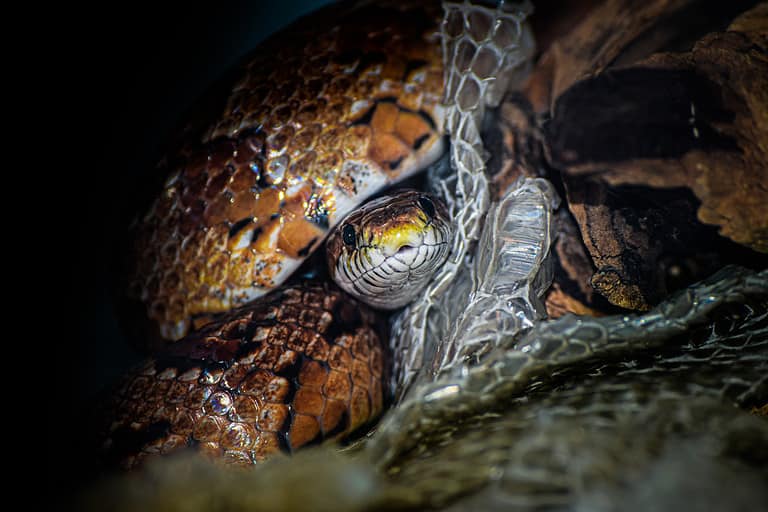
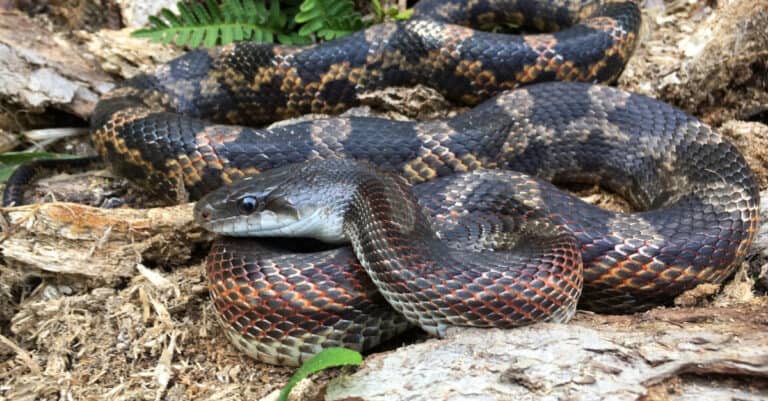
Western rat snake

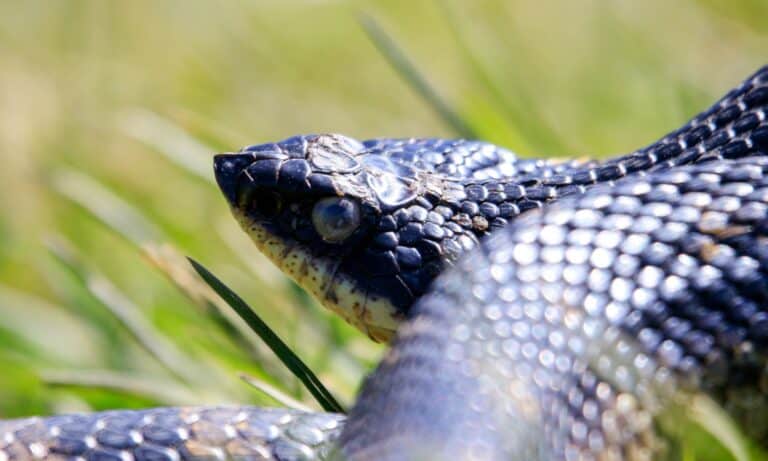
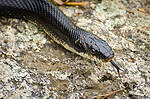
Western rat snakes darken as they mature and lose most of the pattern on their heads and bodies.

adult western rat snake in defensive posture

Western rat snake showing ‘S’ shape in a defensive posture.

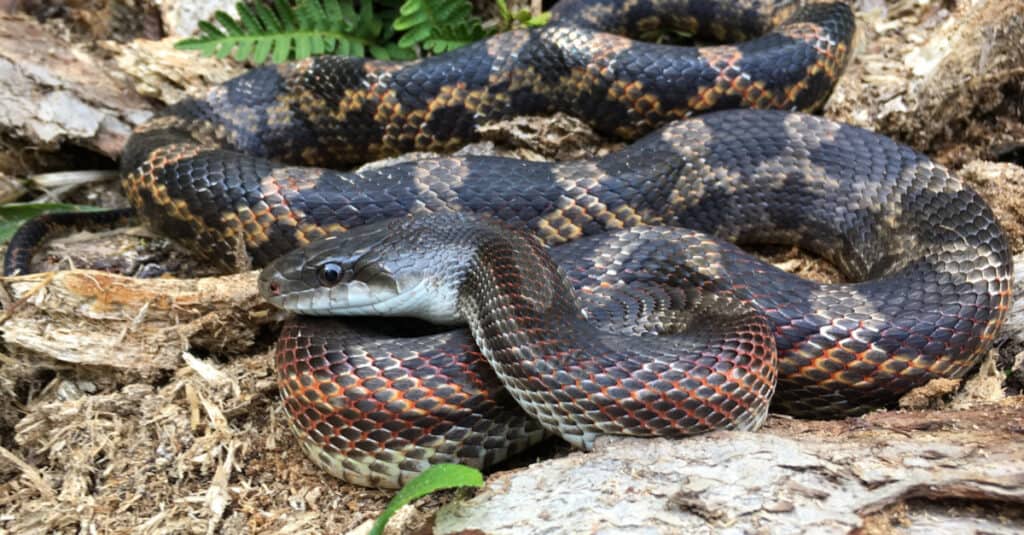
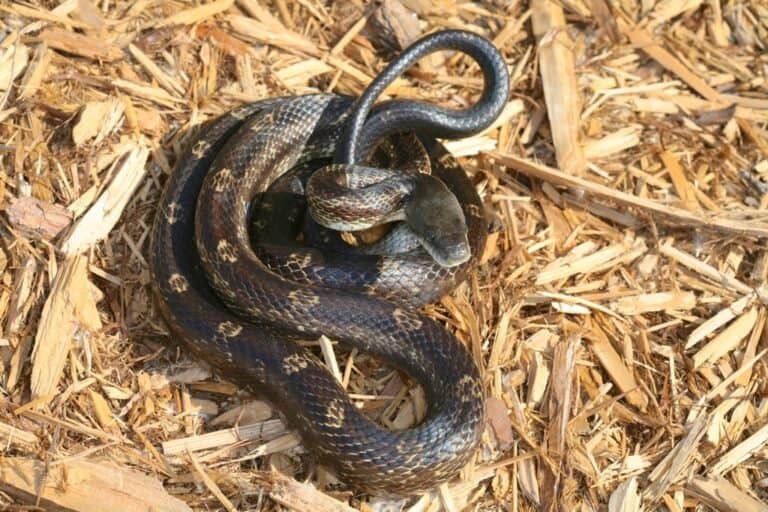
Young Western Rat snake

Western rat snakes come in many colors but darken with age and lose some of the patterns.

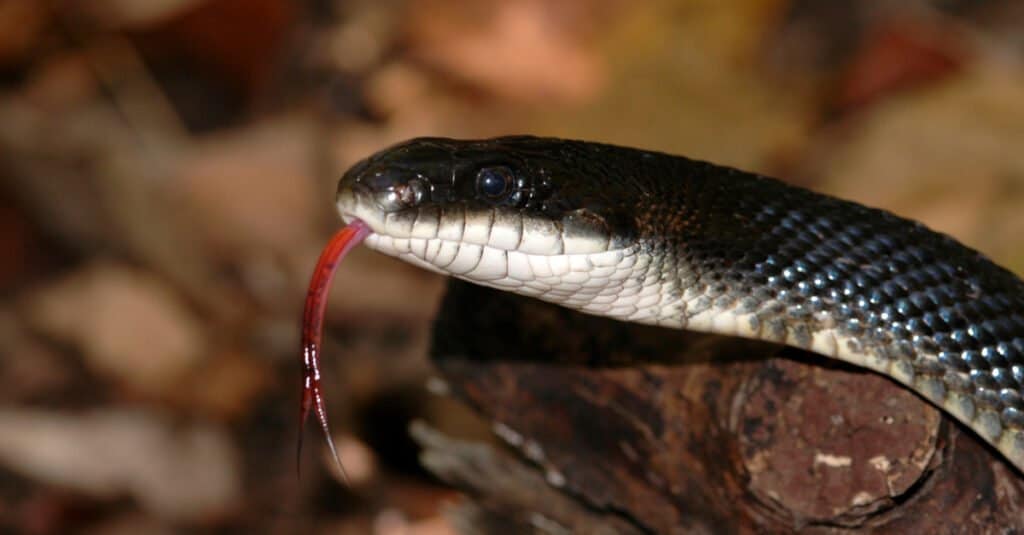
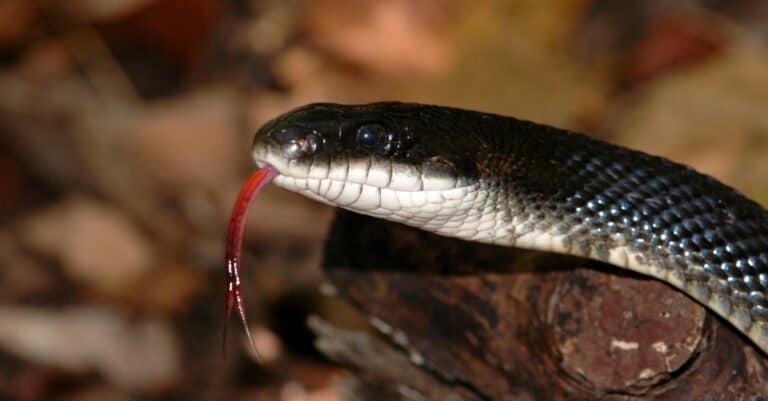
closeup of western rat snake

Many western rat snakes have white chins.

How Dangerous Are Western Rat Snakes?

These snakes aren’t dangerous; however, if you corner one it may freeze and hope you don’t see it, bite, release an awful-smelling musk, rattle its tail, or coil up and strike. Western rat snakes have several defenses against threats and will use any tool at their disposal to escape injury.

  • At the first sign of a threat, a western rat snake may stiffen and kink up, giving its body a zig-zag shape; it may also freeze in place, hoping you won’t see it.
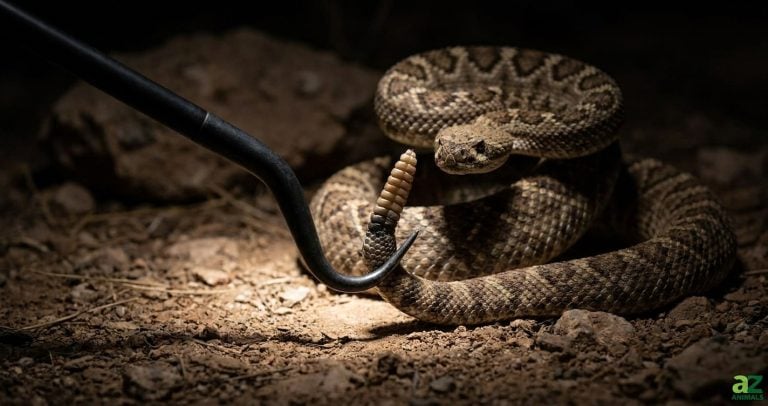
  • If that fails, then it might coil up, form its neck into an ‘S’ shape, and rattle its tail. Some believe the tail rattle is mimicking rattlesnakes, but other disagree because the same behavior occurs in many snakes around the world where there are no rattlesnakes.
  • At this point, if you are still bugging this snake, it will bite. Fortunately it won’t be too bad; remember, it doesn’t have any venom.
  • Its last resort (not that biting isn’t bad enough), is to release musk from its vent, or cloaca. This stuff stinks. It doesn’t wash off well, and sort of sticks to you until you scrub a lot.

All that said, it’s not a dangerous snake, and is very helpful to people. They keep rodents (and other critters) from taking over the world.

Western Rat Snake Behavior and Humans

Western rat snakes aren’t aggressive, and they won’t come after you. Most often, these snakes try to escape. Even as they’re being harassed by someone they’re looking for an escape route. While human encroachment can be a problem for them, by and large, they have adapted to life in the suburbs.

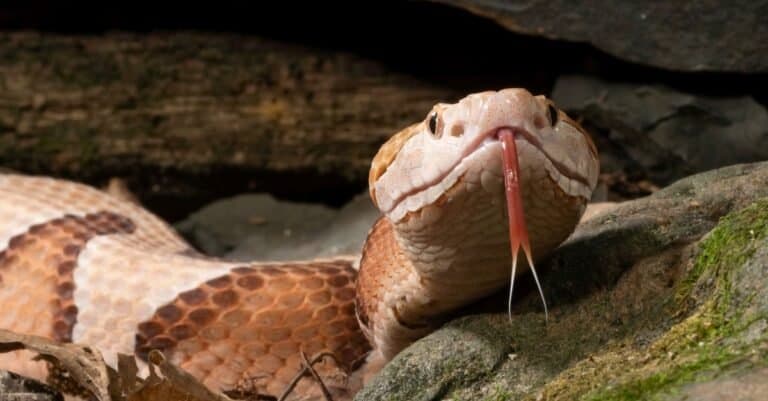
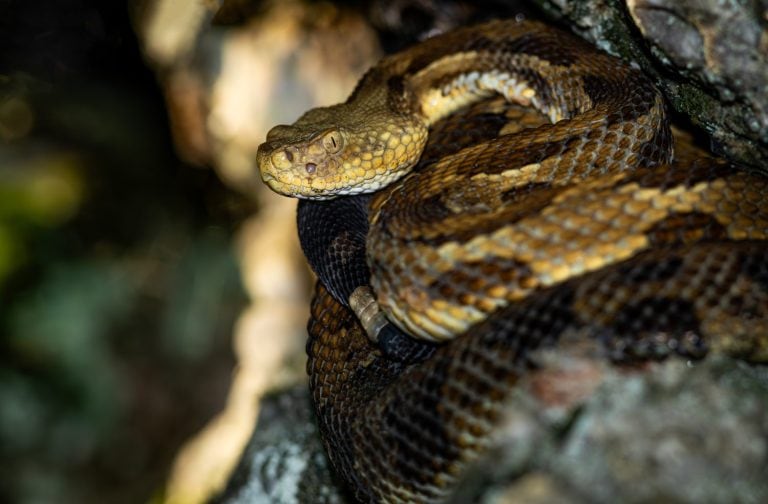
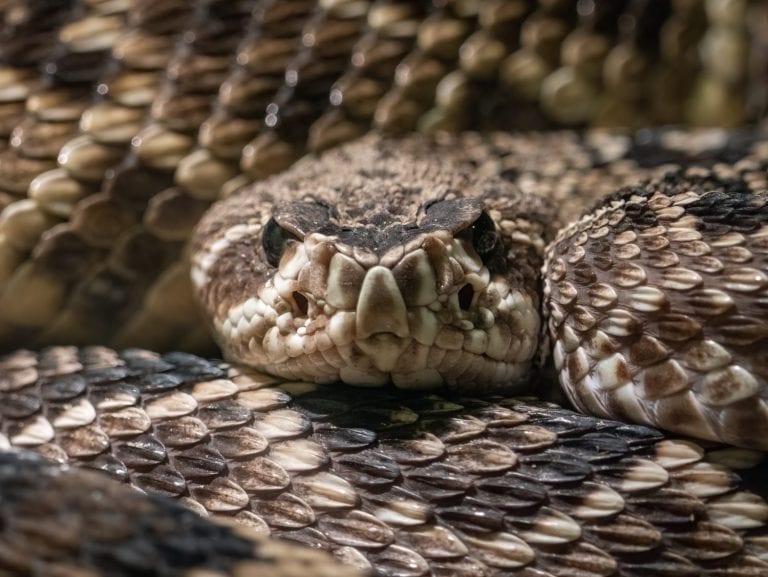
However, many of these snakes are killed because of their pattern; people mistake them for rattlesnakes or copperheads and panic. In addition to confusing their pattern with venomous snakes, western rat snakes, like many other non-venomous snakes, can spread their head out to look more diamond-shaped like a pit viper; however, from above the snake’s head, its eyes are easy to see. A pit viper’s eyes are very difficult to see from above its head.

These constrictors perform a vital service, and while they are often found in some unexpected places, they’re harmless.

Similar Animals

View all 442 animals that start with W

Sources

  1. Reptile Database / Accessed February 23, 2022
  2. IUCN Redlist / Accessed February 25, 2022
  3. Western Rat Snake | Seneca Park Zoo / Accessed February 25, 2022
  4. Western Ratsnake | Missouri Department of Conservation / Accessed February 25, 2022
Gail Baker Nelson

About the Author

Gail Baker Nelson

Gail Baker Nelson is a writer at A-Z Animals where she focuses on reptiles and dogs. Gail has been writing for over a decade and uses her experience training her dogs and keeping toads, lizards, and snakes in her work. A resident of Texas, Gail loves working with her three dogs and caring for her cat, and pet ball python.
Connect:

Thank you for reading! Have some feedback for us?


Western Rat Snake FAQs (Frequently Asked Questions)

No, like all rat snakes, western rat snakes are non-venomous.