









Quick Take
- The white-tailed eagle and the bald eagle have nearly identical wingspans, yet most people overlook one key difference that separates them. Compare the two eagles →
- This bird is classified as migratory, yet not all of them actually migrate. Where they live changes everything. See who actually migrates →
- A single eagle nest in Iceland was reused continuously for over 150 years, a fact that reveals something remarkable about this species. Explore nest facts →
- As an apex predator with zero natural enemies, the white-tailed eagle still faces serious threats, and the source of those threats might surprise you. See the real threats →
The white-tailed eagle is a sea eagle. It has a fairly large range across Eurasia. It is a raptor or a carnivorous bird of prey. Its plumage is unique and quite beautiful.

4 Incredible White-tailed Eagle Facts
- It is the national bird of Germany and is portrayed in the country’s coat of arms.
- White-tailed eagles will steal food from other birds.
- They mate for life.
- The white-tailed eagle is an apex predator.
Where to Find the White-tailed Eagle
White-tailed eagles are found across Europe and Asia, with rare vagrant sightings in North America but no established populations there. They are native to Europe, Greenland, Russia, China, and the Middle East. They are present in marine, freshwater, and terrestrial ecosystems. They most commonly reside in coastal areas. Other types of living environments include marine, wetland, grassland, and forest habitats. Today, they can be found in numerous countries across the globe. Their range extends across much of Europe and Asia, as well as Greenland and Iceland, but they are not found in Africa, Australia, or most of North America or South America. The best place to find these magnificent creatures is near large bodies of water. Look up to the sky, towards trees, and near cliffs to spot one. They can be found year-round.
Nests
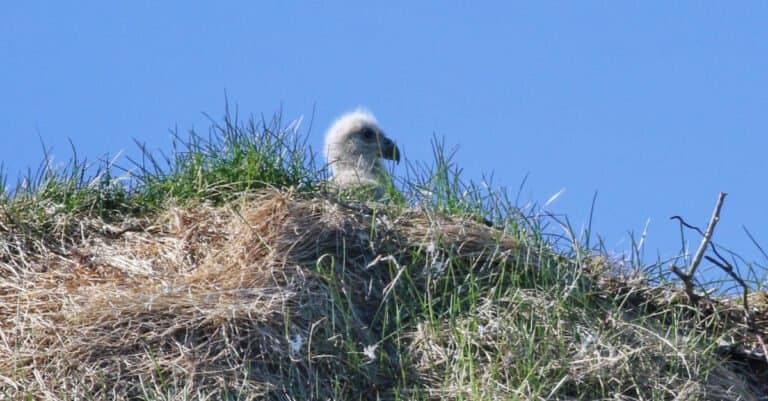
The female is generally in charge of building the nests. She will build an immense structure that measures approximately 6.6 feet deep and 3.3 feet across. She uses sticks and branches to form the exterior of the nest. It is then lined with moss, seaweed, wool, and various plant materials. The nest is located up high, usually in the main fork of a tree, on a hefty branch, or sometimes on an otherwise vacant cliff.
Classification and Scientific Name
Haliaeetus albicilla is the scientific name for the white-tailed eagle. This bird of prey is sometimes called other names such as the white-tailed sea eagle, Eurasian sea eagle, gray sea eagle, white-tailed fish eagle, or erne. Being a bird, the white-tailed eagle is in the Aves class. It is included in the Accipitridae family, which encompasses species of eagles, hawks, kites, and Old World vultures. Haliaeetus albicilla has two subspecies: Haliaeetus albicilla albicilla and Haliaeetus albicilla groenlandicus (Greenland white-tailed eagle).
The genus Haliaeetus is translated as “sea eagle.” It is derived from the Greek words hali, which means “sea” and aetos meaning “eagle.” The scientific name albicilla comes from New Latin abli and cilla, which mean “white” and “tail” respectively.
White-tailed Eagle vs. Bald Eagle
The white-tailed eagle and the bald eagle, though closely related, are two distinct species. They are both sea eagles, sharing the same genus Haliaeetus. They are also similar in size with a nearly identical wingspan. There is only a discrepancy of half an inch or less between the wingspan of the two birds. The most striking physical difference between these two species is the coloring, particularly the head. The bald eagle’s head is pure white and contrasts greatly against its dark brown body. The white-tailed eagle’s head is cream to light brown in color and seems to meld into the shades of brown and black of its body.
Size, Appearance & Behavior
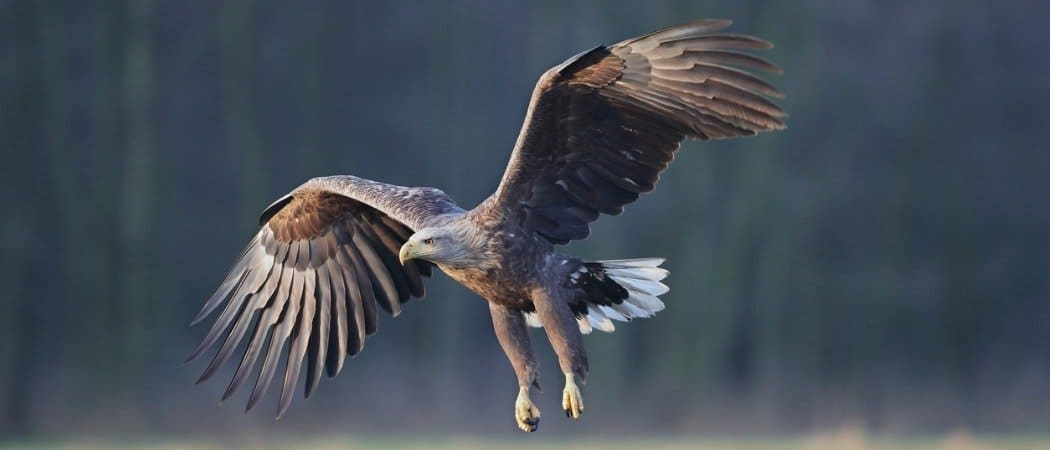
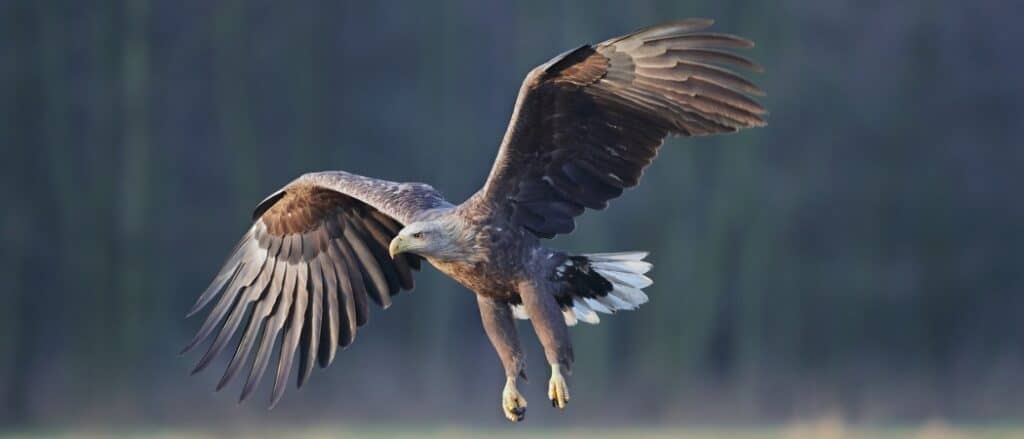
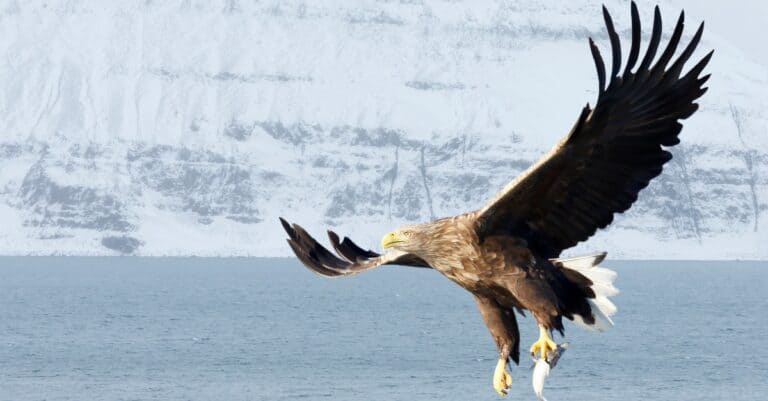
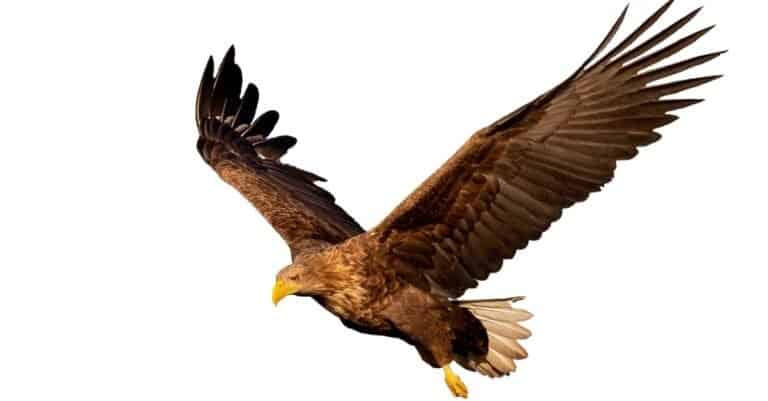
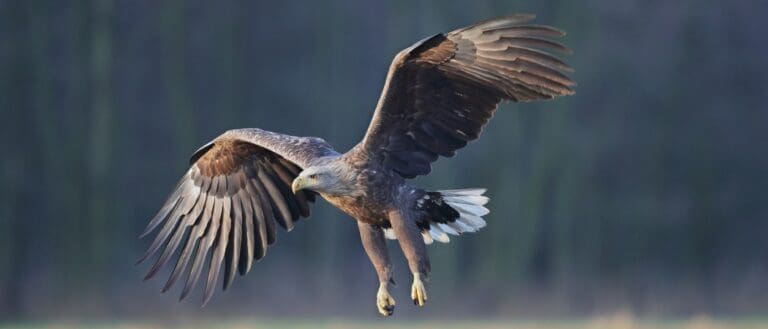
This massive bird is 66 to 94 centimeters (25.9 to 37 inches) in length. It weighs between nine and a half and 12 pounds. Its impressive wingspan measures from 5.8 to 8 feet. It is covered in feathers, has a long beak, and sharp talons. Its head and neck are cream to light brown. It transitions into a grayish hue where it connects with the body. The body feathers include variations of brown with some black patches around the edges. The tail, as its name suggests, is white, and it is short and shaped like a wedge. The talons are large and curved, the beak is hooked, and both are yellow. One talon, the hallux claw, is larger than the rest and is used for killing. The wings are full and bold.
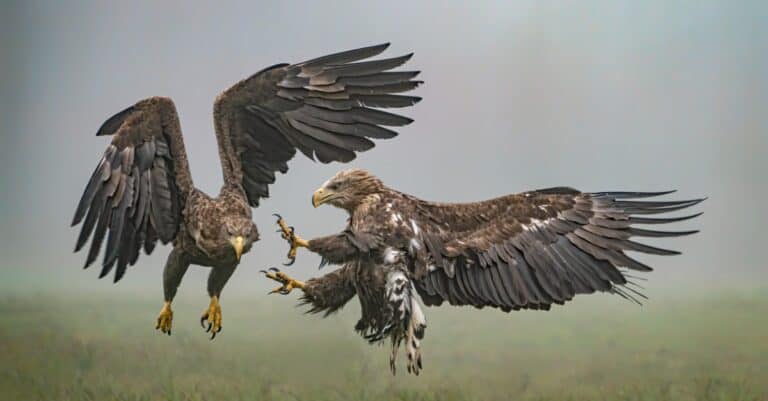
These eagles are very territorial. They will engage with other birds to protect their territory, which can be over 40 miles. They fly at high speed. These diurnal birds usually roost in pairs. They can be quite vocal, especially during the breeding season. Their calls consist of 15 to 30 vocalizations in a sequence. A group of eagles is called a convocation.
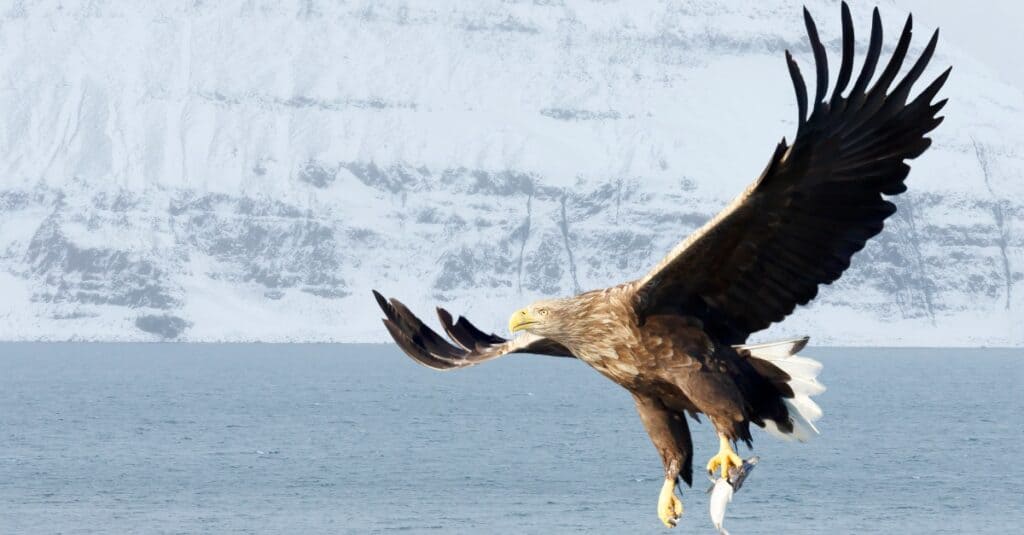
The White-Tailed Eagle’s territory can range as far as 40 miles, and it is almost always located around bodies of water.
©iStock.com/Dgwildlife
White-tailed Eagle Migration Pattern & Timing
Although the white-tailed eagle is considered a migratory bird, not all of them migrate. The population in the northern and eastern ranges (Russia and Asia) heads southwest once the breeding season is over. The European inhabitants are rather sedentary and prefer to stay put in the same location.
Diet
White-tailed eagles are carnivores. Their diet consists only of meat. They are scavengers and are known to steal food from other animals. During the winter, they eat about 200 to 300 grams of food per day. Within the breeding season, they need more food and eat between 500 and 600 grams in a day.
What does a White-tailed eagle eat?
It eats an abundance of animals, including a great quantity of fish. It eats other birds such as ducks, seagulls, coots, and partridges. It also eats small mammals like muskrats, hares, and susliks (a species of ground squirrel). It feeds on carrion, which is the decaying flesh of animals. The white-tailed eagle eats large amounts of carrion during the winter.
Predators, Threats & Conservation Status
The white-tailed eagle is an apex predator, with no natural predators of its own. The only threats it faces are from humans. Disturbances from humans and egg collecting are the current major threats. Accidental poisoning from pesticides is also a problem. Deforestation, degradation of wetlands, and pollution cause further harm to this species as well. In several areas, a purposeful reintroduction of the species has been occurring. It seems to be helping where populations have declined in the past.
The white-tailed eagle’s conservation status on the IUCN Red List is of least concern. It is listed in CITES Appendix I.
What eats the White-tailed Eagle?
Nothing is known to eat the white-tailed eagle.
Reproduction, Young & Molting
The breeding season for white-tailed eagles takes place from January to July in the south, and from April to September in the north. This species is monogamous. They mate for life and remain together in pairs. During courtship, the male and the female will participate in aerial displays, often interlocking their talons and descending in a spiral. They will also call out to each other loudly. They regularly breed in the same territory, time after time. They reuse nests for generations. In fact, there was a nest in Iceland that was used consecutively for over 150 years.
The female will lay between one and three eggs. The average clutch size is two eggs. It takes 38 to 42 days for the eggs to hatch. The babies, called eaglets, need a great deal of nurturing until they are old enough to be on their own. Both parents provide care for their young. They can leave the nest and fledge 70 to 80 days after hatching. About a month or two after fledgling, they are considered to be independent. They first molt when they are one year old, from May to November.
The average lifespan for this bird is 20 to 25 years. One individual in captivity exceeded the typical lifespan, living to 42 years old.
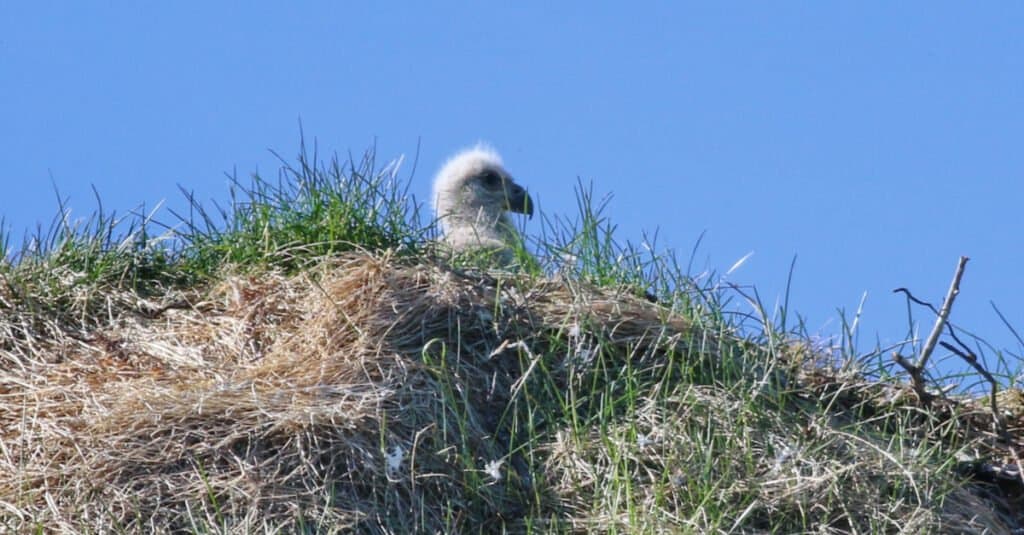
The White-Tailed Eagle mates for life, and you can find its nests in trees and on cliffs.
©xpixel/Shutterstock.com
Population
According to IUCN, the total estimated population is between 20,000 and 60,000. Europe contains 50–74% of the global population, with an estimated 20,900 to 29,200 mature individuals. The species was once extinct in the United Kingdom but has since been successfully reintroduced. The population is not severely fragmented, and the trend is increasing. They are categorized as of least concern.
White-Tailed Eagle Pictures
View all of our White-Tailed Eagle pictures in the gallery.

xpixel/Shutterstock.com
Sources
- EOL / Accessed September 16, 2021
- IUCN Red List / Accessed September 16, 2021
- Britannica / Accessed September 16, 2021
- The Wildlife Trusts / Accessed September 16, 2021
- Thai National Parks / Accessed September 16, 2021