




T
Species Profile

Tapir

Tapiridae

Tapirs: forest gardeners with a snorkel nose
Danny Ye/Shutterstock.com
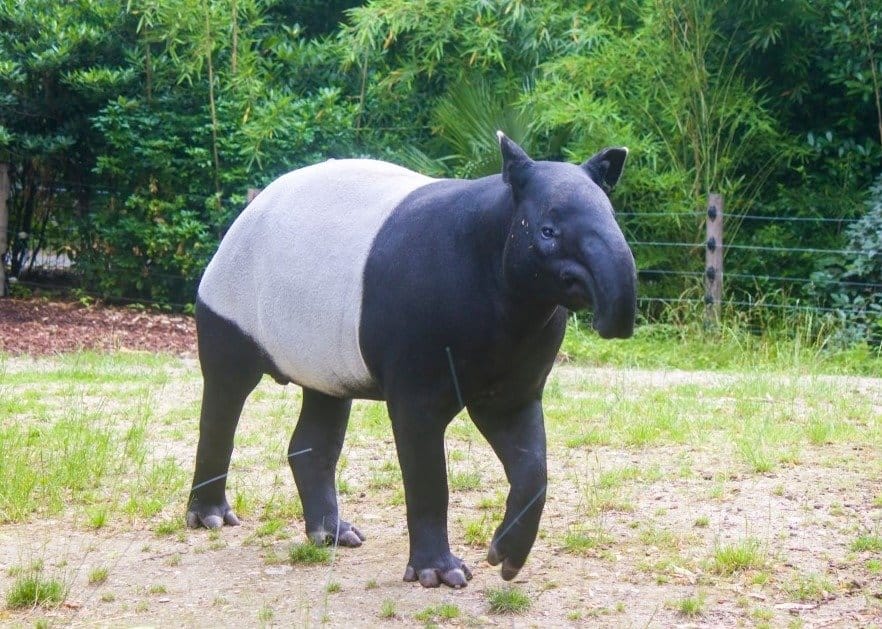
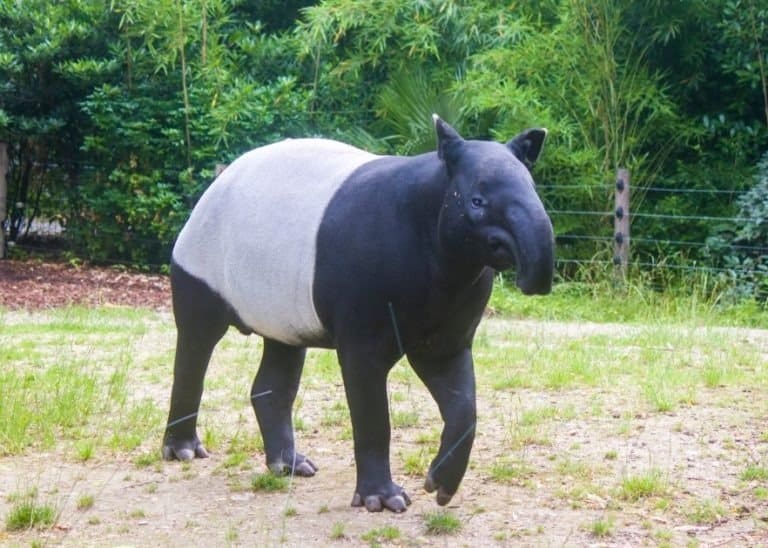
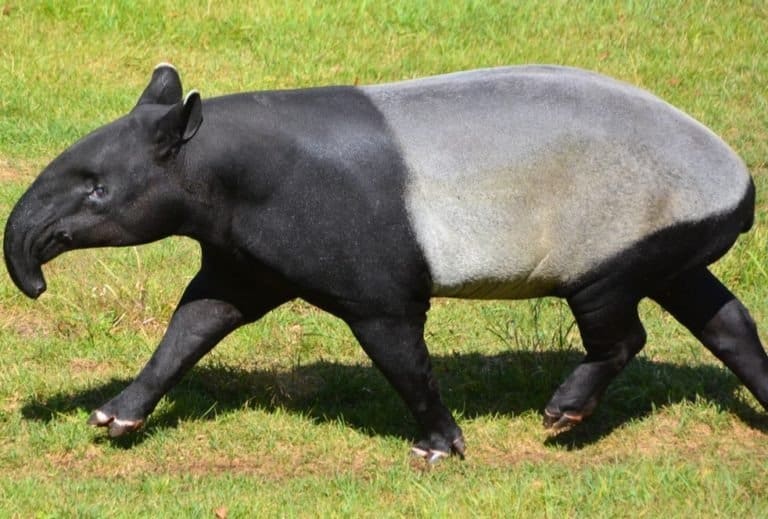
A Malayan tapir is eating grass.

At a Glance

Family Overview This page covers the Tapir family as a group. Stats below are general traits shared across the family.
Also Known As anta, danta
Diet Herbivore
Activity Nocturnal+
Lifespan 22 years
Weight 350 lbs
Status Not Evaluated
Did You Know?

Family-wide size range: ~1.8-2.5 m long, ~0.9-1.2 m shoulder height, roughly ~150-320 kg (smallest to largest living tapirs).

Scientific Classification

Family Overview "Tapir" is not a single species but represents an entire family containing multiple species.

Tapirs (family Tapiridae) are large, primarily forest-dwelling odd-toed ungulates closely related to horses and rhinoceroses. Living tapirs are placed in the genus Tapirus and occur in Central/South America and Southeast Asia.

Kingdom
Animalia
Phylum
Chordata
Class
Mammalia
Order
Perissodactyla
Family
Tapiridae

Distinguishing Features

  • Stocky, pig-like body with short legs (odd-toed ungulate)
  • Flexible prehensile snout forming a short trunk
  • Herbivorous browser (leaves, shoots, fruit); important seed dispersers
  • Often nocturnal/crepuscular and strongly associated with water

Physical Measurements

Males and females differ in size

Height
♂ 3 ft 3 in (2 ft 6 in – 3 ft 11 in)
♀ 2 ft 11 in (2 ft 6 in – 3 ft 7 in)
Length
♂ 7 ft 4 in (6 ft 1 in – 8 ft 8 in)
♀ 7 ft 5 in (6 ft 1 in – 8 ft 6 in)
Weight
♂ 661 lbs (331 lbs – 705 lbs)
♀ 485 lbs (331 lbs – 705 lbs)
Tail Length
♂ 3 in (2 in – 5 in)
♀ 3 in (2 in – 4 in)
Top Speed
30 mph
running

Appearance

Primary Colors
Secondary Colors
Skin Type Short, coarse hair over thick hide; bristlier along neck in some. Skin is tough and resilient, aiding movement through dense vegetation; hair length and gloss vary by habitat and season.
Distinctive Features
  • Odd-toed ungulate build (Perissodactyla), related to horses and rhinoceroses; heavy-bodied with stout limbs.
  • Prehensile, flexible snout (short trunk) used for browsing, grasping foliage, and smelling.
  • Forefeet typically with four toes and hindfeet with three, adapted for soft forest soils.
  • Rounded ears; small eyes set laterally; robust neck and shoulders.
  • Size varies across the family: roughly 0.7-1.2 m shoulder height and about 150-320 kg adult mass.
  • Tail extremely short; overall silhouette pig-like but anatomically distinct from pigs/peccaries.
  • Excellent swimmers; streamlined body and flexible snout used while wading or submerged.
  • Geographic and ecological breadth: Neotropics and Southeast Asia, mostly forest and riverine habitats; many act as important seed dispersers and several species are threatened or endangered.

Sexual Dimorphism

Sexual dimorphism is generally mild across tapirs. Females are often slightly larger and heavier than males, while overall coloration, snout structure, and patterning are similar; size overlap is substantial.

♂
  • Typically slightly smaller body mass and shoulder height on average.
  • May show more visible neck/shoulder scarring where intrasexual competition occurs.
♀
  • Often slightly larger, with broader torso and higher average mass.
  • Enlarged abdomen and mammary development obvious only during late pregnancy/lactation.

Did You Know?

Family-wide size range: ~1.8-2.5 m long, ~0.9-1.2 m shoulder height, roughly ~150-320 kg (smallest to largest living tapirs).

Lifespan across species is commonly ~20-30 years; individuals in human care can reach ~30-35+ years.

Tapirs are Perissodactyla-closer relatives of horses and rhinoceroses than of pigs or hippos.

All living tapirs belong to one genus (Tapirus) but span two regions: 3 species in the Americas and 1 in Southeast Asia.

Their flexible snout works like a short trunk for grabbing leaves, sniffing, and even acting as a "snorkel" when swimming.

Tapirs are important seed dispersers: they swallow many fruits whole and deposit viable seeds far from the parent plant.

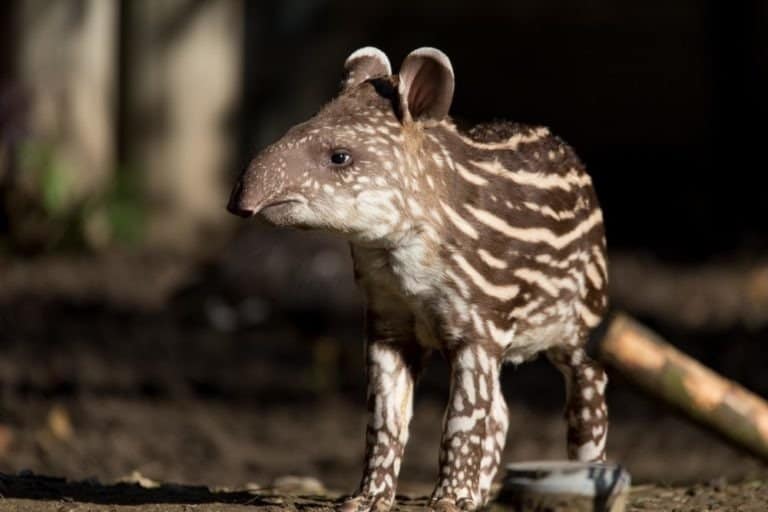
Tapir calves are born with stripes/spots for camouflage-patterns fade as they grow, though the adult look varies strongly among species (e.g., the Malayan tapir's bold black-and-white coat).

Unique Adaptations

  • Prehensile snout (short proboscis): a muscular, flexible upper lip/nose used to grasp foliage, investigate scents, and manipulate food with precision.
  • Odd-toed ungulate foot design: typically 4 toes on the forefeet and 3 on the hindfeet, spreading weight on soft forest soils and aiding stability on muddy slopes.
  • Powerful, compact body with dense bones and thick skin: useful for pushing through undergrowth and resisting minor bites/scratches in dense vegetation.
  • Excellent smell and hearing (with comparatively modest eyesight): well-suited for navigating dim, cluttered forest environments.
  • Camouflaged young: striped/spotted coats break up outlines in dappled light; this "forest patterning" is shared across the family in infancy.
  • Aquatic escape option: comfort in water and mud provides refuge from heat, insects, and some predators; the snout helps breathe while partially submerged.
  • Digestive strategy: hindgut fermentation allows processing of tough, fibrous browse-supporting their role as large-bodied browsers and seed dispersers.

Interesting Behaviors

  • Mostly solitary, but not strictly: adults often avoid each other, yet ranges can overlap, and pairs may associate briefly for breeding; mothers raise a single calf for many months.
  • Crepuscular-to-nocturnal tendencies are common, especially where human disturbance is high; in quieter areas, activity can shift more into daylight.
  • Frequent use of water: many tapirs swim well, wade along river edges, and wallow in mud to cool down and deter biting insects.
  • Trail-making and "route fidelity": individuals often move along repeated paths through dense vegetation, effectively creating forest corridors.
  • Scent communication: tapirs commonly use urine, feces (often in latrine-like piles), and glandular scents to mark presence and reproductive status.
  • Feeding ecology: primarily browsers (leaves, shoots, twigs) with opportunistic fruit-eating; the balance varies by habitat and season across species and elevations.
  • Geophagy and mineral seeking: visits to natural salt/mineral licks are recorded in multiple species, likely aiding nutrition and detoxification of plant compounds.
  • Vocal range: whistles, squeals, and snorts support short-range communication in thick forest and during mother-calf contact.

Cultural Significance

Tapirs (Tapiridae) are forest animals in the Amazon, Central America and Southeast Asia. Indigenous peoples know them in stories and as food. The Malayan tapir's black-and-white look helps conservation. Threats are habitat loss and hunting; their status ranges from Vulnerable to Endangered. They are flagship mammals for tropical forest conservation.

Myths & Legends

In Malay Peninsula stories, people say the Malayan tapir's black-and-white coat came from an accident—being burned or stained in a great fire. Its look became a warning origin story about the forest.

In many Amazon Indigenous stories, tapirs (Tapiridae) appear in animal tales with powerful predators like the jaguar. The tapir's strength, caution, or stubbornness teaches lessons about hunting, respect, and forest life.

Mesoamerican and Indigenous Central American cultures long knew tapirs—especially Baird's tapir—as important forest animals. They appear in art and stories as creatures of deep, watery, hidden places that show forest wildness.

In parts of Amazonia, tapirs appear in Indigenous stories as "forest owners" or "masters of animals." Large game are given ritual respect, with rules about when and how they may be hunted.

Conservation Status

NE Varies by species (no single IUCN Red List category is assigned to tapirs as a family; extant tapir species are currently assessed from Vulnerable to Endangered).

Has not yet been evaluated against the criteria.

Population Decreasing

Protected Under

  • CITES: Tapiridae listed across Appendix I and Appendix II (species-dependent, reflecting different threat levels).
  • National wildlife protection laws in multiple range countries across Central/South America and Southeast Asia (varies by jurisdiction).
  • Occurrence in protected areas (national parks/reserves) is common but enforcement effectiveness and connectivity between reserves vary widely.

You might be looking for:

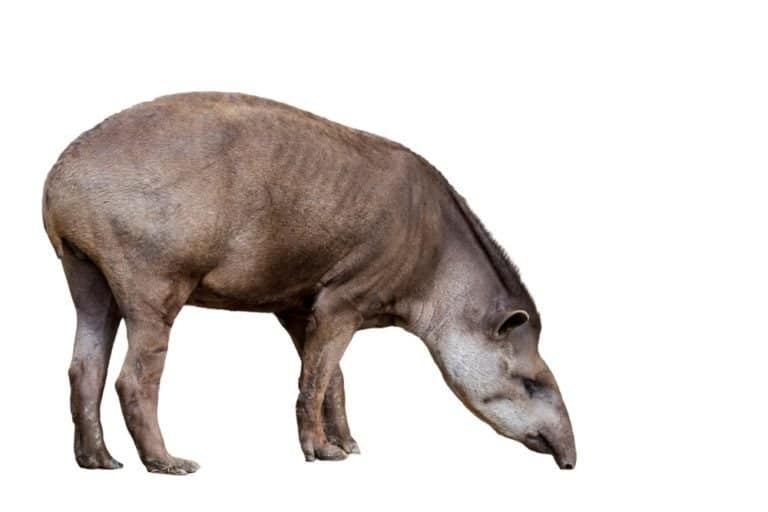
Brazilian (Lowland) Tapir

35%

Tapirus terrestris

Widespread in South America; the most commonly encountered tapir in much of the Amazon and adjacent regions.

Baird’s Tapir

25%

Tapirus bairdii

Largest native land mammal of Central America; ranges from southern Mexico into northwestern South America.

Malayan Tapir

25%

Tapirus indicus

Distinct black-and-white coloration; the only Asian tapir species.

Mountain Tapir

15%

Tapirus pinchaque

High-elevation Andean species with woollier coat; among the most threatened tapirs.

Life Cycle

Birth 1 calf
Lifespan 22 years

Lifespan

In the Wild
15–30 years
In Captivity
20–40 years

Reproduction

Mating System Promiscuity
Social Structure Solitary
Breeding Pattern Transient
Fertilization Internal Fertilization
Birth Type Internal_fertilization

Across Tapiridae, adults are mostly solitary and mate opportunistically; males range widely and may overlap multiple females, and females may mate with more than one male. Courtship is brief, bonds do not persist, and females raise a single calf alone.

Behavior & Ecology

Social Candle Group: 1.5
Activity Nocturnal, Crepuscular, Cathemeral, Diurnal
Diet Herbivore Soft fruits and tender leaves/shoots (preference varies by habitat and season across the family)

Temperament

Generally shy, cautious, and cover-dependent; avoid humans but may habituate in low-disturbance sites.
Can be defensive and surprisingly aggressive when cornered, injured, or when protecting calves.
Family-level size variation is large: roughly 150-320+ kg and ~180-250 cm body length across species.
Lifespan across the family is typically ~20-35 years (wild often lower; captivity often higher).
Use regular trails and water for thermoregulation and predator avoidance; strong swimmers across species.
Activity timing varies with habitat and human pressure: more nocturnal where disturbed, more diurnal in remote areas.

Communication

high-pitched whistles or squeals Especially calves
snorts and blows during alarm or investigation
grunts and low-frequency calls at close range
clicks or chirps reported in some contexts
scent-marking with urine spraying and feces; use of dung piles in some populations
chemical cues for mate assessment and spacing via persistent scent on trails and resting sites
tactile contact (nose-to-nose, nuzzling) between mother-calf and during courtship
auditory signaling amplified in dense forest; footfalls and splashing can function as disturbance cues

Habitat

Biomes:
Tropical Rainforest Tropical Dry Forest Savanna Wetland Freshwater
Terrain:
Mountainous Hilly Plains Valley Riverine Muddy
Elevation: Up to 14107 ft 7 in

Ecological Role

Large-bodied browser and important seed disperser in forest and riparian ecosystems (family-wide), influencing plant regeneration and understory structure.

Seed dispersal via endozoochory (moving and depositing viable seeds in dung, often away from parent trees) Selective browsing that shapes understory composition and forest regeneration patterns Nutrient cycling and soil fertilization through dung deposition Trail creation and habitat connectivity effects (repeated movement paths can influence plant recruitment and access for other animals)

Diet Details

Other Foods:
Leaves Young shoots and stems Twigs and buds Fallen fruit and soft fruits Herbs, forbs and understory plants Aquatic and semi-aquatic vegetation Bark Grasses +2

Human Interaction

Domestication Status

Wild

Tapirs (family Tapiridae; genus Tapirus) have never been domesticated. In Central and South America and Southeast Asia, people sometimes catch and tame young tapirs for a short time. They do not breed well in home settings and keep wild habits and strong stress reactions, so long-term domestication has failed.

Danger Level

Moderate
  • Defensive charges, especially when cornered or when a female is protecting a calf
  • Severe bites (tapirs have strong jaws and can cause deep lacerations/crushing injuries)
  • Trampling/knockdowns during close encounters (including in captivity)
  • Zoonotic disease exposure risk when handling (e.g., via bodily fluids/parasites; risk depends on context and hygiene)
  • Indirect risk via vehicle collisions where tapirs cross roads (hazard to drivers and passengers)

As a Pet

Not Suitable as Pet

Legality: Tapirs (Tapiridae) are usually illegal as private pets or need strict exotic wildlife permits, often only for approved zoos or sanctuaries. CITES lists many species (Appendix I); trade and local laws limit ownership.

Care Level: Expert Only

Purchase Cost: $10,000 - $50,000
Lifetime Cost: $150,000 - $600,000

Economic Value

Uses:
Subsistence and opportunistic hunting (bushmeat) Hide/leather use (local/traditional) Human-wildlife conflict costs (crop damage, fencing, roadkill) Ecotourism and wildlife viewing value Zoo exhibition, education, and conservation breeding programs Scientific research and conservation funding value Cultural significance in some Indigenous/local communities
Products:
  • meat (local consumption where hunting occurs)
  • hide/leather (limited/local use)
  • non-material services: tourism/education/research value

Relationships

Related Species 2

Rhinoceroses
Rhinoceroses Rhinocerotidae Shared Order
Horses, zebras, and donkeys Equidae Shared Family

Types of Tapir

4

Explore 4 recognized types of tapir

Baird's tapir Tapirus bairdii
Mountain tapir Tapirus pinchaque
South American tapir (Brazilian tapir) Tapirus terrestris
Malayan tapir Tapirus indicus

Amazingly, the roots of the modern Tapir species can be traced all the way back to the Eocene Epoch, which lasted from 56 to 33.9 million years ago.

These early Tapirs were smaller than their modern counterparts and did not have an elongated nose or upper lip. These species weighed up to 400 pounds and were normally half the size of the existing species.

Evolution

The first examples of Tapirs with long snouts appeared during the Oliogocene period, which ended 23 million years ago. The species from 30 million years ago are nearly identical to their living cousins today. In fact, today’s South American, Asian, and Mountain tapirs have evolved extraordinarily little over the last 20 to 30 million years.

Tapirs are considered living fossils because they haven’t changed much since their evolution, more than 50 million years ago, and are considered one of the most primitive large mammals in the world.

In general, these animals are solid creatures with large protruding rumps. They are covered with varying amounts of red, brown, gray, or black fur. The mountain Tapir, which makes its home in the Andes mountain, is smaller but has more fur than the other existing species.

Tapirs are animals that resemble numerous animals, some of which people think are most closely to donkeys, but they weigh up to 800 pounds and can be more than six feet long. They also stand between two and four feet high at the shoulder. Their tough hides provide protection from most predators.
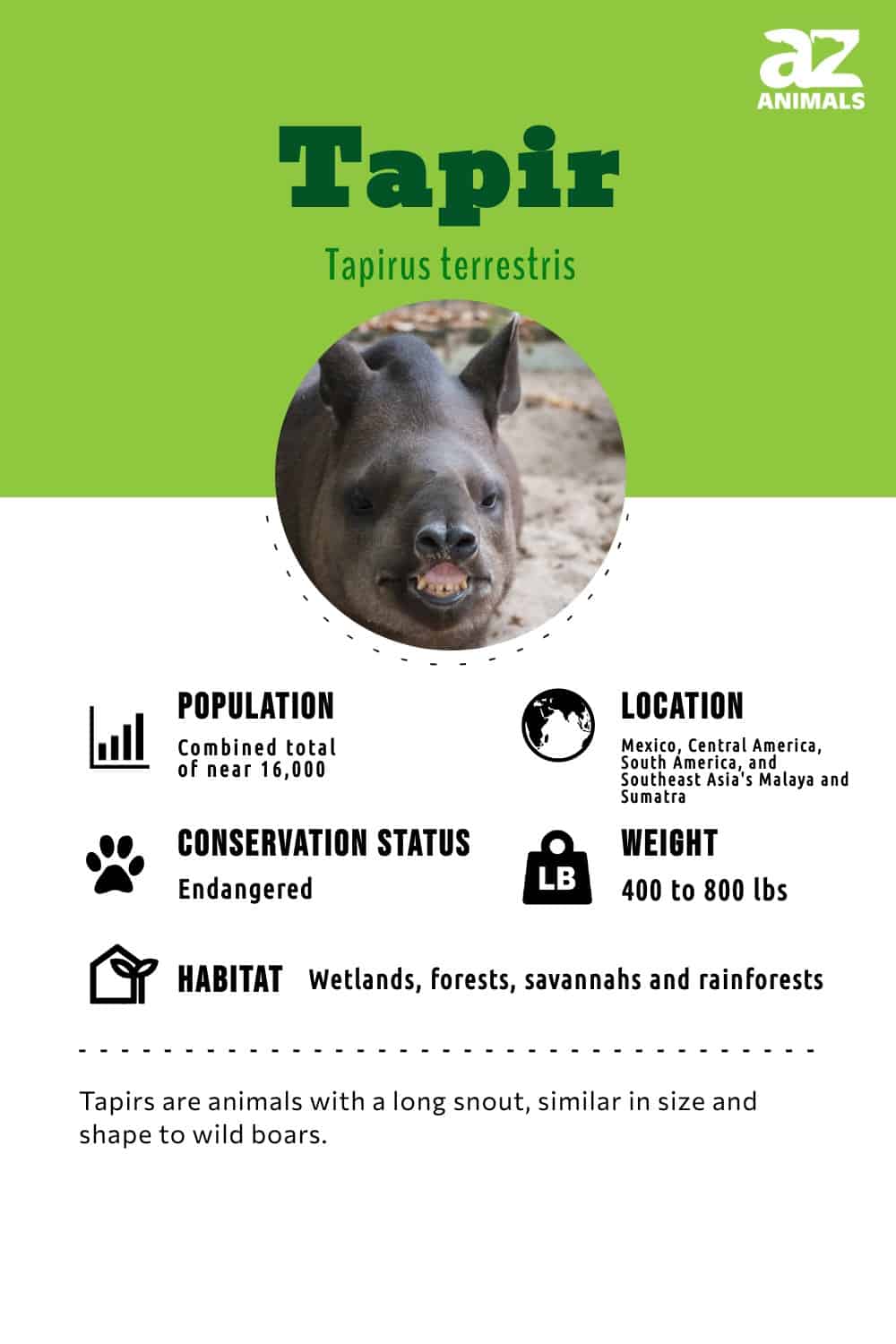
5 Incredible Tapir Facts!

  • Tapirs are animals that have existed on Earth for more than 30 million years.
  • They live in grasslands, forests, swamps, mountains, and other environments in South America, Asia, and India.
  • They have between 42 and 44 teeth.
  • Tapirs have between 52 and 80 chromosomes depending on the species.
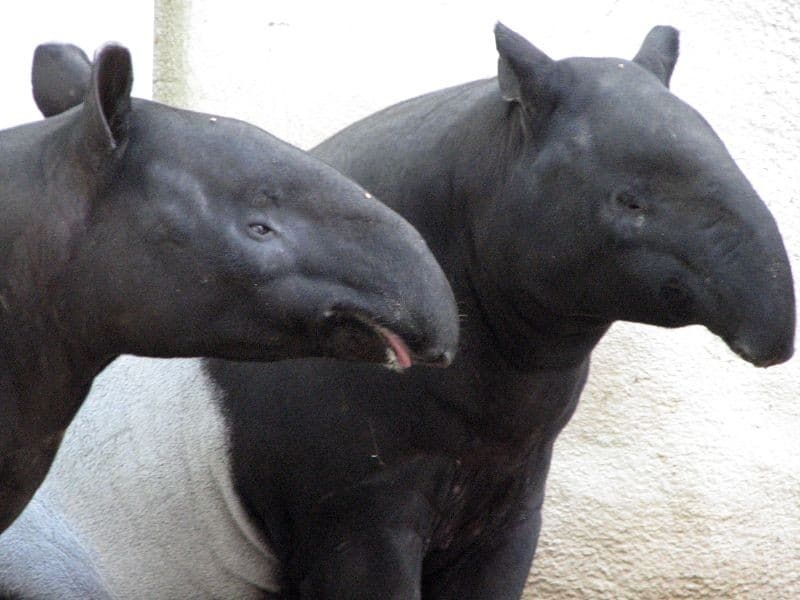
Scientific Name

There are four living, or extant species of this animal, including:

  • Tapirus terrestris, or the South American Tapir
  • Tapirus pinchaque, or wooly tapir
  • Tapirus indicus, or Malayan tapir
  • Tapirus bairdii, or Baird’s tapir.

A fifth species with the scientific name Tapirus kabomani, or the Kabomani Tapir, is not yet officially recognized. Beyond the living species, there have been at least 15 other known extinct species over the many millions of years since this unique creature first appeared.

Appearance And Behavior

In general, modern Tapirs all have a long snout, known as a proboscis, that is omnidirectional. They use this flexible appendage to gather berries, fruits and other vegetation from all surrounding areas. Their mouth contains between 42 and 44 teeth that are largely flat to help grind plants and fruits.

Other than the nose, these animals are similar in size and shape to wild boars or to Rhinoceroses. They can reach more than six feet long and nearly three feet high. They weigh anywhere from 400 to 800 pounds as adults and have tough skins that make them resistant to many predators that are native to South America, India, and Asia.

These animals are generally solitary creatures. They will gather in small groups, called candles, to procreate, and for social interaction. Babies, known as calves, remain with their mothers until they reach six to eight months of age. At that time, they go off on their own and the mother is free to raise another offspring.
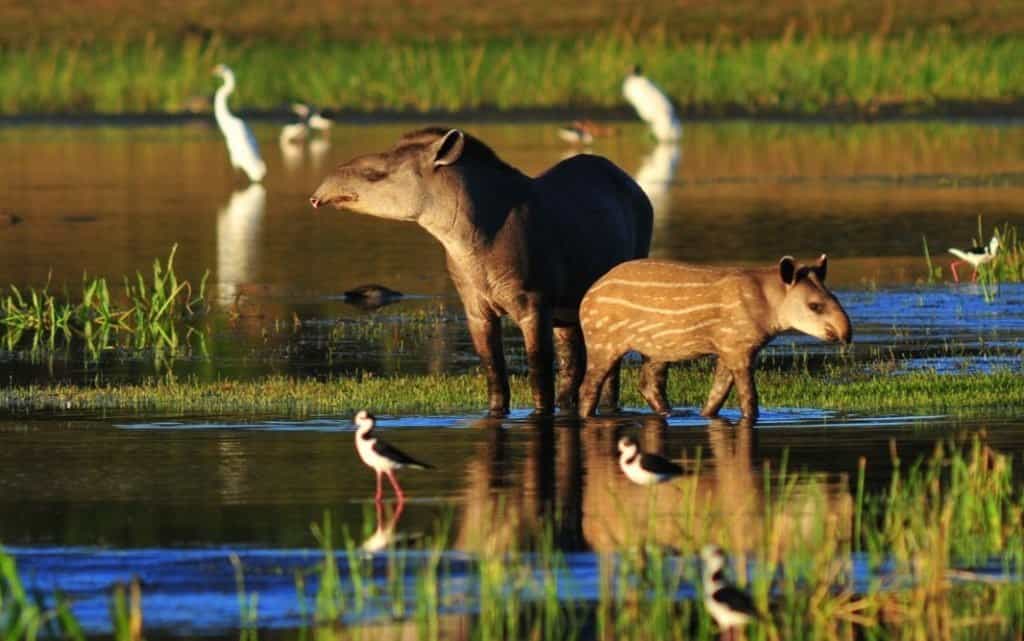
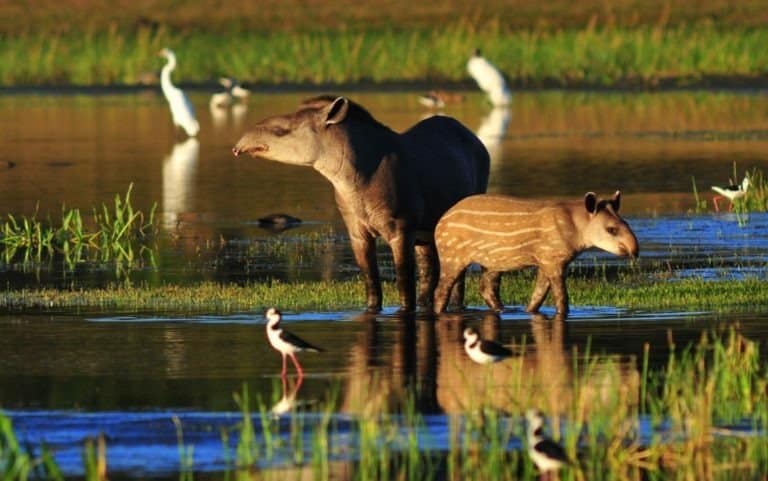
Tapir mother with baby

Tapirs have diverse native habitats.

Habitat

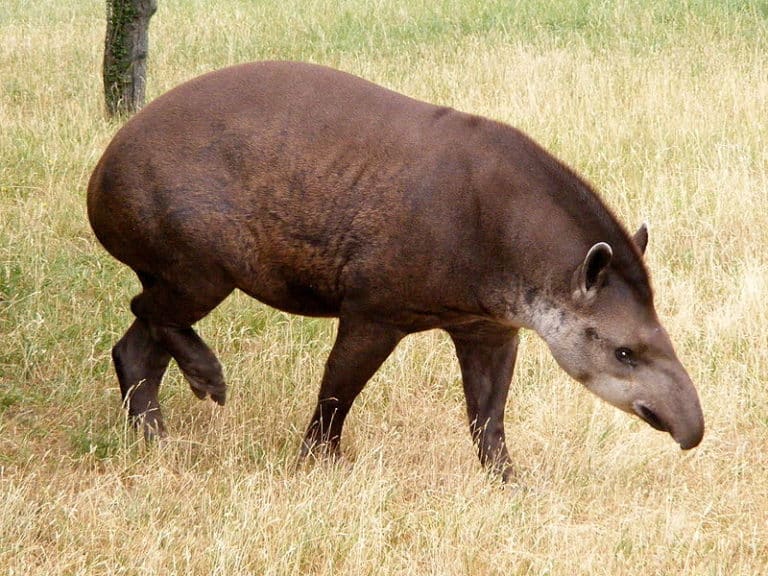
Tapirs have diverse native habitats depending upon which species it is and where it is found. For example, the South American species, the scientific name Tapirus terrestris, lives in the grassy plains of Brazil, Venezuela, Colombia, Argentina, Peru, Ecuador, and Guiana.

In contrast, the Baird Tapir, scientific name Tapirus bairdii, roams the grasslands of Mexico, Central America, and parts of northern South America. The Mountain Tapir is smaller and woolier than its cousins. It primarily lives in the Andes mountains.

The Indian or Asian tapir is found in Cambodia, Indonesia, and Laos. It has also been seen in Malaysia, Myanmar (formerly known as Burma), Thailand, and Vietnam. These animals like to forage in the jungles and rainforests of these countries.

Diet
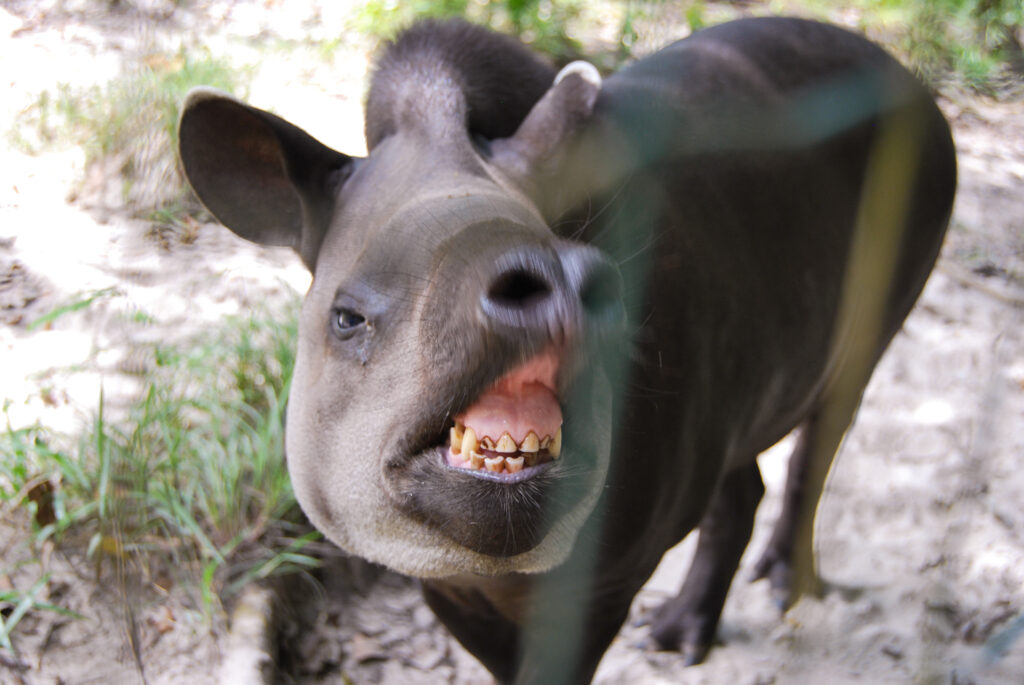
A photograph of a tapir center frame smiling at the camera. Its teeth need to be cleaned.

Tapirs are herbivores and use their long noses to grab items that may seem out of reach.

All species are herbivores, which means that their diet includes only grasses, seeds, fruits, and other plant life. This creature’s proboscis can move in all different directions to grab low-lying leaves and fruit that other animals might not be able to reach. The animal does not eat meat, so its teeth are used solely to grind up its vegetative diet.

Predators And Threats

This animal has tough skin on its back and neck that helps protect it from many predators that might want to target it as a source of meat. However, crocodiles have been known to attack them while they are wallowing in swamps and mud pits or while trying to cool off in lakes and rivers.

Wild jungle cats that roam the grassy plains in Central America or the jungles of South America and Asia also may prey on these animals. Tigers, jaguars, and cougars are three examples of larger felines that hunt the Tapir.

Despite these few natural predators, perhaps the biggest risk to the animal’s survival are humans. People have hunted the Tapir for centuries to obtain not only its meat but also its hides. The Tapir’s durable skin makes them particularly prized for leatherwork in some parts of Asia and India.

Deforestation and the destruction of their natural mating habitats are also other major risks to these animals. In fact, all four Tapir species are either endangered or vulnerable according to conservation tracking groups. Estimates indicate that none of these species have a population larger than 4.500 out in nature.

Reproduction, Babies, And Lifespan
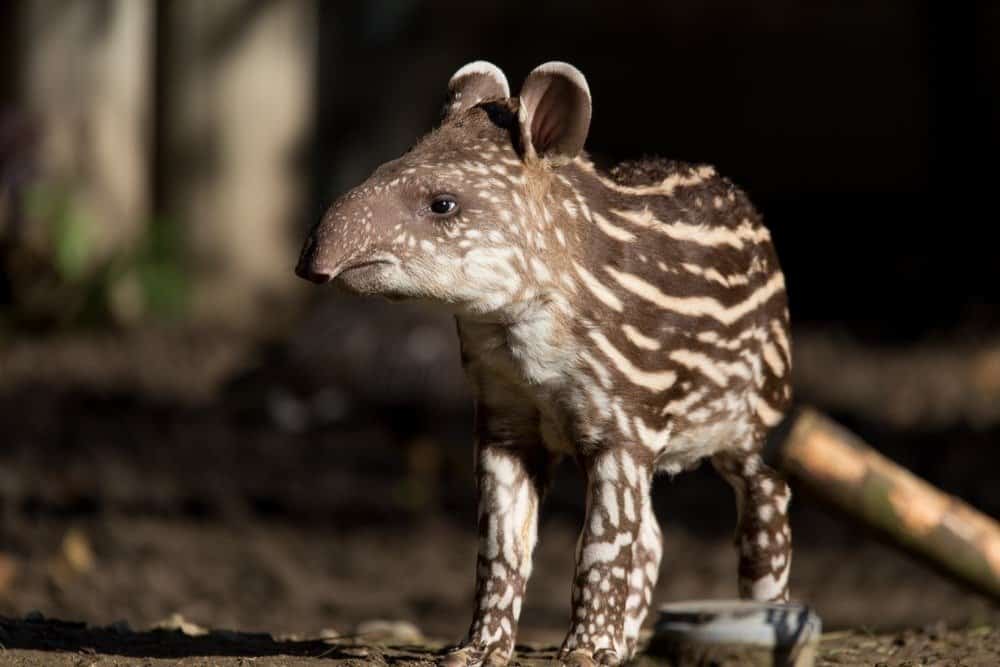
Small striped baby of the endangered South American tapir (Tapirus terrestris)

After birth, a calf is weaned over the next six to eight months.

These animals have a relatively long gestation period. They generally attempt to mate just before the rainy season in South America and Asia. If successful, then a male or female baby, known as a calf, is born 13 months later just after the rainy season begins.

Mothers can only carry one calf at a time. After birth, the female raises and weans her offspring over the next six to eight months. At that time, the juvenile is nearly full-grown, and the mother can look for a new mate. Female Tapirs can have one calf every two years throughout their lives.

Female Tapirs often reach sexual maturity before their male counterparts. Females can become sexually active as early as three years old whereas it may take a male Tapir between four and five years to completely mature. Once mature, procreation can take place on dry land or while the Tapirs are cooling off in lakes, rivers, or other large bodies of water.

A Tapir’s lifespan remains remarkably consistent whether they are out in the wild or held in captivity at a zoo. In fact, most individuals of the four recognized tapir species live between 20 and 30 years. Their consistent lifespan may be because of their large size, tough hides, and other natural defenses limit their number of true predators in the wild.

Population
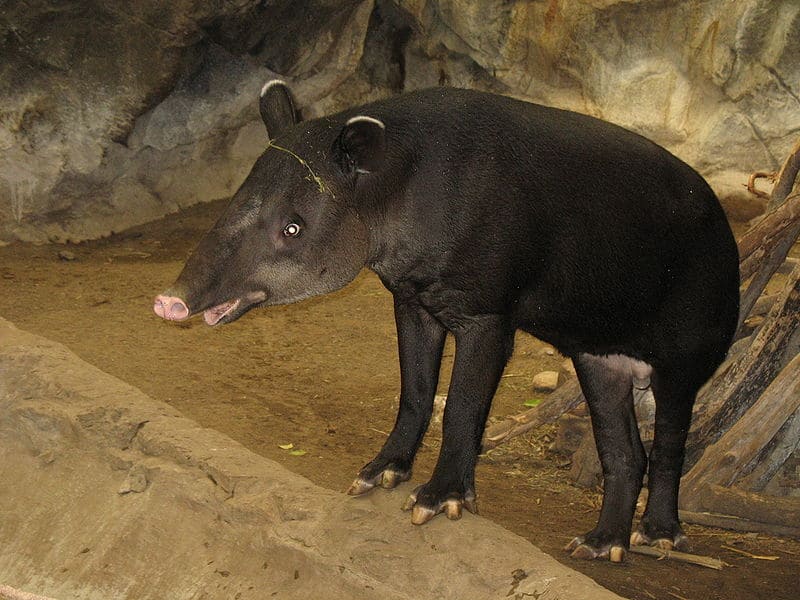
All the recognized Tapir species are listed as either vulnerable or endangered on wildlife conservation lists. None of the four species have a population bigger than 4,500 in the wild. Scientists believe that the Malayan Tapir may have a population as low as 3.000 left in the world. The Baird Tapir’s count is only slightly better at 4,500 animals.

Tapirs In The Zoo

These animals generally survive well at the zoo. Their life expectancy is surprisingly similar whether they are in captivity or out in the wild. These creatures typically live for 20 to 30 years, but some specimens have lived 35 years or more at the zoo. In fact, the San Diego Zoo has an established breeding program that has resulted in more than 30 baby Tapirs being born over the last 80 years.

Tapirs can be kept with other species native to Central America, South America, or Asia. For example, Tapirs live in the same exhibit as capybaras and guanacos at the San Diego Zoo.

View all 606 animals that start with T

Sources

  1. Wikipedia / Accessed December 23, 2020
  2. National Geographic / Accessed December 23, 2020
  3. Live Science / Accessed December 23, 2020
  4. Animal Corner / Accessed December 23, 2020
  5. Mongabay / Accessed December 23, 2020
Melissa Bauernfeind

About the Author

Melissa Bauernfeind

Melissa Bauernfeind was born in NYC and got her degree in Journalism from Boston University. She lived in San Diego for 10 years and is now back in NYC. She loves adventure and traveling the world with her husband but always misses her favorite little man, "P", half Chihuahua/half Jack Russell, all trouble. She got dive-certified so she could dive with the Great White Sharks someday and is hoping to swim with the Orcas as well.
Connect:

Thank you for reading! Have some feedback for us?


Tapir FAQs (Frequently Asked Questions)

Tapirs eat grass, seeds, fruits, berries, and other vegetation. They do not eat meat and are therefore categorized as herbivores. Most Tapirs consume between 75 and 80 pounds of food per day.