


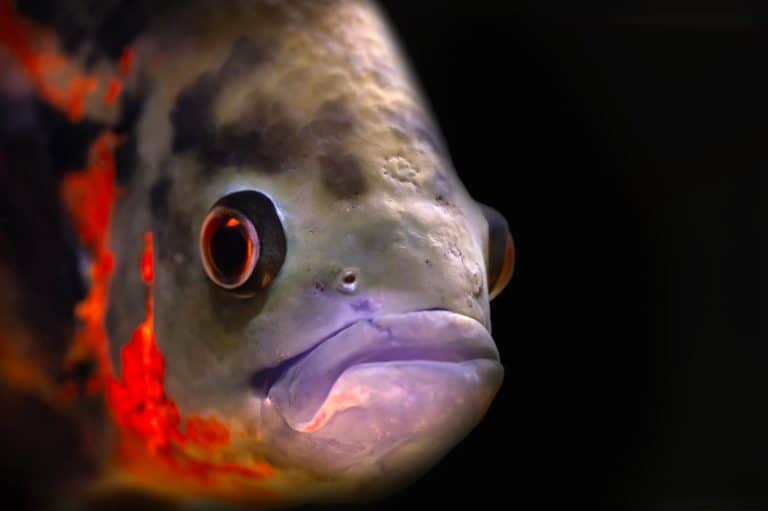



Quick Take
- Achieving a 20-year lifespan requires managing the species’ unique personality and environmental demands.
- Dropping to 55 degrees creates an immediate survival crisis for the Oscar species.
- Discovering their interior design capability reveals unexpected intelligence that contradicts typical fish behavior.
- Completing the nest cleaning stage is necessary to trigger the courtship ritual.
People who own Oscar fish might have bought one or two for their beautiful colors, but soon they’re surprised to see that the fish has a personality. They’ll notice their pet Oscar seems to be watching them as they go about their business. They may even believe that their Oscar recognizes them. The fish can be hand-fed, and if they don’t like the decor in their tank, they’ll change it by uprooting a plant, picking up a rock or a bit of gravel, and moving it around.

Four Incredible Oscar Fish Facts
- Oscars can change color according to their circumstances or mood, often becoming darker or paler due to stress, illness, or environmental changes.
- Oscars are monogamous.
- No one really knows why it’s called “Oscar,” but it may be a corruption of its species name, ocellatus.
- Oscars can tolerate water with very low oxygen levels. It may even come up to the surface to suck in air to supplement its oxygen.
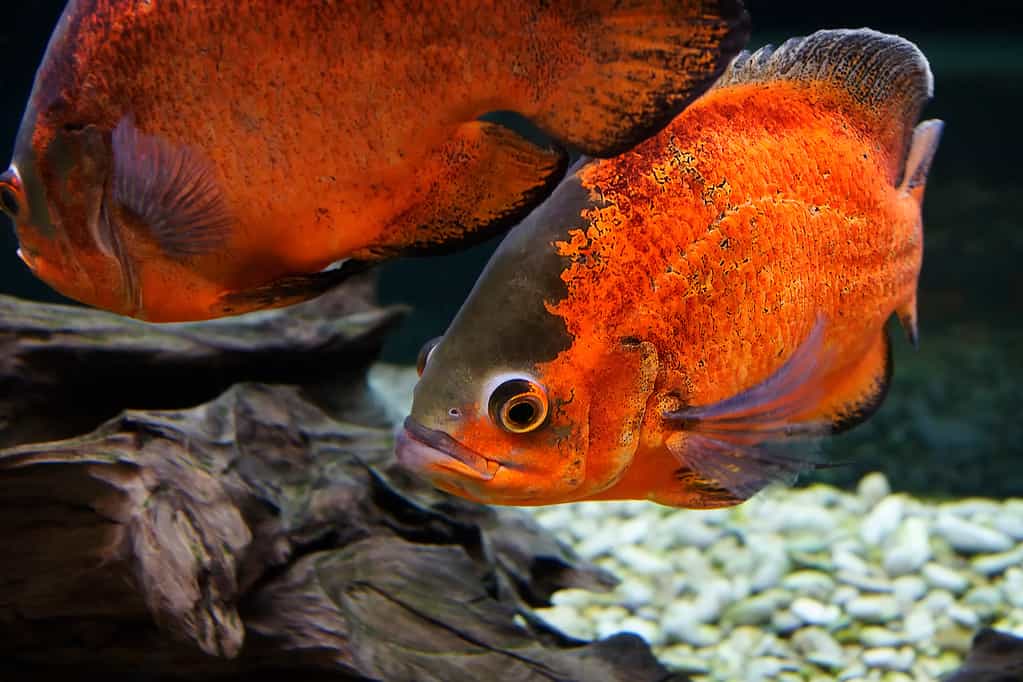
They are called Oscar based on the Latin word Ocellatus for “little eyes,” which describes the red eyespots at the base of the fish’s tail fin.
©Lexa_1112/Shutterstock.com
Origin and Evolution
It was first discovered and named in 1831 as Lobotes ocellatus by zoologist Louis Agassiz. This is because he believed the specimens collected were from the Atlantic Ocean.
The Oscar originates from the Amazon and Orinoco river basins and their tributaries, but it is now distributed throughout the world as they were kept as pets and sometimes released in non-native waters. The fish adapted and thrived, though it can be an invasive species in certain places.
Though the Astronotus genus has long been considered monotypic, recent studies indicate that a number of other species of the Oscar fish could be abundant in South America.
Classification and Scientific Name
The Oscar is a fish in the Cichlidae family, a large family that encompasses as many as 3,000 species. The Oscar fish’s genus is Astronotus, of which there are only two species, and its scientific name is Astronotus ocellatus. Astronotus comes from the Greek word for “star”, which is Astra, and the Greek word for “back,” noton. Ocellatus is Latin for “little eyes” and describes the red eyespots at the base of the fish’s tail fin. Though the Oscar fish’s origin is in South America, it has spread to rivers in North America and other regions where it may even be considered invasive.

Though there is one species of Oscar, it has been bred and crossbred to create several different varieties.
©TigerStocks/Shutterstock.com
Different Types of Oscar Fish
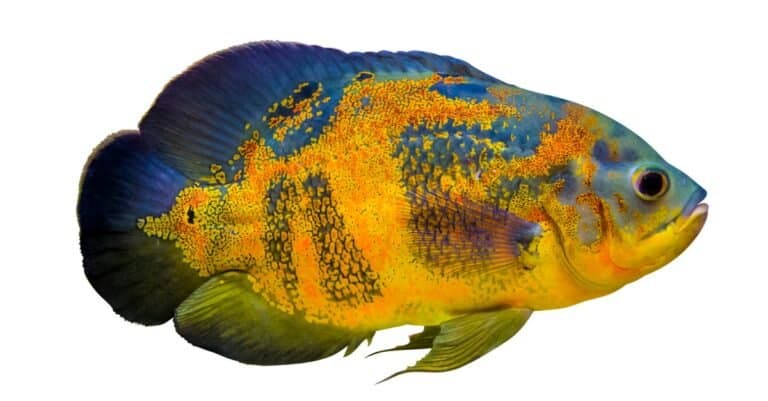
Though there is one species of Oscar, it has been bred and crossbred to create several different varieties for the home aquarium. They include veil-tailed Oscars, with beautiful, flowing pelvic, dorsal, caudal, and pectoral fins. There are albino Oscars, bright yellow Lemon Oscars, White, Blue, and Black Oscars, Green Oscars, Copper Oscars, and Golden Oscars. The price of these fish can range from a few dollars to about one hundred dollars.
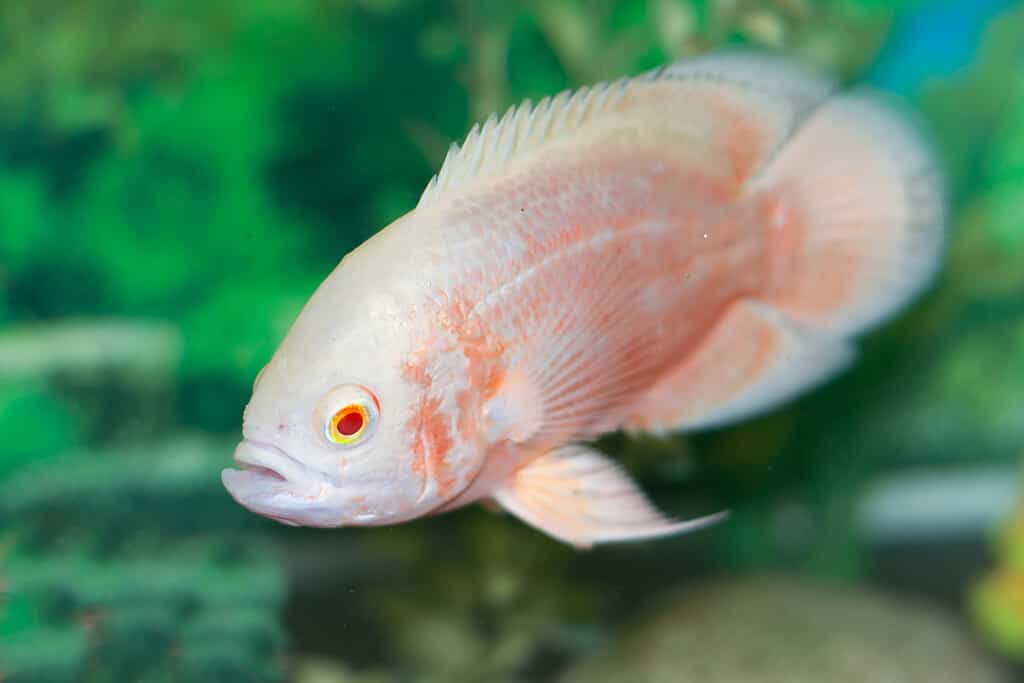
These fish, like other Oscars, may turn into interior designers in their tanks, rearranging the rocks and décor you place inside to their liking.
©Santhosh Varghese/Shutterstock.com
Appearance
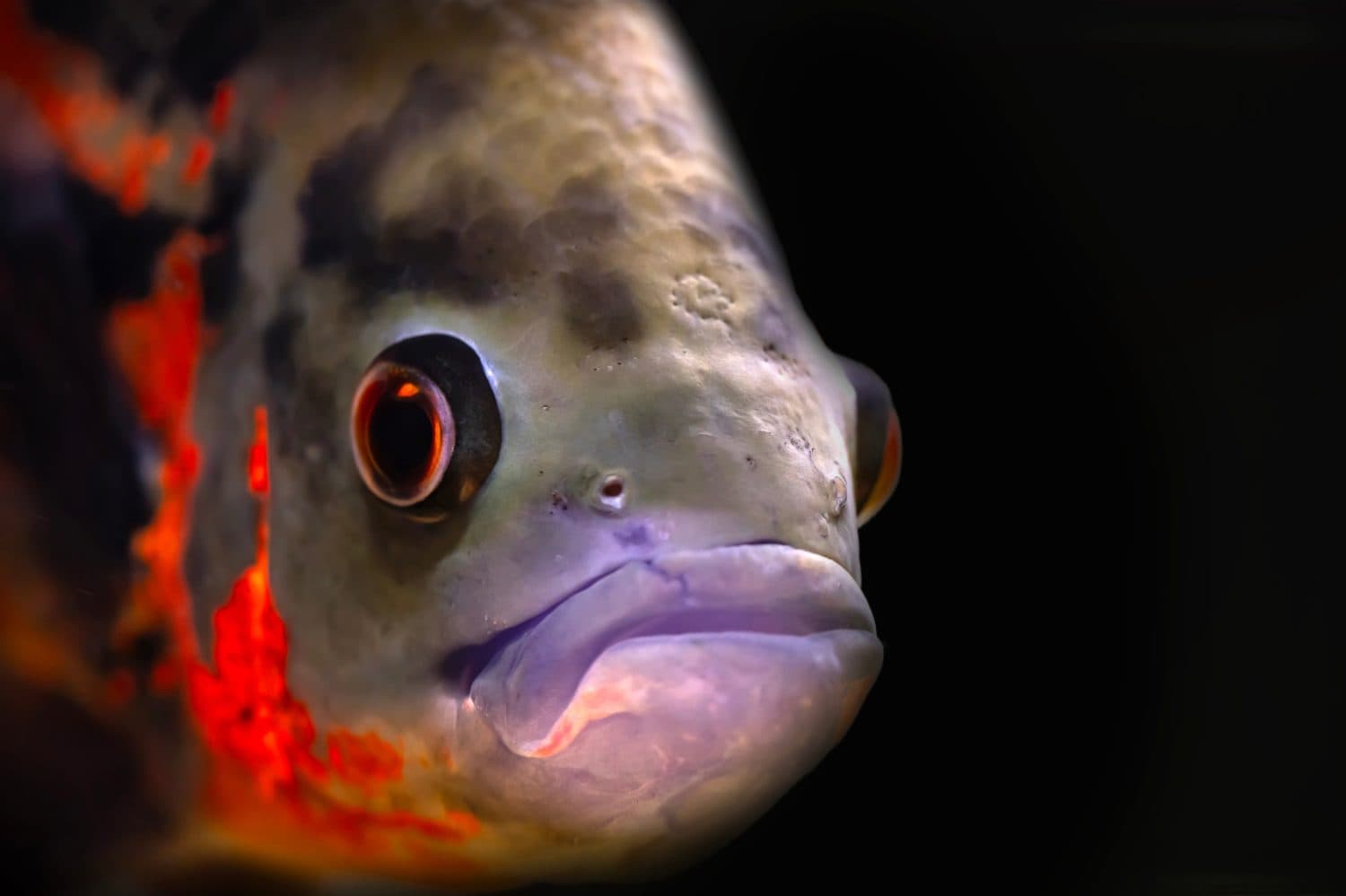
The Oscar fish is a large member of the cichlid family. Its body is a deep, somewhat compressed, elongated oval, about 15 inches long when the fish is fully grown. Though it has been bred to have many colors and patterns, a wild Oscar is dark green or brown with orange, red, or yellow splotches. The wild Oscar fish also has eyespots at the base of its tail. These eyespots serve to confuse would-be predators long enough for the fish to make its escape.
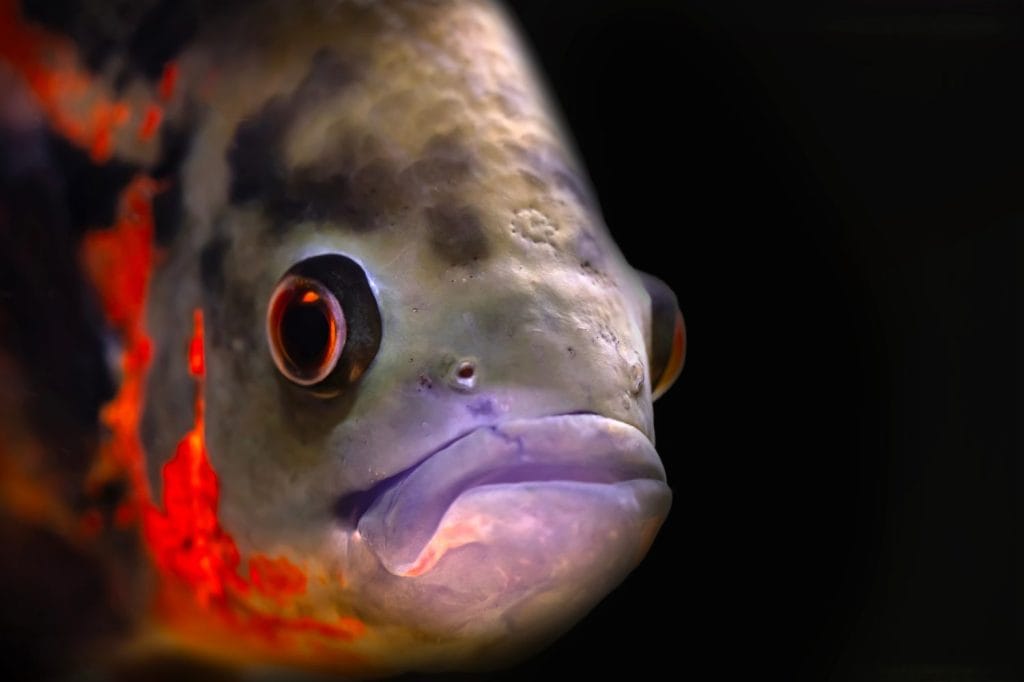
The Oscar’s eyes are bulbous, dark, and edged in red, and its mouth is large and thick-lipped. The fins are scaled and contain many spines and rays. Baby Oscars have different colors than their parents, which helps camouflage them. They have a rapid growth rate and soon take on the coloration of the adults.
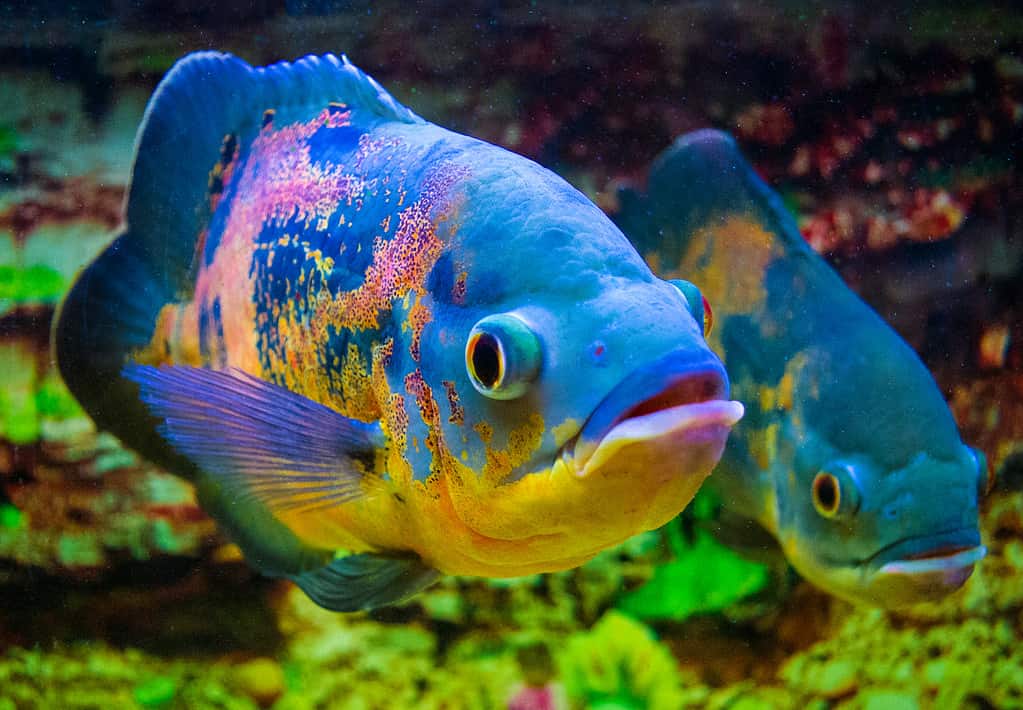
Despite being a bit moody, Oscar fish are affectionate, often referred to as “river dogs.”
©weter 777/Shutterstock.com
Distribution, Population, and Habitat
Though the origin of the Oscar is in the tropics of South America, it is now found in the wild in Australia, the United States, China, and India, and is sought as a pet in both the United Kingdom and America.
Oscars are widely distributed in the rivers and basins of Colombia, Brazil, Peru, and French Guiana, and there have been reports of them appearing in Argentina. It has been introduced in North America, Australia, Guam, Poland, Singapore, the Ivory Coast, and Germany.
The fish’s habitat is slow or still rivers with muddy or sandy bottoms, for the Oscar is a bottom feeder. It does best when the temperature is between 68 and 82.4 degrees Fahrenheit. It can’t survive temperatures below 55 degrees, so an owner should take care to monitor the water in the tank. The fish can tolerate a wide pH level of between 6 and 8.

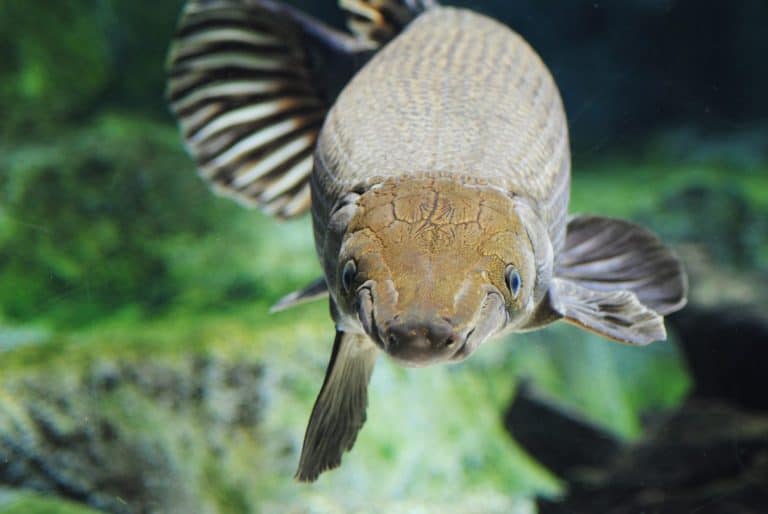
The Oscar fish is a bottom feeder.
©iStock.com/Andrei310
Predators and Prey
The Oscar is an omnivore and will eat insects and their larvae, smaller fish, freshwater shrimp, snails, clams, and detritus. Other food includes algae, nuts, and fruit that have fallen into the water. In turn, the Oscar is food for piranhas, reptiles, wading birds such as herons, and humans. It’s also the victim of parasites such as Ichthyophthirius multifiliis and trematodes. Oscars are vulnerable to Dactylogyrus gill fluke disease and a malady called hole-in-the-head disease. Scientists don’t know what causes this disease, but one cause may be a parasite called Hexamita.
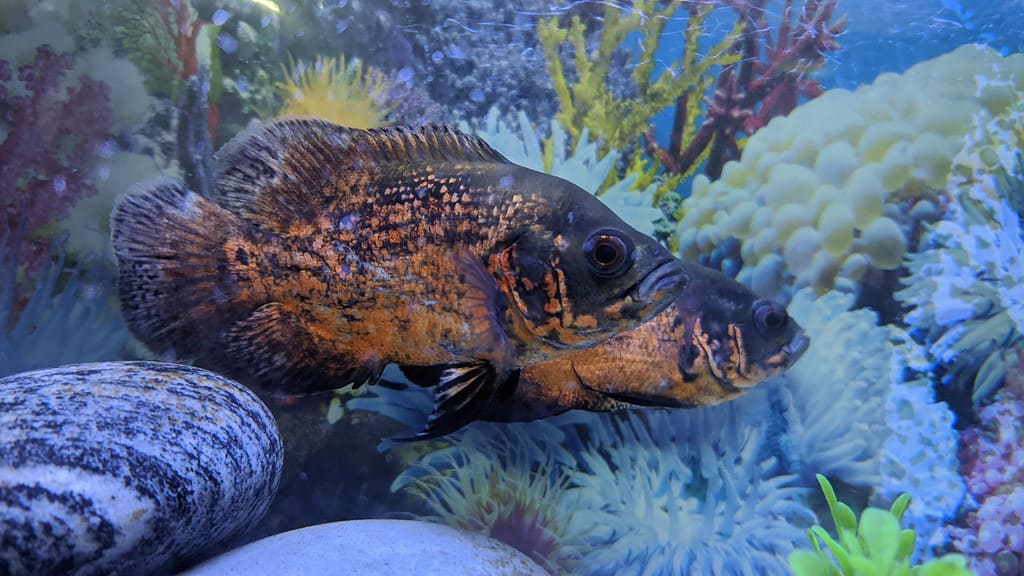
They love to eat and, like other Oscars, don’t play well with most other types of fish.
©Pixels Dot/Shutterstock.com
Reproduction and Lifespan
Oscars are somewhat unusual for fish in that they are monogamous, and a pair may breed with each other several times. They are ready to breed when they’re about 14 months old and can reproduce for as long as 10 years. The fish breed when the water temperature reaches 77 degrees Fahrenheit.
The pair first takes care to clean a nest site together, which can take some time. When they’re ready to spawn, they engage in a courtship ritual that involves spreading their fins and flaring their gills. Their colors also grow especially vivid. Then, the female lays eggs over the nest site, followed by the male, who deposits sperm.
Oscars reproduce three to four times a year, and each clutch contains between 300 and 3000 eggs. Larger females lay more eggs. Both parents care for the eggs and then the fry until they’re about a year old. The growth rate of a fry is very fast, and they gain about an inch every month. The lifespan of the Oscar fish can be as long as 20 years.
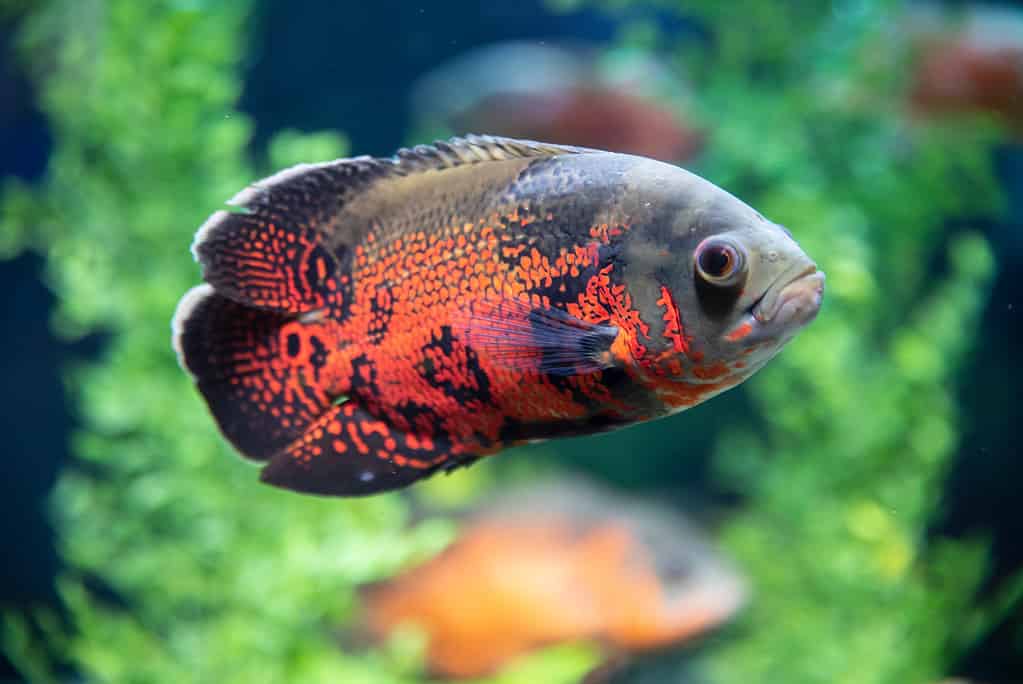
Oscars are somewhat unusual in that they are monogamous, and a pair may breed with each other several times.
©letspicsit/Shutterstock.com
Fishing and Cooking
The Oscar is a popular food fish in South America and is often seen in markets. The Florida Oscar is a popular game fish for anglers because it puts up a good fight and is easy to lure with different types of bait such as cut-up fish, worms, and crickets. There is no limit to how many Oscars can be caught per season. It is considered a good panfish, but some reports claim that the fish contains mercury, and consumption of them should be limited.
Oscar Fish Pictures
View all of our Oscar Fish pictures in the gallery.

iStock.com/Andrei310
Sources
- Wikipedia / Accessed October 30, 2021
- Kidadl / Accessed October 30, 2021
- Practical Fishkeeping / Accessed October 30, 2021
- Fishkeeping World / Accessed October 30, 2021
- Florida Museum / Accessed October 30, 2021
- CABI / Accessed October 30, 2021
- Fishbase / Accessed October 30, 2021
- Aqua Goodness / Accessed October 30, 2021
- T A G / Accessed October 30, 2021