D
Species Profile

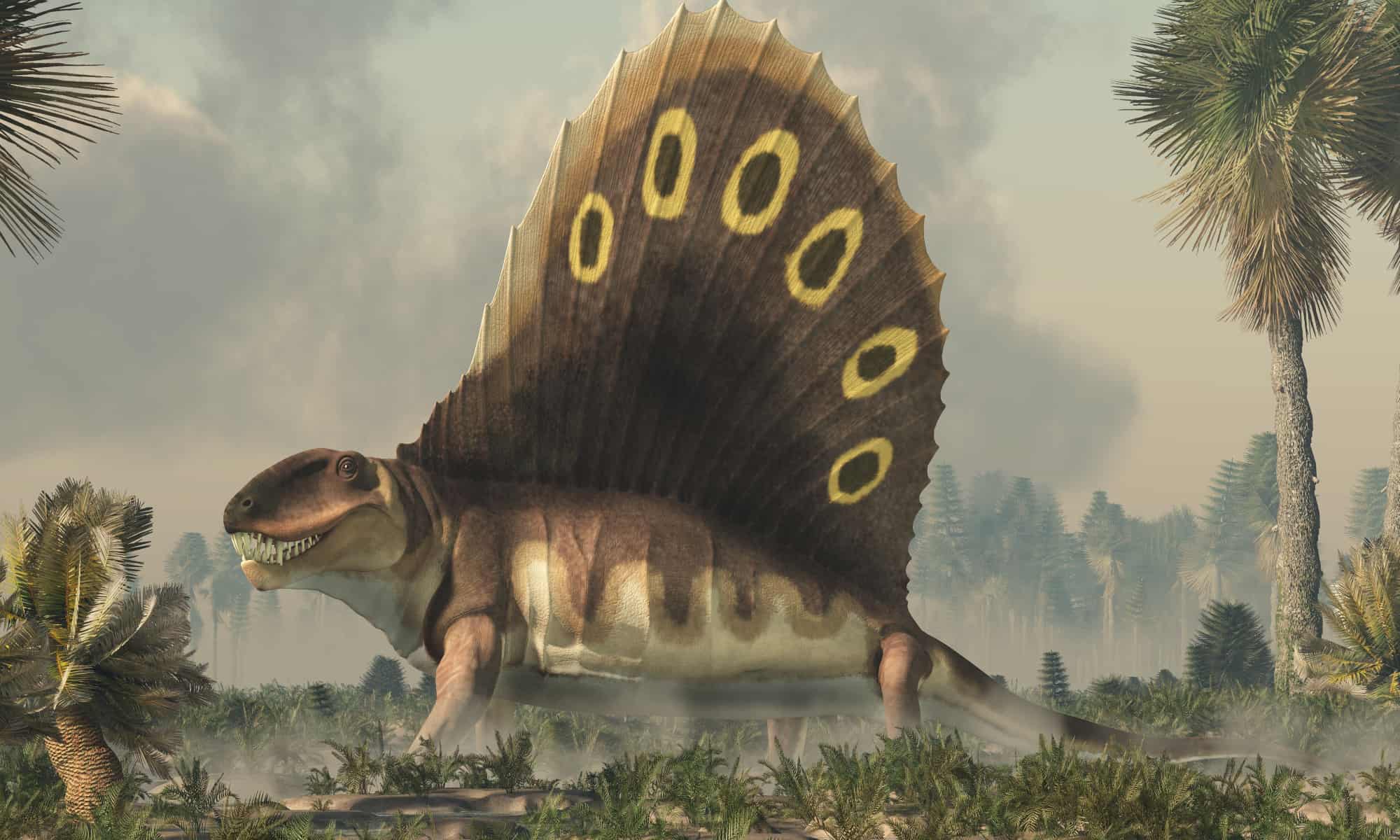
Dimetrodon

Dimetrodon

Permian sailback-before dinosaurs
Daniel Eskridge/Shutterstock.com

Dimetrodon Distribution

Click a location to explore more animals from that region

Loading map...

Size Comparison

Human 5'8"
Dimetrodon 3 ft 3 in

Dimetrodon stands at 58% of average human height.

dimetrodon

At a Glance

Genus Overview This page covers the Dimetrodon genus as a group. Stats below are general traits shared across the genus.
Also Known As sail-backed reptile, sail-backed synapsid, sailback, sail-backed dinosaur, sail lizard, pelycosaur
Diet Carnivore
Activity Diurnal+
Lifespan 15 years
Weight 250 lbs
Status Not Evaluated
Did You Know?

Dimetrodon is not a dinosaur; it's a synapsid (on the mammal line) from the Early Permian (~295-272 million years ago).

Scientific Classification

Genus Overview "Dimetrodon" is not a single species but represents an entire genus containing multiple species.

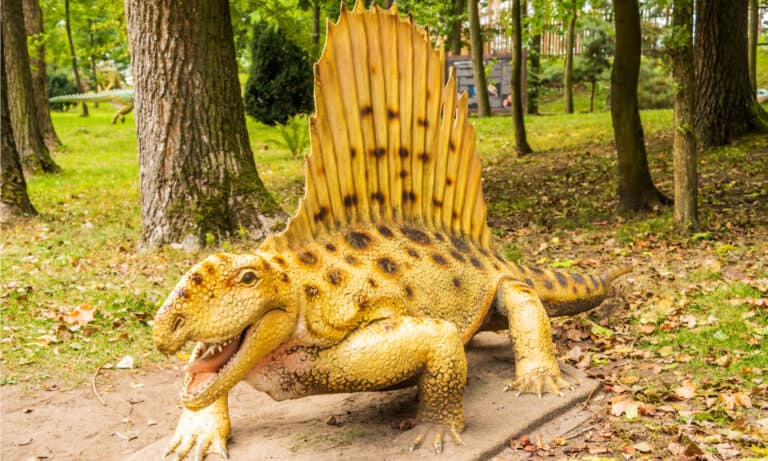
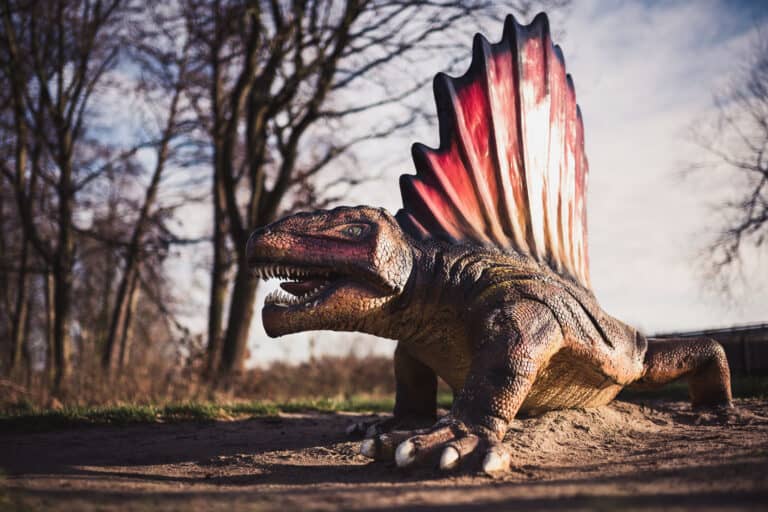
Dimetrodon is an extinct genus of sail-backed synapsids (stem relatives of mammals) that lived during the Early Permian. It was a prominent terrestrial predator and is often mistakenly called a dinosaur, though it predates dinosaurs by tens of millions of years.

Kingdom
Animalia
Phylum
Chordata
Class
Synapsida
Order
Sphenacodontia
Family
Sphenacodontidae
Genus
Dimetrodon

Distinguishing Features

  • Large dorsal ‘sail’ supported by elongated neural spines
  • Synapsid skull architecture (single temporal opening), not a reptile/dinosaur trait set
  • Robust, low-slung body with powerful jaws and differentiated teeth (notably large caniniform teeth)

Physical Measurements

Males and females differ in size

Height
♂ 2 ft 4 in (1 ft 2 in – 3 ft 11 in)
♀ 2 ft 7 in (1 ft 4 in – 3 ft 11 in)
Length
♂ 9 ft 10 in (5 ft 3 in – 15 ft 1 in)
♀ 9 ft 10 in (3 ft 11 in – 15 ft 1 in)
Weight
♂ 220 lbs (33 lbs – 551 lbs)
♀ 243 lbs (33 lbs – 551 lbs)
Tail Length
♂ 3 ft 3 in (1 ft 8 in – 5 ft 3 in)
♀ 3 ft 3 in (1 ft 4 in – 5 ft 11 in)
Top Speed
12 mph
Dimetrodon: short bursts 10–25 km/h

Appearance

Primary Colors
Secondary Colors
Skin Type Dimetrodon likely had reptile-like skin made of keratin (scaly or pebbled) based on relatives. No direct evidence of fur. The sail was long spines probably covered by skin and blood vessels; soft tissue not preserved.
Distinctive Features
  • Permian-age synapsid (mammal-line) sphenacodontian-explicitly NOT a dinosaur; Dimetrodon predates dinosaurs by tens of millions of years.
  • Large dorsal sail formed by elongated vertebral neural spines; sail size/shape varies among species (taller vs. comparatively shorter profiles).
  • Skull typically deep and powerfully built with prominent caniniform teeth and differentiated tooth sizes (heterodonty relative to many reptiles), consistent with a predatory role; robustness varies across species.
  • Body generally low-slung with strong limbs; proportion differences across the genus (some species more gracile, others more robust).
  • Adults of Dimetrodon ranged about 1.5 to 4.6 meters long; weight is unsure but likely from a few tens up to a few hundred kilograms, depending on species and body condition.
  • Lifespan (genus-wide): unknown from direct evidence; likely on the order of years to a few decades, plausibly ~10-20+ years depending on species, growth rate, and survivorship (high uncertainty).
  • Behavior/Ecology (generalized across the genus): primarily terrestrial predator in Early Permian ecosystems; likely ambush-capable, taking a range of prey including large amphibians and other tetrapods, with potential opportunism (scavenging/varied prey) depending on habitat and species.
  • Different Dimetrodon species likely focused on different prey and lived in Permian floodplains, river edges, and seasonally dry areas; some may have stayed near water more often, but this is debated.
  • Sail function hypotheses (avoid overstating certainty): thermoregulation (heat gain/loss), visual display (mate attraction/dominance), and species recognition are all proposed; multiple functions may have applied and could have differed among species and life stages.
  • Contemporaneous fauna context: coexisted with Early Permian amphibians (e.g., temnospondyls), other synapsids, and various reptiles; often near aquatic systems where large amphibians were abundant prey.

Did You Know?

Dimetrodon is not a dinosaur; it's a synapsid (on the mammal line) from the Early Permian (~295-272 million years ago).

Across the genus, adults ranged roughly from ~1.7 to ~4.6 m long, from smaller hunters to very large apex predators.

Its name ("two measures of teeth") refers to differently sized teeth-front canines plus smaller slicing teeth behind.

The famous back "sail" is made of elongated spinal spines; leading ideas include thermoregulation, display, and species recognition.

Most fossils come from the Permian "Red Beds" of what's now Texas and Oklahoma, but some species are known from Europe (e.g., Germany).

Dimetrodon likely preyed on other large Permian animals and shared habitats with sail-backed herbivores like Edaphosaurus.

Unique Adaptations

  • Tall neural spines forming a dorsal sail: a standout structure among early synapsids, potentially combining display, species recognition, and heat-management roles.
  • Mammal-line skull architecture: synapsid traits (including a single temporal opening) reflect jaw-muscle arrangements along the lineage that later produced mammals.
  • Heterodonty (tooth differentiation): enlarged canines plus smaller cutting teeth provided a versatile toolkit for seizing and processing vertebrate prey.
  • Powerful, deep skull in many species: built for strong bites and resisting struggling prey; skull robustness varies across the genus.
  • Large-body predatory build in some species: the biggest Dimetrodon species became among the dominant terrestrial carnivores of their time.

Interesting Behaviors

  • Predatory ecology across the genus: many species were top or near-top terrestrial predators in river-margin and floodplain ecosystems; smaller species likely hunted smaller vertebrates more often.
  • Feeding behavior implied by skull/teeth: robust jaws and differentiated teeth suggest gripping prey with large canines and slicing with posterior teeth; exact prey choice likely varied by species and body size.
  • Habitat use: commonly associated with seasonally dry floodplains, channels, and wetlands; individuals may have foraged along watercourses where prey concentrated.
  • Intraspecific signaling (hypothesized): the sail may have supported visual displays (e.g., intimidation, mate attraction); display intensity/shape likely varied among species.
  • Thermal strategy (hypothesized): if the sail aided heat exchange, daily activity patterns could have been influenced by basking and cooling opportunities; the degree of reliance may have differed among species and climates.

Cultural Significance

Dimetrodon is a key deep time animal in museums and classrooms. Teachers use it to explain the Permian, mass extinctions, and how synapsids differ from dinosaurs. Its sail-backed shape is a popular icon.

Myths & Legends

Scientific naming lore (1878): paleontologist Edward Drinker Cope named Dimetrodon, with the genus name meaning "two measures of teeth," reflecting its distinctive tooth sizes-an enduring story repeated in museum labels and popular books.

"Not a dinosaur" as a modern cultural tale: in 20th-21st century popular media and toys, Dimetrodon was repeatedly grouped with dinosaurs; this long-running misassociation became a staple anecdote in paleontology outreach.

Red Beds bone-hunter lore: early collecting in the Permian Red Beds of Texas and Oklahoma fueled stories of "sail-backed monsters" from ancient floodplains-an evocative historical narrative tied to classic American fossil expeditions.

Conservation Status

NE Not Evaluated

Has not yet been evaluated against the criteria.

Population Unknown

You might be looking for:

Dimetrodon grandis

32%

Dimetrodon grandis

One of the larger, well-known Dimetrodon species from the Early Permian of North America.

Dimetrodon limbatus

26%

Dimetrodon limbatus

Early described species; medium-sized sail-backed synapsid from the Permian of Texas/Oklahoma region.

Dimetrodon milleri

18%

Dimetrodon milleri

Smaller Dimetrodon species; often cited in discussions of size and diversity within the genus.

Edaphosaurus (common confusion)

12%

Edaphosaurus

Another sail-backed Permian synapsid; frequently confused with Dimetrodon but typically more herbivorous and differently built.

Life Cycle

Lifespan 15 years

Lifespan

In the Wild
8–25 years

Reproduction

Mating System Data Deficient
Social Structure Solitary
Breeding Pattern Seasonal
Fertilization Internal Fertilization
Birth Type Internal_fertilization

Dimetrodon likely had internal fertilization as an amniote synapsid. Individuals were mostly solitary, probably came together briefly to mate seasonally. Exact mating system (monogamy, polygyny, or promiscuity) and parental care are unknown.

Behavior & Ecology

Social No specific group term (typically solitary) Group: 1
Activity Diurnal, Crepuscular, Cathemeral
Diet Carnivore Small-to-medium tetrapods-especially amphibians and other prey concentrated around Early Permian water sources

Temperament

Predatory, generally solitary disposition; likely tolerant only at distance except during mating or resource bottlenecks.
Intraspecific interactions likely ranged from avoidance to overt aggression (threat displays, chasing, biting) depending on resource availability and breeding season.
Activity likely linked to thermoregulation: many individuals probably most active in daylight or twilight with flexibility (cathemeral) based on temperature, season, cloud cover, and habitat.
Exact lifespan for Dimetrodon is unknown; based on growth of early synapsids and similar large cold-blooded predators, a likely range is about 10–30+ years, varying by species, size, and environment.

Communication

Low-frequency grunts or growls Inferred
Hisses or forceful exhalations Inferred
Visual displays using posture and lateral presentation; the sail could have enhanced size/condition signaling and threat display, though its primary functions may have varied among species.
Jaw gaping, head/neck elevation, and body orientation as intimidation or spacing signals Inferred from reptile-like threat repertoires
Chemical communication (skin/cloacal gland cues) and scent marking/trackway-based cues are plausible but unconfirmed.
Tactile contact during courtship/mating; biting or shoving in aggressive encounters Inferred

Habitat

Biomes:
Wetland Freshwater Savanna Tropical Dry Forest Temperate Grassland Temperate Forest
Terrain:
Plains Riverine Valley Coastal Muddy
Elevation: Up to 4921 ft 3 in

Ecological Role

Dominant terrestrial predator (apex predator in some communities; large mesopredator in others) across Early Permian ecosystems

Top-down regulation of vertebrate prey populations (amphibians, early amniotes, smaller synapsids) Shaping community structure via predation pressure and selective removal of vulnerable individuals Energy transfer from aquatic and semi-aquatic food webs to terrestrial systems where aquatic prey were taken Nutrient redistribution through consumption of carcasses and prey remains (including incidental scavenging)

Diet Details

Main Prey:
Temnospondyls and other amphibians Fish Small-to-medium terrestrial reptiles and other early amniotes Synapsids Juvenile and vulnerable tetrapods at water margins

Human Interaction

Domestication Status

Wild

Dimetrodon is an extinct, sail-backed Early Permian synapsid never domesticated. Humans interact only through fossils, research, museums, and media. Adults ranged about 1.5–4.6 m and ~15–250+ kg; lifespan maybe 5–25 years. It was a land predator of floodplains and rivers. The sail likely helped heat control or display. Often called a dinosaur; some fossils are traded.

As a Pet

Not Suitable as Pet

Legality: Not applicable as a live pet (extinct). Ownership/sale concerns apply only to fossils: legality depends on provenance, land ownership, export/import rules, and jurisdiction; museum-quality or scientifically important specimens may be restricted or ethically discouraged from private trade.

Care Level: Expert Only

Purchase Cost:
Lifetime Cost:

Economic Value

Uses:
Paleontological research value Museum and educational value Commercial fossil/replica market Media and entertainment branding
Products:
  • Museum exhibits and interpretive programming
  • Research publications and comparative datasets
  • Fossil specimens (often fragmentary), subject to legal/ethical constraints
  • Casts, resin replicas, and 3D prints
  • Books, curricula, and documentary content
  • Licensing/merchandise tied to prehistoric wildlife imagery

Relationships

Predators 2

Dimetrodon
Dimetrodon Dimetrodon
Large temnospondyl amphibians Eryops megacephalus

Related Species 3

Sphenacodon Sphenacodon Shared Family
Ctenospondylus Ctenospondylus Shared Family
Secodontosaurus Secodontosaurus obtusidens Shared Family

Ecological Equivalents 5

Animals that fill a similar ecological role in their ecosystem

Sphenacodon Sphenacodon Very similar Early Permian sphenacodontid predator with a comparable body plan and likely overlapping prey spectrum. Often considered a close ecological analogue where their ranges did not overlap.
Ctenospondylus Ctenospondylus Another sail-backed sphenacodontid interpreted as a terrestrial predator, sharing a broadly similar hunting niche and functional morphology.
Edaphosaurus Edaphosaurus Frequently co-occurs in the same Early Permian ecosystems and is similarly sail-backed, but occupies a contrasting niche as a large-bodied herbivore — important as potential prey (especially juveniles) and as a community counterpart shaping food webs.
Gorgonopsians Gorgonopsia Later Permian apex terrestrial predators (synapsids) that occupied a broadly comparable top-carnivore role in ecosystems following Dimetrodon, serving as a functional analogue across time.
Temnospondyl amphibians Temnospondyli Large, semi-aquatic temnospondyl amphibians were major predators and scavengers in many Permian floodplain systems. They likely competed for some prey (amphibians and smaller tetrapods) and could threaten juveniles near water.

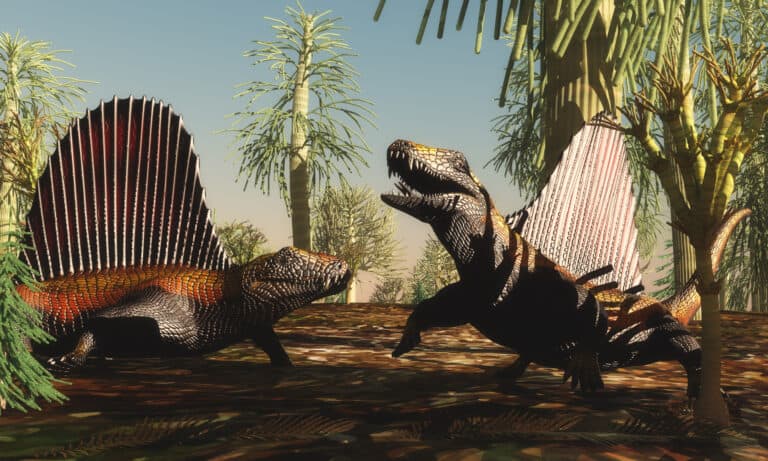
Dimetrodon is an extinct, mammal-like animal that lived during the Early Permian Period, around 295–272 million years ago. Several ancient animal fossils have been discovered in the southwestern part of the US. Although it is commonly mistaken for a dinosaur, the Dimetrodon is older than the earliest dinosaurs by about 40 million years. Dimetrodon was an apex predator known for the prominent spine sail on its back which was used for balance and thermal regulation. 

Description and Size
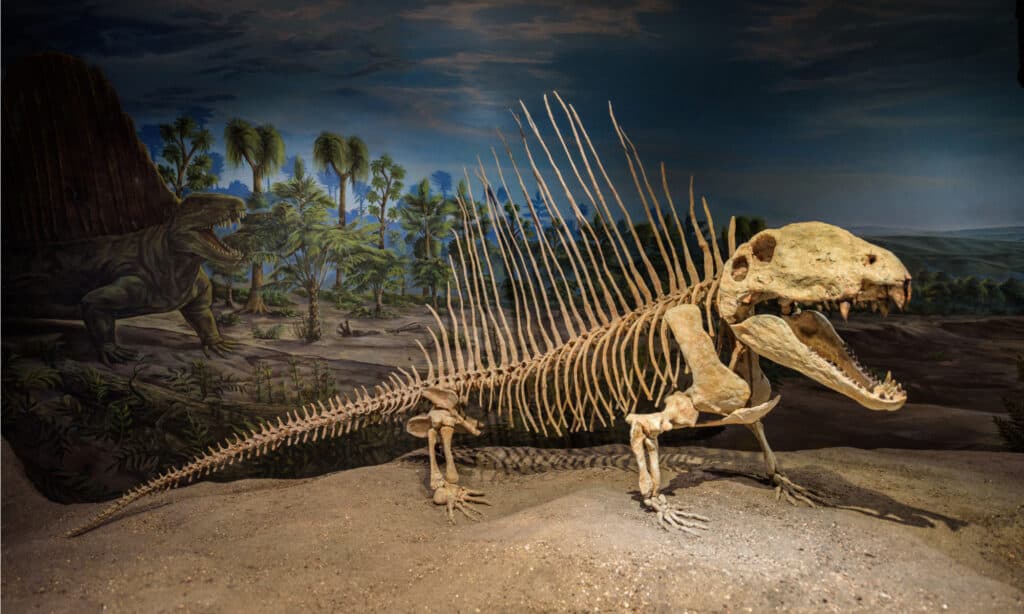
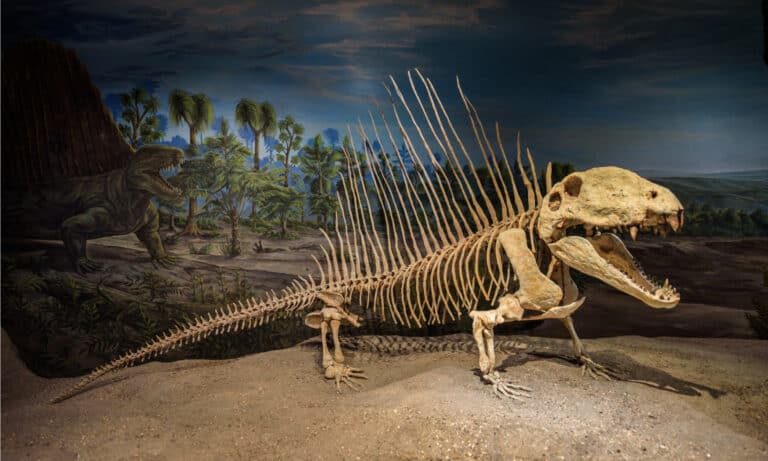
Dimetrodon skeleton

Beautifully preserved skeleton of a Dimetrodon at the Dinosaurs exhibits of the Royal Tyrrel Museum of Palaeontology in Alberta. The two types of teeth, shearing teeth, and sharp canine teeth can be seen clearly.

The name Dimetrodon means “two measures of teeth.” This name is for the famous American paleontologist Edward Drinker Cope. He first used the term “Dimetrodon” in 1878 in an article for the Proceedings of the American Philosophical Society. There are no less than fifteen species of Dimetrodon, one-third of which gor their name from Cope himself. Edward Cope gave Dimetrodon its name because it was the first terrestrial animal to have ziphodont teeth with serrated edges. As different species evolved, the teeth differed.

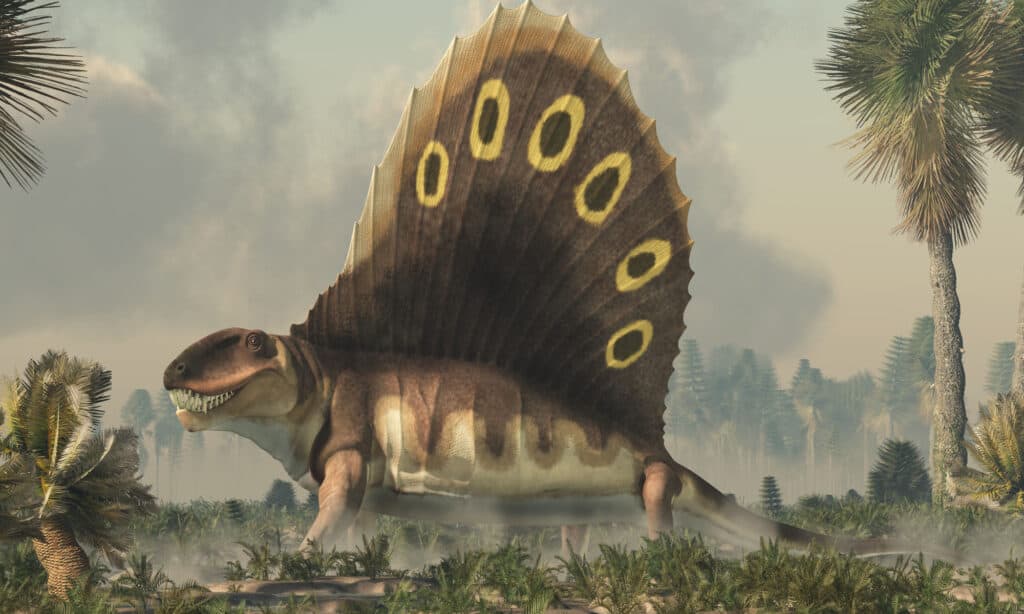
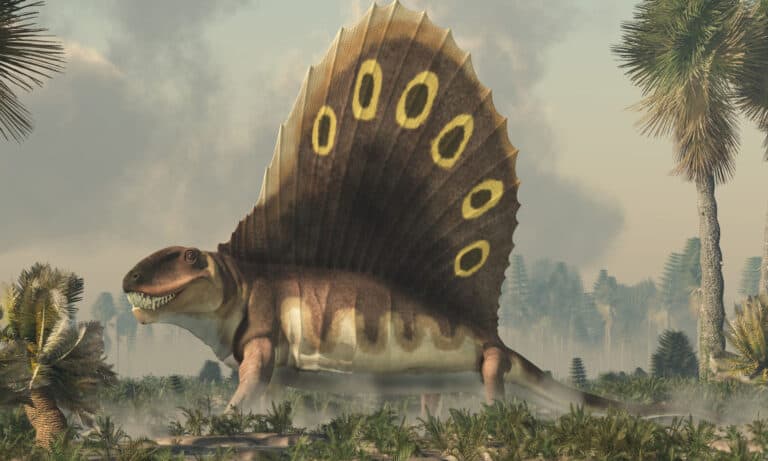
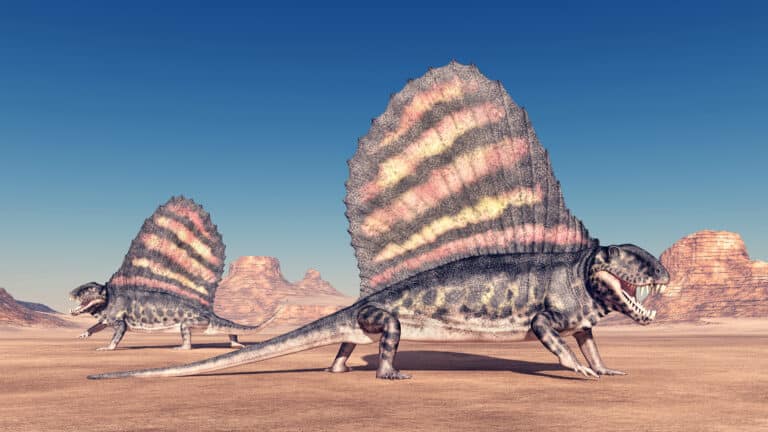
The most prominent feature of Dimetrodon was undoubtedly its large sail. The sail projects outwards from its vertebrae and forms by an extended neural spines entwined by a membrane of several blood vessels. Scientists believe that the iconic sail is mainly for temperature regulation. Other researchers doubt this is true, considering the Sphenacodon—a close relative of Dimetrodon that also existed during the Early Permian—had no sail. 

The skull features were among the most distinctive features that distinguished Dimetrodon from most of the earliest sauropods. Dimetrodon had a high and laterally-compressed skull. The beast had incisor-like front teeth, a large canine tooth with a row of smaller teeth behind the canine. The teeth and large skull openings behind the eye were instrumental in helping paleontologists understand and recognize the animal better. This opening is the temporal fenestrae. 

The average Dimetrodon size ranged between six and 11 feet, with an estimated weight of 60–400 pounds. However, the most prominent member of this genus (D. angelensis) was slightly larger than fifteen feet and weighed about 550 pounds. Dimetrodon was sexually dimorphic, which means the males were larger than the females. 

Diet—What Did Dimetrodon Eat?

Dimetrodon was carnivorous and largely preferred to feed on fish and other amphibians. Scientists deduced this diet from cross-examining and comparing teeth from three different Dimetrodon species. The discovered differences in size and dentition mean that it evolved over time to hunt larger prey. 

The Dimetrodon’s regular prey evolved into larger sizes over time as there were several large carnivores to contend with. To keep up, Dimetrodon also had to grow bigger to hunt larger prey within its ecosystem. The sharp canines in the front of its snout were perfect for digging into freshly-killed prey. Teeth at the back were mostly for shearing bones and grinding tough muscles. 

Habitat—Where and When Dimetrodon Lived

Dimetrodon lived during the Permian Period from about 286 million to 270 million years ago. Fossils finds in various locations across North America, including Texas, Oklahoma, Nova Scotia, and Canada. Finds are also in Germany and other European countries. These regions represent an area known as Euramerica during the Permian.

Scientists believe this animal was adaptable to a wide range of habitats, including dry arid lands, swampy areas, scrublands, muddy waters, and vegetative areas. However, most of the fossil finds were in lowland ecosystems that were probably wetlands during the Permian. Dimetrodon is cold-blooded like most modern-day reptiles and walks on four legs, moving mostly like contemporary crocodiles. However, it is classified as a synapsid, meaning it is more closely related to mammals than reptiles. 

Threats and Predators

Dimetrodon was an apex carnivorous predator, largely hunting amphibians and tetrapods, tearing them apart with its large teeth. For a long time, it was the most dominant carnivore predator in its native environment until bigger therapsids superseded it. Its ability to regulate its body temperatures gave it a hunting advantage in the morning while other creatures were still groggy. 

Dimetrodon repeatedly preyed more on organisms like Diadectes and Euryops. They also ate giant salamanders. Dimetrodon was at the top of the food chain and didn’t have to defend itself against predators. The sail on its back was more for display during the mating season rather than a defense mechanism. The sail is made of soft tissues rather than strong muscles. This has led scientists to conclude that Dimetrodon would not have stood a chance if it had lived in the time of actual dinosaurs. 

Discovery and Fossils

The first set of Dimetrodon fossils was discovered in the 1800s. Credit for the earliest discoveries is for Donald Mcleod, who lived in the British colony of Prince Edward Island in 1845. Mcleod recovered a maxilla which he sold to John William Johnson, a Canadian geologist. This particular find in 1854 is the mandible of Bathygnathus borealis—a carnivore related to Thecodontosaurus. In 2015, modern paleontologists reclassified it as Dimetrodon. This was also the first Dimetrodon jaw with ziphodont teeth discovered in Canada. 

Most of this animal’s fossils were discovered in a geological deposit known as the Red Beds in Texas and Oklahoma. Edward Drinker Cope was the first to publish an official description of this animal. Cope obtained the fossil he used for his description and those of many other Permian tetrapods from several collectors who had been exploring the famous red beds in Texas.

More recently, fossil discoveries were made at a site known as Bromacker locality in Germany in 2001. Fragmentary remains like this have been found all over Europe. However, Dimetrodon fossils are most prominent in US cities such as Utah, Oklahoma, Texas, Arizona, and Ohio. These areas were part of the Euramerica Supercontinent during the early Permian. 

The first specimen of the Dimetrodon with a tail was found in Texas in 1927. The fossil found revealed that the tail formed a large portion of this animal’s total body length. There is no fossil evidence yet that depicts its skin. However, fossil evidence from Ascendonanus shows that Dimetrodon might have had scales like modern reptiles.   

Extinction—When Did It Die Out?

They went extinct by the end of the Permian Period because of a phenomenon widely described as the Great Dying or the Permian extinction event. The Great Dying was a disastrous event caused by the warming of the earth’s climate. This triggered changes in the oceans and other ecological changes. The event wiped out over 90% of dinosaur species and 97% of all lives on earth, including land and ocean species.

Similar Animals to the Dimetrodon

Similar animals to the Dimetrodon include: 

  • Spinosaurus — Spinosaurus lived in the region now popularly referred to as North Africa during the Cenomanian to upper Turonian stages of the late Cretaceous period. This dinosaur had a sail on its back, just like Dimetrodon. It also had a thick body, and it was a carnivore.
  • Edaphosaurus — Edaphosaurus was an herbivore. Like the Dimetrodon, it also had a distinctive sail. This animal lived during the Permian, around the same time as Dimetrodon. 
  • Anteosaurus — This is a genus of mammal-like reptiles that lived in South Africa during the Permian period. It is one of the largest synapsids to have ever lived. 
View all 450 animals that start with D

Sources

  1. Earth Archives / Accessed November 11, 2022
  2. Biology Dictionary / Accessed November 11, 2022
  3. Wikipedia / Accessed November 11, 2022
  4. Animals Fandom / Accessed November 11, 2022
Abdulmumin Akinde

About the Author

Abdulmumin Akinde

Abdulmumin is a pharmacist and a top-rated content writer who can pretty much write on anything that can be researched on the internet. However, he particularly enjoys writing about animals, nature, and health. He loves animals, especially horses, and would love to have one someday.
Connect:

Thank you for reading! Have some feedback for us?


Dimetrodon FAQs (Frequently Asked Questions)

Dimetrodon lived during the Permian. This genus of dinosaurs went extinct towards the end of the Permian Period. It lived between 286 million and 270 million years ago.