

Quick Take
- Pademelons have a built-in alarm system for the entire forest, yet they don't make a single sound to trigger it. See their forest behavior →
- One pademelon species was once called 'friend of man,' and the story behind that name is stranger than it sounds. Explore the species names →
- Male and female pademelons look so different they could almost be mistaken for separate species. See the size differences →
- A pademelon joey is born in a state that barely qualifies as alive, and what happens next is both remarkable and counterintuitive. Follow the joey's journey →
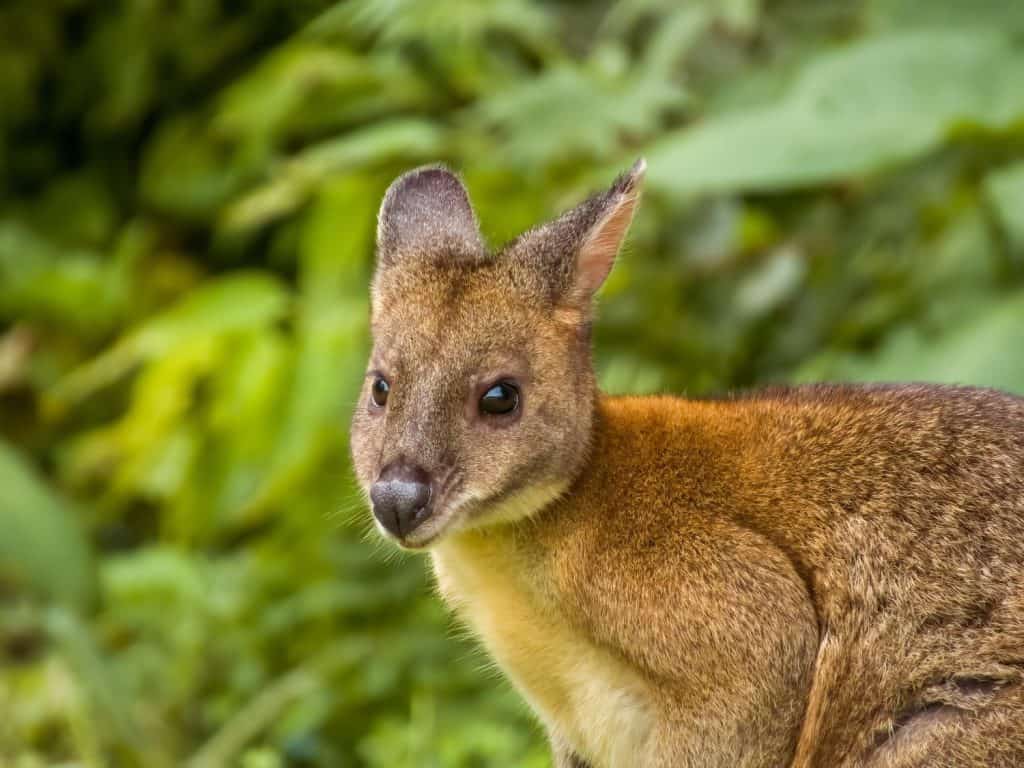
Found in Australia’s forest and island areas, the pademelon is a small- to mid-sized marsupial. It is a solitary, nocturnal animal. There are seven pademelon species, but population numbers are declining because many species are losing their habitats and being hunted. When awake, these marsupials forage for berries, herbs, grass, and leaves. If the animal detects a predator, it uses its hind legs to thump the ground, alerting other nearby forest animals of the danger.

Top Pademelon Facts
- Pademelons live in diverse environments, including thick bush, forests, and swampy areas.
- The animals are usually a blend of black, brown, gray, and red.
- Male pademelons are typically about twice as large as females.
- The species forms tunnels in the bushes and grasses of its habitats to reach food and escape predators.
Evolution And History
The pademelon belongs to the larger family Macropodidae, a marsupial family that is thought to have evolved from mammals of the class Theria. Marsupials are believed to have begun diverging from eutherian (placental) mammals approximately 143–180 million years ago. These marsupials most likely came from North America and eventually expanded into South America and Asia. During the migration process, as land masses began to break off and form what became Australia, they became isolated and evolved into the marsupials of today.
The fossil evidence of a Tasmanian pademelon was found in Australia, dating back to the early Pliocene epoch, which suggests that this species may have crossed from Tasmania to the mainland during times of low sea levels.
Classification and Scientific Name
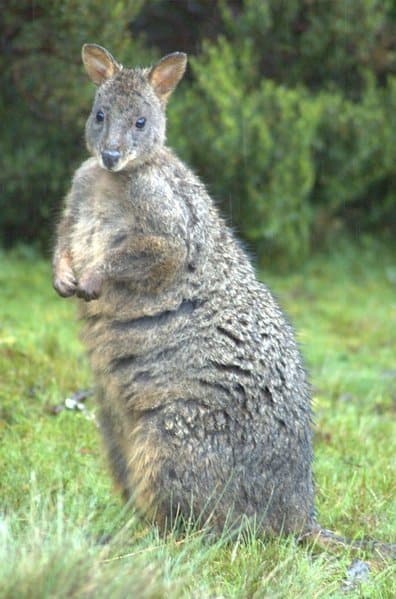
The pademelon, like all marsupials, has a common trait of large back feet.
©PanBK / Creative Commons – Original
The pademelon belongs to the genus Thylogale, and the animals are a part of the Macropodidae family. They are of the Mammalia class and are included in the Order Diprotodontia. The definition of “macropod” is big foot. This is a trait that’s common in marsupials like the pademelon. Often, macropods feature back legs that are much bigger than their front legs. Members of this family also often have large back feet and powerful tails that help them balance.
The name pademelon comes from the Dharuk Aboriginal word “badimaliyan.” The seven different types of pademelons are Tasmanian, Brown’s, Dusky, Calaby’s, mountain, red-legged and red-necked. The dusky pademelon has had many names. In the past, locals called it the Aru Islands wallaby. Before that, it was known as the philander, which means friend of man. In the second series of the book “Travels” by Cornelis de Bruijin, the characters called this mammal the philander.
Appearance And Behavior
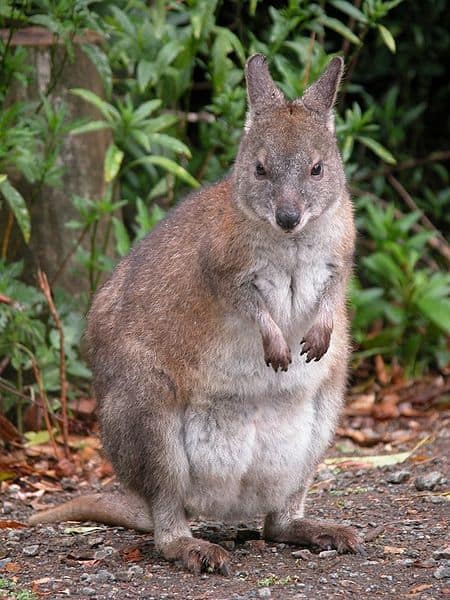
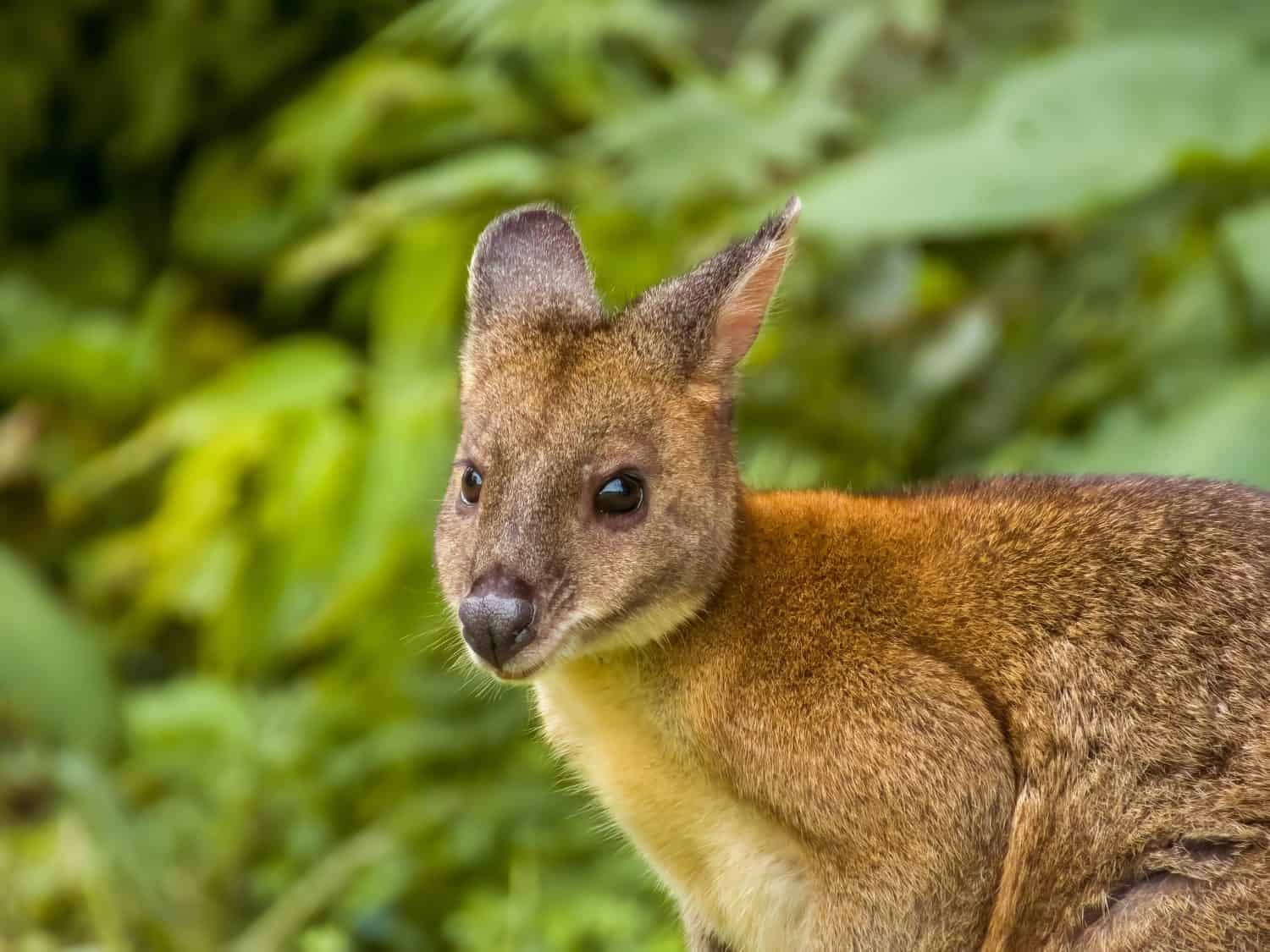
Pademelons are similar in shape to kangaroos and wallabies but much smaller.
©Gaz / Creative Commons – Original
Small and similar in body shape to their kangaroo and wallaby cousins, you can tell that you’ve come across a pademelon from its shorter height and thicker body. Pademelons get around by hopping on their hind legs. They hold their front legs tucked up against their bodies, and they have small paws and sharp claws.
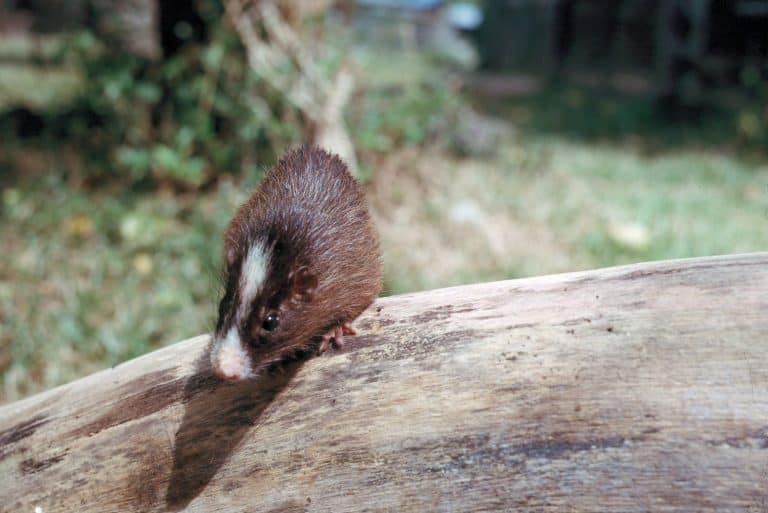
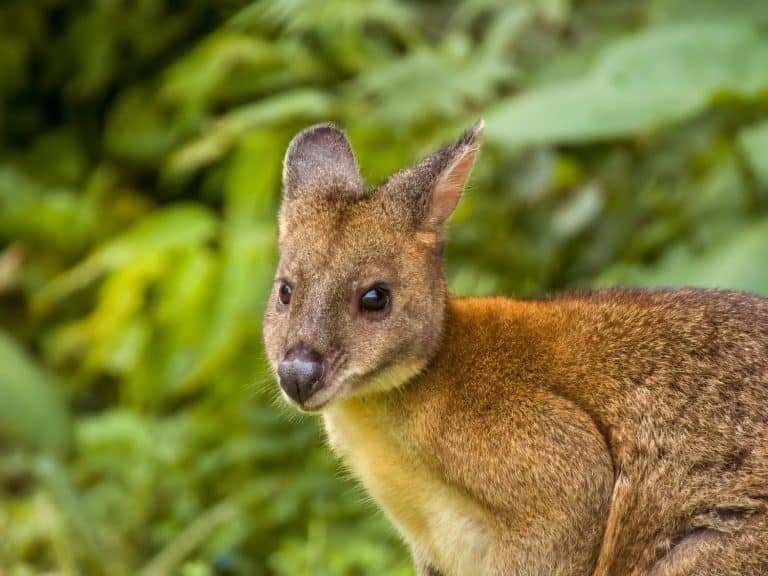
Pademelons have soft fur, and they generally feature a dark stripe along the cheek extending from the side of the mouth to just behind the eye. Over the dark stripe is a section of white fur. The animal has lighter-colored fur on its belly than it does on its back and legs. Pademelons have a noticeable stripe along the hip too. The animal has a short, stubby tail that’s covered with a small amount of sparse fur. Their feet are soft and coated with dark brown fur. The animal has round ears that give it a mouse-like appearance. Female pademelons have a belly skin fold that covers a furry pouch.
When it comes to behavior, pademelons prefer to be on their own. The only time that they meet up is to mate and sporadically graze together in grassy clearings. The animals travel long distances looking for food. They make their way through the forest from early in the morning until evening. To keep up their energy, the animals rest several times throughout the day. As pademelons travel to and from their grazing areas, they form tunnels and trails through the foliage.
Pademelons are harmless, curious animals that often permit people to walk up to them for a photo opportunity before hopping slowly away. A fully grown male pademelon weighs up to 15 lbs (7 kg) on average, though larger species such as the Tasmanian pademelon can reach up to 26.5 lbs (12 kg). Female pademelons usually weigh about 8.4 pounds. An adult’s length is from around 1 foot to about 2.5 feet. You can recognize a male pademelon by its larger body size, defined muscles, and broad forearms and chest.
Habitat
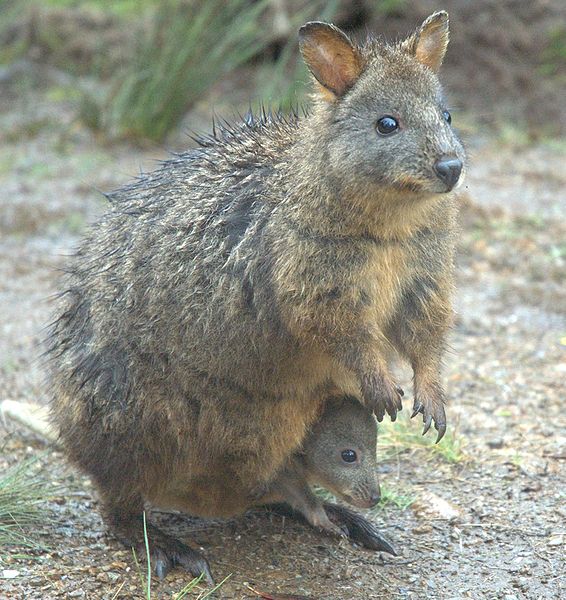
This small marsupial resides in the thick eucalyptus forests.
©PanBK at the English language Wikipedia / Creative Commons – Original
Pademelons make their homes in rainforest areas, particularly in thick eucalypt forests. The animals prefer to live near the forest’s edge. They make their homes in coastal areas of Australia, Tasmania, and Papua New Guinea. You’ll find red-legged pademelons along the coast from Cape York Peninsula in Queensland down to New South Wales. They also live in the southern part of New Guinea. If you’re in Tasmania and come across a pademelon, it will likely be a red-necked or Tasmanian pademelon. Years ago, this type of pademelon also lived in the southeastern region of Australia’s mainland. New Guinea is home to the dusky pademelon. This part of the world features a humid subtropical climate, one with cool winters, warm summers, and plentiful year-round rainfall.
Diet
Pademelons are herbivores, eating grass, leaves, herbs, berries, ferns, mosses, and shoots. The Tasmanian pademelon dines on nectar-bearing flowers when available, while the red-legged pademelon typically eats fallen leaves. This type of pademelon may also obtain sustenance from fruit like the Moreton Bay fig and the Burdekin plum. In some cases, the animals eat tree bark and young trees.
Predators And Threats
The pademelon’s main predators include dogs, foxes, wedge-tailed eagles, quolls, Tasmanian devils, and feral cats. Humans are also a threat to the species due to clearing land to make way for homes, farmland, and other developments. This same trend has resulted in kangaroos and wallabies seeking new habitats in areas where pademelons generally live, which also decreases the food supply for all of the species. Another risk to pademelons is rabbits. While not a predator, rabbits are a competing species that consumes the same grasses as pademelons and can reduce the availability of a primary food source.
Historically, Aboriginal peoples and early settlers also valued pademelon meat. In Tasmania and the state’s outer islands, residents kill off pademelons to keep their numbers low. Residents also hunt them for their meat and fur. According to the IUCN Red List, pademelons range from least concern to endangered, based on the specific species.
Reproduction, Babies And Lifespan
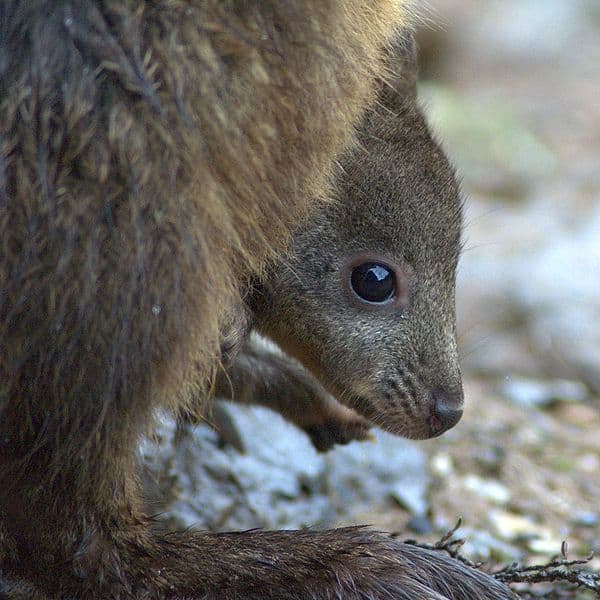
Pademelons have babies that are called joeys and will live in their mother’s pouch until 6 months old.
©PanBK / Creative Commons – Original
Pademelons breed year-round, and they are polygynandrous, meaning they have multiple partners. While the species technically breeds all year long, an estimated 70% of births occur at the start of winter. When a male selects a mate, he makes soft noises at her. The sound resembles the call a female makes to summon her young. For the species, fertilization happens internally, with the gestation period lasting for an estimated 30 days. Pademelons usually only have one baby, and when it is born, it is a small, blind, defenseless, furless embryo.
Like kangaroo young, a newborn pademelon is called a joey. Right after birth, the joey makes its way from the mother’s birth canal to her pouch. Once there, it attaches itself to one of her teats. Female pademelons have four teats. The joey will live and grow from this undeveloped state within its mother’s pouch until it reaches 6 months old. At this age, the joey will start to venture outside of the female pademelon’s pouch. Baby pademelons return to their mother’s pouch for food until the mother decides to wean it. Weaning usually occurs between 8 and 12 months of age.
Pademelon joeys benefit from being protected by their mothers until they are large and strong enough to fend for themselves. The animal becomes sexually mature at 14 to 15 months old.
Pademelons live for 4 to 8 years in the wild. In captivity, they live for around 10 years. According to disease surveys, pademelons can suffer from toxoplasmosis. When the animals are kept as pets, they may contract roundworms along with selenium and vitamin E deficiencies. They can also get salmonellosis, which is a bacterial infection. If you decide to keep one as a pet, be sure to take your animal friend to an exotic vet annually.
Population
The Department of Primary Industries, Parks, Water, and Environment is an organization that has been conducting yearly animal surveys in Tasmania for almost 45 years, and it counts the number of pademelons in the area. In 2018, the organization counted 134 pademelons in the Central region of the state and 345 on Flinders Island. The organization determined that there were 30 animals on King Island, 917 in North East Tasmania, and 582 in North West Tasmania. It also counted 398 pademelons in South East Tasmania and 32 in South West Tasmania.
Pademelon Pictures
View all of our Pademelon pictures in the gallery.

Sources
- David Burnie, Dorling Kindersley (2011) Animal, The Definitive Visual Guide To The World's Wildlife / Accessed December 21, 2009
- Tom Jackson, Lorenz Books (2007) The World Encyclopedia Of Animals / Accessed December 21, 2009
- David Burnie, Kingfisher (2011) The Kingfisher Animal Encyclopedia / Accessed December 21, 2009
- Richard Mackay, University of California Press (2009) The Atlas Of Endangered Species / Accessed December 21, 2009
- David Burnie, Dorling Kindersley (2008) Illustrated Encyclopedia Of Animals / Accessed December 21, 2009
- Dorling Kindersley (2006) Dorling Kindersley Encyclopedia Of Animals / Accessed December 21, 2009
- David W. Macdonald, Oxford University Press (2010) The Encyclopedia Of Mammals / Accessed December 21, 2009