C
Species Profile

Chilean Recluse Spider

Loxosceles laeta

Six eyes, one hiding place: corners.
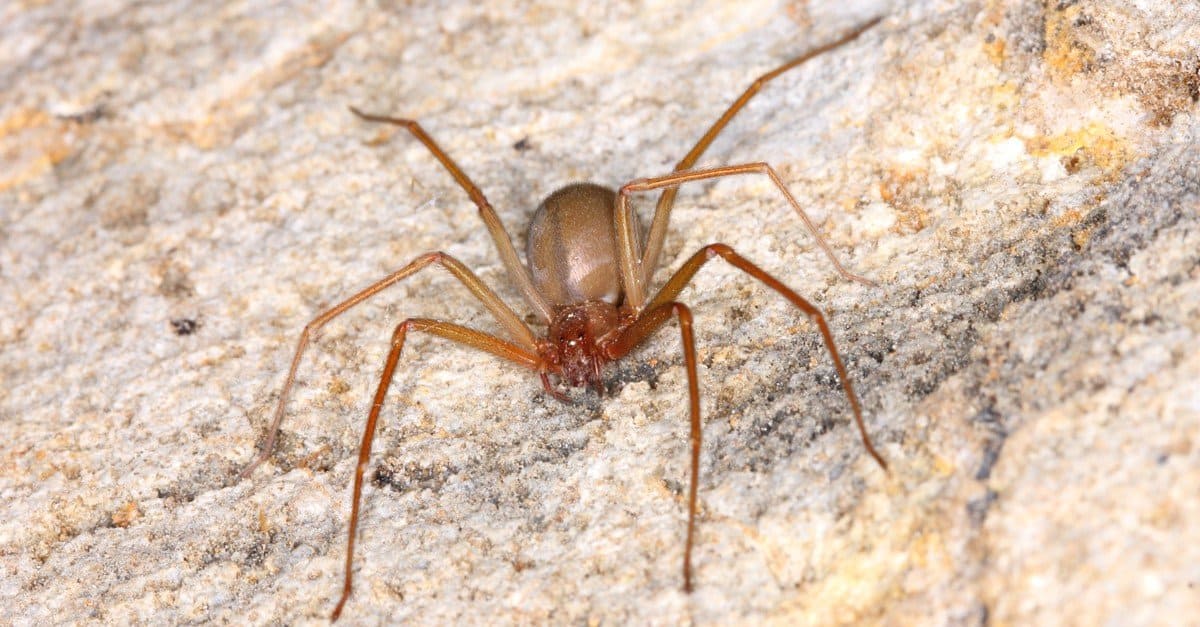
Pong Wira/Shutterstock.com

Chilean Recluse Spider Distribution

Click a location to explore more animals from that region

Invasive Species
Loading map...
Most Dangerous Spiders

At a Glance

Wild Species
Also Known As South American recluse, Peruvian recluse, recluse spider, violin spider, fiddleback spider
Activity Nocturnal+
Lifespan 2 years
Weight 8.0E-5 lbs
Status Not Evaluated
Did You Know?

Adults typically measure ~8-15 mm body length (females often larger); the apparent "size" is mostly long legs rather than a big body.

Scientific Classification

A medically significant recluse spider species in the genus Loxosceles, known for venom that can cause loxoscelism in humans. It is one of the most notorious Loxosceles species due to the potential severity of bites.

Kingdom
Animalia
Phylum
Arthropoda
Class
Arachnida
Order
Araneae
Family
Sicariidae
Genus
Loxosceles
Species
Loxosceles laeta

Distinguishing Features

  • Recluse-type body form with long legs and a generally plain brown coloration
  • Characteristic Loxosceles eye arrangement (six eyes in three pairs) rather than the typical eight-eyed pattern of many spiders
  • Tends to hide in secluded, undisturbed places; bites are typically defensive and occur when pressed against skin

Physical Measurements

Length
2 in (1 in – 2 in)
Weight
0 lbs (0 lbs – 0 lbs)
Venomous

Appearance

Primary Colors
Secondary Colors
Skin Type Arthropod chitinous exoskeleton with fine setae; generally smooth-looking, matte to slightly velvety on the abdomen; legs typically lack conspicuous banding and lack prominent spines compared with many other spiders.
Distinctive Features
  • Chilean Recluse Spider (Loxosceles laeta) adults are about 8–15 mm long, females often larger, with long thin legs that make their leg span much bigger than the body.
  • Eyes: 6 eyes arranged in three pairs (dyads) in a semicircular pattern-key trait for Loxosceles and critical for separating true recluses from many harmless 8-eyed house spiders.
  • Legs: long, thin, usually uniformly colored (no strong rings/bands), with relatively few obvious spines; overall 'delicate' build.
  • Cephalothorax marking: darker brown patch that may resemble a violin/fiddle, but can be faint/atypical; should not be used as a sole definitive identification criterion.
  • Nocturnal and reclusive: typically hides in dark, undisturbed locations (behind/under furniture, stored clothing, boxes, wall voids); often encountered indoors in synanthropic settings in its introduced range.
  • Chilean Recluse Spider (Loxosceles laeta) has medically significant venom (sphingomyelinase D-associated loxoscelism). Bites are defensive/accidental (e.g., trapped in clothes). Necrotic wounds alone do not show a Loxosceles bite; check location, exposure history, and other causes.

Sexual Dimorphism

Sexes are similar in overall tan-brown coloration and general patterning; dimorphism is mainly in size/shape and reproductive structures rather than dramatic color differences. Females tend to have a larger, more rounded abdomen; males are typically slimmer with proportionally longer legs.

  • Typically smaller-bodied and more slender overall; abdomen narrower/less rounded.
  • Proportionally longer legs relative to body size; palpal organs enlarged/modified (adult males) but often requires close inspection for confirmation.
  • Typically larger-bodied with a fuller, more rounded abdomen, especially when gravid.
  • Epigynal region (adult females) differs diagnostically, generally requiring close examination/magnification for reliable sexing beyond size/abdomen shape.

Did You Know?

Adults typically measure ~8-15 mm body length (females often larger); the apparent "size" is mostly long legs rather than a big body.

Like other Loxosceles, it has 6 eyes arranged in three pairs (dyads)-a key ID trait vs many common house spiders with 8 eyes.

The famous "violin" marking can be faint or variable; eye pattern + smooth-looking legs (few obvious spines) are more reliable clues.

Its medically important venom activity is largely linked to sphingomyelinase D, associated with dermonecrosis and, in some cases, systemic illness (loxoscelism) (e.g., Schenone et al., clinical literature on loxoscelism; toxin studies on Loxosceles SMase D).

It's strongly synanthropic in parts of its range: populations often persist inside homes, storage areas, and clutter where prey is available and humidity is buffered.

Bites are usually defensive/accidental-most commonly when the spider is trapped against skin in clothing, bedding, or when hands reach into stored items.

Unique Adaptations

  • Medically significant venom chemistry: venom includes sphingomyelinase D (SMase D) and other components that can damage cell membranes and trigger inflammatory and hemolytic pathways-central to loxoscelism pathophysiology in Loxosceles.
  • Six-eye arrangement (three dyads): a distinctive sensory layout within a family where many other spiders have eight eyes; useful for taxonomic identification.
  • Cryptic, low-contrast coloration suited to indoor microhabitats (wood, plaster, cardboard) where it hides in cracks and corners.
  • Silk retreat strategy: rather than relying on a large capture web, it uses silk to create a protected daytime refuge, reducing exposure to predators and desiccation.
  • Physiology suited to long intervals between meals (a trait documented broadly in recluse spiders): supports survival in low-prey indoor environments where feeding opportunities can be sporadic.

Interesting Behaviors

  • Reclusive, mostly nocturnal hunter: typically rests in a silk retreat by day and forages at night on walls, floors, and near baseboards.
  • Low-contact lifestyle: commonly found behind furniture, in closets, cardboard boxes, folded textiles, and wall voids-places that create accidental bite scenarios when disturbed.
  • Sparse, irregular "messy" webbing: the web is primarily a retreat/harborage rather than a prey-catching orb; prey capture relies heavily on ambush and short pursuits.
  • Defensive freezing/withdrawal: when disturbed it often remains still or flees to cover rather than displaying threat postures-contributing to under-detection in homes.
  • Seasonal indoor persistence: in synanthropic settings, individuals may be encountered year-round, with activity often noticed more during warm months when foraging increases.
  • Accidental-bite context: bites are most associated with putting on clothes/shoes, rolling onto a spider in bed, or handling stored items-consistent with its non-aggressive, "pressed-against-skin" bite mechanism.

Cultural Significance

Loxosceles laeta, the 'corner spider' in Chile and nearby areas, is a public-health concern because it lives near people and can cause loxoscelism. Advice: cut indoor clutter and check or shake clothing, shoes, and bedding.

Myths & Legends

'The corner spider lives in the old house': Chilean household lore often portrays it as a nearly inevitable inhabitant of older homes, thriving behind dressers and picture frames-an unseen tenant that 'belongs' to dark corners.

In city stories across the Americas, seeing a violin-shaped mark on a spider's back is treated as a sign of great danger. The 'violin' is used to scare children and new renters.

Night-bite tales: common bedtime stories and warnings describe it as a spider that 'comes out when you sleep,' reinforcing rituals like shaking sheets and checking shoes before morning.

Cardboard-box superstition: movers' and storage-room stories warn that stacked boxes 'attract the corner spider,' making unpacking a tense, half-ritualized process of tapping, shaking, and inspecting.

People note the name laeta (Latin for 'happy' or 'cheerful') is an odd contrast to the Chilean recluse spider's scary reputation, a point often repeated in local stories and media.

Conservation Status

NE Not Evaluated

Has not yet been evaluated against the criteria.

Population Unknown

Life Cycle

Birth 100 spiderlings
Lifespan 2 years

Lifespan

In the Wild
1–3 years
In Captivity
2–5 years

Reproduction

Mating System Polygynandry
Social Structure Solitary
Breeding Pattern Transient
Fertilization Internal Fertilization
Birth Type Internal_fertilization

Behavior & Ecology

Social Aggregation (loose colony in buildings) Group: 1
Activity Nocturnal, Crepuscular
Diet Insectivore Cockroaches (Blattodea; commonly taken in human dwellings)
Seasonal Hibernates

Temperament

Reclusive/shy; spends daylight hours hidden in retreats and crevices
Non-aggressive toward humans; bites typically occur when pressed against skin in clothing/bed linen or during handling
Defensive escape behavior dominates (freezing/retreating) over threat displays
Intraspecific aggression can occur; cannibalism possible, particularly among juveniles or when resources are scarce (reported broadly in Loxosceles; limited L. laeta-specific quantification)

Communication

chemical cues/pheromones: mate location likely mediated by silk-borne pheromones Well-supported in Loxosceles congeners; species-level confirmation strongest for other Loxosceles spp., with L. laeta presumed similar
substrate vibration: courtship and mating involve tactile/vibratory signaling via leg tapping and web/ground vibrations Common across recluse spiders; detailed ethograms more often published for congeners than for L. laeta specifically
silk and contact cues: individuals detect conspecific presence via silk lines and direct contact, influencing avoidance, mating, and potential agonistic interactions

Habitat

Biomes:
Mediterranean Desert Hot Temperate Grassland Temperate Forest Tropical Dry Forest
Terrain:
Coastal Valley Plains Hilly Mountainous Rocky
Elevation: Up to 9842 ft 6 in

Ecological Role

Synanthropic mesopredator (generalist arthropod predator) in urban/peri-urban ecosystems

Reduces populations of indoor pest arthropods (e.g., cockroaches, flies, small moths) Contributes to regulation of arthropod community structure in human-built environments Serves as prey for larger arthropod predators (e.g., centipedes, larger spiders) and some vertebrate insectivores, linking urban food webs

Human Interaction

Domestication Status

Wild

Loxosceles laeta is a wild, non-domesticated recluse spider that often lives near people in dark indoor spots like closets and behind furniture. Native to western South America (Chile), it has spread via trade. People find them in buildings, risk accidental bites from clothes or clutter, face public-health cases (loxoscelism), pest control, and venom research (sphingomyelinase D).

Danger Level

High
  • Medically significant envenomation (loxoscelism): bites can cause painful lesions that may progress to dermonecrosis; systemic loxoscelism (e.g., hemolysis, fever, malaise) is possible and has been associated with severe complications including acute kidney injury; fatalities have been reported in the medical literature.
  • Highest risk scenarios involve accidental compression against skin (putting on stored clothing/shoes, rolling onto spider in bedding) in cluttered/undisturbed indoor areas where the species can establish.
  • Clinical confusion/misattribution is common: many skin lesions are incorrectly labeled as recluse bites; confirmed bites require expert identification or strong epidemiologic linkage.

As a Pet

Not Suitable as Pet

Legality: Chilean Recluse Spider (Loxosceles laeta) is often not listed as a pet, but laws may limit keeping, moving, importing, or releasing venomous or nonnative spiders. Always check local and official rules.

Care Level: Expert Only

Purchase Cost: Up to $50
Lifetime Cost: $50 - $300

Economic Value

Uses:
Public health relevance (medical costs and surveillance) Biomedical/toxinology research Education (arachnology, bite-prevention outreach) Ecosystem service (general insect predation, mostly incidental in homes)
Products:
  • venom-derived research reagents (e.g., sphingomyelinase D studies; not a consumer product)
  • clinical/toxicology reference materials and diagnostics (case management support, where available)
  • educational materials for bite prevention and home exclusion

Relationships

Predators 7

Cellar spider Pholcus phalangioides
House centipede Scutigera coleoptrata
Jumping spider
Jumping spider Salticidae
Wolf spider
Wolf spider Lycosidae
Spider wasps
Spider wasps Pompilidae
Mud-dauber wasp Sceliphron spp.
House gecko Hemidactylus spp.

Related Species 5

Brown recluse spider Loxosceles reclusa Shared Genus
Mediterranean recluse spider Loxosceles rufescens Shared Genus
Desert recluse spider Loxosceles deserta Shared Genus
Brazilian recluse spider Loxosceles gaucho Shared Genus
Six-eyed sand spider Sicarius hahni Shared Family

Ecological Equivalents 5

Animals that fill a similar ecological role in their ecosystem

Brown recluse spider Loxosceles reclusa Similar human-associated spider: active at night, hides in clutter and cracks, ambushes prey, and will bite when pressed against skin (e.g., in clothing or bedding). Its venom contains sphingomyelinase D and can cause cutaneous loxoscelism; it is the closest North American analogue.
Mediterranean recluse spider Loxosceles rufescens Shares the same indoor-dwelling, crevice-hiding niche and hunting style (low-web, wandering/ambush predation at night). Often transported via commerce and establishes in buildings, paralleling the invasive/synanthropic tendencies attributed to Loxosceles laeta in many regions.
Six-eyed sand spider Sicarius spp. Close relative in the family Sicariidae (genus Sicarius) that lives in arid sandy habitats. A cryptic ambush predator with venom that can harm people—some species produce sphingomyelinase D—and can cause strong cytotoxic and blood‑destroying effects.
Black widow
Black widow Latrodectus spp. Shares association with human structures and medical significance, but occupies a different niche: black widows are web-dependent (tangle-web) predators whose neurotoxic venom (α-latrotoxin) causes latrodectism rather than the necrotic loxoscelism caused by recluses. They often co-occur around buildings and woodpiles where Loxosceles laeta may also shelter.
False widow spider
False widow spider Steatoda spp. Common indoor and around‑building spiders that can be mistaken for medically important species. They occupy similar sheltered microhabitats (corners, storage areas). Their bites are typically less severe than those of Loxosceles, but they strongly overlap in synanthropic niche and encounter scenarios.

Chilean Recluse Spiders (Loxosceles laeta) are highly venomous spiders of the family Loxosceles. This type of spider is native to South America and lives in a wide range across several South American countries.

The Chilean Recluse Spider is extremely dangerous and is one of the most venomous of all recluse spiders. Bites from this type of spider oftentimes result in serious injury or potentially even death. For this reason, these animals are widely feared where they occur.

Chilean Recluse Spiders go by many nicknames. Thankfully, for those who live in its native range, one of those is the “happy spider.” It has this nickname due to the fact that it only bites out of self-defense or when touched.

Some of the other names for the Chilean Recluse Spider include Fiddle Back Spider, Violin Spider, and Araña de Rincon, or ‘corner spider.’ The first two names come from the violin-shaped patterns on its thorax, which can help one identify this spider.

Species, Types, and Scientific Names

Chilean Recluse Spiders are members of the Sicariidae, which itself is part of the Arachnida class of animals. More specifically, they are members of the genus Loxosceles, which includes all of the other types of Recluse Spiders.

The scientific name of the Chilean Recluse Spider is Loxosceles laeta. Members of its family, Sicariidae, live all over the world. Many members of this spider family are highly venomous, some at deadly levels.

Appearance: How to Identify Chilean Recluse Spiders

Like many Recluse Spiders, Chilean Recluse Spiders don’t actually have the flashiest appearance. However, there are some common indications that can help you identify one.

One thing to look for is the source of their nickname, Violin Spider. They have this nickname because of the violin pattern on their thorax. This pattern appears as black line formations, with the neck of the violin pointed towards the spider’s rear end.

Another way to differentiate a Chilean Recluse Spider from other spiders it might be related to is through its size. Chilean Recluse Spiders are, on average, the largest of the recluse spiders, averaging between a hefty 8-40 mm.

Chilean Recluse Spiders are also identified by the strange shape of their webs. Like many types of recluse spiders, these spiders spin chaotic, disorderly webs with no discernible patterns.

Usually, you won’t want to get close enough to a recluse spider to observe this. However, many recluse spiders have a distinctive eye pattern that helps scientists identify them in the field.

This eye pattern features two closely put-together eyes in the center of the spider’s face. There also are two eyes set wider apart towards the sides of the spider’s head.
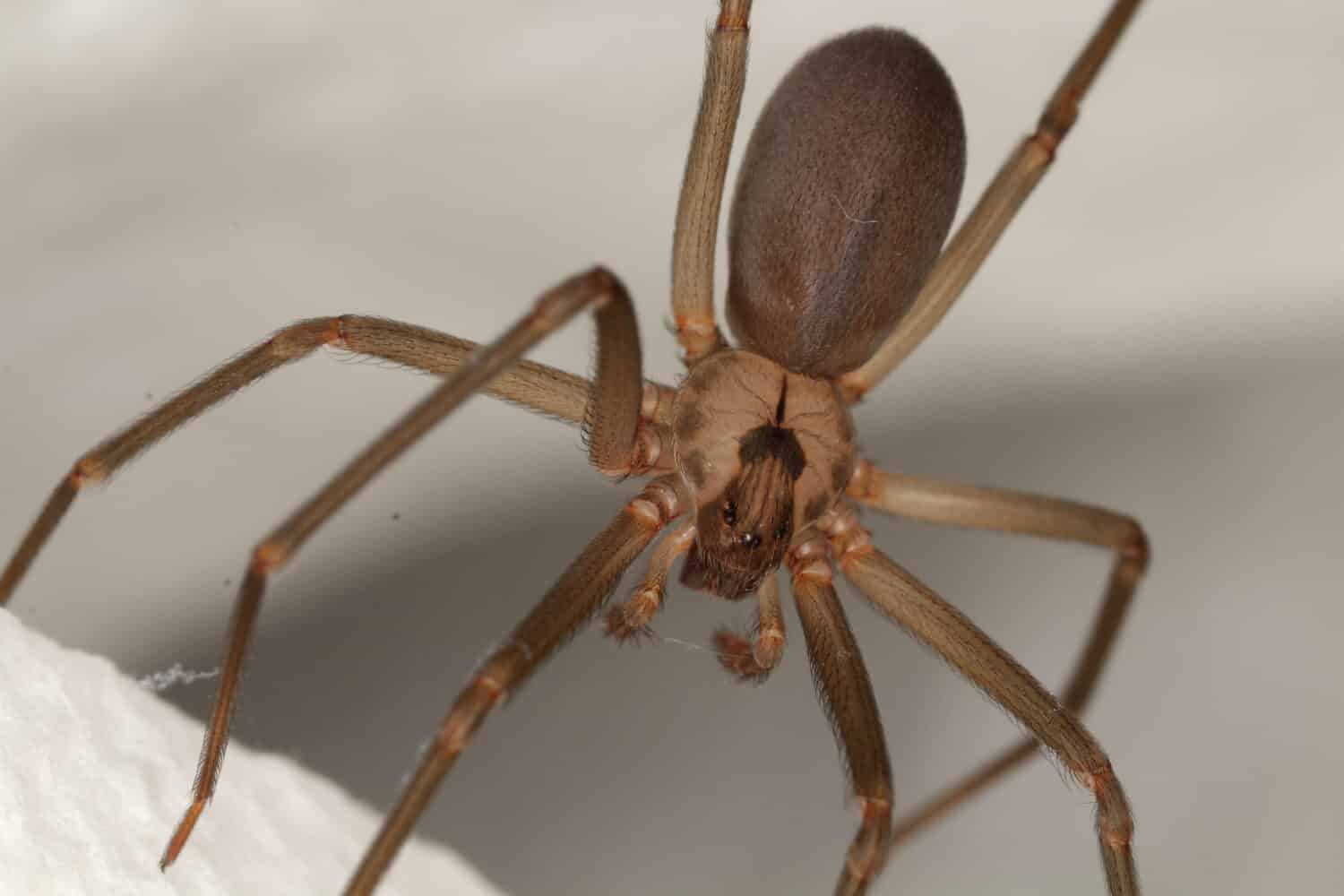
Brown recluse spider. Violin spider.

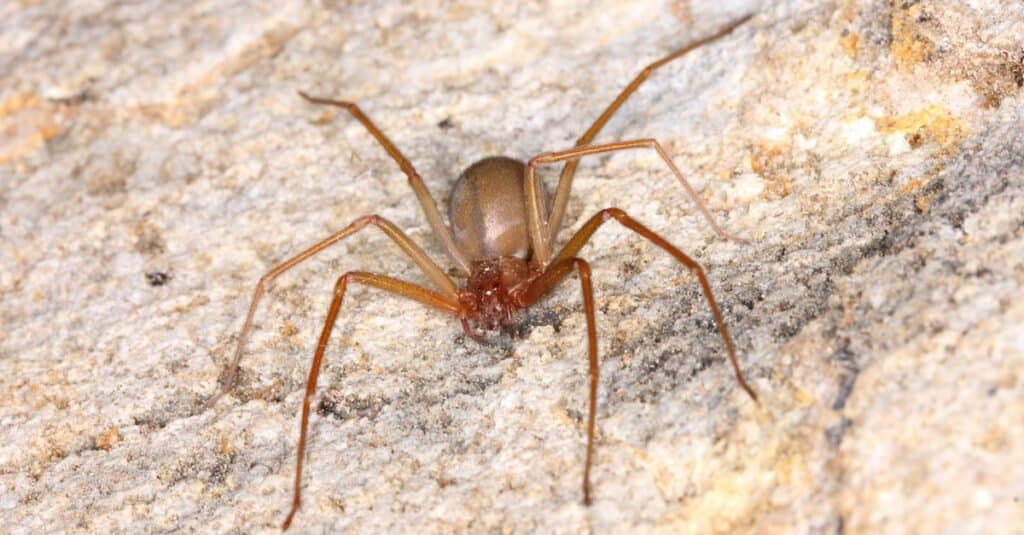
Chilean Recluse Spiders have a violin pattern on their thorax.

Habitat: Where to Find Chilean Recluse Spiders

Like many recluse spiders, Chilean Recluse Spiders like to dig themselves into the dark, cool corners of sheds, houses, and gardens. This is one of the reasons that these spiders are relatively dangerous. They like to occupy dark areas where people might be rifling for tools or gardening supplies and the like.

One of the spider’s nicknames, the Araña de Rincon, makes reference to this. This Spanish phrase roughly translates to “spider in the corner” in English.

Chilean Recluse Spiders are native to South America but have been introduced all over the world. They exist in places as diverse as Los Angeles, Australia, Massachusetts, and Helsinki.

Evolution and History

Spiders and other arachnids have been independently evolving as an order of animals for at least 380 million years. This means that the earliest spiders likely shared space with the dinosaurs and other prehistoric creatures. Scientists point to the emergence of ‘true spiders’ (spiders that spin webs and produce silk) about 375 million years ago.

Arachnids themselves likely independently evolved from an aquatic class of similar creatures. These ancient creatures are called the chelicerates. Nowadays, there are thousands of species of spiders that have been described by science, spread out over 4,000 genera and 114 families.

What Do Chilean Recluse Spiders Eat?

What Do Chilean Recluse Spiders Eat?

Chilean Recluse Spiders and the rest of the recluse spider family are active rather than passive hunters. This means that they will actively go out and pursue their prey to eat. They do this rather than lie in wait for something to land on their web.

These spiders prefer to hunt at night and stay dormant during the day. Like most spiders, their diet consists primarily of insects. However, they also eat other spiders and small fish as well.

There have been some observations of Chilean Recluse Spiders engaging in opportunistic scavenging. This type of behavior is also common with the other types of recluse spiders.
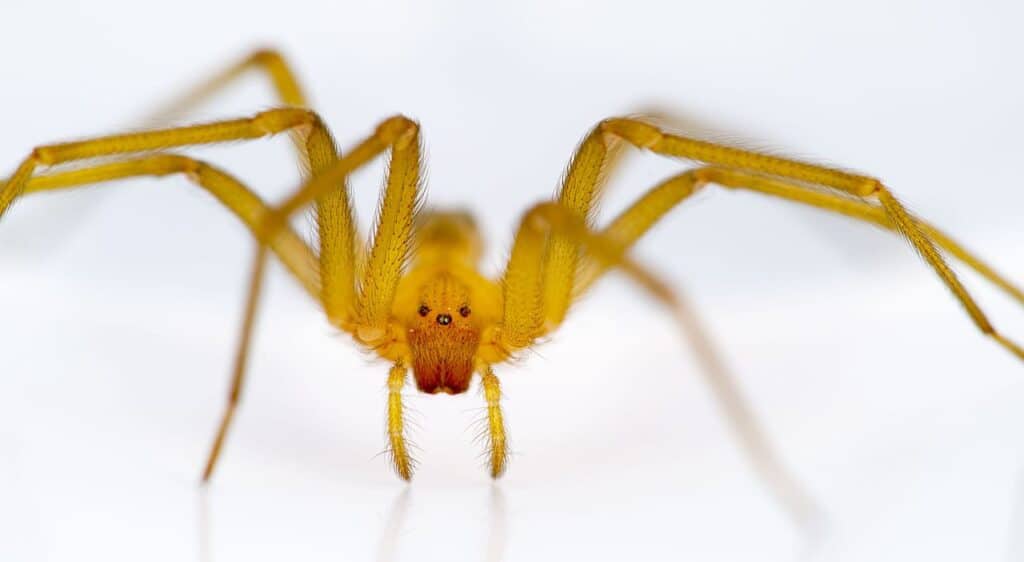
Chilean Recluse Spider

Chilean Recluse Spiders are active rather than passive predators.

What Eats Chilean Recluse Spiders?

Common predators of Chilean Recluse Spiders include fish, birds, and small mammals such as raccoons. These are the types of creatures that eat most kinds of spiders.

It’s possible that common household pets like cats and dogs will also eat these spiders. Such encounters can be dangerous for one’s pets.

How to Get Rid of Chilean Recluse Spiders

Because the spiders are highly venomous and highly dangerous, great care must be taken when trying to remove them. Anything less could result in serious injury.

In many cases, performing preemptive measures of spider control can help prevent them from establishing a colony. This includes things like sweeping, removing excess clutter and vegetation, and frequently dusting or vacuuming the corners of one’s household.

You can also take extra steps to deter spiders from entering your main household. One effective method comes through sealing off the creaks under and over your doorways and windows. There are a variety of household products that can help you do this.

If you’re dealing with multiple recluse spiders on the level of an infestation, you’ll likely want to call a professional exterminator to deal with this problem. That’s because an infestation on this level can be a highly dangerous situation.

Chilean Recluse Spider Venom

As mentioned before, Chilean Recluse Spiders are highly venomous and are perhaps the most venomous of all of the spiders in their family.

The venom of the Chilean Recluse Spider induces a unique set of symptoms and conditions upon a bite. This is true for the other species of recluse spiders as well. This set of conditions is named loxoscelism, so called for the scientific name of this family of spiders, loxosceles.

The effects of a bad recluse spider bite can be quite severe, and the impact of loxoscelism is nothing to laugh at. Some of the common symptoms include skin ulcers, skin necrosis, kidney failure, nausea, and even possibly death. The venom of recluse spiders attacks the red blood cells of a victim. The cells subsequently begin to dissolve and die as the venom courses through a victim’s bloodstream.

Chilean Recluse Spider venom is highly complex and contains a cocktail of different toxins. This makes the study of these spiders highly interesting for those in the medical field. It can help teach science more about how to treat these types of spider bites.

An anti-venom for spider bites is available. It is primarily found in South American countries where these spiders are the most common. However, a victim must seek treatment almost immediately to counteract the negative effects of a bite. Seeking treatment outside of the first 12 hours of a spider bite can be too late for the anti-venom to be effective.
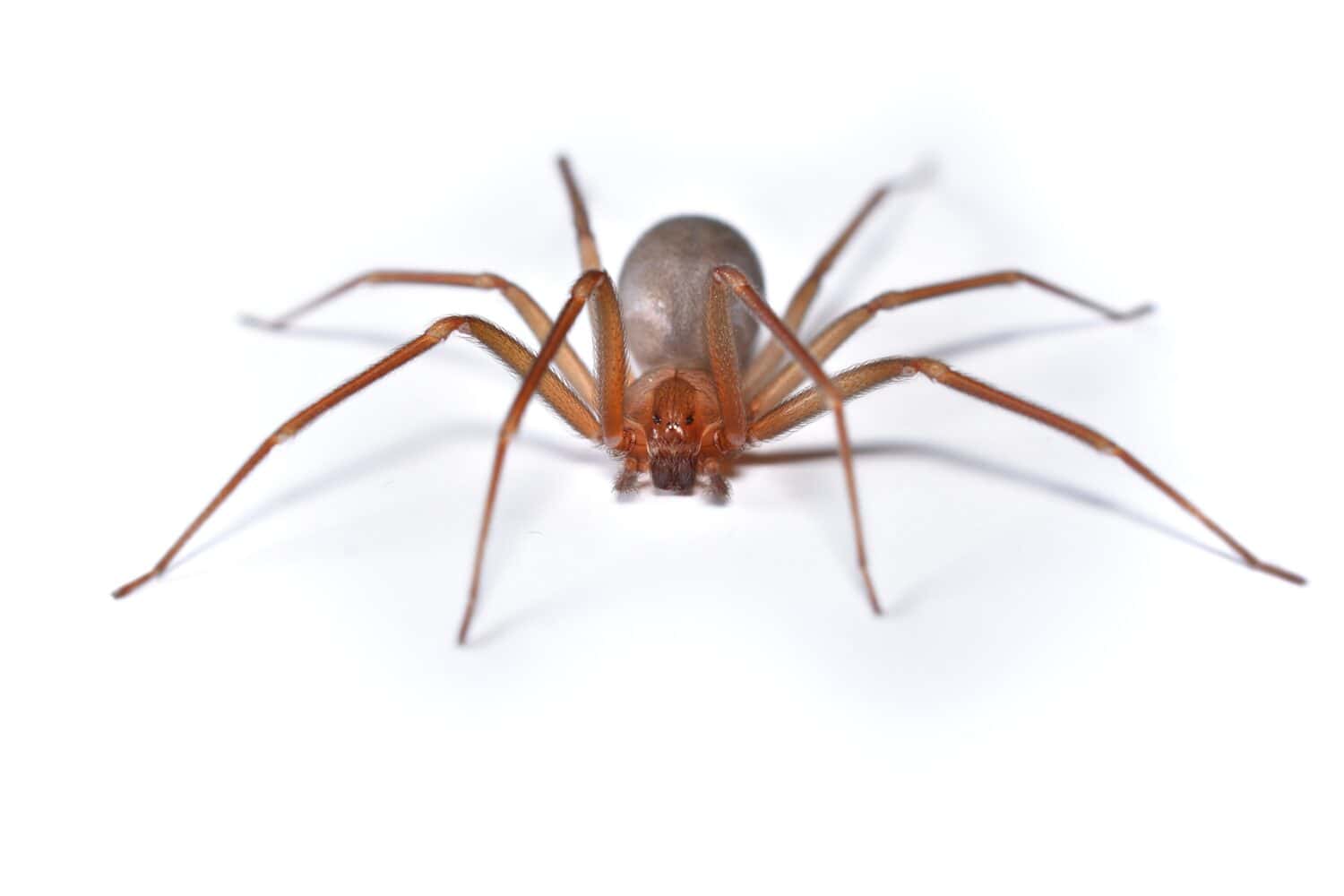
Closeup picture of a female of the Mediterranean recluse spider Loxosceles rufescens (Araneae: Sicariidae), a medically important spider with cytotoxic venom photographed on white background.

Chilean Recluse Spiders are highly venomous.

FAQS

· How Dangerous Is the Chilean Recluse Spider?

The Chilean Recluse spider is highly venomous but non-aggressive. The danger of this spider comes from accidental bites incurred when victims accidentally disturb the spider where it’s dwelling.

· Where Do Chilean Recluse Spiders Live?

Chilean Recluse spiders are native to South America but can be found worldwide. In the United States, they have been recorded in California, Georgia, Massachusetts, Florida, and Kansas.

· What Are the Chilean Recluse Spider’s Nicknames?

The Chilean Recluse spider has several nicknames. Some of the most common ones include the Violin Spider, Fiddleback Spider, and Araña de Rincon (corner spider).

Related Animals

1. Brown Recluse Spider

2. Desert Recluse
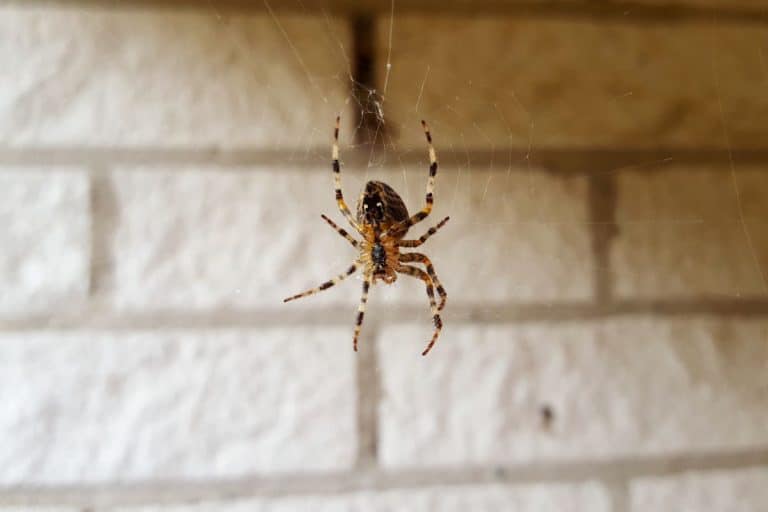
3. Six-eyed Sand Spider

View all 392 animals that start with C

Thank you for reading! Have some feedback for us?