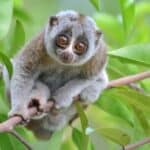
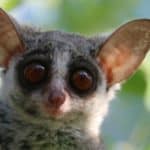
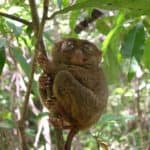
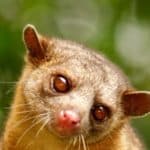
“Lemurs are found only on Madagascar.”
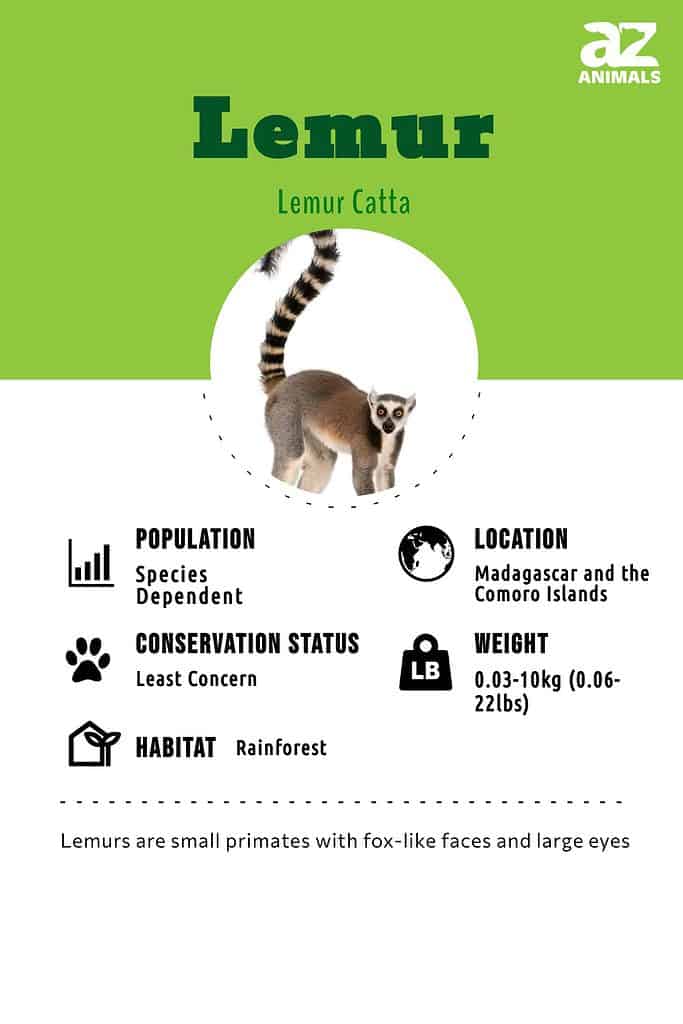
Lemurs are tiny species of primate that are only found on one group of islands: Madagascar and the Comoro Islands. This makes them one of most endangered groups of animals on earth. They have tiny bodies with long, thin tails. There are over 100 species of these mammals living on the islands.
Lemur Facts
- Their scientific name means ghost, or spirit of the dead, due to their white faces and large, round eyes.
- In the past, these creatures may have floated to Madagascar on “rafts” of vegetation.
- There are over 100 species of lemur on Madagascar and the surrounding islands, including the gray mouse and the ring-tailed lemur.
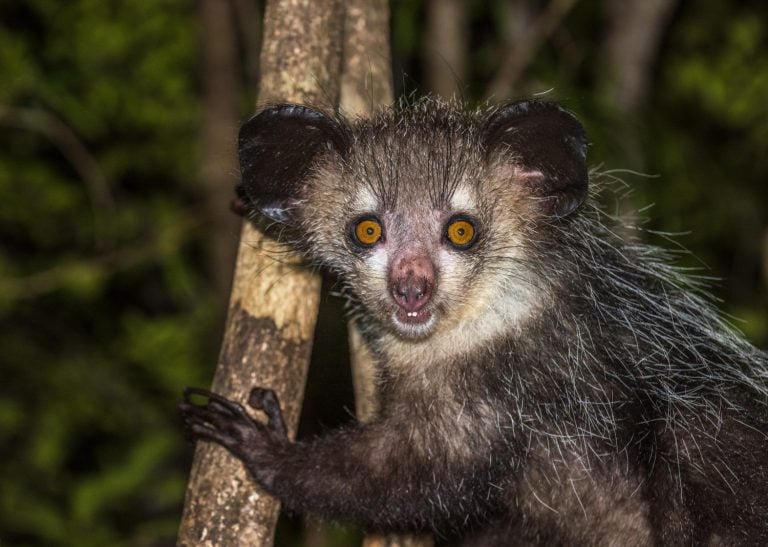
- The aye-aye is a unique species that uses its long middle finger to pry grubs and worms from the inside of trees.
- Lemurs are one of the few species of animal to live in a matriarchal society, with one female leading the troop.
Scientific Name
Their scientific name lemur is a Latin word meaning “ghosts, specter of the dead.” This is due to these creatures’ bright white faces, large eyes, and nocturnal habits.
Different species have different scientific names. For example, the ring-tailed lemur’s scientific name is Lemur catta, where catta means “cat”. Another species, the gray mouse (or lesser mouse) lemur, has the scientific name Microcebus murinus. This name means “gray, small, long-tailed monkey.”
Types
There are 101 lemur species. The most popular of them have been listed below.
—
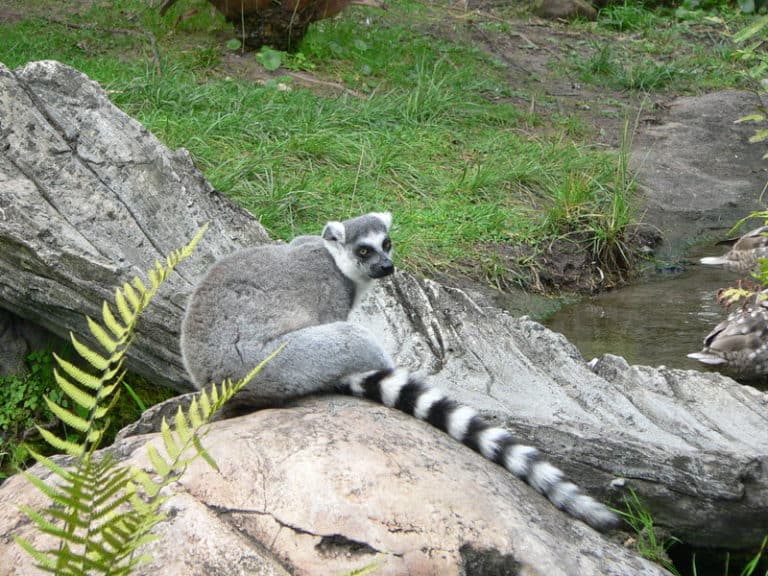
- Ring-tailed lemur (Lemur catta): Extremely social and vocal, this primate is perhaps the most widely recognized member of its species. Its most notable feature is its striking tail covered in alternating bands of black and white fur.
- Aye-aye (Daubentonia madagascariensis): Rather solitary, this lemur with dark fur, and large bat-like ears is known for its slender, bony fingers with which it pulls grubs out from tree trunks.
- Blue-eyed black lemur (Eulemur flavifrons): These lemurs with light blue eyes are often covered in black or ginger fur. They are especially fond of pollen, fruit and honey and are known for their belligerent nature and fondness for squabbling with each other.
- Coquerel’s sifaka (Propithecus coquereli): White fur, black faces and ears, and arms and chests covered in reddish fur, and golden or amber eyes, give this lemur a rather striking appearance. It is also arboreal and diurnal.
- Eastern lesser bamboo lemur (Hapalemur griseus): Somewhat portly and covered in silver reddish fur, this lemur lives among bamboo clusters.
- Fat-tailed dwarf lemur (Cheirogaleus medius): Its main claim to fame is its status as the only tropical mammal which hibernates. However it does not regulate its body temperature during the process. The lemur itself has a rodent-like face and light brown fur.
- Greater dwarf lemur (Cheirogaleus major): Found on the eastern coasts of Madagascar as well as its northern region, this arboreal lemur is known for its soft calls, preference for walking rather than leaping, and for carrying its young in its mouth.
The following species are also popular:
- Golden-crowned sifaka (Propithecus tattersalli)
- Golden bamboo lemur (Hapalemur aureus)
- Golden-brown mouse lemur (Microcebus ravelobensis)
- Greater bamboo lemur (Microcebus ravelobensis)
- Madame Berthe’s mouse lemur (Microcebus berthae)
- Red-fronted lemur (Eulemur rufifrons)
- Red lemur (Varecia rubra)
- Silky sifaka (Propithecus candidus)
- Verreaux’s sifaka (Propithecus verreauxi)
Evolution
Although Madagascar is believed to have separated from East Africa 160 million years ago, the ancestors of the lemurs would come along much later — approximately 100 million years later, to be precise.
Scientists believe that the fact that both Madagascar and Mozambique were located 1,650km further to the south than at present, enabled these primates to reach the island. Their more southward position meant lemurs’ ancestors were able to deal with a more powerful set of ocean currents flowing towards Madagascar, rather than the forceful marine movements which push outwards from the island today.
Approximately 10 million years after their arrival, lemurs separated from lorises.
About 20 million years ago, the currents changed as the continental plates moved northward, preventing the possibility of any new arrivals enabling the lemurs to develop in relative isolation.
Appearance
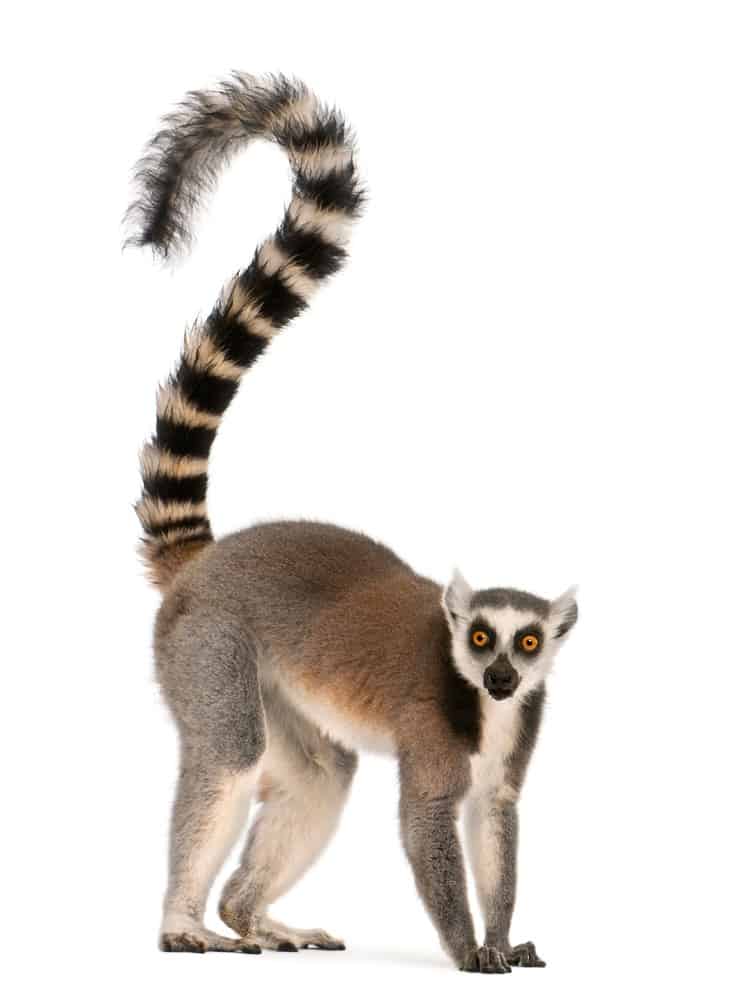
Lemurs do not have prehensile tails
©Eric Isselee/Shutterstock.com
A small species of primate, lemurs are animals that can grow to be about 3 inches to 28 inches long (excluding their tails) and weigh anywhere from less than a pound to 22 pounds. Their tails can be much longer than their bodies, and on average, they weigh about as much as a cat.
Lemurs are fox-like animals with narrow faces. They have pointed ears and a small, moist nose. Their fingers are adapted for gripping trees and fruit, and their sharp claws help them climb trees. Some have longer hind legs, built for jumping from branch to branch. Unlike other monkey species, lemurs do not have prehensile tails.
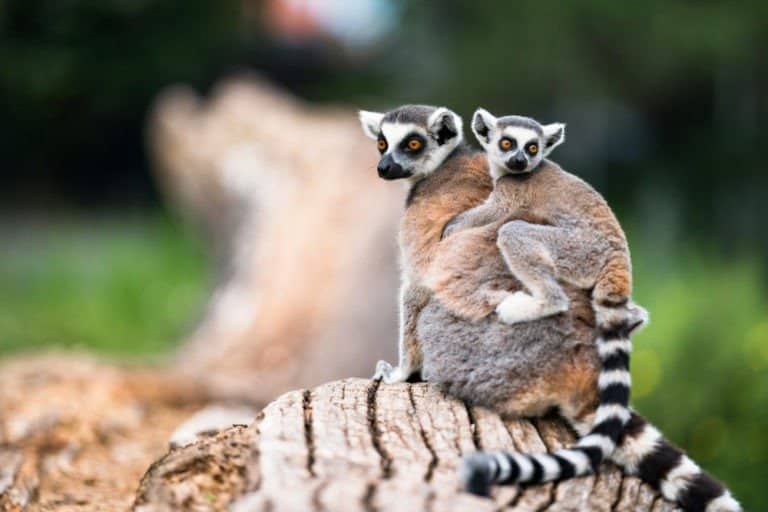
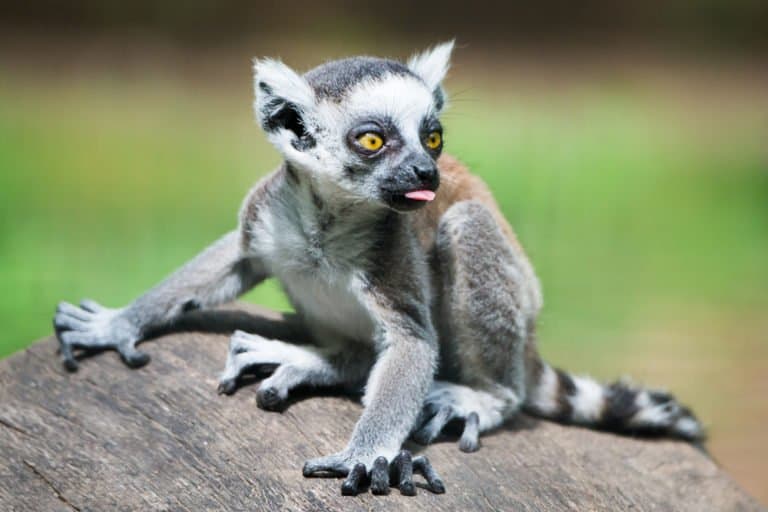
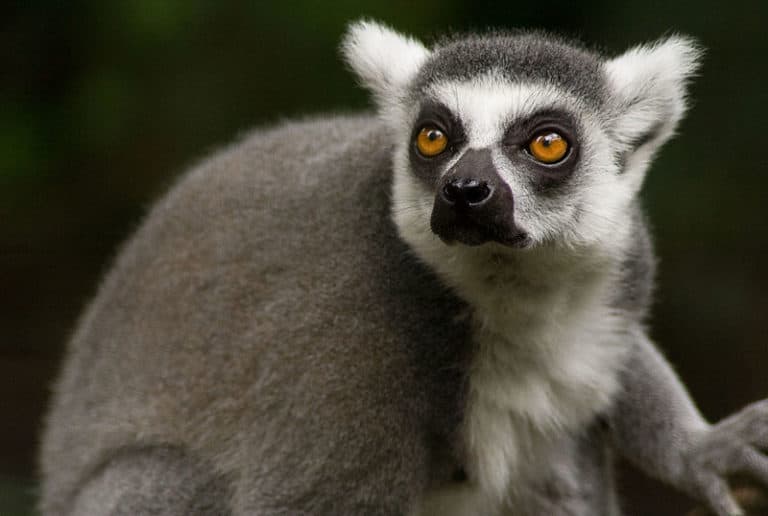
They vary greatly in appearance; their fur can be gray, brown, or black. They can be solid colored, or have features like ringed tails or white patterns. By far the most recognizable species is the ring-tailed lemur. Named for its ringed black and white tail, these lemurs have black skin, wide brown eyes, and gray coats. The lesser mouse lemur, or gray mouse lemur, has reddish-grey fur and, as the name suggests, looks a bit like a mouse. The lesser mouse lemur is one of the smallest lemur species.
One very unique species of lemur, called the aye-aye, is a small brown creature known for its orb-like eyes and long, prehensile middle finger. It uses this finger to dig grubs out of holes in trees and branches.
Behavior
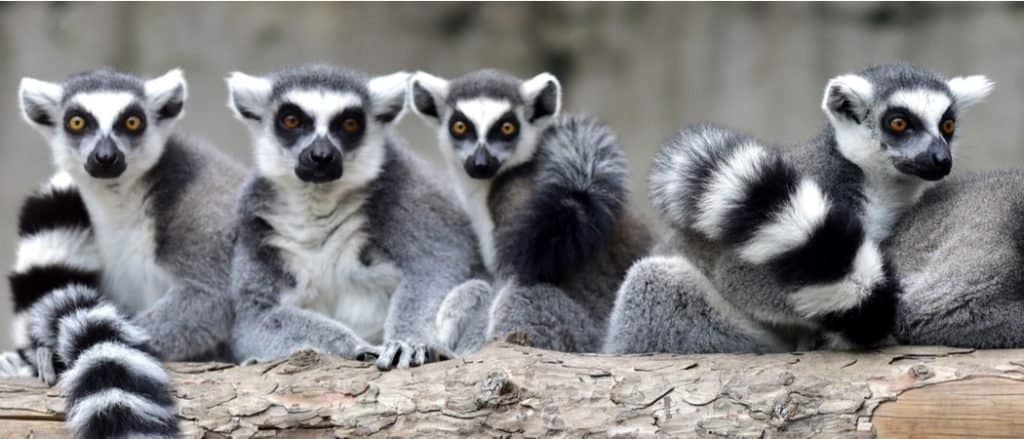
Lemurs are social animals. However, their groups are matriarchal in nature
©Wang LiQiang/Shutterstock.com
These creatures spend most of their days flying through the trees, on the lookout for food. They live in groups called “troops.” These groups can be as small as 6 animals, or as large as 30. The group constantly looks out for its members, and they use alarm calls to alert each other to danger. These calls can vary depending on the species — some calls sound cat-like (ring-tailed), some sound like chirps (mouse), and some sound like grunts (brown).
These creatures are unique in that they live in a matriarchal society — one dominant female typically leads a group. She decides where the group sleeps and eats. These animals are better adapted for nocturnal life, which is the reason they have such large eyes. They sleep in nests made of leaves, or in the forks of trees.
The ring-tailed species is unique among these primates because they are mostly ground dwellers. They are the only species known to have ringed tails, which they use for communication. A tail held high can alert others to danger, even in the dense woodlands. They also mark their territory using scratches on trees, as well as by scent marking the area.
Lemur Habitat
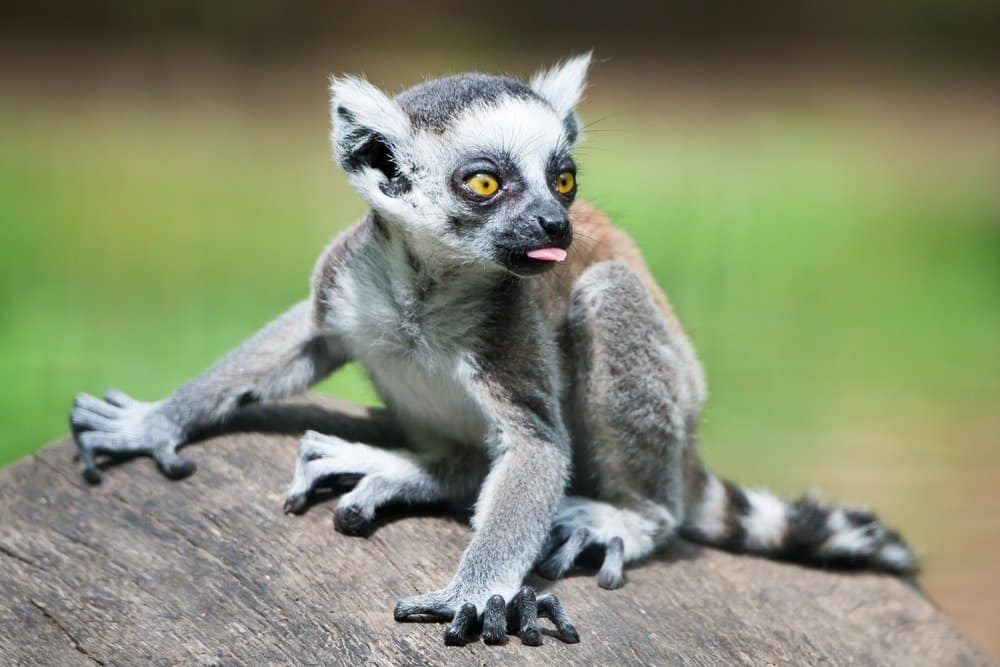
Lemurs are generally arboreal although one species is terrestrial
©Abeselom Zerit/Shutterstock.com
Madagascar and its surrounding islands are rather isolated. That means this species was able to evolve without any outside influence. It is said that lemurs may have floated to Madagascar form the mainland and evolved there. Madagascar is an island with a great amount of biodiversity, and may different habitats for these creatures to inhabit. Some areas are marshy, others are dry. Some are mountainous, and others are forested. Generally, they prefer to live in the trees. But each species evolved specifically to fit in the niche of its habitat on Madagascar and the Comoro Islands.
Lemur Diet
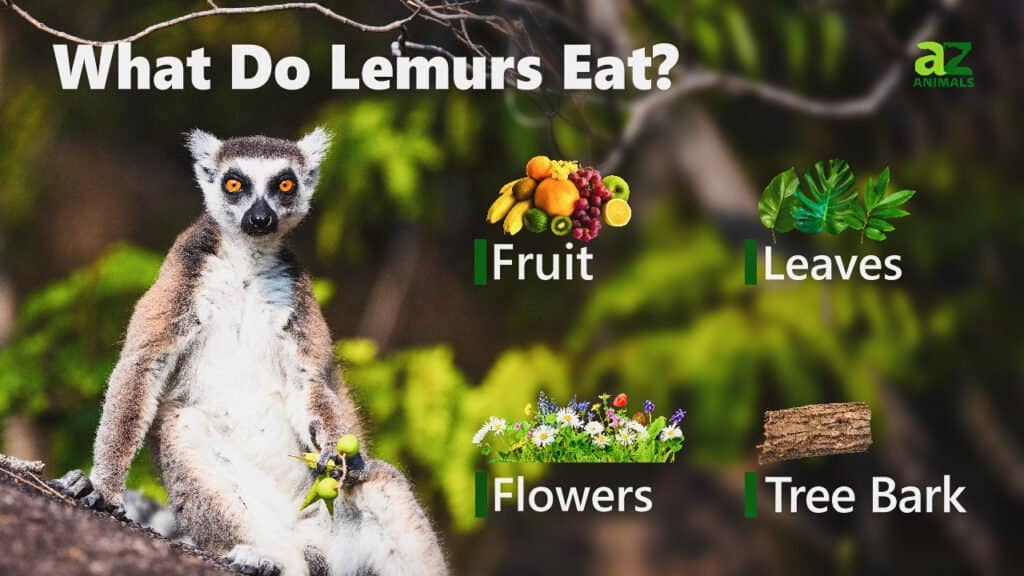
Larger species are generally herbivores. They prefer leaves, fruit, flowers, bark and tree sap. Smaller species become more omnivorous, chowing down on insects as well as fruit and leaves. Sometimes, they even decide to eat bird eggs or small birds themselves.
Lemur Predators and Threats
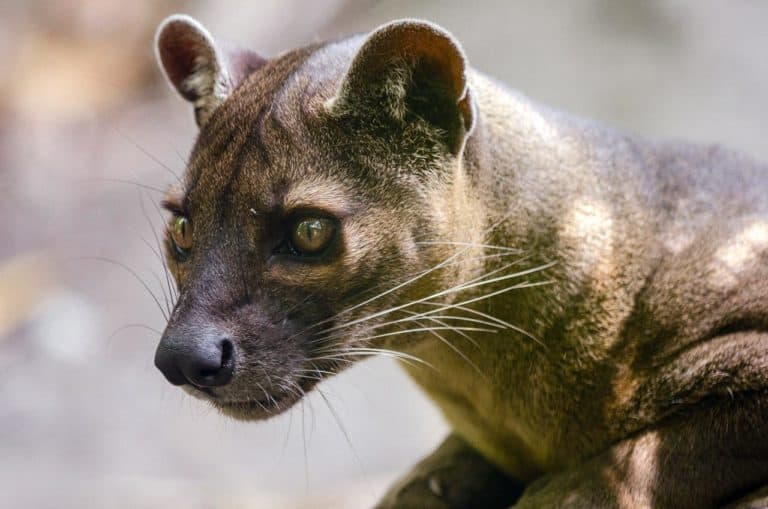
Madagascar’s top predator is the fossa, a relative of the mongoose that preys on many different species that live on the island. In addition, lemurs can fall prey to flying harrier hawks and boa constrictors as well.
Habitat loss is an enormous threat to every species on Madagascar, and the lemur is no exception. Illegal deforestation and mining have threatened lemur species, with 17 of them having gone extinct since humans arrived on Madagascar over 2,000 years ago. Hunting is also detrimental to these populations. Invasive species such as dogs and cats, which humans brought with them to Madagascar, are also a threat and generally disrupt the fragile ecosystem of the island.
As a species, they vary from vulnerable to critically endangered.
Reproduction, Babies, and Lifespan
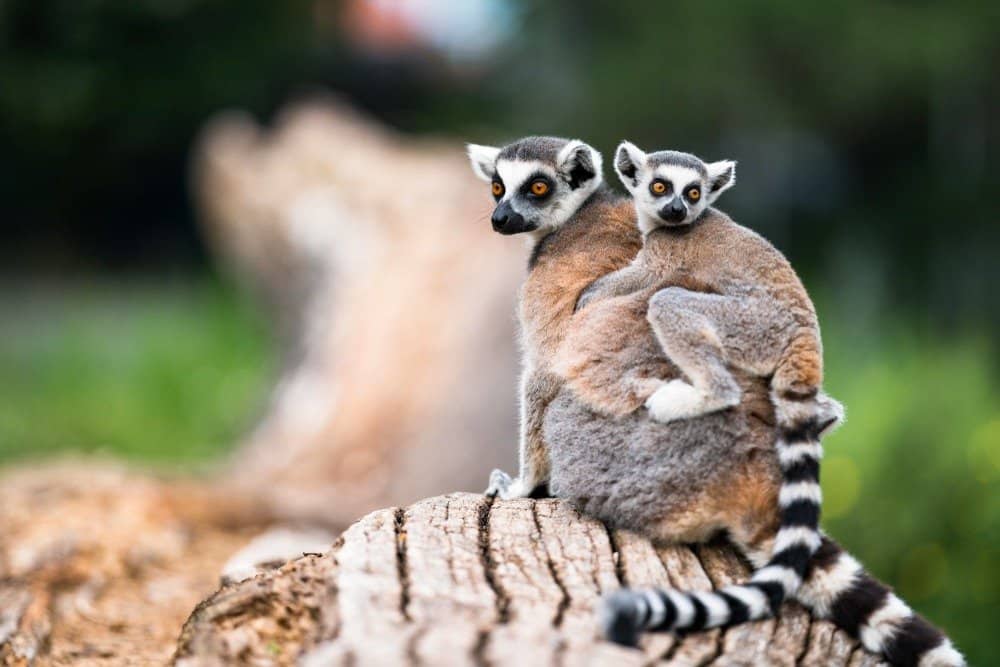
Maternal care varies depending on the species
©Ondrej_Novotny_92/Shutterstock.com
Males will scent mark and quarrel over females during the mating season. In some species, females are fertile for only one day out of the entire year. Most only produce one baby per season, but some litters may contain as many as six young. Most gestation periods last between 2 and 5 months.
Young lemurs are known as pups, and typically cling to their mothers for the first few weeks of life. In some species, such as lesser mouse lemurs, the babies are not strong enough to hold on and must be carried around. Soon, the pups climb from the belly to the back. After three to four months, the pups are able to walk and climb by themselves and no longer need to hold on to their mothers.
Some species take a different approach: for the first month, mothers hide their young in large piles of foliage while they go forage. This allows the young to stay hidden. Once the first month of life is over, the young become too curious and active to stay put.
Lemurs are typically done growing after they reach 1.5 years of age. Some can live for as long as 30 years, however, lifespan varies depending on the species.
Population
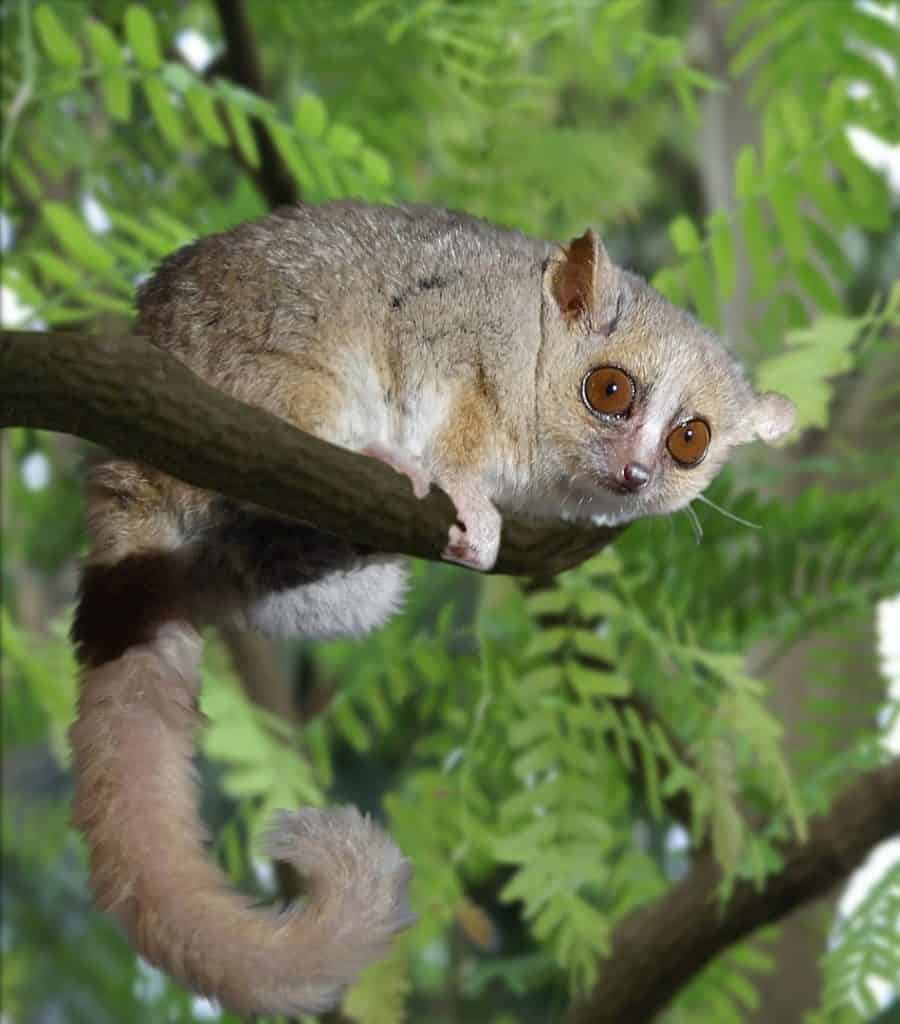
The number of lemur species which have thriving populations is rather low
©photographer: Gabriella Skollar; editor: Rebecca Lewis / CC BY-SA 3.0 – Original / License
Populations vary wildly between species depending on their conservation status. One species, known as the northern sportive lemur, is estimated to only have 18 living individuals remaining. Only 8% of lemurs are classified as “least concern.” All other species have experienced population decline due to the multiple threats to the biodiversity of Madagascar.
Lemurs in the Zoo
Ring-tailed lemurs are the most common variety found in zoos. The San Diego Zoo features five species, including ring-tailed and blue-eyed black lemurs. Other zoos that house lemurs as well as support conservation are the Akron Zoo in Ohio, and the Jacksonville Zoo and Naples Zoo in Florida.
Lemur Pictures
View all of our Lemur pictures in the gallery.

Ondrej_Novotny_92/Shutterstock.com