


L
Species Profile

Lace Monitor

Varanus varius

Lace-patterned climber of Australia's east
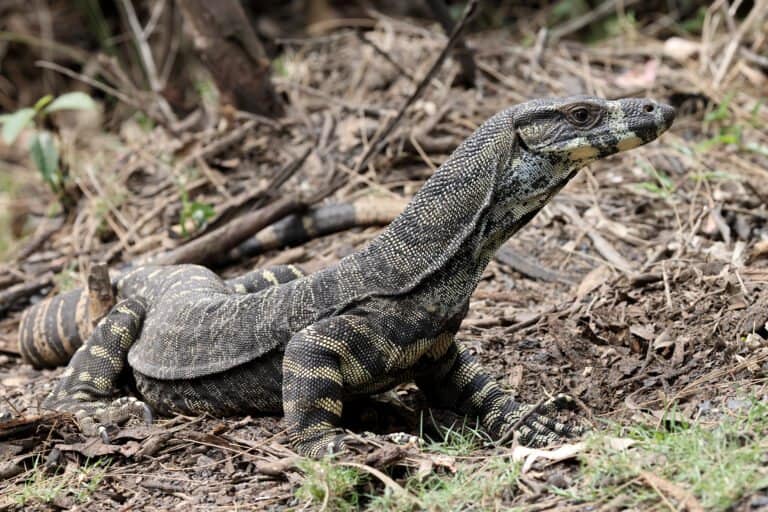
Liquid Ghoul/CCBYSA2.5

Lace Monitor Distribution

Click a location to explore more animals from that region

Endemic Species
Loading map...

Found in 1 country

Lace monitor lizard

At a Glance

Wild Species
Also Known As Lace goanna, Tree goanna, Goanna, Monitor lizard, Australian monitor
Diet Carnivore
Activity Diurnal
Lifespan 12 years
Weight 14 lbs
Status Least Concern
Did You Know?

Adults commonly reach 1.5 m total length; maximum documented lengths approach ~2.0 m.

Scientific Classification

The lace monitor (Varanus varius) is a large, diurnal Australian monitor lizard (goanna) known for its contrasting cream/yellow ‘lace-like’ markings on a dark body and its strong climbing ability.

Kingdom
Animalia
Phylum
Chordata
Class
Reptilia
Order
Squamata
Family
Varanidae
Genus
Varanus
Species
Varanus varius

Distinguishing Features

  • Large monitor lizard with prominent pale, lace-like patterning over a dark body
  • Long, laterally compressed tail and strong limbs with sharp claws
  • Excellent climber; frequently seen on tree trunks and in canopy
  • Powerful jaws and forked tongue typical of varanids; opportunistic predator/scavenger

Physical Measurements

Males and females differ in size

Length
1 in (1 in – 1 in)
4 ft 7 in (3 ft 11 in – 5 ft 3 in)
Weight
22 lbs (11 lbs – 44 lbs)
8 lbs (4 lbs – 13 lbs)
Tail Length
3 ft 8 in (2 ft 11 in – 4 ft 5 in)
2 ft 8 in (2 ft 4 in – 3 ft 1 in)
Top Speed
12 mph
running
Venomous

Appearance

Primary Colors
Secondary Colors
Skin Type Dry, keratinized reptile skin with overlapping, pebbly (often weakly keeled) scales; long, clawed digits adapted for climbing.
Distinctive Features
  • Large varanid build; adults commonly 1.5-2.0 m total length, reported to ~2.1 m (Pianka & King, 2004; Cogger, 2014).
  • Cream/yellow ocelli and rosettes create a net-like 'lace' pattern, densest on back and flanks.
  • Long, laterally compressed tail with clear pale/dark banding; used for balance while climbing.
  • Elongate head and neck; prominent forked tongue used for chemosensory tracking (varanid trait).
  • Strong, curved claws and powerful limbs; noted as a proficient arboreal climber as well as ground forager.
  • Diurnal, opportunistic predator/scavenger; routinely patrols and basks in open sunlit areas within eastern Australian habitats.
  • Reported longevity: often ~10-15 years in the wild, with >20 years documented in captivity in husbandry records (commonly reported in zoo/keeper literature).
  • Eastern Australia distribution (Queensland to Victoria; also parts of South Australia), typically in forests/woodlands and coastal ranges where climbing substrates are available.

Sexual Dimorphism

Dimorphism is modest: males average larger and more robust, with broader heads and thicker necks. During breeding season males may appear more massive at the tail base due to hemipenal bulges and overall musculature.

  • Typically larger overall size and heavier build.
  • Broader head and more pronounced jaw musculature.
  • Thicker neck and tail base; may show hemipenal bulges near the vent.
  • Typically smaller overall size and lighter build.
  • Narrower head and less pronounced jowls.
  • Relatively slimmer neck and tail base compared with males.

Did You Know?

Adults commonly reach 1.5 m total length; maximum documented lengths approach ~2.0 m.

A large adult can weigh roughly 5-14 kg, with males typically heavier than females.

Females often lay eggs in active termite mounds; incubation commonly lasts ~8-9 months (temperature-dependent).

Clutches are usually about 6-18 eggs, with larger clutches occasionally reported in big females.

Like other varanids, it "tastes" the air with a forked tongue and a Jacobson's organ to track prey and carrion.

It's strongly arboreal: long claws and powerful limbs let it climb high into trees to hunt, bask, and escape threats.

As a scavenger, it helps recycle nutrients by rapidly locating and consuming carrion in forests and woodlands.

Unique Adaptations

  • Forked tongue + vomeronasal (Jacobson's) organ: high-resolution chemical sensing for locating prey and carrion over distance (a hallmark varanid trait).
  • Powerful climbing toolkit: long, strongly curved claws and robust forelimbs for vertical tree climbing and tearing into rotting logs or nests.
  • Thermite-mound incubation strategy: using the mound's buffered temperature/humidity improves egg development in variable eastern Australian climates.
  • Robust skull and recurved teeth: suited to gripping slippery prey and tearing flesh, supporting both predation and scavenging.
  • High aerobic capacity for a reptile (typical of monitor lizards): supports active, wide-ranging daytime foraging compared with many other lizards.

Interesting Behaviors

  • Diurnal basking and patrols: spends mornings basking to raise body temperature, then ranges widely through forest/woodland edges in daylight.
  • Arboreal hunting and refuge: readily climbs trunks and branches to raid bird nests, hunt possums, or avoid predators and people.
  • Termite-mound nesting behavior: females may excavate a chamber in an active mound, deposit eggs, and the mound's stable microclimate supports long incubation.
  • Opportunistic feeding: actively hunts live prey (insects to small mammals) and also scavenges carrion, often being among the first vertebrates to arrive at carcasses.
  • Threat display: when cornered it may gape, hiss, inflate the body, lash with the tail, and use claws/teeth defensively.
  • Scent-trailing with tongue flicks: frequent rapid tongue-flicking while moving, following chemical trails to food and conspecifics.

Cultural Significance

Goannas, including the lace monitor (Varanus varius), are important in Aboriginal life as totems, clan symbols and teaching figures. They appear in rock art and traditional knowledge about seasons, fire and bush foods. The name 'goanna' comes from 'iguana.' The name 'lace monitor' shows its pale-on-dark pattern.

Myths & Legends

Across many Aboriginal Australian Dreaming traditions, Goanna is a powerful ancestral being whose journeys shape country, explaining features of the landscape and establishing law and kinship responsibilities (often linked to specific places and totemic lineages).

In widely told oral traditions from different parts of Australia, Goanna appears as a cunning forager and climber-sometimes a trickster, sometimes a teacher-whose actions demonstrate consequences of greed, disrespect, or breaking cultural rules.

In some communities, the goanna (Lace Monitor, Varanus varius) appears in initiation and identity stories; its tracks, burrows, and favorite trees are seen as signs of ancestors and reminders to care for land and animals.

Early colonists called the lace monitor (Varanus varius) 'goanna' (from 'iguana'), and settlers said its markings looked like lace. These names became part of Australian bush language and stories.

Conservation Status

LC Least Concern

Widespread and abundant in the wild.

Population Stable

Protected Under

  • CITES Appendix II (Varanus spp. generally listed, regulating international trade)
  • Australia: protected as native wildlife under state/territory legislation (examples: NSW Biodiversity Conservation Act 2016; QLD Nature Conservation Act 1992; VIC Wildlife Act 1975; SA National Parks and Wildlife Act 1972; WA Biodiversity Conservation Act 2016; TAS Nature Conservation Act 2002)

Life Cycle

Birth 8 hatchlings
Lifespan 12 years

Lifespan

In the Wild
6–20 years
In Captivity
10–30 years

Reproduction

Mating System Polygynandry
Social Structure Solitary
Breeding Pattern Seasonal
Fertilization Internal Fertilization
Birth Type Internal_fertilization

Adults are solitary; during the spring-summer breeding season males range widely and fight rivals, courting and mating with multiple females. Copulation is internal via hemipenes; females nest and provide no parental care beyond egg-laying.

Behavior & Ecology

Social Solitary Group: 1
Activity Diurnal
Diet Carnivore Bird eggs and nestlings (seasonally targeted via nest-raiding; frequently noted as a major, high-reward food source in field accounts).
Seasonal Hibernates

Temperament

Wary and avoidance-oriented toward humans; usually retreats to trees or cover when approached.
Bold, opportunistic predator/scavenger; may persist at food sources despite disturbance.
Can become defensive and aggressive when cornered or handled (hissing, tail-whipping, biting).
Intraspecific interactions often involve threat displays and dominance posturing during competition or breeding.

Communication

Hissing exhalations during defensive and agonistic encounters.
Chemoreception via tongue-flicking to detect prey, predators, and conspecific scent trails Typical varanid behavior; see Pianka & King 2004
Visual threat displays: elevated posture, lateral body compression, head/neck extension, gape display.
Tactile combat/ritualized fighting between males during breeding competition Grappling, pushing
Scent marking and investigation of feces/skin secretions likely mediates spacing and reproduction Varanid-wide evidence; e.g., Auffenberg 1981; Pianka & King 2004

Habitat

Biomes:
Temperate Forest Temperate Rainforest Tropical Rainforest
Terrain:
Coastal Mountainous Hilly Plains Riverine Rocky
Elevation: Up to 3280 ft 10 in

Ecological Role

Large-bodied terrestrial-arboreal mesopredator and facultative scavenger in eastern Australian forests/woodlands.

Regulates prey populations (notably insects and small mammals, including some introduced pest species) through predation Influences bird reproductive success via nest predation (egg and nestling removal) Carrion removal and nutrient recycling via scavenging (reduces persistence of carcasses in the environment) Provides prey/food resources to higher predators and scavengers indirectly (e.g., via carcass fragmentation and leftovers)

Diet Details

Main Prey:
Insects and other arthropods Other invertebrates Small mammals Birds Bird eggs Reptiles Amphibians Carrion +2

Human Interaction

Domestication Status

Wild

Varanus varius (lace monitor or goanna) is not domesticated. In Australia it lives wild in forests, farm edges, campgrounds and near towns. People have killed or chased it as a poultry predator or scavenger and sometimes eaten it, but it has not been bred for tameness. Keeping in captivity is limited and it is usually protected.

Danger Level

Moderate
  • Defensive bites and deep lacerations from teeth; significant puncture/tearing risk due to large head and strong jaw musculature.
  • Scratches/claw injuries during handling (powerful climber with long claws).
  • Zoonotic risk typical of reptiles (e.g., Salmonella) from contact with animal or contaminated surfaces.
  • Escalated conflict risk in campgrounds/urban edge habitat where animals are habituated to food scraps-approaches humans and can be cornered.

As a Pet

Not Suitable as Pet

Legality: Lace Monitor (Varanus varius): In Australia you need a wildlife licence to keep one and taking from the wild is illegal; export is tightly restricted. Laws vary overseas - check local and import rules.

Care Level: Expert Only

Purchase Cost: $500 - $3,000
Lifetime Cost: $15,000 - $60,000

Economic Value

Uses:
Ecotourism/wildlife viewing Education and research Limited/regulated captive trade (where legal) Ecosystem services (scavenging and predation on some pest species)
Products:
  • wildlife interpretation/park tourism value (non-consumptive)
  • research specimens/data (ecology, behavior, venom/anticoagulant oral secretions studied in varanids)
  • captive-bred individuals in legal markets (not from Australian export in typical cases)

Relationships

Related Species 6

Komodo dragon
Komodo dragon Varanus komodoensis Shared Genus
Perentie Varanus giganteus Shared Genus
Sand goanna Varanus gouldii Shared Genus
Rosenberg's monitor Varanus rosenbergi Shared Genus
Yellow-spotted monitor Varanus panoptes Shared Genus
Mertens' water monitor Varanus mertensi Shared Genus

Ecological Equivalents 5

Animals that fill a similar ecological role in their ecosystem

Perentie Varanus giganteus Lace Monitor (Varanus varius) is a large diurnal predator that actively searches for vertebrates and carrion. It overlaps most with the Perentie in ground-level foraging in open forest or woodland edges; adults reach about 2.1 m and 14 kg.
Sand goanna Varanus gouldii Co-occurs in eastern and southern Australia and shares a diurnal predator and scavenger role, feeding on invertebrates, small vertebrates, and carrion. Varanus varius climbs and raids nests, while Varanus gouldii remains on the ground and in burrows. Both are active foragers.
Yellow-spotted monitor Varanus panoptes Both are large, diurnal predators and scavengers that eat eggs, nestlings, and a wide variety of prey, and can climb well. Varanus panoptes favors floodplain and riparian areas; Varanus varius favors eastern forests. Both lay eggs in termite mounds.
Carpet python
Carpet python Morelia spilota A large forest predator that shares habitat with V. varius (Varanus varius). Both take arboreal prey — birds and nestlings — and use tree hollows. V. varius is active during the day; Morelia spilota is mainly nocturnal/crepuscular (active at night and at dawn/dusk) and ambushes, often constricting prey.
Spotted-tailed quoll Dasyurus maculatus Forest and woodland mesopredator overlapping parts of the lace monitor's range. Both are opportunistic predators and scavengers that may take arboreal prey and raid nests. Similar trophic position (mid-to-upper predator) but differ in hunting mode and temporal activity—quolls are largely nocturnal.

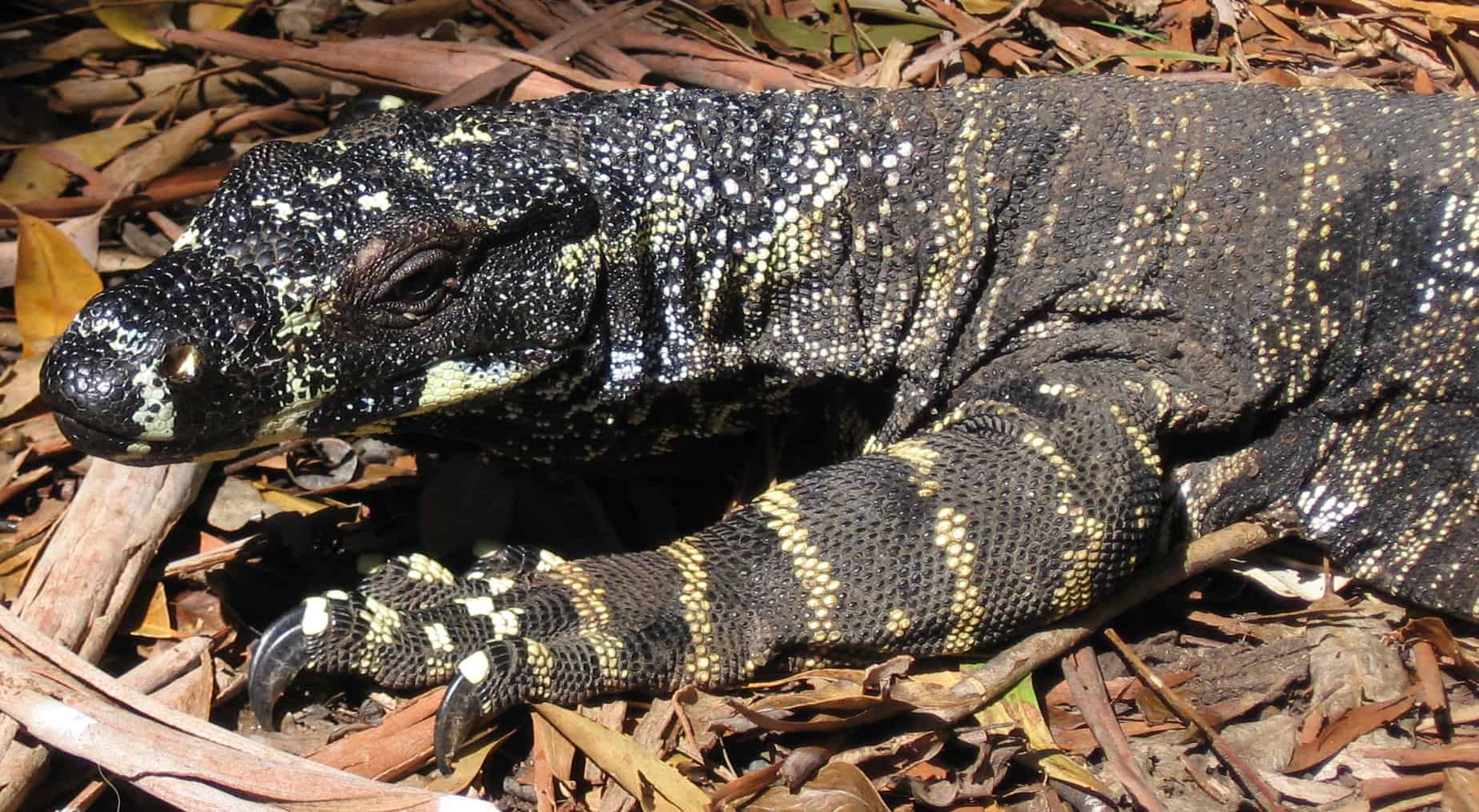
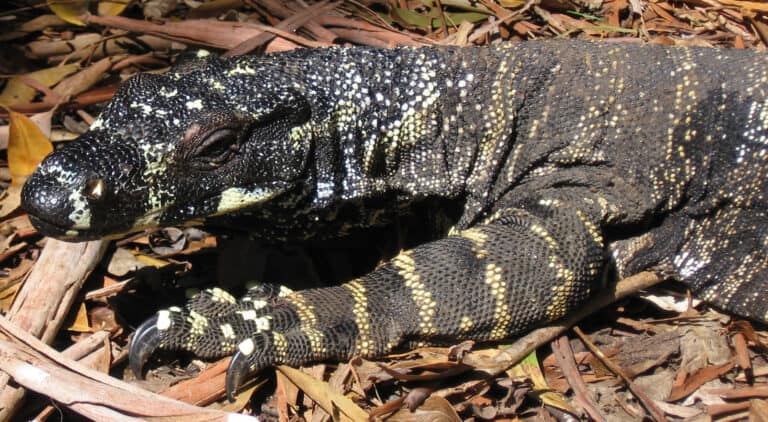
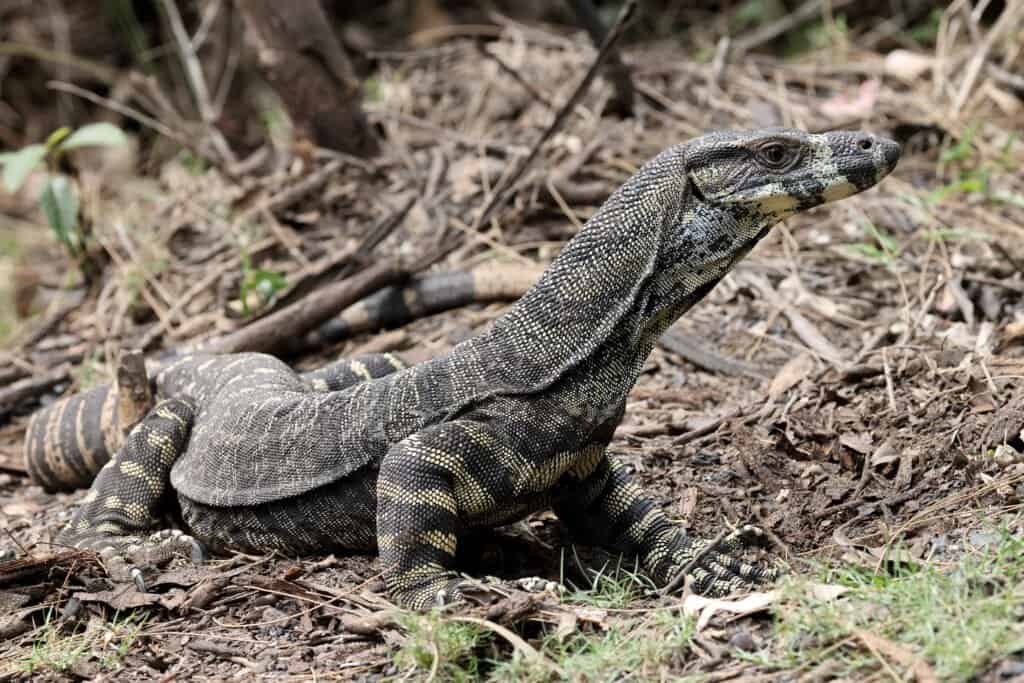
Lace monitors are massive reptiles native to Australia. There are two types of lace monitors, each with its own coloring. The first type is dark grey to bluish-black and covered in cream spots. It has a black head and snout with distinguished black and yellow bands under the chin, extending to the neck. In addition, its tail has thin black and cream rings that get wider towards the end of the tail.

The second type is yellow with subtle black mottling and thick dark brown or black bands from the shoulders to the tail. They have black heads. This color pattern is called bell’s form.

Lace Monitor Facts

  • The lace monitor is massive and is the second-largest lizard in Australia, narrowly missing the top place held by the perentie.
  • These monitor lizards are slightly venomous. If bitten, humans can experience shooting pain, disruption of blood clotting, and swelling.
  • Females prefer to lay their eggs in termite mounds inside trees.

Lace Monitor Scientific Name

The lace monitor’s scientific name is Varanus varius, and they belong to the order Squamata. This order is the most diverse of extant reptiles and includes animals like lizards and snakes. They are known for their flexible jaw structures and have shields or scales instead of shells or secondary palates.

These lizards are members of the family Varanidae, which consists of giant tropical Old-World lizards like monitors. What sets them apart is their elongated necks and tails. In addition, these carnivores have well-developed limbs.

Lace Monitor Appearance

Lace monitors are coved with blue-grey scales and have cream underbellies, along with cream bands. However, another variation is yellowish-brown scales and yellow rings instead of cream spots.

These lizards have blue-grey tails with cream rings that start to thicken as they get closer to the base of the tail, which is so long, it makes up about half of their length. They have forked tongues, similar to snakes. They also have long claws that help them climb. These lace monitors are massive and measure between 5 to 6 feet long, and weigh about 44 pounds!
Lace monitor

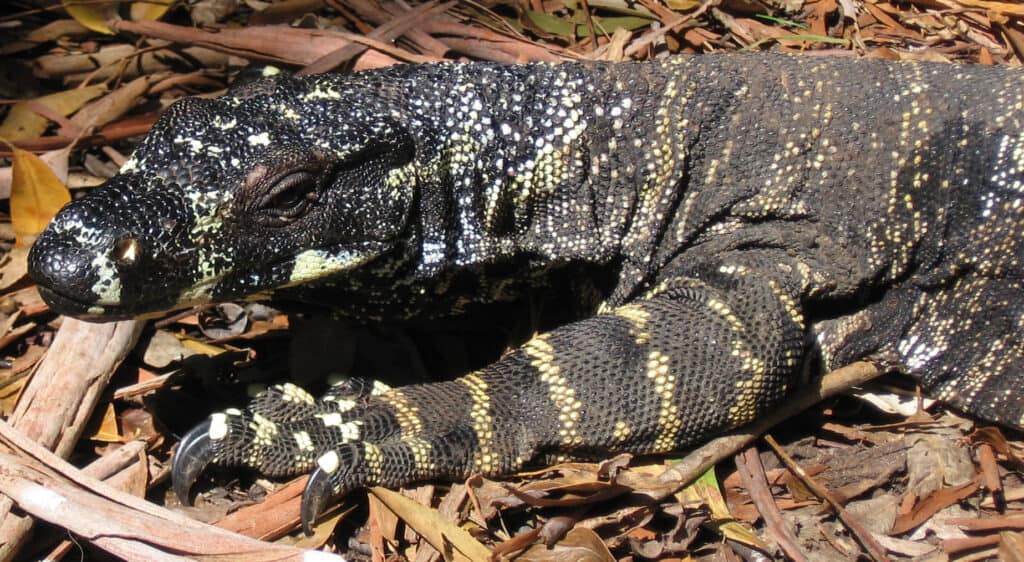
Lace monitors are covered in cream spots and bands.

Lace Monitor Behavior

The lace monitor is typically solitary and likes to be on its own. Therefore, people only see them together during mating season. Unfortunately, these sneaky reptiles often venture out foraging and hunting on agricultural land, poaching poultry and chicken eggs.

When communicating, they make a loud, hissing sound, and they will strike any potential danger with their mighty tails. These monitor lizards don’t have the best hearing because their auditory organs are not full-fledged.

Lace Monitor Habitat

The lace monitor has a diverse habitat and can be found along Australia’s east coast on slopes, ranges, and the adjacent plains of eastern Queensland, New South Wales, and Victoria.

In addition, some of these lizards can also be found in certain areas of south Australia.

Their habitat of choice is semi-humid or humid forests that include river basins. While they are often spotted on the ground, these lizards spend most of their lives in the hollows of trees. Should anyone or anything approach them, they will spiral around the tree, ensuring that the trunk is always between them and the perpetrator.

Lace Monitor Diet

The lace monitor diet consists of the following:

Lace monitors will use their sharp claws to climb trees and invade the nesting holes of birds like the lorikeet to prey on their young. You’ll know when one of these massive lizards is on the prowl when you hear birds squawking ferociously.

These monitor lizards have long, sharp teeth curved towards the back of their mouth, making it very hard for their prey to escape their jaws.

Researchers recently discovered that lace monitors are venomous. One bite from these giant reptiles causes bleeding and swelling in humans. It was once thought that they carried bacteria in their saliva that caused these symptoms, but we now know it is venom similar to a rattlesnake, but not as potent. Although this toxin only causes slight symptoms in people, it is strong enough to subdue small prey.

Lace monitors don’t chew their food; they swallow it whole or tear it into pieces with their front claws and teeth. In addition, they scavenge from time to time, and it’s not rare to see several lace monitors feeding on a dead animal.

They are often spotted in public campgrounds or picnic areas, where they become very tame, and forage the bins and grounds for any discarded scraps.

Lace Monitor Predators and Threats

Dingoes and birds of prey are the only animals that hunt and eat lace monitors.

Lace monitors are listed as Least Concern on IUCN’s Redlist and are abundant in Australia, as they are very adaptable and protected by law.

Lace Monitor Reproduction, Babies, and Lifespan

The lace monitor’s breeding season takes place between September and December. Multiple males may court the same female, and they will try to establish dominance by engaging in ritual combat.

These fights are not as violent as they sound. First, the rival male lizards will stand on their hind limbs and hold each other up with their front limbs. Next, they puff out their throat pouches to intimidate each other. Finally, one of the rivals will tire and fall to the ground in defeat or run to shelter.

The victor will approach the female with confident head-shaking movements and use his tongue to explore her body. Once mating starts, it can last for several hours.

These lizards lay eggs four to six weeks after mating. Females can lay up to 20 eggs and deposit them in a termite mound or a hole in the ground. Eggs are elongated and have a parchment-like shell that measures around 2 inches long.

To make sure the eggs stay warm, the female will fill the hole with leaf litter or grass. As the plant matter starts to decompose, it generates enough heat to incubate the eggs. If the female lays her eggs in a termite mound, the termites will close the hole, keeping the eggs warm and safe from predators.

Babies

Lace monitor eggs take eight to 10 weeks to hatch, depending on the temperature. They can take longer to hatch if they are incubating in cold temperatures. Offspring have a sharp egg-tooth, which they use to peck their way out of the shell.

After mothers lay their eggs, they will stay close by to help their babies escape the termite mound. When the hatchlings emerge, they are generally 12 inches long and weigh around 1 ounce.

Lifespan

These massive lizards only reach sexual maturity at around four to five years old. However, they can live 10 to 15 years in the wild. Astonishingly, they can live up to 40 in captivity.

Lace Monitor Population

Although the exact number of lace monitors is unknown, their population is stable, and there is nothing posing a threat to their survival. In fact, Australian law protects them, and citizens may not harm them.

Lace Monitors in Captivity

Monitors, in general, do well in captivity. They eat well, and females lay eggs in their enclosures. However, if you have more than one male, they will fight, although there will probably be no casualties. Still, these conflicts can result in scratches because fighting usually involves clawing rather than biting. However, there have been reports of lace monitors being seriously injured by their rivals.

In captivity, lace monitors establish a social hierarchy based on size and strength. This hierarchy is especially predominant during feeding time. Larger individuals will attack the smaller lizards to get to the food.

In captivity, lace monitors tend to spend more time sunbathing than their counterparts in the wild. In addition, they are more likely to be out during cold weather. While some of these magnificent lizards will want the shelter to retreat to at night, others won’t mind sleeping in the open.

When it comes to decorating your enclosure, make sure there are logs or beams where they can bask. You may provide large plants for these lizards to sleep on, but most prefer logs and an enclosed shelter where they can hide. In addition, they might enjoy a shallow pond where they can submerge themselves.

While these giant lizards eventually become tame, this takes time. Some owners have said it took years for their lace monitor to take food from their hands without biting them. In fact, some may never become tame.

In most cases, lace monitors kept alone tend to settle down quickly, and taming them is easier than taming those living in groups.

However, their temperaments tend to vary depending on the individual; they all cope with captivity differently.

Feeding

Captive lace monitors need to be fed throughout most of the year, excluding the colder months, as the cold affects their digestive system.

Their diet in captivity should include the following:

  • Fish bones
  • Reptiles
  • Frogs
  • Small mammals
  • Snails
  • Eggs (including goanna eggs)
  • Chopped meat (kangaroo is generally preferred)
  • Birds

Breeding

Most lace monitors will try to reproduce in captivity. The male will approach the female, try to mount her, and stroke her with his tongue. In addition, males like to wrap their tails around the female’s tail.

She will walk away if she isn’t interested in a particular male. However, this does not deter the male; he will keep trying to mate for a whole day, sometimes longer. There have even been records of males courting a single female for weeks on end.

Females often copulate with more than one male, and males can mount more than one female daily. Fighting will only occur if more than one male is interested in a particular female. However, this rarely happens in captivity because of the well-established hierarchy.

When the female lays her eggs, the other lizards in the enclosure will try to eat them, so it’s best to separate her before she lays.

View all 131 animals that start with L

Sources

  1. Auckland Zoo / Accessed November 12, 2022
  2. Reptile World Facts / Accessed November 12, 2022
  3. Wikipedia / Accessed November 12, 2022
Chanel Coetzee

About the Author

Chanel Coetzee

Chanel Coetzee is a writer at A-Z Animals, primarily focusing on big cats, dogs, and travel. Chanel has been writing and researching about animals for over 10 years. She has also worked closely with big cats like lions, cheetahs, leopards, and tigers at a rescue and rehabilitation center in South Africa since 2009. As a resident of Cape Town, South Africa, Chanel enjoys beach walks with her Stafford bull terrier and traveling off the beaten path.
Connect:

Thank you for reading! Have some feedback for us?


Lace Monitor FAQs (Frequently Asked Questions)

Males generally display aggression if provoked or during mating season.