



C
Species Profile

Cactus Wren

Campylorhynchus brunneicapillus

Built for heat, armed with thorns
Susan Hodgson/Shutterstock.com
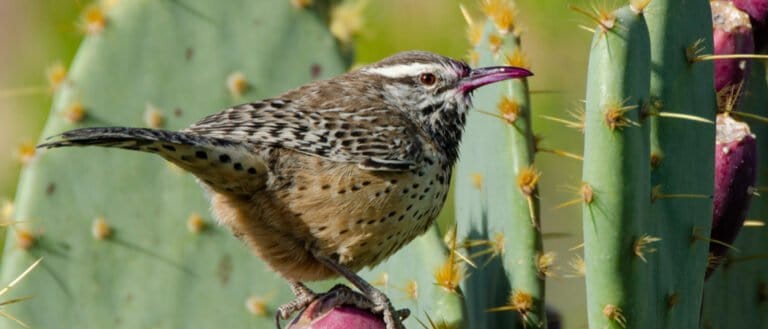
A cactus wren perched on a piece of wood against a blurry, bright background

At a Glance

Wild Species
Activity Diurnal+
Lifespan 2.5 years
Weight 0.047 lbs
Status Least Concern
Did You Know?

It's the largest wren commonly found in the U.S.: 18-23 cm long and ~33-47 g (Cornell Lab of Ornithology).

Scientific Classification

The Cactus Wren is a large, boldly patterned wren native to arid regions of the southwestern United States and northern/central Mexico, well known for nesting in cholla and other spiny desert plants.

Kingdom
Animalia
Phylum
Chordata
Class
Aves
Order
Passeriformes
Family
Troglodytidae
Genus
Campylorhynchus
Species
Campylorhynchus brunneicapillus

Distinguishing Features

  • Large wren with white eyebrow (supercilium) and heavily spotted breast
  • Brown-and-white barred tail and wings
  • Often associated with cholla/prickly pear; builds bulky, football-shaped nests in spiny plants
  • Loud, harsh, chattering calls rather than a long melodious song

Physical Measurements

Length
7 in (7 in – 8 in)
Weight
0 lbs (0 lbs – 0 lbs)
Top Speed
25 mph
About 40 km/h (estimated)

Appearance

Primary Colors
Secondary Colors
Skin Type Feathered plumage (keratin-based feathers); keratin bill; scaly keratinized skin on legs/feet typical of passerines. Adapted for hot, arid environments via behavior (seeking shade, using cactus nests/cover) more than exposed-skin specializations.
Distinctive Features
  • Largest regularly occurring wren in the U.S.; typical adult size reported as length 18-23 cm, wingspan about 28 cm, mass 0.034-0.048 kg (as reported by the Cornell Lab of Ornithology species account).
  • Very bold underpart spotting (dark spots on a pale/whitish background) and strong facial patterning with a clear white eyebrow (supercilium).
  • Long, slightly decurved bill suited to probing/gleaning insects and other arthropods from cactus, bark, and ground litter.
  • Tail and wings show clear dark barring/striping; tail often held slightly cocked like many wrens but appears longer and more strongly barred than in smaller, plainer wrens (helpful to avoid confusion with House Wren).
  • Desert-plant association: strongly tied to cholla and other spiny cacti for cover and nesting; frequently perches atop cactus and forages on/near the ground in open arid scrub.
  • Cactus Wren (Campylorhynchus brunneicapillus) builds large, football-shaped cactus nests with a side entrance, often in cholla. Made of coarse grass and plant fiber, nests keep birds warm and safe; pairs may build several nests.
  • Heat/drought coping behaviors: uses cactus and shrub shade, reduces midday activity, and roosts in enclosed nests that buffer temperature extremes typical of Sonoran/Mojave/Chihuahuan desert climates.
  • Range context (appearance-linked ecology): resident in arid regions of the southwestern United States and northern/central Mexico; plumage tones and bold disruptive pattern suit desert scrub and cactus stands.

Did You Know?

It's the largest wren commonly found in the U.S.: 18-23 cm long and ~33-47 g (Cornell Lab of Ornithology).

Pairs often build multiple nests in a territory-one for breeding plus extra "dummy/roost" nests used for sleeping and shelter (Birds of the World).

Typical clutch is 3-5 eggs; incubation averages ~16 days; young fledge about 18-23 days after hatching (Birds of the World).

Its enclosed, football-shaped nest usually has a side entrance and is frequently anchored in cholla or other spiny cacti for predator defense.

The harsh, mechanical rattle call is so distinctive that Spanish-language common names in Mexico reference a rattle or noisemaker.

Oldest known wild Cactus Wren recorded by banding data reached 10 years, 1 month (USGS Bird Banding Laboratory; reported via Cornell).

Unique Adaptations

  • Desert water strategy: meets much of its water needs through food (insects, fruit) and reduces exposure by sheltering in dense vegetation-key for surviving arid Southwest conditions (general desert-bird physiology; Birds of the World accounts for habitat use).
  • Spine-shield architecture: large, enclosed nests positioned among cholla spines reduce access for many predators; the side entrance further limits entry routes.
  • Camouflage that "breaks up" the body outline: bold spotting and streaking (plus the strong white eyebrow) blends with high-contrast desert light and shadow in thorn scrub and cactus patches.
  • Robust bill and foraging versatility: a comparatively heavy bill for a wren supports a broad diet (arthropods, small vertebrates on occasion, fruit/seeds), helping it persist through seasonal desert shortages.
  • Year-round residency with flexible nesting: the ability to build/occupy roost nests enhances survival during cold desert nights and heat waves.

Interesting Behaviors

  • Cactus-first nesting: commonly places nests in cholla and other thorny desert plants; the spines act like living barbed wire against predators (documented across Sonoran/Chihuahuan Desert populations).
  • Multi-nest building: pairs may construct several bulky nests in a season; non-breeding nests are used as roost sites and refuge during bad weather or disturbance (Birds of the World).
  • Ground-foraging and "pounce" hunting: spends much time walking and hopping on the ground, probing leaf litter and soil for insects and other arthropods, then retreating to shrubs/cacti as lookout perches.
  • Year-round territoriality: mated pairs typically remain together and defend territories in all seasons, using loud vocalizations and chases to deter intruders (Birds of the World).
  • Heat-timing behavior: concentrates foraging during cooler morning/evening periods and uses shade within dense shrubs/cacti during the hottest parts of the day-behavioral thermoregulation typical of desert passerines.
  • Nest reuse and maintenance: nests can be repaired and reused for roosting; fresh lining may be added even outside the breeding cycle.

Cultural Significance

The Cactus Wren is strongly associated with the Sonoran Desert and is the official state bird of Arizona (designated 1931). It's widely used as a regional emblem of desert resilience-frequently appearing in Arizona nature education, park interpretive materials, and local branding that highlights native cactus landscapes.

Myths & Legends

Arizona's "state bird story": when Arizona selected an official bird (1931), the Cactus Wren became a celebrated symbol of the state's desert identity-an adopted emblem rather than an ancient legend, but a lasting cultural association.

People in parts of Mexico and the U.S. Southwest give the Cactus Wren (Campylorhynchus brunneicapillus) Spanish names meaning rattle or noisemaker because its loud, rattling call links it to local folk sounds.

In Sonoran Desert stories, people call the Cactus Wren (Campylorhynchus brunneicapillus) the 'architect of the cholla' because it builds nests stuck in cholla thorns, a common cultural tale.

Conservation Status

LC Least Concern

Widespread and abundant in the wild.

Population Decreasing

Protected Under

  • United States Migratory Bird Treaty Act (MBTA, 1918) - protects native migratory birds, including Cactus Wren, from take/possession without authorization.
  • Protected on many public lands within its range (e.g., U.S. National Parks, National Wildlife Refuges, state/provincial protected areas) where desert scrub habitats are managed or conserved.
  • Mexico: covered under general wildlife protection frameworks (for example, the General Wildlife Law); may occur in federally protected natural areas within its Mexican range (species-specific threat listing varies by jurisdiction).
  • Protected under the Migratory Bird Treaty Act (United States, 1918; 16 U.S.C. §§ 703-712; see also 50 CFR § 10.13 list of migratory birds).

Life Cycle

Birth 4 chicks
Lifespan 3 years

Lifespan

In the Wild
1–7.5 years
In Captivity
2–10 years

Reproduction

Mating System Monogamy
Social Structure Socially Monogamous
Breeding Pattern Long Term
Fertilization Internal Fertilization
Birth Type Internal_fertilization

Behavior & Ecology

Social Pair Group: 2
Activity Diurnal, Matutinal, Vespertine
Diet Insectivore Large arthropods (especially beetles and grasshoppers)

Temperament

Bold and conspicuous for a wren; often forages openly on the ground and low shrubs in desert vegetation
Strongly territorial: pairs frequently give loud vocal displays and actively chase conspecifics near territory boundaries (year-round territoriality emphasized in major species references such as Birds of the World)
Highly nest/roost-site attached: uses multiple nests (including 'dummy' nests) within a territory, with roosting in enclosed nests a common behavior in cooler conditions (documented in desert field studies)

Communication

Loud, harsh, rasping song often transcribed as a series of repeated churrs or 'jar-jar-jar' notes; used in advertisement and territorial defense Standard descriptions in Birds of the World and regional avifaunas
Scolding/chatter calls (rapid, dry chatters) used during agitation and when responding to intruders
Contact notes between mates and family members during foraging and while moving through thorny vegetation
Duet-like coordination: mates commonly answer or overlap calls during boundary encounters, functioning as coordinated territorial defense Reported in behavioral observations for the species
Postural and locomotor displays during aggression (approach, chasing, conspicuous perch displays); visual signaling is aided by open perches on cacti and shrubs typical of its habitat
Nest/roost placement as a social cue: multiple conspicuous nests within a territory (including non-breeding 'dummy' nests) may function in spacing and territory advertisement in addition to shelter/roosting

Habitat

Biomes:
Desert Hot Mediterranean Tropical Dry Forest
Terrain:
Plains Valley Plateau Hilly Rocky Sandy
Elevation: Up to 5577 ft 5 in

Ecological Role

Arid-land insect predator and opportunistic frugivore/seed consumer (secondary seed disperser).

Regulates local arthropod populations (natural pest control, including herbivorous insects) Contributes to food-web energy transfer in desert ecosystems (preying on arthropods and serving as prey for raptors/snakes) Potential seed dispersal via fruit consumption (notably cactus fruits) in desert plant communities

Diet Details

Main Prey:
Other Foods:
Cactus fruits and pulp Desert berries and soft fruits Seeds

Human Interaction

Domestication Status

Wild

Cactus Wren (Campylorhynchus brunneicapillus) is fully wild with no domestication history. It lives year-round in arid scrub/desert in SW U.S. and Mexico, nesting in spiny cacti (cholla, prickly pear). Often near people but not tame; territorial at nests. Size ~18–20 cm, 33–47 g. Can live several years but many die young. Interacts via yards, habitat work, rehab, research, and birding.

Danger Level

Low
  • Defensive behavior near nests (scolding, close fly-bys; minor peck/scratch risk only if handled).
  • Indirect household risks typical of wild birds: ectoparasites in/near old nests and attraction of predators (e.g., cats/snakes) if nesting occurs close to homes.
  • No specialized venom/toxin and not considered a meaningful direct physical threat to people.

As a Pet

Not Suitable as Pet

Legality: Cactus Wren (Campylorhynchus brunneicapillus): In the U.S., it's generally illegal to keep as a pet without federal permits under the Migratory Bird Treaty Act. In Mexico, possession also requires permits.

Care Level: Expert Only

Purchase Cost:
Lifetime Cost:

Economic Value

Uses:
Ecotourism/birdwatching value (desert birding target) Ecosystem services (insect predation; contributes to local arthropod control) Cultural/symbolic value (regional icon; Arizona state bird) Scientific research and education (desert adaptation, nesting ecology)
Products:
  • non-consumptive wildlife recreation services (guided birding, park visitation)
  • educational/symbolic use (imagery in outreach and regional branding)

Relationships

Predators 10

Related Species 12

Giant Wren Campylorhynchus chiapensis Shared Genus
Bicolored Wren Campylorhynchus griseus Shared Genus
Rufous-naped Wren Campylorhynchus rufinucha Shared Genus
Stripe-backed Wren Campylorhynchus nuchalis Shared Genus
Spotted Wren Campylorhynchus gularis Shared Genus
Gray-barred Wren Campylorhynchus megalopterus Shared Genus
Boucard's Wren Campylorhynchus jocosus Shared Genus
Canyon Wren Catherpes mexicanus Shared Family
Bewick's Wren Thryomanes bewickii Shared Family
House Wren
House Wren Troglodytes aedon Shared Family
Carolina Wren Thryothorus ludovicianus Shared Family
Marsh Wren Cistothorus palustris Shared Family

Ecological Equivalents 6

Animals that fill a similar ecological role in their ecosystem

Curve-billed Thrasher Toxostoma curvirostre Shares Sonoran/Chihuahuan Desert scrub habitat and forages on the ground and in low shrubs for arthropods. Both species commonly use thorny shrubs and cacti for cover and nesting, reducing predation risk in open desert landscapes.
LeConte's Thrasher Toxostoma lecontei Occupies very arid desert scrub, relies heavily on arthropod prey, and uses dense shrubs for concealment and nesting in hot, open habitats.
Verdin Auriparus flaviceps Small desert passerine that forages actively for insects in low desert vegetation and nests in dense, thorny shrubs. Overlaps strongly with cactus wren in diet (arthropods) and microhabitat use.
Black-tailed Gnatcatcher Polioptila melanura Arid scrub specialist that gleans insects from desert shrubs and cacti. Overlaps with cactus wren in insectivory and in using desert scrub structure for nesting and cover.
Rock Wren Salpinctes obsoletus Another wren occupying arid landscapes. It overlaps in an arthropod-based diet and in heat- and drought-tolerant behavior, though it more strongly favors rocky substrates than cactus-dominated scrub.
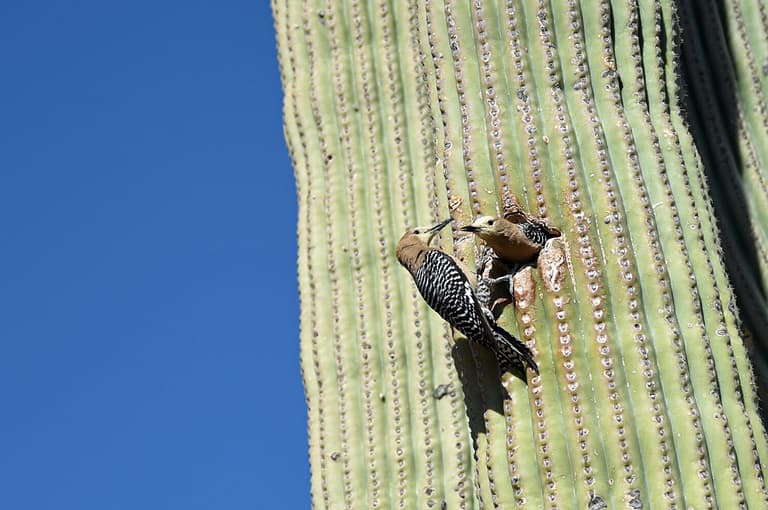
Gila Woodpecker Melanerpes uropygialis Common desert bird that frequently uses saguaro and other large cacti and desert trees for nesting and feeds on insects and other invertebrates. Shares the cactus-structured desert niche, although it nests in cavities rather than building external cactus nests.

Quick Take

  • Maintaining 8.5 million adults requires the bird to navigate a 19% population crash every 10 years.
  • The 7-inch diameter of the football-shaped nest creates a high-stakes physical constraint for the bird.
  • Surviving the desert without free-standing water reveals a paradoxical biological adaptation for this bird.
  • The male must construct multiple dummy nests during incubation to ensure territory security.

If you’ve ever taken a hike through a desert trail in the Southwestern United States, you may have had a scratchy, mechanical serenade. The cactus wren is a staple in these desert environments, whether perched on cacti or hopping around on the dry, dusty ground. These desert birds are adequately adapted to live in harsh environments.

An educational infographic about the Cactus Wren with sections on its anatomy, diet, nesting habits, and a map of its habitat in the Southwestern US and Mexico.
It survives without drinking water, builds decoy nests to trick predators, and faces a brutal population crash every 10 years. Discover the high-stakes survival strategy of the desert’s toughest resident. © A-Z Animals

5 Amazing Cactus Wren Facts

  • The cactus wren is non-migratory and establishes permanent residences.
  • They build football-shaped nests to deter predators.
  • It is the largest wren in the United States, growing 7.5 inches long.
  • It will eat dead insects off of cars.
  • They form permanent pair bonds for life.

Where to Find the Cactus Wren

The cactus wren is only found in the United States and Mexico. You can find it in six states, including California, Nevada, Arizona, Utah, New Mexico, and Texas. In Mexico, it inhabits Sonora, Sinaloa, Chihuahua, Coahuila, Hidalgo, Nuevo León, and Baja California. This bird lives in arid and semi-desert regions, which include the Sonoran and Chihuahuan deserts. They are non-migratory and establish permanent territories, unwilling to leave even during seasonal changes. Further, they are exceptionally territorial and will defend their habitats with vigor, loudly proclaiming when you’ve overstepped the boundary.

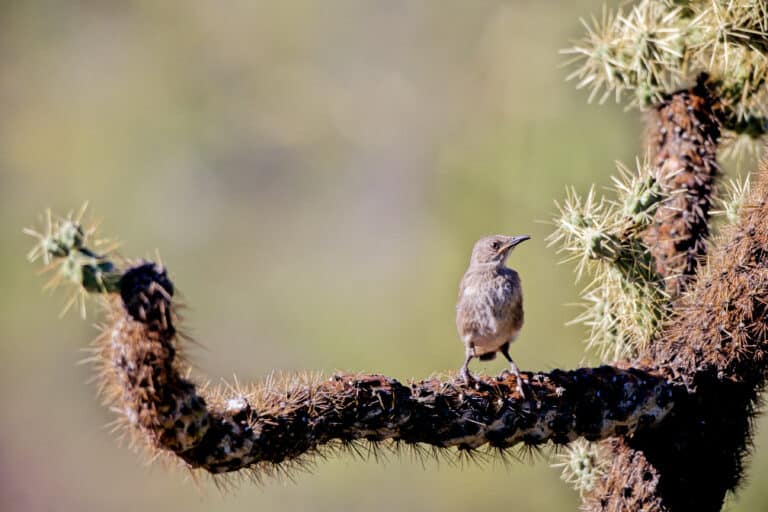
This wren lives in a variety of low, dry habitats, mainly deserts with thorny shrubs and cacti. Their favorite is the cholla cactus, mesquite brush, and yucca. You will most likely see them in pairs or families, hopping in brush or parading on the ground.

Nests

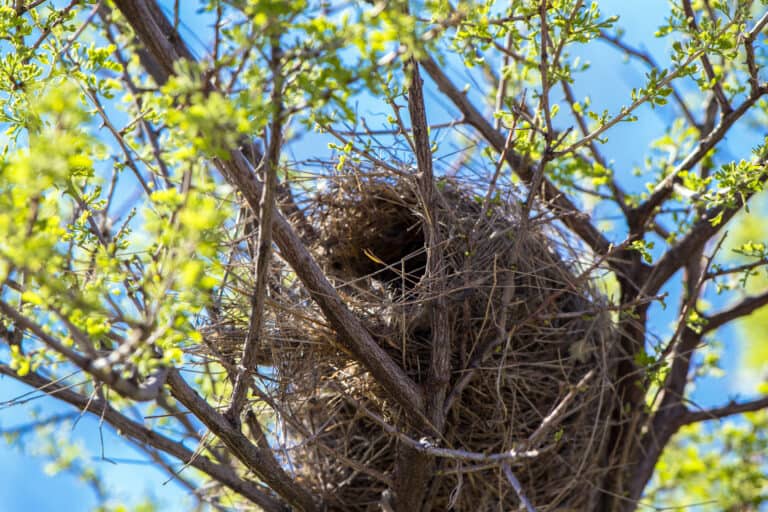
Females pick out the nesting spot, and males join in with the building. You can find their nests three to 10 feet above the ground in desert vegetation like cholla cacti, acacia, and mesquite, surrounded by thorns. The nest is football-shaped with tunnel entrances, and the duo uses grass and plant fiber to structure it. It’s typically seven inches in diameter and 12 inches long, weighing about six ounces. Its unique shape is designed to be just big enough for them to squeeze through but small enough to keep predators out. They line the inside of their nest with feathers, making it a soft, comfortable, and secure place to hatch chicks.

Classification and Scientific Name

The cactus wren’s (Campylorhynchus brunneicapillus) genus is Campylorhynchus, which is Greek for “curved beak,” and its binomial name brunneicapillus translates to “brown hair.” Its common name describes its propensity for perching, nesting, and hiding in various cacti in desert habitats. There are several subspecies of cactus wren, but scientists generally only recognize seven; all of them fall within its preferred range in North America.

Size, Appearance, and Behavior

As the largest wren in the United States, it is between 7.1 and 7.5 inches long, weighs 1.18 to 1.65 ounces, and has a wingspan of 11 inches. This chunky bird has a long, sturdy beak, a long, rounded tail, and short, rounded wings. Its bill curves slightly downwards and is about the same size as its head. The cactus wren has an overall brown color with white and black specks, with distinctive long, white eyebrows. Males and females look alike, but juveniles are paler with brown eyes instead of red.

Most wrens are shy and like to hide in vegetation, but cactus wrens are social, loud, unbothered creatures. They always make their presence known out in the open, loudly calling and fanning their tail feathers. This species is adaptable and curious, always exploring new food sources, even picking dead insects off of cars. They are not strong fliers, so you will most likely see them hopping on the ground or low shrubs foraging for food.
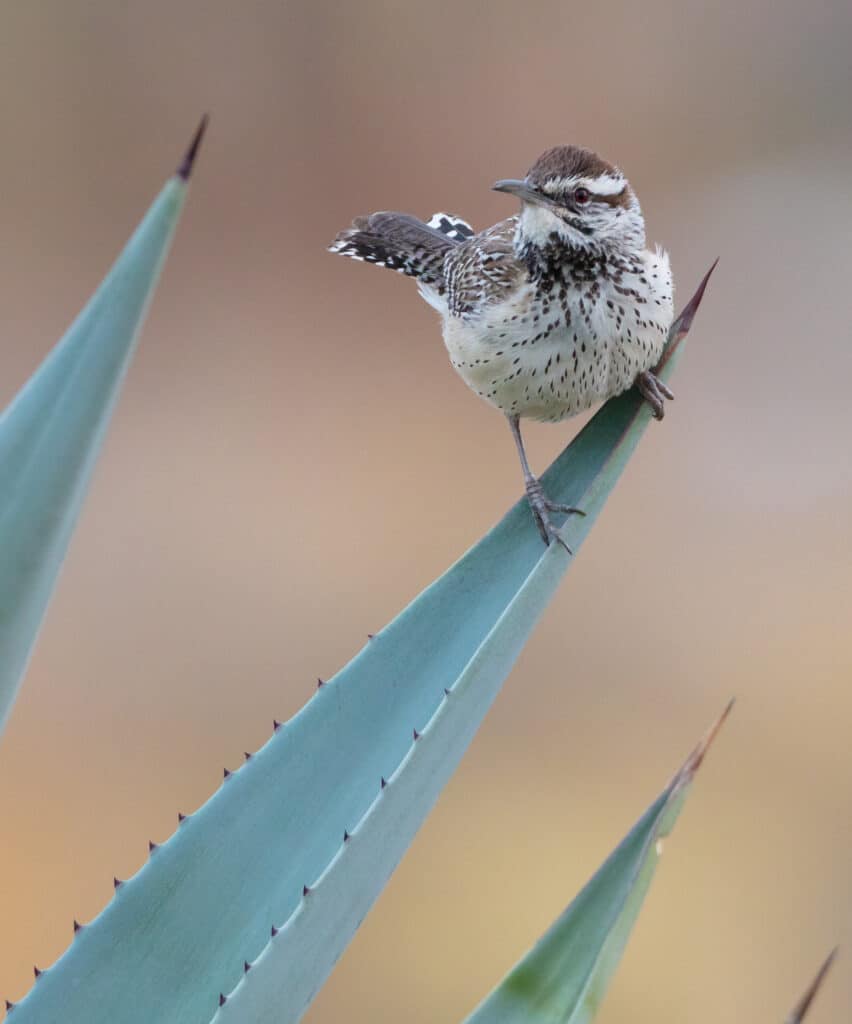
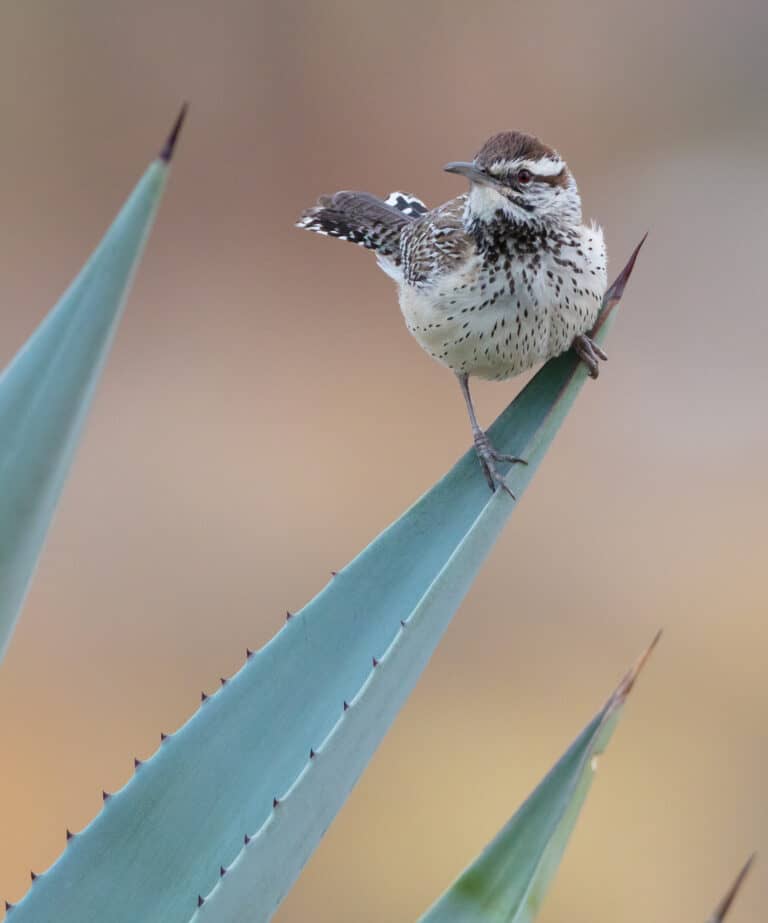
A cactus wren perched on the tip of an aloe leaf

Cactus wrens are between 7.1 and 7.5 inches long and weigh 1.18 to 1.65 ounces.

Diet

The cactus wren is primarily an insectivore, but as a curious forager, it will try many things.

What Does a Cactus Wren Eat?

The cactus wren mainly eats spiders and insects, such as ants, wasps, beetles, butterflies, and grasshoppers; It will occasionally eat small reptiles like lizards. Around 20% of their diet comes from plant material, like berries, seeds, nectar, and cactus fruits. As a desert species, this wren rarely drinks free-standing water. Instead, it receives most of its hydration from the food it consumes, primarily cactus fruit and sap. The cactus wren feeds its chicks a diet of whole insects, typically grasshoppers.

Predators, Threats, and Conservation Status

The IUCN lists the cactus wren as “least concern,” meaning it has a large range and does not approach the criterion for a threatened species. However, its population is declining, though not significantly, and it faces possible future issues from climate change. The cactus wren may be particularly sensitive to drought, wildfires, and spring heat waves. Extreme heat and drought affect their young and can cause food shortages, and wildfires have the potential to ruin their habitats.

What Eats the Cactus Wren?

Like most birds, the cactus wren must deal with anything larger with claws and teeth. Its predators include hawks, coyotes, foxes, bobcats, and domestic cats. Their football nests are to protect them and their young.

Reproduction, Young, and Molting

Cactus wrens establish monogamous pair bonds, and the couple defends their year-round home together. Their interactions are unique. They give each other a greeting ceremony, where they spread their wings and give a harsh call. Egg laying typically occurs shortly after copulation, and the males create “dummy” nests while the female is incubating.

They typically lay three to four eggs, and incubation takes 16 days (solely by the females). Wrens may destroy eggs from nearby nests, but are not known for brood parasitism. Once hatched, both parents feed the nestlings, and the young leave around 19 to 23 days after hatching. However, they will remain in their parents’ territory until they are between 30 and 50 days old.

Population

The cactus wren’s global population is 8.5 million mature individuals. This species has a downward-trending population, with an average decline rate of 2.1% per year (from 1970 to 2017). However, short-term data indicate their numbers have declined by 19% over the past decade. Some studies indicate they may need supplemental food to increase reproductive success.

View all 392 animals that start with C

Sources

  1. IUCN Red List / Accessed September 2, 2022
  2. JSTOR / Accessed September 2, 2022
  3. San Diego Management & Monitoring Program / Accessed September 2, 2022
  4. Sabino Naturalists / Accessed September 2, 2022
  5. Conservation Evidence / Accessed September 2, 2022
Niccoy Walker

About the Author

Niccoy Walker

Niccoy is a professional writer for A-Z Animals, and her primary focus is on birds, travel, and interesting facts of all kinds. Niccoy has been writing and researching about travel, nature, wildlife, and business for several years and holds a business degree from Metropolitan State University in Denver. A resident of Florida, Niccoy enjoys hiking, cooking, reading, and spending time at the beach.
Connect:

Thank you for reading! Have some feedback for us?


Cactus Wren FAQs (Frequently Asked Questions)

No. The cactus wren establishes permanent territories.